Introduction
Research on affirmative action in higher education has been a recurring theme of analysis for economists and other social scientists. Many quantitative articles focus on issues related to the admission and progress of students who benefited from the introduction of such policies. When analysing questions related to admission, researchers aim to understand the effects of these policies on the composition of the student body and the competition for places in the institution concerned. With regard to student progression, the main concern is to understand how applicants who benefit from the policy perform at university, for example through the analysis of grade point averages, completion rates and drop-out rates.
This article aims to contribute to the existing literature by analysing the admissions process that followed the first affirmative action policy implemented in higher education in Brazil. It shows that applicants' scores in the admissions tests at Universidade do Estado do Rio de Janeiro (Rio de Janeiro State University, UERJ) were associated with their socio-economic background, that the implementation of the quota system brought competition levels among quota applicants to values close to one and that the policy was effective in bringing into the university many applicants who would not have been selected if only their final scores in the admissions test had been taken into consideration.
The US literature offers a number of analyses of the impact of admissions quotas. In the United States the proportion of black students in the principal universities analysed would have dropped from 7.8 per cent to 2.1 per cent in the absence of affirmative action policies.Footnote 1 In India, policy-makers opted for a quota system for disadvantaged castes, with the result that groups suffering discrimination fill between 22.5 per cent and 49.5 per cent of places in federal universities.Footnote 2 In South Africa, the proportion of black students enrolled at the University of Cape Town between 1982 and 2004 went from 13 per cent to 49 per cent due mainly to affirmative action policies.Footnote 3
In contrast with the international experience, empirical studies of admissions under affirmative action policies in Brazil are scarce. They do, however, include publications on quota policies at Universidade Nacional de Brasília (Brasília National University, UNB) and a collection of papers reporting the experience of eight public universities in Brazil.Footnote 4
The Brazilian demand for publications in this field is a consequence of the country's recent experience with affirmative action, a natural result of the decline of the notion of ‘racial democracy’ and the increase in the number of people who believe in the existence of actual racism in Brazil.Footnote 5
As a consequence of this new racial project, which aims to replace the notion of ‘racial democracy’, one can see that affirmative action policies in higher education in Brazil are in a period of growth. After ten years of constant expansion in the implementation of quotas in Brazilian public universities, in April 2012 the Supreme Court declared that the adoption of racial quotas as an admission criterion was constitutional. Law 12711 was subsequently approved officially in August 2012. This reserved 50 per cent of university places for students from public schools, taking into account also the total of black, pardos (individuals of mixed race) and indigenous in each Brazilian state. This should result in a considerable change in the composition of the student body in most of the best and largest universities in the country.
In order to contribute to this debate, this article analyses issues related to the access of applicants to UERJ, the university which first implemented affirmative action policies in 2001. Many authors consider the original act of the Rio de Janeiro state assembly to be the starting point for this sort of policy in Brazil. As of 2010, UERJ offered 57 degree courses in five campuses (Maracanã, São Gonçalo, Baixada Fluminense, Resende and Nova Friburgo), with approximately 38,000 applicants for 5,000 places.
Despite the praiseworthy efforts of the institution to foster debates about the equality of opportunities, one can observe problems, as one might expect from a pioneering programme. At the time the law was promulgated, there was no experience in Brazil that could serve as a reference for important questions concerning the groups that should benefit, or the number of places each group should have reserved for it. As a consequence, some aspects of this policy might still be open to improvement.
The good news is that during this period the information office at UERJ (Diretoria de Informática, DINFO) succeeded in establishing a solid historical database on which this study relies. By providing quantitative data on the current policy of UERJ we intend to contribute to a better understanding of the admission of applicants from disadvantaged backgrounds to Brazilian universities.
The Background: Rio de Janeiro and UERJ
UERJ is located in Maracanã, a neighbourhood fairly close to the centre of Rio de Janeiro, the city with the second largest population in the country, with over 6 million inhabitants.
Like all other large Brazilian cities, Rio de Janeiro is marked by striking socio-economic inequalities. Most children go to public schools, usually of lower quality than private ones, and thus arrive at a point where they are at a disadvantage in the university admission test (commonly known as the vestibular), compared with their peers from private schools. Unlike high schools, public universities are renowned for being of higher quality than private ones. This accounts for an even greater demand for places at public universities.
The vestibular is the usual name given to the admissions process that prestigious universities administer. The final mark, which comes from a series of tests, is the main factor in the decision to admit an individual student. Most affirmative action policies still rank students according to their final test scores, but now rankings are established within each predefined group such as quota students who report themselves as black, or non-quota students.
With regard to the question of race, income disparities among white, black and pardo students are noticeable. The darker a person's skin, the higher the expectation that s/he will come from a lower-income family. Such differentials are due to inequality of opportunities, such as higher educational levels among white people, and to racism in the form of discrimination against blacks.
The city of Rio de Janeiro is thus defined as much by its economic dynamism as by the significant inequality of opportunities which is evident. Given the city's importance in the country, it is also naturally the home of some of the country's principal universities, such as UERJ.
UERJ is a state university known for its high quality. It has over 31,000 undergraduate and graduate students. Like most public universities in Brazil, UERJ's admissions process is based on the vestibular and it now reserves a number of places for students from specific underprivileged groups.
The quota system at UERJ is regulated by a state law and was first applied to the vestibular in 2003. After several reversals and alterations to the original draft law, Law 5346/2008 was in force at the time of writing, and specifies the guidelines for this policy. It established the following proportions of places for each socio-economic group: 20 per cent for black and indigenous students; 20 per cent for students from public schools; 5 per cent for people with disabilities or the children of people who died or acquired work-related disabilities while working for the state of Rio de Janeiro (civil and military police officers, safety inspectors and members of the prison administration).Footnote 6 Should the applicant choose to compete for a place reserved for black and indigenous students, s/he must submit a statement declaring him/herself to be either black or indigenous. Since the university does not verify the accuracy of such statements, it is possible that even students who see themselves as white might ask for consideration of their application within these quotas.
In order to compete for any reserved places, applicants must meet specific ‘disadvantage criteria’ which are established each year, based on per capita income. For the vestibular that took place in 2010, the basis for this study, the requirement was that the gross per capita income of the applicant's household be equal to or lower than Reais$ 960 (from this point, references to any of the groups that benefited imply that these conditions were met).Footnote 7 In the case of an applicant who can prove his/her income disadvantage, but who does not fulfil any of the other criteria (being black, from a public school or having a disability), s/he is not entitled to a quota place.
In the standard Brazilian vestibular, places are granted to applicants with the best scores compared with others competing to study the same subject. The quota system at UERJ means that this competition takes place within each category, taking account of the proportion of places reserved to each group. Unfilled places in any given group are automatically redirected to standard, non-quota applicants.
The vestibular at UERJ consists of two phases. The first part is the admission test, comprising 60 closed-ended questions. Following this, applicants are classified in groups based on their scores, ranging from A (best performance) to E (worst performance). Applicants classified as A score 20 points, those classified in group B receive 15, those with a C 10 and those with a D 5. Applicants who achieve any grade better than E are entitled to take part in the second phase, consisting of open-ended questions. Before the second phase the applicants must select the degree programme for which they will be competing and state whether they are interested in places reserved for quota students or not. Applicants must then select the quota category for which they wish to apply, choosing from the four possibilities (black, public schools, disability or non-quota). Three open-ended tests worth 20 points each are completed for each programme of study. The subjects of these tests vary according to the degree selected, as well as the weight attributed to each subject; the test for each degree has one double-weighted subject. A candidate's final score can thus range from zero to 100.
Data
The 2010 UERJ vestibular
The data used in this paper refer to the UERJ's 2010 vestibular. The database contains detailed information on every applicant. The original sample included 32,557 applicants, 2,592 of whom were omitted because they missed a test; 2,549 candidates were also removed from the database as they did not answer the socio-economic questionnaire. After excluding some outliers, individuals below the required age, the data on 27,415 applicants remained available for econometric analysis.
We compared the average scores of applicants who answered the questionnaire required for a quota place with those of applicants who chose not to do so. The result was a small difference in favour of the applicants who did not answer the questionnaire (42.1 points versus 40.7), which means that there is no significant bias in the final sample.
The database includes information on all applicants who were admitted, not on those who actually enrolled. This means that applicants who ended up entering the university as students during a later admissions cycle are not included in the pool of candidates used for this study. In 2010, 23 per cent of all enrolments occurred during later admissions cycles. It should be noted, therefore, that the dependent variable in the logistic regressions in the following sections represents the probability of admission, not of enrolment.
Most variables used here come from the socio-economic questionnaires that applicants completed when they registered for the vestibular. The questionnaire contains 26 questions, such as whether the applicant took classes specifically to prepare for the vestibular, their household's gross income, their parents' educational level, the kind of secondary school they attended and their self-reported skin colour.
The question concerning the applicant's skin colour has to be considered carefully. Its exact wording is: ‘How would you define the colour of your skin?’ IBGE, the Brazilian Institute for Geography and Statistics, which is responsible for the census, defines five possible skin colours in Brazil: preto (black), pardo (mixed), branco (white), amarelo (yellow) and indígena (indigenous). The alternatives given in the UERJ questionnaire mimic the IBGE definitions except for the first, which in this case is negro (an alternative word meaning ‘black’).
Methodological difficulties arise from the definition offered by the university. It is known that there is a great disparity between students' perceptions of themselves and how policy-makers perceive the same question. The current government, some black popular movements and some social scientists advocate and apply in Brazilian universities a new racial concept, defining negros as the sum of pretos and pardos. However, many Brazilians still share the idea of ‘racial democracy’ or have other understandings of the Brazilian racial mosaic, and as a consequence they might view pretos and negros as synonyms. Some Brazilians might also take pardos as a separate and broad category, perhaps a synonym of words like mulato, mestiço and moreno, and possibly encompassing different race mixtures and not only a black-white one.Footnote 8
If we return to considering the question itself, it literally deals directly with the skin colour, rather than with a social construct. Nevertheless, we chose to keep the definitions as they are presented in the questionnaire with all the caveats mentioned above. Thus, references to an applicant's colour in the socio-economic questionnaire are divided into the following categories: negro (black), pardo (mixed), branco (white), amarelo (yellow) and indígena (indigenous).
It should be said that an applicant's enrolment for a racial quota place is not bound by the answer given in the socio-economic questionnaire. This means that students exist who claim to be pardos in the questionnaire, but who apply for places for black students in the quota system. Therefore, in all references here to the type of quota place, the category denominated as ‘black’ contains all those students who identified themselves as such and chose to apply for a place in this group in the racial quota system, in other words those who signed a statement declaring themselves to be black. The great majority of self-reported blacks in the quota system had selected either the option negro (71 per cent) or pardo (22 per cent) when completing the socio-economic questionnaire. Indigenous applicants, who also compete for quota places in the same category, represented only 3.5 per cent of the total.
Finally, it is clear that linking negros to pardos is a controversial topic, leaving much space for criticism, whether from sectors opposed to affirmative action, or those who support it. According to Feres Júnior, in certain circumstances, the percentage of pardos who actually view themselves as negros in Brazil is lower than 1 per cent.Footnote 9
Business intelligence, UERJ
Business Intelligence (BI) is a tool developed by the UERJ's Departmento de Informática (DINFO, IT department) to provide the managers of the institution with relevant data on the vestibular and on students' progression. It extracts detailed information from the UERJ's vestibular and undergraduate studies databases, transforms and then consolidates them in descriptive statistics. This process is known as ETL (extract, transform and load) and its final result is a user-friendly interface, which can provide managers with data relevant to decision-making. The system enables the production of indexes according to user-defined filters. This tool is able to extract consistent data from 2003 onwards and splits them in two main independent databases: one allows the extraction of data related to the vestibular, and the other permits administrators and researchers to follow up the progression of both quota and non-quota students at the university. It therefore becomes possible to evaluate different dimensions: quota and non-quota students; a student's performance through time; and detailed data from specific degree programmes, for instance. In contrast to the microdata mentioned above, this database provides information on students who actually enrolled at the university.
Analysing Access to UERJ
In this section we begin by analysing the consolidated vestibular data using descriptive statistics. Issues such as the distribution of socio-economic profiles according to test scores, the ratio of applications per place, unfilled places, average scores and minimum scores are examined. This is followed by an econometric approach. We employ ordinary least squares methods in order to estimate how income-related factors, parents' education, school type or race affect an applicant's score. We then use logistic regressions, with controls for degree programme and type of place, which are aimed at verifying the probability of admission of different groups. Finally, we try to understand the impact of the quota system, by analysing the socio-economic profile of those directly affected by the affirmative action policy and we also estimate the number of quota students who would not have needed the policy to be admitted.
Descriptive Statistics on Admitted and Non-Admitted Applicants in the Vestibular, by Degree Programme
Through descriptive statistics we can first understand how socio-economic factors can either impede or facilitate the final performance of an applicant in the UERJ's vestibular examination. Second, we analyse the structure through which the university offers places, as well as any compensations (or distortions) that the quota system causes, given that, depending on an applicant's characteristics (quota or non-quota applicant) and on his or her degree programme, this system may give rise to either enhanced restrictions or opportunities.
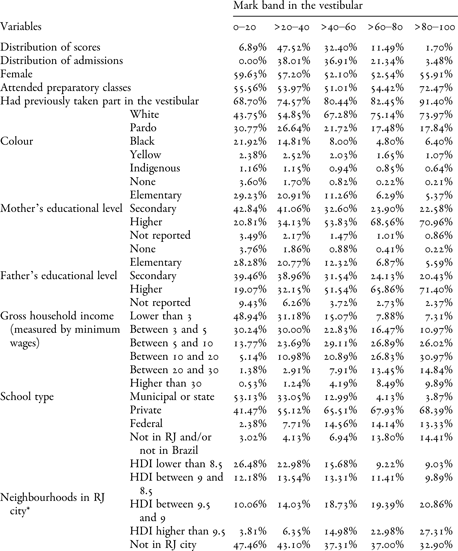
Making use of the information available in the university's database, we have investigated the outcome of applicants with different socio-economic profiles. To do this, we classified individuals into five vestibular score categories, each with a range of 20 points, and studied their characteristics. Table 1 presents the results. The distribution of the applicants' final scores provides yet more evidence of the low quality of Brazilian basic education in the public schools. Over 50 per cent of the applicants had a maximum score of 40 points. At the other end of the scale, the group with a final score higher than 60 points consisted of only 13 per cent of the candidates.
Descriptive Statistics from the Vestibular

Source: UERJ microdata. Compiled by the authors.
*Information on the HDI of each neighbourhood as in Adalberto Cardoso (ed.), Desenvolvimento humano e condições de vida na cidade do Rio de Janeiro (Rio de Janeiro: Prefeitura da Cidade do Rio de Janeiro, 2004).
Scrutinising the applicants' socio-economic profile within each mark band shows a strong correlation between the characteristics listed and the result achieved in the vestibular. As marks increase, one sees a rise in the proportion of applicants who had either already taken the vestibular on an earlier occasion or had attended classes to prepare for it. The scores of white applicants rise progressively through the mark bands; whites account for 43.75 per cent in the lowest group and 73.97 per cent in the highest. As for those who defined themselves as black in the questionnaire, their participation in the different bands declined from 21.92 per cent in the lowest to 6.40 per cent in the highest. Applicants who reported having parents with higher education levels represent only 19.07 per cent of those with the lowest scores, but 71.40 per cent of those in the top group. Effects of this size are also associated with other variables analysed in this article. Applicants living in households with incomes larger than 20 times the minimum monthly wage represented 1.91 per cent of those with the worst results. This proportion rises progressively up to 24.73 per cent for those in the highest band. Applicants from private or federal secondary schools account for a majority among the best performers. The same happens to applicants living in neighbourhoods with a high human development index (HDI). Applicants from neighbourhoods with an HDI above 9.5 represent 27.31 per cent of the top performers.
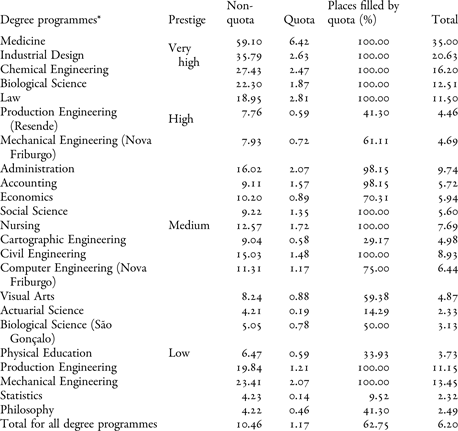
Based on the UERJ'S business intelligence (BI) system we were able to investigate a number of issues related to access itself. Table 2 shows the distribution of places in a specific set of degree programmes, focusing on those that were offered and the proportions of unfilled places in each following the 2010 vestibular. Quota applicants filled only 62.75 per cent of the places. For highly prestigious degree programmes, there were almost no unfilled places. Vacancy rates never exceed 5 per cent. Among programmes with low prestige, vacancy rates can be as high as 70 per cent, or even 90 per cent.Footnote 10 Quota applicants seem to be seizing the opportunity to apply for the most prestigious degrees, something they would not consider without the quota system.
Ratio of Applications per Place in 2010: Quota and Non-Quota Applicants
Source: UERJ, Business Intelligence. Own compilation.
* The authors can provide a complete list of degree programmes.
In aggregate terms, while the ratio of applications per place for quota applicants is near to 1:1, for non-quota applicants the ratio exceeds 10:1. The analysis of the data regarding the 2010 vestibular thus leads to the conclusion that we are close to a point of zero competition among quota students, at least in the case of an aggregated analysis.
As a consequence, one might expect that the minimum qualification scores for quota applicants would fluctuate around the minimum that an applicant required not to be disqualified on account of scores (the threshold was 20 marks). Table 3, which provides average and minimum scores for applicants who enrolled in some of the programmes of low or medium prestige offered by the UERJ, confirms this suspicion. In medicine, a programme with very high-prestige, non-quota applicants had to reach a minimum of 74.25 points, whereas the minimum score for quota applicants who defined themselves as black was 69.25 and for applicants with disabilities, 27.00.
Average and Minimum Scores of Applicants: 2010 Vestibular
Source: Business Intelligence. Own compilation.
The abbreviations refer to the four types of quota places: NI, blacks and indigenous; EP, public school; NC, non-quota; and DEF, with disabilities.
Table 3 also shows differences between the average vestibular scores of students admitted, per group. The mean score for medicine was 87.75 for non-quota applicants and 76.72 for applicants in the racial quota system.
These results might lead to two distinct interpretations. Proponents of a decrease in the percentage of reserved places might make use of a narrow interpretation of the concept of equality of opportunities.Footnote 11 Those who advocate this position could argue that an individual's outcome is a result of his or her socio-economic situation, as well as his or her effort. Thus only that part of the inequality due to differences in family circumstances might be considered unfair and should therefore be rectified. Applied to the previous results, this would mean bringing ratios of applications per place for both quota and non-quota applicants closer together. A direct consequence of the implementation of this view at UERJ would be a drastic drop in the number of places reserved for quota applicants (or an increase of places for non-quota applicants, if possible).
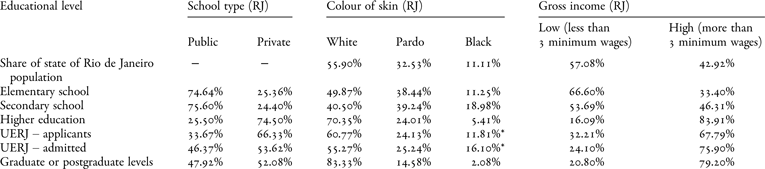
Alternatively, although certain features of UERJ's quota system may seem unfair, the low level of competition identified among beneficiaries of this policy might be justified by what is sometimes called the ‘pipeline effect’.Footnote 12 According to this view, researchers understand students' progress through different education levels as a flow, bound to pass through a network of pipelines to reach the labour market. Given that graduation rates from elementary and secondary school are lower for socially disadvantaged groups, the supply of applicants may not be large enough to ensure that these groups get full access to the university, even when a significant supply of university places exists. This results in a notably lower ratio of applications per place for quota groups. In order to prove this theoretical hypothesis empirically, we have compared the UERJ data with Pesquisa Nacional por Amostra de Domicílios data (National Household Sample Survey, PNAD), and present the results in Table 4.
Populational Representation of School Type, Colour of Skin and Gross Income
Source: Own compilation, based on data from PNAD and Business Intelligence.
As already noted, in contrast to those answering the PNAD questionnaire, UERJ applicants did not have the option of defining black skin colour as preto in their socio-economic questionnaire. Out of those classified at UERJ as blacks, 22 per cent are pardos.
At the level of secondary education 75.60 per cent of students attend public schools. Even though this is the type of school for the majority of students in the state of Rio de Janeiro, the percentage from these schools admitted in any degree programme at UERJ was only 46.37 per cent in 2010. This low percentage is due to the better preparation of applicants from private schools, who represent 53.62 per cent of enrolments. Comparing the percentage of blacks and pardos in the population of Rio de Janeiro to the percentage of blacks and pardos enrolled in higher education we realise that, even though they correspond to 32.53 per cent and 11.11 per cent of the state's total population respectively, they represent only 24.01 per cent and 5.41 per cent of those participating in higher education in the state of Rio de Janeiro. However, the difference between the share of a certain group in the population and its share among higher education students is smaller at UERJ than at other universities, partially due to the quota system.
The concept of ‘proportionality’ is broadly used to justify and guide the definition of percentages of places reserved for different castes in India.Footnote 13 In the case of UERJ, such differences are alleviated for pardos and completely eliminated for blacks. One should note that the adoption of a racial quota system of 20 per cent has a significant impact on the admission of black applicants. As a result, instead of flattening inequalities of opportunities among people of different skin colours, the UERJ policy may be fostering inequalities in favour of those who declared themselves to be ‘black’.
Among all the variables mapped, income is the most significant with regard to access to higher education. Even though 57.08 per cent of the population of the state of Rio de Janeiro has a per capita monthly income of less than one minimum wage, the percentage of students enrolled in institutions of higher education who belong to this group is 16.09 per cent in Rio de Janeiro and 24.10 per cent at UERJ.
By analysing the PNAD data, we can see that the problem of the flow of students from a disadvantaged family background is an empirical question that is relevant to this study. Low-quality public secondary schools, along with precarious socio-economic conditions, end up being significant determinants in the decision of thousands of potential candidates not to apply for a place at UERJ. However, the chances increase considerably for those who get as far as the vestibular and choose to apply for reserved places. Competition within quota groups is low due to the ‘pipeline effect’ and a ‘high’ percentage of reserved places (given the total of applicants for these places). The weak performance of applicants who benefit from this affirmative action thus translates into negligible ratios of applications per place, minimum scores near the disqualification threshold and significant levels of unfilled places among the groups that should benefit.
Econometric assessment of access to UERJ
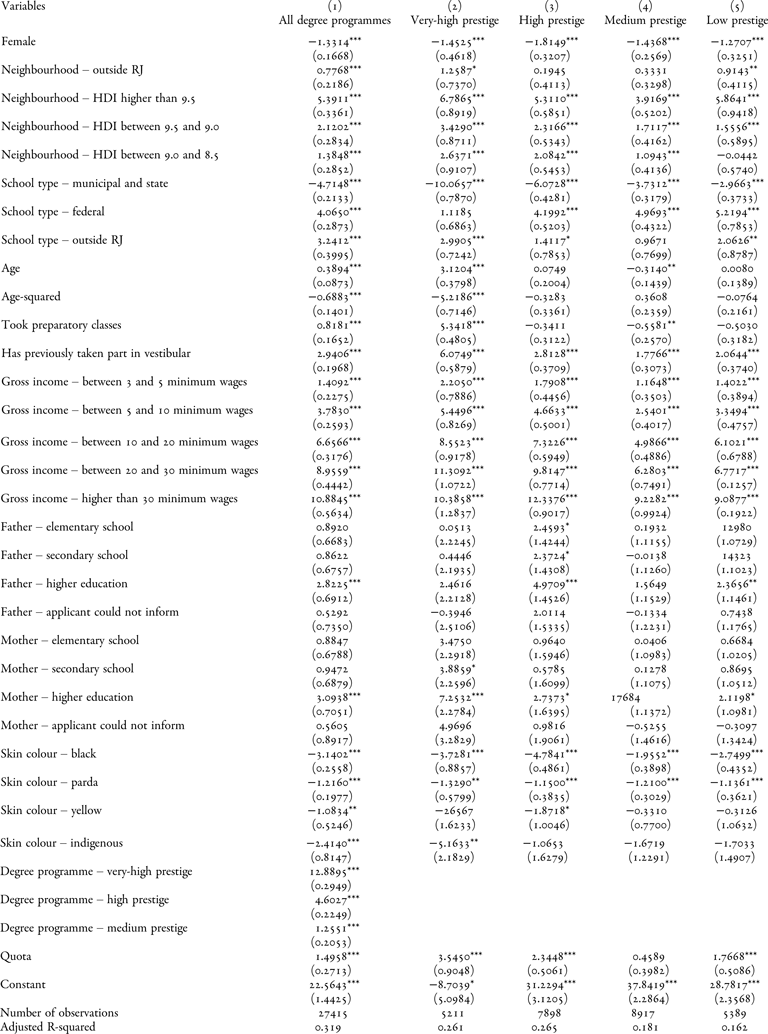
Making use of the UERJ's vestibular database, we have investigated further the association between applicants' performance and their socio-economic characteristics. To do so we applied ordinary least squares methods, using an applicant's vestibular score as the dependent variable. Table 5 shows the results of five different regressions.
Socio-Economic Factors Related to Applicants' Score – Ordinary Least Squares
Source: UERJ microdata; HDI of each neighbourhood as in Cardoso (ed.), Desenvolvimento humano e condições de vida. Own compilation. Reference categories: neighbourhood (HDI lower than 8.5), school type (private), gross income (3 minimum wages), parents' educational level (no formal education), skin colour (white), prestige of degree programme (low).
The first encompasses all applicants who took part in the last phase of the vestibular and answered the socio-economic questionnaire. The other regressions split the sample, according to degree programmes and their respective level of prestige, in order to investigate possible idiosyncrasies. ‘Very high’ prestige is a binary variable with a value of 1; this encompasses programmes with a ratio of applications per place higher than 15:1. In the same way ‘high’ prestige means a ratio of between 10:1 and 15:1; ‘medium’ between 5:1 and 10:1; ‘low’ prestige, less than 5:1.
Before presenting the results, we need to consider some of the usual econometric concerns, such as omitted-variable bias, sampling bias and quality adjustment.
We have included a wide set of variables as controls, aiming at mitigating problems due to omitted-variable bias.Footnote 14 Such an approach is plausible under the selection-on-observables assumption, justifiable given our reasonable knowledge of the process that generated the variables. In particular we included a variable seldom present in other studies, namely the neighbourhood's HDI (in four categories).Footnote 15 Rio de Janeiro is a city of great inequalities, evident in clearly defined concentrations of poverty and wealth. It should be expected that both public and private schools in well-off neighbourhoods such as Gávea or Ipanema are better than schools in poorer areas of the city, or even that these neighbourhoods contain the highest concentration of parents with higher education or the highest household incomes. Moreover, individuals living in better-off neighbourhoods have more contact with friends, neighbours and relatives who value education and often end up by positively influencing applicants' education-related decisions. Thus, the ‘neighbourhood’ variable also functions as a proxy of social capital. A dummy variable has been introduced to indicate applicants living in other cities.
Estimated coefficients refer to aspects associated with an individual's test score and are conditioned to the fact that this individual took the vestibular. Unobservable factors might affect both the decision to participate in the vestibular and an individual's final score, which means that sampling bias might affect our regressions. Applicants are not a random group; instead, it is likely that individuals who apply for the vestibular belong to a subset of people who are most self-confident and best prepared to take the test. Therefore, socio-economically disadvantaged groups are less likely to be included in the sample than more privileged groups.
A frequently applied technique to solve this problem is Heckman's correction. This procedure can be easily employed in many fields for which there are observations concerning the total population available. This is not the case for the vestibular. Information on individuals who were eligible to apply but who chose not to do so is simply not available.
To the best of our knowledge, the only article analysing higher education in Brazil which addresses such a bias is by Emilio et al., who employ PNAD data.Footnote 16 The authors conclude that there was a small reduction in the magnitude of the estimators, along with a negligible improvement of the model's adjustment. The impact of the bias has proved to be essentially quantitative. Moreover applying such procedures does not ensure good results.Footnote 17 Our choice here was to admit that there may be distortions in the magnitude of the estimated coefficients. Yet, even with this caveat in mind, we believe it is possible to draw important conclusions regarding the relationship between the applicants' socio-economic conditions and their score.
All models presented a p-value for the F-test tending to zero and thus we are able to rule out the null hypothesis that independent variables do not exert influence over an applicant's average score. The models' adjusted R-squared ranged from 0.319 to 0.162. The complete model presented a high adjusted R-squared for cross-section data.
As for the results presented by the models, it is noticeable that per capita income seems to be the main socio-economic variable related to an applicant's average score in all the regressions. School type has proven to be decisive in the results of the vestibular. Applicants from state schools have an average score of −4.71 marks compared to those from private schools.
The ‘neighbourhood’ variable is important. We expect this variable to help capture the relationships between applicants and family members, neighbours, friends and other people living in the same area, all of whom have the ability to improve the set of information available to an applicant. Its perceived effect was higher than that for the parent's educational level. This highlights a role that we believe to be relevant and that is currently on the margins of debates on the socio-economic conditioning factors of educational outcomes, namely the influence that other people have on an applicant.
The educational level of an applicant's mother resulted in higher and more significant coefficients than their father's. One might expect this, given that it is the mother who, for socio-cultural reasons, usually sacrifices her working hours for the benefit of a greater presence in the children's upbringing and education.
The comparison of racial choices in the questionnaire shows that, in all regressions, whites perform better than the other groups. The progressive inclusion of control factors led to a reduction in all the coefficients related to skin colour and, with the exception of the ‘indigenous’ category, statistical significance remained at the 1 per cent level. In the complete model, the performance of blacks is worse than that of the reference category (whites).
Care must be taken when studying performance differentials between self-declared whites and blacks in the vestibular. Were the border between blacks and whites clear and in the absence of omitted-variable bias, these results could be, at least partially, attributed to racism. However, this border is neither clear nor stable. Racial descriptions reflect habits, rules, social traditions, and not only genetic origins.Footnote 18 Thus an individual who used to perceive himself as black a few years ago may now declare himself as pardo or vice versa; a pardo who comes into contact with Brazilian racial movements may start perceiving himself as negro, or a black individual may start declaring herself to be parda as a consequence of a rise in her social status. Another possible example would be of a white Brazilian who, after being in contact with Europeans and comparing his skin colour with theirs, changes his opinion on race in Brazil and starts to define himself as pardo. Thus, such conclusions are related to the institutional situation and the way in which the questions were asked.
One possible conclusion would be that socio-economic aspects other than skin colour, such as gross income, school type, neighbourhood and parents' educational level, would appear to have stronger effects on an applicant's scores. But that is not the whole story, since coefficients related to black skin colour would in such a case be expected to drop to moderate levels after including controls for all other variables in the model, and this did not happen. After isolating the effects of all other categories, blacks still present an average result of three points lower than whites.
Given the weaker results achieved by black applicants in the vestibular, those who defend racial quota systems argue that the proposal to open the doors of the university to non-whites would reflect the belief that in Brazil inequality is only not limited to socio-economic matters, since there is a racial component to discrimination that requires repair through the implementation of direct affirmative action. This statement results from a worldview described by Luiza Schwartzman as a ‘new racial project’, which aims at polarising the country between whites and blacks. This concept contrasts with the normative hegemonic position in Brazil during the twentieth century, known as ‘racial democracy’, according to which the country is the result of a mixture of races and discrimination would occur only as a result of socio-economic factors, rather than racial ones.Footnote 19
The coefficients associated with the ‘skin colour’ variable in this study do not necessarily create an argument for the adoption of a colour-sighted policy.Footnote 20 There is great space for research on this topic in Brazil. Due to the close correlation between income, school type and skin colour in Brazil, a colour-blind policy benefiting deprived applicants from public schools may significantly increase the presence of self-declared blacks at university. In fact, the results of a simulation applied to the UERJ database showed that the apportionment of just 20 per cent of the quota places to deprived applicants from public schools would raise the proportion of self-declared blacks from 8.59 per cent to 10.50 per cent (compared to a system without affirmative action with the vestibular score as the only criterion for admission). This would bring the proportion of black students at UERJ close to the proportion of blacks in the population of Rio de Janeiro state (11.11 per cent).Footnote 21
With reference to the ‘female’ variable, we found that women still perform worse than men in the vestibular. In the worst scenario, however, the difference in the final average score was no higher than two percentage points. In relation to total enrolments, women have outperformed men and are a majority in the student body admitted in 2012: 2,207 new female students and 2,024 new male students. This indicates that gender difference is low in higher education in Brazil, and significantly lower than skin colour difference. Women form a majority in three of the four high-prestige degree programmes. The percentage of female students exceeds 84 per cent in these four programmes. At the other end of the spectrum, women represent less than 20 per cent of the students in four engineering programmes and in computer sciences.
When we separate the regressions into four groups of candidates according to the prestige of the programmes, it becomes possible to ascertain the effect of the ‘pre-vestibular’ variable. In the model that uses the full sample, taking part in preparatory classes proved significant, but with a small magnitude (0.81). The isolation of applicants according to the prestige of the programme revealed a relevant difference in this coefficient. For applicants competing for degrees of very high prestige, preparatory classes brought an increase of 5.34 points in the final results in the vestibular. For the other programmes, the coefficient was negative. One explanation for this is that applicants competing for programmes with the highest ratio of applications to places enrol on expensive private preparatory courses, which use the best teachers. Their motivation to achieve better results contributes to a positive, strong and significant effect on the variable. The average applicant to the other programmes might, in contrast, take preparatory classes in institutions with infrastructure and teachers of lower quality. This kind of preparation was insufficient to increase the applicant's score. This is an important finding that invalidates the claim that community preparatory courses are a good alternative to quota policies.
With regard to controlling for the degree programme, those who applied for places in those with very high prestige ended up with an average score of 12.88 points higher than those applying for programmes with low prestige.
After controlling for all the remaining explanatory variables, the sign for the coefficient for quota applicants proved positive. This was a surprise. Even after isolating each socio-economic aspect, we had expected the coefficient to remain negative, which did not happen. One reasonable explanation is the possibility that quota applicants who decide to take the vestibular have applied relatively high levels of effort.Footnote 22 This phenomenon is identified in studies of the progress of quota students at UERJ which recognise a combination of lower coefficients of achievement with higher rates of completion.Footnote 23 Maybe this perseverance is also present at an earlier moment, namely during preparation for the vestibular.
The Relationship between Socio-Economic Factors and Admission in the UERJ Vestibular
We understand there is a high demand for higher education that remains unmet by public institutions. Restrictions on the supply of places vary from one degree programme to another, affecting a candidate's chances of admission. The likelihood of an applicant being admitted to medicine is much lower than that for teacher training. Affirmative action policies also affect admission chances, but in favour of applicants from disadvantaged family conditions, to the detriment of those who do not benefit from such a policy. A logistic regression provides important insights regarding the distortions/compensations brought about by the implementation of this system.
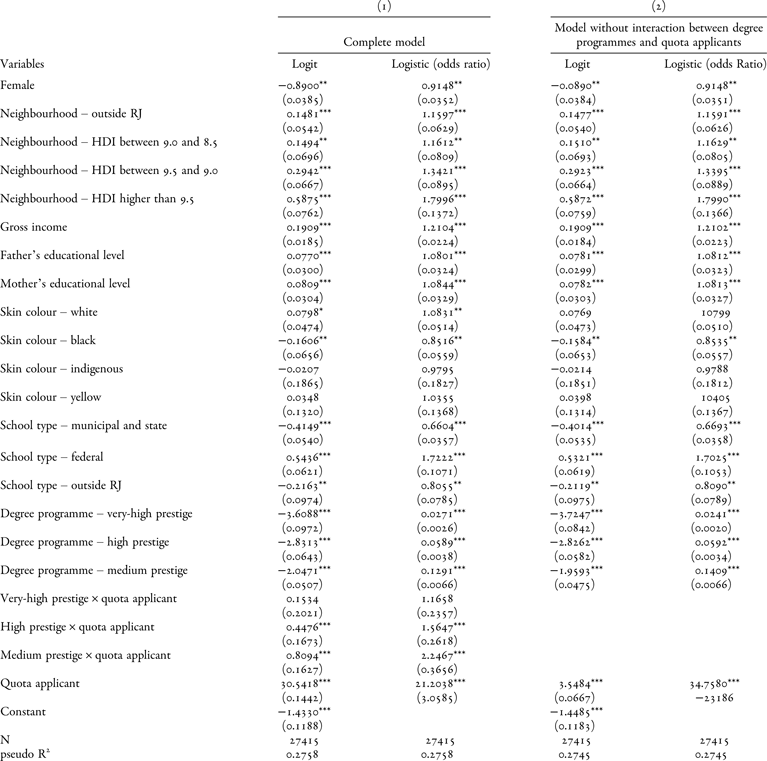
In this type of regression analysis, the dependent variable is a binary variable to which the value 1 is attributed, should the applicant be admitted, or 0 if s/he is not. The vector of explanatory variables encompasses gender, gross income, parents' educational level, skin colour, school type, degree programme, neighbourhood and type of quota. In order to improve or adjust the model, we have transformed the variables of the parents' educational level and gross income into quantitative variables. Each alternative in the questionnaire was attributed a value. Thus, gross household income became a variable ranging from one to six. The parents' educational level is divided in four possible values, organised as follows: none, elementary or unknown, secondary and higher. The answers ‘elementary’ and ‘unknown’ were combined into one group due to closeness in the final average scores of both groups. The same sampling bias problem identified in the ordinary least squares method's coefficients might also be found here: this should be borne in mind while analysing the results in Table 6.Footnote 24
Socio-Economic Factors Related to Applicants' Admission, LOGIT Method
Source: UERJ microdata. Own compilation. Information on HDI as in Cardoso (ed.), Desenvolvimento humano e condições de vida. Reference categories: neighbourhood (HDI lower than 8.5), school type (private), skin colour (white), prestige of degree programme (low).
Two models were estimated: one with interactions between quota applicants and the level of prestige of degree programmes, and another without this interaction. The purpose of these interactions is to verify how the chances of quota applicants change according to the programme. In general, both models presented similar coefficients, as well as adjustment levels.
The estimated coefficients show that the higher the competition for a particular degree programme, the lower the admissions chances for a quota applicant. This is mainly due to the competition for places on high-prestige degrees among quota applicants. The same does not happen in low-prestige degree programmes, where the ratio of applications to places in this group is close to unity, so that the quota applicant is only required to achieve scores close to the minimum threshold in order to obtain admission.
It is important to notice that, in the presence of the variable quota applicant, the other variables represent the admission probability of an applicant, regardless of whether this applicant decided to enter the vestibular as a quota applicant or not. Thus, the variable black shows the chances of admission of an applicant who declared him/herself to be black in the questionnaire, but decided not to apply for quota benefits. It is known that some black applicants choose not to apply for reserved quota places due to their own personal preferences. There are also applicants who miss the deadline for submitting documents, or who do not fulfil the stated conditions of deprivation. Thus, the skin colour coefficient allows for comparison between blacks and whites who compete for places under equal conditions.
With regard to the model that does not specify interactions one realises that increases in income and parents' educational levels raise the chances of admission in the vestibular. Applicants from a federal public school have a probability of admission 70 per cent higher than that of applicants from private schools. Being male and pardo also has a positive impact on chances of admission.
White applicants, from a private or a federal school, with high household income, living in a neighbourhood with a high HDI and with parents who have completed higher education are the applicants with the highest chances of admission in the absence of a quota system. However, the existence of an affirmative action policy tends to change the admission chances of different groups. The results of the logistic regressions show that the most important determinants of the chances of admission to UERJ are not socio-economic. Above all, the supply of places and the quota system have a significant impact.
With everything else constant, applying for a very-high prestige degree programme presents an odds ratio of 0.0271 relative to a low-prestige programme. In other words, the chances of admission to a low-prestige degree are 36.90 to 1, when compared to those of very high prestige. Relative to non-quota applicants, the quota system would benefit the quota applicant with an admission chance of 34.75 to 1.
It is worth noting that in the presence of affirmative action, some situations do not arise. A white applicant, from a private secondary school and with a household income higher than the deprivation threshold, cannot apply for any quota place, unless he or she lies or omits some piece of information. As a consequence, even though the logit result may present a high probabilistic value in this case, the limitation imposed by the affirmative action policy prevents this estimate from becoming true.
Borderline Analysis: ‘Displaced’ and ‘Displacing’ Applicants
The analysis in this section focuses on the impact of the quota system on the socio-economic composition of the student cohort. The introduction of affirmative action affects some applicants, but not others. The best applicants gain admission, with or without this policy, while those with the lowest results within each degree programme are not admitted either way. Affirmative action does not have any direct impact on these individuals. It is important to emphasise the term ‘direct impact’, as there is evidence that the introduction of affirmative action alters the level of effort that quota and non-quota applicants apply in their preparation to take the vestibular, and it also possibly alters the profile of the applicants who take universities' admission tests.
However, some applicants are located just on the borderline of the admission process. The introduction of a quota system has a direct impact on these individuals. The international literature splits them into two groups: (a) ‘Displacing’ are the applicants who benefit, those who would not have been admitted in a merely meritocratic admission process, with vestibular scores as the only admission criterion; (b) ‘Displaced’ are the applicants negatively affected, those who would have been admitted through a purely meritocratic admission process, but are rejected due to the introduction of the affirmative action. As university places are limited, this is equivalent to saying the displaced applicants were rejected, so that displacing applicants could be admitted.
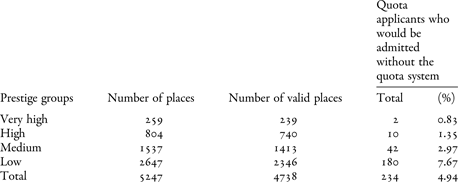
Table 7 shows the number of applicants in the quota group who would have been admitted, even without the quota system. It was based on our microdata. Since incomplete information was removed, the number of places used in the analysis and the number of quota applicants observed do not represent reality, but an approximate number, designated here as ‘valid places’. In view of the 979 valid places for very-high and high-prestige degree programmes, it was possible to determine that only 12 quota applicants would have been enrolled in a meritocratic system, the equivalent of 1.35 per cent of all applicants admitted.
Quota Applicants not Benefited by the Quota System
Source: UERJ microdata. Own compilation.
Even in low-prestige programmes, where we would have expected the quota system to have a lesser impact, only 7.67 per cent of the applicants would have been successful in the vestibular without affirmative action. The consolidated result for the whole university shows that only 4.94 per cent of quota applicants would have been admitted in the absence of the quota system. These results mirror those of a previous study, which verified the same phenomenon in UERJ Law School, emphasising the fact that the policy is effective in selecting applicants from difficult circumstances.Footnote 25
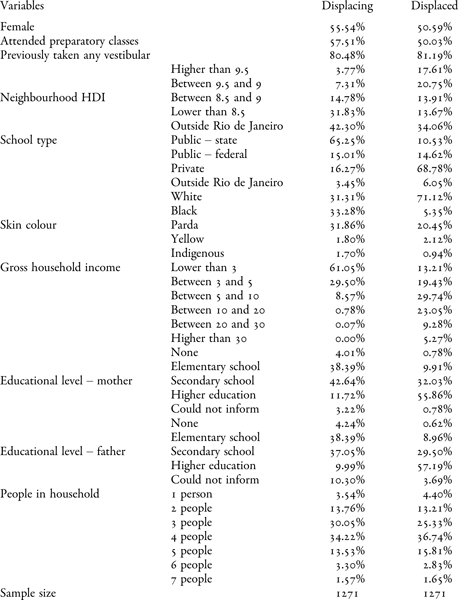
Finally, in Table 8 we analysed the socio-economic profile of displacing and displaced applicants. As evidenced by the econometric analysis, income is the most important determinant of an applicant's marks. At the top of the wealth pyramid, 37.6 per cent of displaced applicants declared having gross household income higher than ten minimum wages. For the applicants who benefited, this percentage falls to 0.85 per cent.Footnote 26 As for applicants with disadvantaged economic backgrounds, the situation is reversed: 62.38 per cent of displaced applicants declared a gross household income below the level of ten minimum wages, while among those who benefited this proportion rises to 99.12 per cent. It is worth noting that the analysis of those who were either benefited or handicapped by UERJ's quota system reflects a greater level of redistribution in the UERJ policy, compared with similar action at the Universidade Nacional de Brasília (Brasília National University, UNB) studied by Andrew Francis and Maria Eduarda Tannuri-Pianto. This is because the UERJ established a deprivation condition based on per capita income, while the UNB's affirmative action relies on racial aspects alone.Footnote 27
Analysis of Applicants Impacted by the Quota System
Source: UERJ microdata. Own compilation.
*Information on HDI as in Cardoso (ed.), Desenvolvimento humano e condições de vida.
A similar observation applies to the educational level of a candidate's parents. Among displaced applicants, the majority of parents possess higher educational levels compared with parents of displacing applicants. It was also possible to determine that the types of student who mostly benefited were females, applicants from state secondary schools, blacks, applicants with lower household incomes, applicants whose mother finished secondary school and father elementary school. The result of this analysis is unambiguous: in this context, applicants with admittedly disadvantaged backgrounds benefit. The profile of those who fail to gain entry as a result of the quota system is different: males, those from private schools, self-declared whites, a household income of between five and ten minimum wages and those with parents with degrees. This profile seems to mirror that of the typical middle-class, white applicant from private schools.
There is evidence that affirmative action focused on a specific type of applicant may end up by handicapping another historically disadvantaged type. In India quotas seem to have resulted in an impairment to female access, since the majority of applicants from the castes suffering discrimination were male.Footnote 28 There is reverse evidence in the case of UERJ. The current policy also contributes to gender equality, since more female applicants were admitted than not.
This does not invalidate the possibility that some disadvantaged groups end up being under-represented in this specific case. A common argument is that poor white applicants from private schools are handicapped by the system. This would happen because, through being white, they are not allowed to apply for places reserved for racial quotas and, since they have attended private schools, they are not eligible for places reserved for applicants from public schools. Thus a high number of poor white applicants would be affected by the current policy, as they are not eligible for reserved places and must face a higher ratio of applications per place than they would in a system that only took into consideration the final score in the vestibular. The empirical results seem to support this argument, since 71.12 per cent of all displaced applicants are white, 68.78 per cent attend private schools and 62.38 per cent have household incomes lower than ten minimum wages.
Conclusions
The empirical analysis of admission to UERJ based on the 2010 vestibular produced revealing results. The descriptive statistical study of admissions data exposed strong socio-economic distortion among different mark bands. The proportion of black applicants from state and municipal secondary schools drops significantly in groups that perform best in the vestibular. While black applicants represented 21.92 per cent of applicants with scores below the minimum threshold (20 points), only 6.40 per cent of them appeared in the best performing group. Applicants from municipal or state schools amounted to 53.13 per cent of the lowest performing and only 3.87 per cent of the highest performing groups.
The subsequent tables show an important contrast in the competition between quota and non-quota applicants. In the case of the first, we could observe a negligible ratio of applications per place, minimum scores close to minimum required scores and unfilled places in some degree programmes. The second group's behaviour was similar to that observed in many vestibulares across the country, high competition for places that translates into high minimum scores and no vacancies. In total, across all degrees, the ratio of applications per place was around 10.46 for non-quota and only 1.17 for quota applicants.
The difference in behaviour between the two groups accounts for the different flows of quota and non-quota applicants. The number of non-quota applicants that go through all educational levels until they reach the vestibular is usually ten times higher than the total of groups for whom places are reserved. To increase the pool of quota applicants the quality of basic public education requires improvement.
We then undertook some econometric analysis and confirmed that gross household income proved to be the main variable associated with an applicant's score, followed by school type, neighbourhood, parents' educational level, skin colour and gender. Even with the full set of control variables, there is still a noticeable difference in performance among those who identified themselves as whites or blacks, equivalent to around 3 points in the complete model. However, the implications of this coefficient should be handled with care, as racial boundaries are not clear in Brazil and this differential results from the way in which self-declared black applicants in the UERJ admissions process perceive themselves. Thus, changes in the self-declarations could alter the results related to race. Nevertheless, it was possible to show that these results are in line with international studies, as socio-economic factors other than race have a stronger impact on an applicant's score.
Based on the analysis of subsamples defined by the prestige of particular degrees, measured by the proportion of total applicants to places, preparatory courses for the vestibular would not appear to be a substitute for the quota system. This is because the coefficient was only positive for applicants who chose to apply for very-high prestige degree programmes; for the others, the coefficient was negative.
Regarding the chances of admission, we have shown that the large number of reserved places compared to low demand makes the ‘quota applicant’ variable the main factor responsible for an increase in an applicant's chances. An insufficient supply of places in very-high prestige programmes also has a negative impact on an applicant's chances.
The last section presented additional important findings regarding access. We have shown that very few quota applicants would have been admitted in the absence of the quota system. Simulations performed using the original UERJ database have proven that only 4.94 per cent of all quota applicants would have been admitted without the quota system. In very-high prestige degree programmes this proportion would be as low as 0.83 per cent of all admitted applicants. The quota system has therefore been able to bring into the university people who would not have been admitted through a traditional admissions process.
As for those directly impacted by the quota system, we can see that the majority of displacing applicants come from disadvantaged socio-economic backgrounds, whereas most of the displaced applicants belong to Rio de Janeiro's middle or high class. The acknowledgement that applicants come from disadvantaged socio-economic backgrounds helps us to see that UERJ has been effective in meeting the goal of redistributing places, favouring greater social justice according to some normative viewpoints.
We believe that our findings may contribute to various debates in the economics of education. They emphasise the need for elementary schools of better quality in order to increase the flow of disadvantaged applicants into higher education. They also provide objective criteria to validate or criticise normative positions concerning affirmative action. Finally, they raise important questions to be scrutinised by the authorities at UERJ and other Brazilian universities.