Introduction
Despite the prominence long given to conquest in explaining how today’s predominantly Muslim regions took shape, Islamization was more often a gradual, uneven, and largely non-violent process. If violence occurred, the perpetrators were often local zealots rather than foreign invaders, and their transformation into zealots was itself the result of such a gradual process. Even within the historical core of the Muslim world created by the ‘Arab conquest’ of the seventh to eighth century CE, in the Middle East and North Africa, Islamic doctrines and practices took a long time to permeate religiously and culturally diverse societies, and they did so not only in times of war.Footnote 1
Yet Islam has figured very differently in the historiography of different parts of what could be called the Islamic culture area. It is typically seen as having long been absolutely fundamental to the dynamics of Middle Eastern societies: as Ira M. Lapidus puts it in his standard work on the history of Islamic societies, there is a ‘Middle Eastern Islamic paradigm’.Footnote 2 By contrast, in the countries of South and Southeast Asia, Central Asia, and Africa, Islamization long remained one historical force among many others, Islam waxing and waning and being reconfigured in the terms of distinct local religious paradigms, such as Javanese mysticism.Footnote 3
These differences clearly reflect different historical realities, but, arguably, their perception has also been shaped by contingent factors more to do with source material and the development of historiographic approaches than with the societies in question. Based on a case study of Islamization in twentieth-century East Africa, the present study problematizes two explanatory strategies that recur in the historiography of Muslim countries beyond the Middle East and North Africa. They are examined together because, though logically separate, they often occur together. The insights gained from the case study suggest that both need qualification.
The first of these explanatory strategies concerns the ‘agents’ of Islamization in these ‘further Islamic lands’.Footnote 4 The societies in question are very diverse, from East African port cities to Southeast Asian peasant societies and Central Asian nomads. Yet, everywhere, the first Muslims appear to have been traders, while the most dedicated proselytizers tended to be traveling ‘holy men’: the scholarly lineages of West Africa; the miracle-working saints of Central and Southeast Asian conversion myths.Footnote 5 There is also widespread agreement that local elites provided a crucial point of contact for the transmission of Islamic teachings to wider society. The second strategy is implied more often than argued for, especially in the literature on Africa. It holds that bouts of scripturalist zeal on the part of elites (and the holy men with whom they allied themselves) led to Islamic allegiance permeating society at large. Once the elites were ‘fully’ converted, it is suggested, their newfound concern for orthodoxy made them intolerant of ‘nominal’ Muslims around them and drove them to convert everyone else.Footnote 6
This view of the agents of Islamization attributes no role to either plebeians or popular politics, which only appear to enter the picture once Islam has already become widely accepted as a source of political idioms.Footnote 7 The role of the populations led by the Islamizing elites appears essentially receptive and conservative; sometimes open to the holy men’s persuasion, occasionally forced into accepting the new religion, and sometimes limiting the scope for Islamization by passive resistance. Proselytizing zeal among leaders with greater exposure to Islamic learning then provides a welcome explanation for this ‘trickling down’ of religious notions.
Yet, while the personal commitment of Islamizing leaders was a factor, for instance in the history of medieval Central Asia or the nineteenth-century jihads of West Africa, it cannot explain why such zeal took hold at certain times and not at others.Footnote 8 The scriptures were always present, but only sometimes did holy men or Islamizing elites feel compelled to act upon them in this way. Contemporary, particularly anthropological, studies of religious diversity in Muslim countries make it clear that elites often accommodated rather than execrated divergent forms of observance.
In part, the association between exposure to the scripture and interest in Islamization among the elites is also based on the assumption that people, and especially commoners, often accepted Muslim allegiance but otherwise continued as before: they converted ‘nominally’.Footnote 9 These nominal Muslims were supposed to be the particular objects of the zealots’ ire. But the notion of nominal conversion is dubious. Even if new Muslims did not proceed to become model Muslims (by academic Islamicists’ standards), they were still likely to face questions as to how to live as Muslims. Becoming Muslim meant changing social allegiances, whether or not it involved deep personal commitment, and such changing allegiances had to be signalled in ritual practice and ways of life. For this reason, conversion (as the initial acceptance of Islamic allegiance) and Islamization (as the broader process whereby Muslim ways became part of the cultural and social fabric of society) are closely connected in the pragmatics of new Muslims’ lives.
The case study from East Africa presented below concretizes the problems with both the standard account of agents of Islamization and the scripturalist motivation that has been attributed to them. Muslim traders, rulers, and Sufis were all present here at certain points in time, but the decisive actors were local villagers: they built mosques by collective effort and converted each other using knowledge obtained from urban educators.Footnote 10 Moreover, these new Muslims immediately began to address the question of how to live their Islamic allegiance, and acknowledged the paramount role of the scriptures in answering these questions. Nevertheless, in practice they depended on oral instructions, and the deference to the scriptures did not preclude challenges to the experts charged with interpreting them.
The parallelism of grassroots Islamization and the marked doctrinal independence of the new Muslims in this case does not imply that grassroots Islamization is of necessity non-scriptural. More generally, it is not my aim to establish this case as the paradigm for a different ‘model’ of Islamization. Rather, what is at stake is paying due attention to popular agency as a neglected variable in the process of Islamization. While some of the notions at issue here have already been critically assessed by historians and anthropologists, it is worth following them up in the literature on Islamization. This allows us to identify the scope for adding to or modifying existing explanations.
The following pages initially trace the focus on traders, holy men, and their allies among local elites in the existing literature on gradual Islamization. They then contrast these accounts with findings by anthropologists of Islam, which make clear that Islamizing local rulers would not necessarily have been either willing or able to enforce Muslim allegiance. This is followed by an account of the East African case study that focuses on the role of commoners and the way in which they construed Muslim ways of life.
Traders, saints, and rulers: the recognized agents of gradual Islamization
In all sites of gradual Islamization, conversion to Islam has been going on for several centuries. The first conversion of a West African ruler to Islam to be reported in Arab language sources occurred in the eleventh century CE, in present-day Senegal.Footnote 11 Again according to Arab sources, Muslims were present among the rulers of the Sahelian empires of Mali and Songhay in the thirteenth to sixteenth centuries. Franciscan missionaries to Central Asia were taken aback by the presence of ‘Saracens’ in the thirteenth century, and Portuguese travellers to ports in Java, such as Tomé Pires, began to report the presence of Muslim traders and rulers as soon as they reached there in the sixteenth century.Footnote 12 On the East African littoral, the archaeological record suggests the presence of Muslims since at least the twelfth century, and in the fourteenth century Ibn Battuta found well-established Muslim rulers and congregations in the Swahili city states on this coast.Footnote 13
The same sources also attest to the importance of Muslim traders in introducing Islamic teachings to these regions, and especially to their rulers. While there are many local nuances to the dynamics of the interaction between traders and local elites, views on the central reasons why the traders’ hosts were attracted to Islam do not differ much. Muslim traders offered attractive goods and the connections needed to keep them in supply. They represented a sophisticated urban culture and a powerful religious knowledge. Their religious practice, with its scriptures and formal rules, formed a kind of ritual expertise that local rulers reasoned could add to their own.Footnote 14
If this reasoning portrays rulers’ interest in Islam as fairly pragmatic, another recurrent type of actor in the spread of Islam is more clearly religiously motivated: the saint, who survives particularly well in the oral record. Javanese Muslims know of nine foundational proselytizers who spread Islam through the island.Footnote 15 In Central Asia, travelling missionaries from neighbouring Muslim regions are held responsible for converting local rulers and founding Muslim communities as well as ruling dynasties. Different parts of West Africa have known different scholarly lineages since at least the sixteenth century: family networks with a strong religious tradition, whose members travelled widely to obtain and then spread Islamic knowledge.Footnote 16 In East Africa, scholarly networks connecting southern Arabia and East Africa introduced new ritual techniques in the nineteenth century, and the leaders of Sufi orders have been credited with popularizing Islam beyond the towns in the twentieth century.Footnote 17
Muslims, then, existed for a long time in religiously mixed environments and specific social and spatial niches. The question is why Islam eventually spread beyond these niches and enclaves, to permeate the fabric of society. Sometimes, local elites eventually enforced Islamic allegiance, as Jay Spaulding and Nehemia Levtzion have argued for Sahelian West Africa, while the best-known case of forceful Islamization in this region involved a counter-elite led by Uthman dan Fodio.Footnote 18 Ricklefs similarly describes occasional zealots among Java’s local Muslim rulers, coexisting and conflicting with non-Muslim, or insufficiently Muslim, rulers through the centuries. In Central Asia, Timur justified his conquests in the late fourteenth century as jihad against negligent Muslims.Footnote 19
Increasing familiarity with, and commitment to, the commands of the scriptures is seen as a crucial driving force for the proselytism of Islamizing elites and travelling holy men.Footnote 20 For the latter group, this commitment is taken as self-evident. For the former, increasing attention to scriptural orthodoxy has been explained as a function of their interaction with more orthodox Muslim foreigners, and their access to education. As the elites became more orthodox Muslims over time, so the reasoning goes, they became less tolerant of continuing non-Islamic practices around them. The elites thus gradually shaped the surrounding society into a more Islamic mould. A related explanation focuses on the exemplary role of urban and ruling elites. Marshall Hodgson cites the ‘culture gradient’ between the residences of Islamized rulers and Muslim traders and the surrounding countryside, and more generally between urban, literate Islamic culture and local non-Islamic cultures, in explaining the attractiveness of Islamicate culture.Footnote 21
But the rationale of this kind of Islamization by imitation is not clear. If plebeians became Muslim because they recognized the affinities of Islam with sophistication, wealth, and power, then what exactly were they trying to achieve for themselves, as conversion in itself did not actually mitigate their poverty and powerlessness? Moreover, it is not obvious that rulers and traders who were Muslim, but did not practise strict Islamic regulations on taxation and trade, would have significantly privileged Muslim followers or trading partners, or that the contempt they might show for non-Muslim ones made their Islamic allegiance attractive. Muslim elites themselves might prefer to maintain a clear cultural distance from the plebeians; evidence to that effect exists for East Africa.Footnote 22
The presence of visibly Islamic elites, or of groups committed to scriptural orthodoxy, then, does not necessarily explain the gradual Islamization of society at large. Historical explanations of Muslim proselytism that pivot on injunctions in the Islamic scriptures presuppose an ‘Islamicist’ normative reading of the Qur’an.Footnote 23 Rather than simply ‘trickling down’ from the knowledgeable to the ignorant, the spread of Islamic teachings needs to be seen as part of an interaction in which both sides, knowledgeable elites and dissenting, as yet ‘ignorant’ masses, play a dynamic role.
Diversity and contestation in contemporary Muslim societies
Inspiration for this attempt can be found in studies of the recent history and contemporary religious dynamics of societies that are generally recognized as already Islamized. Here, the importance of non-elite groups is recognized. Among political scientists, Eickelman and Piscatori’s study of ‘Muslim politics’ traces the emergence of debates around ‘public symbols’ (such as the headscarf) in the Middle East, with participation from many strata and segments of society.Footnote 24 Richard Mitchell’s account of the Society of Muslim Brothers in Egypt shows a similar convergence of disparate groups around Hassan al-Banna’s agenda.Footnote 25 These are merely examples from a large and diverse literature.
While the above authors could be said to address ‘inner-Islamic’ conversion, that is, the way that people change from one form of Islamic observance to another, others more explicitly address the way that the transition from non-Muslim observances towards Islam shapes the emergent Muslim society. In a famous study of the diversity of Islamic observance in Java, Clifford Geertz explains the failure of Javanese elites to enforce orthodoxy with reference to the persistence of pre-existing cultural patterns.Footnote 26 According to him, Java’s experts on scripture, the religious notables known as santri, consider themselves spiritually privileged, in keeping with the spiritual hierarchies recognized by the Javanese before conversion to Islam. Concomitantly, their religious allegiance is inward-looking; they ignore rather than execrate popular practices that clash with their understanding of proper Muslim behaviour.
Geertz argues that Muslims’ acceptance of the coexistence of different and potentially conflicting ways of being Muslim derives from cultural patterns (Javanese mystical hierarchies and, in his comparative site, Moroccan rural–urban relations) that predate the arrival of Islam. Arguments of the same nature have been made for other places. DeWeese identifies a parallel between collective genealogies pivoted on mythical ancestors and oral traditions on the foundation of Muslim communities, where the travelling holy man becomes a quasi-ancestor.Footnote 27 In all these cases, a pre-existing religious heritage cushioned the doctrinal impact of Islamic scripture. Among the elements of Muslim practice percolating across cultural and geographic boundaries, deference to the sacred texts was not necessarily central, and the way in which texts were used was itself open to cultural transformations.
Michael Lambek’s studies of knowledge and practice in the Indian Ocean island of Mayotte provide a particularly clear example of the scope for parallelism between shared deference to the scriptures and disunity in their interpretation and in religious observance.Footnote 28 People in Mayotte have long considered themselves Muslim, and their allegiance to Islam is salient in ritual and cosmology. Nevertheless, it has not displaced practices and beliefs of non-Islamic derivation. Lambek distinguishes three bodies of practice among Mayottans, two of which are to varying degrees Islamic, and none of which is about to displace the others.
Muslims on the island assert the primacy of Islamic religious rules, and insist that the Qur’an and hadith provide a complete, unambiguous, and knowable set of these rules. At the same time, they acknowledge that, being far from the centres of Islamic learning, they do not themselves have secure knowledge of them. Because of the reference to distance from the Islamic heartlands in this self-perception, Lambek calls Mayotte’s religion ‘peripheral Islam’.Footnote 29 A crucial implication of this acknowledgement of peripheral status, though, is that it allows Mayottans to doubt, challenge, and pick and choose between the local purveyors of scriptural knowledge: after all, none of them are perfect. Concomitantly, debates between local scholars on the interpretation of Islamic rules are transformed into public contests over their credibility, which depend as much on their perceived personal qualities, on rhetorical abilities and personal loyalties, as on their religious erudition. Scriptural debate becomes a contest for personal authority.
Robert Launay reports a similar situation from West Africa. Dyula Muslims, an old, well-established community in a multi-religious town, argue among themselves about the monetary value of marriage payments prescribed by the Qur’an, while insisting that Qur’anic instructions on the matter are clear and unambiguous.Footnote 30 In both cases, the shared deference to perfect scriptural rules preserved far away in practice fuels personal contests.Footnote 31 For Sulawesi, Thomas Gibson describes a situation where Islamic teachings have permeated different realms of social practice to varying degrees and in different ways, leading to an enduring parallelism of institutions of diverse, only partly Islamic origins.Footnote 32
The arguments reviewed here indicate why it cannot be taken for granted that elites, even if self-consciously Islamic and respected as such, could or would impose their view of orthodoxy. Conversely, the fact that Islamic practice has gradually spread and become entrenched, in spite of the limited ability of elites to enforce it, again draws attention to the question of the contribution of commoners in this process.
Islamization in twentieth-century East Africa: the limited role of Sufis and traders
Continental East Africa, as distinct from the coastal belt, provides an opportunity to examine this question because Islamization here is quite recent. As mentioned above, the oldest Muslim enclaves on the East African Swahili coast may be a millennium old. For most of its history, however, Islam in East Africa remained confined to a coastal belt sometimes under ten, sometimes up to thirty, kilometres wide. Within this zone, rural Muslim congregations could be found by 1850.Footnote 33 Between about 1880 and 1960, though, Islam was transformed from a coastal to a continental East African creed, spreading as far as the southern shores of Lake Malawi and the present-day Eastern Congo.Footnote 34
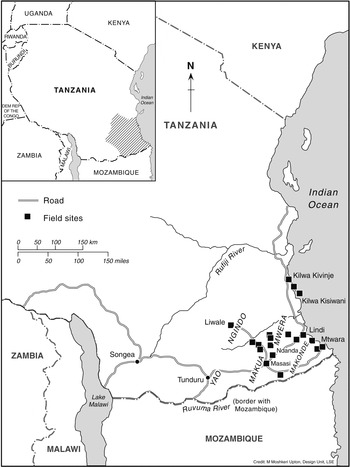
Main field sites in Lindi and Mtwara regions, Tanzania, and main ethnic groups.

Between 2000 and 2004, I collected about 400 interviews in the Mwera-, Makua-, Yao-, Makonde-, and Ngindo-speaking areas beyond the southern Swahili coast. Interviews took place in the course of seventeen months, at about twenty interview sites. Sites included coastal towns, country towns in the interior, villages, and isolated hamlets, up to 200 kilometres as the crow flies, or 300 by road, from the coast. In this area, now the southeast Tanzanian regions of Lindi and Mtwara, missionary and ethnographic sources confirm that rural people, at the onset of the colonial period, by and large were not Muslim.Footnote 35 Today, though, Muslims form a large majority of the population. Both oral and written (missionary) sources suggest that the majority of conversions occurred between about 1910 and about 1950. Despite variations in ethnic composition, poverty, and stratification, oral information from across this region suggests a path towards the growth of rural Muslim congregations in which villagers were the crucial mediators.
This is despite the fact that all the ‘typical’ agents of Islamization had been present here. The first Muslims whom people in the East African interior encountered were traders driving the ‘commercial expansion’ of trade in slaves and ivory, whereby the East African interior was tied into world markets in the course of the nineteenth century.Footnote 36 The first local Muslims, in the late nineteenth century, were people who interacted with slave-trading local ‘big men’ and others working in the caravan trade.Footnote 37 The politics of Islam at this time, then, were as Levtzion and Spaulding or Lapidus would suggest: it was associated with dominance.Footnote 38 From the late nineteenth century, we also find holy men at work in East Africa, notably leaders of the Qadiriyya and Shadhiliyya brotherhoods. Opinions differ on whether these Sufis proselytized so as to extend the influence of the Arabophone literate elites of the coast, or posed a challenge to it by providing an Islamic identity to the flotsam and jetsam of the caravan trade.Footnote 39
According to rural informants, though, the contribution of the Qadiriyya and Shadhiliyya Sufi brotherhoods (tarika), active on the coast since the late nineteenth century, to the progress of rural Islamization was limited and largely indirect. Many rural Qur’an teachers had received what training they had in boarding schools run by the major sheikhs associated with the tarika in the coastal towns of Kilwa and Lindi.Footnote 40 Yet only on the Makonde Plateau, in the south-eastern corner of the area discussed, did Sufi rituals become relatively widespread before the Second World War.Footnote 41 It was the ritual practice that spread, more than the organizational structure. Elsewhere, the tarika only began to recruit actively in the 1950s, amid the relative prosperity, and hence increased mobility, of the post-war era.Footnote 42
It is debatable how much of a departure from a general pattern this sequence constitutes, with tarika following rather than instigating initial conversion. For central and northern Tanzania, August Nimtz has suggested that Sufis had a pioneering role. This claim, however, was based on information provided by coastal tarika leaders;Footnote 43 research in the mainland regions in question might have led to a different emphasis. This consideration applies also to accounts of the role of the Shadhiliyya on the mainland given by its paragons in the Comoro Islands. There is more evidence for the early presence of the tarika in regions south of our area of study, among Yao populations near Lake Malawi. Yet even here, it comes predominantly from relatively large and quasi-urban settlements.Footnote 44 Among the Yao immigrants in rural south-east Tanzania, a visiting mission envoy in 1922–3 noticed Qur’an teachers and their followers, but none of the flags, rituals, and festivities of the tarika.Footnote 45
Traders, meanwhile, had been relatively numerous in the late nineteenth century, but very clearly focused on business. They were itinerant peddlers or adventurers, who depended on larger trading houses on the coast, and had no reason to share their views on Islam with people who, to the mind of their coastal sponsors, were potential slaves.Footnote 46 During the period when most conversions took place, between about 1910 and about 1950, traders rarely ventured beyond the coastal belt. With the approval of the British colonial government, South Asian trading houses had largely replaced Arab or Swahili ones. They traded mostly in grain and coconuts, and, while villagers vividly recall long journeys on foot to exchange their harvest for sugar, cooking pots, and tax money, religion did not come into these interactions at all.
Arguably, the attention given to Sufis and traders in discussing rural Islamization reflects the expectations of observers more clearly than events in the countryside. The role of Sufis was hypothesized early on and, with their visible ritual, pride in their far-flung connections, and salience in oral sources, they are relatively easy to trace.Footnote 47 Traders, too, had relatively good chances of leaving documentary traces, as they were noticed in the often deprived countryside. Oral (and some scant documentary) records from the region considered here suggest a different emphasis.
Indigenous religious practice: dispersed ‘ritual authority’
Missionary observers of Islamization sometimes claimed that Islam was more compatible with Africans’ habits than Christianity.Footnote 48 While this holds true of some specific practices, such as polygyny and circumcision, it would be excessive to posit a general cultural affinity. As we shall see below, practices seen as incompatible with a newly acquired religious allegiance could be made compatible or ignored: an approach as common among Christian as among Muslim converts.Footnote 49 Nevertheless, a consideration of established religious practice in our region helps understand where the small-scale Muslim proselytizers of the inter-war period came from.
There were four kinds of religious experts working among the people here. Lineages contained ritual leaders who propitiated the ancestors on their behalf, typically at trees, with a sacrifice known as msoro.Footnote 50 Villages, meanwhile, contained ritual experts who oversaw and performed in collective rituals. The most important ones were those concerned with the series of initiation rituals (unyago) that marked the transition to adolescence, and later to marriage and parenthood.Footnote 51 While the marriage, pregnancy, and birth unyago were performed individually for the couples in question, the one for children was a large collective effort. The initiands, separated by gender, spent weeks together in purpose-built camps, provisioned by the entire village, instructed by its elders, and cared for by ritual experts, who for boys included a circumciser.
The other two kinds of expert were much less integrated into the fabric of everyday social relations. Healers, often members of specialized lineages, had a close relationship with the wilderness that supplied many of their materials, and were known to handle dangerous knowledge and substances. Their ability to detect, but also practise, witchcraft added to the aura of danger that surrounded them, and they often lived somewhat apart.Footnote 52 Lastly, the region also contained territorial shrines with dedicated ritual experts. In this regard, it formed part of a continuum with South Central Africa, where this phenomenon is better researched.Footnote 53 Unlike lineage-specific ancestors, the spirits propitiated at these shrines were accessible to anyone who approached them in the appropriate manner. Some of these shrines, dedicated to a kind of spirit known as mgende, still function today in the extreme north-west of the area under review.Footnote 54
Within a recent and still ongoing history of migration, the presence of such place-specific spirits was one of the factors with which migrants reckoned. The range of spirit forces and rituals was attuned to the way of life of people who moved their villages frequently across thinly populated land, as the matrilineages at the core of villages splintered and recombined. There is no indication that the opportunistic, often militaristic ‘big men’ of the era of long-distance trade achieved control over this multifarious ritual activity, or that they even tried. The pioneers who facilitated rural Islamization in the twentieth century would show a similar independence. These village teachers were often otherwise undistinguished villagers, respected for their learning and commitment, but neither particularly wealthy nor of high ritual or social status.Footnote 55
Village proselytizers ‘fetching’ Islam
There was thus a marked shift in social affiliations between the handful of Muslims in the late pre-colonial period, and the successful proselytizers active in the first half of the twentieth century. The Muslims present before 1900 were travelling traders, scribes in the service of ‘big men’ who lived off the intensive slave trade, and sometimes these big men themselves.Footnote 56 These pre-colonial elites were largely cut down by the suppression of anti-colonial resistance, which in this area took the form of the devastating Maji Maji war of 1905–7.Footnote 57 Around the time of this war, from about 1900, though, ordinary villagers who had spent some time on the coast began to work as Qur’an teachers, while local networks of lineage elders endorsed the construction of mosques. German sources disdainfully identified these men as schamba-waalimu (‘field-teachers’). As some informants put it, rather than traders or saints ‘bringing’ Islam, villagers went to ‘fetch’ it.Footnote 58
This process of rural Islamization cannot be interpreted as an outcome of villagers’ ideological and practical subordination to Islamizing elites. It occurred after the pre-colonial elites who fitted this notion had disappeared. Moreover, the Muslim townspeople on the Swahili coast had lost their pivotal socio-economic position with the end of the slave trade and the Zanzibari commercial empire, and were now largely irrelevant to trade up-country.Footnote 59 Political power, meanwhile, lay in the hand of European Christians. Uniterested in a region that was deemed to hold little economic potential, they exercised it through precarious, small-scale intermediaries, who changed often and coexisted with unappointed village elders, whose influence was based on lineage and personal stratagems.Footnote 60
To make sense of this popular interest in religious change, we have to consider the nature of power relations in the rural areas. All the ethnic groups in question were what colonial administrators called ‘stateless’ and historians have called ‘decentralized’.Footnote 61 Much rural settlement was impermanent. Many Makua, Yao, and Makonde settlers had arrived in the area recently, as part of a slow secular process of migration, and longer-established Ngindo and Mwera populations had moved in response to this immigration. Constrained by the uneven availability of surface water, population densities were generally low, and villages splintered and relocated in response to internal tensions, conflicts with neighbours, and environmental constraints.
In this context, control over persons was negotiated within lineages and shifting settlements by ambitious individuals who exploited whatever means of social control were available to them. In the nineteenth century, this meant above all the trade in slaves and arms, and the ‘big men’ of this era fed off the trade routes towards the coastal towns. But their authority remained somewhat improvised, often violent, and contestable.Footnote 62 Arguably, the millenarian currents in the Maji Maji War (1905–7) signalled the fighters’ pursuit of emancipation from the big men no less than of freedom from the colonial rulers.Footnote 63
The public execution of some rebellious big men and the humiliation of others by the colonial government made their subjection under colonial rule brutally evident, while the confiscation of guns and suppression of the arms trade precluded resumption of their militarized political practice once the war was over.Footnote 64 Moreover, the economic decline of the elites formerly dependent on long-distance trade towards Zanzibar was precipitous, as the local cash crops were marginal and presented no viable alternative to the slave trade. Already before the First World War, Arab notables on the coast were becoming indebted to the German East African Company and, by the early 1920s, they were effectively impoverished.Footnote 65 Up-country, the colonial government replaced the big men with gullible, if often ineffective, appointees.
For villagers, though, the demise of long-distance trade and the big men meant a chance to renegotiate relationships of dependency. Ambitious individuals now had considerably fewer means to tie dependants to themselves than in the nineteenth century, but villagers continued to be attentive to differences in wealth and status. Ex-slaves who struggled to establish independent homesteads were derided, and men sought to establish themselves as heads of lineage sub-units by controlling their sisters and their sisters’ children.
Muslim allegiance became a reference point in these negotiations of dependency. In part, that entailed reinterpreting the status of villagers in relation to the coastal Muslim towns. Informants interpreted becoming Muslim as a way of taking allegiance with these towns: ‘I reject the ways of the mainland, I want those of the Swahili [coast]’, is how one convert remembered her own motivation.Footnote 66 But this urbanity mattered for villagers above all as a way to assert entitlements within the social networks of rural settlements. Already in the late pre-colonial period, both slaves and masters tended to construe the conversion of a slave as a challenge to prevailing social hierarchies, rather than deferral to it. Concomitantly, low-status converts formed separate congregations with distinct ritual practices. They chose to be Muslim in a way that was manifestly, actively different from that of either the pre-colonial elites they remembered or their impoverished successors.Footnote 67
References to the coastal origins of Islam survived far into the colonial era among village proselytizers: they added salt to the water used in converts’ ablutions in imitation of sea water and, in Kimwera, one of the languages of south-east Tanzania, even the word used to denote ‘Muslim’ referred to the coastal towns: mulungwana, from Swahili muungwana, free-born citizen.Footnote 68 But rural proselytizers and their followers took this association for granted and, rather than elaborating it, they emphasized the meaning of being Muslim for local social relations. Islam was a good religion because it made you a good person, patient, forbearing, and cooperative. In effect, the new rural Muslims redefined the meaning of Islamic allegiance. In the late pre-colonial period, when Arab plantation owners, urban merchants, and rural warlords were the people most likely to be Muslim, it had been a sign of dominance.Footnote 69 In the thinking of village Muslims and proselytizers after 1900, it was a token of equality.
These village proselytizers, then, represent not simply a later stage in the process of Islamization, but rather a strikingly different dynamic. Their understanding of Islamization was informed by social relations among villagers no less than by their relations with urban areas or Muslim foreigners. Rural informants tended to identify the commitment to Islam with a social personality that was the opposite of the Muslim warlords and traders of the nineteenth century: cooperative and humble, rather than domineering and proud. As one informant put it, an early rural proselytizer impressed his audience with his assertion that ‘only those who were well thought of by others and who respected and loved others could become Muslims and gradually a number of his listeners came to accept Islam’.Footnote 70
Rather than elders leading the way in Islamization, their sponsorship of mosques tended to be a response to rising popular interest in Islam. They never exerted control over their fellow villagers’ religious decisions.Footnote 71 In effect, elders and commoners in the villages conducted a subtle negotiation over the meaning of the acceptance of Islam. Everyone construed it as progressive but, while elders presented it as evidence of the beneficial character of their leadership, other villagers emphasized the personal character of the decision, and its significance as a step towards equality among villagers, rather than towards the entrenchment of the elders’ leadership.
Islamization and Christianization as related and contingent processes
The parallelism between Islamization and Christianization again highlights the relative autonomy of individual converts, for converts to both religions often coexisted in the same village, and even in the same family. Two missions were present in this area from the late nineteenth century: the Anglican Universities’ Mission to Central Africa, and the Catholic Mission Benedictines. Both of them achieved some success, but were out-competed by Muslim proselytizers.Footnote 72 Today, the Anglican Church started by the UMCA remains strong in the up-country district of Masasi, while Catholic communities are concentrated around Benedictine mission stations scattered along the main road inland, and on various locations in Makonde- and Mwera-speaking regions. Together, they comprise about 20% of the population, while the remaining 80% in these districts are Muslim.Footnote 73
Although missionaries reported some bragging matches between Muslim and Christian children, and complained of occasional interference of Muslims in Christian festivities, interactions between Muslims and Christians were typically not hostile.Footnote 74 Rather, the differences in the spread of the two religions, and the greater success of Islam, point to differences in the way in which the two religions were or were not integrated into pre-existing patterns of life. A major difference here lay with the fact that Muslim proselytizers and proselytes generally did not take issue with the unyago rites. By contrast, both missions sought to control them and substitute their own rituals, and the Catholic mission went so far as to bluntly condemn any involvement of their disciples in the traditional unyago.Footnote 75
In the absence of a cash crop boom, the typical pragmatic motive for sending children to mission school – to enable them to help their parents negotiate their place in the rise of ‘rural capitalism’ – was missing. In this context, interest in formal education, Muslim or Christian, remained relatively low, and mission education was not necessarily perceived as more progressive.Footnote 76 A comparison between Muslim and Christian educational practices suggests that the greater degree of continuity between Muslim and local educational practices was part of the reason why parents chose them. The teachers who provided rudimentary Qur’anic education to some of the children of new rural Muslims were often neighbours, or members of the students’ extended family network, working out of their homes.Footnote 77 They were thus the same people who would have been involved in these children’s unyago. Christian schoolteachers, by contrast, were often relative strangers, answerable to their employers rather than to students’ parents.
The fact that both Islam and Christianity found adherents at the same time makes it clear that culture and society in this region did not have an intrinsic affinity with one of these religions over the other. Rather, a multiplicity of interactions – with townspeople, with missionaries, among themselves – tipped the balance in favour of Islam. Many informants emphasized the difference between the incoming religions and pre-existing African religious practice, as concerned with ancestors and spirits, over that between Islam and Christianity, both concerned with God. Comparisons with other parts of the hinterland of the Swahili coast reinforce this point: other regions with a similar pre-colonial history became Christian or maintained African religious practice while resisting Islamization.Footnote 78
Ritual, scripture, and how to determine how to be Muslim
Rural Muslims in south-east Tanzania also provide a case study of how new Muslims addressed the issue of how to be Muslim in the absence of any enforcement of Islamic observances. It is very evident that not all tenets of social life are derived from Islamic sources. To this day, village Muslims’ knowledge of Arabic remains limited to a handful of formulas, which are reproduced but rarely literally understood. A version of Islamic law is applied irregularly in marriage and inheritance cases, but never in criminal law.Footnote 79 Arabic literacy is limited to the recitation of Qur’an surahs by local shehe (that is, shaykhs). Meanwhile, the propitiation of ancestors continues, albeit less centrally, and descent continues to be reckoned matrilineally.
Nevertheless, new Muslims were concerned with the question of how to live up to their new allegiance. From the start, this involved changes in one’s way of life as well as in names and dress style. Informants and missionaries agree that new Muslims avoided ‘unclean’ meat, including not only bush pig but also rat.Footnote 80 Arguments over the status of hippopotamus meat (was it clean like fish or unclean like pig?) became intense enough in the 1950s to be noticed by colonial administrators rarely interested in Islamic affairs.Footnote 81 African religious precedents had been more concerned with actions than with definitions, and rural Muslims continued this pragmatic interest. One informant characterized villagers’ interest in Islam by saying that they asked Muslims whom they observed on the coast ‘What is this you’re doing? – It is called ‘religion’. – What ‘religion’? – The religion of the Prophet. – The religion of the Prophet? So what do you do?’Footnote 82
Throughout the twentieth century, villagers continued to examine the question of how to act as a Muslim. The rural proselytizers who facilitated conversion also advised converts not to address God ‘through objects’, that is the trees and shrines of established ritual.Footnote 83 They could bring no pressure to bear to enforce this advice, and sacrifice has not disappeared. Still, the practice of sacrifice has changed significantly. Today, the msoro ritual performed at trees is clearly remembered, but no longer practised. Instead, the term msoro has come to refer to a meal, shared by family members, and often by a Muslim ritual expert, in the home of a person suffering from a specific affliction (often illness). It is accompanied by the burning of incense and Qur’an recitations, akin to the domestic maulid performances with which coastal Muslims sometimes seek divine blessing.
The sacrifice has thus lost its public and lineage-based aspect and, if ancestors are acknowledged to be involved, then it is only as intercessors before God. Although also related to broader changes in the role of lineages, it is evident that rural Muslims have changed ritual practice to reconcile Islamic monotheism with the role of ancestors. They were not insensitive to the fact that Muslim practice was not endlessly compatible with established ritual, but establishing the border between what they call, in a Swahili-ized rendering of the Arab terms, halali (‘permitted’) and haramu (‘prohibited’), is a tentative process, subject to continuous revision.
Engagement with the scriptures is part of this search for the right way to be Muslim; but their interpretation and use have remained malleable, and easily blend into non-scriptural ritual practice. Thus, in a women’s madrasa (meaning a Qur’an school) in the Mwera-speaking country town of Rwangwa, I observed two starkly different explanations of the surah known here, after its inception, as tabatiada. Footnote 84 Of the three men taking turns to teach here, only one, Muhammad Mkweka, regularly provided context and explanations, though never verbatim translations, of the surah that his students recited. Tabatiada was one of a group of surah that he recommended for regular recitation to protect against the ill will of others.Footnote 85
One day, a protégé of Mkweka stood in for him at the madrasa, a blind man who was said to be able to ‘read’, that is, recite, the entire Qur’an by heart. Seeking to take advantage of his knowledge, the women asked him about the literal meaning of tabatiada. He explained that it was an indictment of an opponent of the prophet that threatened the detractor with shackles and hellfire. His translation of a grammatically obscure line was ‘his wife will carry firewood to the flames [in which her husband is languishing]’. The women at the madrasa, most of them wives, looked at each other in consternation at these words, one of them observing quietly that ‘some surah are scary once you know what they mean’.
Like three or four generations of Muslim students before them, these women ascribed to the words of this surah a concrete, beneficial effect, without knowing their meaning. They respected the words in their materiality, in a way that went far beyond the appreciation of usefulness. They might ingest ink that had been used to write them as medicine, and they took pains to reproduce them correctly. The words mattered to them as process: the written text had again become performance. Michael Gilsenan’s observation, made with reference to regions where allegiance to Islam is much older, applies to them: ‘The directness of the relationship with Allah through the Word and its intensely abstract, intensely concrete force is extremely difficult to evoke, let alone analyze, for members of societies dominated by print and the notion that words stand for things.’Footnote 86
The literal meaning of the writing that these women appreciated so deeply, though, was actually disconcerting. It jarred with their understanding of the inherently beneficial, protective qualities of the performed text. Their predicament is not adequately described by saying that they had not learned ‘enough’ about the surah, compared to members of scriptural elites. Rather, they had learned something different: a performance style and a therapeutic practice, rather than textual interpretation. A person, then, cannot only know more or less about the Muslim religion, but also very different things about, or very different parts of, it. The use of the text can itself travel as a specific form of practice, rather than as a constitution on which all other practice is built. Rather than a stable body of textual knowledge gradually establishing itself in a non-literate environment, we find elements of textual teaching and practice passed on, adopted, and adapted, in a process inseparable from social as well as cultural context.
Concomitantly, different injunctions and prohibitions based on the scriptures have found different degrees of acceptance among rural Muslims in East Africa. Even closely related practices, such as different dietary avoidance rules, have been adopted to different degrees. Despite the early concern about keeping dietary rules with regard to meat, in the early 2000s rural Muslims continued to defend the consumption of locally made beer, arguing sometimes that it was a foodstuff that only happened to be slightly alcoholic, rather than liquor proper, or else that Muhammad could not have had it in mind when he prohibited liquor, because this type of beer did not exist in Arabia.Footnote 87
Two related processes, then, undermine the dominance of scripture: the recuperation of the use of scripture into performance and practice, and creative oral embroidering on the approximately known contents of the scriptures. The survival of diverse forms of Muslim observance is not only due to the persistence of idiosyncratic local cultural influences in different Islamic cultures, such as Geertz’s Javanese scholars with their insistence on spiritual privilege in the Javanese mystical tradition. Rather, the partly independent development of ‘popular’ Islam is also an expression of the relative intellectual and social independence of non-elite, in this case rural, communities.
The present case allows us to trace some of the roots of the construction of Islamization as the ‘trickling down’ of cultural traits, spasmodically intensified by scripturalists among the elite, through an examination of the attitudes of the European observers present. Missionaries in the nineteenth and twentieth centuries thought of Islam as the religion of slave traders, and were exasperated that the potential victims of enslavement showed interest in the perpetrators’ religion. They dealt with it by training their own experts on Islam.Footnote 88 These mission experts absorbed the text-centred approach of contemporary European scholars of Islam, and combined it with their own conviction that religiosity should be founded on careful consideration of the meaning of religious scripture. Moreover, they were disposed to be critical of the Muslims they observed, measuring them against the norm of European ‘Islamicists’.
These missionary Islamicists questioned both the religious knowledge of members of the old Muslim communities of East Africa and the motives of recent African converts. They inspected the libraries of local Muslim notables, and found them paltry. They conducted disputations with them, and found their knowledge of the text of the Qur’an limited.Footnote 89 Confronted with such, to their minds, unconvincing leadership, they dismissed the motives of new Muslims: converts were ‘imitating’ their oppressors. Driven by admiration for material wealth, their conversions were only ‘skin deep’. Colonial officials, for their part, found Muslim Africans harder to fit into their racial and cultural preconceptions. With the slightly higher status accorded Muslim Arabs in the colonial order in mind, they denigrated conversion as a naïve attempt at social climbing.Footnote 90
In this manner, the European observers who produced many of the written sources on rural Muslims portrayed them as clumsy imitators of an already corrupted religious tradition. Historians using these sources have to grapple with their underlying assumption that villagers’ adoption of Muslim allegiance implied uncritical deference to its established representatives on the coast. Moreover, they have to beware of the insinuation that East Africa’s Muslims would have been ‘more’ Muslim if they had been more attentive to the Islamic scriptures as these European observers understood them.
Conclusions
In this case, then, both the agents of Islamization and their aims and methods diverge from the standard accounts of gradual Islamization. To establish this point, though, extensive travel in the countryside and detailed statements by rural informants were required. In the more accessible urban centres of the region, oral tradition was again dominated by references to Sufi saints, whose actual role in the conversion of the countryside had been limited to providing education to the proselytizers.Footnote 91 Even though most conversions in the countryside occurred only two to four generations ago, its local agents were already fading from memory.
The proselytizers’ rapid disappearance into obscurity highlights the possibility that processes similar to the one observed here occurred in other locations, made untraceable by the passage of time, or possibly overlooked. There are many examples of the ways in which the oral record favours holy men and princes. Levtzion comments on the tendency of Javanese accounts to neglect the role of traders in their favour.Footnote 92 Among Chinese Muslims, Israeli documents attempts to construct royal antecedents for their conversion, in spite of the manifest marginalization of these Muslims from the imperial hierarchy.Footnote 93
Meanwhile, in Central Asia, DeWeese notes that some aspects of the hagiographic oral traditions might in the past have been implicit assertions of the equality of local Muslim converts with erudite Muslim immigrants.Footnote 94 The sixteenth-century Javanese port towns discussed by Ricklefs could be construed as sites of social competition involving plebeians, in which the acceptance of Islam might have been a stratagem, similar to Glassman’s analysis of social relations in nineteenth-century Swahili towns. In fact, Gibson, while maintaining the focus on urban elites, argues that Islamization in nearby South Sulawesi should be understood as the outcome of a loss of certainties in an increasingly connected and mobile world.Footnote 95
Given the limitations of the evidence, attempts to trace further instances of popular dynamics in Islamization are likely to remain speculative in most cases, so that insisting on their possibility may appear a futile exercise. But arguably there are benefits in acknowledging the scope for such processes, even if they remain sketchy.
For a start, it is a way of addressing familiar, yet problematic underlying assumptions about the nature of Islamization. The view of Islamization as a form of cultural mimicry, whereby local, oral cultures are absorbed into a larger and, because literate, more ‘advanced’ cultural sphere has antecedents, not only in the above-mentioned musings of missionaries and colonial officers, but also in modernization theory.Footnote 96 Non-literate, decentralized societies appear to be drawn into the realm of history by joining the ‘Muslim world’, a historical sphere of states, elites, and written sources. Yet, as we have seen, illiterate peasants in a lineage society might turn to Islam to curtail the ambitions of a budding elite. Moreover, they did so partly to overcome the brutal stratification of their recent ‘pre-Islamic’ past, reminding us that their history did not, in fact, begin only when they joined the larger Islamic sphere, and that Islamization does not provide any more obvious direction to their history than modernization has turned out to do.Footnote 97
The recognition of popular agency also contributes to normalizing the inherent diversity of the Islamic culture area. The reality of dramatic variations between Muslim societies over time and place is no longer contested, and yet it continues to be perceived as a problem.Footnote 98 There is more concern among scholars about pinning down the commonality that holds together the ‘Muslim world’ than there appears to be regarding what might be called the ‘Christian’ or ‘Buddhist world’.Footnote 99 Yet, while it is unclear whether there is any more substance to the notion of a ‘Muslim world’ than to that of a Christian one, the term ‘Muslim world’ continues to be used.
As Zachary Lockman has argued, this propensity to think of Muslim societies as a unitary ‘civilization’ has deep roots in the history of Middle Eastern and Islamic studies. In part, it arose from Islamicists’ and Orientalists’ tendency to interpret Muslim society from the vantage point of classic Arabic–Muslim texts.Footnote 100 The unchanging injunctions that Islamicists deducted from these texts were assumed to propel social action in certain ways: an assumption of which the explanation of reform movements with reference to the learnedness of their leaders is an instantiation. By contrast, the findings presented here have highlighted the necessity to anchor Islamization and subsequent debates on how to be Muslim in specific social processes, so as to explain why and how certain milieus with access to Islamic knowledge were motivated and able to pursue them.
More broadly, the above findings exemplify how deeply place-specific social conditions (as distinct not only from religious doctrine but also from Geertzian cultural character) shaped the process of the acceptance of Islam, not as a special case but as a matter of course. The resulting societies were certainly Muslim. It is not to be taken for granted, though, that this Muslim character is what best explains them.
The manifest explanatory problems posed by the processes of Islamization discussed here also draw attention to issues that arise in the understanding of religious diversity within the Middle Eastern core region of Islam. The status of writing has been found to be complex and contestable here, too. Andrew Shryock, for instance, describes the mistrust of Bedouins in Jordan of the commission of their oral traditions to writing, as it lays them open to the attentions of a state bureaucracy whose engagement with their affairs they observe warily.Footnote 101 Brinkley Messick, examining the uses of writing by religious and worldly authorities in Yemen, concludes that the spoken word has remained the model for written contracts in this part of the Arabian peninsula.Footnote 102 Michael Gilsenan’s observation on the tension between words as a means of access to God on the one hand, and of human communication on the other, has already been cited.
The problematic nature of the authority of writing within the Middle Eastern heartlands of the Islamic culture area brings home the point that the variations observable in Muslim regions beyond the Middle East cannot be taken as an indication of a ‘weaker’, ‘subnormal’ form of Islamization in these places. There appears to be at least as much variation within the Middle Eastern heartlands as between them and the areas of gradual and more recent Islamization. This observation does not imply a dismissal of the idea of commonality between Islamic societies, but it suggests that there may not be one commonality between all of them. Rather, different nodes in the web of Islamic societies may be connected to each other through different permutations of the ‘Islamic paradigm’.Footnote 103
For Africa, and maybe for other ‘frontier regions’ of monotheism that have experienced both Muslim and Christian proselytism (such as parts of the former Soviet Union), the differential inculturation of the scriptures among converts to Islam also serves to weaken the contrast between Christian and Muslim conversion. The ‘vernacularization’ of the Christian scriptures has been recognized as a crucial aspect of Christian proselytism, with Muslims’ wariness of translating the Qur’an and literalism about religious rules forming a convenient contrast.Footnote 104 The evidence presented here, however, makes it clear that, despite these differing emphases, the scriptures did not tower above Muslims quite as abstractly and forbiddingly as this contrast suggests. As with Christianization, the understanding of Islamization depends on that of social contexts and processes as much as textual precedent. Both are historical processes rather than the function of fundamental cultural affinities – a point worth stressing at a time when there is a tendency to think in terms of contrasting civilizations.