CORRUPTION, REFORM, AND SCIENTIFIC KNOWLEDGE
The reason that William Grace punched George Sharpe in the face, on a Manhattan street corner in July 1877, seems to epitomize the corruption of the late nineteenth century. Both men were cogs in powerful machines. As Surveyor of the Port of New York, Sharpe was one of the chief officers of the city's Custom House; Grace, a Republican operative from Brooklyn, had been a customs inspector under Sharpe's command until the Surveyor had fired him for drunkenness. Grace had refused to keep quiet afterwards, writing to the Secretary of the Treasury that Sharpe was in league with some of the city's most powerful importers. Now they chanced to meet just as Grace was on his way to testify before a Treasury investigator. The inspector demanded an apology, Sharpe perhaps spat back, and Grace, over six feet tall and “burly as an ox,” pounded away until police hauled them both to jail.Footnote 1
Sharpe's allies rallied to the courtroom, among them the former and current district attorneys, the police commissioner, and Collector Chester Arthur, the head of the Custom House. To the assembled reporters they pressed a familiar story of individual venality. Grace had begun work as a customs inspector in February, taking charge of a section of Brooklyn waterfront known as Sugar District No. 13, but soon triggered a chorus of complaints from the refineries under his watch. The firm of Havemeyers & Elder had complained to Sharpe that Grace was “a nuisance and a loafer,” while another, De Castro & Donner, reported that he had demanded “perquisites of sugar” from the captains unloading on their wharves and threatened to cry fraud if denied.Footnote 2 According to Grace's friends, however, it was he who had discovered corruption on the refiners’ part soon after assuming his post. The Havemeyer and De Castro firms, they claimed, routinely defrauded the revenue through false weighings, artificial coloration, overvalued exports, and the “most criminal” use of harmful adulterants. Employees collected the “sweepings” of sugar that had come loose aboard ship and illegally weighed cargoes on company scales rather than government-provided devices. When Grace had reported these findings, he discovered that the Surveyor was part of the scheme and had in fact solicited the refiners’ charges as pretext for Grace's dismissal.Footnote 3
At his trial, Grace claimed that the Havemeyer brothers, Henry and Theodore, operated a “Sugar Ring” of officials, merchants, and refinery brokers that ruled customs in New York. “The case was not one of prosecution for assault and battery,” Grace insisted, “but the influence of sugar refiners and Government officials was making itself felt in their interest.”Footnote 4 Within a few months of Grace's arrest, De Castro & Donner's treasurer fled to Cuba carrying the company's books, and the Havemeyers seized the firm. President Hayes forced Sharpe out, and Grace's four-month sentence was commuted by a Democratic governor eager to needle his opposition.Footnote 5
Much more was at stake in these conflicting stories than one officer's inebriation. Not only was sugar refining the city's largest manufacturing employer, and Havemeyers & Elder the biggest and most profitable refinery in the country, but the tariff Grace enforced was more controversial and widely felt than any other. As Americans’ annual consumption of sugar exploded—doubling between 1860 and 1900, to nearly sixty pounds per person—the sugar tariff became by far the largest item of federal revenue. Both its importance to the state and the amount of money available to siphon were vast. By the end of the 1870s, sugar alone paid for one-sixth of the government's budget.Footnote 6
Grace's punch thus encapsulates so many sordid tropes of Gilded Age corruption: business power over public officials, smugglers and the custom house, tariffs and protectionism, and patronage and machines—not to mention a general miasma of alcohol and violence. Such stories about corruption have framed our understandings of the Gilded Age for more than a century. Over the last few decades, however, historians have questioned the justifications for that frame. They have pointed, rightly, to the origins of corruption rhetoric in anti-Reconstruction revanchism and its rejection of federal power to enforce civil rights. Moreover, they have suggested that the Gilded Age was unlikely to have been more profoundly corrupt than earlier periods. Its chief distinguishing feature, on this account, is the “discovery” by newspapers and political entrepreneurs that corruption and reform were powerful electoral issues.Footnote 7 Likewise, Richard John argued in these pages not long ago that since “gilded” implies gilders, the term may distract us from taking full stock of the changes to industrial organization and technological systems that truly marked the period as novel.Footnote 8
Yet twenty-first-century events, from banks that are Too Big to Fail and super PACs that pour billions into elections, have encouraged a reconsideration of the importance of corrupt activity to American capitalism. “Although historians have tried to diminish the corruption of the Gilded Age,” writes Richard White, “it is hard to study the period without being aware of how corrupt the normal procedures of business and governance became.”Footnote 9 In works beyond White's magisterial Railroaded, the “friendship” between capital and capitols has returned to the center of nineteenth-century political economy. Economic historians have suggested that the very scale of the late nineteenth century's new industrial systems increased the incentives for corruption while simultaneously reducing the ability of democratic institutions to cope, as larger and better-financed corporations saw enormous gains to manipulating the processes of a national government that itself wielded greater authority.Footnote 10 Much of that authority and wealth, argue Peter Andreas and Andrew Wender Cohen, derived from the illicit movement of goods. Smuggling was a foundation of U.S. economic might, a justification for growing state power, and a vehicle for expressing racialized anxieties about citizenship, nationalism, and empire.Footnote 11
A century after the Progressives, however, most of these and other histories still counterpose the problem of Gilded Age corruption against something called “reform.” The concept of Progressive or proto-Progressive reform remains inextricable from the notions of efficiency, rationality, and science that the reformers themselves tried to claim as their own. This association remains whether or not historians believe that the reformers themselves and the institutional structures they created were captured by business interests.Footnote 12 For White, for instance, the consequence of corruption was that building railroads, which “might have been done relatively methodically, efficiently, and cheaply,” instead “would be done badly [and] expensively.”Footnote 13 His complaint echoes that of a particular class of Gilded Age contemporaries: the urban merchants and professionals who wanted “the business of government done on business principles.”Footnote 14 Ideas of “science” and “efficiency”—along with cognates like “reason,” “theory,” or “experiment”—were politically powerful in the nineteenth century, just as today.Footnote 15
But it is a profound mistake to use those ideas to analyze the Gilded Age, because it was only during industrialization itself that such terms assumed the meanings we now take for granted. The processes that gave birth to those meanings were themselves deeply political, and they are inseparable from efforts by economic and intellectual elites, in sites as diverse as New World plantations and English shipyards, to wrest control of the labor process. In the forging of modern industrial society, the historians of science Simon Schaffer and Lissa Roberts argue, “self-appointed mental workers, such as philosophers, scientists, policy-makers and bureaucrats … claimed and constructed the dominion of their ‘understanding’ over handworkers and their crafts.”Footnote 16 On the factory floors of the nineteenth century, the scientific management of Frederick Winslow Taylor was meant to make industry more efficient by liberating it from the tyranny of craftsmen's proprietary knowledge.Footnote 17 The claim that science and reason are the antidote to corruption is the product of struggles for control of capitalism.
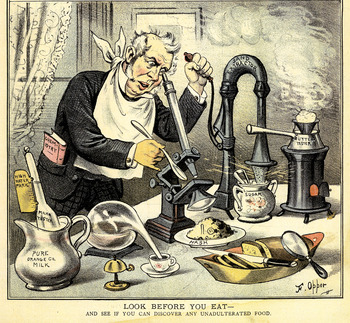
At many registers, science and objectivity have seemed to be natural allies of reform and probity, implacable enemies of corruption and fraud. “Progressive reformers targeted corruption in all its forms,” Jackson Lears writes, “hoping to cleanse individual and society alike.” Reformers’ emphasis on purification was “the common thread that tied Southern white supremacists with pure-food-and-drug advocates.”Footnote 18 The Gilded Age was infamously an “era of adulteration,” during which newspapers published breathless stories of swill milk, bogus butter, and toxic meat.Footnote 19 Historians have almost invariably written of adulteration as though it were detectable through scientific measures and solvable through rational control thanks to the “border patrol” of chemists and physicians (Figure 1). But like any other border, this one was invented and contested rather than found in nature. So historians cannot resolve disputes over the qualities of commodities by invoking scientific experts, because those very individuals’ expertise and social status were themselves in dispute.Footnote 20
“Look Before You Eat—And See If You Can Discover any Unadulterated Food.” Cover of Puck, Mar. 12, 1884. Courtesy Food and Drug Administration.

These disputes about adulteration further help us understand the Gilded Age's discourse of corruption within the broader history of capitalism. For centuries, the ambiguity and complexity of turning nature into commodities has been consistently redefined in ways that disempower workers and favor those with political and economic power. In the seventeenth century, this was true for gold trading in Africa and New Spain; in the eighteenth, for tobacco in Virginia and in London; the early nineteenth, in cotton fields of the Mississippi Valley and the cotton exchanges of Liverpool; in the grain futures in Chicago in the 1860s; in steel mills in Pittsburgh in the 1890s. The forms of knowledge that count as scientific and progressive are the result of contests in such sites, not their cause.Footnote 21 And in each case, the wielders of forms of expertise judged unscientific stood accused of the same crimes: adulteration and subjectivity, unreliability and untrustworthiness, corruption and fraud. As historians and sociologists of science have long demonstrated, judgments about the objectivity or reliability of scientific measurements are always judgments about the human beings making them.Footnote 22
William Grace understood this lesson. Upon his release, he insisted to the Secretary of the Treasury that the sugar tariff had to be enforced by “competent” appraisers, chemists, and samplers, and Arthur replaced by a “thoroughly honest collector” at the head of the Custom House.Footnote 23 Historians have argued that concerns over the rectitude of the sugar tariff ended when the Treasury began employing chemists in its custom houses. In doing so they have concurred with the Havemeyers, who, though they denied any misconduct of their own, nonetheless insisted that the Treasury could avert fraud only by adopting new instruments and techniques.Footnote 24
In the remainder of this essay, I want to pursue the questions about how to value sugar that were embodied in the dispute between Grace's hand and Sharpe's head. Doing so makes apparent the difficulty of distinguishing between science and art, objectivity and subjectivity, purity and adulteration, and corruption and integrity. As we will see, scientific practices were hardly inevitable techniques of accountability and good governance. They could also be put to work to obfuscate and confuse, and thereby to wrest and secure social and economic control.Footnote 25 The process by which certain forms of behavior became defined as corrupt and unscientific, and others as proper and progressive (and even Progressive), becomes more visible when we leave the level of corporations and their allies in the Senate and descend to the docks, custom houses, and laboratories where state authority met private power.
THE PURITY OF SUGAR AND THE RISE OF THE SUGAR TRUST
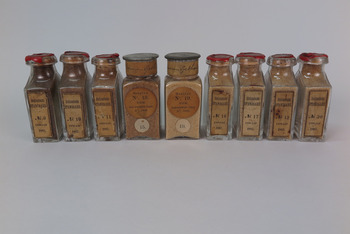
Grace was charged with enforcing tariffs that represented attempts to codify knowledge about sugar at the outset of the Civil War. In 1861, Congress passed new revenue laws that specified the use of an instrument called the “Dutch standard” for sugars (Figure 2). This was a series of jars, certified by the government of the Netherlands, that contained sugars of different colors, numbered from lowest (6 or 7) to highest (about 25) in order of lightness, and thus, supposedly, by sweetness and value. When a sample was brought to a customs appraiser, however, the law implicitly called on more of his knowledge about sugar than just its appearance: where it was from, how it had been produced (“advanced beyond the raw state … by clarifying or other process”), and what it was for (“not yet refined”).Footnote 26 Even the sugars that filled the Dutch scale's jars varied along multiple dimensions, such as moistness and the size of crystals. Opponents would later argue that the need to exercise judgment left the scale easy to undermine.
Jars of the Dutch scale, 1882 and 1892. Division of Medicine & Science, National Museum of American History, Smithsonian Institution. Courtesy Smithsonian Institution.

The original statute specified only two rates, one for sugar up through No. 12 “D.S.” and one rate for sugar above. In 1875, Congress added four further brackets, in an attempt to align the tariff more closely to the actual range of market prices for differently colored sugars.Footnote 27 At the same time, however, it raised rates by 20 percent, and shortly thereafter the Treasury began receiving reports that sugar was being inaccurately charged under tariff schedules. In early 1877, prominent figures in the sugar industry warned the new Treasury secretary, former Ohio senator John Sherman, that the government was losing millions of dollars—10 or even 15 percent of its total sugar revenue—to such frauds and errors.
In November 1877, customs officials in Baltimore seized a cargo of 712 bags of sugar from Demerara in British Guiana. The U.S. attorney sued for forfeiture, charging that the sugar had been “artificially colored” after its production specifically to evade American tariffs and that the importer was well aware of this fact.Footnote 28 A month later, the New York Custom House seized another Demerara cargo on the same grounds.Footnote 29 Outraged importers replied that the problem was governmental ignorance of modern means of making sugar.Footnote 30 By the 1870s, many Caribbean sugar factories had adopted novel machines and processes from the European sugar-beet industry, and such methods produced sugar whose properties posed problems for judgments based on color.Footnote 31 Sherman, therefore, dispatched a team of Treasury investigators to the Caribbean to trace the seized cargoes and interview the sugar boilers who had made them. These artisans, the agents found, were masters of manipulating temperature and pressure in order to coat otherwise-perfect crystals with a burned film of “unnatural dark color.” The crystals thus retained the hue of molasses without extraneous matter that would affect the taste or hinder further refinement. The sugar makers had clearly engineered their products to evade U.S. tariffs, yet these investigators could not point to anything “artificial” about the process.Footnote 32
Moreover, once the sugar arrived in American ports, its evaluation depended on samplers and appraisers. The samplers, Sherman and others complained, were the lowest-paid employees of the customs service, and presumably easy targets for bribery.Footnote 33 The more testimony Congress and the Treasury heard, the more sampling seemed an obscure art, as samples drawn from a single hogshead could “vary from four to five [Dutch] numbers in color.”Footnote 34 If a sampler was inclined to help a purchasing refinery, he might take from the darker portion and thus lower the duty; if, on the contrary, he was of a mind to favor a competitor or an importer, he could sample from the lighter part of the barrel. Witnesses attested to samplers’ unaccountable expertise and their questionable morality. “I sampled for three years myself,” one refiner testified, “and if I were in the business now I believe I could cheat the government out of a quarter of a million dollars … and I believe anybody else could do it.”Footnote 35
Meanwhile, merchants accused appraisers of profiting from their geographic isolation. In July 1877, for instance, one importer complained to Chester Arthur of “the greater facilities the appraisers have for committing fraud, if they should be so inclined, by being, so to say, isolated from easy contact with the collector and deputy collectors of the custom-house.”Footnote 36 The following December, Sherman endorsed these criticisms of the Dutch scale and its users. “Embarrassment has occurred during the past year in the collection of duties on sugar,” he wrote in his annual report. Insisting that both Demerara cargoes “were of a higher intrinsic grade” than their color represented, he called on Congress to abolish the color standard, “which bears no definite relation to the value of the sugar” and could be subverted by “foreign substances.”Footnote 37
By 1879, however, no legislation was in sight, and Sherman announced his new interpretation of existing tariff statutes. Henceforth the Treasury was to consider the Dutch scale to be “essentially a measure of saccharine strength and not of color as an abstract physical attribute of matter.” This interpretation justified his accompanying order that custom houses levy sugar duties using an instrument called the polariscope.Footnote 38
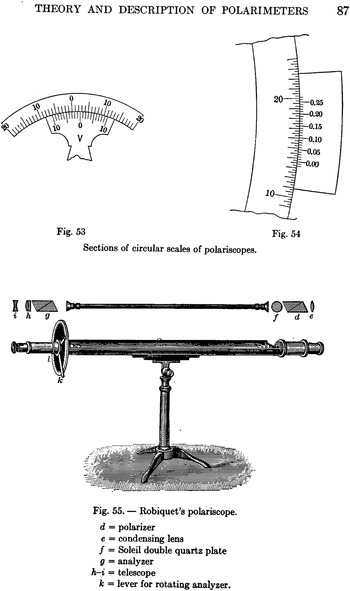
Developed in the first half of the century by the French physicist Jean-Baptiste Biôt, the polariscope measured the degree to which substances rotated the direction of polarization of light. Sucrose, the molecule at the heart of cane sugar, rotated polarization in proportion to its concentration. By the 1870s, polariscopes were widespread in refineries and in commercial laboratories on which New York's sugar brokers relied in their transactions.Footnote 39 The instrument's advocates claimed it was simple, reliable, and accurate. The polariscope's operation, the Smithsonian physicist Joseph Henry told Sherman, “can readily be taught to any intelligent person of ordinary education.” James Garfield, Sherman's chief congressional ally, argued that as a result the Treasury could depend on polariscope operators’ reliability. If Henry felt that one “without special skill, can be taught to use this instrument accurately,” Garfield said, “I have not quite the courage to say it is not so.”Footnote 40 When the Committee on Ways and Means invited two instrument dealers to show their wares, one member recalled being “polariscope struck. It seemed to us that the polariscope was a beautiful and splendid thing,” and they were eager to approve its use (Figure 3).Footnote 41
Mid-nineteenth-century polariscope, from Charles A. Browne, Handbook of Sugar Analysis (1912). Courtesy HathiTrust.

Not all were so sanguine. Smaller refiners, in particular, objected that the Havemeyers supported the polariscope precisely because it would make customs manipulation both easier to commit and harder to detect. The results of even expert polariscope users, for instance, routinely differed. The Columbia chemistry professor Charles Chandler noted that, although the whole range of raw and refined sugars varied by only a few percent of sucrose content, “the ordinary testing of sugars by the polariscope is not accurate within 1%. Differences of 2 or 3% or even more may occur when different samples are taken from the same lot of sugars and tested by different chemists.”Footnote 42 Others pointed out that not many people could hold the polariscope operators accountable, while judgments of color, texture, and grain were based on common sensory experiences.Footnote 43 “I think Havemeyer is trying to persuade the Government to use the Polariscope in connection with the duty & we are against him & don't think it wise as it will leave such an open door for fraud,” the refiner William Booth wrote Chandler.Footnote 44
Moreover, parties to private transactions understood how to manipulate the polariscope. Buyers and sellers each hired their own samplers and their own chemists, and negotiations began when these chemists each produced certificates stating their wildly different tests of the same cargo. One refiner's value might differ from another, while both disagreed with the seller; parties routinely called for resamples and retests, and disagreements often aborted the sale.Footnote 45 “Some will go on color, some on classification, and the seller will have his goods sampled and tested, and will make them test 95 [percent sucrose],” explained the refiner Lawson Fuller, “and then the buyer will have them sampled and tested and they will test perhaps 92, and then both parties knowing how much they are cheating each other, will come to a square understanding and strike a balance just [as] though they had not sampled or tested the goods at all.”Footnote 46
This symmetric negotiation, opponents feared, would not be replicated in the custom house. For while an importer might appeal a high valuation by a government chemist, there would be no one to challenge a value that was too low, and millions of dollars would flow to private interests. If polariscopists were in a refiner's pocket, no one would be able to tell. “Men are generally honest,” one small refiner testified, but “some men's sight through the polariscope would be very defective if a fifty or a hundred dollar bill got into one end of the instrument.”Footnote 47
Two large public meetings on the sugar tariff, in 1879 and 1880, ended in fisticuffs. Resolutions against the instrument topped the agenda in 1879, so a pro-polariscope squad of Havemeyer employees from Brooklyn attempted to pack the hall. When Fuller accused the Havemeyers of having “on the proceeds of fraud and adulteration, built up eight new refineries,” Henry Havemeyer shouted his eagerness to settle things outside.Footnote 48 After Sherman pressed ahead with the polariscope, the next year's meeting pilloried him for succumbing to the Havemeyers’ campaign cash.Footnote 49
Congress codified the instrument just as the sugar refining business became less profitable than ever. Several attempts at a cartel failed in the early 1880s, including in 1882 when the Havemeyers’ Williamsburg refinery burned to the ground. Its replacement, the world's largest and most efficient, could process twice as much sugar as any competitor, at only 0.44¢ per pound. By 1885, when the price difference between a pound of raw and refined had fallen to just over 0.7¢, the Havemeyers may have been the only ones consistently earning profits.Footnote 50
That same year, Boston refiners began to complain to the Treasury about the chemist at the New York Custom House. Identical samples of sugar, they alleged, were measured as much as 3 percent less pure by Manhattan's chemist than by Boston's. As average profit on a pound of refined sugar was barely 0.06¢—about the same as the duty added from one percentage point on the polariscope—a 3 percent difference was so enormous that sugar cargoes were being “imported” at New York and then reloaded onto ships bound for New England.Footnote 51 Their New York rivals, meanwhile, claimed that they were simply more efficient, and could import rawer sugar and process it more cheaply. The Boston importers, however, insisted that the Treasury fire their custom house's chemist, and wanted “a more liberal man substituted.”Footnote 52
The Treasury deputized a Boston newspaperman named T. Aubrey Byrne, who submitted a report in late 1887 dense with testimony from weighers, samplers, laboratory assistants, brokers, and refiners. He, like Grace, concluded that a “sugar ring” of customs chemists and Treasury officials had conspired to siphon millions of dollars in duties. The alleged ringleader was the Havemeyers’ broker, who moved with ease among the custom house, refinery docks, and private laboratories. Following Byrne's report, the Treasury fired the New York chemist, Edward Sherer, and reassigned Boston's chemist to his place.Footnote 53 Yet the following year, a second report by different agents concluded that Byrne had fabricated the ring's existence. The Boston refiners Byrne had quoted, and whose complaints had motivated his report in the first place, now denied even speaking to him, and claimed they had “complained of … rigid tests at Boston, not of … liberal tests at New York.” The bewildered investigators recommended Sherer be reinstated. Yet the discrepancy between New York and Boston remained, even after the agents uncovered dissenting views of how polariscopes were meant to be calibrated.Footnote 54
As Boston's Daily Globe wrote, “the controversy reverted to the main question, the honesty of the chemists at Boston and New York.”Footnote 55 After 250 blind tests of sugar samples exchanged among the Boston, Philadelphia, and New York custom houses, it became clear that the Manhattan laboratory consistently found sugars to contain over half a percent less sucrose, on average. The Agriculture Department's chief chemist, Harvey Wiley, concluded the same after his own tests. The immense work of the New York laboratory—over a hundred samples a day—would not, Wiley argued, mean that “the instruments used should not read practically the same numbers with the same solution, … the flasks should not be accurately calibrated, the tubes of proper length, and the operations of weighing, dissolving, and reading made with a fair degree of accuracy.” Not even Wiley's personal inspection of each city's laboratory could resolve the source of the variation.Footnote 56 “New York tests are on a plane below that of all the other ports,” wrote the agents, “and these planes never intersect.”Footnote 57
In his defense, Sherer offered a startling explanation of his low values: different people just used polariscopes differently. “He believes that the Boston chemists are high readers,” the agents reported. They were unimpressed by Sherer's practice of rounding down to favor his city's importers, but lacking concrete evidence against his “personal integrity,” all they could do was recommend that the New York tests “be ‘toned up’” by half a degree.Footnote 58 They deemed such an adjustment sufficient compensation for Sherer's lowballing, since they could not point to any way in which he was dishonest in his use of the instrument.Footnote 59
Ultimately, the agents were confident that no “sugar ring” existed, whatever Sherer's personal tendencies, because he “could not discriminate in favor of particular persons unless he knew whose sugars he was testing.” By 1890, the architecture of the New York customs laboratory had been designed to sequester the chemists, preventing them, according to a Times reporter given a tour, from knowing “anything whatever about the ownership of the sugar to be graded, its place of production, the steamer by which it was brought to port or the date of its arrival.” They possessed only a serial number assigned by a clerk.Footnote 60 The somewhat paradoxical implication was that the polariscope users were both the most important men in the sugar trade and also those most deserving of suspicion.
Yet such anonymity, by the late 1880s, offered the Treasury little protection. This was because, in 1887, the Havemeyers had cajoled most rivals into joining a “Sugar Trust” representing 84 percent of East Coast refining capacity. Their monopoly power boosted the margin between raw and refined sugar from 0.7¢ to 1.258¢ the next year.Footnote 61 There was now only one refiner of sugar, one buyer to benefit from a low polariscope reading, not just in New York but up and down the East Coast. Thus there existed no need to discriminate among sugar samples. The formation of the Trust might also have explained the sudden silence of Byrne's previously voluble Boston refiners. Whereas it had, in 1885, been in the interests of New Englanders to complain about Sherer's “liberality” in New York, it was now decidedly in their collective profit-sharing interest to complain of stinginess in Boston instead.
GILDED AGE CORRUPTION AND NINETEENTH-CENTURY CAPITALISM
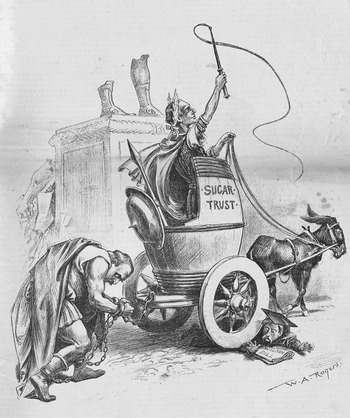
To contemporaries, there was a direct link between the rise of the sugar monopoly and refiners’ power over new scientific means of enforcing the tariff. In September 1894, Harper's Weekly placed sugar's materiality at the center of its analysis of the passage of the protectionist Wilson-Gorman tariff, a bill widely credited to the Trust's political power. On the magazine's cover, the triumphant Trust rides a chariot made of a hogshead (Figure 4).
“Gorman's Triumph—A Humiliating Spectacle.” Cover of Harper's Weekly, September 8, 1894. Courtesy Harvard College Library.

That same month, a dark joke in Brooklyn's Daily Eagle tied power over politics to power over measurement.
“Name some of the qualifications for a United States senator,” said a professor to a young man who was being examined for admission to college.
“He must be 30 years of age, be above sixteen, Dutch standard, and be able to stand the polariscope test,” replied the applicant.
He got marked 100.Footnote 62
At the best of times, sugar refining was a high-volume, low-margin business. By influencing customs chemists to raise certain refiners’ tariff burden, even by fractions of a cent per pound, the more powerful refiners might entirely wipe out the profits of their rivals. These, wrote the Daily Globe in 1888, were the “infamous practices which made it so easy to organize the Sugar Trust.”Footnote 63 When the Treasury turned from the Dutch scale to the polariscope, it did not substitute a modern and objective form of chemical measurement for one that was based on color and thus subjective and corruptible. Instead, it helped to delegitimize one variety of human expertise in favor of another.
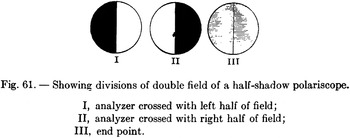
There is no better evidence of this than the way the polariscope actually worked. Light entered the instrument from the far end, then was split so that one beam passed through a sugar sample while the other did not. This created different colors or shades in each half of the eyepiece. By rotating a dial linked to a prism, the operator manipulated the colors; when both halves in the eyepiece appeared the same color, a scale on the dial indicated the angle, from which the sucrose content could be calculated (Figure 5). Thus, for all its elaborations of brass and glass, the polariscope's operation ultimately also consisted of the comparison of two colors. As one of the instrument's critics had written in 1879, “only the most accurate eye and skillful adjustment can exactly determine the perfect color blending which marks the record of true grade upon the scale.” This was precisely the same charge that its advocates had leveled at the users of the Dutch standard.Footnote 64
View through the eyepiece of a polariscope, from Charles A. Browne, Handbook of Sugar Analysis (1912). Courtesy HathiTrust.

Long before that, the same had been said of the bodily knowledge of plantation slaves. As early as the 1790s, Cuban planters had attempted to import European artisans to control “the skill of negro-boilers”; by the 1860s, factory chemists promised laboratory-like regimes of “chemical control.” Polariscopes would guarantee purity and quality, freeing owners from the tyranny of slaves’ and freemen's knowledge, which they denigrated and discredited even as they tried desperately to capture it.Footnote 65
The commodification of nature accelerated across the nineteenth century. Cotton and sugar were familiar goods; now, they were supplemented by new creations, such as frozen lamb, artificial indigo, and canned “extract of meat.” The boosters of these novelties called upon equally novel scientific disciplines in order to proclaim that such unprecedented objects were safe and reliable, and simultaneously to assume control over how and by whom they were made.Footnote 66 In subsequent decades this process would repeat. The historian of technology David Noble summarized the logic behind automation in the oil industry in the 1940s: “up to now the workers had somehow successfully run refineries without the aid of reason, but management was no longer willing to rely upon such routine miracles.”Footnote 67
The story of the valuation of sugar thus has two lessons for historians of the Gilded Age. First, the pervasive discourse of corruption was not limited to the nineteenth century or to the United States. The new scientific morality of the New York Custom House descended from and contributed to centuries of attempts to deskill work and workers’ knowledge. Domestic genealogies of corruption, descending from Reconstruction, the press, party warfare, or unchecked corporations, existed alongside these fundamental global transformations of economic life. Second, because the meaning of corruption, like the meaning of science itself, was the outcome and not the cause of these transformations, it cannot be used to explain it.
This is certainly not to deny the truth of the arguments made by modern scholars of corruption. At every level of government and business, private favors were unquestionably exchanged for public goods, with disastrous consequences.Footnote 68 But payments for legislative activity may be relatively transparent, which is why senators and financiers took pains to hide them. The closer one looks at the materiality of capitalism the harder it becomes to distinguish licit activity from illicit. On the docks and in the laboratories of the nineteenth century, where goods were actually valued and exchanged, scientific methods were just as interested as any other. Thus, beyond asking whether and to what degree American capitalism was built on corrupt activity, historians should look for the ways that capitalism seeks to control what counts as corruption itself.
“The present seems so nineteenth century,” writes Richard White.Footnote 69 This is not just true because the Supreme Court has released unprecedented cash into political campaigns while constricting the legal definition of “corruption” to its narrowest possible sense, nor because a few huge institutional investors have rebuilt the market power of the trusts.Footnote 70 It is also potentially true, and potentially dangerous, wherever technological or scientific reason is cast against rhetoric about untrustworthy human beings. So delivery companies like UPS deploy hundreds of telematic sensors on each truck, measuring drivers in real time in order to pit optimized efficiency against their employees’ supposed laxity, no matter the cost to their health.Footnote 71 So financial institutions, in the name of liquidity, continue to hide systemically dangerous behavior behind high-frequency trading and computerized models so rococo as to be inscrutable to the banks themselves, let alone regulators or the public. The meanings of corruption were fluid in the Gilded Age, and they still are.