Introduction
Climate change
The Antarctic Peninsula region is very sensitive to climate change. During the last 50 years, it has warmed by 2.5°C, much faster than mean global warming, and unmatched elsewhere in Antarctica (Vaughan et al. Reference Vaughan, Marshall, Connolley, King and Mulvaney2001). It is thus important to determine whether this strong late-20th century warming is a regional manifestation of anthropogenic greenhouse warming, or whether it is typical of past (natural) climate variability in the region. In this paper we use the sediment record of two marine vibrocores in previously unstudied areas to deduce the history of the northern Larsen C and Larsen B ice shelves on the east coast of the Antarctic Peninsula.
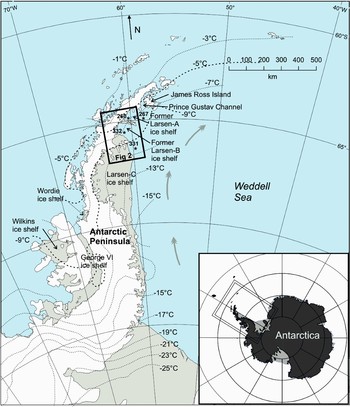
One response to the recent warming has been the retreat or collapse of many ice shelves, Prince Gustav, Larsen A and Larsen B to the east of the Peninsula, and Wordie and Wilkins to the west (Vaughan & Doake Reference Vaughan and Doake1996, Skvarca & de Angelis Reference Skvarca and De Angelis2003; Fig. 1). The ice shelves may have receded in response to a changing climate that allowed the substantial production of summer melt water which has weakened the ice shelves, and could have propagated pre-existing crevasses and initiated ice shelf fragmentation (MacAyeal et al. Reference MacAyeal, Scambos, Hulbe and Fahnestock2003).
The Antarctic Peninsula showing the location of ice shelves which have recently disintegrated or retreated rapidly, and the study area of Larsen B and northern Larsen C (Fig. 2). Grey arrows indicate clockwise circulation of the Weddell Gyre. Isotherms from Morris & Vaughan (Reference Morris and Vaughan2003).

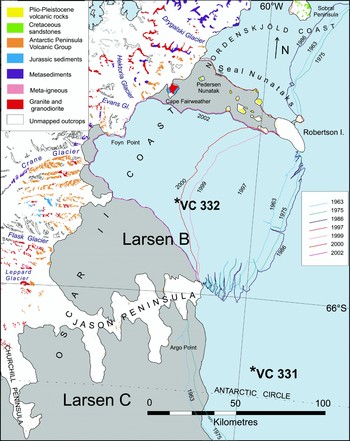
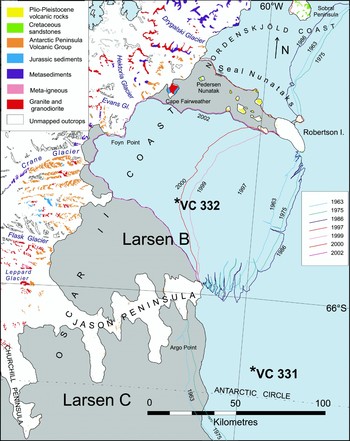
Historical observations show that some Antarctic Peninsula ice shelves have been retreating since 1843 (Cooper Reference Cooper1997). Figure 2 shows the historic retreat of the Larsen B ice shelf from 1963. However, recent final stage collapses have been more dramatic: the ice shelf in Larsen Inlet collapsed in 1989, Larsen A and the Prince Gustaf Channel (PGC) in 1995 (Skvarca et al. Reference Skvarca, Rack, Rott and Ibarzabal y Donangelo1999) and 3250 km2 (Shepherd et al. Reference Shepherd, Wingham, Payne and Skvarca2003) of Larsen B ice shelf collapsed in 2002, after the warmest summer on record (Skvarca & de Angelis Reference Skvarca and De Angelis2003). Only remnants of the Larsen A and B ice shelves remain today. This progressive retreat over the course of many decades, culminating in a final stage collapse during one summer season, is quite different from the behaviour that we expect from ice shelves, which is continuous advance punctuated by calving events on a timescale of years to decades (Vaughan & Doake Reference Vaughan and Doake1996). It is the unusual collapse that has been linked to climate change through the onset of summer melting.
Ice shelves and outcrop geology of Larsen B and northern Larsen C. Sources: ice shelves from Ferrigno et al. (in press a, in press b), and Cook et al. (Reference Cook, Fox, Vaughan and Ferrigno2005); geology from Fleet (Reference Fleet1968), Marsh (Reference Marsh1968), Fleming & Thomson (Reference Fleming and Thomson1979), Thomson & Harris (Reference Thomson and Harris1979).
There is much speculation as to whether the Larsen C ice shelf to the south may collapse within this century. Morris & Vaughan (Reference Morris and Vaughan2003) note that, of all the Antarctic Peninsula's surviving ice shelves, none south of the -9°C (2000 ad) isotherm has been reported as showing any progressive retreat. Only those lying between the -5°C and -9°C isotherms have shown significant retreat or total loss. According to such analysis, the Larsen C ice shelf, lying just below the -9°C isotherm, is likely to be the next ice shelf on the east coast of the Antarctic Peninsula to suffer if recent warming continues or is maintained for a long enough period. Scambos et al. (Reference Scambos, Hulbe and Fahnestock2003) have found that the northernmost portions of the Larsen C shelf (north-east of Churchill Peninsula and Alexander Point; Fig. 1), have the firn characteristics and melt season length these authors associate with impending break-up.
Satellite radar altimeter measurements show that between 1992 and 2001, the Larsen C ice shelf has lowered by up to 0.27 ± 0.11 m yr-1. The lowering can be best explained by increased summer melt water and loss of basal ice through melting. If this estimate of basal erosion is correct, the Larsen C ice shelf will approach the thickness of the Larsen B at the time of its collapse in some 100 yrs. This would occur more rapidly if the rate of basal melting is increased by a warming ocean (Shepherd et al. Reference Shepherd, Wingham, Payne and Skvarca2003).
Morphology of the continental shelf, and geology of the Oscar II coast
Prior to this investigation, the most southerly bathymetric surveys carried out were in the area of the former Larsen A ice shelf, where bathymetric data had been collected in 1995 (del Valle et al. Reference del Valle, Lusky and Roura1998) followed by BAS- and US-led cruises in 2000 and 2002, undertaking multibeam bathymetric surveying and coring. Evans et al. (Reference Evans, Pudsey, O'Cofaigh, Morris and Domack2005) used geological and geophysical data from the northern Larsen continental shelf to show that a number of rapidly flowing outlets drained the Antarctic Peninsula ice sheet through cross-shelf troughs, after the ice advanced across the continental shelf. Fast-flowing ice occurred in the troughs of Larsen A and Larsen Inlet, and ice streams drained through the PGC and the Robertson Trough. The lack of ship tracks means that similar detailed bathymetric data is not available farther south, and it is not known whether the pattern of E–W troughs first noted by Sloan et al. (Reference Sloan, Lawver and Anderson1995) continues south to Larsen C.
The Oscar II coast and its hinterland constitute the drainage basin of the glaciers feeding the Larsen B and C ice shelves, the most likely source of sediment in the cores (Fig. 2). In this region there is a gradual transmission from Jurassic sedimentary rocks (black shale, mudstones, sandstones and conglomerates) up into a volcanic sequence (Fleet Reference Fleet1968). At Argo Point on the south-east part of the Jason Peninsula, the land nearest to the site of the core from Larsen C, Plio-Pleistocene volcanic olivine-basalts crop out and the summit is capped by a small basalt-scoria cone which was probably still active until less than 1 m.y.a. (Saunders Reference Saunders1978). The Oscar II coast contains numerous plutonic intrusions, those nearest the site of the core from Larsen C comprising granite, microgranite, granodiorite and adamellite, though there are also some gabbros to the north of the Churchill Peninsula. Metamorphic rocks (banded gneisses, migmatites, amphibolites and metagabbros) only occur in the Leppard Glacier area, north of the Jason Peninsula. The next nearest location is c. 250 km south, where metamorphic metasedimentary / metavolcanic rocks crop out on Joerg Peninsula and Solberg Inlets.
Previous work
Prior to the collapse of the northern Antarctic Peninsula ice shelves, there was little observational data concerning sub-ice shelf sedimentation, and models of the dynamics and basal thermal regime of ice shelves were mainly theoretical (Anderson Reference Anderson1999).
However, a number of vibrocores from Larsen A, Larsen Inlet, the PGC and northern Larsen continental shelf, taken between 2000 and 2002 have now been investigated (Evans & Pudsey Reference Evans and Pudsey2002, Evans et al. Reference Evans, Pudsey, O'Cofaigh, Morris and Domack2005). Recovered sediments were grouped into three units on the basis of lithofacies associations, grain-size distribution, shear strength, porosity and water content. The lowest unit, Unit C of Evans et al. (Reference Evans, Pudsey, O'Cofaigh, Morris and Domack2005), was interpreted as subglacial till, with high shear strength, low water content, poorly sorted grains, deposited and compacted underneath the weight of grounded ice. The overlying soft diamicton was interpreted as a weak deformation till derived by the deformation of over-consolidated till and underlying sedimentary bedrock by grounded ice.
A transitional heterogeneous unit, Unit B of Evans et al. (Reference Evans, Pudsey, O'Cofaigh, Morris and Domack2005), overlies the diamicton, crudely stratified fine to coarse grained lithofacies, with low shear strength and up to 50% water content, interpreted as of glacimarine origin, with deposition in a sub-ice shelf setting proximal to the grounding line.
The upper part of most cores consisted of an olive grey/brown mud-dominated unit, Unit A of Evans et al. (Reference Evans, Pudsey, O'Cofaigh, Morris and Domack2005), bioturbated with low shear strength and relatively high water content. Small quantities of poorly sorted gravel sized clasts are present. This unit is interpreted as rain-out and suspension settling of fine grained lithic and biogenic material in a distal, sub-ice sheet and/or open marine setting. The coarse-grained debris is interpreted as ice rafted, which may include subglacial debris as well as supra-glacial and englacial debris, depending on the extent of basal melting or freezing near the grounding line (Zotikov et al. Reference Zotikov, Zagorodnov and Raikovsky1980, Drewry & Cooper Reference Drewry and Cooper1981, Powell Reference Powell1984, Pedley et al. Reference Pedley, Paren and Potter1988, Jenkins & Doake Reference Jenkins and Doake1991). In a number of cores Unit A contains an upper division of more silty clay with diatoms, and a lower barren clay which abruptly overlies sandier sediments of Unit B.
In general, the upper mud unit in cores from the north-eastern Antarctic Peninsula shelf varies in thickness and in diatom content, with the thickest units from the more distal cores on the continental shelf south of the PGC, and the more northerly cores being more diatom-rich. If this relationship holds true further south, then (depending upon how deep they penetrate the substrate) the Larsen B and C cores might be expected to consist of subglacial tills overlain by grounding-line sediments, with a thick, diatom-poor drape of siliceous mud from distal sub-shelf deposition, melt water plumes and/or open marine conditions.
Disappearance of ice shelves earlier in the Holocene
There is evidence that the most northern Antarctic Peninsula ice shelves may have fluctuated in extent or totally disappeared in the past. The ice shelf south of the PGC appears to have formed before 11–12 000 carbon 14 yrs bp (Evans et al. Reference Evans, Pudsey, O'Cofaigh, Morris and Domack2005). Geomagnetic palaeointensity dating of sediments beneath the former Larsen A ice shelf indicate that the ice shelf existed by 10.7 ± 0.5 ka (Brachfeld et al. Reference Brachfeld, Domack, Kissel, Laj, Leventer, Ishman, Gilbert, Camerlenghi and Eglinton2003).
Four cores from PGC contain an interval of ice rafted debris from the opposite side of the channel (Pudsey & Evans Reference Pudsey and Evans2001). This could be explained by either major changes in the position of the ice convergence, or the disappearance of the ice shelf so that icebergs carrying debris from different sources could drift freely over the sites. Only the later explanation is consistent with the fact that mixed assemblages of ice rafted debris, including rock types known only from farther south, are present in the same samples. This interpretation coincides with the inferred large-scale deglaciation of northern James Ross Island at 6–7 ka bp (Ingolfsson et al. Reference Ingolfsson, Hjört, Björck and Lewis Smith1992), and with the suggested disappearance of the George VI Ice Shelf at 6500 yrs bp (or 5800 yrs bp if a 1300 yr marine carbon reservoir correction is used (Clapperton & Sugden Reference Clapperton and Sugden1982)).
However further south, recent surveys using records of diatoms, detrital material and geochemical parameters from six cores in the vicinity of the Larsen B ice shelf have demonstrated that the partial collapse of this shelf in March 2002 is unprecedented during the Holocene (Domack et al. Reference Domack, Duran, Leventer, Ishman, Doane, McCallum, Amblas, Ring, Gilbert and Prentice2005).
New sedimentary records
Location of cores
The sites of the Larsen C and B vibro cores, taken in 2002 during cruise JR71 of RRS James Clark Ross are located on Fig. 2. VC331, off Larsen C is currently the most southerly core on the eastern continental shelf of the Antarctic Peninsula and was taken in 525 m of water, in a shallow trough with a c. 5 m sedimentary drape. The site is some 15 km beyond the current margin of the ice shelf and some 50 km from the nearest land, the Jason Peninsula. This site is beyond the greatest known extent of the ice shelf, measured in 1902 (Cooper Reference Cooper1997). Cruise JR71 coincided with the break-up of Larsen B in early March 2002 and VC332 was taken at a site which, until days earlier, had been covered by the ice shelf and only a few hundred metres from the disintegrated and still moving ice mass to the north. The site was at 573 m water depth and appears from two swath bathymetry lines to be in an E–W trough, which may connect with Robertson Trough farther east (Evans et al. Reference Evans, Pudsey, O'Cofaigh, Morris and Domack2005 their fig. 1).
Methods
The cores were characterized using magnetic susceptibility, shear strength, carbon content, bulk textural analysis and silt/clay particle sizing. They were also sampled for diatoms and foraminifera.
To carry out the bulk textural analysis, samples were sieved through increasingly smaller screens from 2 mm to 63 microns, and the percentage composition of each fraction by weight was determined. The petrology of the gravel and coarse sand fractions was determined by comparison with the archive of Antarctic Peninsula hand specimen rocks held in the British Antarctic Survey. The silt/clay fraction volumetric percentages were measured using a Malvern Mastersizer 2000. Graphic logs and downcore data are set out in Fig. 3 and the grain-size data are given in Figs 4 & 5.
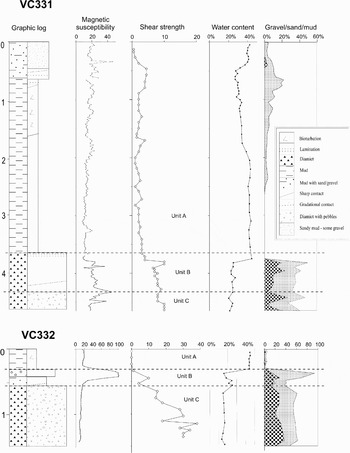
Core logs, physical properties and gravel-sand-mud content of cores VC331 and VC332.

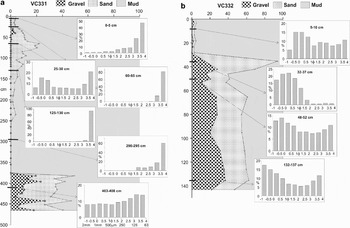
Grain size distribution of the sand fraction; histograms are representative of over 70 samples measured. a. core VC331; the sand in Unit A is mainly very fine and well or very well sorted except for the gravel-bearing interval 20–35 cm. The diamict is very poorly sorted but has a weak mode in the very fine sand range (3–4 phi). b. core VC332; all units have a mode in the coarse to very coarse sand range (-1 to 1 phi) which has not been reported anywhere else in the Larsen Area (Evans et al. Reference Evans, Pudsey, O'Cofaigh, Morris and Domack2005).

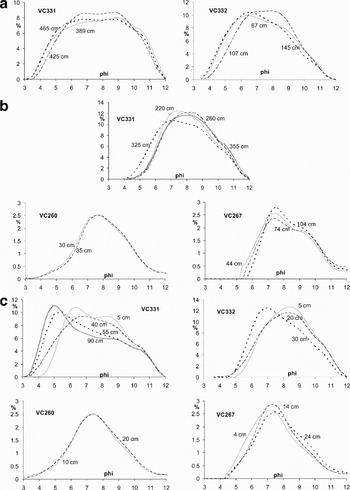
Grain size distribution of the silt and clay fraction of cores VC331 and VC332, compared with cores VC260 from Larsen A and VC267 from the adjacent continental shelf. The different y-axis scales result from different class intervals used to report the data (0.1 phi or 0.5 phi). All samples had the fraction coarser than 4 phi (63 microns) removed before measurement. a. diamicts (Unit C), b. clays (lower part of Unit A), c. silty clays (upper part of Unit A). In VC332 Unit A was not subdivided.

Sediment description of VC331, Larsen C
The three units A, B and C recognized in cores from farther north can be identified in this core. The lowest 45 cm consists of dark grey muddy diamict (Unit C) and from 375 to 420 cm faintly stratified gravelly muddy sand shows colour alternations from dark greyish brown to dark grey (Unit B). In both units magnetic susceptibility is variable (20–40 SI), shear strength is 7–10 kPa and water content is relatively low (average 24%). Carbonate content of some 4% is in the form of very fine grains considered to be of inorganic origin (? alteration of volcanic rocks), as no calcareous microfossils are seen even in poor preservation. Pebble-sized angular to rounded clasts, about 20% with striations, consist of rhyolite, dark grey siltstone and granite, with rare volcanic scoria. The sand fraction is unsorted (Fig. 4, lowest histogram).
Unit A comprises a lower sub-unit of completely uniform dark olive grey clay from 375 to 155 cm with only 0.1 to 3% of very fine, well-sorted sand (Fig. 4a, histogram 290–295 cm), and a more varied upper subunit exhibiting lamination and bioturbation and with sand content locally up to 20% (Fig. 3). Magnetic susceptibility is quite uniform showing an upward increase from 10 to 20 SI, shear strength is low and water content 30–40%. A minor concentration of granules from 20–40 cm is reflected as higher magnetic susceptibility. Carbonate content of 0.6–1.7% is again thought to be of inorganic origin, except for the sample at 2 cm (2.7% carbonate) which contains identifiable planktic and benthic foraminifera: the former consists of Neoglooquadrina pachyderma (sinistral) and (dextral) in the ratio c. 9:1, and the latter Astrononion echolsi, Cibicides refulgens, Earlandammina drakensis, Ehrenbergina spp., Globocassidulina subglobosa and Trifarina angulosa. The gravel and sand detritus is mainly rhyolite of great variability of colour and size, with some granites, siltstones and black shale. There is also some very fresh vesicular lava and volcanic scoria. No metamorphic rocks were found. The sand fraction is mainly well-sorted and very fine, except in the granule-rich layer where it is unsorted (histogram at 25–30 cm, Fig. 4a).
Muddy diamict assigned to Unit C forms the lowest metre of VC332, with the gravel fraction comprising 99% siltstone, with only the occasional clast of rhyolite. The siltstone differs from that of VC331, having black specks of plant-derived material. Also in contrast to the Larsen C core, VC332 contains metamorphic clasts. Water content is low, and shear strength 15–35 kPa, significantly higher than the Larsen C core.
The diamict is overlain by a thin gravelly mud and then by 10 cm of well-sorted very coarse lithic sand of high magnetic susceptibility (100 SI); the sand grains comprise c. 60% very varied rhyolitic clasts, and c. 40% siltstone (Fig. 4b, histogram 32–37 cm). The upper 31 cm of the core (Unit A) consists of faintly mottled mud with high water content, low shear strength and sand/gravel content of less than 5%.
Diatoms are present in Unit A of both cores VC331 and 332, but sparse and poorly preserved. Till pellets were not observed in Unit B.
Foraminifera were present in the top c. 20 cm of VC332, mainly Neogloboquadrina pachyderma (sinistral) and (dextral) in the ratio 9:1, but in insufficient quantity for dating purposes. Benthic foraminifera were also present, but in insufficient numbers and species for valid assemblage inferences.
Discussion
We discuss the depositional units from base to top of the cores and compare them with cores from Larsen A and Prince Gustav Channel to the north (Fig. 1).
Diamict Unit C
The diamict unit of the Larsen C core VC331 appears to have been deposited under a grounded ice sheet as a basal, mud rich till. However, its shear strength is low compared to the shear strength (up to 90 kPa) of the diamict in cores farther north (Pudsey et al. Reference Pudsey, Evans, Domack, Morris and del Valle2001, Evans et al. Reference Evans, Pudsey, O'Cofaigh, Morris and Domack2005), and thus we interpret it as deformation till. The clasts within the diamict of VC331 comprise igneous rocks (rhyolites and some granites), and siltstones, all of which are found in the hinterland of the Oscar II coast. At the base, volcanic scoria was found. The presence of local rock types in the gravel fraction implies entirely local sediment sources.
The diamict of the Larsen B core VC332 is consistent with deposition under a grounded ice sheet, though, in contrast to the diamict in the Larsen C core, the higher shear strength (averaging between 15–35 kPa) would imply that VC332 diamict comprises lodgement till. The decrease in shear strength up the unit would be consistent with a reduction in the confining pressure of the ice as the ice sheet retreated from the site. It contains abundant pebbles of siltstone, with the very occasional rhyolite.
The fine fractions of the diamicts in VC331 and 332 are unsorted (Fig. 4a & b). They contrast with diamicts from Larsen A and the continental shelf south of James Ross Island, interpreted as subglacial by Evans et al. (Reference Evans, Pudsey, O'Cofaigh, Morris and Domack2005), which commonly show polymodal distributions with peaks in the very fine sand range (3–4 phi) and near the silt-clay boundary (8 phi; Evans et al. Reference Evans, Pudsey, O'Cofaigh, Morris and Domack2005, their fig. 14). The very fine sand may be derived directly from the poorly-cemented Cretaceous sediments on James Ross Island and elsewhere around Larsen A (Fleming & Thomson Reference Fleming and Thomson1979); these sediments are largely absent from the glacial catchments of Larsen B and C.
Both cores VC331 and VC332 are located in > 500 m deep troughs running approximately west to east across the continental shelf (based on only two ship tracks near each site). In the Larsen A area, deep glacial basins and W–E orientated troughs with glacial landforms have been recognized (Evans et al. Reference Evans, Pudsey, O'Cofaigh, Morris and Domack2005). It is therefore reasonable to suppose that, during the last glacial period, ice streams could also have created the troughs in the Larsen B and C areas.
Transitional heterogeneous Unit B
Unit B in VC331 shows faint but distinct lamination around 380–385 cm depth. Such lamination is difficult to envisage in a sub-glacial diamict, and we suggest this was deposited near to the ice shelf grounding line after the ice shelf floated off the substrate. Deposition might have occurred through sub-ice shelf rain out, bottom current activity and/or sediment gravity flows (Evans & Pudsey Reference Evans and Pudsey2002). The poor sorting in the sand fraction in this unit suggest that gravity flow is the most likely of these possibilities.
The well-sorted coarse to very coarse sand in the transitional Unit B of core VC332 is completely different and is very unusual for sub-ice shelf deposition (Evans et al. Reference Evans, Pudsey, O'Cofaigh, Morris and Domack2005). No well-sorted but poorly lithified coarse sandstones are known to outcrop on the Oscar II coast, so it is probably not derived from a local sedimentary rock. An origin by mass flow was considered, but the sandy mass-flow deposits known from Larsen Inlet (Fig. 2) are much more poorly sorted with considerable amounts of fine sand (Evans & Pudsey Reference Evans and Pudsey2002, Evans et al. Reference Evans, Pudsey, O'Cofaigh, Morris and Domack2005). We therefore infer the process of winnowing by extremely strong currents. Meltwater (both supraglacial and subglacial) is often invoked as a sorting agent in more temperate glacial settings (Drewery & Cooper Reference Drewry and Cooper1981, Elverhoi et al. Reference Elverhøi, Lonne and Seland1983, Powell & Molnia Reference Powell and Molnia1989, O'Cofaigh et al. Reference O'Cofaigh, Dowdeswell and Grobe2001, Evans et al. Reference Evans, Pudsey, O'Cofaigh, Morris and Domack2005), but most authors have agreed that marine currents are likely to have been more significant in the polar conditions prevailing around the Antarctic Peninsula in the late Quaternary. Marine currents can be focused by topography and can be locally very strong in ice shelf cavities, particularly during times of glacial retreat and rapid sea level change.
Mud Unit A
The lower part of the mud unit of core VC331 is composed entirely of uniform dark olive grey mud. It lacks mottling, lamination, or gravel and sand detritus, consistent with deposition from pelagic “rain-out” from under an ice shelf, distal from the ice grounding line. The upward fining of the sand fraction implies that the site of the Larsen C core was becoming increasingly distal from the ice grounding line and from sediment carried in suspension by meltwater plumes.
The lack of iceberg rafted debris implies no icebergs, and therefore the lack of seasonally open water consistent with the presence of ice shelf, and the negligible percentage of diatom fragments, low carbonate content (1–2%), lack of foraminifera, and lack of mottling (implying no bioturbation) are also consistent with a sub-ice shelf environment, far from seasonally open water allowing insufficient nutrients to penetrate to sustain organisms.
Mottling increases from 160 cm up the unit and some silty laminations occur from c. 60 cm, implying that as the ice shelf front retreated towards the site of VC331, more ocean currents were able to encroach the site bringing nutrients allowing bioturbation to commence and increase as the ice margin came closer. Such a hypothesis is supported by work on the Amery Ice Shelf East Antarctica (Hemer & Harris Reference Hemer and Harris2003) where it was shown that landward flow of oceanic water could penetrate beneath floating ice shelves for a distance of at least 80 km.
From 45 cm to the core top, poorly sorted and angular gravel clasts are present, and the sand and silt fractions are also poorly sorted, implying the presence of iceberg-rafted debris and therefore seasonally open water. An alternative explanation, that the sediment was delivered by gravity flows down the sides of the trough in which VC331 is located, is thought unlikely, as the sides of the trough slope at less than 1 degree. Calcareous foraminifera are present in the top 15 cm of the core, another pointer towards seasonally open water.
If the former explanation is correct, around the time 45–50 cm of the core was being deposited, the ice margin retreated from the site of VC331 (today it is some 15 km away). The presence of volcanic scoria is further evidence for this. As no on-land outcrops are known, the scoria could have been delivered directly by wind, or rafted by sea ice, but it is hard to see how it could be deposited in water from under an ice shelf. However, there is no evidence that seasonally open water occurred at any time from the deposition of the diamict until 45–50 cm. There is no gravel in the core between this level and the diamict, and the sand fraction is extremely well sorted, with the fraction < 125 µm comprising over 95%. This lack of iceberg-rafted debris implies that the ice margin has not been landward of the site of VC331 earlier in the Holocene.
The mud unit in the Larsen B core has no iceberg rafted debris, implying that the site was covered by an ice shelf, and that the unit was water lain from suspension under the ice shelf, distally from the source of terrigenous material.
The site of VC332 is some 35 km landward of the pre-2002 ice shelf margin. If the above interpretation is correct then from the time that the ice shelf separated from the substrate until March 2002, the site of VC332 has always been covered by an ice shelf, and there is no evidence that the ice shelf retreated past the site of VC332 earlier in the Holocene. This is in contrast to VC331, which may have become seasonally sea ice free since the deposition of the section c. 45–50 cm down the core.
The stability of ice shelves depends on many factors, the volume of glacier input and rate of flow, the amplitude of tides, morphology of the embayment, the presence of islands and sea bed shoals to “pin” the shelf, etc (Anderson Reference Anderson1999). However, whether an ice shelf survives or retreats is ultimately a function of temperature. Retreat may be triggered or perhaps more conditioned by increased basal erosion by a warming sea (Shepherd et al. Reference Shepherd, Wingham, Payne and Skvarca2003) or atmospheric warming causing surface water melt and propagating crevasses (Morris & Vaughan Reference Morris and Vaughan2003, MacAyeal et al. Reference MacAyeal, Scambos, Hulbe and Fahnestock2003). From the above evidence, comprising data from only two sites, the Larsen B site has experienced stronger currents implying a higher degree of basal melting, possibly making it more susceptible to collapse through basal erosion from a warming ocean.
Grain size analysis shows the fine fractions of Unit A in both cores VC331 and VC332 are more poorly sorted than cores farther north. Figure 5b compares the lower part of Unit A in core VC331 with the stratigraphically equivalent sections of VC260 (Larsen A; Pudsey et al. Reference Pudsey2002) and VC267 (continental shelf east of Larsen A; Evans et al. Reference Evans, Pudsey, O'Cofaigh, Morris and Domack2005 their fig. 12e). VC331 contains more coarse silt (4–6 phi) than the other cores. Figure 5c compares the upper, silty clay sections of the same cores and includes Unit A of VC332. The upper 65 cm of VC331 is distinctly bimodal with medium-coarse silt modes, implying more significant influence of bottom currents during the late Holocene in northern Larsen C than elsewhere in the area.
Petrographic evidence from gravel fractions
In contrast to VC331, where the diamict gravel is mainly rhyolitic, the gravel in the diamict in VC332 consists almost entirely of siltstone/fine sandstone, with fossil plant material, similar in appearance to the sandstones derived from the Cretaceous of James Ross Island and the Sobral Peninsula (Pudsey & Evans Reference Pudsey and Evans2001; Fig. 2). Thus the provenance of the sediment in the two cores is different, probably reflecting the geology up-ice flow adjacent to each core, with VC332 having some features in common with James Ross Island farther north.
Certain rock type absences are significant. No black shale was found in VC332, although this rock type crops out to the north of the Jason Peninsula. This may again be symptomatic of the very local derivation of the lodgement till. No metamorphic rocks were identified in VC331, though such rocks occur both to the north (Leppard Glacier) and farther south. Given the clockwise circulation of the Weddell Gyre, icebergs are generally known to drift northward, dropping rafted debris, including metamorphic clasts, from the south. The fact that no metamorphic clasts were found in VC331, despite the site experiencing seasonally open water gives no evidence for such south–north iceberg drift. This could imply that icebergs are locally derived from the calving of the Larsen C ice shelf; alternatively perhaps all it implies is that the drift from the south was blocked by an ice shelf.
Diatom and foram inferred assemblages
There are very few diatom remains throughout either core, and those present are highly fragmented. This is consistent with the palaeo-environment inferred for the cores. VC332 appears to have remained covered by an ice shelf throughout the Holocene until 2002, and, though the ice shelf has retreated from the site of VC331, it is today covered for most of the year by sea ice. Both environments are hostile to photo-synthesising organisms.
Foraminifera are present only in the top c. 25 cm of each core, in each case mainly the planktic species Neogloboquadrina pachyderma sinistral and dextral, in the ratio 9:1, consistent with the polar locations of the cores. The low abundance of foraminifera may be explained from the trophic nature of the sites. The Weddell Gyre carries water from the Circumpolar Current, down the east side of the Weddell Sea supporting relatively large volumes of biota (Mackensen et al. Reference Mackensen, Grobe, Kuhn and Futterer1990) across the Ronne and Filchner ice shelves (where it is mixed with shelf water) and north up the Antarctic Peninsula. Thus the water reaching the sites of VC331 and VC332 is both low in nutrient, and under-saturated in carbonate, resulting in a hostile environment for foraminifera. The initial low abundance and bioturbation which destroys many agglutinated tests within a few centimetres of the surface (Murray & Pudsey Reference Murray and Pudsey2005) may explain why no foraminifera are found below c. 25 cm in the cores.
Geochronology
Due to the lack of carbon 14-datable material in both Larsen C and B cores, neither the age, nor the sedimentation rates are known, and hence there is no direct way to date the units. However, the transition from grounded ice sheet to ice shelf conditions may have been completed south of the PGC before 11–12 000 carbon 14 yrs bp (Evans et al. Reference Evans, Pudsey, O'Cofaigh, Morris and Domack2005). Brachfeld et al. (Reference Brachfeld, Domack, Kissel, Laj, Leventer, Ishman, Gilbert, Camerlenghi and Eglinton2003) date the same transition in the Greenpeace Trough to 10.7 ± 0.5 ka. Both of these sites are well north of VC331 and VC332, and ice sheet retreat may have commenced earlier there than farther south. Thus the above dates might serve as indirect estimates of the earliest date of the transition from glacial to water lain diamict, which may be represented by c. 385 cm in VC331 and c. 54 cm in VC332.
Prior disappearance of ice shelves
The presence and provenance of iceberg rafted debris has been used to infer that a floating ice shelf in the PGC might have disappeared at the mid Holocene climatic maximum (5–2 ka) (Pudsey & Evans Reference Pudsey and Evans2001) and subsequently reformed. The George VI Ice Shelf is inferred to have disappeared at 6500 yrs bp (or 5800 yrs bp if a 1300 yr reservoir correction is used (Clapperton & Sugden Reference Clapperton and Sugden1982)), also later reforming. In contrast, the Larsen C and B shelves appear to have persisted, at least as far as the sites of VC331 and VC332, until the deposition of layer 50 cm (for VC331) and throughout the Holocene (VC332).
Conclusions
The sedimentation of the continental shelf near the Larsen C ice shelf as revealed in core VC331, comprises an underlying diamict unit, c. 1 m thick, probably deposited sub glacially during the last glaciation as deformation till. The material in the diamict appears locally derived from the continental shelf, but matches the rock types along the adjacent Oscar II coast. The upper 3.5 m of VC331 is mud which has characteristics of having been water lain under a floating ice shelf. Iceberg-rafted debris is only present in the top c. 50 cm of the core, implying that only since the time of deposition of this layer, (later than 5000–2000 yrs bp - by analogy with Larsen A cores), has the site has been seasonally ice free. Since then the ice shelf has retreated and is now c. 15 km landward of the site of VC331. Satellite data suggest it continues to thin (Shepherd et al. Reference Shepherd, Wingham, Payne and Skvarca2003).
The sedimentation on the continental shelf under the former Larsen B ice shelf, revealed by core VC332, also consists of an underlying diamict, this time probably lodgement till. Material in the diamict appears also to be locally derived, but in contrast to VC331, it has characteristics similar to rocks found farther north in the Larsen A and James Ross Island areas. The overlying mud unit also appears to be water lain from under an ice shelf, but is thinner and more poorly sorted, and may have experienced stronger bottom currents. There are other layers within the mud, including c. 10 cm of unconsolidated coarse sand/gravel, which may have resulted from winnowing of finer fractions by strong flows. Thus this area appears to have experienced strong currents beneath the ice shelf, possibly contributing to strong basal erosion.
Unlike the Larsen C core, no iceberg rafted debris was found in the Larsen B core. This implies that the site of VC332 has been continually covered by ice shelf from the last deglaciation until the collapse in 2002. This is the same conclusion as that drawn by Domack et al. (Reference Domack, Duran, Leventer, Ishman, Doane, McCallum, Amblas, Ring, Gilbert and Prentice2005).
Comparing the two cores, Larsen B appears to have experienced stronger basal erosion, which may be one reason it collapsed recently. Larsen C has started to retreat in the late Holocene, and if the current trend of rising atmospheric and ocean temperatures persists, it will continue to thin and basal erosion may accelerate, leading to further retreat and possible collapse.
The Larsen A and PGC ice shelves fluctuated in size earlier in the Holocene, becoming seasonally ice free perhaps around the time of the Holocene maximum. In contrast, no such reduction has been inferred for the Larsen B shelf prior to 2002, and the Larsen C shelf does not appear to have receded beyond the site of VC331 prior to the deposition of the layer at 50 cm.
Deposition on the 400 km long continental shelf off the Larsen C ice shelf has been inferred from the analysis of a single core at its northern tip. Insufficient foraminifera were present in the core for AMS 14C dating, and no metamorphic clasts were found. In order to obtain a more representative picture of this area of continental shelf, clearly it is desirable to study additional cores, as far south as possible (sea ice permitting), including large volume box cores to allow the collection of sufficient foraminifera to date at least the core tops, and to confirm or otherwise the presence of metamorphic clasts, with implications for the motion of the Weddell Gyre.
Acknowledgments
We thank the officers and crew of RRS James Clark Ross for their skilful ice navigation, and the British Geological Survey team for coring in Antarctic conditions. We thank our colleagues in Cambridge University and the British Antarctic Survey for technical assistance and discussions, particularly David Vaughan who provided valuable comments on an earlier draft of this paper. We thank the Director of the British Antarctic Survey for permission to cite both the unpublished cruise report of the James Clark Ross cruise JR 71 and the Saunders 1977–78 geological field report. Finally we thank John Murray of SOC, Gerhard Schmiedl of the University of Leipzig and Andreas Mackensen and Astrid Eberwein of the Alfred-Wegener Institut for assistance with foraminifera identification. Ellen Cowan and Christian Hjört provided helpful reviews of the paper.