Professional interpreting involves a set of very complex and cognitively difficult language processing tasks where many processes have to be performed simultaneously, many of them involving concurrent activation of two linguistic codes. For example, in simultaneous interpreting, the interpreter receives a speech fragment in a source language (SL) at the same time that she/he is simultaneously reformulating and producing another fragment into the target language (TL). From a psycholinguistic perspective, the interpreter has to elaborate an adequate mental representation of the speech from linguistic processes including lexical/semantic activation, syntactic processing, and propositional analyses. This mental representation will be used to plan and produce an equivalent reformulation in the TL (Gerver, Reference Gerver and Briskin1976; Gile, Reference Gile, Dollerup and Lindegaard1994; Hromosová, Reference Hromosová1972; Mackintosh, Reference Mackintosh1985; Padilla, Bajo, Cañas, & Padilla, Reference Padilla1995). Theories of interpreting (Gerver, Reference Gerver and Briskin1976; Lederer, Reference Lederer1994/2003; Seleskovitch & Lederer, Reference Seleskovitch and Lederer1984) identify three interrelated phases that are not necessarily serial during the interpreting process: comprehension of the incoming discourse, deverbalization, or reformulation (depending on the theoretical approach, see Macizo & Bajo, Reference Macizo and Bajo2006), and production. Because these processes occur concurrently during the interpreting task, the interpreter has to learn to allocate her/his cognitive resources efficiently to achieve accurate interpreting (Gile, Reference Gile1995/2009).
Efficient resources distribution is especially significant for comprehension during translation (Gile, Reference Gile1995/2009). Although the unit for comprehension in translation is not exactly known, meaning has to be extracted to correctly produce the message in the TL. Hence, the quality of reformulation and production is highly dependent on comprehension. Padilla (Reference Padilla1995) suggests that many of the cognitive resources required by interpreting are devoted to the listening and comprehension tasks (see Gile, Reference Gile, Danks, Shreve, Fountain and McBeath1997, for a systematic analysis of cognitive efforts in interpreting processes). In order to translate, interpreters have to understand the logical and functional structures of the sentences composing the text or discourse (Gile, Reference Gile2005/2009), but because comprehension in interpreting is not a goal in itself, it is also subject to pragmatic constrains, that is, in translation and interpreting, comprehension processes are linked to the goal of producing a discourse or text in another language that conveys the meaning of the original message (Dancette, Reference Dancette, Danks, Shreve, Fountain and McBeath1997) and not so much to deep understanding by part of the interpreter of this meaning. To achieve this goal, translators and interpreters may develop strategies that draw in the use of extralinguistic knowledge and deeper linguistic analyses (Gile, 2004/2009). As a consequence, despite the temporal pressure and the different linguistic codes activated, the interpreters are able to manage to understand and communicate the meaning of the discourse successfully. Have professional interpreters developed specific strategies for comprehending the SL in interpreting tasks? Would these strategies generalize to within language reading comprehension? The aim of the study reported here was to explore whether interpreters differ from bilinguals and monolingual readers in their reading comprehension skills. Although many interpreting tasks involve auditory input and very high temporal pressure, we wanted to explore if their comprehension strategies generalize to visual input and within language reading.
Research on the comprehension processes involved in interpreting has explored the effect of segmentation strategies (Jones, Reference Jones1998; Meuleman & Van Besien, Reference Meuleman and Van Besien2009), recoding from one linguistic code to another (Macizo & Bajo, Reference Macizo and Bajo2004, Reference Macizo and Bajo2006; Ruiz, Paredes, Macizo, & Bajo, Reference Ruiz, Paredes, Macizo and Bajo2008), as well as the effects of speech rate on interpreting (Chernov, Reference Chernov1969; Galli, Reference Galli, Gran and Taylor1990; Gerver, Reference Gerver and Foulke1969, Reference Gerver1974; Shlesinger, Reference Shlesinger2003). In addition, a few studies have directly compared expert interpreters, nonexperienced bilinguals, and monolingual control speakers on several aspects of discourse processing that may underlie different strategies during comprehension (Bajo, Padilla, & Padilla, Reference Bajo, Padilla, Padilla, Chesterman, Salvador and Gambier2000; Dillinger, Reference Dillinger, Lambert and Moser-Mercer1994; Lee, Reference Lee1999; Tommola & Helevä, Reference Tommola, Helevä, Bowker, Cronin, Kenny and Pearson1998), but these few studies have reached contrasting conclusions.
Evidence in support of more efficient comprehension strategies in the interpreters was provided by Bajo and colleagues (Reference Bajo, Padilla, Padilla, Chesterman, Salvador and Gambier2000). Professional interpreters, bilingual speakers, interpreting students, and control participants were asked to perform text comprehension, lexical decision, and categorization tasks. The interpreters were faster in all of these tasks, especially when more difficult relations between the stimuli were involved. Thus, they were faster in a word by word reading task and they rejected nonwords and categorized nontypical exemplars more readily than bilinguals and controls. In addition, Macizo and Bajo (Reference Macizo and Bajo2004, Reference Macizo and Bajo2006; see also Ruiz et al., Reference Ruiz, Paredes, Macizo and Bajo2008) have shown TL activation during reading for translation. This activation imposes large cognitive demands that may have consequences in the way comprehension is carried out by the interpreters.
In contrast, Dillinger (Reference Dillinger, Lambert and Moser-Mercer1994) provided evidence suggesting that experienced interpreters do not perform comprehension processes in ways that qualitatively differ from the ways in which other individuals perform them. In his study, professional and inexperienced interpreters were required to interpret narrative and expository texts from English into French and, afterward, to recall each text while oral protocols were recorded. The protocols were transcribed and later categorized as a function of the number of SL propositional information included in the interpreter's TL productions. In addition, to study the effect of text properties, these propositions were sorted based on their importance for the discourse organization of SL text. The results showed that, independently of their interpreting experience, participants showed similar effects of narrativity and text structure. This would suggest that interpreters and bilinguals used similar processes and strategies to comprehend the texts.
These inconsistencies may be due to several factors. First, is possible that inconsistencies in support of more efficient comprehension in interpreters are due to the index used to evaluate their proficiency (i.e., generalized speed-up). For example, Segalowitz and Segalowitz (Reference Segalowitz and Segalowitz1993; for a review, see Segalowitz & Hulstijn, Reference Segalowitz, Hulstijn, Kroll and De Groot2005) observed that better performance in L2 lexical processing was not solely attributable to faster reaction times (RTs), but it was better indexed by greater proportion of change in response variability than that seen in reaction times. Second, differences in comprehension strategies might arise at different levels of analyses. For example, Dillinger's (Reference Dillinger, Lambert and Moser-Mercer1994) study considered variables only at the discourse level and, it is possible that translators and bilinguals differ in more local lexical, syntactic, and semantic analyses also involved in comprehension. Language comprehension in both, within-language (e.g., reading) and between-language tasks (e.g., translation) includes processes at the word, sentence, and discourse level. Word processing includes encoding visual features of words into abstract representations (e.g., graphemes) and the retrieval of word form and meaning from long-term memory (lexical access). The processes at the sentence level include syntactic operations (e.g., the use of parsing rules) that establish the grammatical and semantic relations between words to obtain a sentence interpretation. Finally, discourse processes include the integration and interpretation of successive sentences by using textual cues and the reader's world knowledge to arrive at a global mental representation (Gernsbacher & Shlesinger, Reference Gernsbacher and Shlesinger1997; Gile, Reference Gile, Danks, Shreve, Fountain and McBeath1997; Just & Carpenter, Reference Just and Carpenter1980; Kintsch & van Dijk, Reference Kintsch and van Dijk1978; Long & Chong, Reference Long and Chong2001; Scovel, Reference Scovel1998). Different comprehension strategies may arise from the differential use of any of these processes. Hence, in the current study we explored how experienced interpreters and nontrained participants process lexical, syntactic, and semantic information during text comprehension, and we use an error-detection task instead of reading times.
Error-detection tasks have been used previously to explore reading comprehension strategies during first and second language processing (e.g., Frisch, Hahne, & Friederici, Reference Frisch, Hahne and Friederici2004; Guo, Guo, Yan, Jiang, & Peng, Reference Guo, Guo, Yan, Jiang and Peng2009; Hahne, Reference Hahne2001; Hahne & Friederici, Reference Hahne and Friederici2001; Jiang, Reference Jiang2007; Kaan & Swaab, Reference Kaan and Swaab2003; Tokowicz & MacWhinney, Reference Tokowicz and MacWhinney2005) and to clarify the factors involved in comprehension monitoring (e.g., Baker, Reference Baker1979; Baker & Anderson, Reference Baker and Anderson1982; Gambrell & Bales, Reference Gambrell and Bales1986; Oakhill, Hartt, & Samols, Reference Oakhill, Hartt and Samols2005; Winograd & Johnston, Reference Winograd and Johnston1982). In error-detection tasks, different types of linguistic inconsistencies such as substitutions of letters, syntactic violations, or contradictory information are introduced in text and participants are instructed to detect these errors while processing the text. The idea is that differences in lexical, syntactic, or semantic processing will be captured by different patterns of error detection.
In general, the results show that syntactic and semantic inconsistencies are more difficult to detect than those including misspellings (Butterfield, Hacker, & Plumb, Reference Butterfield, Hacker, Plumb, Carlson and Butterfield1994; Faigley & Witte, Reference Faigley and Witte1981; Hacker, Plumb, Butterfield, Quathamer, & Heineken, Reference Hacker, Plumb, Butterfield, Quathamer and Heineken1994; Levy & Begin, Reference Levy and Begin1984; Roussey & Piolat, Reference Roussey and Piolat2008; Sommers, Reference Sommers1980), because they require processing of larger structures and involve greater cognitive load in working memory (WM; Daneman & Stainton, Reference Daneman and Stainton1993; Hacker et al., Reference Hacker, Plumb, Butterfield, Quathamer and Heineken1994; McCutchen, Francis, & Kerr, Reference McCutchen, Francis and Kerr1997). However, this greater difficulty in syntactic and semantic error detection varies if participants are familiar with the topic of the text or if they are oriented to semantic processing (Baker & Zimlin, Reference Baker and Zimlin1989; Beal, Bonitatibus, & Garrod, Reference Beal, Bonitatibus and Garrod1990, cited in Larigauderie, Gaonac'h, & Lacroix, Reference Larigauderie, Gaonac'h and Lacroix1998). Hence, error-detection tasks are sensitive to variations in the type of text and reading. Similarly, they are also sensitive to differences in reading skills (Baker & Zimlin, Reference Baker and Zimlin1989) and to second language (L2) proficiency and experience (Jiang, Reference Jiang2004, Reference Jiang2007).
In the current experiment, professional interpreters, interpreting students, untrained bilinguals, and monolingual speakers received instructions to read short English texts (L2) to comprehend them and to detect possible lexical, syntactic, and semantic inconsistencies with the purpose of capturing differences in reading comprehension among the groups. Because in the interpreting context, interpretations are more frequently performed from the interpreters’ L2 to their native language (L1), we preferred to explore comprehension processes in English, the L2 of our bilingual participants (for a review about directionality in translation, see Gile, 2009). In the study, bilinguals equated in L2 proficiency to the interpreters and students of interpretation were selected so that differences among groups could not be explained by differences in L2 knowledge. In addition, a group of English monolingual speakers was included. We introduced this last group because many studies have shown that bilingualism has some cost in language-related tasks; especially in those involving verbal fluency (Gollan, Montoya, & Werner, Reference Gollan, Montoya and Werner2002) or lexical access (i.e., picture-naming tasks; Ivanova & Costa, Reference Ivanova and Costa2008; Roberts, Garcia, Desrochers, & Hernández, Reference Roberts, Garcia, Desrochers and Hernández2002; for a review, see Bialystok, Reference Bialystok2009), but some advantages in executive control tasks involving conflict resolution, inhibition, planning or monitoring (Bialystok, Reference Bialystok1999, Reference Bialystok2001; Bialystok, Craik, & Ruocco, Reference Bialystok, Craik and Ruocco2006; Bialystok & Martin, Reference Bialystok and Martin2004; Colzato et al., Reference Colzato, Bajo, van den Wildenberg, Paolieri, Nieuwenhuis and La Heij2008; Costa, Hernández, Costa-Faidella, & Sebastián-Galles, Reference Costa, Hernández, Costa-Faidella and Sebastián-Galles2009). Hence, we thought important to have a monolingual control group to compare their performance with our three bilingual groups (bilinguals, students of interpreting and professional interpreters) because the error detection task involves both linguistic processes (comprehension) and control (monitoring).
Therefore, the groups of participants in the current study differed in interpretation skills (interpreters vs. noninterpreters) and in language knowledge (monolinguals vs. bilinguals). If training in interpretation makes a difference in the way that comprehension strategies are performed, we would expect qualitative differences in the error detection pattern and global comprehension of interpreters and noninterpreters.
Finally, we also measured the WM capacity of our participants for two main reasons: first, because, regardless some inconsistencies (for a review, see Köpke, Reference Köpke2009), studies on WM in interpreting show superior WM capacity for professional interpreters (Bajo et al., 1995; Padilla, Macizo, & Bajo, Reference Padilla, Macizo and Bajo2007). Second, because many comprehension studies in monolingual contexts have shown correlations between individuals’ WM competence and level of comprehension. Specifically, it has been claimed that low memory capacity lead to a poor comprehension (for a review, see Daneman & Carpenter, Reference Daneman and Carpenter1980; Daneman & Merikle, Reference Daneman and Merikle1996), whereas high memory capacity has been related with more efficient maintenance and updating of information in text, better inference processes and, in general, better comprehension (Bajo et al., Reference Bajo, Padilla, Padilla, Chesterman, Salvador and Gambier2000; Lee-Sammons & Whitney, Reference Lee-Sammons and Whitney1991; Oakhill, Reference Oakhill1982, Reference Oakhill1984; Palladino, Cornoldi, de Beni, & Pazzaglia, Reference Palladino, Cornoldi, de Beni and Pazzaglia2001). WM capacity has been also related with performance in reading for revision (Adams, Simmons, Willis, & Pawling, Reference Adams, Simmons, Willis and Pawling2010; Piolat, Roussey, Olive, & Amada, Reference Piolat, Roussey, Olive, Amada, Allal, Chanquoy and Largy2004; Roussey & Piolat, Reference Roussey and Piolat2008), and interpreting (Christoffels, de Groot, & Kroll, Reference Christoffels, de Groot and Kroll2006; Christoffels, de Groot, & Waldorp, Reference Christoffels, de Groot and Waldorp2003). Hence, it was important to control WM and explore the possible mediating role of WM in the comprehension strategies of the interpreters and noninterpreters groups.
In summary, we used the error-detection task as a mean to unravel differences in comprehension strategies among our groups of participants. We wanted to know whether the interpreters showed different pattern of error detection than bilinguals, students of interpreting and monolingual participants that may indicate the development of qualitative different reading comprehension strategies as a result of interpreting experience. We also explored whether these possible differences were mediated by WM capacity.
METHOD
Participants
There were 76 participants in this study: 19 monolingual speakers, 19 bilinguals without training in interpreting, 19 interpreting students, and 19 professional interpreters.
All participants were asked to perform a Spanish or English version of the Reading Span Test (Daneman & Carpenter, Reference Daneman and Carpenter1980) to assess their WM span in their first language. In this test, sets of sentences were shown and participants were instructed to read each sentence aloud and to recall the last word of each sentence at the end of the set. The number of sentences in the set increased gradually from two to six. The size of the largest set of sentences in which all last words were recalled correctly represented the participant's memory span. Participants with 3.5 or higher scores are usually considered to have a high memory span (Miyake, Just, & Carpenter, Reference Miyake, Just and Carpenter1994).
The group of monolingual participants was composed of 19 monolingual speakers of English (15 female) from Pennsylvania State University (State College, PA). Their mean age was 18.47 years (SD = 0.84) and their mean WM capacity was 3.07 (SD = 0.76). The group of fluent bilingual speakers without training or experience in interpretation was composed of 19 participants (12 female) with mean age of 23.05 years (SD = 2.31, range = 19–27 years) and a mean WM span of 3.31 (SD = 0.59). The third group was composed of 19 students of interpreting (15 female) from the School of Translators and Interpreters of the University of Granada. Interpreting students carried out training in consecutive and simultaneous interpreting during the last year of their degree. At the time of the assessment, all of the interpreting students had completed this training. They were preparing their final exam that consisted of a simulation of a real simultaneous interpreting. Their mean age was 21.73 years (SD = 2.13, range = 20–27) and their mean reading span was of 3.65 (SD = 0.88). Finally, 19 interpreters (12 female) with a mean of 9.5 years of professional experience (SD = 7.89) composed the interpreter group. Their age ranged from 23 to 62 years (M = 36.88, SD = 10.76; 4 of them were < 25; 5 were between 25 and 35; 7 were between 36 and 45, and the 3 older interpreters were 49, 53, and 62, respectivelyFootnote 1). All interpreters had at least 1 year of professional experience. They used to spend an average of 15 hr per month in professional practice in interpreting tasks, mainly conferences and meetings. In addition, the younger interpreters reported practicing on their own 2–3 days a week. The mean span was 4.29 (SD = 0.68) in this group. An analysis of variance conducted on mean WM span showed significant differences among the groups, F (3, 72) = 9.08, MSE = 0.55, p < .05. These differences were due to the higher memory span for the interpreter group relative to the other groups. There were no differences in WM span among the other groups (p > .05). The larger memory span of the interpreters relative to the rest of participants in our study replicates previous results (Bajo et al., Reference Bajo, Padilla, Padilla, Chesterman, Salvador and Gambier2000; Padilla, Bajo, & Macizo, Reference Padilla, Bajo and Macizo2005).
Bilingual participants were unbalanced Spanish/English bilinguals but with high fluency in L2 (first quartile in the standardized language proficiency test, Oxford Quick Placement Test; Oxford University Press, 2004). The bilinguals were asked to fill out a language history questionnaire, previously used in our laboratory, to assess their subjective fluency and their language history in L2 (Macizo & Bajo, Reference Macizo and Bajo2006; Macizo, Bajo, & Martin, Reference Macizo, Bajo and Martín2010). In this questionnaire, participants scored in a 10-point scale, where 1 = not proficient and 10 = very proficient, their skills in reading, oral comprehension, writing, and speaking in their L2. Scores were comparable in the nontrained bilinguals (M = 8.23, SD = 1.08), interpreting students (M = 8.46, SD = 0.55) and professional interpreters (M = 8.72, SD = 0.82), F (1, 53) = 1.42, MSE = 0.76, p > .05. They were also asked to indicate the frequency of L2 use (write, read, and speak) per week. The scores were similar in nontrained bilinguals (M = 5.15, SD = 0.99), interpreting students (M = 3.93, SD = 2.25) and interpreters (M = 5.12, SD = 1.47; all ps > .05). In addition, all bilingual participants had been living abroad for over 6 months without interruption and they traveled continuously for short periods of time to English-speaking countries. At the moment of the experiment, all participants spoke their L2 daily for personal or professional reasons. Hence, all bilinguals in our study had a very high and similar level of proficiency, history, and use of L2 without differences among the groups (nontrained bilinguals, interpreting students, and professional interpreters). The participants reported no history of language disabilities and all had normal or corrected to normal visual acuity. They were paid for participating in the study.
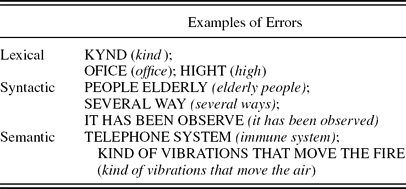
Design and materials. Eight texts from different sources (Anderson, Schejerlng, & Saltin, Reference *Anderson, Schejerlng and Saltin2000; Chapuis, Reference *Chapuis2000; Chodorow, Tetreault, & Han, Reference *Chodorow, Tetreault and Han2007; Griffin, Reference *Griffin and King1999; Grossman, Reference *Grossman and King1999; King, Reference *King and King1999; Langride, Reference *Langride2000; Larsen, Reference *Larsen2000) were selected to elaborate the material of the study. The texts covered a variety of matters to avoid possible individual differences due to familiarity with the topic. Because our participants differed in age, we took special care to use texts in which world knowledge coming from experience and age did not have an influence on comprehension (Butterfield, Hacker, & Albertson, Reference Butterfield, Hacker and Albertson1996; McCutchen et al., Reference McCutchen, Francis and Kerr1997). All texts had a logical structure and described a coherent sequence of events. The length of the texts ranged from 330 to 515 words (M = 426.87, SD = 66.37). The semantic and grammatical characteristics of each text were manipulated to introduce semantic and surface errors in texts. Thus, 3.89% of the words in each text were orthographically altered or replaced by an inaccurate form according to the context. As a result, lexical, syntactic, and semantic errors were generated. Lexical errors consisted of misspellings, replacement, or deletion of letters (see Table 1), which did not altered the linguistic form or meaning of the word. There were a mean of 7 lexical errors in each text, ranging from 5 to 8 according to the length of the texts. These errors were placed in words belonging to different grammatical categories (adjectives, nouns, or verbs). Syntactic errors consisted of a violation of very basic grammatical rules such as number congruency between noun, adjective, and verb or changes in the appropriate word order (see Table 1). There was a mean of 6.62 syntactic errors in each text (ranging from 5 to 7 errors according to the length of the texts). Finally, semantic errors were constructed by selecting words that were inconsistent with the argument and context of the text (see Table 1). We did not include incorrect prepositions or erroneous phrasal verbs because these are particularly difficult for nonnative speakers (Chodorow, Tetreault, & Han, Reference *Chodorow, Tetreault and Han2007). There were only three errors of this type in each text to avoid that the semantic modifications altered the underlying meaning structure or the plot described in the story. Furthermore, semantic errors were never located in the first sentences of the text so that the participants had a clear idea about the topic of the text when this type of error was first encountered, and thus, they were able to detect them. Detection of both syntactic and semantic errors required processing of larger units of information than the lexical errors. The errors were equally spread throughout the text.
Examples of lexical, syntactic, and semantic errors (corrections) for the texts

To assess global comprehension a verification questionnaire was included after each text. The questionnaire was presented in a separate sheet of paper and it was composed of four true–false and four open-ended questions printed in black ink. Participants were instructed to answer the questions without rereading the text. Each correct response was scored with 25, so that the participant could have a maximum score of 100 in both the true–false questions and the open-ended questions. Approximately half of the questions assessed factual explicit information in text, whereas the other half was directed to assess implicit information that could be extracted from correct understanding of the text. For example, one of the texts described a scene that took place in a waiting room where there was a group of people. One possible verification question was “how many people were in the room?” The exact number of people was never mentioned in text, but the text provided a description of each person in the room, information about who was talking, and so on. Hence, to correctly answer the question participants had to construct a correct representation of the text as to be able to extract the number.
Eight printed “exercise books” containing four texts were constructed. The order of the texts was counterbalanced across the exercise books. The order in which the exercise books were administered was also counterbalanced across participants.
Procedure. Each participant received an exercise book with four printed texts. They were instructed to read each text fluently and trying to understand it because they would have to answer some questions about its content after they finished reading. They were also instructed to monitor the text while reading to detect possible errors. They were told to circle or underline whatever aspect of the text they considered wrong. Participants were not given explicit information about the types of error that could be detected, but asked to mark whatever error or inconsistencies they found. Instructions emphasized comprehension over error detection. Participant read the text and then received the verification questionnaire. Once the questionnaire was completed, the participants read the following text and so on.
There was no time limit to read the text or to answer the questions, but all of the participants took approximately 7 min to finish working on each text. Although comprehension in interpreting is usually performed under time pressure we preferred not to impose it, because our aim was to investigate whether the interpreters use different reading strategies even when tested in normal reading. That is, we wanted to explore whether interpreters training and experience generalize to normal reading conditions.
RESULTS AND DISCUSSION
For each participant, we computed the pattern of error detection (percentage of lexical, syntactic, and semantic errors correctly detected) and the global comprehension (percentage of correct responses in the verification questionnaire). To avoid the problem of unequal variance across cells (because of the reduced number of errors) the analyses were performed with the arcsine transformation of these values.
Error detection
We calculated the arcsine values of correctly detected lexical (eight maximum), syntactic (eight maximum), and semantic errors (three maximum) for each participant and we conducted an analysis of covariance with type of error as within-participants variable, group as between-groups variable and WM span as a covariate.Footnote 2 We introduced WM span as covariate because there were between-groups differences in WM capacity (see the Method Section) and we wanted to explore if possible differences in error detection were present regardless memory span.
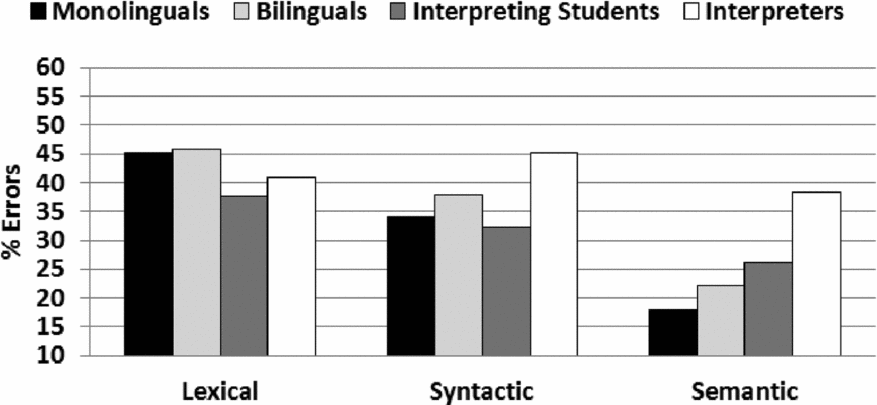
The results showed that the main effect of group was significant, F (3, 71) = 2.58, MSE = 273.05, p < .05, ηp2 = 0.11. The main effect of type of error was not significant, F (2, 142) = 1.84, MSE = 105.78, p > .05, ηp2 = 0.02, but interestingly the interaction between types of error and group was significant, F (6, 142) = 4.27, MSE = 105.78, p < .05, ηp2 = 0.13. Analyses conducted to explore this interaction indicated that there were no differences in the percentage of lexical errors detected by the groups, F (3, 71) = 2.31, MSE = 119.33, p > .05. However, interpreters identified a greater number of syntactic errors (M = 45.12, SD = 2.92) than the monolinguals (M = 34.03, SD = 2.76), F (1, 71) = 4.37, p < .05. None of the other comparisons among the groups were significant (all ps > .05). Finally, the analysis revealed that the interpreters recognized a larger number of semantic errors (M = 38.27, SD = 3.59) than the monolinguals (M = 17.83, SD = 3.39), F (1, 71) = 125.52, p < .05, untrained bilinguals (M = 22.01, SD = 3.39), F (1, 71) = 7.85, p < .05, and the interpreting students (M = 26.09, SD = 3.39), F (1, 71) = 5.05, p < .05. No differences were obtained between the monolinguals, bilinguals, and interpreting students (all ps > .05; see Figure 1).
The mean percentage of detected errors by type of error and group of participants.
Although WM scores were introduced as covariate in the previous analyses, we were interested in the possible role of WM during the error monitoring and comprehension task so we performed additional analyses. Because monolinguals, bilinguals, and students of interpreting had similar performance in the error detection task, we collapsed the data for these groups and divided them up according to their WM span. In this way, we had a group that was comparable to the professional interpreters in terms of WM capacity and another group with lower WM capacity. Following Miyake and colleagues’ (Reference Miyake, Just and Carpenter1994) criteria, participants who had a WM score greater than 3.5 were assigned to the high WM span group, whereas those who had scores below 3.5 were assigned to the low WM span group. The new analyses compared 19 low span participants (M = 2.81, SD = 0.55; 6 monolinguals, 6 bilinguals, and 7 interpreting students), 19 high span participants (M = 4.13, SD = 0.66; 6 monolinguals, 6 bilinguals, and 7 interpreting students), and 19 professional interpreters (with mean memory span of 4.29, SD = 0.68). WM span was similar for the high-span participants and the interpreters (p > .05) and these two groups scored higher than the low span participants (all ps < .05).
The analysis of variance on the error-detection pattern showed main effects of group, F (2, 54) = 6.07, MSE = 344.79, p < .05, ηp2 = 0.13, and types of error, F (2, 108) = 19.44, MSE = 158.59, p < .05, ηp2 = 0.19. Likewise, the interaction between types of error and group reached statistical significance, F (4, 108) = 5.59, MSE = 158.59, p < .05, ηp2 = 0.11. Analyses conducted to explore this interaction indicated that the percentage of lexical errors detected did not differ among the groups, F (2, 54) = 0.62, MSE = 134.19, p > .05. The interpreters (M = 40.51, SD = 2.65), the participants with high WM span (M = 44.66, SD = 2.65) and the participants with low WM span (M = 42.12, SD = 2.65) identified similar numbers of lexical errors. The analysis performed on the percentage of syntactic errors showed a significant effect of group, F (2, 54) = 5.98, MSE = 172.59, p < .05. Interpreters detected a greater percentage of syntactic errors (M = 46.49, SD = 3.01) than both high-span (M = 37.79, SD = 3.01), F (1, 54) = 4.16, p < .05, and low-span participants (M = 31.82, SD = 3.01), F (1, 54) = 11.84, p < .05. Finally, the analysis performed on the percentage of semantic errors also indicated significant differences between groups, F (2, 54) = 7.75, MSE = 335.19, p < .05. There were significant differences between interpreters (M = 41.81, SD = 4.32) and both high-span (M = 24.07, SD = 4.32), F (1, 54) = 8.41, p < .05, and low-span participants (M = 18.83, SD = 4.32), F (1, 54) = 14.12, p < .05.
Hence, these analyses performed on error detection indicated that interpreters identified more syntactic and semantic errors than the other groups of participants. This pattern of results cannot be accounted for WM span because interpreters detected more syntactic and semantic errors than individuals without training in interpreting but with similar WM capacity.
Global comprehension scores
We compared the performance of the groups in the comprehension questionnaire. We conducted two separate analyses of covariance, with WM span as the covariate on the arcsine values calculated on the percentage of correct responses for each type of comprehension tests.
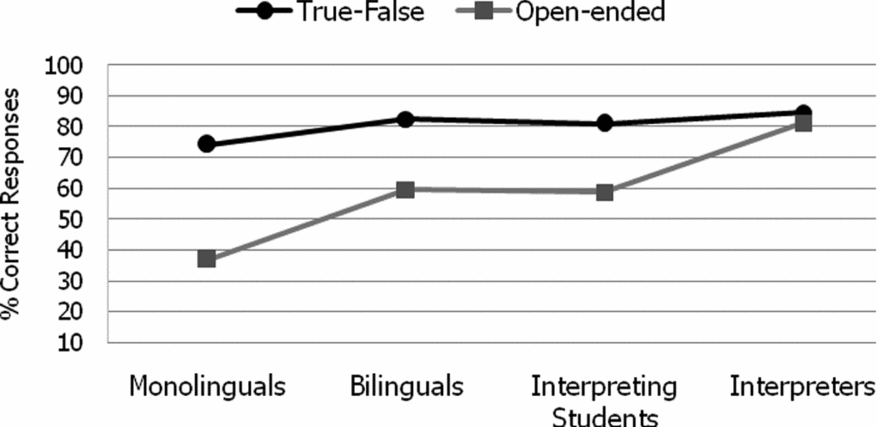
First, we analyzed performance for the true–false questions. This analysis revealed very high and similar performance for all of the groups, F (3, 71) = 2.59, MSE = 77.71, p > .05, ηp2 = 0.11 (see Figure 2).
The mean percentage of correct responses in true–false and open-ended questions for each group.
Second, we analyzed the percentage of correct responses in open-ended questions. The results of this analysis revealed significant group differences, F (3, 71) = 19.16, MSE = 89.36, p < .05, ηp2 = 0.45. The interpreters had a significant higher percentage of correct responses (M = 66.03, SD = 2.28) than the monolinguals (M = 37.11, SD = 2.13), F (1, 71) = 56.14, p < .05, untrained bilinguals (M = 50.98, SD = 2.28), F (1, 71) = 15.34, p < .05, and interpreting students (M = 50.29, SD = 2.28), F (1, 71) = 20.13, p < .05. Participants in the monolingual group showed poorer comprehension than both bilinguals, F (1, 71) = 19.59, p < .05, and interpreting students, F (1, 71) = 15.53, p < .05. There were no significant differences between bilinguals and students (F < 1; see Figure 2).
We also analyzed comprehension considering the WM span groups. The results on the mean percentage of correct responses in true–false questions revealed significant differences between the groups, F (2, 54) = 9.15, MSE = 84.19, p < .05, ηp2 = 0.25. Low-span participants showed poorer comprehension (M = 60.56, SD = 2.09) than both high span participants (M = 66.35, SD = 2.09), F (2, 54) = 3.77, p < .05, and interpreters (M = 73.28, SD = 1.99), F (2, 54) = 18.25, p < .05. Significant differences between high span participants and interpreters were also obtained, F (2, 54) = 5.42, p < .05.
A main effect of group was obtained when analyzing the percentage of correct responses in the open-ended questions, F (2, 54) = 20.37, MSE = 123.29, p < .05, ηp2 = 0.43. Thus, interpreters had better comprehension of the texts (M = 66.99, SD = 2.54) than both high span (M = 48.75, SD = 2.54), F (1, 54) = 22.94, p < .05, and low-span participants (M = 44.21, SD = 2.54), F (1, 54) = 36.58, p < .05. The differences between low- and high-span participants were not significant, F (1, 54) = 1.58, p > .05.
GENERAL DISCUSSION
In this experiment we explored reading comprehension skills in interpreters and noninterpreters. We aimed to know whether experience in simultaneous interpreting promotes the development of special comprehension strategies that extend to situations other than translation. The idea was that because of the very demanding context in which comprehension is performed during interpreting, the interpreters may develop qualitatively different strategies to cope with these demands that may generalize to situation where understanding is performed in less demanding contexts.
With this purpose in mind we used an error-detection task in which interpreters, students of interpretation, nontrained bilingual and monolingual participants had to revise different texts to recognize possible inconsistencies while reading for understanding.
We observed that interpreters detected more semantic errors than monolinguals, nontrained bilinguals, and interpreting students. They also had a better understanding as reflected by the higher percentage of correct responses in the comprehension questionnaire. When participants were grouped according to their WM capacity, interpreters’ performance was superior to the participants with high and low WM span both in the detection of syntactic and semantic errors and in the reading comprehension tests.
This pattern of results is important in the context of interpreting skills, the bilingual advantage, and the role of WM in understanding. Therefore, in the following paragraphs we discuss each of these issues.
Interpreting skills and comprehension
As we mentioned, we wanted to explore whether training in interpretation leads to better reading strategies. Results of our experiment seem to suggest that this is the case because professional interpreters detected more inconsistencies and they had more accurate recall of the texts than untrained participants with comparable WM capacities. In addition, these differences were more evident when they detected syntactic and semantic errors. Note that detection of syntactic and semantic errors involve processing larger units of information and performing deeper linguistic analyses. Therefore, this pattern of results provides support to the claim that the interpreters develop more efficient comprehension strategies (Bajo et al., Reference Bajo, Padilla, Padilla, Chesterman, Salvador and Gambier2000). This is consistent with results within the interpreting field suggesting that the interpreters devote more effort to control the meaning of the discourse than to the lexical analyses while interpreting (Christoffels & de Groot Reference Christoffels, de Groot, Kroll and de Groot2005; Fabbro, Gran, & Gran, Reference Fabbro, Gran and Gran1991; Ivanova, Reference Ivanova1999). For example, Fabbro et al. (Reference Fabbro, Gran and Gran1991) compared interpreting students and professional interpreters in the recognition of correct translations. The source sentences were delivered to one ear of the participants and the translation to the other ear. They were asked to detect possible translation errors. Results indicated that students recognized more superficial errors while expert interpreters identified semantic errors in a higher percentage. Our results extend these findings to general reading tasks suggesting that the intensive training and the continued practice of the interpreters change the way they confront comprehension.
Training in interpretation involves, at least in some training programs, in-class exercises directed to more efficient semantic access. In addition, professional interpreting involves coping with semantic and syntactic incoherencies or ambiguities under strong temporal pressure while trying to reexpress the source message in the target language.Footnote 3 As a result, experience in this highly demanding task may produce changes in the way in which linguistic processes are performed. For example, interpreters have shown more efficient linguistic processing such as lexical access and retrieval (Bajo et al., Reference Bajo, Padilla, Padilla, Chesterman, Salvador and Gambier2000; Christoffels et al., Reference Christoffels, de Groot and Waldorp2003) or verbal fluency (Fabbro & Daró, Reference Fabbro and Daró1995). Gerver, Longley, Long, and Lambert (Reference Gerver, Longley, Long and Lambert1984) found that the students’ skills to fill in a missing word and generate synonyms predicted individual differences in simultaneous interpreting performance. Likewise, professional practice has been related with superior comprehension abilities or increased WM skills (Bajo et al., Reference Bajo, Padilla, Padilla, Chesterman, Salvador and Gambier2000; Liu, Schallert, & Carroll, Reference Liu, Schallert and Carroll2004; Padilla et al., Reference Padilla, Bajo, Cañas, Padilla and Tommola1995). Although is hard to find longitudinal studies on the development of expert performance (but see Ericson, Reference Ericson2000), it has been observed that comprehension processes and lexical access are more efficient after only 1 year of training in interpreting (Bajo et al., Reference Bajo, Padilla, Padilla, Chesterman, Salvador and Gambier2000). However, results of our experiment suggest that more training and experience may be needed to produce qualitative changes, because the performance of our interpreting students did not differ from other untrained bilinguals. Therefore, it is possible that very extensive experience is needed to change the way in which comprehension is performed. In fact, research on expert performance suggests that many years of experience result in different knowledge organization or analytical strategies (Ericson, Reference Ericson2000; Moser-Mercer, Reference Moser-Mercer2008).
Interpreting and WM
The important role of the WM skills in reading and language comprehension is well established (Daneman & Merikle, Reference Daneman and Merikle1996; Yuill, Oakhill, & Parkin, Reference Yuill, Oakhill and Parkin1989). Also, in the interpreting domain, the role of WM to produce quality interpretations has been emphasized (Gile, Reference Gile1995). Consistent with this and with results from other studies, our interpreters showed larger WM capacity than the rest of the groups.
Some results obtained in the present study corroborate the relation between WM capacity and reading comprehension. Participants with high span presented better comprehension in the open-ended questions and they detected more syntactic errors relative to low-span individuals. Thus, WM was important for global comprehension so that high span participants outperformed low span replicating the many studies that show correlations between WM and comprehension scores (Daneman & Carpenter, Reference Daneman and Carpenter1980; Perfetti & Hart, Reference Perfetti, Hart and Gorfien2001). However, could the differences in WM span explain the qualitative different way in which the interpreters seem to achieve comprehension? The answer to this question seem to be no. Aware of the important role of WM skills on comprehension and interpreting, we carried out different analyses in this experiment to assess its influence on the performance of our participants. Because the interpreters had higher WM span than the rest of the groups, we first introduced WM span as covariate to control for its possible influence. The qualitative differences in error detection were the result of these analyses. In addition, when additional analyses grouping our participants by span were performed, interpreters detected more syntactic and semantic errors than the high span participants. Hence, the pattern of error detection in professional interpreters seems to be due to their experience in interpretation and not to WM span. This suggests that there is more to interpreting skills than the interpreters’ larger WM capacity. As we mentioned, very possibly, this difference is related to the interpreters’ linguistic skills (see also Christoffels et al., Reference Christoffels, de Groot and Waldorp2003, for the importance of lexical access in interpreting).
Bilingualism and control
Our experiment involved comparisons of interpreters and interpreting students with highly proficient bilinguals and monolingual speakers. There were no differences among monolinguals, bilinguals, and interpreting students in the error-detection task and they showed worse performance than professional interpreters. However, monolinguals reading in their native language presented worse global comprehension relative to the other groups who read in their L2. These results indicate that bilinguals, regardless of their training in interpreting were better when they read at the time they performed the error detection tasks. Because language processing and error monitoring require attentional control, it might be possible that bilingualism is associated to greater executive control. In fact, previous studies show that bilinguals have better attentional control to avoid interference between their two active languages, and that they become especially skilled in situations requiring conflict resolution (Bialystok, Reference Bialystok2007; Bialystok, Craik, & Luk, Reference Bialystok, Craik and Luk2008; Costa, Hernández, & Sebastian-Gallés, Reference Costa, Hernández and Sebastián-Gallés2008). Similarly, our data suggests that because bilinguals probably need to monitor their speech for intrusions from the nonintended language, their experience in detecting and controlling these intrusions may generalize to other type of tasks that also require attentional control, and therefore, this may include error detection in general reading tasks. Whether this ability extends to other nonverbal task should be subject of further investigation.
CONCLUSION
The results of the present study suggest that intensive practice in interpreting develop more efficient comprehension strategies involving processing of larger units and deeper semantic analyses. This difference seems not to be due to the interpreters’ large WM capacity, because this more efficient processing holds when the interpreters are compared to high WM span participants. The differences between the untrained participants and the interpreters are possibly due to the more automatic way in which the interpreters perform linguistic analyses such as lexical and semantic access. However, because the present study only involved English, the L2 of the bilinguals and interpreters’ participants, further research should investigate whether these conclusions can be extended to the interpreters L1 or L3 or to languages other than English.
ACKNOWLEDGMENTS
This research was supported by Doctoral Research Grant SEJ2005-00842 (to C.Y.), the Ramón y Cajal research program (to P.M.), Grant PSI2009-11094/PSI (to P.M.), Grant EDU2008-01111 (to T.B.), and Grant CSD2008-00048 Consolider Ingenio 2010 from the Ministry of Science and Innovation of the Spanish Government, and Proyecto de Excelencia Grants JA-2007 and JA-2008_HUM 360 (to T.B. and P.M.).