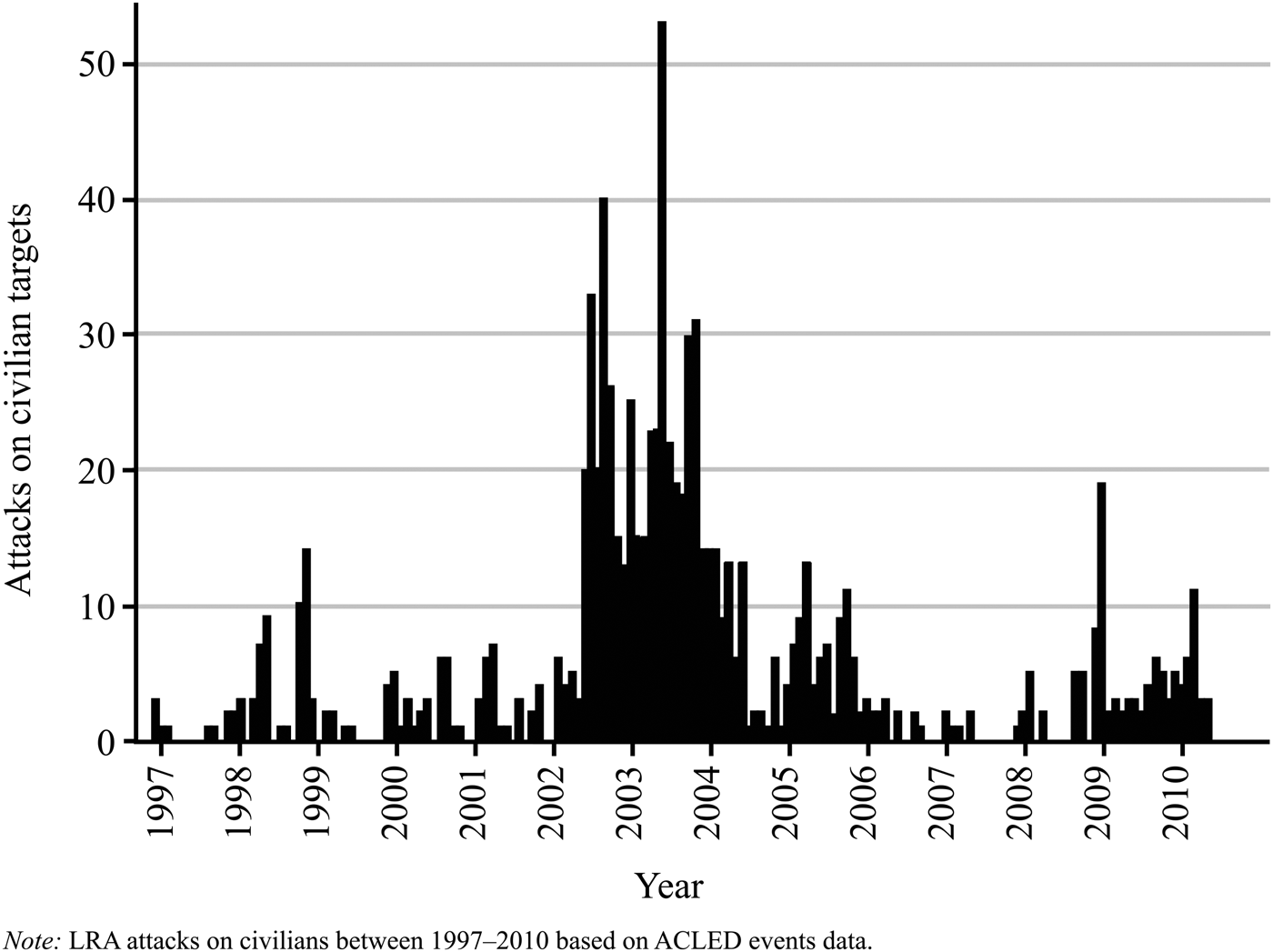
Shortly after Christmas 2008, the Lord's Resistance Army (LRA) attacked multiple villages along the border of the Democratic Republic of Congo (DRC) and Sudan, killing and abducting more than 1,000 people.Footnote 1 LRA brutality is certainly not uncommon, but both the scale and timing of these attacks were largely unanticipated. As Figure 1 demonstrates, LRA violence varies significantly over time, and the “Christmas Massacres” followed a relative lull in violence during previous years. What explains such surges in violence? More broadly, why do rebels engage in high levels of victimization at some moments yet act with relative restraint at others? The answers to these questions are both normatively and substantively important for scholars and policy-makers interested in ameliorating the human costs of conflict.
LRA attacks on civilians per month

Although research on civilian abuse during civil war has increased significantly in recent years, the mechanisms responsible for changes in actors' tactics from one time point to the next remain poorly understood. Several influential studies link rebel violence (or other behaviors) to groups' organizational configurations, resource bases, or the interplay of these factors.Footnote 2 These arguments highlight the factors that predispose groups to violence but provide few insights into why victimization occurs at specific moments and in specific places because group behavior is viewed as a byproduct of largely fixed group characteristics. By contrast, instrumentalist approaches view civilian victimization as one of multiple strategies through which rebel groups achieve their goals. Studies adopting this perspective note that civil wars occur within a capricious landscape and have identified a number of diverse mechanisms to explain both temporal and geographic variations in civilian targeting. Such studies theorize that insurgents target civilians to attain war resources, impose costs on adversaries and their supporters, exert control over territory, and shape local civilians' behavior. Moreover, researchers link group strategies to factors such as control, popular support, power distribution, threat perception, and resource availability.Footnote 3
The emerging instrumentalist literature increasingly presumes a relationship between conflict interactions—either single events or broader patterns of events—and motives for civilian targeting. To the extent that the outcomes of conflict events shape factors such as control, resources, and support, they should also influence rebel violence strategies. Despite this intuition, few analyses have explicitly investigated the impact of battlefield wins and losses on patterns of rebel violence.Footnote 4 Consequently, their impact on subsequent rebel behavior remains unclear. Establishing clear linkages between conflict processes and victimization would contribute to the field's understanding of the motives for rebel violence. Moreover, evidence of a systematic relationship might allow policy-makers, military strategists, and aid workers to better anticipate the timing and location of victimization and respond to such tragedies more effectively.
I examine the potential relationship between the outcomes of discrete conflict interactions (for example, the severity of wins and losses) and intentional rebel violence against civilians. Two competing logics suggest opposite influences of loss on violence. I critique these logics and then use a stylized model of rebel-civilian bargaining to illustrate how acute resource demands may incentivize insurgent violence and predation in the period immediately following significant conflict losses. I evaluate hypotheses based on these expectations by analyzing a single case (the LRA) disaggregated to the subnational level as well as a cross-sectional sample of post–Cold War African insurgencies.
Battlefield Outcomes and Civilian Targeting
Two competing logics suggest potentially opposing influences of rebel conflict losses on civilian targeting. On the one hand, heavy conflict costs may suppress rebel violence; on the other, losses may create short-term incentives for civilian victimization. With respect to the former, significant losses may severely weaken insurgents' military capacity and constrain the geographic area over which the group can effectively carry out military operations. Dwindling capabilities might therefore limit rebels' ability to carry out large-scale attacks against civilian population centers, particularly if rebels are driven into peripheral areas of the state. This logic appears popular with policy-makers, and it serves as the basis for military strategies such as the “surge” in Iraq, in which the United States deployed 20,000 additional troops to Iraq in 2007.Footnote 5 Similarly, rebels may attempt to improve their treatment of civilians to attract new recruits and to replenish depleted resources following losses. In this case, rising resource demands could theoretically enhance civilians' bargaining position relative to rebels, thereby allowing them to leverage better behaviors. If either of these situations obtains, rebel violence might be expected to decline in the wake of major losses.
Although plausible, this perspective overlooks several key facts regarding the nature of irregular conflict. First, as the history of the LRA and events such as the recent wave of extremist bombings in postwar Iraq demonstrate, insurgents require only limited military capabilities to inflict significant costs on civilian populations.Footnote 6 Previous studies also suggest that whereas rebels do vary their war strategies in response to changing capabilities and resource access, they tend to employ conventional tactics more (rather than less) frequently as capabilities increase.Footnote 7 Severe capability loss and resource depletion might therefore reduce the risk of rebel attacks on well-defended (hard) targets but would not necessarily deter attacks against unarmed civilians, particularly in areas where government control is weak. Rather, this logic suggests that more vulnerable locations will become increasingly attractive targets of predation by desperate rebels.
It is likewise unclear how losses might lead rebels to seek rapprochement with civilians. Following major losses, rebels' time horizons often shrink, leading them to prioritize short-term strategic objectives such as resource acquisition over longer-term goals like institution building or the provision of services to constituent populations. Facing acute resource demands, rebels often turn to local civilians who typically represent the most proximate source of food, shelter, recruits, and so on. Even where a nominally positive history of civilian-rebel interactions exist, rebel demands may exceed civilians' willingness to voluntarily comply following losses. This situation leaves rebels to choose between coercively acquiring resources and foregoing them.
Civilians certainly possess some level of agency during civil conflicts, and existing research suggests that they retain some ability to bargain with rebels over the extent of their cooperation.Footnote 8 However, civilian-insurgent bargaining is largely asymmetrical given that rebels retain the outside option of taking resources by force. The likelihood of violence is therefore largely related to the outcome of rebel-civilian bargaining. Factors that facilitate successful bargaining should reduce the likelihood of victimization whereas those that impede it should increase the likelihood of violence.
The outcomes of recent conflict events—particularly significant losses—likely represent an influential factor in this relationship. First, the costs accrued through conflict interactions determine the severity of the demands rebels impose on civilians. Second, observed gains and losses shape civilians' expectation regarding the balance of risks and rewards for supporting rebels. Importantly, civilians' support often declines following losses and major setbacks because it is often linked to civilians' subjective assessments of the group's likelihood of success and the promise of future benefits.Footnote 9 Furthermore, weakening rebel control over territory and populations reduces civilian compliance, increases defection rates, and raises the likelihood of civilian targeting.Footnote 10 Coercive violence and predation are therefore more likely when (and where) rebel demands outpace civilian compliance and civilians fail to accede to rebel demands. Without other immediately available resources, rebels become more likely to resort to predation and coercion in the wake of significant material losses.
H1:
Civilian victimization increases following material losses.
Rebel-civilian relations are not strictly determined by resource demands. Factors such as organizational capacity, the ability to credibly provide benefits to supporters, and the presence of alternative resource streams likewise influence rebel-civilians interactions. These factors also influence which sets of strategies appear most acceptable to a group in the wake of losses and thus structure how the group chooses to respond. Consequently, these largely static characteristics condition the expected relationship between battlefield fortunes and civilian targeting.
All else equal, insurgent demands are more easily met when the group enjoys the support of the local population. But all else is rarely equal during insurgency, and sympathy for rebels does not necessarily insulate civilians from violence. Civilians have strong incentives to hide their preferences during war, and even sympathetic populations are often reluctant to collaborate in the face of uncertainties about war outcomes and actor credibility.Footnote 11 Rebels may therefore resort to violence to enforce compliance and extract resources, even among populations that support insurgent goals. However, as Kalyvas demonstrates, territorial control increases civilian compliance and constrains violence.Footnote 12 It may also mitigate the influence of material losses on victimization. When rebels control large swaths of territory they are able to transfer resources from areas of consolidated control to areas where control is weakened by recent losses, thereby ameliorating the resource burdens imposed by losses and reducing demands on local civilians. Moreover, even in the face of battlefield losses, control allows rebels to credibly signal their ability to provide security and other benefits to loyal civilians. Given the virtues territorial control extends to rebels, groups that effectively control territory should be comparatively better able to successfully bargain with civilians for support, even in the wake of material losses.
H2:
Groups that exercise substantial territorial control are less likely to target civilians following material losses.
Previous research suggests that groups who rely on external support or who finance the rebellion using conflict resources are more likely to target civilians.Footnote 13 These resource streams allow rebels to forego more traditional, community-based organizational strategies and contractual bargaining for local support. This contributes to mutual indifference, increased ideological distance, and limited positive interactions between rebels and civilians. Where these conditions exist, civilians are less likely to support (or understand) insurgent goals, and insurgents are more likely to engage in violence and looting.Footnote 14 Furthermore, the lack of strong community connections and absence of historical patterns of positive interactions with civilians are likely to exacerbate rebels' resource dilemma following losses. Although the sale of commodities or infusion of additional resources from foreign patrons may eventually permit rebels to replenish resources without relying on civilians, major losses impose immediate resource constraints. Insurgents may therefore still face pressures to extract resources from a local population that they have likely neglected or abused in the past. This situation complicates their ability to successfully bargain over resources and encourages predation.
H3a:
Groups with foreign sponsorship are more likely to target civilians following material losses.
H3b:
Groups financed through the sale of conflict resources are more likely to target civilians following material losses.
Finally, organizational structures may also influence rebels' response to losses. Clear command-and-control structures as well as strong internal discipline reduce the likelihood that troops abuse civilians.Footnote 15 Because the strength of organizational structures influences the group's ability to engage cooperatively with local communities,Footnote 16 weak structures may impede the group's ability to successfully bargain when they face severe resource constraints. Furthermore, following losses, individual members may pursue self-serving, predatory goals—even to the detriment of group goals—simply because the leadership in unable to police their behaviors. Consequently, weak organizational structures exacerbate the influence of material loss on civilian victimization.
H4:
Groups with weaker organizational structures are more likely to target civilians following material losses.
Data and Analyses
Analyses conducted at the subnational level are useful for evaluating microlevel conflict processes. However, it is important to acknowledge that macrolevel processes often drive microlevel events. Consequently, there is much to learn from “scaling-up” microlevel theories and testing them at the meso- and macrolevels.Footnote 17 I therefore examine the proposed relationship at two distinct levels of analysis. I first conduct a microlevel analysis of LRA violence disaggregated to the district-week, which accounts for conflict dynamics obscured at higher levels of aggregation. A single case analysis cannot, however, account for factors that vary across groups. Therefore I also conduct across-sectional time-series analysis of post–Cold War African insurgencies that allows me to both verify the validity of the central hypothesis across a range of diverse cases and to investigate the conditional hypotheses.
Microlevel Analysis
The microlevel analysis focuses on the LRA for two reasons. First, the group's brutality leads many observers to conclude that there is little logic to its actions, suggesting something of a hard case for rationalist arguments. Second, temporal and geospatial variation in the group's violence suggests that static factors (for example, resource endowments, organizational structures, leader psychology) cannot fully account for the group's tactics. Focusing on a case where these factors are largely constant over time allows me to evaluate the hypothesis that conflict interactions influence patterns of violence.
Data on LRA conflict events come from the Armed Conflict Location Events Dataset (ACLED).Footnote 18 I aggregate these data to the subnational (for example, district) unit-week to closely examine the sequencing of events. Rather than employing arbitrarily sized grid-squares (or hexagons) as the unit, I instead rely on actual administrative divisions because they often reflect important geographical, ethnic, or political boundaries. Gridded units sacrifice the potential underlying importance of these divisions in exchange for consistency in unit size. Such small units (often fifty square kilometers) also dramatically increase the number of nonevent observations within a sample, especially in time-series analyses. Because of substantial differences in the size of administrative units across states, I aggregate to different levels of administration for each state: the district in Uganda and the Sudan, the territory (zone) in the Democratic Republic of Congo, and the sub-prefecture in Central African Republic.Footnote 19 This aggregation creates more equivalently sized units. I also control for the size of the units. Subnational administrative unit data are taken from the GADM database on Global Administrative Areas.Footnote 20
ACLED includes event-level data on battles, attacks on civilians, changes in territorial control, and other conflict-related events. These data are coded from a variety of secondary sources, including local and regional press accounts, the Integrated Regional Information Network (IRIN), Relief Web, Factiva, various humanitarian agencies, and information available from the Uppsala Conflict Data Program (UCDP) archives.Footnote 21 I rely on ACLED's data because they provide relevant substantive information on conflict events and their outcomes that I use to create key variables employed in the analysis. The sample for the analysis includes all subnational units in which the LRA were active between 1997 and 2010. A unit enters the sample once an LRA-related conflict event occurs within it and remains active thereafter. I therefore exclude from the analysis areas in which no conflict events occurred (for example, 90 percent of the DRC). Aggregating the data to the unit-week produces a sample with approximately 13,500 observations, including nearly 600 unique attacks on civilians committed by the LRA as well as more than 900 other conflict events spread over fifty subnational units in four countries.
The dependent variable in the analysis is a weekly count of the number of attacks on civilians committed by the LRA in a subnational unit. Relying on counts of attacks rather than estimates of deaths offers both benefits and drawbacks. This operationalization treats attacks in which dozens of civilians are killed as equivalent to events in which a single civilian is killed. However, deaths are only one form of violence inflicted upon civilians—abductions, torture, beatings, sexual violence, and the destruction of property occur frequently during civil wars. These forms of violence are captured by ACLED but excluded from most other data sets. Furthermore, data on the occurrence of an attack are often more reliable than estimated death counts. Indeed, media reports often agree where and when an event occurred but sharply diverge on details such as the number of persons killed or injured.
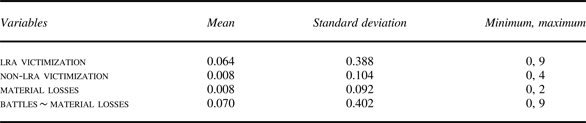
I create the key independent variable using information available in ACLED. Specifically, I construct a weekly count of conflict interactions that produced substantial material losses for rebels. First, ACLED indicates whether a given battle resulted in a territorial gain, loss, or no change for an actor. Second, ACLED makes available short summaries of the relevant events captured in the data set. These coding notes include information on the context and outcome of various conflict interactions. I use this supplementary information plus the existing ACLED coding of changes in territorial control to create the loss measure.Footnote 22 I code an event as a material loss if the interaction produced any of the following outcomes: the loss, capture, defection, or deaths of twenty or more rebel troops; the liberation of twenty or more abductees or child soldiers;Footnote 23 the destruction of rebel camps; or the capture or destruction of rebel supply stores. I aggregate these events to the district week and lag the measure by one period. Summary statistics for relevant variables are located in Table 1. Figure 2 shows the locations of major LRA losses (points) mapped onto the frequency of anticivilian violence (shading) for the effected region.Footnote 24
LRA losses and attacks on civilians

Descriptive statistics

I control for the number of attacks on civilians committed by rival armed factions (for example, the Sudanese People's Liberation Army (SPLA) and Uganda forces) as well as the number of battles between the LRA and other armed factions that did not produce significant losses. I include a one-week lag of LRA attacks on civilians and spatial lags (contiguous district t−1) of each of the conflict events variables to control for temporal and spatial dependence. I also control for district-level infant mortality rate, logged population size,Footnote 25 logged district land area (km2), and whether the majority of the district's population is ethnic Acholi (which the LRA claimed to represent).Footnote 26 Finally, I include a dummy variable for the year 2002 to account for a significant shift in the conflict landscape. Although the LRA received significant support from Sudan during the 1990s, improved relations between Sudan and Uganda in the early 2000s led Sudan to terminate this support. Moreover, in March 2002 Ugandan troops gained permission to pursue the LRA into Sudan during operation “Operation Iron Fist.” These events represented a period of sustained setback for the LRA that may correlate with increased violence.
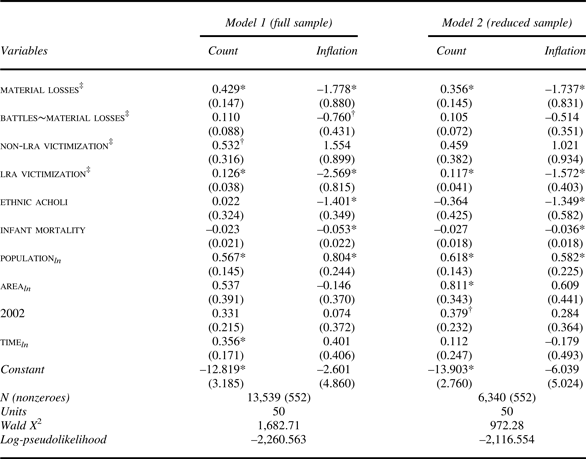
Results for the microlevel analysis are presented in Table 2. Most units do not experience attacks on civilians at most time points, creating an overabundance of zeroes in the sample.Footnote 27 I therefore employ a zero-inflated negative binomial model. This model estimates the relationship between covariates and the dependent variable in two stages. First, the inflation step employs logistic regression to predict whether a given observation belongs to a population of true zeroes. Thus, the model takes into account that some units are simply not exposed to rebel attacks on civilians at some time points. The second step models the events count according to a negative binomial distribution, which includes a parameter accounting for overdispersion in the count. Because the LRA was simply not active in some districts during much of the sample period, I also test a second model using a reduced sample limited to districts in which the LRA was active during the year. In both models I cluster the standard errors on the subnational unit to account for within unit correlation.
Microlevel analysis results

Notes: Coefficients and standard errors (clustered by spatial unit). * = p ≤ .05; † = p ≤ .10 (two-tailed test). ‡ = Lagged one period. Spatial lags suppressed.
The results from both models provide support for H1. In the count equations of both models, LRA losses positively correlate to more attacks on civilians in the district during the subsequent week, and the coefficients are statistically significant. The negative and significant coefficients on the material loss measure in the inflation equations of both models suggest that losses reduce the likelihood that the district experiences no attacks in the subsequent week. Put otherwise, losses increase the likelihood that the district is at risk for an attack. There is only weak support for the argument that violence spiked in 2002 when Sudan cut off support to the LRA and Ugandan troops pursued them into Sudan. It is possible that accounting specifically for the conflict events that this macrolevel event produced simply washes out the influence of the cruder year dummy. This suggests a connection between macrolevel events such as shifting alliances and microlevel conflict events that may not be observable at higher levels of aggregation.
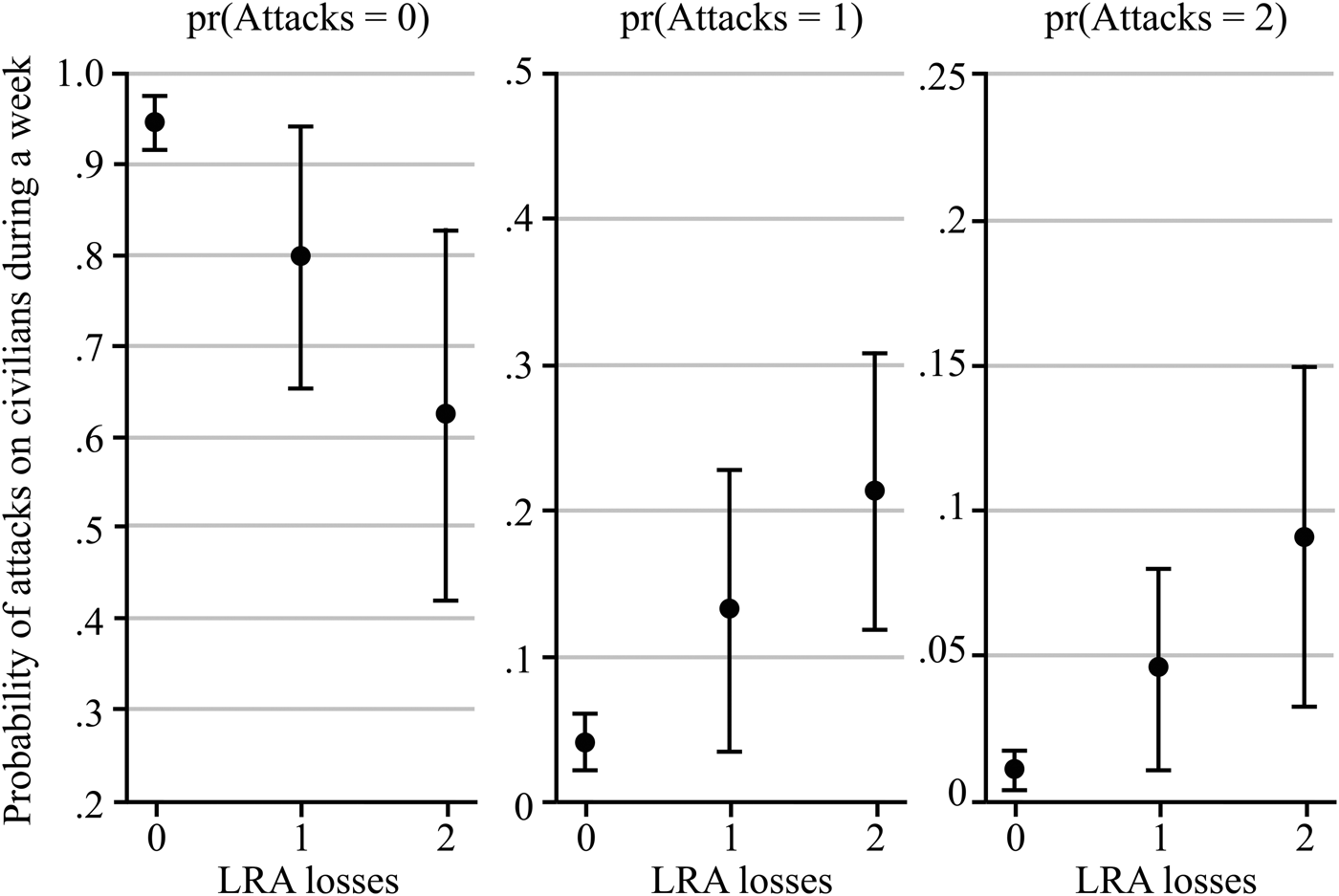
Figure 3 displays the substantive impact of the relationship found in Model 2.Footnote 28 The panels reflect the probabilities of observing zero, one, and two attacks on civilians over the number of LRA losses in the previous week. As the first panel illustrates, for districts in which the LRA was active during the year, the base probability of zero attacks on civilians is approximately 94 percent. However, this probability declines when the group experiences material losses, falling to 80 percent after a single loss and to roughly 65 percent after two losses in the district. The second panel illustrates the probability of observing a single attack on civilians in a district in a week. When the group experienced no losses in the previous week, the risk of a single attack on civilians is about 5 percent. This risk increases to approximately 14 percent for weeks following a substantial rebel loss and to more than 20 percent when the group experienced two major losses in the previous week. A similar pattern emerges for the risk of two attacks. The likelihood of two attacks in a week is under 2 percent when the group has not recently experienced significant losses yet increases to 5 percent and 9 percent when the group experienced one and two setbacks respectively.
Probability of LRA attacks

These results help shed light on notable episodes of LRA violence. For example, the Christmas Massacres occurred in the wake of the Garamba Offensive, which destroyed up to 70 percent of the LRA's camps and severely depleted the group's resources.Footnote 29 As noted, there is also some evidence that violence spiked in 2002 following Operation Iron Fist. Indeed, Figure 1 shows that LRA attacks spiked in mid-2002. The timing of these attacks follows shortly after the Ugandan military's pursuit of the LRA into southern Sudan in early April of that year.Footnote 30 Following this incursion the LRA attacked refugee centers and villages along the border of Sudan and Uganda, killing hundreds of civilians.Footnote 31 Similarly, the LRAs first major wave of mutilations (as well as a general uptick in violence) followed closely on the government's 1992 counterinsurgency offensive, which included organizing and arming local militias.Footnote 32
Macrolevel Data and Analysis
To determine the generalizability of these findings, I conduct a separate analysis of post–Cold War African conflicts using the group-month as the level of analysis. I construct the sample by merging the Non-State Actor Dataset (NSA)Footnote 33 and the UCDP Geocoded Events Dataset (GED).Footnote 34 I aggregate events data from the GED to the group-month and merge these with the NSA to produce a data set with nearly 4,000 observations, reflecting more than eighty individual groups in twenty-eight countries. I choose the group-month as the unit of analysis because the argument assumes that violence occurs shortly following losses. Analysis at higher levels of temporal aggregation would therefore obscure this relationship.
The dependent variable is the estimated monthly count of noncombatants killed through one-sided violence by a specific rebel faction as reported in the GED data set.Footnote 35 The UCDP defines one-sided violence as the intentional and direct use of violence against noncombatants. This definition necessarily excludes deaths by siege or infrastructure damage as well as deaths from battlefield error, negligence, or crossfire.Footnote 36 For instance, the execution of unarmed tribal leaders during the rebel occupation of a village would be included in the data set whereas civilian deaths resulting from exchanges of gunfire between rebel and government forces in a densely populated urban area would not. This conceptualization makes the data appropriate for testing hypotheses on the causes of strategic (as opposed to incidental) violence.
I operationalize the severity of material losses as the estimated proportion of a group's forces lost in battle in the previous month. I scale losses to group size because the resource burden losses impose depends on the size of the group. For instance, whereas the deaths of twenty-five troops may reflect a trivial cost to a robust force of 25,000 troops (0.1 percent), it would literally decimate a rebellion of 250 guerillas. Data on troop deaths are taken from the GED data set while annual troop estimates are taken from the UCDP Conflict Encyclopedia.Footnote 37 I also account for the severity of government troop losses, operationalized in the same manner.
Accounting for the contingent relationships hypothesized in this study requires group-level indicators related to territorial control, group organizational structure, and funding sources. Cross-sectional data on such characteristics are rare; however, a handful of recent contributions provide reasonable proxy measures. Data on territorial control, group structure, and foreign support are taken from the NSA data set. Territorial control indicates whether or not a rebel group exerted effective control over territory within the conflict state during the year. Central control reflects whether a central command structure existed and exercised at least a moderate degree of control over constituent units or troops in the field. Foreign support accounts for whether the group received material support from an external state sponsor. I use data from Rustad and Binningsbo to account for whether the organization financed the rebellion through the sale of conflict resources (minerals, gems, or drugs).Footnote 38 I interact each with the loss variable to test the potential contingent relationships I discussed.
I also employ several control variables. Because civilian deaths are likely a function of fighting severity, I include the logged value of rebel and government deaths accruing in the current month.Footnote 39 I also include the log-transformed value of government one-sided violence during the previous month of one-sided violence to account for the possibility of reciprocal victimization. I account for temporal dependence by including the lagged value of rebel one-sided violence. I also control for whether the conflict involved secessionist aims,Footnote 40 the conflict state's population size (logged),Footnote 41 and conflict duration in logged months since onset.
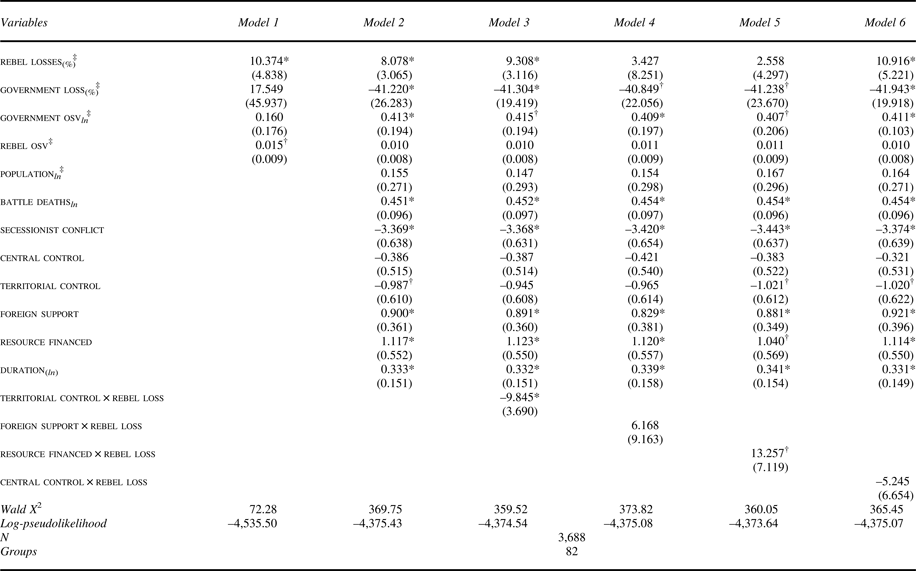
I employ negative binomial regression in the macrolevel analysis because the dependent variable is a monthly count of rebel one-sided violence, and it presents significant overdispersion. In each model, standard errors are clustered on the group. Table 3 presents the results of these regression analyses. Model 1 reports a base specification with sparse controls. Model 2 includes additional control variables. In both models, the rebel troop loss variable is positive and statistically significant, suggesting that as losses mount civilian victimization increases. These results offer some support for H1 and are consistent with a wealth of anecdotal evidence. Kalyvas, for instance, recounts that in Colombia guerillas increasingly resorted to indiscriminate violence after they were driven from the town of Tame in the early 2000s by the military and allied paramilitary forces.Footnote 42 Wickham-Crowley similarly highlights numerous cases in which Peruvian and Venezuelan guerillas attacked uncooperative civilians in the immediate aftermath of battlefield defeats in the 1960s and 1970s.Footnote 43 Moreover, these results are consistent with those from the microlevel analysis of the LRA case, suggesting the generalizability of those findings.
Macrolevel analysis results

Notes: Coefficients and standard errors (clustered by dyad). * = p ≤ .05; † = p ≤ .10 (two-tailed test). ‡ = Lagged one period.
Although not specifically theorized in this article, it might also be expected that rising regime costs, which are likely correlated with rebel victories, should be negatively correlated with rebel victimization. The variable for government losses is negative in all specifications except for the sparse first model and generally achieves statistical significance. This suggests a possible supportive corollary to H1: not only does violence spike after losses, but it may also decline in the wake of rebel victories.
Models 3 through 6 serve as preliminary tests of potential refinements to the general model. Although the general argument posits a relationship between rebel losses and civilian victimization, it is highly likely that this relationship is conditioned by the group-level characteristics that organizational and structural theories suggest predispose groups to greater overall levels of violence. Model 3 includes an interaction term between the loss variable and a binary indicator for territorial control in order to evaluate H2. Models 4 and 5 examine the conditioning effects of conflict resources and foreign sponsorship to evaluate H3a and H3b. Model 6 evaluates H4 by including an interaction term composed of the loss variable and an indicator for strong central organization.
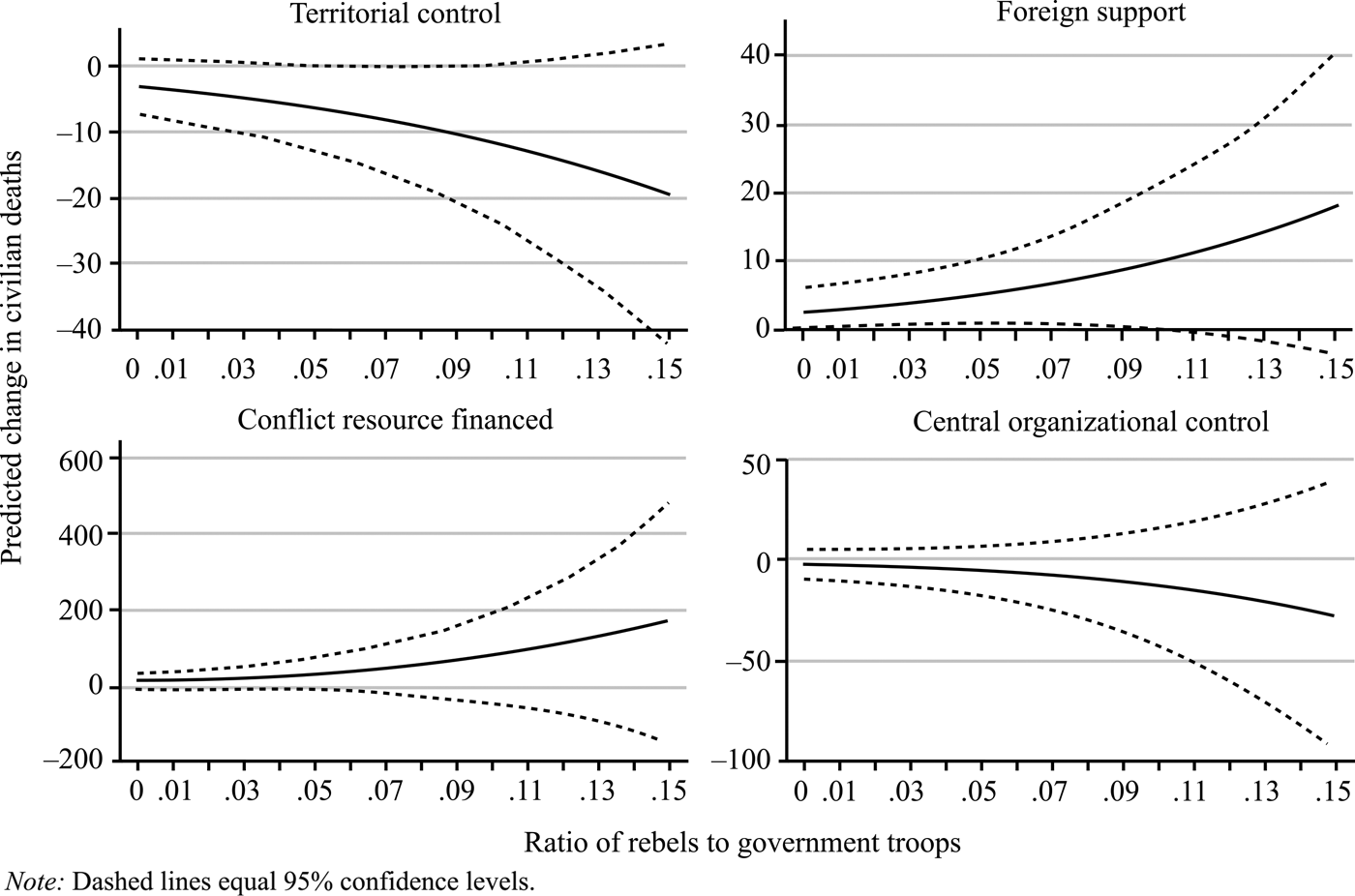
H2 to H4 propose that loss is conditioned by specific factors, and the inclusion of the interaction term in the empirical model asserts this statistically. It is therefore not useful (and potentially incorrect) to infer statistical or substantive effects from either the constituent term coefficient or from those on the interaction terms.Footnote 44 As such, I estimate the marginal effects for the hypothesized interactions and illustrate them in Figure 4.Footnote 45 The graphs included in the figure correspond directly to Models 3 to 6 in Table 3. Each panel illustrates the difference between expected one-sided violence by groups that possess the specified characteristics over the range of recent rebel losses compared with those that do not.
Marginal effects for interactions

The first panel illustrates the effect of territorial control. Based on the confidence intervals shown here, the difference between the two group types does not become statistically significant until a loss rate of approximately 3 percent per month and then remains significant until roughly 10 percent per month—the window in which the upper bound of the confidence intervals is below the zero line. At a monthly loss rate of 3 percent groups that maintain effective territorial control are predicted to kill approximately seven fewer civilians per month than those that lack such control. At a loss rate of 10 percent per month the difference increases to approximately eleven fewer civilians. This result provides some support for H2, which suggested a conditioning influence of territorial control on the relationship between rebel troop losses and civilian victimization.
The second panel illustrates the influence of foreign sponsorship on the relationship between victimization and monthly troop losses. Although neither the rebel troop loss variable nor the interaction term are statistically significant according to the results presented in Table 3, the marginal effects reported here suggest that a window of losses exists in which the two group types are in fact statistically different from one another.Footnote 46 Specifically, at a loss rate up to 11 percent foreign sponsorship exerts a statistically significantly conditioning influence on rebel violence. In substantive terms, when no rebel troops were killed in the previous month, rebels with foreign support are expected to kill approximately five more civilians than those groups not supported by a foreign government. This difference increases to roughly twelve deaths at a loss rate of 11 percent. This result provides support for the H3a. Foreign sponsorship therefore exerts a significant exacerbating influence on the relationship between rebel losses and civilian targeting.
Despite the marginally significant coefficient for the interaction term, the third panel reveals only weak support for the conditioning influence of conflict financing. The lower bound of the confidence interval hugs the zero line between 0 percent and 3 percent before dropping noticeably below it. This result provides little support for H3b. The last panel demonstrates the influence of strong central organization on group violence. According to the graph, at no point along the range of loss values presented does the variable exert a statistically significant effect. Consequently, there is no support for the logic that stronger organizational capacity dampens rebel violence following losses. The results presented in this study therefore provide modest support for two of the corollary hypotheses while failing to provide convincing evidence for the other two.
Turning quickly to the controls, the results suggest that victimization increases as conflict intensity increases. They also suggest that—at least in Africa—secessionist conflicts produce lower levels of intentional civilian deaths compared with revolutionary conflicts. The coefficient for the lagged government victimization variable is positive and significant in most specifications, providing some support for the argument that conflict violence is often reciprocal. As in the microlevel analysis, civilian targeting tends to increase as conflict duration increases. A few of the characteristics hypothesized to condition the effect of rebel losses exert an independent influence on violence according to the results from Model 2. Territorial control exerts a marginal reductive effect on rebel violence whereas both foreign support and resource financing exert a positive and significant influence. There is no evidence that organizational structures independently influence violence.
Conclusion
The results from both the micro- and macrolevel analyses provide preliminary evidence that rebels are increasingly likely to target civilians following significant material losses. The argument proposed that this empirical relationship likely results from rebels' inability to satisfy acute resource demands created by substantial material losses. Where rebels are unable to contract with civilians for the provision of resources, they engage in looting or coercive violence to acquire necessary goods and services.
Although looting and coercive violence are common methods of resource extraction, they are neither the group's sole strategic options nor the inevitable outcome, even in the wake of major setbacks. Rebels might choose alternative strategies such as offering additional resources to civilians in exchange for support, shift their ideological position closer to those of civilians, or attempt to otherwise improve their relations with civilians. However, the constraints imposed by losses often complicate or preclude less coercive methods of resource extraction. As previous research suggests, perceptions of group strength, which are correlated with the likelihood of victory, and the credible provision of resources are the factors most likely to attract civilian support. Consequently, ideological appeals, promises of future benefits, and improved behaviors are likely to carry little weight among civilians where rebels have recently suffered major losses.
The logic presented in this study also suggests that factors that facilitate bargaining with civilians should diminish the odds of rebel violence. Indeed, as the macrolevel analysis suggests, additional factors may mitigate this relationship. Where groups control territory or where they are already heavily reliant on civilian support, the influence of material loss is likely muted, thereby constraining victimization. By contrast, groups funded by alternative resource streams—and that are therefore less likely to possess strong social connections to civilians—are generally more likely to target civilians following losses.
Despite the consistency in these results, they present only correlational evidence for the relationship between loss and violence and cannot fully evaluate the extent to which bargaining failure contributes to rebel violence. Assessing whether postdefeat violence results from failed civilian-insurgent bargaining, an attempt to signal resolve or to impose costs on the regime,Footnote 47 battlefield frustration, or some other mechanism would be quite challenging. However, a fuller understanding of the underlying mechanisms driving this relationship would benefit both theorists of political violence and policy-makers and practitioners interested in ameliorating the human costs of civil war. For instance, better tests of the proposed mechanisms could help illuminate potential strategies for reducing such violence. Advances in data collection and the movement toward microlevel analysis of conflict have allowed researchers to get closer to the action and to improve our understanding of conflict dynamics over space as well as time. That said, future research in the form of fine-grained case analyses, survey-research conducted in areas recently afflicted by conflict violence, and agent-based modeling approaches that directly model complex interactions in a dynamic environment could help further tease out and test the underlying mechanisms that drive violence.
Despite these limitations, the discussion and results highlight the importance of accounting for conflict interactions and other dynamic elements of the conflict environment in explanations of civilian targeting. As the microlevel analysis demonstrated, static factors and initial conditions may predispose actors to violence or restraint, but changes in the conflict landscape heavily influence temporal and spatial variations in violence. Future research in this area is likely to prosper by further examining the interaction of organizational or structural factors and conflict dynamics. Although the measures of insurgent characteristics used in this article are among the most current and most nuanced available, they are nonetheless crude proxies for difficult-to-measure features. More refined measures would allow researchers to better evaluate these mechanisms and assess how organizational and strategic factors interact to produce conflict violence.
Finally, these findings have potentially important policy implications. The results suggest that successful counterinsurgency operations or other efforts to thwart brutal nonstate actors may produce unexpected consequences. As the events surrounding both Operation Iron Fist in 2002 and the Garamba Offensive in 2008–2009 demonstrated, attacks that deal heavy blows to insurgents but ultimately fail to defeat them may exacerbate civilian victimization. This is consistent with previous research that suggests that biased interventions or even peacekeeping missions may create incentives for rebels to attack civilians.Footnote 48 Such findings are disheartening given that they suggest that there is indeed a high cost to defeating rebellion, even where the government attempts to limit the costs of its own counterinsurgency operations on the population. These results highlight the need for state governments, international organizations, and nongovernmental organizations (NGOs) involved in peacekeeping missions and other foreign interventions to devise strategies to better protect civilians from the potential backlash they might inadvertently create.