Problem gambling is defined by the American Psychiatric Association DSM-IV-TR as ‘. . . persistent and recurrent maladaptive gambling behaviour that disrupts personal, family and vocational pursuits’ (American Psychiatric Association, 2000) and has been identified as an addictive disorder with similarities to substance use disorders in terms of neurocognitive and physiological pathways (Potenza, Reference Potenza2006; Saunders & Cottler, Reference Saunders and Cottler2007). The ubiquity of different forms of gambling, including online and community-based electronic gaming machines (EGMs), makes gambling readily accessible (Petry & Hodgins, Reference Petry and Hodgins2012). It is also a serious public health concern at an international level where population prevalence rates average 2% or more, and occurs more frequently in younger populations (Becona, Reference Becona1996; Bondolfi, Osiek, & Ferrero, Reference Bondolfi, Osiek and Ferrero2000; Delfabbro, Reference Delfabbro2009; Shaffer & Hall, Reference Shaffer and Hall2001; Wardle et al., Reference Wardle, Sproston, Orford, Erens, Griffiths, Constantine and Pigott2007; Wong & Ernest, Reference Wong and Ernest2003). Comorbid mental health disorders such as depression and anxiety are common in both treatment-seeking and general populations of problem gamblers (Lorains, Cowlishaw, & Thomas, Reference Lorains, Cowlishaw and Thomas2011).
Research into problem gambling has expanded in the past 10 to 15 years and findings have become more accessible in the public domain, including those from treatment efficacy studies (Hodgins, Stea, & Grant, Reference Hodgins, Stea and Grant2011; Petry & Hodgins, Reference Petry and Hodgins2012). Treatment approaches are similar to those for other addictions and include psychological, peer-support, and pharmacological interventions (Daughters, Lejuez, Lesieur, Strong, & Zvolensky, Reference Daughters, Lejuez, Lesieur, Strong and Zvolensky2003; Jackson, Thomas, & Blaszczynski, Reference Jackson, Thomas and Blaszczynski2003). To date, the best evidence for gambling treatments exists for psychological interventions where variations of cognitive–behavioural therapy (CBT) have been the most researched (Gooding & Tarrier, Reference Gooding and Tarrier2009). The current CBT evidence base has been endorsed as ‘. . . trusted to guide practice in most situations’ using NHMRC (National Health and Medical Research Council) assessment grades for developers of guidelines (Problem Gambling Research and Treatment Centre [PGRTC], 2011).
The theoretical underpinnings of CBT include cognitive and psychobiological processes that are two dominant approaches to explaining gambling disorders (Clark, Reference Clark2010). The cognitive approach is based on the principle that problem gamblers hold erroneous perceptions of randomness; erroneous beliefs (e.g., ‘luck helps me win’) and inaccurate perceptions (e.g., ‘gambling makes things better for me’; Ladouceur et al., Reference Ladouceur, Sylvain, Boutin, Lachance, Doucet, Leblond and Jacques2001; Raylu & Oei, Reference Raylu and Oei2004) which are rewarded, learned, and become habitual. Evidence for this approach has come predominantly from ‘think aloud’ techniques where gamblers have verbalised their perceptions and beliefs during gambling activities (Gadboury & Ladouceur, Reference Gadboury and Ladouceur1989). Cognitive therapy (CT) for problem gambling focuses on teaching the concept of randomness, increasing awareness of inaccurate perceptions and restructuring erroneous gambling beliefs (Ladouceur et al., Reference Ladouceur, Sylvain, Boutin, Lachance, Doucet, Leblond and Jacques2001). Cognitive restructuring plays an important role in CT and has been shown to be clinically efficacious in treating a range of mental health conditions (Beck & Dozois, Reference Beck and Dozois2011).
Treatments that target gambling related psychobiological states (e.g., urge to gamble) are predominantly behavioural (exposure-based; Battersby, Oakes, Tolchard, Forbes, & Pols, Reference Battersby, Oakes, Tolchard, Forbes, Pols, Zangeneh, Blaszczynski and Turner2008; Oakes, Battersby, Pols, & Cromarty, Reference Oakes, Battersby, Pols and Cromarty2008; Tolchard, Thomas, & Battersby, Reference Tolchard, Thomas and Battersby2006). Exposure therapy (ET) is grounded in a classical conditioning paradigm and cue-exposure with extinction processes (e.g., elimination of gambling urge) has been proposed as more beneficial than other types of therapy (e.g., aversive therapy) in treating gambling addiction (Brown, Reference Brown1987). ET has shown to be clinically effective in treating psychological conditions such as post-traumatic stress disorder (PTSD) and specific phobias (Marks, Lovell, Noshirvani, Livanou, & Thrasher, Reference Marks, Lovell, Noshirvani, Livanou and Thrasher1998; Ougrin, Reference Ougrin2011).
Both CT and ET have similar hypothesised mechanisms of therapeutic change in anxiety disorders as they do in gambling disorders (Battersby et al., Reference Battersby, Oakes, Tolchard, Forbes, Pols, Zangeneh, Blaszczynski and Turner2008). ET and CT have been shown to be equally effective in the treatment of PTSD, obsessive–compulsive disorder (OCD) and panic disorder (PD). It has been suggested that CT is superior to ET in the treatment of social phobia, although findings are limited due to heterogeneity between studies including therapy-specific expertise of individual research groups and modality of treatment (individual vs. group; Ougrin, Reference Ougrin2011).
CBTs for problem gambling typically comprise a combination of ET and CT techniques based on an ostensible evidence base (e.g., Carlbring, Jonsson, Josephson, & Forsberg, Reference Carlbring, Jonsson, Josephson and Forsberg2010; Dowling, Reference Dowling2006; Raylu & Oei, Reference Raylu and Oei2012). While CBT in general has shown to be clinically superior to control conditions such as wait-list groups (Dowling, Reference Dowling2006) and self-help groups (e.g., Gamblers Anonymous [GA]; Petry et al., Reference Petry, Ammerman, Bohl, Doersch, Gay, Kadden and Steinberg2006), there remains uncertainty as to the validity of evidence for core components of this approach. For example, the most recent review of CBT for gambling disorders suggested CT had an ‘added advantage’ relative to other treatment elements. However, evidence was tentative due to heterogeneity between studies and this may have attenuated the effects of other treatments with comparable importance (Gooding & Tarrier, Reference Gooding and Tarrier2009).
A more recent Cochrane review (2012) of psychological therapies specific to gambling disorders further supported the clinical efficacy of CBT (Cowlishaw et al., Reference Cowlishaw, Merkouris, Dowling, Anderson, Jackson and Thomas2012). Of the 12 studies included for meta-analysis, 3 were focused on CT (Ladouceur et al., Reference Ladouceur, Sylvain, Boutin, Lachance, Doucet and Leblond2003; Ladouceur et al., Reference Ladouceur, Sylvain, Boutin, Lachance, Doucet, Leblond and Jacques2001; Sylvain, Ladouceur, & Boisvert, Reference Sylvain, Ladouceur and Boisvert1997). However, studies with a focus on an exposure-based approach were excluded (McConaghy, Armstrong, Blaszczynski, & Allcock, Reference McConaghy, Armstrong, Blaszczynski and Allcock1983, Reference McConaghy, Armstrong, Blaszczynski and Allcock1988; McConaghy, Blaszczynski, & Frankova, Reference McConaghy, Blaszczynski and Frankova1991) as they did not meet eligibility criteria of having a control condition such as ‘no treatment controls, referral to Gamblers Anonymous and non-specific treatment component controls’ (p. 1). It has been suggested that behavioural therapies are, in general, more parsimonious in terms of delivery than CT (Jacobson et al., Reference Jacobson, Dobson, Truax, Addis, Koerner, Gollan and Prince1996). Therefore it is important that the evidence for these core treatment approaches is elucidated.
The best evidence to inform clinical practice has come from ‘gold standard’ randomised clinical trials (RCTs; Sackett, Rosenberg, Gray, Haynes, & Richardson, Reference Sackett, Rosenberg, Gray, Haynes and Richardson1996). However, clear conclusions are often difficult to draw due to a common lack of transparency in reporting RCT findings which ‘compounds problems arising from poor methodology’ (Moher et al., Reference Moher, Hopewell, Schulz, Montori, Gøtzsche, Devereaux and Altman2010, p. 1). In response to this and in order to improve the reporting of parallel group randomisation trials and enable readers to critically appraise the validity of findings, an international group of experts including journal editors, clinical epidemiologists and statisticians developed CONsolidated Standards Of Reporting Trials (CONSORT; Begg et al., Reference Begg, Cho, Eastwood, Horton, Moher, Olkin and Stroup1996). Since inception in 1996, the checklist has been shown to be associated with significant improvement in reporting of RCTs (Plint et al., Reference Plint, Moher, Morrison, Schulz, Altman, Hill and Gaboury2006) and has evolved with revisions in 2001 (Moher, Schulz, & Altman, Reference Moher, Schulz and Altman2001) and Reference Moher, Hopewell, Schulz, Montori, Gøtzsche, Devereaux and Altman2010 (Moher et al., Reference Moher, Hopewell, Schulz, Montori, Gøtzsche, Devereaux and Altman2010). CONSORT has been extended for appraisal of cluster randomised trials (Campbell, Elbourne, & Altman, Reference Campbell, Elbourne and Altman2004), non-inferiority and equivalence randomised trials (Piaggio, Elbourne, Altman, Pocock, & Evans, Reference Piaggio, Elbourne, Altman, Pocock and Evans2006), non-pharmacological treatments (Boutron, Moher, Altman, Schulz, & Ravaud, Reference Boutron, Moher, Altman, Schulz and Ravaud2008) and is endorsed by ‘many journals, influential editorial groups, such as the World Association of Medical Journals, and translated into several languages’ (http://www.consort-statement.org/).
The objective of this study is to review existing evidence from randomised clinical trials on the following research question. Among problem gamblers (population), how accurate and valid is the evidence base on cognitive and exposure-based therapies in terms of the CONSORT checklist for randomised trials of non-pharmacologic treatment (Boutron et al., Reference Boutron, Moher, Altman, Schulz and Ravaud2008). It is also hypothesised that an improvement in the reporting of RCTs concerning these therapies is associated with the introduction of CONSORT in 1996.
Methods
Data Sources
The search for primary studies used the OVIDSP interface with two databases (MEDLINE and psycINFO) from inception to September 2012. A list of keywords and MeSH terms were generated to identify studies of cognitive and/or behavioural treatments for gambling disorders. Keywords used for the search were the union of gambling disorders/problem gambling/pathological gambling intersected with the union of cognitive therapy/behaviour therapy/cognitive behaviour therapy and related terms. Appendix A provides search terms for PsycINFO; the same keywords were used for MEDLINE, and MeSH terms were adapted for this database. Limitations were imposed restricting the searches to studies written in the English language and those involving a systematic review, meta-analysis, quantitative study, or treatment outcome/randomised clinical trial. An additional manual search was conducted of reference lists within full-text articles that were assessed for eligibility, systematic reviews and meta-analyses identified in the database search. The Guideline for Screening, Assessment, and Treatment in Problem Gambling approved by NHMRC for clinical practice guidelines was also downloaded (http://www.med.monash.edu.au/assets/docs/sphc/pgrtc/guideline/problem-gambling-guidelines-web.pdf) and further manual searches of the associated references were conducted. Finally, the Cochrane Library was also searched for reviews involving psychological treatments of gambling disorders. The results from the search were then merged within reference management software (EndNote X4).
Study Selection
The titles and abstracts of the studies identified through the aforementioned searches were assessed by one author (DS). Eligibility criteria for initial study inclusion were based on the Cochrane Handbook for Systematic Reviews (Higgins & Green, Reference Higgins and Green2011) in the following order of importance: published, or in press, in a refereed journal; participants were treated for a primary gambling disorder including pathological gambling and problem gambling in either an inpatient or outpatient setting (Hodgins, et al., Reference Hodgins, Stea and Grant2011); at least one intervention comprising a cognitive, behavioural, or combined cognitive–behavioural approach; allocation of participants to either treatment and control or to two or more active treatments including non-inferiority, equivalence, factorial, cluster, and crossover trials. No criterion relating to random allocation of participants was included at initial screening due to the potential of being unstated in a study abstract or title.
The full text of selected reports were then retrieved and independently examined by two authors (DS, KD) for compliance with eligibility criteria for inclusion in the final review. The criteria were specific to the administration of an ET or CT approach to a primary gambling disorder. Only randomised trials involving at least one of these approaches were included. Modality of treatment delivery was limited to face-to-face, either individual or group format and conducted in outpatient or inpatient settings. No limitations were placed on the theoretical nature of comparative treatments or control conditions. ET was operationalised as a treatment that substantially involved problem gamblers being exposed to gambling-related stimuli, using either imaginal or in vivo procedures, with the aim of reducing or extinguishing psycho-physiological responses such as urge or craving to gamble (Battersby et al., Reference Battersby, Oakes, Tolchard, Forbes, Pols, Zangeneh, Blaszczynski and Turner2008). CT was operationalised as any treatment that predominantly comprised a systematically structured intervention designed to alter participants’ erroneous thoughts and belief structures specific to gambling, with the aim of facilitating the development of a more functional set of gambling-related cognitions (Ladouceur et al., Reference Ladouceur, Sylvain, Boutin, Lachance, Doucet, Leblond and Jacques2001). Any disagreements about the eligibility of a study were resolved by discussion between authors. Details of studies that passed initial screening and then subsequently excluded were recorded.
All full-text articles that met eligibility criteria were independently appraised by two authors (DS, KD). The CONSORT guidelines for randomised trials of non-pharmacologic treatment (Boutron et al., Reference Boutron, Moher, Altman, Schulz and Ravaud2008) were used in conjunction with more recent CONSORT guidelines for reporting parallel group randomised trials (Moher et al., Reference Moher, Hopewell, Schulz, Montori, Gøtzsche, Devereaux and Altman2010) in order to critically assess the accuracy and validity of results reported within each study. Where relevant, CONSORT extensions for other classes of trial design (non-inferiority, equivalence, factorial, cluster, and crossover trials) were also used concomitantly. The CONSORT for non-pharmacological treatments was developed as a guide for scientific reports of interventions such as surgery, rehabilitation, and psychological therapies. The checklist comprises 23 items to assist in the identification of key pieces of information ideally embedded in the title, abstract, introduction, methods, results, and discussion and essential to the evaluation of the internal and external validity of reported findings. CONSORT statements for parallel group randomised trials as well as extensions are available at http://www.consort-statement.org/. For each study included in this review, individual CONSORT items were rated as either ‘absent’, ‘present with some limitations’, or ‘present’.
Data Analysis
Statistical analyses were conducted using Stata 12.0 (StataCorp, 2011). Frequencies of ratings for CONSORT items (absent, present with some limitations, and present) were calculated for each article along with an average rating for all articles. Fisher's exact tests were conducted on cross-classification frequencies to identify any significant associations between ratings and CONSORT sections (title and abstract, background, methods, results, and discussion), year of publication and therapy type. A significance level of 5% was used.
Results of Search
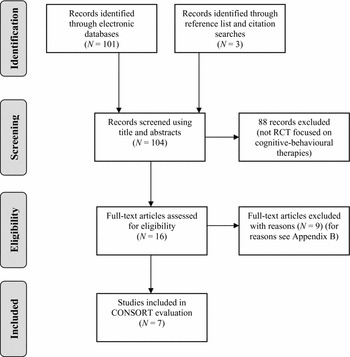
The search resulted in a deduped set of 104 citations. Systematic searches yielded seven papers (RCTs) for CONSORT evaluation (Figure 1). One study comprised of a treatment with both cognitive restructuring and behavioural components (problem-solving training and social-skills training; Sylvain et al., Reference Sylvain, Ladouceur and Boisvert1997). However, authors made explicit that the central focus of treatment was correction of erroneous gambling-related cognitions and therefore the study was included in this review. Reasons for study exclusion are provided in Appendix B.
Selection of studies

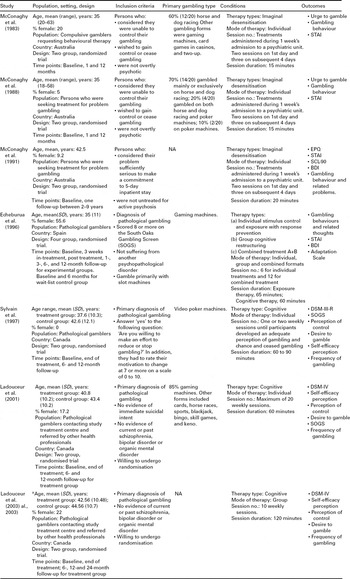
The seven included studies are summarised in Table 1. Three were conducted in Australia using imaginal desensitisation and published between 1983 and 1991 (McConaghy et al., Reference McConaghy, Armstrong, Blaszczynski and Allcock1983, Reference McConaghy, Armstrong, Blaszczynski and Allcock1988; McConaghy et al., Reference McConaghy, Blaszczynski and Frankova1991), one in Spain (1996) comprising of individual and combined cognitive restructuring (CT) and in vivo exposure with response prevention (Echeburua, Baez, & Fernandez-Montalvo, Reference Echeburua, Baez and Fernandez-Montalvo1996) and three in Canada with a main focus on CT between 1997 and 2003 (Ladouceur et al., Reference Ladouceur, Sylvain, Boutin, Lachance, Doucet and Leblond2003; Ladouceur et al., Reference Ladouceur, Sylvain, Boutin, Lachance, Doucet, Leblond and Jacques2001; Sylvain et al., Reference Sylvain, Ladouceur and Boisvert1997). The mode of delivery for all ET interventions was individual format and three of these were conducted in an inpatient psychiatric facility (McConaghy et al., Reference McConaghy, Armstrong, Blaszczynski and Allcock1983, Reference McConaghy, Armstrong, Blaszczynski and Allcock1988; McConaghy et al., Reference McConaghy, Blaszczynski and Frankova1991). Cognitive treatments were delivered in outpatient settings for both individual (Ladouceur et al., Reference Ladouceur, Sylvain, Boutin, Lachance, Doucet, Leblond and Jacques2001; Sylvain et al., Reference Sylvain, Ladouceur and Boisvert1997) and group (Echeburua et al., Reference Echeburua, Baez and Fernandez-Montalvo1996; Ladouceur et al., Reference Ladouceur, Sylvain, Boutin, Lachance, Doucet and Leblond2003) formats. All trials reported that participants were randomly allocated to either a treatment or control group. Participants across the studies were drawn from populations with a spectrum of gambling disorders. All CT interventions were based on clinician-diagnosed pathological gambling at study screening (Echeburua et al., Reference Echeburua, Baez and Fernandez-Montalvo1996; Ladouceur et al., Reference Ladouceur, Sylvain, Boutin, Lachance, Doucet and Leblond2003; Ladouceur et al., Reference Ladouceur, Sylvain, Boutin, Lachance, Doucet, Leblond and Jacques2001; Sylvain et al., Reference Sylvain, Ladouceur and Boisvert1997) as was one of the ET interventions (Echeburua et al., Reference Echeburua, Baez and Fernandez-Montalvo1996). The remaining ET interventions (McConaghy et al., Reference McConaghy, Armstrong, Blaszczynski and Allcock1983, Reference McConaghy, Armstrong, Blaszczynski and Allcock1988; McConaghy et al., Reference McConaghy, Blaszczynski and Frankova1991) were conducted on the strength of self-reported problem gambling. The proportion of males across study samples ranged from 44.4% to 100%, with an overall average of 81.6%. The main type of gambling reported was gaming machines in three studies (Echeburua et al., Reference Echeburua, Baez and Fernandez-Montalvo1996; Ladouceur et al., Reference Ladouceur, Sylvain, Boutin, Lachance, Doucet, Leblond and Jacques2001; Sylvain et al., Reference Sylvain, Ladouceur and Boisvert1997), horse and dog racing in two studies (McConaghy et al., Reference McConaghy, Armstrong, Blaszczynski and Allcock1983, Reference McConaghy, Armstrong, Blaszczynski and Allcock1988), and no information was provided in two studies (Ladouceur et al., Reference Ladouceur, Sylvain, Boutin, Lachance, Doucet and Leblond2003; McConaghy et al., Reference McConaghy, Blaszczynski and Frankova1991).
Summary of Included Studies

Note: Abbreviations: DSM-III-R, Diagnostic and Statistical Manual of Mental Disorders (3rd ed., rev.); DSM-IV, Diagnostic and Statistical Manual of Mental Disorders (4th ed.); STAI, Spielberger State-Trait Anxiety Inventory; EPQ, Eysenck Personality Questionnaire; SCL-90, Symptom Checklist-90; BDI, Beck Depression Inventory; SOGS, South Oaks Gambling Screen. aMean (SD) age reported for treatment completers only.
Validity of Evidence
Following the independent CONSORT ratings conducted by two authors, comparisons of scores revealed some areas of disagreement, mainly within the background and discussion sections. Following discussions and, where necessary, the involvement of a third author (PH), final consensus was achieved.
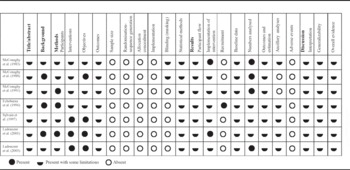
Table 2 shows the final ratings for each study across all 23 CONSORT items. The frequency of items rated as ‘absent’ per study ranged from 6 to 7 (26.09–30.43%), with an average of 6.86 (29.83%) rated as ‘absent’. The frequency of items rated as ‘present with some limitations’ per study ranged from 11 to 14 (47.83–60.87%), with an average of 13.14 (57.13%) rated as ‘present with some limitations’. The frequency of items rated as ‘present’ ranged from 2 to 5 (8.70–21.74%), with an average of 3 (13.04%) rated as ‘present’.
Evaluation of Included Treatment Studies Using the 23-item CONSORT Checklist for Non-Pharmacologic Interventions

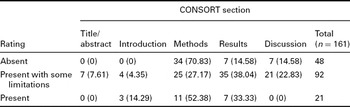
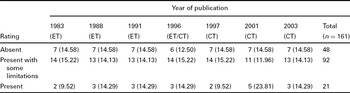
Table 3 presents the results of comparisons between rating categories and CONSORT section using cross-classification analysis, and indicated there was a significant association (p < .001). Across all studies, 70.83% of items rated as ‘absent’ were in the methods section. A consistent issue was that the terms ‘randomly assigned’ (Echeburua et al., Reference Echeburua, Baez and Fernandez-Montalvo1996; Ladouceur et al., Reference Ladouceur, Sylvain, Boutin, Lachance, Doucet and Leblond2003; Ladouceur et al., Reference Ladouceur, Sylvain, Boutin, Lachance, Doucet, Leblond and Jacques2001; Sylvain et al., Reference Sylvain, Ladouceur and Boisvert1997) or ‘randomly allocated’ (McConaghy et al., Reference McConaghy, Armstrong, Blaszczynski and Allcock1983, Reference McConaghy, Blaszczynski and Frankova1991) were used in the methods section of each study without elaboration about how the random allocation sequence was generated, how allocation was concealed, or how the treatment allocation was implemented. There was no significant association between frequency of rating categories and year of publication (p = .999) (Table 4) or treatment type (p = .981).
The Distribution of Ratings and CONSORT Sections

Note: Values are n (%). P < .001, Fishers exact.
The Distribution of Ratings and Year of Publication

Note: Abbreviations: ET, exposure therapy; CT, cognitive therapy. Values are n (%). P = 0.999, Fishers exact.
Discussion
In this systematic review of randomised controlled trials involving CT and ET for gambling disorders we identified seven studies for appraisal of reported evidence using CONSORT. The studies were published between 1983 and 2003 and conducted across Australia, Canada, and Spain. There was a preponderance of males across samples and mean age ranged from 35 to 45 years. On average, approximately 31% of the 23 CONSORT items were rated as ‘absent’ across studies, and more than 52% rated as ‘present with some limitations’.
Similar to the findings of a broader systematic review of psychological therapies (Cowlishaw et al., Reference Cowlishaw, Merkouris, Dowling, Anderson, Jackson and Thomas2012), a number of methodological shortcomings were also identified in the literature that focused on ET and CT approaches of treatment specific to problem gambling. That is, 71% of the CONSORT items rated as ‘absent’ were specific to the methods section across the studies. None of the studies under examination provided sufficient information about randomisation to allow the reader to assess whether the treatment groups were approximately comparable in terms of known and unknown prognostic factors such as severity of gambling behaviours or comorbid conditions.
Sample sizes were generally small, and although three of the studies (Echeburua et al., Reference Echeburua, Baez and Fernandez-Montalvo1996; McConaghy et al., Reference McConaghy, Armstrong, Blaszczynski and Allcock1983, Reference McConaghy, Armstrong, Blaszczynski and Allcock1988) reported participant groups that were exactly equivalent in numbers, no information was provided on how this was achieved (e.g., blocked randomisation). Such limitations pose a major threat to internal validity and generalisability of trial findings.
The methodological deficits identified were further compounded by the absence of reported sample size calculations and clear differentiation between primary and secondary outcome measures. As different hypotheses and outcome measures require different sample sizes to achieve sufficient power, any conclusions drawn from these studies are limited and should be considered descriptive rather than suggestive of causal inferences.
Only one study reported any blinding status to minimise the possibility of biased influences (McConaghy et al., Reference McConaghy, Armstrong, Blaszczynski and Allcock1983). Although it is impossible to blind therapists or participants to CBT interventions, CONSORT states that unblinded data analysts may introduce bias through the selection of statistical techniques to generate more favourable estimates of treatment effects. However, with a growing number of trial protocols becoming available in the research literature (West, Reference West2012) the reader will be able to assess if data analyses were carried out according to a pre-specified statistical plan (Miller & Stewart, Reference Miller and Stewart2011).
Ideally, clinicians should to be able to research and evaluate the relevance and efficacy of any given treatment in terms of its historical context within the intervention literature. However, in the current review, only one study reported dates for recruitment and follow-up (Echeburua et al., Reference Echeburua, Baez and Fernandez-Montalvo1996), limiting the reader's capacity in this area.
CBTs have continuously developed over the past 50 years or so. Behavioural therapy (BT) emerged as the ‘first wave’ in the 1950s followed by a second wave of CT in the 1970s. A subsequent merger of CT and BT occurred in the late 1980s to early 1990s to become the generic CBT. Since the mid-1990s, a third wave has evolved with a range of approaches, such as acceptance and commitment therapy (ACT), cognitive behavioural analysis system of psychotherapy (CBASP) and functional analytic psychotherapy (FAP). While some of these approaches are becoming more and more widely used in clinical interventions, there is currently a relatively low level of evidence providing empirical support (Öst, Reference Öst2008). Based on the studies examined in this review there is potential for gambling treatments to be accepted and applied as ‘gold standard’ ahead of the supporting data.
Research has indicated that there may be harmful effects for some following psychological treatments. For example, in the treatment of Chronic Fatigue Syndrome (CFS), patient organisations reported that CBT worsened symptoms and consequently motivated a safety and effectiveness trial (White et al., Reference White, Goldsmith, Johnson, Potts, Walwyn and DeCesare2011). A previous survey of Cochrane reviews showed that most studies involving drug interventions reported adverse events whereas further improvement was generally required for non-pharmacological interventions (Hopewell, Wolfenden, & Clarke, Reference Hopewell, Wolfenden and Clarke2008). Commensurate with this, none of the studies included in the current review reported on adverse events, rendering it difficult to consider the risk associated with these treatments in a meaningful way (Moher et al., Reference Moher, Hopewell, Schulz, Montori, Gøtzsche, Devereaux and Altman2010). Similarly, reporting of adverse events in the treatment of conditions that are commonly comorbid with gambling disorders (such as major depression) is often limited (Jakobsen, Hansen, Simonsen, Simonsen, & Gluud, Reference Jakobsen, Hansen, Simonsen, Simonsen and Gluud2012). This is an important consideration as treatments specific to gambling disorders have potential for negative effects. For example, patients engaged in imaginal and in vivo exposure tasks are more vulnerable to harmful gambling behaviour due to increased urge levels (Sharpe & Tarrier, Reference Sharpe and Tarrier1992) and appropriate management strategies need to be employed.
The findings of this literature review did not support the hypothesis that there would be an improvement in the reporting of RCTs concerning CT and ET in association with the introduction of CONSORT in 1996. The reviewed studies were published between 5 and 25 years before the CONSORT extension for non-pharmacologic treatments became available. However, three studies were published following the first CONSORT for parallel randomised trials in 1996 (Begg et al., Reference Begg, Cho, Eastwood, Horton, Moher, Olkin and Stroup1996). Another recent systematic review also found that reporting of study findings for behavioural interventions (Fink et al., Reference Fink, Parhami, Rosenthal, Campos, Siani and Fong2012) for problem gamblers had not significantly improved over time, although none of the Australian studies involving imaginal desensitisation were included (McConaghy et al., Reference McConaghy, Armstrong, Blaszczynski and Allcock1983, Reference McConaghy, Armstrong, Blaszczynski and Allcock1988; McConaghy et al., Reference McConaghy, Blaszczynski and Frankova1991). Conversely, reporting transparency has been shown to have improved significantly for a range of clinical conditions (e.g., rheumatological diseases, ophthalmology, and obstetrical anaesthesia) where reporting according to CONSORT guidelines has also been adopted (Plint et al., Reference Plint, Moher, Morrison, Schulz, Altman, Hill and Gaboury2006).
The results of this review have important implications for the application of CBTs, perhaps even beyond gambling disorders. While the evidence base has recommended CBT to address gambling disorders in ‘most situations’ (PGRTC, 2011), the data from meta-analyses offered to support this recommendation are clouded due to methodological limitations. Despite the partial evidence for CT and ET, a range of cognitive-behavioural programs that involve a combination of these techniques have become available in recent years (Carlbring et al., Reference Carlbring, Jonsson, Josephson and Forsberg2010; Dowling, Reference Dowling2006; Raylu & Oei, Reference Raylu and Oei2012). It is suggested that more well-designed trials are needed in order that CT, ET, and CBT approaches may continue to be improved and potentially reduce the high dropout rates commonly reported for problem gamblers (Melville, Casey, & Kavanagh, Reference Melville, Casey and Kavanagh2007)
Our systematic review had a number of limitations. Search terms in MEDLINE and psycINFO were limited to English language. There may be other publications reporting randomised trials in non-English languages that could potentially influence the conclusions of this trial. Also, it is possible that some studies were missed due to deviations in article indexing as a result of incomplete reporting; for example, the lack of identification as a randomised trial in the title and abstract. This was accounted for, at least partly, by not including the criterion of randomised trials in the initial screening. Further, there may have been limitations in search terms used in the databases and we may not have fully covered the terminology for cognitive and behavioural (exposure-based) therapies. However, the research team comprised of clinicians with many years of experience in the application of psychological therapies and we are confident that a comprehensive search was achieved.
Only seven reports were identified for evaluation in this review and this represents a small proportion of the gambling intervention literature. This is not surprising considering the relatively nascent stage of research into gambling treatments (Hodgins et al., Reference Hodgins, Stea and Grant2011) and our principal focus on two key therapeutic approaches. The most recent reviews of psychological treatments in general have evaluated randomised designs (n = 14; Cowlishaw et al., Reference Cowlishaw, Merkouris, Dowling, Anderson, Jackson and Thomas2012), and both randomised and nonrandomised designs (n = 26; Fink et al., Reference Fink, Parhami, Rosenthal, Campos, Siani and Fong2012) for gambling disorders. Finally, we did not contact authors of the studies in order to clarify any missing or incomplete details. We believe it would have been counterintuitive to our study objectives to appraise the transparency of published trials that clinicians, policy makers and patients may access and take at face-value.
Conclusion
Randomised trials with low risk of bias are needed for cognitive and exposure-based treatments for problem gambling. To improve the reporting of findings, standardised guidelines such as CONSORT should be used. Future systematic reviews would also benefit from using these guidelines to assess the methodological quality of studies and, if needed, obtain additional information by contacting the authors. This would enable the reader to more accurately and confidently appraise pooled estimates of treatment effects.
Appendix A Search strategy for PsycINFO
1. gambl$.ab,ti. 2. (gambl$ adj3 addict$).ab,ti. 3. (gambl$ adj3 disorder$).ab,ti. 4. (patholog$ adj3 gambl$).ab,ti. 5. (problem$ adj3 gambl$).ab,ti. 6. exp Pathological Gambling/ 7. cbt$.ab,ti. 8. cognitive behavio?r$ therap$.ab,ti. 9. cognitive behavio?r$.ab,ti. 10. (exposure$ adj3 graded).ab,ti. 11. (exposure$ adj3 imaginal$).ab,ti. 12. (exposure$ adj3 in vivo$).ab,ti. 13. (exposure$ adj3 therap$).ab,ti. 14. (exposure$ adj3 treatment$).ab,ti. 15. (implosive adj3 therap$).ab,ti. 16. (extinction$ adj3 response$).ab,ti. 17. (extinction$ adj3 rational$).ab,ti. 18. (extinction$ adj3 urge$).ab,ti. 19. (habituat$ adj3 rational$).ab,ti. 20. (imaginal$ adj3 desensiti?$).ab,ti. 21. (systematic adj3 desensiti?$).ab,ti. 22. (cogniti$ adj3 therap$).ab,ti. 23. (cogniti$ adj3 treat$).ab,ti. 24. (cogniti$ adj3 intervent$).ab,ti. 25. (cogniti$ adj3 technique$).ab,ti. 26. (cogniti$ adj3 restruct$).ab,ti. 27. exp Behavior Therapy/ or exp Cognitive Behavior Therapy/ or exp Cognitive Therapy/ 28. 1 or 2 or 3 or 4 or 5 or 6 29. 7 or 8 or 9 or 10 or 11 or 12 or 13 or 14 or 15 or 16 or 17 or 18 or 19 or 20 or 21 or 22 or 23 or 24 or 25 or 26 or 27 30. 28 and 29 31. 31. limit 30 to (human and english language and (“0830 systematic review” or 1200 meta analysis or 1800 quantitative study or “2000 treatment outcome/randomized clinical trial”))
Appendix B Characteristics of Excluded Studies