

I. INTRODUCTION
The opioid crisis is one of the largest public health problems in the history of the United States.Footnote 1 Over two million people suffer from opioid use disorders.Footnote 2 Of the more than 70,000 drug overdose deaths in 2017, two thirds were related to a prescription or illegal opioid.Footnote 3 The opioid crisis has been declared a public health emergency by the federal government, resulting in a nationwide lawsuit brought by states and municipalities against opioid manufacturers and distributors, whose aggressive marketing of the prescription opioid Oxycontin many believe caused the opioid crisis.Footnote 4
One of the major state-level interventions to combat the opioid crisis has been the implementation of prescription drug monitoring programs (“PDMPs”) by all fifty states and the District of Columbia.Footnote 5 PDMPs collect data on every prescription written for a controlled substance, such as an opioid, and record it in a statewide database.Footnote 6 The information in PDMPs facilitates identification of doctors and pharmacists who may be improperly prescribing or distributing opioids and patients who may be abusing or selling opioids.Footnote 7 By avoiding diversion from legitimate sources and monitoring prescriber and patient activities, PDMPs aim to reduce abuse of controlled substances.Footnote 8 Law enforcement has also taken advantage of PDMPs, using them as a tool in drug and narcotics investigations involving controlled substances.Footnote 9 In federal cases, these records are often obtained by the Drug Enforcement Administration using an administrative subpoena pursuant to Section 876(a) of the Controlled Substances Act.Footnote 10 In some state cases, law enforcement does not need a subpoena and may even have direct access to the state PDMP database.Footnote 11
Defendants and state agencies have challenged searches of PDMPs on Fourth Amendment grounds, arguing that law enforcement’s warrantless access to state PDMP databases violates patients’ reasonable expectation of privacy in records held in PDMPs.Footnote 12 To date, these arguments have been met with mixed results. Some courts have held that there is a reasonable expectation of privacy in prescription drug records,Footnote 13 while others have stated that either there is no expectation of privacy in PDMPsFootnote 14 or that any expectation of privacy is sufficiently diminished to permit warrantless searches.Footnote 15 The Supreme Court has not yet considered a Fourth Amendment challenge to warrantless searches of PDMPs or evaluated whether patients possess a reasonable expectation of privacy under the Fourth Amendment in their prescription drug records.Footnote 16 In the meantime, lower courts still continue to debate and diverge on the issue, putting patient privacy at risk.Footnote 17
This Article argues that patients have a reasonable expectation of privacy under the Fourth Amendment in their prescription drug records held in PDMPs and no exceptions to the Fourth Amendment’s probable cause and warrant requirements apply. Because of patients’ recognized privacy interest in medical records, including prescription drug records, the disclosure of prescription information to third-party medical professionals does not trigger the third-party doctrine.Footnote 18 Privacy and confidentiality are central to the physician-patient relationship, and such an application of the third-party doctrine would undermine that trust and impede patients’ access to health care.Footnote 19 Further, neither the administrative search exception nor the special needs exception permit law enforcement to access PDMPs without probable cause or a warrant.Footnote 20 Health care is not one of the few industries that has been categorized as closely regulated so as to permit warrantless searches under the administrative search exception and the regulation of medical care does not negate the long history of privacy inherent in the health care profession. Preventing illegal drug use, even in a public health epidemic like the opioid crisis, is not a special need separate from traditional crime control allowing a search without probable cause. Therefore, law enforcement requires both probable cause and a warrant to access records in PDMPs.
This Article proceeds in four parts. Part II reviews the background of the opioid crisis, the Controlled Substances Act, and PDMPs. Part III introduces the Fourth Amendment framework and cases considering an individual’s expectation of privacy in prescription drug records and PDMPs. Part IV argues that no exceptions to the probable cause and warrant requirements apply to searches of PDMPs and therefore, the Fourth Amendment requires law enforcement to have probable cause and a search warrant before accessing PDMPs. Part V concludes with thoughts on the future of patient privacy in the opioid crisis. Ultimately, this Article argues for heightened Fourth Amendment protections of prescription drug records in PDMPs to adequately protect patient privacy interests and access to health care.
II. BACKGROUND
The opioid crisis is only America’s latest confrontation with drug abuse.Footnote 21 For years, the United States has been working to eradicate illicit drug use and abuse through state and federal programming.Footnote 22 This Part provides background on the opioid crisis PDMPs. Section A describes relevant provisions of the Controlled Substances Act, the main drug enforcement statute that currently authorizes warrantless access to records in federal narcotics investigations. Section B introduces the opioid crisis in the context of drug enforcement and regulation in the United States. Section C defines PDMPs and explains their structure, function, and regulation. Section D explains the how law enforcement uses and accesses the data held in PDMPs.
A. The Controlled Substances Act
The United States has been working for decades to prevent illicit drug and narcotics abuse and distribution.Footnote 23 In 1970, Congress passed the Controlled Substances Act (“CSA”)Footnote 24 with the express purpose of “conquer[ing] drug abuse and [controlling] the legitimate and illegitimate traffic in controlled substances.”Footnote 25 The CSA created the Drug Enforcement Administration (“DEA”) to implement and enforce the law.Footnote 26 Specifically, the CSA granted rulemaking authority and investigatory power, including the power to subpoena records, to the DEA in the space of drugs and narcotics enforcement.Footnote 27
While the CSA targeted illicit drug abuse, not all drugs defined as controlled substances are exclusively recreational.Footnote 28 Many controlled substances have accepted medical uses; in fact, controlled substances comprise thirteen percent of all prescriptions filled in the United States.Footnote 29 Controlled substances are subject to a range of federal and state regulations, including prescription reporting requirements, DEA authorization of prescribers, and limitations on patient refills.Footnote 30
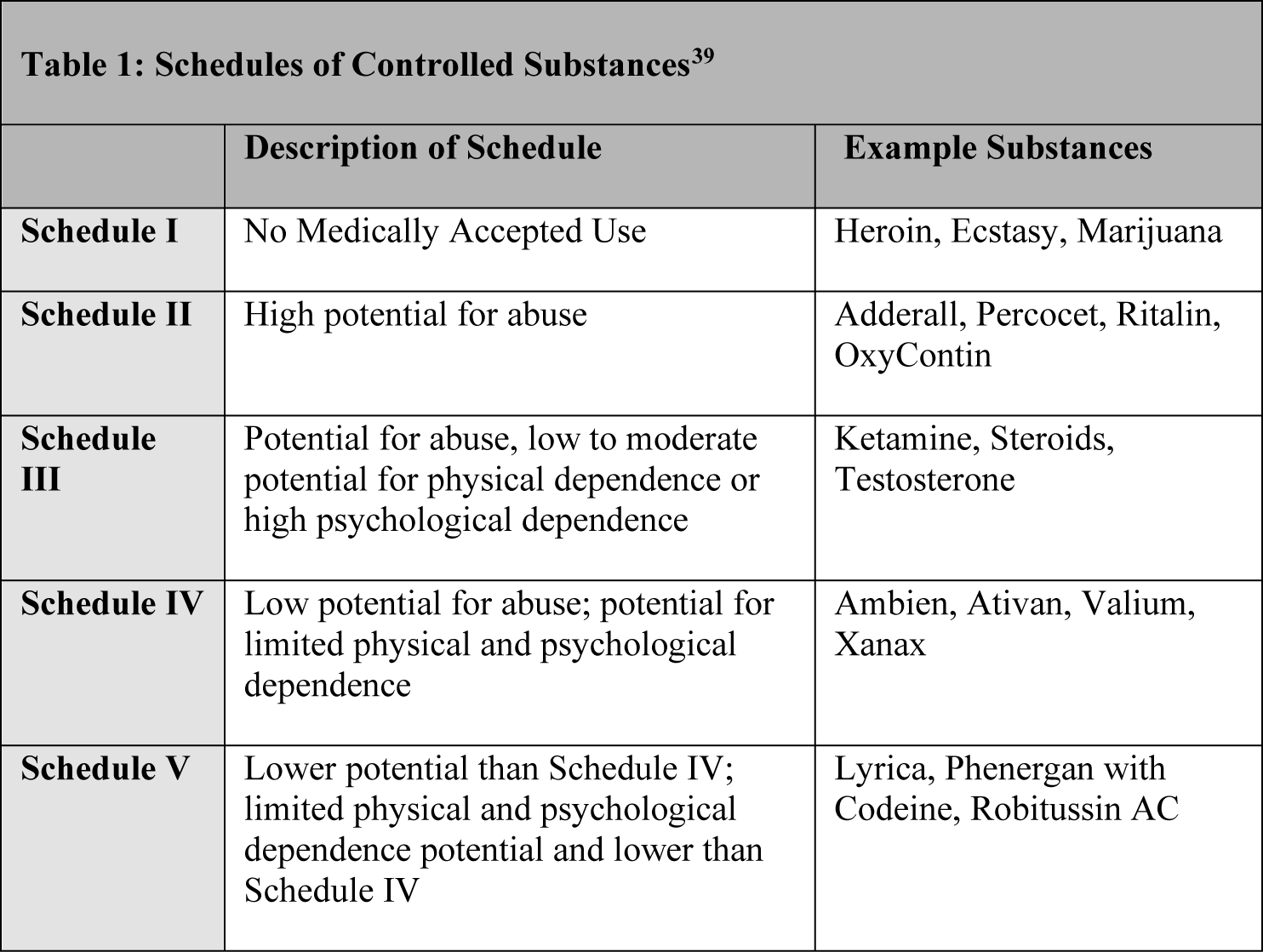
The DEA regulates controlled substances differently “based on their accepted medical uses, the potential for abuse, and their psychological and physical effects on the body.”Footnote 31 The different categories of controlled substances, based on their risk of physical and psychological dependence and their medical uses as described in Table 1, are called “schedules.”Footnote 32 Substances in Schedule I, such as heroin, have no recognized medical use.Footnote 33 Substances in Schedule II, such as prescription opioids, have a high potential for abuse.Footnote 34 Substances in Schedule III have a lesser potential for abuse than Schedule II, a low to moderate potential for physical dependence, and a high potential for psychological dependence; these include ketamine and steroids like testosterone.Footnote 35 Schedule IV controlled substances have a low potential for abuse and a limited potential for physical and psychological dependence; these include many drugs for anxiety and depression.Footnote 36 Schedule V controlled substances have a lower potential for abuse and dependence relative to Schedule IV controlled substances.Footnote 37 Most Schedule V controlled substances are preparations containing limited quantities of narcotics and include Lyrica, Robitussin AC, and Phenergan with Codeine.Footnote 38
Schedules of Controlled SubstancesFootnote 39

B. Opioids and the Opioid Crisis
The group of controlled substances at the center of the current drug abuse crisis is opioids.Footnote 40 Opioids are a class of drugs derived from the poppy plant that control pain and cause feelings of euphoria and sedation.Footnote 41 All opioids are either Schedule I or Schedule II controlled substances.Footnote 42 Opioids with no medical uses, like heroin, are illegal Schedule I controlled substances.Footnote 43 Prescription opioids are categorized in Schedule II.Footnote 44 Common commercial opioid products in the United States include OxyContin, Percocet, Vicodin, and Dilaudid.Footnote 45
In the medical context, opioids are used for the treatment of moderate-to-severe pain.Footnote 46 Opioids are often prescribed for short-term use to patients with acute pain following surgery.Footnote 47 Many patients with chronic pain, nerve diseases, and cancer require opioids for extended periods of time.Footnote 48 Long-term use of opioids is associated with additional risks to patients, especially those with a prior history of addiction.Footnote 49
Opioids are highly addictive: even a short prescription to control pain can result in dependence, with the risk of addiction increasing dramatically after three days of use.Footnote 50 Opioid addiction and abuse pose significant risks to patients and public health.Footnote 51 Improper use of opioids can depress the respiratory system and result in death.Footnote 52 While there have been various regulations and prescribing guidelines implemented to prevent opioid abuse, these have presented their own challenges, including under-prescribing and preventing patients with chronic pain and terminal illness from accessing needed medications.Footnote 53
Different types of opioids have played more significant roles in opioid overdoses and death over the past several decades. In the 1960s and 1970s following the Vietnam War, heroin played the most significant role in opioid abuse.Footnote 54 In the early 2000s, most opioid overdoses were related to prescription opioids.Footnote 55 In recent years, most opioid overdoses have been related to heroin and fentanyl.Footnote 56 Thus, while prescription opioids continue to play a role in opioid abuse and overdose, the opioid crisis today is predominantly a crisis of illegal opioids. Even so, many public health responses continue to focus on prescription opioids.
Both the federal and state governments have taken steps to address the opioid crisis and prevent opioid abuse and overdose. The Trump Administration declared the opioid crisis a public health emergency in October 2017Footnote 57 and instituted the President’s Commission on Combating Drug Addiction and the Opioid Crisis.Footnote 58 Both the Department of Health and Human Services (“HHS”) and the Commission have issued recommendations on how best to address the opioid crisis, including strengthening opioid prescription surveillance and increasing cooperation between federal and state public health and law enforcement agencies.Footnote 59
Many states have also instituted programming to address the opioid crisis.Footnote 60 Several states and municipalities across the country have brought lawsuits against Purdue Pharmaceuticals, one of the manufacturers of prescription opioids, for its contribution to the opioid crisis resulting from marketing practices for OxyContin.Footnote 61 States and other municipalities have also brought lawsuits against several other manufacturers and distributors for their respective conduct contributing to the opioid crisis.Footnote 62 States are also expanding access to naloxone, an overdose reversal drug, and medication assisted therapies, which use medication in addition to behavioral therapies to treat addiction.Footnote 63 Massachusetts in particular has been a leader in its opioid response, adopting legislation aimed at strengthening intervention, harm reduction, education, and access to treatment.Footnote 64
C. Prescription Drug Monitoring Programs
One of the most significant state-level public health interventions targeting the opioid crisis are prescription drug monitoring programs (“PDMPs”). PDMPs are state databases that electronically collect, aggregate, and store data on every prescription written for a controlled substance in the state.Footnote 65 PDMPs collect controlled substance prescription data, typically from physicians or pharmacists within a week of filling the prescription.Footnote 66 Reportable information contained in PDMP records generally includes the patient’s name, address, and date of birth; the drug’s name, amount, and number of refills; and information on the prescribing physician and pharmacy.Footnote 67 This information is aggregated in a centralized statewide database so that health care professionals can reference the database to inform prescribing practices and identify patients who may have or may later develop a substance use disorder.Footnote 68
The adoption of PDMPs has increased in recent decades in response to the opioid crisis.Footnote 69 As of February 2018, all fifty states and the District of Columbia have implemented an operational PDMP to reduce diversion from legitimate sources and abuse of controlled substances.Footnote 70 The structure and regulation of PDMPs varies from state to state. Each state operates its own independent PDMP,Footnote 71 although there is some sharing of information between state PDMPs.Footnote 72 Most PDMPs are run by state departments of health,Footnote 73 although some are operated by law enforcement agencies,Footnote 74 professional licensing boards,Footnote 75 or departments of consumer protection or consumer affairs.Footnote 76 The group of individuals who have access to PDMPs also varies from state to state. Generally, health professionals and certain state health agency employees are given access to PDMPs.Footnote 77 Many states mandate that prescribers and pharmacists register with the PDMP or access the PDMP at regular intervals.Footnote 78
Despite the widespread use of PDMPs across the country, the effectiveness and accuracy of the programs are unclear. Studies have mixed results as to whether PDMPs are effective in deterring or preventing patient opioid abuse. Several studies have found that particularly strong PDMPs were associated with opioids being prescribed in lower dosages and a lower number of opioid prescriptions filled,Footnote 79 a decrease in opioid death rates,Footnote 80 and a decrease in the number of opioid prescriptions written.Footnote 81 Other studies, however, have “found little to no association between program implementation and deaths related to opioid pain relievers.”Footnote 82 A study conducted at Yale University found that PDMPs were only effective in influencing opioid prescribing and abuse if states mandate that physicians check PDMPs prior to writing a prescription.Footnote 83 As utilization of PDMPs has been low,Footnote 84 the potential effectiveness of PDMPs—and the accuracy of the information contained in the databases—may be severely undermined.
D. Law Enforcement Use Of and Access to PDMPs
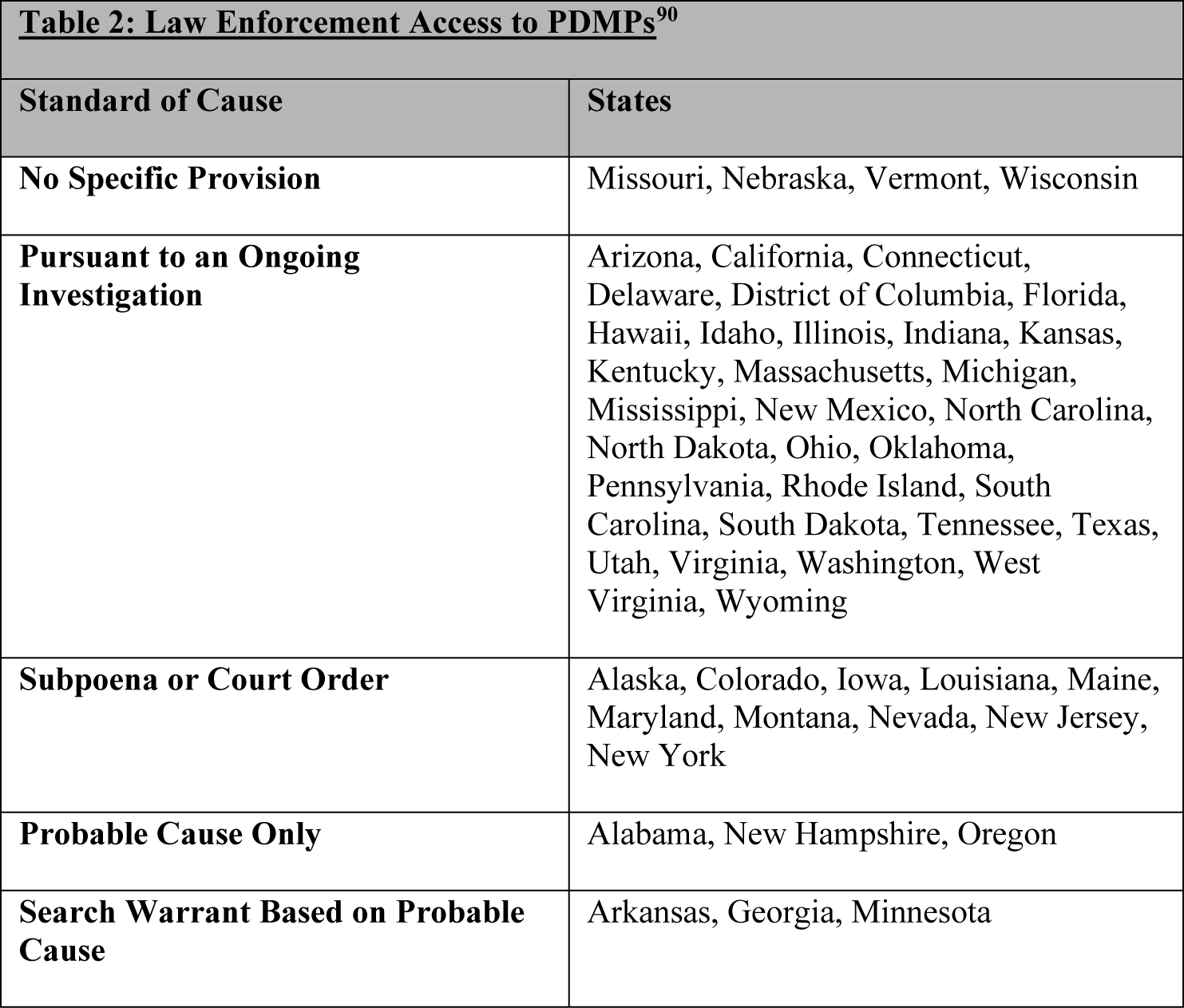
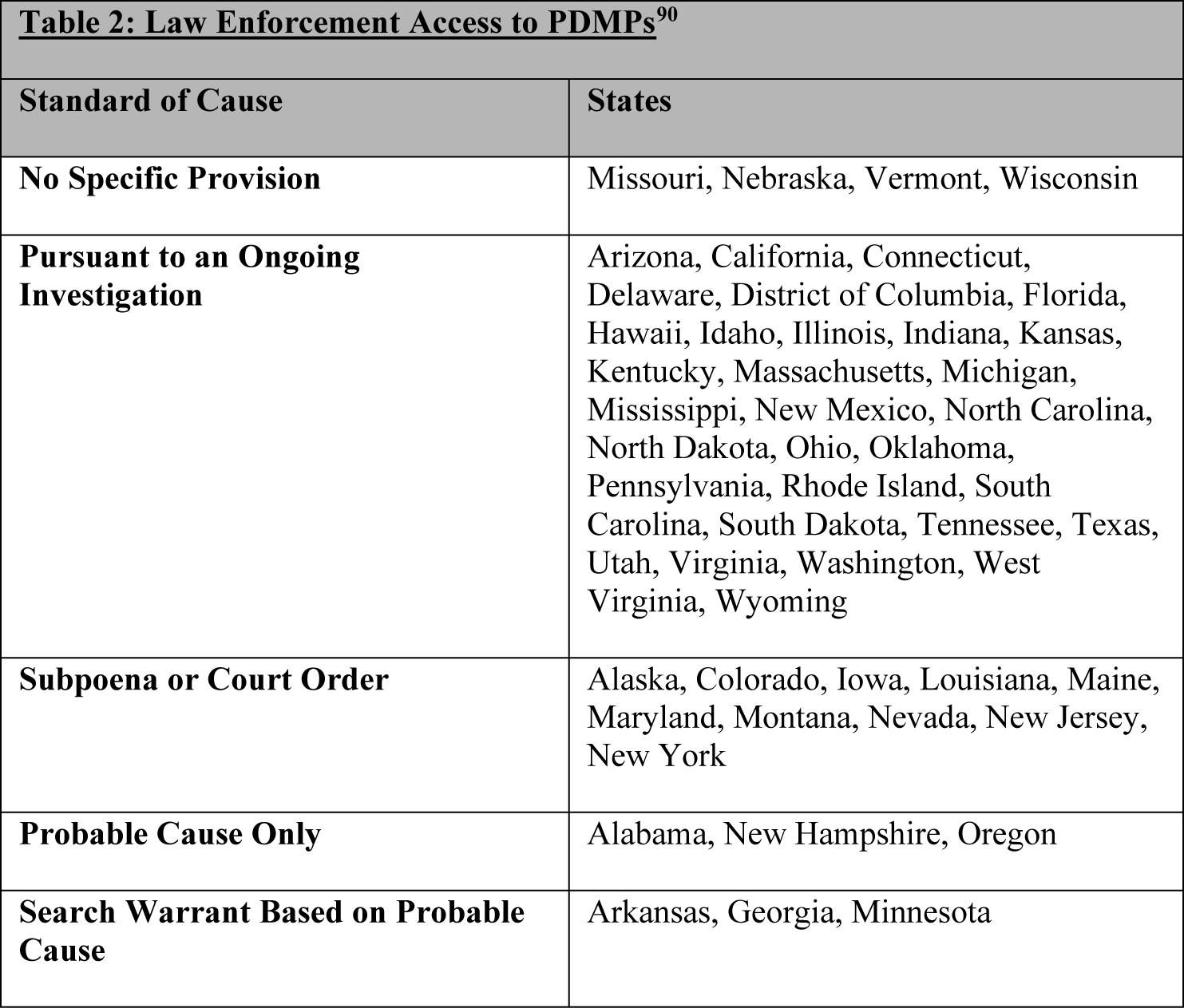
While the primary goal of PDMPs is public health and prescriber-oriented,Footnote 85 PDMPs have been used to aid the government in identifying health care professionals who may be improperly prescribing or distributing controlled substances and patients who may be improperly using or distributing controlled substances.Footnote 86 At least thirty states give law enforcement access to PDMPs under various circumstances.Footnote 87 Some states require the access to the PDMP be related to an ongoing investigation,Footnote 88 while many other states give law enforcement direct access to PDMPs, allowing them to access it at their discretion.Footnote 89 The general standards for law enforcement access to each states’ PDMP are categorized in Table 2.
Law Enforcement Access to PDMPsFootnote 90
Searches of PDMPs have resulted in several cases against physicians for improperly prescribing and patients for distributing opioids and other controlled substances.Footnote 91 PDMPs have proven to be a useful tool for law enforcement; however, their primary public health purpose and the lack of oversight of law enforcement in accessing these databases have raised difficult questions about patient privacy.
III. THE FOURTH AMENDMENT FRAMEWORK APPLIED TO PRESCRIPTION DRUG MONITORING PROGRAMS
Several Fourth Amendment challenges to warrantless searches of PDMPs have already been raised in state and federal courts. This Part introduces the Fourth Amendment framework and the doctrines most applicable to searches of PDMPs. Section A provides an overview of the Fourth Amendment and the relevant exceptions to the probable cause and warrant requirements. Section B summarizes the relevant Supreme Court cases on searches of medical and prescription drug records. Section C reviews lower federal and state court cases considering Fourth Amendment challenges to searches of PDMPs, as well as searches of health and prescription information from other sources, categorizing these decisions based on the expectation of privacy found in the records at issue.
A. THE FOURTH AMENDMENT AND ITS EXCEPTIONS
The Fourth Amendment protects the “right of the people to be secure in their persons, houses, papers, and effects, against unreasonable searches and seizures” and requires that “no Warrants shall issue, but upon probable cause.”Footnote 92 Evidence obtained by law enforcement in violation of the defendant’s Fourth Amendment rights is typically excluded from use in criminal cases.Footnote 93 Whether the evidence was obtained in violation of the defendant’s Fourth Amendment rights depends on two questions: first, did a search or seizure occur; and second, was the search or seizure reasonable?Footnote 94 The contours of each question are described in turn below.
The threshold for Fourth Amendment protection is the occurrence of a search or seizure. A search occurs when a party infringes on an individual’s subjective expectation of privacy that society is prepared to recognize as objectively reasonable.Footnote 95 The Supreme Court has declined to articulate a single test determining whether an expectation of privacy is reasonable, and there is great debate among courts and scholars as to what can and should be included in the analysis.Footnote 96 Theories supporting an expectation of privacy consider the likeliness that law enforcement will discover the information, whether an individual has property rights in the searched material, and whether the information disclosed should be protected based on policy concerns or the particularly sensitive nature of the information disclosed.Footnote 97
With a search having occurred, the second issue remains whether that search was reasonable.Footnote 98 Reasonableness is “measured by examining the totality of the circumstances.”Footnote 99 The Supreme Court has emphasized various factors in reviewing the reasonableness of searches, including the arbitrariness of the search,Footnote 100“the intention of the framers of the Fourth Amendment, the uses to which the individual has put a location, and [] societal understanding that certain areas deserve the most scrupulous protection from government invasion.”Footnote 101
The Supreme Court has repeatedly held that searches conducted without probable cause and a search warrant are “per se unreasonable under the Fourth Amendment—subject only to a few specifically established and well-delineated exceptions.”Footnote 102 These include the third-party doctrine, the administrative search exception, and the special needs exception.
1. Third-Party Doctrine
One of the “well-delineated exceptions”Footnote 103 to Fourth Amendment protection is the “third-party doctrine.”Footnote 104 The third-party doctrine holds that an individual loses a reasonable expectation of privacy in specific information by willingly disclosing that information to another.Footnote 105 Law enforcement can therefore obtain such information without probable cause or a warrant. The Supreme Court has applied the third-party doctrine to confidential informants,Footnote 106 bank records,Footnote 107 and telephone records,Footnote 108 among other contexts.
In recent cases, the Supreme Court has declined to extend the third-party doctrine to cases involving information available only because of significant technological advancement. In United States v. Jones, the Court held that law enforcement’s long-term GPS surveillance of a suspect’s car constituted a search under the Fourth Amendment.Footnote 109 The Court expressed concern over the vast amount of information that a device was able to collect, especially in comparison to the searches capable at the time the Fourth Amendment was written.Footnote 110 Justice Sotomayor, in her concurrence, expressed particular concern over the application of the third-party doctrine in this context, suggesting that the Court may need to completely rethink the third-party doctrine because of the amount of information that could be exposed in the digital age.Footnote 111 Most recently, in Carpenter v. United States,Footnote 112 the Court held that the third-party doctrine did not extend to historical cell-site location information, cell phone location information collected by cell phone providers.Footnote 113 By declining to extend the third-party doctrine and emphasizing the uniqueness and intrusiveness of the data, Chief Justice Roberts, writing for the majority, emphasized that a “person does not surrender all Fourth Amendment protection by venturing into the public sphere.”Footnote 114
2. The Administrative Search and Special Needs Exceptions
Two additional exceptions to the Fourth Amendment’s probable cause and warrant requirements are administrative searches and special needs searches. Administrative searches are searches conducted pursuant to a statutory regime.Footnote 115“The Supreme Court has held that searches for administrative purposes, like searches for evidence of crime, are encompassed by the Fourth Amendment.”Footnote 116 Unlike other searches for evidence, however, administrative searches do not require particularized probable cause, individualized suspicion, or a search warrant.Footnote 117 This is due to the fact that administrative searches are not conducted for criminal purposes but for regulatory compliance.Footnote 118 For an administrative search to be exempt from the probable cause and warrant requirements, it must be: (1) reasonable; (2) conducted pursuant to an administrative regime (not solely for law enforcement purposes); and (3) governing a highly or pervasively regulated industry.Footnote 119 Courts consistently emphasize the third factor as reducing the expectation of privacy, and have categorized liquor, firearms, mining, and automobile junkyards as closely regulated industries under the administrative search exception.Footnote 120
Special needs searches are suspicionless searches conducted by law enforcement pursuant to some special need.Footnote 121 This special need must be distinct from a law enforcement purpose.Footnote 122 Special needs searches are exempt from the Fourth Amendment probable cause and warrant requirements.Footnote 123 The Supreme Court has recognized drug testing at schools and sobriety checkpoints on roads as special needs exempting the probable cause and warrant requirements.Footnote 124 Administrative searches of highly regulated industries have also been found to constitute a special need.Footnote 125 This does not remove Fourth Amendment protection, however, as “when ‘privacy-related concerns are weighty enough’ a ‘search may require a warrant, notwithstanding the diminished expectations of privacy of the [accused].’”Footnote 126
3. Subpoenas
Distinct from the traditional searches under the Fourth Amendment are subpoenas. Subpoenas, a written order for an individual or entity to produce documents, are not held to the same probable cause and warrant requirements of Fourth Amendment searches and seizures.Footnote 127 Instead, subpoenas are only subject to a reasonable relevance standard, not the higher probable cause standard required for warrants.Footnote 128 The reasonable relevance standard requires that subpoenas “be sufficiently limited in scope, relevant in purpose, and specific in directive so that compliance will not be unreasonably burdensome” in order to comport with the Fourth Amendment.Footnote 129 This lower standard has been deemed permissible because subpoenas are less invasive and intrusive than searches (and are therefore sometimes called constructive searches) because they are only seeking records and books, and individuals are able to challenge subpoenas prior to enforcement.Footnote 130
However, the idea that subpoenas are “constructive searches” does not shield them from Fourth Amendment concerns. Even after a subpoena is issued and enforced, individuals can challenge the validity of administrative subpoenas on Fourth Amendment grounds when they can demonstrate a reasonable expectation of privacy in the subpoenaed evidence.Footnote 131
B. The Supreme Court on Health and Prescription Drug Privacy
While the Supreme Court has not considered a Fourth Amendment challenge to searches of prescription drug records, the Court has discussed the constitutionality of public health programs requiring mandatory reporting of prescription drugs, the constitutionality of reporting certain medical information to law enforcement, and the broader application of Fourth Amendment rules in the health care context.
One of the most commonly cited Supreme Court cases in Fourth Amendment challenges to PDMP searches is Whalen v. Roe.Footnote 132 In Whalen v. Roe, patients and physicians challenged a New York state statute which set mandatory reporting requirements for all prescriptions for certain drugs.Footnote 133 The reporting regime essentially made a type of PDMP. Plaintiffs argued that the statute was an unconstitutional invasion of privacy under the Fourteenth Amendment.Footnote 134 The Supreme Court disagreed,Footnote 135 upholding the prescription reporting regime. The Court held that the mere existence of a state database of prescription drug records itself did not constitute a constitutional violation of the right to privacy.Footnote 136 The legitimate public health justifications of the regulation weighed in favor of permitting the invasion of privacy for public health reasons.Footnote 137 While Whalen did not consider a Fourth Amendment challenge, the Court, in its Fourteenth Amendment analysis, “implicitly recognized a right to privacy in prescription records,”Footnote 138 though it did not definitively assert or recognize an expectation of privacy.
The Court later reviewed a Fourth Amendment challenge to searches of medical information in Ferguson v. City of Charleston.Footnote 139 In Ferguson, the state hospitals conducted urine tests of obstetrics patients who were suspected of using cocaine.Footnote 140 Under circumstances delineated in a protocol developed in partnership by the hospital and the Charleston Solicitor, the hospital would report positive test results to law enforcement and the patient would be arrested.Footnote 141 The Court ultimately concluded that the urine test was a search under the Fourth Amendment and reporting the positive test results to law enforcement without patient consent violated the Fourth Amendment.Footnote 142 The Court stated that there is a “reasonable expectation of privacy enjoyed by the typical patient undergoing diagnostic tests in a hospital [] that the results of those tests will not be shared with nonmedical personnel without her consent.”Footnote 143 The long term public health goal did not constitute a special need that waived the probable cause and warrant requirements.Footnote 144
While no other Supreme Court case has addressed the Fourth Amendment protections of health information or the prescription drug information specifically, recent cases have expressed a special concern for the application of Fourth Amendment rules in the health care context. For example, in Riley v. California, Chief Justice Roberts commented that searches of a cell phone “could reveal an individual’s privacy interests or concerns—perhaps a search for certain symptoms of disease, coupled with frequent visits to WebMD.”Footnote 145 In United States v. Jones, Justice Sotomayor, in her concurrence, noted with unease that GPS data could reveal “trips to the psychiatrist, the plastic surgeon, the abortion clinic, [and] the AIDS treatment center.”Footnote 146 Most recently, in Carpenter v. United States, both Chief Justice Roberts for the majority and Justice Gorsuch in dissent worried that cell-site location information could disclose private health and medical information.Footnote 147 The dicta in these opinions may indicate a propensity by the Court to provide additional Fourth Amendment protection to health information,Footnote 148 and potentially PDMPs. These cases may indicate a willingness for courts to provide a greater degree of protection for health information, including prescription drug information held in PDMPs.
C. Federal and State Court Fourth Amendment Challenges to PDMP and Prescription Drug Record Searches
Several federal and state courts have considered Fourth Amendment protections of prescription drug records in a range of contexts.Footnote 149 The holdings of these cases generally fall into three categories regarding the Fourth Amendment expectation of privacy recognized in prescription drug records: finding a reasonable expectation of privacy, a diminished expectation of privacy, or no expectation of privacy. Each of these categories is examined further in the following subsections.
1. Recognizing an Expectation of Privacy in Prescription Drug Records
A “majority of the [federal] Circuit Courts of Appeals have concluded that the constitutional right to privacy extends to medical and prescription records.”Footnote 150 Some of these cases have explicitly considered searches of PDMPsFootnote 151 while others considered searches of pharmacies,Footnote 152 physicians’ offices,Footnote 153 or other repositories of health records.Footnote 154
One of the most prominent PDMP cases is Oregon Prescription Drug Monitoring Program v. U.S. Drug Enforcement Administration.Footnote 155 Prior to this case, the state of Oregon had a policy of not complying with administrative subpoenas from the DEA for information in its PDMPFootnote 156 because the state had a statute deeming the information in the PDMP “protected health information” and requiring that law enforcement have probable cause to access the PDMP.Footnote 157 Oregon challenged two subpoenas for information held in the state’s PDMP—one for information of a patient and the other for the information of two doctors.Footnote 158 The state requested that the district court “determine whether the Supremacy Clause of the United States Constitution and [21 U.S.C.] § 876 [of the Controlled Substances Act] preempt” the Oregon statute.Footnote 159 The American Civil Liberties Union (“ACLU”) intervened representing four patients taking controlled substances and one physician prescribing controlled substances, arguing that warrantless access of the database is a Fourth Amendment violation.Footnote 160
The district court found a reasonable expectation of privacy in the records held in the PDMP.Footnote 161 The patients and doctors demonstrated a subjective expectation of privacy in the PDMP records.Footnote 162 Recognizing this expectation, the court moved to analyzing whether the expectation of privacy was reasonable.Footnote 163 Reasonableness is determined by “weigh[ing] ‘such factors as the intention of the Framers of the Fourth Amendment, the uses to which the individual has put a location, and our societal understanding that certain areas deserve the most scrupulous protection from government invasion.”Footnote 164 The court began by emphasizing the confidentiality associated with the medical profession throughout history, writing, “[m]edical records, of which prescription records form a not insignificant part, have long been treated with confidentiality. The Hippocratic Oath has contained provisions requiring physicians to maintain patient confidentiality since the Fourth Century B.C.E.”Footnote 165
The expectation of privacy was also supported by Ninth Circuit precedent recognizing a “heightened … expectation of privacy for both physician and patient”Footnote 166 and the Supreme Court’s holdings in Whalen v. Roe and Ferguson v. City of Charleston. Based on the long history supporting the expectation of privacy in the physician-patient relationship, the court agreed that “it is more than reasonable for patients to believe that law enforcement agencies will not have unfettered access to their records.”Footnote 167 The use of administrative subpoenas under the CSA was therefore “unreasonable.”Footnote 168
The court also distinguished the search of the PDMP from the third party-doctrine cases based on the voluntariness of the reporting.Footnote 169 Unlike bank and phone records, which are created in the course of a voluntary business relationship, the PDMP reporting is mandated by law; the court recognized that “[t]he only way to avoid submission of prescription information to the PDMP is to forgo medical treatment or to leave the state. This is not a meaningful choice.”Footnote 170 The court concluded that searches of the PDMP pursuant to the DEA’s administrative subpoena power violated the Fourth Amendment.Footnote 171 On appeal, the Ninth Circuit reversed the district court’s decision on standing grounds, making no decision with regard to the expectation of privacy under the Fourth Amendment in the PDMP records.Footnote 172
Other courts have found an expectation of privacy under the Fourth Amendment in prescription drug records or medical records in contexts outside of PDMPs. For example, the Louisiana Supreme Court in State v. Skinner Footnote 173“f[ound] the Fourth Amendment and [the Louisiana Constitution] require a search warrant before a search of prescription and medical records for criminal investigative purposes is permitted.”Footnote 174 The court in Skinner considered a challenge to a subpoena for prescription drug records from pharmacies for a patient suspected of doctor-shopping.Footnote 175 Based on the fact that “[a] majority of the federal Circuit Courts of Appeals have concluded the constitutional right to privacy extends to medical and/or prescription records”Footnote 176 and “Louisiana’s constitutional requirement for a heightened privacy interest for its citizens,” the Louisiana Supreme Court recognized the expectation of privacy as reasonable.Footnote 177
The Fourth Circuit in Doe v. Broderick also required probable cause and a warrant to search a patient’s substance abuse treatment records in a methadone clinic.Footnote 178 Following a jewelry store robbery where the getaway vehicle was stolen in the vicinity of a methadone clinic, Detective Broderick sought, and received, a search warrant for the methadone clinic’s recordsFootnote 179 based on an affidavit that was “nothing more than a guess.”Footnote 180 The warrant was based on nothing other than the affidavit, and thus, law enforcement lacked probable cause. Doe challenged the search as a Fourth Amendment violation.Footnote 181 The Fourth Circuit held that “Doe maintained a legitimate expectation of privacy in his substance abuse treatment records for Fourth Amendment purposes”Footnote 182 and “that Detective Broderick’s search of the clinic’s records and files without probable cause violated Doe’s rights under the Fourth Amendment.”Footnote 183 The analysis made clear that probable cause and a search warrant were required to access these sensitive medical records held by the methadone clinic, records which likely contained extensive information about prescription medication and drug use.
2. Recognizing a Diminished Expectation of Privacy in Prescription Drug Records
Some courts have only recognized a diminished expectation of privacy in prescription drug records. In Lewis v. Superior Court, the California Supreme Court reviewed a challenge to the Medical Board’s obtaining records from the state PDMP, the Controlled Substance Utilization Review and Evaluation System (“CURES”) database.Footnote 184 In the course of investigating Dr. Lewis, a Medical Board investigator obtained records from CURES without authorization, a subpoena, or a warrant.Footnote 185 Dr. Lewis challenged the search as a violation of his patients’ privacy interests under the California constitution.Footnote 186 The court recognized a patient’s expectation of privacy in their prescription drug records, but given the mandatory reporting regime surrounding controlled substances, it asserted “that privacy interest is less robust than the privacy interest associated with medical records.”Footnote 187 As such, no individual cause requirement was required.Footnote 188 Specifically, the court said that delays resulting from patients challenging subpoenas of prescription drug records “would impede the Board’s ability to swiftly identify and stop dangerous prescribing practices.”Footnote 189 Legitimate countervailing government interests in crime control and the limitation on access to the database were found adequate protections permitting the search. Dr. Lewis had forfeited his Fourth Amendment claims,Footnote 190 but the general analysis would likely parallel the state constitutional analysis.
Many courts have agreed with the diminished expectation and provided additional analysis of the administrative search exception. In State v. Welch,Footnote 191 the Vermont Supreme Court reviewed a challenge to law enforcements’ acquisition of Welch’s prescription drug records by calling the pharmacy and asking for the records of original prescriptions, which were maintained by the pharmacy pursuant to state law.Footnote 192 The court recognized an expectation of privacy in these records not based on the physician-patient relationship, as the defendant argued, but on an “expectation that those records cannot be arbitrarily disclosed.”Footnote 193 Notwithstanding the expectation of privacy, however, the search did not require a warrant under New York v. Burger Footnote 194 because pharmacies constitute a “pervasively regulated industry.”Footnote 195 Both the ConnecticutFootnote 196 and OhioFootnote 197 Supreme Courts have also concluded there is a diminished expectation of privacy in prescription drug records due to the administrative regime surrounding prescription drugs, applying similar reasoning to the court in Welch.Footnote 198
In another case recognizing a severely diminished expectation of privacy in pharmacy records, the Nebraska Supreme Court in State v. Wiedeman Footnote 199 applied the third-party doctrine to the acquisition of pharmacy records with a subpoena.Footnote 200 The court explained that a pharmacy customer “had no ownership or possessory interest in the pharmacies from where the records were obtained … [and] the prescription records [were] not [the defendant’s] effects or papers.”Footnote 201 Strictly applying the third-party doctrine, the court emphasized the voluntariness inquiry, saying that “[t]he desire for medical care will not negate the voluntariness of the disclosure to third-party pharmacies.”Footnote 202 This was further supported by the “well-known and long-established regulatory history” of the controlled substances, which the court said “significantly diminishe[d] any societal expectation of privacy against governmental investigation of narcotics prescriptions.”Footnote 203 Therefore, the defendant had no reasonable expectation that her pharmacy records would not be shared upon government inquiry.Footnote 204
3. Recognizing No Expectation of Privacy in Prescription Drug Records
Still other courts have not recognized any expectation of privacy in prescription drug records. In United States Department of Justice Drug Enforcement Administration v. Utah Department of Commerce,Footnote 205 in the course of an investigation into improper prescribing by a physician, the DEA subpoenaed records from Utah’s state controlled substances database.Footnote 206 Utah declined to comply with the subpoena as a warrant was required under state law.Footnote 207 The district court granted the DEA’s request to enforce the administrative subpoenas.Footnote 208 In addition to holding that the state statute was preempted by the federal CSA, the court held that “[p]rescription drugs are a highly regulated industry in which patients and doctors do not have a reasonable expectation of privacy.”Footnote 209 The holding was also based on the third-party doctrine: the expectation of privacy was removed because
[a] patient in Utah decides to trust a prescribing physician with health information to facilitate a diagnosis. In so doing, a patient takes the risk—in this circumstance, a certainty—that his or her information will be conveyed to the government as required by the Database Act.Footnote 210
The fact that the patient had shared their information with any third party, including the doctor from whom the patient sought the prescription, removed any reasonable expectation of privacy under the Fourth Amendment.Footnote 211 As a result of this lack of privacy expectation and the regulatory regime of prescription drugs and reporting, a subpoena was permitted to access the Utah database without violating the Fourth Amendment.Footnote 212
The Kentucky Supreme Court also held there is no reasonable expectation of privacy in PDMPs, applying the administrative search exception and the third-party doctrine.Footnote 213 In Williams v. Commonwealth, the Kentucky Supreme Court considered a challenge to a search of the state PDMP in the course of an investigation of one doctor.Footnote 214 The court specifically held that the investigator’s access of the database was not a search.Footnote 215 Applying the third-party doctrine, the court decided that there was no reasonable expectation of privacy in the PDMP.Footnote 216 It was important that the “data [was] not available to the general public, but rather only to specified personnel who certify that they are conducting a bona fide specific investigation involving a designated person.”Footnote 217 The limited amount of information available (only certain classes of prescription drugs and associated prescribing information) contributed to the finding that the access was less invasive and not a search.Footnote 218 Further, the court stressed that “it is well known by citizens that any prescriptions they receive and fill will be conveyed to several third parties, including their physician, their pharmacy, and their health insurance company.”Footnote 219 The court concluded that the PDMP review “does not constitute a ‘search’ under the Fourth Amendment or [the Kentucky Constitution] since citizens have no reasonable expectation of privacy in this limited examination of and access to their prescription records.”Footnote 220 As such, it did not “infringe upon or otherwise manipulate any well-recognized Fourth Amendment or [Kentucky Constitution] freedoms.”Footnote 221
IV. THE CASE FOR FOURTH AMENDMENT PROTECTIONS OF PRESCRIPTION DRUG MONITORING PROGRAMS
Lower state and federal courts have reached varying conclusions regarding the extent of patients’ privacy rights and Fourth Amendment protections regarding records in PDMPs.Footnote 222 This Part applies the Fourth Amendment framework to PDMP searches for patient records and argues that PDMPs should be subject to heightened Fourth Amendment protections due to the sensitive, private nature of the information contained in PDMPs. Section A asserts that individuals have a reasonable expectation of privacy in their records held in PDMPs, and therefore, law enforcement access of a PDMP constitutes a search under the Fourth Amendment. Section B argues that law enforcement requires both probable cause and a search warrant to search PDMPs because neither the administrative search nor the special needs exceptions apply to searches of PDMPs.
A. Patients’ Reasonable Expectation of Privacy in PDMPs
The first step in establishing patients’ Fourth Amendment protection is determining whether there is a reasonable expectation of privacy in prescription drug records held in PDMPs. The expectation of privacy must both subjectively exist and be objectively reasonable to society.Footnote 223 Given the prescription drug records in PDMPs contain “particularly private and personal information,”Footnote 224 patients have a reasonable expectation of privacy in PDMP records that must be protected under the Fourth Amendment.
1. Historical and Legislative Bases of Medical Privacy
Patients have a strong, even heightened, expectation of privacy in their health information. The health care system is built on an expectation—a trust—of confidentiality of care.Footnote 225
Historically, the confidentiality of the physician-patient relationship can be traced back millennia to the Hippocratic Oath and continues to be a central tenet of medical care today.Footnote 226 The American Medical Association agrees that “there exists a basic right of patients to privacy of their medical information and records.”Footnote 227
When seeking medical care, individuals do not expect their doctor or other health care staff to share their information.Footnote 228 Several surveys have supported that patients expect that their health information will be kept confidential by their physician unless there are “exceptional” circumstances “that threaten the welfare of the patient.”Footnote 229 In particular, patients expect that information sharing of physicians will be limited to other health care professionals in the patient care team.Footnote 230
The expectation of privacy in health information is not limited in scope, and necessarily extends to a patient’s prescription drug records. Many prescription drugs treat a limited set of conditions, and disclosing the patient’s taking of that prescription drug would necessarily disclose their medical diagnosis—for example, antiretrovirals treating HIV/AIDS or anti-depressants treating anxiety and depression. Distinguishing between disclosing the fact that someone is taking a specific prescription and disclosing the medical condition that specific prescription drug treats would be nonsensical. Further, even in states where there are notice requirements for PDMPs,Footnote 231 the patient would expect that the state department of health and their physicians are notified of the prescription, not law enforcement.Footnote 232
The expectation of privacy in health information, including prescription information, is further supported by the vast body of health and privacy legislation in the United States. While there is no federal legislation specifically protecting PDMPs, the federal government has recognized the expectation of privacy in private health information by adopting legislation to protect health privacy. Congress enacted the Health Insurance Portability and Accountability Act (“HIPAA”),Footnote 233 subsequently expanded under the Health Information Technology for Economic and Clinical Health (“HITECH”) Act,Footnote 234 to protect the privacy of health information and regulate the exchange of health information.Footnote 235 Both HIPAA and HITECH protect the disclosure of personal health information and grant HHS the power to issue rules governing the use, privacy, and security of private health information.Footnote 236 There are also specific regulations that protect privacy for participants in substance use disorder treatment programs, which encompasses protection of records including prescription information.Footnote 237
Admittedly, there are limitations to the scope of these privacy regulations. HIPAA only applies to certain actors called covered entities—health providers, health plans, health care clearinghouses, and their respective business associates.Footnote 238 HIPAA also has certain disclosure exceptions. For example, doctors are permitted to disclose protected health information (including prescription drug records) upon request from law enforcement.Footnote 239 A physician is also required to report certain medical conditions to the government: some contagious or dangerous diseases to the Centers for Disease Control and Prevention;Footnote 240 and gunshot woundsFootnote 241 and concerns for child Footnote 242 or elder abuseFootnote 243 to local police.
But these limitations do not undermine a patient’s expectation that law enforcement will not be given access to PDMPs without cause. These reporting responsibilities weigh in favor of both the patient’s protection and public health protection: identifying medications with unknown risks, potential epidemics, individuals posing risk to the patient’s health, and public health. Reporting of prescription information to PDMPs protects patients to the extent that it works to identify doctors who are improperly prescribing opioids. However, such reporting is significantly different than reporting personal medical information to law enforcement.
2. Public Health and Policy Needs for Privacy Protection
Beyond the strong historical and legislative evidence supporting patients’ expectation of privacy in health and prescription drug information, there are also important public health policy reasons that society should recognize a patient’s expectation of privacy in their PDMP records.
A weakened expectation of privacy associated with PDMPs would have a significant negative effect on patient access to health care.Footnote 244 Patients are less likely to seek medical care when they are worried that their personal medical information may be shared with third parties; this has been shown to be the case in particular with people with HIV/AIDS and to some extent for people with mental illness.Footnote 245 If patients do seek care, it may be delayed, requiring additional or riskier procedures, potentially causing both the patient and the health care system to suffer.Footnote 246 Even more worrisome, individuals may choose to go to alternative, less safe health care providers, which could increase the risk to themselves and the public.Footnote 247 As PDMP investigations are often focused on highly addictive opioids, the decreased access to medical care for populations in need of substance use disorder treatment could be detrimental to public health.
Further, as a policy matter, if a diminished privacy right is associated with all patients who seek a controlled substance, suspicion of all patients solely for using a controlled substance is justified. Thus, if that privacy framework were to be adopted, the use of controlled substances to treat medical conditions is essentially criminalized. While some controlled substances are associated with risk of abuse, many are not and confer no reason for suspicion of criminal activity or diminished privacy. For example, in addition to opioids, ADHD medications, anxiety and depression medications, and hormones for gender affirmation therapy are all controlled substances.Footnote 248 Finding a diminished privacy expectation based on controlled substance use could therefore decrease access to treatment for people with mental illnesses, including anxiety and depression; people with chronic pain; people with substance use disorders; and transgender people.Footnote 249 This could be even more serious in marginalized groups, who already face disparities in access to care and confidentiality of care.Footnote 250
3. Overcoming the Third-Party Doctrine
The third-party doctrine does not extend, and should not be extended, to cover PDMPs. A cookie-cutter application of the rule would hold that because patients have discussed their prescriptions with their doctor (a third party) and the doctor complied with state regulation and reported the prescription to the PDMP (another third party), individuals have lost all reasonable expectation of privacy in their prescription drug records held in the PDMP.Footnote 251 Such a holding would be a perversion of the Fourth Amendment and the physician-patient relationship.
Patients have an expectation of trust with their doctor. Both common law and federal and state statutes recognize and protect the physician-patient relationship and support this expectation of privacy and confidentiality.Footnote 252 The alternative for patients here is to go without care, which is often not a choice at allFootnote 253 and the Supreme Court has made clear individuals do not give up their expectation of privacy solely by “venturing into the public sphere.”Footnote 254 The lack of viable alternatives for patients undermines the voluntariness justification at the core of the third-party doctrine.Footnote 255 Further, as Professor Oliva has written, patients do not “share their prescribing data with the state PDMPs—voluntarily or otherwise.”Footnote 256 Patients share the information directly with a physician in the course of the confidential physician-patient relationship. It is the health care providers or “dispensers” who “do so involuntarily because they are mandated to transfer patient prescribing-related information to the PDMPs by state law.”Footnote 257 While it could be argued that the dispensers have some decreased expectation of privacy, the voluntariness justification of the third-party doctrine does not extend to patients.
Some courts and scholars have also emphasized that PDMP records may be more limited than some medical records as they only contain the records of controlled substance prescriptions.Footnote 258 Many prescription drug records, however, can provide detailed information about a person’s medical history: whether they have cancer, a mental illness, or HIV/AIDS, for example, all conditions which a person would not normally share with a non-medical professional or law enforcement. As mentioned previously, in Jones, Justice Sotomayor expressed concern that GPS data could expose “trips to the psychiatrist, the plastic surgeon, the abortion clinic, [and] the AIDS treatment center.”Footnote 259 Access to lesser amount of personal health information than may be available in a patient’s entire medical record does not negate the fact that law enforcement would gain access to other personal health information without cause.
Moreover, a strict application of the traditional third-party doctrine ignores the Court’s holding in Carpenter, which considered the private nature of the information.Footnote 260 Interpreting the holdings in Miller and Smith, the Court in Carpenter explained that third-party doctrine analysis requires consideration of “the nature of the particular documents sought to determine whether there is a legitimate expectation of privacy concerning their contents.”Footnote 261 This inquiry into the nature of the documents was required notwithstanding that the records in question were created in the course of business.Footnote 262 The fact of “diminished privacy interests does not mean that the Fourth Amendment falls out of the picture entirely.”Footnote 263 Most importantly, the Court concluded that because the information in question was so intrusive and personal, “the fact that the information is held by a third party does not by itself overcome the user’s claim to Fourth Amendment protection.”Footnote 264 These all weigh greatly in favor of not applying the third-party doctrine to searches of PDMPs. Controlled substance information is different than general business records and can provide a window into deeply personal aspects of an individual’s physical health, mental health, and medical history.
These records also reveal information about a long period of time in a patient’s life.Footnote 265 The majority in Carpenter was also deeply concerned about the long-term surveillance associated with the cell-site records—in that case 127 days total and the search covering seven days.Footnote 266 The Court held that this extended period of surveillance with the records was unreasonable.Footnote 267 PDMP records often hold records covering at least that period of time.Footnote 268 While some programs only maintain records for one year, some keep prescription drug records for six years or longer.Footnote 269 The long-term quality of information available from PDMPs strongly supports an expectation of privacy and undermines arguments for warrantless access, which was denied in Carpenter.
Given the Supreme Court’s recent Fourth Amendment decisions, the prescription drug records in PDMPs are outside the scope of the third-party doctrine. PDMPs contain deeply sensitive and personal health information that is deserving of heightened Fourth Amendment protections. Applying the third-party doctrine would punish individuals for seeking medical treatment and disregard the historical confidentiality central to the medical profession.
4. Distinguishing Property Perspectives of the Fourth Amendment
While most Fourth Amendment challenges to PDMP searches have not been decided on property grounds, property perspectives still inform the reasonable expectation of privacy analysis under the Fourth Amendment. People have a stronger claim to a reasonable expectation of privacy in an object or place that is his or her property.Footnote 270
Prescription drug records are not considered the property of the individual in nearly every state.Footnote 271 In most states, medical records are considered the property of the doctor.Footnote 272 Thus, patients would likely have no property interest in these records.Footnote 273
PDMP records, in contrast, are neither in the possession of the patient, nor the hospital or physician with whom the patient may share an expectation of trust.Footnote 274 They are in the possession of the department of state government, usually the department of health, which operates the PDMP.Footnote 275 In terms of property law, the individual would have little to no interest in the record itself.Footnote 276 It is not his or her papers or effects; it is an entry in a government database.
Consistent with privacy law in the United States, which “treats health data differently depending on how they are created and who is handling the data—that is, who is the custodian,”Footnote 277 traditional constructions of the third-party doctrine could apply. Under HIPAA, protections are based on the person in possession of the health information.Footnote 278 Requirements only attach if the person is a “covered entity” or “business associate” as defined by the statute.Footnote 279 Not every person in possession of protected health information has a duty to maintain its security and confidentiality, and perhaps that could be the case for PDMPs.
But the property at issue here is not the entirety of the database or a physical record. The property being searched and sought after is the specific prescription information related to a specific patient. Patients have a greater privacy interest in the information shared in a physician-patient relationship even when it is subsequently reported to PDMPs. Several scholars argue that the information within the health records—the actual health information or data—is or should be the property of the individual.Footnote 280 Under this view, individuals would have a property interest—and Fourth Amendment privacy rights—in their prescription information held in PDMPs. The government department maintaining the PDMP may be the custodian, but it would be required to adequately protect the prescription information from intrusion. At the very least, while individuals may not have a property claim to the records, the sensitivity of the information and the association with the patient’s private life supports the expectation of privacy in the PDMP information.
B. PROBABLE CAUSE AND WARRANT REQUIREMENTS FOR PDMPS
Recognizing patients’ reasonable expectation of privacy in the prescription drug records in PDMPs, it follows that law enforcement access to a PDMP constitutes a search under the Fourth Amendment.Footnote 281 Searches without probable cause and a warrant are per se unreasonable under the Fourth Amendment unless one of the exceptions to the probable cause and warrant requirement apply.Footnote 282 As discussed below, no exception applies to searches of PDMPs.
1. The Inapplicability of the Administrative Search Exception
Courts have repeatedly, and wrongly, applied the administrative search exception to searches of PDMPs.Footnote 283 The prescription drug industry is recognized as a highly regulated industryFootnote 284: it is subject to a comprehensive regime of research, approval, labelling, and reporting requirements. Because the prescription drug industry is pervasively regulated, courts have asserted that there is a lesser expectation of privacy in the prescription drug records submitted in the database.Footnote 285 The diminished expectation of privacy associated with the regulation means that individuals have given up some privacy by participating in this regulated industry, and therefore, law enforcement can search without suspicion and without a warrant.Footnote 286
This is a faulty formulation of the administrative search exception. First, this is not a search of the prescription drug industry or pharmaceutical industry. The prescription drug industry is pervasively regulated, but the administrative regulations apply to the prescription drug business: their manufacturing plants, their research, and information related to FDA approval and monitoring (e.g., adverse events). Searches of PDMPs are far removed from the prescription drug industry. The industry is not subject to state PDMP reporting requirements. The industry is not in the room when the doctor is writing a prescription and it has no role in dispensing the drug beyond having originally manufactured it and shipped it to a wholesaler or distributor.Footnote 287 The prescription drug industry is not the industry subject to regulation and search in these cases.
PDMP reporting statutes regulate the conduct of physicians and pharmacists, and to some extent patients.Footnote 288 Even so, the fact that regulation exists does not make physicians and pharmacists prescribing controlled substances a regulated industry. The Supreme Court has maintained a narrow definition of pervasively regulated industry, as shown in City of Los Angeles v. Patel when it declined to include the hospitality industry under the definition.Footnote 289 The industry in question is the health care industry, which is not one of the pervasively regulated industries currently recognized in this narrow exception. In Patel, the Court identified liquor sales, firearms dealing, mining, and automotive junkyards as industries that were closely regulated so as to permit warrantless searches.Footnote 290 Key in deciding whether to include hotels in the definition of closely regulated industries was whether there was a comprehensive scheme of regulation and “history of government oversight” such that the industry could not possess an expectation of privacy.Footnote 291 While health care professionals are subject to many regulations, these regulations and the history of the government oversight of medical care do not negate the long history of privacy inherent in the medical profession.Footnote 292 Lower courts have largely recognized this and excluded medical care from the definition of a pervasively regulated industry because of the “greater expectation of privacy considering th[e] type of medical care.”Footnote 293 This heightened expectation of privacy associated with the health care system undermines the justification for the administrative search exception—a diminished expectation of privacy related to the administrative regime and the choice to participate in a pervasively regulated industry. Individuals cannot be said to be choosing to participate in a pervasively regulated industry, as was contemplated in Burger,Footnote 294 by seeking medical care to stay alive. Such an interpretation of the administrative search exception would distort the voluntariness of participation in the health care system for patients and would have catastrophic consequences for access to health care.
Further, searches of PDMPs, even when investigating conduct by physicians and pharmacists, are not the suspicionless administrative searches described in Burger.Footnote 295 When physicians look at the PDMP, they are not always looking to see if an individual is doctor-shopping. PDMPs also inform the doctor of the patient’s medication history and how much of a specific medication the patient has been taking. These databases allow the physician to inquire into the patient’s experience with these medications. While this could suggest to a physician that a patient is doctor-shopping, it could also suggest that a patient has a substance use disorder, is developing a tolerance for a medication, or has an underlying condition. Unlike a physician’s review of PDMPs in the course of medical care, law enforcement reviews these records in the course of an investigation. Law enforcement does not periodically monitor random doctor’s prescribing patterns or random patients’ prescription patterns.Footnote 296 When investigating specific conduct, law enforcement searches PDMPs for evidence of potential misconduct by a specific doctor or patient in order to support a future case. While the CSA may demonstrate a need for investigations of prescription drug abuse, it does not undermine the confidentiality at the very core of the medical profession. The regulatory regime does not destroy the physician-patient relationship or the expectation of privacy therein.
Searches of PDMPs do not constitute searches of a closely or pervasively regulated industry subject to the administrative search exception of the Fourth Amendment. If there is no cause, PDMP searches are not the random type of suspicionless search permitted under the administrative search exception. If there is cause, this is the exact type of search forbidden by the Fourth Amendment.Footnote 297 In any event, the administrative search exception does not permit law enforcement searches of PDMPs in the course of an investigation.
2. The Absence of a Special Need
Courts have recognized several types of special needs searches excluding the warrant requirement. The most relevant to searches of PDMPs are the pervasively regulated industry exception and a purpose other than ordinary crime control. As the previous section established that PDMPs do not qualify as a pervasively regulated industry, the remainder of this subsection will address whether searches of PDMPs serve a purpose other than ordinary crime control—particularly in addressing the opioid crisis.
The purpose of law enforcement searches of PDMPs is ordinary crime control. The Supreme Court has repeatedly held that fighting drug abuse is not a special need separate from law enforcement.Footnote 298 While there is an overarching public health goal in the PDMP program—to combat the opioid crisis—this is not the goal of law enforcement when it conducts searches of the database; it is a positive secondary effect. Law enforcement in Ferguson also tried to address a drug abuse crisis by testing pregnant women in hospitals, but the Supreme Court struck down that policy as there was no special need to justify the suspicionless search.Footnote 299 Similarly, in Indianapolis v. Edmond, the Supreme Court held that a local drug problem did not provide law enforcement a special need for suspicionless vehicle searches at a checkpoint.Footnote 300 Cases like Maryland v. King, where a suspicionless search was upheld, concerned searches of people who already have a lowered expectation of privacy.Footnote 301 Neither patients nor health care professionals are a population with a lowered expectation of privacy.
The opioid crisis, like any other drug crisis, is not a special need outside of ordinary crime control. Neither the administrative search exception nor the special needs exception to the Fourth Amendment apply; therefore, there is no justification for suspicionless, warrantless searches. While law enforcement may desire to access PDMPs in the course of their investigation, it needs probable cause and a warrant to do so.
3. Requiring Probable Cause And A Warrant To Search PDMPs.
Searches without probable cause and a warrant are per se unreasonable under the Fourth Amendment, subject to certain exceptions.Footnote 302 None of these exceptions apply to searches of PDMPs. Searches of PDMPs in the course of an investigation where there is suspicion, but no probable cause or warrant, violate the Fourth Amendment. Law enforcement, therefore, must obtain probable cause and a warrant prior to accessing PDMPs.
V. CONCLUSION
Patient privacy must be protected in the opioid crisis. Prescription drug monitoring programs are a valuable tool for health care professionals in tracking the flow of prescription drugs, especially prescription opioids, to patients. They have also proven a valuable tool for law enforcement in investigating diversion of prescription opioids. Yet, while protecting people from illegal drugs and combatting the opioid crisis are laudable goals, protecting public health should not, and must not, come at the cost of patient privacy.
Patients have a reasonable expectation of privacy in their prescription drug information held in PDMPs. Warrantless access by law enforcement PDMPs violates the Fourth Amendment. To protect individuals’ constitutional rights and access to health care, law enforcement must have probable cause and a search warrant before accessing the private patient information stored in PDMPs. Any lesser requirement puts the privacy—and constitutional rights—of everyone at risk.
For helpful conversations and comments on earlier drafts of this article and the moot court problem which inspired this article, I would like to thank Nicholas Bagley, Mary Ann Chirba, Ariel Geist, Randy Hertz, Orin Kerr, Sylvia Law, Madhu Swarna, the staff of the N.Y.U. Moot Court Board, the judges and competitors in the 2019 Wendell F. Grimes Moot Court Competition at Boston College Law School, and the staff and anonymous peer reviewer of the American Journal of Law and Medicine. An extra special thank you to Mary Ann Chirba, who supervised my work on the moot court problem that inspired this piece and gave extensive comments on earlier drafts of this article.
All opinions and errors are my own.