Introduction
With the commercialization and adoption of glyphosate-resistant (GR) soybean as well as GR corn (Zea mays L.), GR canola (Brassica napus L.), GR alfalfa (Medicago sativa L.), and GR sugar beet (Beta vulgaris L.), the use of glyphosate for weed control has increased drastically over the last 20 yr (Heap and Duke Reference Heap and Duke2018), especially in the United States. This widespread and repeated use of glyphosate resulted in the development of glyphosate resistance in 38 species worldwide, of which 17 were found in the United States. This alarming trend requires an urgent need for integrated and diverse approaches to weed management (Beckie and Harker Reference Beckie and Harker2017; Buhler et al. Reference Buhler, Liebman and Obrycki2000; Owen Reference Owen2016), which should aid in reducing multiple applications of glyphosate. One such approach should be based on the concept of critical period of weed control.
Critical period of weed control (CPWC) could be a very important component of integrated weed management, as it has potential to provide guidelines for the use of PRE herbicides and the timing for POST herbicide application (Knezevic et al. Reference Knezevic, Evans and Mainz2003). In essence, the CPWC represents the time interval between two separately measured crop–weed competition components: the critical time for weed removal (CTWR) and the critical weed-free period. During crop emergence, resources present in the environment may be sufficient to support both weed and crop growth. However, with continued competition between weeds and crops, the weeds are no longer tolerated due to negative effects on the crop, marking the beginning of the CPWC, which is also referred to as the CTWR (Knezevic et al. Reference Knezevic, Evans, Blankenship, Van Acker and Lindquist2002). The CTWR can be influenced by several factors, including crop and weed characteristics (Tursun et al. Reference Tursun, Datta, Budak, Kantarci and Knezevic2016), environmental variables (Knezevic Reference Knezevic2007; Tursun et al. Reference Tursun, Datta, Budak, Kantarci and Knezevic2016), cropping practices such as crop planting density and row spacing (Adigun et al. Reference Adigun, Osipitan, Lagoke, Adeyemi and Afolami2014; Osipitan et al. Reference Osipitan, Adigun and Kolawole2016; Teasdale Reference Teasdale1995), soil nutrients (Evans et al. Reference Evans, Knezevic, Lindquist, Shapiro and Blankenship2003; Knezevic et al. Reference Knezevic, Evans, Blankenship, Van Acker and Lindquist2002; Odero and Wright Reference Odero and Wright2013), and PRE weed control program (Knezevic et al. Reference Knezevic, Elezovic, Datta, Vrbnicanin, Glamoclija, Simic and Malidza2013).
Understanding how PRE herbicides could influence the CTWR will aid in optimizing weed control strategies and allow for the development of better resistance-management strategies (Knezevic et al. Reference Knezevic, Elezovic, Datta, Vrbnicanin, Glamoclija, Simic and Malidza2013). Hence, the objective of this study was to determine how PRE herbicides would influence CTWR in GR soybean across years and locations in Nebraska.
Materials and methods
Experimental site description
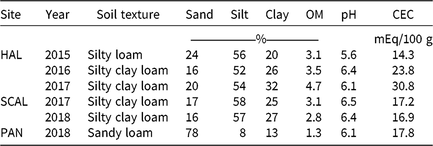
Field trials were conducted over a period of 4 yr at three Nebraska locations: Haskell Agricultural Laboratory (HAL), Concord (42.37°N, 96.95°W), in 2015, 2016, and 2017; South Central Agricultural Laboratory (SCAL), Clay Center (40.52°N, 98.05°W), in 2017 and 2018; and Panhandle Research and Extension Center (PAN), Scottsbluff (41.87°N, 103.67°W), in 2018. The soil texture for all locations was silty clay loam irrespective of the year of study, except at HAL in 2015 (silty loam) and PAN (sandy loam) (Table 1). The soil pH was slightly acidic (5.6 to 6.4) for all years or locations (Table 1). The organic matter content and cation exchange capacity (CEC) of soils ranged from 1.3% to 4.7% and 14.3 to 30.8 mEq/100 g, respectively (Table 1).
Soil texture and composition in 2015, 2016, and 2017 at Concord (HAL); 2017 and 2018 at Clay Center (SCAL); and 2018 at Scottsbluff (PAN), NE a .

a Abbreviations: CEC, cation exchange capacity; OM, organic matter
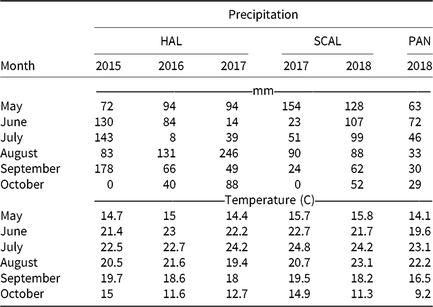
The GR soybean was planted in 76-cm row spacing. At HAL, the seeding rates were 369,000, 371,000, and 370,000 seeds ha−1 planted on May 31, June 9, and May 15 in 2015, 2016, and 2017, respectively. Seeding rate at SCAL was 346,000 seeds ha−1, planted on April 24 and 25 in 2017 and 2018, respectively. Seeding rate at PAN (May 12, 2018) was 349,000 seeds ha−1. At all locations, planting was done mechanically; for example, a John Deere® Finger Pickup Planter (1819 Chiefs Way, Wayne, NE 68787) was used at HAL, and a Monosem NG Plus Planter (1001 Blake Street, AQ907 Edwardsville, KS 66111) was used at PAN. Plot sizes were 8 m by 3 m at the HAL location, and 9 m by 2 m at the SCAL and PAN locations. Soybean varieties were ‘Pioneer® 92Y70’ (2015; DuPont Pioneer, Johnston, IA 50131), ‘NK S27-J7’ (2016; Syngenta, Greensboro, NC 27419), and ‘NK SJ-27’ (2017) at HAL; ‘NK S27-J7’ (2017 and 2018) at SCAL; and ‘AG20X7’ (2018; Monsanto, Lindbergh Boulevard, St Louis, MO 63167) at PAN. Before planting, fields were conventionally tilled and disked. Average monthly air temperatures and total rainfall varied among years and between locations (Table 2).
Total monthly precipitation and average temperature from May to October in 2015, 2016, and 2017 at Concord (HAL); 2017 and 2018 at Clay Center (SCAL); and 2018 at Scottsbluff (PAN), NE.

Experimental design
Trials were established as a randomized complete block design in a split-plot arrangement. The presence of PRE herbicide (PRE) or absence (no PRE) represented the main plots. PRE herbicide was either sulfentrazone plus imazethapyr (350 + 70 g ai ha−1; Authority Assist®, FMC, 2929 Walnut Street, Philadelphia, PA 19104) or saflufenacil plus imazethapyr plus pyroxasulfone (26 + 70 + 120 g ai ha−1; Zidua® PRO, BASF, 26 Davis Drive, Research Triangle Park, NC 27709). In 2015, only sulfentrazone plus imazethapyr was used as a PRE herbicide. In 2016 and 2017, at the HAL location, sulfentrazone plus imazethapyr and saflufenacil plus imazethapyr plus pyroxasulfone were used separately as PRE herbicides. At the SCAL location, in 2017 and 2018, and at Scottsbluff in 2018, saflufenacil plus imazethapyr plus pyroxasulfone was used as the PRE herbicide. The subplot treatments consisted of seven weed removal timings (weeds were allowed to grow until predetermined growth stage of soybean): first trifoliate (V1), third trifoliate (V3), sixth trifoliate (V6), full flowering (R2), early seed (R5) of soybean, with weed-free and weedy season-long checks. There were four soybean rows in each subplot. Treatments were replicated eight times in 2015 and four times in 2016, 2017, and 2018 at all locations. Weeds were removed at each timing by the application of glyphosate (1,400 g ae ha−1, Roundup PowerMax®, Monsanto), except at R2 and R5 soybean growth stages, when weed removal was done by hoeing. After the specified removal times, plots were kept weed-free for the rest of the season either by application of glyphosate or by hoeing.
Herbicide applications were conducted with a CO2-pressurized backpack sprayer with TeeJet® flat-fan nozzles (Spraying Systems, Wheaton, IL 60187) spaced at 56 cm and calibrated to deliver 140 L ha−1 of aqueous solution. PRE herbicides were applied with TeeJet® AIXR 110020 (2015, 2016, and 2017 at HAL) or TeeJet® AIXR 110015 nozzles (2017 and 2018 at SCAL and PAN). POST herbicide applications were conducted with TeeJet® AIXR 110020 (2015) or TeeJet XRC 80020 nozzles (2016, 2017, and 2018).
Data collection and analysis
Temperatures were recorded hourly with data loggers throughout the growing seasons. Temperatures were converted to soybean growing degree days (GDD) after emergence using the method described by Gilmore and Rogers (Reference Gilmore and Rogers1958). The GDD (equivalent to weed removal timing) was used as the explanatory variable and calculated as follows:
 $${\rm{GDD}} = \mathop \sum \nolimits^ \left[ {{{{T_{{\rm{max}}}} + {T_{{\rm{min}}}}} \over 2}} \right] - {T_{{\rm{base}}}}$$
([1])
where T max and T min are daily maximum and minimum air temperatures (C), respectively, and T base is the base temperature (10 C) for soybean growth.
Species composition and weed density for each weed species were collected in all plots before weed removal. Weed counts were conducted within 0.25-m2 quadrats placed in the middle of each plot. Yield components (plants m−2, pods per plant, seeds per pod, and 100-seed weight) were collected in 2017 (HAL and SCAL) and 2018 (SCAL and PAN) by clipping soybean plants within a 50-cm length of one of the two middle rows in each plot. Soybean was harvested using an Almaco SP40 combine harvester (1819 Chiefs Way, Wayne, NE 68787) from the entire row length of the two middle rows in each plot in 2015 and 2016 at HAL and in 2018 at PAN. At SCAL (2017 and 2018), a Gleaner K2 combine harvester (AGCO, 4205 River Green Parkway, Duluth, GA 30096) was used to harvest from the entire row length of the two middle rows in each plot. At HAL (2017), 3 m of soybean were hand harvested from two middle rows of each plot and then threshed to determine yield. Yields from all locations were generally reported at 13% moisture.
ANOVA was conducted to test for significance of location and year of study using the PROC GLM procedure in SAS v. 9.4 software (SAS Institute, 100 SAS Campus Drive, Cary, NC 27513). A four-parameter log-logistic regression model described the relationship between soybean yield, yield components or yield loss, and weed removal timings (in GDD) using the following equation (Hall et al. Reference Hall, Swanton and Anderson1992; Knezevic et. al. Reference Knezevic, Streibig and Ritz2007):
 $$Y = {{C + (D - C)} \over {\{ 1 + {\rm{exp}}[B({\rm{log}}X - {\rm{log}}E)]\} }}$$
([2])
where Y is the response (yield, yield components, or yield loss); C is the lower limit; D is the upper limit; X is the GDD calculated after soybean emergence; E is the GDD at the inflection point (also abbreviated as ED50 or I50), and B is the slope of the line around the inflection point.
The GDD (and the corresponding DAE [days after emergence] and SGS [soybean growth stage]) required for a 5% yield loss (ED5) for no PRE and PRE herbicide treatments were calculated from the regression curves and compared using standard errors (Knezevic et al. Reference Knezevic, Osipitan and Scott2018). The ED5, was considered the CTWR. All regression analyses and graphs were performed in R (R Development Core Team 2017) using the dose–response curves (‘drc’) statistical package (Knezevic et al. Reference Knezevic, Streibig and Ritz2007).
Results and discussion
Weed density and species composition
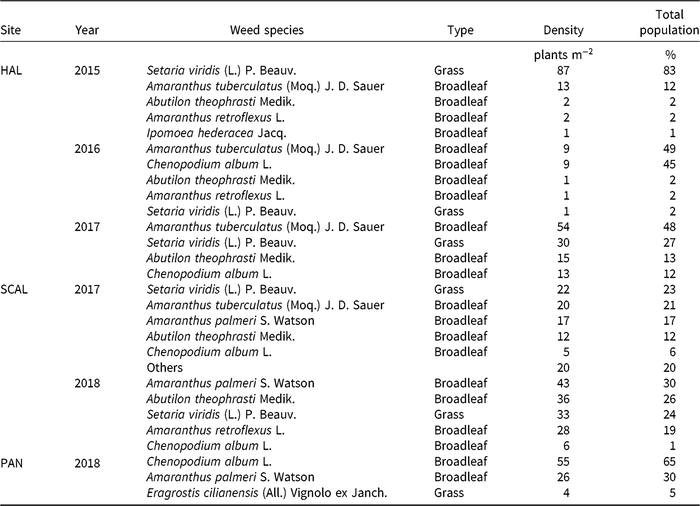
Weed density and species composition varied with years and locations (Table 3). There were more dicot species than monocot species at all locations, except at HAL in 2015. For example, at HAL in 2015, there was a higher presence of grassy species (83%) compared with broadleaf species (17%), while there were more broadleaf species (99% and 73%) in 2016 and 2017, respectively. Similarly, there were also more broadleaf species (77%) than grasses (23%) during the 2017 growing season at SCAL.
Average weed density and species composition in 2015, 2016, and 2017 at Concord (HAL); 2017 and 2018 at Clay Center (SCAL); and 2018 at Scottsbluff (PAN), NE.

Average weed density at HAL in 2015 was 21 plants m−2, with green foxtail [Setaria viridis (L.) P. Beauv.] being the dominant species (83% of the overall weed population). Common waterhemp [Amaranthus tuberculatus (Moq.) J. D.Sauer] accounted for 12% of the weed population. Other weed species were velvetleaf (Abutilon theophrasti Medik.), redroot pigweed (Amaranthus retroflexus L.), and ivyleaf morningglory (Ipomoea hederacea Jacq.), each accounting for <3% of the overall population (Table 3). Weed density at HAL in 2016 was much lower (4 plants m−2 on average) due to a dry spring (Table 3). In contrast, the highest weed density among location-years, averaging 29 plants m−2, was observed at HAL in 2017 (Table 3).
During the 2017 growing season, the SCAL location had an average weed density of 16 plants m−2. The three dominant weed species were green foxtail (23%), common waterhemp (21%), and Palmer amaranth (Amaranthus palmeri S. Watson) (17%). Other weed species belonging to the genus Amaranthus accounted for 20% of the overall weed population. Velvetleaf and common lambsquarters (Chenopodium album L.) accounted for 12% and 6%, respectively, of the overall population. In 2018 at SCAL, the prominent species were Palmer amaranth (30%), velvetleaf (26%), and green foxtail (24%). At PAN, the weed composition was 65%, 30%, and 5% for common lambsquarters, Palmer amaranth, and stintgrass [Eragrostis cilianensis (All.) Vignolo ex Janch.], respectively.
Soybean yield components
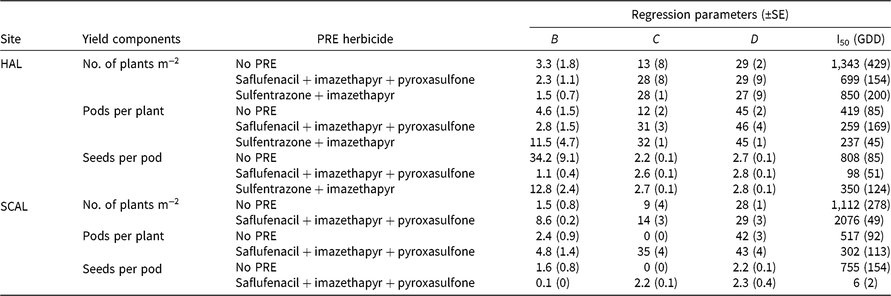
There was a significant impact of weed removal timing on soybean yield components: plants per square meter, pods per plant, and seeds per pod (Figure 1; Table 4). Application of PRE herbicides prevented significant reduction in soybean plants per square meter and seeds per pod, even with delayed weed removal. For example, at HAL in 2017, there was an average of 29 soybean plants m−2 in weed-free plots. Delaying weed removal until the R2 soybean stage (758 GDD) reduced the number to 26 soybean plants m−2 in plots without PRE herbicides. Weed interference throughout the growing season (weedy season-long) without PRE herbicide further reduced soybean plants to 20 plants m−2. In addition, at SCAL in 2017, there was an average of 28 soybean plants m−2 in weed-free plots. Delaying weed removal until R2 soybean stage (505 GDD) significantly reduced the number to 17 soybean plants m−2 in plots without PRE herbicide. Soybean plants were significantly reduced to 12 plants m−2 when weeds interfered throughout the growing season without PRE herbicide (Figure 1; Table 4). Similar results were observed at SCAL and PAN in 2018 (Figure 1).
Soybean yield components as a function of increasing delay of weed removal for no PRE and PRE herbicide applications at Concord (HAL in 2017), Clay Center (SCAL in 2017 and 2018), and Scottsbluff (PAN in 2018), NE.

Regression parameters showing the slope (B), lower limit (C), upper limit (D), and growing degree days (GDD) at 50% reduction (I50) of different soybean yield components for no PRE and PRE herbicide applications in 2017 at Concord (HAL) and Clay Center (SCAL), NE.

On average, there were 45 and 41 pods per plant in weed-free plots, respectively for the HAL and SCAL locations in 2017. At HAL, delaying weed removal until R2 soybean stage (758 GDD) significantly reduced the pod count to 14 pods per plant in plots without PRE herbicides, while in plots with PRE herbicide (saflufenacil + imazethapyr + pyroxasulfone or sulfentrazone + imazethapyr), the pod counts was reduced to 32 pods per plant. At the same location, weed interference throughout the growing season without PRE herbicide resulted in 11 pods per plant, whereas application of any of the PRE herbicides minimized pod reduction, with 32 pods per plant. At SCAL, delaying weed removal until R2 soybean stage (505 GDD) reduced the pod count to 25 pods per plant in plots without PRE herbicide, whereas application of PRE herbicide (saflufenacil + imazethapyr + pyroxasulfone) prevented pod reduction, despite weed removal being delayed until R2. At the same location, weeds interfering throughout the growing season resulted in a very low pod count (3 pods per plant) without the PRE herbicide, while there was no significant reduction in pods in plots with PRE application of herbicide (Figure 1; Table 4). In 2018, the average numbers of pods per plant in weed-free plots were 45 and 62 at SCAL and PAN, respectively. There was a significant reduction in the number of pods in plots with season-long weed interference at both locations, with or without PRE application of herbicides, with the greatest reduction occurring in plots without PRE herbicides (Figure 1).
The number of seeds per pod was reduced for delayed weed removal timing without PRE application of herbicides. At all locations, soybean in weed-free plots produced approximately 3 seeds per pod. Weed interference throughout the growing season without PRE herbicide resulted in approximately 2 seeds per pod (Figure 1).
These results suggest that season-long weed interference without PRE application of herbicides negatively affected the soybean yield components with subsequent impact on the harvested yield. Previous studies have demonstrated that the impact of weed interference on crop yield could be explained by its impact on yield components (Adigun et al. Reference Adigun, Osipitan, Lagoke, Adeyemi and Afolami2014; Eaton et al. Reference Eaton, Russ and Feltner1976; Elezovic et al. Reference Elezovic, Datta, Vrbnicanin, Glamoclija, Simic, Malidza and Knezevic2012; Trezzi et al. Reference Trezzi, Vidal, Patel, Miotto, Debastiani, Balbinot and Mosquen2015). Indeed, the reduced yield can be attributed to the reduction in plants per square meter, pods per plant, and seeds per pod caused by weed interference in this study.
Soybean yield loss
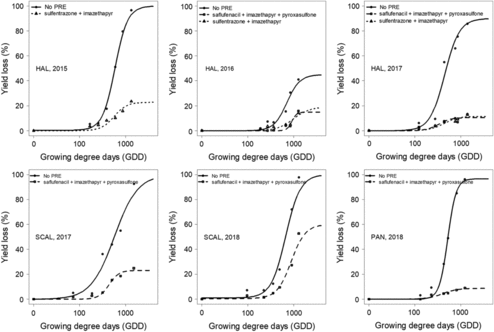
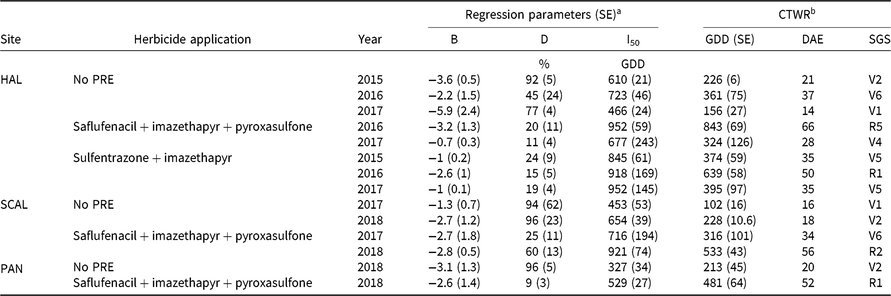
Soybean yields decreased with increased delay in weed removal. Greater yield losses were observed in plots without PRE herbicides compared with plots with PRE herbicides. There were statistical differences in yield loss by location-year; thus, data are presented separately. In 2015, weed interference throughout the soybean-growing season (weedy season-long) resulted in 92% soybean yield loss in plots without application of PRE herbicide compared with 24% yield loss in plots with PRE herbicide (Figure 2; Table 5). Yield losses were lower in 2016 compared with other years of study, irrespective of whether PRE herbicide was applied or not (Figure 2; Table 5). Even without PRE application of herbicide, weed interference throughout the growing season caused relatively less yield loss of 45% compared with other years. Weedy season-long plots with PRE application of herbicides resulted in 14% to 16% soybean yield loss.
Soybean yield loss as a function of increasing delay of weed removal for no PRE and PRE herbicide applications at Concord (HAL in 2015, 2016, and 2017), Clay Center (SCAL in 2017 and 2018), and Scottsbluff (PAN in 2018), NE.

Regression parameters and estimation of critical time for weed removal (CTWR) for no PRE and PRE herbicide applications.

a Parameters B, D, and I50 represent slope, maximum percentage yield loss, and growing degree days at 50% yield loss (GDD) respectively.
b The CTWR was estimated based on GDD at 5% yield loss. DAE, days after emergence; SGS, soybean growth stage
In 2017, the SCAL location had greater yield losses compared with the HAL location in plots with and without PRE treatments. At HAL, weedy season-long plots had yield loss up to 86% without PRE herbicide application, whereas application of saflufenacil plus imazethapyr plus pyroxasulfone or sulfentrazone plus imazethapyr as PRE herbicides in weedy season-long plots resulted in 13% yield loss. At SCAL, weedy season-long plots had up to 93% in yield loss without PRE herbicide application compared with 25% yield loss when PRE herbicide was applied. In 2018 at SCAL and PAN, weedy season-long plots had ≥94% yield loss. At SCAL, yield loss in weedy season-long plots was up to 60% with the application of PRE herbicides, while at PAN, application of PRE herbicides minimized yield loss to 9%.
Critical time for weed removal
The CTWR was estimated based on 5% yield loss. In 2015, the CTWR started at 226 GDD (21 DAE; V2 soybean stage) without PRE herbicide, while PRE application of herbicide (sulfentrazone + imazethapyr) delayed the CTWR to 374 GDD (35 DAE; V5 soybean stage) (Figure 2; Table 5). This implies that the CTWR was delayed by 14 d. In 2016, the commencement of the CTWR was later in the season than is usually expected for soybean. The CTWR started at 361 GDD (29 DAE; V6 soybean stage) without PRE herbicide application, while PRE application of saflufenacil plus imazethapyr plus pyroxasulfone or sulfentrazone plus imazethapyr delayed the CTWR to 843 GDD (66 DAE; R5 soybean stage) or 639 GDD (50 DAE; R1 soybean stage), respectively (Figure 2; Table 5). Thus, with the application of PRE herbicides, the CTWR was delayed by 21 to 37 d.
In 2017 at HAL, the CTWR started at 156 GDD (14 DAE; V1 soybean stage) without PRE herbicide application, while the application of saflufenacil plus imazethapyr plus pyroxasulfone or sulfentrazone plus imazethapyr as PRE herbicides delayed the CTWR to 324 GDD (28 DAE; V4 soybean stage) or 395 GDD (35 DAE; V5 soybean stage), respectively (Figure 2; Table 5), suggesting that the CTWR was delayed by 14 to 21 d with PRE herbicides. At SCAL in 2017, the CTWR started at 102 GDD (16 DAE; V1 soybean stage) without PRE herbicide application, while the application of PRE herbicide delayed the CTWR to 316 GDD (34 DAE; V6 soybean stage) (Figure 2; Table 5). This indicates that application of PRE herbicide delayed the CTWR by 18 d at SCAL. At both the SCAL and PAN locations in 2018, in plots without PRE herbicides, the CTWR started at 213 or 228 GDD, which was equivalent to V2 growth stage and 18 to 20 DAE. PRE application of herbicide delayed the CTWR to 533 GDD (56 DAE; R2 soybean stage) and 481 GDD (52 DAE; R1 soybean stage) at SCAL and PAN, respectively, resulting in a delay in CTWR by 28 to 34 d.
Management implications
The results from the different locations and years suggest that the length of time weed interference could be allowed in soybean without application of PRE herbicide ranged from 102 to 361 GDD, which was equivalent to the V1 (14 DAE) to V6 (37 DAE) soybean growth stages. With the application of PRE herbicides, the need for in-crop weed removal starts from 316 to 843 GDD, equivalent to the V4 (28 DAE) to R5 (66 DAE) soybean stages, depending on the study location and year. Similarly, previous studies have shown that the CTWR in soybean without PRE herbicide could range from 14 to 30 DAE (Gustafson et al. Reference Gustafson, Knezevic, Hunt and Lindquist2006; Knezevic et al. Reference Knezevic, Evans and Mainz2003; Van Acker et al. Reference Van Acker, Swanton and Weise1993), depending on the location of the study. Major factors that influenced CTWR and that varied with locations were weed density and time of weed emergence. The CTWR in crop fields with high weed density and early weed emergence is expected to occur earlier than in those locations with low weed density and late weed emergence (Jeschke et al. Reference Jeschke, Stoltenberg, Kegode, Sprague, Knezevic, Hock and Johnson2011; Kropff et al. Reference Kropff, Joenje, Bastiaans, Habekotte, van Oene and Werner1987; Soltani et al. Reference Soltani, Dille, Burke and Sikkema2017). For example, in our study, without the influence of PRE herbicides, locations with high weed densities and early emergence of weeds had an earlier CTWR (V1 to V2 of soybean stage) compared with a location (HAL in 2016) with very low weed density and late weed emergence, resulting in an unusually late commencement of CTWR at V6.
Application of PRE herbicide delayed weed emergence and reduced density of weeds that could have competed with soybean and reduced yield. This study suggests that the use of PRE herbicides in GR soybean could delay the need for POST application of glyphosate by 14 to 34 d, thereby reducing the need for repeated applications of glyphosate, which is currently the usual practice during the growing season in a GR soybean. In addition, the use of PRE herbicides will provide multiple or alternative modes of action needed to manage GR weeds in GR soybean. It can be concluded that use of PRE herbicides in GR soybean could provide a window of 28 to 66 d after soybean emergence for POST weed removal. Otherwise, weed control without PRE herbicide application should be initiated 14 to 29 d after GR soybean emergence.
Author ORCIDs
O. Adewale Osipitan https://orcid.org/0000-0002-8202-4270
Acknowledgments
This research received no specific grant from any funding agency or the commercial or not-for-profit sectors. No conflicts of interest have been declared.