Introduction
Fetal growth is dependent on maternal nutrient supply. Maternal metabolic disorders or inadequate nutrition result in an unfavorable environment for fetal growth. Maternal malnutrition or hyperglycemia trigger structural and functional adaptations in the fetus that affect growth and can alter the programming of fetal tissues and organs.Reference Freinkel 1 The consequences of such alterations can persist in the postnatal period.
Pregnancy complicated by diabetes mellitus (DM) can negatively affect both mother and fetus. If a pregnant woman is hyperglycemic, excess blood glucose will cross the placenta and reach the fetus at increased rates. However, insulin, the hormone that triggers glucose uptake by cells, is not transported by the placenta. In 1980, FreinkelReference Freinkel 1 raised the hypothesis that excessive nutrient exposure may cause permanent changes, arguing that for the developing fetus excessive exposure to glucose may cause changes in the endocrine system or in neuroendocrine metabolism, mediated by modifications in the phenotypic expression of certain genes. In addition to such a mechanism, exposure to high concentrations of glucose, amino acids, lipids, ketones and other nutrients may exert an effect directly on the fetus, increasing insulin secretion and possibly leading to development of insulin resistance in the future.
In recent years, a number of epidemiological studies have shown associations between being born to a mother with gestational DM (GDM) and higher prevalence of obesity,Reference Pettitt, Baird, Aleck, Bennett and Knowler 2 – Reference Vohr, McGarvey and Tucker 6 , Reference Hillier, Pedula and Schmidt 8 , Reference Silverman, Rizzo and Green 9 glucose intoleranceReference Pettitt, Bennett, Knowler, Baird and Aleck 3 , Reference Vohr, McGarvey and Tucker 6 , Reference Pettitt, Aleck and Baird 7 and type 2 DM (DM2),Reference Pettitt, Aleck and Baird 7 in childhood,Reference Pettitt, Baird, Aleck, Bennett and Knowler 2 , Reference Vohr, McGarvey and Tucker 6 , Reference Hillier, Pedula and Schmidt 8 , Reference Silverman, Rizzo and Green 9 adolescenceReference Pettitt, Baird, Aleck, Bennett and Knowler 2 – Reference Gillman, Rifas-Shiman, Berkey, Field and Colditz 5 , Reference Pettitt, Aleck and Baird 7 or even adult age.Reference Pettitt, Aleck and Baird 7 Most of these studies show that, among offspring of GMD mothers (OGDM), at around 2 years of age, a slow process of relatively increased weight gain begins,Reference Vohr, McGarvey and Tucker 6 , Reference Hillier, Pedula and Schmidt 8 – Reference Touger, Looker and Krakoff 10 which is accelerated after the age of 5 years,Reference Pettitt, Baird, Aleck, Bennett and Knowler 2 – Reference Pettitt, Knowler, Bennett, Aleck and Baird 4 and culminates with the occurrence of obesity, glucose intolerance and DM2 in childhood and adolescence.Reference Pettitt, Baird, Aleck, Bennett and Knowler 2 – Reference Touger, Looker and Krakoff 10 There are no studies in the literature comparing growth patterns among the offspring of mothers with and without GDM, analyzing the first months of infant life.
The aim of this study was to describe the anthropometry, from birth to 2 years of age, of children born to mothers with or without GDM from the 2004 Pelotas Birth Cohort.
Methods
In 2004, a birth cohort study was initiated in the city of Pelotas, Southern Brazil.Reference Barros, da Silva dos Santos and Victora 11 Briefly, all mothers who gave birth in one of the city's five maternity wards were interviewed. Interviews were carried out soon after birth (perinatal study) by nutritionists trained for this purpose, using pre-coded, pre-tested questionnaires. Follow-up visits took place at the mother's home at 3, 12 and 24 months of age. Questionnaires included demographic, socioeconomic, biological and behavioral variables, in addition to pregnancy and delivery characteristics. Follow-up visits were carried out in such a way that children were visited in a period ranging from 7 days before to 7 days after the day the baby reached each of the follow-up ages.
We identified 4243 pregnant women with single deliveries along with their newborn babies, with 0.5% refusals in the perinatal study. Prevalence of self-reported GDM was 2.95% (95% CI: 2.53–3.64). 12 The characteristics of cohort mothers have been described elsewhere.Reference Santos, Barros and Matijasevich 13
Child variables
Child weight and length were measured during the perinatal study and at 3, 12 and 24 months of age. Birthweight was obtained from the child's hospital charts during the perinatal visit. In all hospitals, birthweight was measured using a pediatric electronic scale with 10 g precision. We also measured the cephalic, thoracic and abdominal circumferences using a non-elastic tape measure with 1 mm precision. At 3 months of age, children were weighed using an electronic scale with 10 g precision.
At 12 and 24 months, children were weighed using a digital scale with 100 g precision, which was calibrated on a weekly basis. The scale was placed on a firm, level surface. Mothers were weighed while holding the child, wearing minimal clothing and no shoes, and with weight spread across the two feet placed centrally on the scale. Weight was recorded in kilogram with one decimal. We requested that the child remain undressed during the weighing process. In case this was not allowed by the mother, we took note of the baby's clothes and later subtracted the weight of those clothes from the baby's weight. The mother was then weighed without the baby, and the baby's weight was calculated as the difference between the weight of mother and baby together and that of the mother alone.
Length was measured in centimeters with the baby lying down in supine position, using portable infantometers with 1 mm precision on the occasion of the perinatal study and the 3-, 12- and 24-month follow-ups.
Gestational age (GA) was calculated during the perinatal period using the algorithm proposed by the National Center for Health Statistics, where age is based on the date of the mother's last period (DLP) and on the Dubowitz method.Reference Dubowitz, Dubowitz and Goldberg 14 DLP was used only when deemed consistent with birthweight, length and cephalic perimeter, according to the normal curves for these parameters for each week of GA.Reference Fenton 15 In cases where DLP was not available or inconsistent, we used the maturity estimate given by the Dubowitz method, which was administered to all newborns.
Weight-for-age, length-for-age and weight-for-length Z-scores were calculated based on the curves published by the World Health Organization (WHO), using WHO Anthro 2005 software.Footnote a Adequacy of weight to GA at birth was evaluated using the Williams curves.Reference Williams, Creasy and Cunningham 16 Abdominal circumference, obtained during the perinatal study, was measured at the point of greatest perimeter, at end expiration, using a non-elastic tape measure with 1 mm precision.
At each follow-up, we collected detailed information on duration of breastfeeding. At 3-month follow-up, breastfeeding pattern was categorized as exclusive (breastfed children who were not fed any other fluids or solids foods), predominant (breastfed children who were also fed other fluids, such as water or tea, but who were not fed solid or semi-solid foods), partial (children who were fed breast milk complemented with other types of milk, such as cow's milk or formula, or with solid or semi-solid foods) or weaned (children who were not breastfed). We also recorded any hospital admissions taking place during the follow-up period.
Maternal variables
GDM was self-reported by the mother during the perinatal interview, based on the following questions: ‘Did you have diabetes or high blood sugar during pregnancy?’ (‘A Sra. teve diabetes ou açúcar no sangue durante a gravidez?’). If Yes: ‘Did you already have diabetes before pregnancy?’ (‘Já tinha diabetes antes da gravidez?’). We considered GDM mothers who responded positively to the first question and negatively to the second. Economic level was defined according to the Brazilian National Economic Index [Índice Econômico Nacional (IEN)]. Since information for constructing the economic-level variable was available for only 3265 mothers, data were completed for all participants by imputation.Reference Barros, da Silva dos Santos and Victora 11 We classified mothers into IEN quintiles, from the lowest to the highest.
Maternal weight at the beginning of pregnancy was transcribed from the mother's card, when available, or self-reported by the mother. Mother's height was measured at home during the 3-month follow-up visit, using an aluminum stadiometer with 1 mm precision as recommended by Lohman et al. Reference Lohman, Roche and Martorell 17 Pre-gestational body mass index (BMI) was calculated as maternal weight at the beginning of pregnancy divided by the square of height (kg/m2), and was categorized into <25.0, 25.0–29.9 and ⩾30.0 kg/m2. Maternal family history of DM among first-degree relatives (parents, children and siblings) was self-reported by the mother.
Analyses
We used t-tests to determine the association between maternal GDM and anthropometric outcomes. Two-tailed P-values <0.05 were considered statistically significant. Adjustment was carried out by linear regression based on an a priori hierarchical conceptual framework. Potential confounders with significance ⩽0.20 were kept in the model.
For each outcome, we analyzed associations separately for each sex. In the first level of hierarchic analysis, we included GA, family history of DM, GDM, maternal age, economic level and BMI. In the second level, we adjusted for mediator variables breastfeeding and hospital admission.
As the WHO growth standards are not appropriate for preterm infants at birth or at 3 months, the preterm births were excluded from the analyses aiming to assess the anthropometric growth (lasting 104 OGDM and 3496 offspring of non-GDM). To determine whether there was a difference in growth between OGDM that were large for GA (LGA) or adequate for GA (AGA), we created a variable with four categories: LGA, OGDM; LGA, non-GDM; AGA, OGDM; and AGA, non-GDM.
All analyses were performed using the Stata statistical package.Reference Boston and Sumner 18 The study protocol was approved by the research ethics committees of the Federal University of Pelotas and of the hospitals in which the children were born. Written informed consent was obtained from all mothers who agreed to participate in the study.
The following parameters were used for calculating the study power to detect differences in mean Z-score among children of mothers with and without GDM: number of newborns in the cohort (3600); number of OGDM newborns (104); standard deviation of the Z-score (1.0); confidence level (95%, two-tailed) and 80% statistical power. According to these calculations, the study should be capable of detecting differences in Z-score ⩾0.28.
Results
The global population of studied children with information on maternal GDM was 4239. Of these, 51.9% were boys. Mean weight at birth was 3130 (s.d. 596 ) g and mean GA was 38.4 (s.d. 2.7) weeks. Overall, 300 children were classified as LGA.
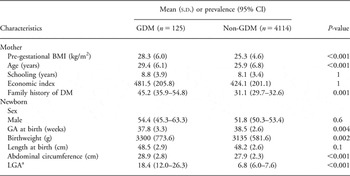
Table 1 shows the distribution of the sample according to maternal GDM. The 125 women with GDM showed higher mean pre-gestational BMI and mean age, and were more likely to have family history of DM compared to those without GDM during that pregnancy. The two groups were similar in terms of schooling and economic level.
Characteristics of mothers and newborns in the 2004 Pelotas Birth Cohort according to the presence of GDM

GDM, gestational diabetes mellitus; BMI, body mass index; DM, diabetes mellitus; GA, gestational age.
aLGA: large for gestational age according Williams.
Pelotas, Southern Brazil, 2008.
Regarding the newborns, there was no difference in sex distribution between babies born to mothers with or without GDM. In both groups, the proportion of boys was slightly higher than that of girls. GA at birth was almost 1 week lower among OGDM (P = 0.004). OGDM were heavier at birth (P = 0.002), but did not differ in terms of length (P = 0.1). Mean abdominal circumference of OGDM was 1 cm longer than among non-GDM (P < 0.001). Prevalence of LGA was three times higher among OGDM (18.4% v. 67.8%; Table 1). With regard to breastfeeding, there was no difference between groups in terms of pattern of breastfeeding at 3 months of age, or in duration of breastfeeding as assessed at 12- and at 24-month follow-ups (data not shown). In addition, prevalence of hospitalization at 3, 12- and 24-month follow-up was similar in both groups (data not shown).
After the exclusion of preterm births, 3600 children were left, 104 of whom were OGDM. Due to losses of follow-up at the 3, 12 and 24 months, respectively, 101, 100 and 99 OGDM were assessed. Total losses and refusals from birth to 24 months of age accounted for 8% and 5%, respectively, in the whole cohort and the subsample of OGDM.
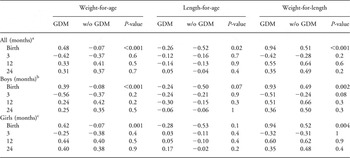
Table 2 presents crude Z-scores for weight-for-age, length-for-age and weight-for-length after the exclusion of preterm births. The analysis of all newborns showed that mean weight-for-age among OGDM was higher than that of babies born to non-GDM mothers (+0.48 v. −0.07; P < 0.001). During the first 3 months of life, there was a deceleration of growth among OGDM. At 3 months of age, mean weight-for-age Z-score was −0.42 among OGDM and −0.37 among offspring of non-GDM mothers (P = 0.6). Growth patterns after 3 months of age were similar in the two groups. Regarding length-for-age, the OGDM showed a higher Z-score at birth than non-GDM (−0.26 v. −0.52; P = 0.02), as to weight-for-length, mean Z-score at birth (0.94 and 0.51 among OGDM and non-GDM, respectively; P < 0.001). From 3 months onwards, mean length-for-age and weight-for-length Z-score were similar in the two groups.
Crude mean weight-for-age, length-for-age and weight-for-length Z-scores at birth and 3, 12 and 24 months of age among children born to mothers with and without (w/o) GDM

GDM, gestational diabetes mellitus; OGDM, offspring of GDM mothers.
aSample size at birth: 104 OGDM and 3496 non-OGDM; at 3 months: 101 OGDM and 3323 non-OGDM; at 12 months: 100 OGDM and 3257 non-OGDM; at 24 months: 99 OGDM and 3219 non-OGDM.
bSample size at birth: 56 OGDM and 1819 non-OGDM; at 3 months: 56 OGDM and 1730 non-OGDM; at 12 months: 55 OGDM and 1693 non-OGDM; at 24 months: 54 OGDM and 1681 non-OGDM.
cSample size at birth: 48 OGDM and 1677 non-OGDM; at 3 months: 45 OGDM and 1593 non-OGDM; at 12 months: 45 OGDM and 1564 non-OGDM; at 24 months: 45 OGDM and 1538 non-OGDM.
The differences among the numbers are due to losses in the follow-up.
Subsample without preterm infants, 2004 Pelotas Birth Cohort, Pelotas, Southern Brazil, 2008.
There was no statistical significance in terms of mean weight-for-age and length-for-age Z-score when analyses were stratified by sex, except at birth, when OGDM were heavier than offspring of non-GDM (Table 2). From birth to 24 months of age, mean weight-for-age Z-score among girls born to GDM mothers was higher than among girls born to non-GDM mothers. Among boys, between 3 and 24 months of age, this trend was reversed.
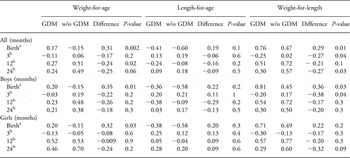
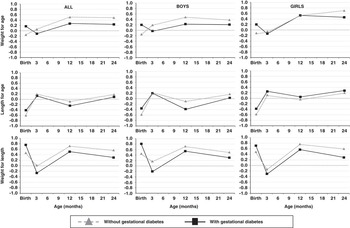
Table 3 and Figure 1 present adjusted growth patterns between birth and 24 months of age for subsample without preterm children, stratified by sex. The number of OGDM in each follow-up was 56, 55, 55, 54 (boys) and 48, 46, 45, 45 (girls), respectively. The analysis model for all anthropometric outcomes initially included only the variable GA. Fully adjusted model included GA, mother's age, pre-gestational BMI, schooling, IEN, family history of DM, breastfeeding and child's hospitalization history. Z-scores for weight-for-age, length-for-age and weight-for-length show that adjusting only for GA (data not shown), and for this and the other confounders were similar. Mean Z-score was lower among OGDM than among non-GDM children for all indicators beginning at 3 months of age. The only exception was that girls born to GDM mothers, as in crude analysis, had higher height-for-age scores. Differences in weight-for-length were statistically significant at birth only among boys or when all children were analyzed together.
Adjusted means and differences in Z-score for weight-for-age, length-for-age and weight-for-length from birth to 24 months of age among children of mothers with or without (w/o) GDM

GDM, gestational diabetes mellitus; GA, gestational age; DM, diabetes mellitus; BMI, body mass index.
aadjusted for GA, family history of DM, maternal age, economic index and BMI.
badjusted for: first level – GA, family history of DM, maternal age, economic index and BMI; second level – breastfeeding and hospital admission.
Subsample without preterm infants, stratified by sex, 2004 Pelotas Birth Cohort, Pelotas, Southern Brazil, 2008.
Weight-for-age, length-for-age and weight-for-length Z-scores from birth to 24 months of age stratified by sex among children born to mothers with and without gestational diabetes mellitus in the 2004 Pelotas Birth Cohort, Brazil (n = 3600; adjusted for gestational age, economic level at birth, mother's age and body mass index at first level and breastfeeding, and child's hospitalization history at the second level).

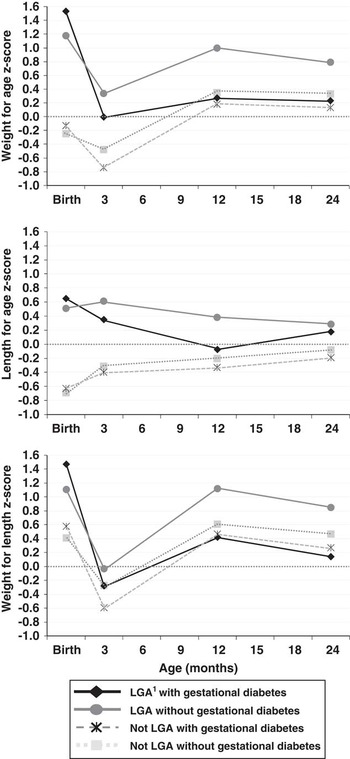
Figure 2 presents the growth patterns of LGA children. Analyses were adjusted for maternal age, pre-gestational BMI, schooling, IEN, family history of DM, breastfeeding and child's hospitalization history. LGA OGDM showed higher weight-for-age scores than LGA non-GDM. Unlike LGA non-GDM, whose weight-for-age scores remained higher than those of AGA babies up to 24-month follow-up, LGA OGDM showed growth patterns that were parallel and very close to those of AGA babies from 12 months onwards. The difference in weight-for-age score between the LGA children of mothers with and without GDM, which at birth was of +0.35 in favor of the first group, was reversed to −0.34 at 3 months of age. At 12 months, this difference was of −0.73 (P = 0.01), and at 24 months, of −0.56 (P = 0.05) in favor of LGA children of non-GDM.
Weight-for-age, length-for-age and weight-for-length Z-scores between birth and 24 months of age, stratified by nutritional status at birth, among children born to mothers with and without gestational diabetes mellitus in the 2004 Pelotas Birth Cohort, Brazil (adjusted for maternal age, pre-gestational body mass index, schooling, IEN (Índice Econômico Nacional), family history of diabetes mellitus, breastfeeding and child's hospitalization); LGA, large for gestational age.

Regarding length-for-age, difference in Z-scores between LGA children of GDM and non-GDM was 0.13 (P = 0.50), −0.25 (P = 0.3), −0.50 (P = 0.1) and −0.11 (P = 0.7), respectively, at birth and 3, 12 and 24 months of age. Differences in weight-for-length Z-score were similar to those found for weight-for-age, respectively +0.37 (P = 0.2), −0.26 (P = 0.4), −0.70 (P = 0.02) and −0.71 (P = 0.01) at birth and 3, 12 and 24 months of age.
Discussion
In the present study, GDM was self-reported by the mother. A previous study investigating the validity of self-reported information on knowledge of GDM among Pelotas mothers immediately after delivery showed a κ-coefficient of 0.73 and 97.9% accuracy (95% CI: 96.8–98.7), with high specificity (99%; 95% CI: 98.1–99.6) and good sensitivity (72.9%; 95% CI: 55.9–86.2), indicating that, for this population, self-reported information on GDM is valid.Reference Dode and Santos 19 Another limitation is that the prenatal weight information was taken from the mother's medical card and could be underestimated.
The absence of statistical significance for most of the differences found between groups of children born to mothers with and without GDM is likely due to insufficient statistical power related to the low prevalence of GDM. Power calculations showed that our study would be able to detect only differences in Z-score ⩾0.28. The analyses without the exclusion of the preterm infants have no effect on the results.
Two large prospective cohorts evaluated the growth patterns of children born to GDM mothers: the Pima Indian study and the Diabetes in Pregnancy Study at Northwestern in Chicago.Reference Pettitt, Baird, Aleck, Bennett and Knowler 2 , Reference Pettitt, Bennett, Knowler, Baird and Aleck 3 , Reference Pettitt, Aleck and Baird 7 , Reference Silverman, Rizzo and Green 9 , Reference Touger, Looker and Krakoff 10 , Reference Pettitt and Jovanovic 20 , Reference Silverman, Rizzo, Cho and Metzger 21 Other studies have been conducted in smaller populations,Reference Vohr, McGarvey and Tucker 6 , Reference Catalano, Thomas, Huston-Presley and Amini 22 , Reference Buzinaro, Berchieri, Haddad, Padovani and de Paula Pimenta 23 with cross-sectional designsReference Gillman, Rifas-Shiman, Berkey, Field and Colditz 5 , Reference Vohr, McGarvey and Tucker 6 , Reference Hillier, Pedula and Schmidt 8 or including only diabetic women.Reference Silverman, Rizzo and Green 9 , Reference Rizzo, Dooley and Metzger 24 The majority of these studies report that the advantage in weight and length at birth, a common occurrence among OGDM, disappear at 12 months of age.Reference Silverman, Rizzo and Green 9 , Reference Silverman, Rizzo, Cho and Metzger 21 , Reference Rizzo, Dooley and Metzger 24 , Reference Schaefer-Graf, Pawliczak and Passow 25 Prospective studies show that, at 5 years of age, OGDM are already heavier than the children of non-GDM mothers.Reference Pettitt, Baird, Aleck, Bennett and Knowler 2 , Reference Pettitt, Bennett, Knowler, Baird and Aleck 3 , Reference Silverman, Rizzo and Green 9 , Reference Touger, Looker and Krakoff 10 , Reference Silverman, Rizzo, Cho and Metzger 21 At 7 years, 50% of OGDM girls from the Chicago cohort,Reference Silverman, Rizzo and Green 9 and 38% of LGA OGDM in the cross-sectional study by Vohr et al. Reference Vohr, McGarvey and Tucker 6 were above the 90th percentile for weight based on the control population. At 8 years, OGDM from Chicago cohort were 30% heavier than the offspring of non-GDM mothers.Reference Silverman, Rizzo and Green 9 Among these studies only two have excluded preterm births: Vohr et al. Reference Vohr, McGarvey and Tucker 6 excluded those born with less than 37 weeks of GA, and the one by Gillman et al. that excluded those with less than 34 weeks at birth.Reference Gillman, Rifas-Shiman, Berkey, Field and Colditz 5
Growth patterns among OGDM from birth to 12 months of age, as well as from 12 to 60 months, were not extensively explored in the publications that we could locate in the literature. Our current data show that not only does the advantage in weight-for-age disappear by 3 months of age, but OGDM also remain smaller than non-GDM children until the age of 2 years. Similar results were reported in the Pima Indian cohort study,Reference Touger, Looker and Krakoff 10 where, after adjustment for GA, sex, age and length, OGDM showed a marked catch-down between birth and 18 months of age.Reference Touger, Looker and Krakoff 10 Our data show that this catch-down begins early (before the age of 3 months), and persists until 24 months of age.
If the growth pattern of Pelotas children is similar to that of children from other cohorts, we would expect that at a certain point between 2 and 5 years of age an acceleration in growth would take place, with OGDM becoming heavier than children of non-GDM mothers, similarly to what was found at the time of birth. Future follow-ups of the 2004 Pelotas cohort will be able to identify exactly when this change takes place.
The importance of studying the effect of GDM on child anthropometry resides in the potential causal effect of this condition on obesity, glucose intolerance and DM2 in future life. Some authors have found that increased risk of these outcomes does not depend on birthweight.Reference Pettitt, Knowler, Bennett, Aleck and Baird 4 , Reference Hillier, Pedula and Schmidt 8 , Reference Silverman, Rizzo and Green 9 , Reference Pettitt and Knowler 26 Others found that the association between GDM and obesity in children or adolescence disappeared after adjustment for birthweight.Reference Gillman, Rifas-Shiman, Berkey, Field and Colditz 5 , Reference Vohr, McGarvey and Tucker 6 The fact that birthweight is a mediator in the causal chain linking GDM to future obesity may be responsible for the loss of statistical association.
The mechanisms leading to the higher risk of future obesity and impaired glucose tolerance among OGDM are unclear. Our results show that OGDM were heavier and had greater abdominal circumference at birth, and that, since mean GA among these children was lower, adjustment for GA exacerbated this difference. LGA prevalence was higher among OGDM. Abdominal circumference among LGA and AGA OGDM was greater than that of their non-GDM counterparts (P < 0.001 and < 0.005, respectively, data not shown). A study carried out by Catalano et al. Reference Catalano, Thomas, Huston-Presley and Amini 22 showed that OGDM had 20% more body fat than the offspring of women with normal glucose tolerance, irrespective of birthweight. Vohr et al.,Reference Vohr, McGarvey and Tucker 6 in a four-group analysis (LGA and AGA children of GDM and non-GDM mothers), also found that, at birth, LGA babies from both groups were larger than AGA babies. At 7 years of age, LGA from both groups of mothers and AGA from the non-GDM group were heavier than AGA OGDM, and LGA OGDM were larger according to all parameters analyzed (weight, thorax and arm circumference and skinfolds).
Several hypotheses have been formulated in an attempt to explain such associations. One possibility is that hyperinsulinemia may be the precursor of future obesity.Reference Silverman, Rizzo and Green 9 Higher maternal blood glucose during pregnancy has also been associated with higher risk of future obesity.Reference Pettitt and Knowler 26 On the other hand, leptin, a hormone secreted by adipocytes as well as by the placenta, also seems to be associated with fetal growth. Leptin is associated with hyperphagia, decreased fat oxidation, increased blood triglycerides, insulin resistance and obesity.Reference Seufert, Kieffer and Leech 27 , Reference Persson, Westgren, Celsi, Nord and Ortqvist 28
There are number of analyses in the literature of the relationship between early-life (intrauterine) exposures and later-life outcomes, such as obesity and DM2 in childhood and adolescence. A study by Eriksson et al. Reference Eriksson, Forsen, Osmond and Barker 29 on subjects of the Helsinki cohort explored the mechanisms by which child growth could lead to adult DM, describing growth during the first years of life. Our results show that among LGA babies, after adjustments, catch-down in weight-for-age during the first 3 months was more intense among OGDM than among offspring of non-GDM. A similar catch-down was described in the Helsinki cohort for children born weighing over 3.5 kg and who developed DM in later life. Thus, abrupt catch-down among these children during the first months, or even the first year, of life should be considered when investigating the etiological mechanism of metabolic alterations in later life.
Although the catch-down seen among OGDM was more intense for LGA babies, it was also present among AGA, when compared to non-GDM children. AGA OGDM also displayed catch-down growth in the first months of life and remained smaller than their controls. Vohr et al. Reference Vohr, McGarvey and Tucker 6 found that, at 7 years of age, AGA OGDM were smaller than all other groups, including the AGA children of non-GDM mothers. Catch-up among this group would occur at a later stage. The study by Eriksson et al.Reference Eriksson, Forsen, Osmond and Barker 29 corroborates this hypothesis, because babies who developed DM in later life and whose birthweight was ⩽3.5 kg showed accelerated growth at around 10 years of age.
This study does not allow us to predict which OGDM baby will become obese or glucose intolerant or develop DM2 in the future, but it shows that growth patterns among these children differ from those of other babies. The regression to the mean, as result of the abrupt weight loss during the first months after delivery, reflecting the reduction in calorie intake in comparison to the intrauterine period, could, according to the fetal origin hypothesis, now outside the uterus but still during the first months of life, constitute an important factor in the causal chain leading to obesity, glucose intolerance and DM2 in later life.
Acknowledgments
None.
Statement of Interest
None.