Introduction
Extracorporeal membrane oxygenation is a form of mechanical support used within the paediatric cardiac ICU. Reference Alsoufi, Awan and Manlhiot1,Reference Alsoufi, Shen and Karamlou2 Historically extracorporeal membrane oxygenation has served as a bridge to recovery, decision, or transplant in the setting of myocardial decompensation, refractory cardiac arrest, or cardiopulmonary failure. Reference Alsoufi, Awan and Manlhiot1 In the past two decades, extracorporeal membrane oxygenation’s use to support patients with univentricular physiology during various stages of palliation has increased. Reference Bacon, Gray and Schwartz3 Hypoplastic left heart syndrome comprises the largest sub-group of patients requiring extracorporeal membrane oxygenation in the post-operative period. Reference Barbaro, Paden and Guner4 Hypoplastic left heart syndrome patients requiring extracorporeal membrane oxygenation during palliation demonstrated a 40% survival to discharge. Reference Barbaro, Paden and Guner4 Despite good evidence to support the use of extracorporeal membrane oxygenation in the post-operative period, the scenario of deteriorating clinical status of single-ventricle patients pre-palliation remains a challenging clinical scenario for cardiac intensivists. Reference Stephens, Shakoor and Jacobso5,Reference Bautista-Hernandez, Thiagarajan and Fynn-Thompson6,Reference Misfeldt, Kirsch and Goldberg7,Reference Chan, Thiagarajan and Frank8 In addition, there is a paucity of data regarding the efficacy and outcomes of extracorporeal membrane oxygenation support pre-palliation in this population. Our aim is to examine the outcomes of patients with single ventricle physiology who were supported with extracorporeal membrane oxygenation as a bridge to palliation, with survival to discharge as the primary outcome. Secondary outcome included evaluating the preoperative and extracorporeal membrane oxygenation-related variables that may influence mortality. We hypothesised that extracorporeal membrane oxygenation can be used successfully as a bridge to palliation in patients with single ventricle physiology.
Materials and methods
Data for this study were retrospectively obtained from the Extracorporeal Life Support Organization Registry from January 1 2016 to December 31 2021. The registry-based study was approved by the Institutional Review Board of the Icahn School of Medicine with a waiver of parental or patient consent No. #2101089, on July 14, 2024. The need for written informed consent was waived by the Institutional Review Board.
Data were reported to the registry from over 250 centres, including international centres. We extracted data for all patients receiving extracorporeal membrane oxygenation support who had a primary International Classification of Disease, 10th revision code for any variant of single ventricle anatomy. Patients were included if they had single ventricle physiology as determined by the International Classification of Disease,10th revision code and required extracorporeal membrane oxygenation support prior to first stage palliation. Codes included were Q22.8, Q20.4, Q20.1, Q22.0, Q23.4, Q20.0, Q22.6, and Q21.3. Patients were excluded if they had a previous surgical intervention and if extracorporeal membrane oxygenation served as a bridge to a ventricular assist device or transplant (n = 2). Data collected included demographic information, diagnosis, procedures, indications for extracorporeal membrane oxygenation, pre-extracorporeal membrane oxygenation support, pre-extracorporeal membrane oxygenation clinical status, cannulation type and site, extracorporeal membrane oxygenation complications, duration of extracorporeal membrane oxygenation, survival to hospital discharge, and discharge disposition.
Data analysis was conducted using IBM SPSS software. Descriptive statistics were performed. Continuous variables were expressed as medians with interquartile ranges for parametric and nonparametric variables. The Mann-Whitney U-test was performed for non-normally distributed continuous variables, and chi-squared test or Fisher exact analysis was performed on all categorical variables. Bivariate analysis was performed to determine the association between variables and mortality. A p value of 0.05 was adopted as statistically significant. Variables that were associated (p value<0.1) with mortality in the bivariate analyses were cast into a multivariate analysis using logistic regression. Due to the limited sample size, each model had a maximum of three parameters. Variables included in the multivariate were hours on extracorporeal membrane oxygenation, need for renal replacement therapy, FiO2, peak end-expiratory pressure, and surgical bleeding. Peak inspiratory pressure was originally included in the multi-variate model, but was eliminated after backwards selection. Odds ratios and associated confidence intervals were calculated for each variable. A 2-tailed p value of less than 0.05 was deemed significant.
Results
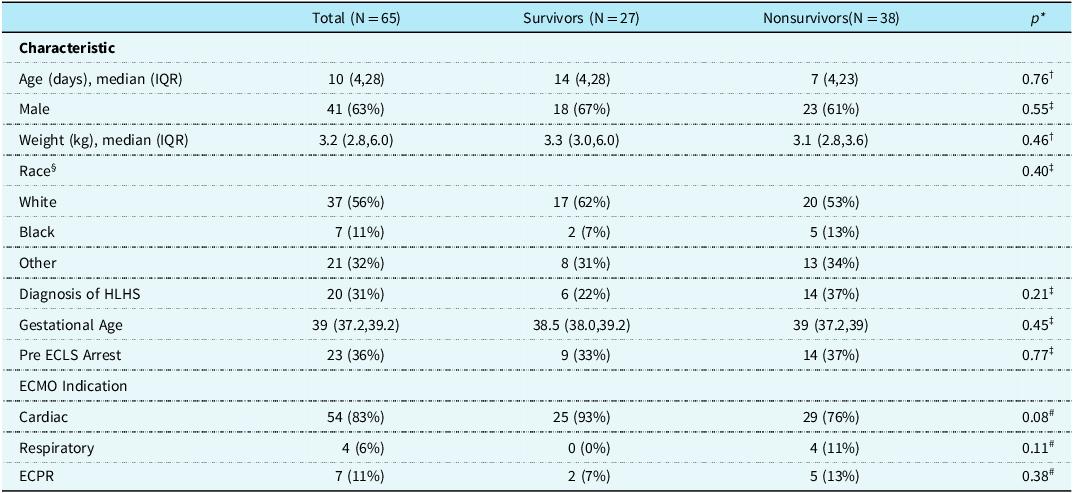
The study population had 65 patients with single ventricle physiology born between January 2016 and January 2021 who required extracorporeal membrane oxygenation support as a bridge to surgical intervention. The median age at the time of cannulation was 10 days [IQR 4, 8] with a median weight of 3.2 kg [IQR 2.8, 6]. Twenty patients (31%) had hypoplastic left heart syndrome, eleven patients (17%) had unspecified single ventricle physiology, nine patients (14%) had double outlet right ventricle, and eight patients had pulmonary atresia (12%). Patient characteristics for survivors and non-survivors are demonstrated in Table 1.
Patient characteristics: survivors vs. nonsurvivors

* All comparisons made between survivors and non-survivors;
† Mann Whitney U-test;
‡ Chi-square test;
# Fisher exact test;
§ Data incomplete;
HLHS: Hypoplastic left heart syndrome; ECMO: Extracorporeal membrane oxygenation;
ECPR: Extracorporeal cardiopulmonary resuscitation;
ECLS: Extracorporeal Life Support.
Pre and initial extracorporeal membrane oxygenation support and cannulation
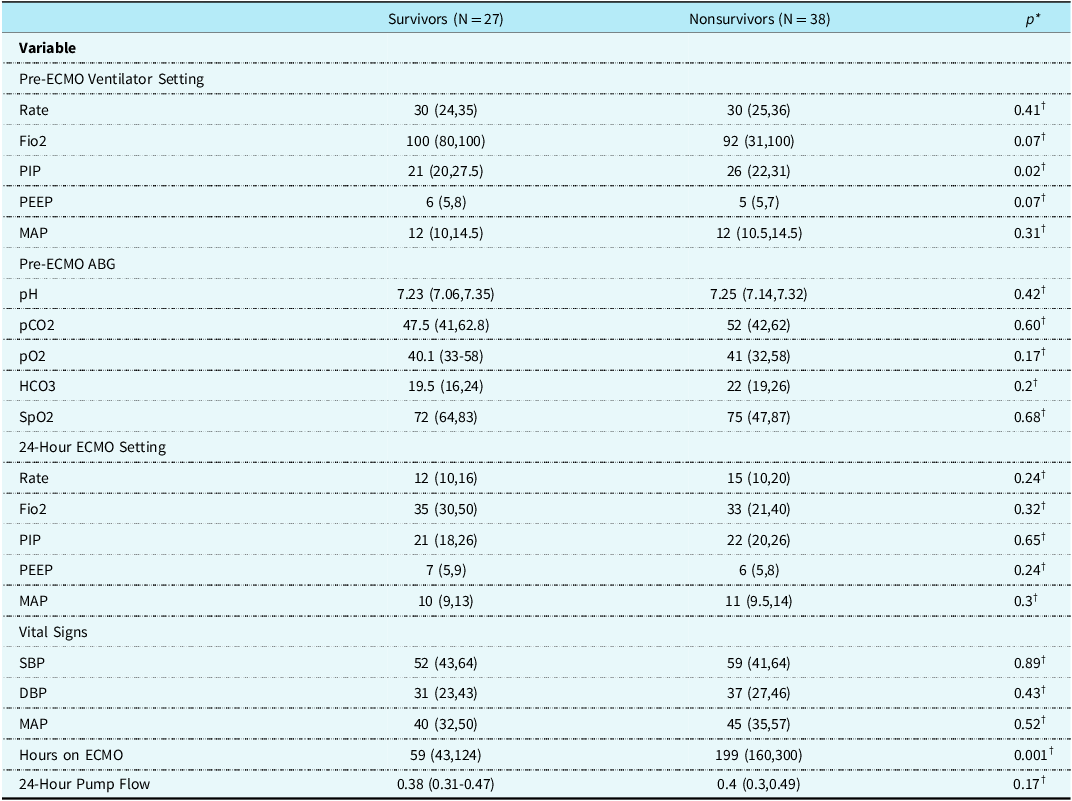
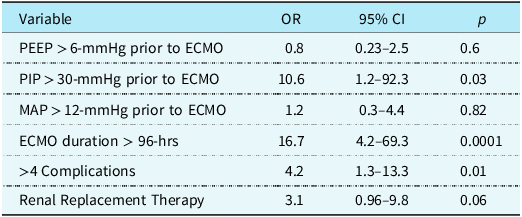
Pre-extracorporeal membrane oxygenation support for survivors and non-survivors is demonstrated in Table 2. Fifty-four patients (83%) required extracorporeal membrane oxygenation for cardiac decompensation, four patients (6%) had respiratory arrest requiring extracorporeal membrane oxygenation, and seven patients (11%) required extracorporeal cardiopulmonary resuscitation. There were no significant differences in indications for extracorporeal membrane oxygenation when comparing survivors and non-survivors. There were no significant differences between the survivors and non-survivors regarding pre-extracorporeal membrane oxygenation blood gases and 24-hour extracorporeal membrane oxygenation settings. Duration of extracorporeal membrane oxygenation was significantly different between non-survivors and survivors (199-h vs. 59-h; p < 0.001). Non-survivors had a significantly higher peak inspiratory pressure prior to extracorporeal membrane oxygenation as compared to survivors (26 mmHg vs. 21 mmHg; p = 0.02). Patients with a peak inspiratory pressure greater or equal to 30 prior to extracorporeal membrane oxygenation were more likely to die prior to discharge (OR 10.6, 95% CI 1.2–92.3, p = 0.01). Table 3
- pre- and initial extracorporeal membrane oxygenation (ECMO) support

* All comparisons made between survivors and nonsurvivors;
† Mann Whitney U-test;.
‡Chi-square test; #Fisher exact test.
Univariate analysis for mortality

ECMO: extracorporeal membrane oxygenation; MAP: mean airway pressure;
PIP: peak inspiratory pressure.
Extracorporeal membrane oxygenation complications
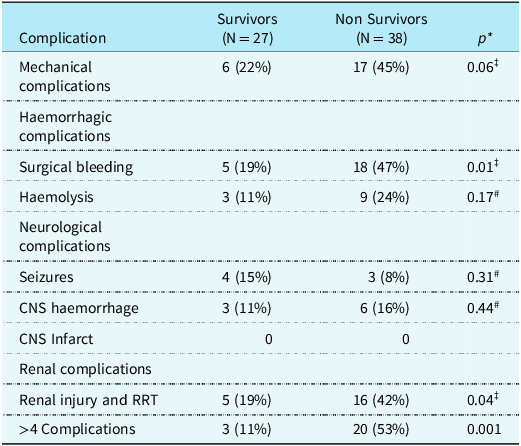
Overall complications related to extracorporeal membrane oxygenation support as compared between survivors and non-survivors are demonstrated in Table 4. Non-survivors as compared to survivors were more likely to have four or more complications while supported on extracorporeal membrane oxygenation (53% vs. 11%; p = 0.001, OR 4.2, 95% CI 1.3, 13.3; p=0.01. Bleeding complications and renal replacement therapy requirement were complications significantly associated with morality prior to hospital discharge (p = 0.01 and p = 0.04). Surgical bleeding and mechanical complications were the most common complications among all the patients.
ECMO complications

DIC: Disseminated intravascular coagulation; CNS: Central nervous system;
RRT: Renal replacement therapy;
CPR: Cardiopulmonary resuscitation; ECMO: Extracorporeal membrane oxygenation;
* All comparisons made between survivors and non-survivors;
‡ Chi-square test;
# Fisher exact test;
Mortality
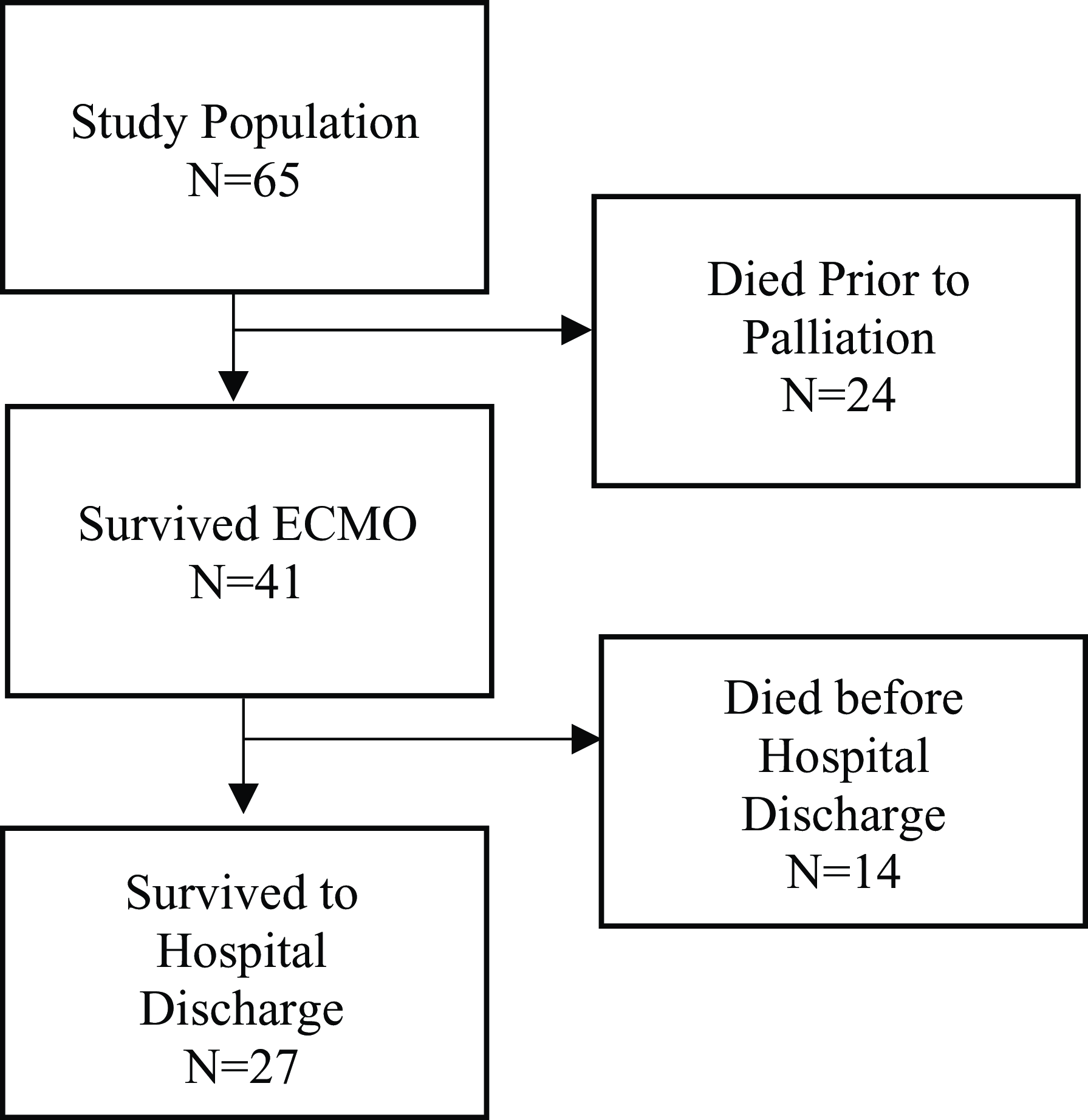
Of the 65 patients in the study, 38 (58%) patients died prior to discharge. Twenty-four patients (63%) died while on extracorporeal membrane oxygenation, and 14 patients (36%) proceeded with palliation but died during the operative or post-operative course, as seen in Figure 1. Table 3 demonstrates univariate analysis of mortality prior to discharge.
Study population.

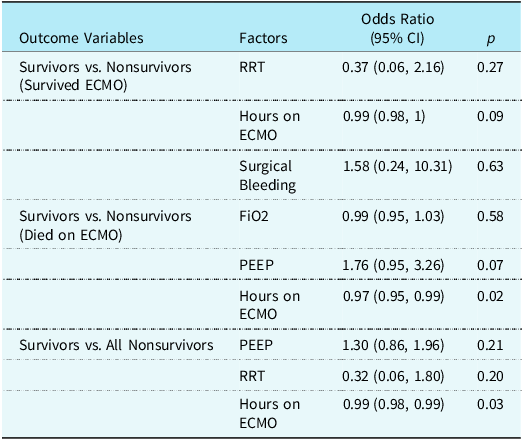
A multivariate analysis using logistic regression was completed in Table 5. The following variables of interest in the multivariable models included: renal replacement therapy, surgical bleeding, cardiac indication for extracorporeal membrane oxygenation, FiO2, peak end-expiratory pressure, and hours on extracorporeal membrane oxygenation. Backward selection was done. Due to the limited sample size, the model had a maximum of three variables. After adjusting for FiO2 and peak end-expiratory pressure, the multivariate model demonstrated that longer duration on extracorporeal membrane oxygenation was significantly associated with mortality when comparing survivors to those who died on extracorporeal membrane oxygenation (OR 0.97, 95% CI 0.95, 0.99, p = 0.02). Similarly, after adjusting for renal replacement therapy and peak end-expiratory pressure, extracorporeal membrane oxygenation duration was significantly associated with mortality when comparing survivors against all non-survivors, including those who survived extracorporeal membrane oxygenation but died before hospital discharge (0.99, 95% CI 0.98, 0.99, p = 0.03). When comparing survivors to those who survived extracorporeal membrane oxygenation but died before hospital discharge, hours on extracorporeal membrane oxygenation were not significantly associated with increased mortality.
Multivariate analysis for mortality

RRT: Renal replacement therapy, PEEP: positive end expiratory pressure, ECMO: Extracorporeal membrane oxygenation
Discussion
In this analysis of registry data of patients with single ventricle anatomy who were supported with extracorporeal membrane oxygenation prior to first-stage palliation, the survival rate to hospital discharge was 42%. Variables significantly associated with hospital mortality included renal injury requiring renal replacement therapy and the presence of equal to or greater than four complications. This suggests that renal compromise may be a marker of poor pre extracorporeal membrane oxygenation perfusion, and may also be associated with worse outcomes in this specific cohort. Reference Mascio, Austin and Jacbos9,Reference López-Herce, Casado and Díez10,Reference Kulik, Moler and Palmisano11 To our knowledge, this is the first study that has reported single ventricle mortality outcomes after pre-operative extracorporeal membrane oxygenation support ads a bridge to first-stage palliation.
Bautista-Hernandez et al., found that extracorporeal membrane oxygenation may be useful in bridging patients with CHD to a definitive vs. palliative repair. Reference Bautista-Hernandez, Thiagarajan and Fynn-Thompson6 Although, their study had a limited single ventricle cohort, 62% of patients survived hospital discharge compared to 42% in our study. Reference Bautista-Hernandez, Thiagarajan and Fynn-Thompson6 In comparison to Bautista Hernandez’ study where 62% of patients survived hospital discharge, only 42% of our patients survived. Bautista Hernandez’s group did not appreciate a significant difference in outcome between single and two ventricle patients, perhaps because the cohort was limited to 6. This may be a reason as to why we saw greater mortality, as we were exclusively looking at the single ventricle population. Reference Bautista-Hernandez, Thiagarajan and Fynn-Thompson6 A population that is generally sicker and more complex. Reference Aydin, Duffy and Rodriguez12 Within Bautista’s study of the three patients with hypoplastic left heart syndrome, two who died had intact atrial septum. Reference Bautista-Hernandez, Thiagarajan and Fynn-Thompson6 Our hypoplastic left heart syndrome population also carried a higher mortality rate, although we were unable to stratify whether the patients had intact atrial septum which could influence outcome. Of the 20 patients who had a diagnosis of hypoplastic left heart syndrome, 14 died (70%). This may highlight that patients with hypoplastic left heart syndrome who suffer cardiac arrest or have haemodynamic deterioration prior to first-stage palliation may not be optimal candidates for pre-operative extracorporeal membrane oxygenation support.
A paper by Fernandez et al., looked at interstage (between stages 1 and 2) survival for patients with hypoplastic left heart syndrome after extracorporeal membrane oxygenation. The study found that 18% of interstage patients requiring extracorporeal membrane oxygenation died. Reference Fernandez, Joy and Allen13 This discrepancy between pre-first-stage palliation and interstage may speak to a more critically ill and unstable neonatal population. Reference Aydin, Duffy and Rodriguez12,Reference Fernandez, Joy and Allen13 Our study’s survival to discharge of 42% mimics the Extracorporeal Life Support Registry report published in 2016. Reference Barbaro, Paden and Guner4 Our study gathered data between 2016 and 2021 and still carried the same mortality rate, indicating no improvement over the course of 5 years. This may be because patients with single ventricle physiology who had myocardial decompensation requiring extracorporeal membrane oxygenation support prior to their surgical palliation had complex haemodynamics that were not suitable for surgical palliation.
The need for renal replacement therapy has been associated with poor outcomes and increased mortality in paediatric patients requiring extracorporeal membrane oxygenation support. Reference Pettit, Selewski and Askenazi14,Reference Wolf, Chanani and Heard15,Reference Morris, Ittenbach and Godinez16 Several studies have highlighted the association between renal replacement therapy and adverse outcomes in single ventricle patients on extracorporeal membrane oxygenation. Renal injury can manifest as acute kidney injury with or without anuria, characterised by a rapid decline in renal function. Reference Wolf, Chanani and Heard15 The underlying mechanisms contributing to renal injury in these patients on extracorporeal membrane oxygenation include haemodynamic instability, decreased renal perfusion, micro emboli, inflammatory response, and nephrotoxic medications. Reference Pettit, Selewski and Askenazi14,Reference Wolf, Chanani and Heard15 A study by Wolf et al., found that paediatric patients with a cardiac diagnosis of extracorporeal membrane oxygenation were significantly more likely to die if they required continuous venovenous hemofiltration, in addition, they had longer hospital stays. Reference Wolf, Chanani and Heard15 Wolf et al.’s population included single and two ventricle patients. Of whom, nearly 20% of patients had hypoplastic left heart syndrome. Reference Wolf, Chanani and Heard15 Another study by Pettit et al., examined the impact of acute kidney injury and fluid overload on paediatric patients receiving extracorporeal membrane oxygenation for cardiac disease. Reference Pettit, Selewski and Askenazi14 They found a significant association between peak fluid overload status and mortality in the presence of acute kidney injury. Reference Pettit, Selewski and Askenazi14 Our study was unable to assess for fluid overload given the limitations of the database. None of the above-mentioned studies exclusively explored renal injury in the context of neonates with single ventricle physiology requiring extracorporeal membrane oxygenation prior to stage one palliation. Our study highlights that renal injury and the use of renal replacement therapy continue to be associated with poor outcomes in this vulnerable population.
Multiple complications on extracorporeal membrane oxygenation have been associated with poor outcomes in neonates with single ventricle physiology. Reference Raithel, Pennington and Boegner17 These patients are at higher risk of developing complications due to the complex nature of their cardiac anatomy and the challenges in managing their pre-operative physiology. Reference Raithel, Pennington and Boegner17,Reference Jaggers, Forbess and Shah18,Reference Perry, Brown and Misfeldt19 These complications can include acute kidney injury, neurologic injury, infections, coagulopathy, and cardiac dysfunction and have been associated with increased mortality. While prolonged duration of extracorporeal membrane oxygenation support and longer hospital length of stay are linked to higher rates of long-term morbidity. Reference Jaggers, Forbess and Shah18,Reference Perry, Brown and Misfeldt19 A study by Misfeldt et al., found that acute renal failure was independently associated with mortality in neonates with single ventricle physiology during extracorporeal membrane oxygenation. Reference Misfeldt, Kirsch and Goldberg7 Another study by Morris et al. reported that both renal and hepatic injury for paediatric post-cardiac surgery patients on extracorporeal membrane oxygenation was associated with increased mortality. Reference Morris, Ittenbach and Godinez16 Our study was looking at preoperative patients; however, one could extrapolate that any evidence of multi-organ dysfunction such as bleeding, anuria, or seizure could be a negative prognostic marker for our patients. The presence of multiple complications on extracorporeal membrane oxygenation may reflect the severity of the underlying disease. Our study similarly found that patients with four or more complications were significantly more likely to die on extracorporeal membrane oxygenation and before hospital discharge.
There were several limitations to this retrospective database study. The variables incorporated into the analysis were limited to discrete data fields collected in the Extracorporeal Life Support Registry. The analysis of specific outcome variables was impacted by incomplete data field completion and only focused on limited variables with an association with mortality. For example, we were unable to determine which patients were placed on prostin prior to extracorporeal membrane oxygenation cannulation, which may have influenced outcome variables. Additionally, the Extracorporeal Life Support Registry includes multiple centres and does not account for centre level-variability related to extracorporeal membrane oxygenation cannulation strategies, circuit architectures, and anticoagulation practices which may have confounded the results. The small sample size and limited power allow us to infer generalisable impact on outcomes but future studies should include more patients and more granular data.
In conclusion, patients supported with extracorporeal membrane oxygenation prior to their first stage of surgical palliation are at high risk for mortality, without improvement in the last decade. Renal injury requires renal replacement therapy, and those who suffer from multiple complications are at increased risk of mortality. This study may serve to set expectations for clinicians as they counsel families on the risks and benefits of extracorporeal membrane oxygenation support prior to their first-stage, single ventricle palliation.
Supplementary material
The supplementary material for this article can be found at https://doi.org/10.1017/S1047951125001386.
Acknowledgements
The author thanks Dr Lamour, Dr Murthy, Dr Esperanza, and Dr Glotzbach for their guidance and feedback in writing the manuscript. The author thanks Mr. Oldenburg for facilitating access to the ELSO (Extracorporeal Life Support Organization) database. The author thanks her mentor and clinical supervisor Dr Aydin for his creativity, support, and mentorship throughout the entirety of the research project. Finally, the author dedicates this work to Dr Ofori-Amanfo who passed away during the research project, but whose impact will be everlasting in the field of paediatric cardiac critical care.
Financial support
This research received no specific grant from any funding agency, commercial, or not-for-profit sectors.
Competing interests
None.