This article explains why Argentina experienced rapid growth during the long nineteenth century.Footnote 1 It argues that the expansion was a response to a massive improvement in the country's terms of trade from independence up to the First World War. By demonstrating the existence of this long terms-of-trade boom, the article corrects a methodological error in the existing literature. Historians of Argentina have previously tended to look at the absolute, rather than the relative, prices of the country's exports, often taking them, moreover, from sources from the core countries, rather than from Argentina itself.Footnote 2 This methodological error is at the heart of the apparent paradox, first observed by Tulio Halperín Donghi, that Argentina's export-led expansion began after independence despite a lack of price incentives for such growth. Here it is demonstrated that once Argentina's terms of trade – that is, the relative prices of its exports and imports – are correctly measured, significant price incentives can be clearly seen, so the paradox is resolved. The main implication of this finding is that Argentina's expansion throughout the long nineteenth century was less a result of internal factors than a response to globalisation.
Halperín Donghi first noted the paradox in two highly influential essays on Argentina's pastoral expansion in the first half of the nineteenth century.Footnote 3 Examining the nominal prices of River Plate hides and tallow in Britain, he found that they rose somewhat after independence in 1810, but then experienced a ‘slow but very prolonged fall’ from the mid-1830s onwards.Footnote 4 Crucially, this fall in prices occurred at the same time as a notable expansion in imports of Argentine hides and tallow into Britain. Halperín Donghi therefore concluded that the pastoral expansion was not due to improved price incentives: as he put it, his numbers ‘perfectly demonstrate[d] the economic climate in which pastoral production occurred in the whole River Plate area (and, for that reason, also in the countryside of Buenos Aires); [it was] a production that did not receive its stimulus, nor see its momentum hampered, by movements in prices'.Footnote 5
Following Halperín Donghi, historians have attempted to explain why Argentina's expansion occurred despite falling prices.Footnote 6 As there appeared to be no price incentives coming from the world market, the focus has been on internal factors. Hence, Halperín Donghi himself looked towards the country's land abundance. He argued that Argentine capitalists were pushed out of commerce following the arrival of British merchants after independence, so they instead invested in rural activities, thereby taking advantage of the abundant quantities of Pampean land, which meant that entry costs were minimal and large profits could be made.Footnote 7 The problem with this explanation is that there was no British monopoly of commerce, as both creole and Spanish merchants remained heavily involved in Buenos Aires' trade.Footnote 8 The question therefore remains why Argentines began to exploit their abundant land only after independence and not before, when it was even cheaper.Footnote 9 Samuel Amaral suggested that it was due to institutional change, as the liberalisation that followed independence freed entrepreneurs from the restrictions placed on them by the colonial state, so they were able to establish more estancias, which were a particularly efficient way of organising pastoral production.Footnote 10 Maria Alejandra Irigoin then suggested that the expansion also occurred because merchants began to invest in land as a hedge against the civil war-induced inflation that afflicted the country in the first half of the nineteenth century.Footnote 11
These alternative explanations of the pastoral expansion become unnecessary, however, once the terms of trade are correctly taken into account. To be clear, what are being referred to are technically known as the ‘net barter terms of trade’ (NBTT), which are the ratio of a country's export prices (Px) to its import prices (Pm). They are calculated as:
 $$NBTT = \displaystyle{{Px} \over {Pm}}$$
When this ratio goes up, the terms of trade are improving; when it goes down, they are deteriorating. Traditionally, concern has revolved around questions of which countries have gained or lost out from changes in the terms of trade.Footnote 12 More recently, however, the focus has shifted towards the issue of how they impact on price incentives within a country, leading to shifts in the allocation of resources between sectors, which can have harmful or beneficial effects on growth.Footnote 13 This article follows this trend. It demonstrates that Argentina underwent a massive terms-of-trade boom during the nineteenth century, which provided price incentives for capital and labour to move into export-oriented agriculture, leading to the rapid expansion of ranching and, later, farming.
Up to now, even those who have looked closely at Argentina's nineteenth-century terms of trade have failed to recognise the magnitude of the boom. Carlos Newland, most notably, used mainly European prices to estimate Argentina's ‘international’ terms of trade and found a roughly 100 per cent improvement from the first half of the 1810s to the second half of the 1830s, but then stagnation until the end of the 1860s.Footnote 14 At the same time, he noted that ‘the domestic terms of trade improved much more dramatically than the international terms of trade’,Footnote 15 with a rough estimate suggesting an almost 400 per cent improvement from 1810 to 1825.Footnote 16 Nevertheless, for Newland, the subsequent stagnation in the international terms of trade meant that the paradox identified by Halperín Donghi persisted, as the pastoral expansion began during a period when price incentives were few. As he and Ricardo Salvatore put it:
The combined effect of declining prices of textiles and rising prices of livestock produced dramatic improvements in the terms of trade, which rose 377 percent between 1810 and 1825 (in local prices). The convergence between local prices and international prices (due to a sharp fall in transport and other transaction costs) stimulated the production of tradable goods, while at the same time lowering the cost of imported food and cloth. However, after 1830 and except for a short recovery during the Crimean war, the prices of Argentine exports were in decline. Hides, in particular, lost 40 percent of their value between 1830 and 1850. Yet, as import prices continued to fall at [a] declining rate, commodity terms of trade remained basically unchanged between 1830 and 1860.
During the first sixty years after independence exports of livestock products grew significantly. […] This rapid growth in the leading sector of the economy was achieved mostly through the extension of the frontier and also through greater efficiency in livestock production. Of course, purely extensive growth (expansion in the use of resources) cannot explain the paradox posited by Halperin Donghi more than thirty years ago: the great boom in the ranching economy was achieved during a time (1830–50) of declining export prices.Footnote 17
Hence, according to Newland and Salvatore, Halperín's paradox persists, as the origins of Argentina's pastoral expansion remain unexplained.
This article shows that during the long nineteenth century Argentina's terms of trade improved far more than is usually supposed. Historians have previously failed to appreciate the magnitude of the boom because they have used prices from the core countries as proxies for prices in Argentina itself. This expediency is justified by the claim that these were ‘external’ terms of trade calculated using ‘international’ prices. Yet there was no such thing as ‘international’ prices for most of the long nineteenth century. Only as trade costs between national markets fell could an integrated world market form.Footnote 18 Using European prices as if they represented international prices is consequently an anachronism that can lead to misleading results. For the nineteenth century, it introduces a major downward bias into the trend of Argentina's terms of trade,Footnote 19 which is partially corrected here by using Argentine prices for exports. The result can be called ‘part-proxy’ estimates of the terms of trade, in that they still rely on other countries' prices for imports. With some crude adjustments made for price convergence on the import side, they suggest an improvement of at least 2,000 per cent from the 1780s through to the first decade of the twentieth century. There were, then, massive price incentives for export-led growth.
To begin, the article explains why the terms of trade were depressed in the late colonial period and why they improved following independence. Initially, it is argued, the boom began as a result of the ending of the Spanish trade monopoly, then it continued thanks to technological change, both in the core's industry and in shipping. The article then provides an indication of how much Argentina's terms of trade improved up to the First World War. The article concludes by discussing the implications of this finding for Argentina's historiography. It argues that the extent of the terms-of-trade boom means that less weight should be given to internal factors than to the impact of globalisation when explaining the origins of Argentina's export-led growth. Improved terms of trade led to labour and capital moving into the export sector, allowing the previously under-utilised Pampean land to be brought into production. Notably, Halperín Donghi himself arrived at a similar conclusion in his later work, when he returned to one of the original metanarratives of Argentina's historiography, in which the country's expansion is seen as a result of the trade liberalisation that accompanied independence.Footnote 20 Indeed, Halperín Donghi explicitly identified improved terms of trade as causing the pastoral expansion on the Pampas.Footnote 21 Nevertheless, it is his earlier work, in which there were no price incentives for the expansion, that continues to feature prominently in the historiography,Footnote 22 which is why this article is necessary.
The Long Boom
In the colonial era the River Plate's terms of trade were depressed by the Spanish monopoly of trade with its American colonies, which was intended to channel resources from the Americas to Spain. In simplified terms, the basic pattern was that Spanish merchants sold imported goods at highly inflated prices in the Americas, then remitted their profits back to the metropole. This, rather than direct fiscal transfers, became the principal means by which resources were extracted: in the second half of the eighteenth century merchants' private remittances of gold and silver were around six times greater than remittances on crown account.Footnote 23 The crown nonetheless benefitted from the trade monopoly by taxing the flow of goods and precious metals, as much of its revenues came from levies on American exports and imports, both in Spain and the Americas,Footnote 24 while the merchants who grew wealthy from the trade also provided the crown with credit.Footnote 25 The monopoly thus played a central role in the crown's extraction of resources from its American colonies.Footnote 26
In the River Plate the trade monopoly sought to promote the flow of silver from Upper Peru's mines back to Spain. For most of the colonial era, all goods legally imported from Europe had to be shipped from Seville (or, later, Cadiz) to the Isthmus of Panama, carried across land to the Pacific, shipped to Callao, Lima's Pacific port, then taken 4,000 kilometres overland by mule trains to the River Plate. Such a lengthy journey brought high trade costs, which inflated the prices of imports, thereby providing a considerable degree of protection for the cottage industries of the Interior's peasant societies. In the Littoral, meanwhile, Buenos Aires developed as an entrepôt for a flourishing contraband trade, with imports of African slaves, European manufactures and tropical goods from Brazil illicitly exchanged for silver from Upper Peru.Footnote 27 This entrepôt role became increasingly formalised during the Bourbon reforms in the second half of the eighteenth century. By making Buenos Aires the capital of the new Viceroyalty of the River Plate in 1776, the Spanish authorities sought to undermine the position of the Lima merchants, who had become too proficient at provisioning the South American market with goods produced in the Americas.Footnote 28 Crucially, the creation of the new viceroyalty placed Potosí, the mining centre of Upper Peru, within Buenos Aires' jurisdiction, so the flow of silver was redirected from Lima towards the River Plate. In 1778 so-called ‘free trade’ was implemented, as Spanish merchants were allowed to trade directly between Buenos Aires and any Spanish port. The city then became an important southern node in a reinvigorated trade monopoly, as the metropole was substantially able to re-establish its commercial hegemony over its South American colonies by restricting the role of Lima's creole merchants.Footnote 29
The trade monopoly depressed the terms of trade for the River Plate's pastoral producers owing to the high trade costs that it entailed, which generated large price differentials between Europe and the Americas.Footnote 30 Competition among Spanish merchants in Buenos Aires was minimal, so their markups remained high – one study has suggested that 70 per cent was considered an ‘acceptable markup’.Footnote 31 A lack of competition meant, moreover, that they had few incentives to use more efficient shipping, so their freight rates were excessive. Pushing costs up further, their goods were heavily taxed by the Spanish authorities. Indeed, most of the legal imports into Buenos Aires were re-exports of other countries' merchandise from Spain, so they had been taxed when they entered that country, taxed again when they were re-exported, then taxed again on arrival in Buenos Aires. Similar taxes would have been levied on the River Plate's exports in reverse order.Footnote 32 The same merchants moreover tended to be involved in both legal and illegal trade, so they had few incentives to effectively undercut themselves by offering contraband goods at better prices.Footnote 33 Consequently, export prices were depressed and import prices inflated. Thus, in the first half of the 1790s cattle hides sold in Buenos Aires for perhaps as little as 20 per cent of their wholesale price in Cadiz.Footnote 34 Ranchers accordingly tended to be impoverished, with most illiterate and many lacking basic goods, such as shoes and socks.Footnote 35 Their influence was largely confined to the marginal frontier regions, whereas merchants dominated Buenos Aires and the Interior cities, where they engaged in commercial activities oriented towards exchanging both imported and locally-made goods for silver from Potosí.Footnote 36 Through these activities merchants accumulated fortunes that dwarfed those of the ranchers; hence, whereas almost 30 Buenos Aires merchants had fortunes of over 50,000 pesos around the time of independence,Footnote 37 there was perhaps only one rancher worth that amount.Footnote 38
The merchant-dominated colonial order began to disintegrate following the British invasions in 1806 and 1807, during the Napoleonic Wars. Even though the British forces were repelled from Buenos Aires on both occasions, the province's ranchers soon heard of the greatly improved terms of trade that the British merchants were offering in Montevideo, the city across the River Plate estuary that had been successfully occupied. The ranchers therefore lobbied the Spanish authorities to liberalise trade. Mariano Moreno, a prominent young lawyer, famously appealed to the Spanish viceroy on the ranchers' behalf.Footnote 39 He noted that in Montevideo ‘[s]ales were made at advantageous prices, goods were bought at minimal values, and the rural world wore fabrics that it had never known before, having sold at high values hides that its grandparents had thrown away as useless'.Footnote 40 The ranchers and their sympathisers recognised, then, that across the River Plate the terms of trade had improved dramatically under the British, so they sought an end to the Spanish trade monopoly. Their goal was trade liberalisation so that they could exploit their country's land resources.Footnote 41 Officials in Spain could not countenance losing the monopoly, however, because they believed, correctly, that it played a fundamental role in their public finances.Footnote 42 Faced with this impasse, independence became inevitable.
The disintegration of the Spanish Empire brought the trade monopoly to an end. Already in November 1809 the Spanish viceroy had been persuaded to allow two British merchants to disembark and sell their cargoes.Footnote 43 Then, three days after an independent government was declared in late May 1810, the remaining restrictions on trade with foreigners were removed.Footnote 44 Subsequently, the number of merchants arriving rose: whereas 50 ships had docked annually at Buenos Aires in the mid-1790s,Footnote 45 there were over 250 foreign merchant vessels entering by the early 1820s.Footnote 46 Crucially, this dramatic increase in overseas trade became the new basis for state finance, as import taxes replaced fiscal transfers from Upper Peru as the main source of government revenues in Buenos Aires. This ensured that post-independence governments would be committed to promoting trade.Footnote 47
This trade liberalisation was the initial cause of the long terms-of-trade boom.Footnote 48 Increased competition among merchants turned Buenos Aires into more of a sellers' market for pastoral producers and a buyer's market for consumers of imported goods. Greater competition squeezed profit margins, so merchants sought to reduce costs by making their operations more efficient. They greatly improved, for instance, the packing of their goods as they crossed the Atlantic, thereby reducing spoilage, which led to lower insurance rates.Footnote 49 To facilitate their trade, taxes were also reduced considerably. Within two weeks of independence, export taxes were lowered,Footnote 50 and they would then be further eroded by inflation, falling to just 4 per cent on dry ox hides by the end of the 1820s.Footnote 51 British and other foreign shipping was also more efficient than Spanish vessels, and merchants could ship their goods directly, which eliminated the costs associated with shipping goods via Spain. As trade costs fell, there was rapid price convergence: thus, in the first half of the 1790s hides had sold in Buenos Aires for around 20 per cent of their in-bond price in Britain, but they were selling for 80–90 per cent by the 1820s.Footnote 52 Prices are not available for imports, but qualitative evidence suggests that a similar convergence took place. In the early 1820s, for instance, a resident British merchant complained that he had ‘bought English stockings cheaper than I could buy them in London’, and that it was ‘cheaper to purchase a stock of linen [in Buenos Aires] than at home’.Footnote 53 Prices in Buenos Aires and London appear to have diverged again in the 1830s, presumably as the numbers of merchant vessels arriving at Buenos Aires stagnated following the initial post-independence influx,Footnote 54 which must have allowed commercial margins to recover somewhat. Nonetheless, price convergence would resume in the second half of the nineteenth century, this time primarily due to the mechanisation of ocean shipping. As metal hulls replaced wooden hulls and steam engines went on to replace sails, freight rates fell across the world.Footnote 55 At the end of the 1860s it had cost 32–5 shillings to ship a ton of coal from Wales to Buenos Aires, but by 1913 it had fallen to 12–21 shillings.Footnote 56 Falling transportation costs then tended to push up Argentina's export prices while lowering its import prices, helping to drive the continuing terms-of-trade boom.
Adding to the effects of price convergence, the terms of trade also improved owing to the ever cheaper goods being produced by the industrial revolution. British cotton textiles, most notably, became far cheaper with the adoption of the power loom, spinning mule and steam engine by small, highly competitive firms that were unable to set prices.Footnote 57 The price of cotton fabrics fell by roughly 90 per cent between the 1770s and the 1850s.Footnote 58 Mechanised production led to less dramatic but still significant falls in the prices of other manufactures, allowing the working classes in Argentina's Littoral provinces to become avid consumers of European, and specifically British, goods. As Woodbine Parish, the British consul to Buenos Aires during the 1820s and ’30s, put it, ‘[t]he gaucho is everywhere clothed in [British goods]. […] If his wife has a gown, ten to one it is from Manchester. The camp-kettle in which he cooks his food – the common earthenware he eats from – his knife, spurs, bit, and the poncho which covers him – all are imported from England.’Footnote 59 Further into the Interior, high costs of internal transportation prevented such a dense penetration of imports.Footnote 60 Yet, this barrier too was overcome following the arrival of the railways from the 1870s onwards. At this point, the terms-of-trade boom became nationwide.
Argentina's terms of trade had been depressed, then, by the colonial order, but they improved dramatically following independence. Initially, this was mainly due to the abolition of the Spanish trade monopoly, which increased competition among merchants, leading to lower trade costs. Subsequently, the boom was driven by the industrial and transportation revolutions, as mechanisation in the North Atlantic core, combined with the competitive organisation of its industry, lowered the prices of the manufactured goods that Argentina imported, while more efficient shipping reduced freight rates, raising export prices and lowering import prices across the periphery.
Measuring the Boom
Historians have not appreciated the magnitude of Argentina's nineteenth-century terms-of-trade boom owing to two methodological errors. Firstly, they have often not looked at Argentina's terms of trade at all, preferring instead to simply examine the nominal prices of its exports.Footnote 61 Secondly, given the work entailed in piecing together Argentina's fragmentary price record, even those who have looked at the terms of trade have relied upon prices from core countries as proxies for prices in Argentina itself.Footnote 62 While commonly used by historians of peripheral countries, such ‘proxy’ estimates are liable to have a major downward bias in the trend owing to the considerable price convergence that took place between the North Atlantic core and the periphery during the nineteenth century.Footnote 63 For Argentina, proxy estimates have suggested an improvement in the terms of trade of around 150 per cent from 1810 to 1913,Footnote 64 but this does not take into account the effects of price convergence. A careful reconstruction of the existing price record indicates that this error results in a major underestimate of the boom.
The most important raw data used in the new estimate of Argentina's nineteenth-century terms of trade are the domestic wholesale prices of the country's exports. From 1780 until 1822 the only export price series available is for dried hides, but then the number of series steadily begins to multiply, although there remain years in which no price series are available. On the import side, a crude proxy price index constructed from export price indices of six of Argentina's major trade partners is used. The result is ‘part-proxy’ terms of trade, in that it uses Argentina's own prices for exports but depends upon prices from its trade partners as proxies for import prices. As such, the new estimate is still likely to have a downward bias in the trend owing to the price convergence that took place during the nineteenth century.Footnote 65 Nonetheless, it suggests a far greater terms-of-trade boom than is normally supposed.
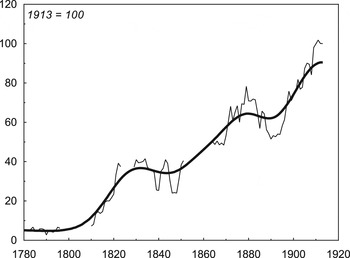
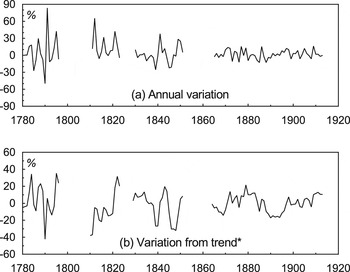
The new estimate, shown in Figure 1, shows an improvement of around 1,500 per cent in Argentina's terms of trade from the 1780s to the first decade of the twentieth century. Even this, however, is likely to understate the boom because the proxy import price index does not take into account the price convergence that took place on the import side. If adjustments are made for the effects of falling trade costs on import prices, it seems likely that the improvement would be more than 2,000 per cent over the same period. Assuming, for instance, that the difference between import prices in Argentina and export prices in the core fell from 100 per cent in the 1780s to 30 per cent in the 1900s, which is plausible, the terms of trade would have improved by 2,300 per cent.Footnote 66 What is more, the terms of trade also appear to have become increasingly stable, primarily due to the winding down of the conflicts over Uruguay, which had seen several naval blockades imposed on Buenos Aires. In Figure 2 this is illustrated by two measures of volatility. Panel (a) simply shows the annual percentage change in the series, while Panel (b) shows the cyclical component of the series as a percentage of its trend component. Both suggest decreasing volatility.Footnote 67 The terms of trade thus appear to have persistently improved for over a century, while also becoming less volatile.
Part-Proxy Terms of Trade for Argentina, 1780–1913

Volatility in Argentina's Part-Proxy Terms of Trade, 1780–1913

Future research could greatly improve the terms-of-trade series that have been presented here. The local prices of imported goods, particularly textiles, need to be gathered, and the export price series that have been used could be improved considerably, given that there are gaps in the series and changes in quality are not always taken into account, especially for hides.Footnote 68 Furthermore, the prices used here are from Buenos Aires, so are unlikely to be representative of much of the country. Were prices collated for, say, Tucumán, it is highly probable that its provincial terms-of-trade boom would appear even greater owing to falling internal transportation costs once the railways arrived in the 1870s.Footnote 69 It seems logical to conclude, then, that collecting prices for other provinces would reinforce the impression that Argentina as a whole experienced a dramatic terms-of-trade boom, even if its timing and degree must have varied across the country.Footnote 70 As will be seen, this means that there were major price incentives for Argentina's nineteenth-century expansion.
Argentina's Globalisation
Whereas much of the historiography has looked at how post-independence Argentina grew by exploiting its abundant land to produce for export, the focus here is on why this expansion began when it did. As was discussed at the beginning of this article, this question has previously been neglected owing to the lasting influence of Tulio Halperín Donghi's brilliant, but methodologically flawed, essays on the post-independence pastoral expansion on the Pampas.Footnote 71 His error was to look at the nominal prices of Argentina's exports, rather than their relative prices – an error that has been repeated by historians such as José Carlos Chiaramonte,Footnote 72 Hilda Sabato,Footnote 73 Samuel AmaralFootnote 74 and Juan Carlos Garavaglia.Footnote 75 Even those authors who have looked at Argentina's terms of trade – Carlos Newland, most notablyFootnote 76 – have tended to calculate them using prices from European countries, thereby introducing a major downward bias into the trend of their estimates. Here it has been demonstrated that the terms-of-trade boom was far greater than they have supposed, even when the methodological error is only partly corrected, as it has been here, by using Argentina's own prices for exports. The result suggests that export-led growth after independence was a response to the massive price incentives that came from Argentina's integration into an emerging world market – it was, in other words, a result of Argentina's globalisation.
The terms-of-trade boom was driven by distinct processes of globalisation in different periods. It began when the Spanish trade monopoly was abolished following independence in 1810. Immediately, there was rapid price convergence as greater competition among the increased numbers of foreign merchants, together with lower taxation, reduced trade costs. The merchants brought with them, moreover, the cheaper manufactures, especially cotton fabrics produced by Britain's industrial revolution. These developments drove the dramatic improvement in the terms of trade during the 1810s and ’20s. The boom then appears to have stalled owing to stagnation in the numbers of merchants arriving. It started up again in the 1850s, this time driven by the continuing falls in the prices of manufactured goods, as well as technological progress in shipping, which reduced transportation costs. Only in the 1890s was there a brief slump in the terms of trade, this time due to a reduction in demand following a downturn in the North Atlantic core. Nonetheless, the secular trend was dramatic improvement from independence to the First World War.
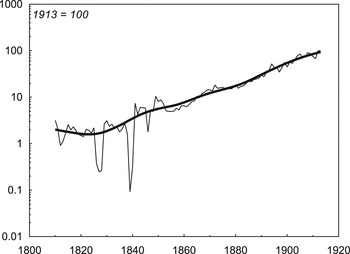
The long boom generated price incentives for Argentina's export expansion because it increased the rewards from producing exportables relative to producing import-competing goods. For instance, a 2,000 per cent improvement in the terms of trade from 1810 to 1913 implies a 3 per cent annual growth in the purchasing power of a unit of exports in terms of imports, without any need for productivity increases. Inversely, it implies an annual 3 per cent fall in the purchasing power of a unit of imports. In response, both labour and capital moved into the export sector, which meant agriculture in the land-abundant Pampean region. The result was the rapid growth of exports. The available data, compiled in Figure 3, suggest that, once the chaos of the wars of independence had subsided, there was a 5 per cent annual growth in the volume of exports from the mid-1820s until the First World War, although with considerably more volatility in the first half of the nineteenth century, primarily due to the blockades that were periodically imposed on Buenos Aires. What happened to import-competing activities is harder to evaluate. In the case of textiles, the import-competing activity par excellence, there has been an interminable debate about what happened after independence.Footnote 77 What is clear is that handicraft textiles persisted in the Interior until at least the 1870s, when the newly-constructed railways began to extend the terms-of-trade boom further inland from the Littoral. Thereafter, the Interior's peasantries substantially ceased to produce textiles: the 1869 national census found 94,882 people who declared their occupations to be related to textiles,Footnote 78 but by 1914 the number had fallen to just 30,980.Footnote 79
Argentina's Export Volume, 1810–1913

This response to the long boom transformed Argentina from a country predominantly involved in subsistence agriculture and import-competing handicrafts to one focused on agricultural production – initially, cattle ranching for hides, then sheep for wool, and finally cereals and beef – for export. For the mass of the population, this entailed a long process of proletarianisation, as self-sufficient peasants were turned into wage earners. The rural poor, who made up the bulk of the population, gradually ceased to engage in subsistence agriculture and import-competing handicraft activities, particularly textiles, and instead sought employment linked to the export sector. This process of proletarianisation took place – unevenly – across the country over the course of the long nineteenth century. In the Littoral it was already under way in the late colonial era and intensified after independence, although it remained a drawn-out process.Footnote 80 In the Interior it began in earnest in the first half of the nineteenth century, but then accelerated once the arrival of the railways undermined handicraft industries in the 1870s and ’80s.Footnote 81 Such proletarianisation, augmented by immigration from abroad, improved the profitability of agriculture by increasing the labour supply, at the same time as greater competition among merchants squeezed commercial margins. Capitalists therefore reoriented their investments away from commerce in imported and import-competing goods towards landownership – a trajectory that was common among wealthy families during the long nineteenth century, as Argentina's dominant class became a predominantly landowning class.Footnote 82 Improving terms of trade in this way drew both labour and capital into the export sector, leading to rapid export growth, as it allowed millions of hectares of Pampean grasslands to be profitably brought into production for export onto the world market.
Looking beyond Argentina, this account of the country's nineteenth-century growth could also have implications for the broader historiography of Latin America. Historians have routinely used European prices to estimate the terms of trade of other Latin American countries as well.Footnote 83 As such, they must have under-appreciated how much the terms of trade improved after independence. This article has argued that in Argentina the result of the terms-of-trade boom – once the indigenous populations beyond the frontier were pacified and displaced – was a century of expansion on the Pampas, which has been much celebrated in the historiography. Yet, a reasonable hypothesis would be that other Latin American countries' experience more closely resembled that of the Interior, which tended to stagnate, at least in relative terms, after independence. The crucial difference between the Interior and the Pampean region was the availability of land. Where land was abundant, improving terms of trade allowed frontiers to expand into the scarcely-populated plains, as labour and capital shifted into the export sector. Where land was scarce, improving terms of trade tended, however, to have less beneficial effects, as import-competing activities went into decline and competition for the limited supply of land increased. Typically, this resulted in peasantries being turned into landless rural proletariats, as their communal lands were expropriated and their handicraft industries undermined by cheaper imports. During the long nineteenth century, similar processes can be seen in Argentina's Andean regions,Footnote 84 the highlands of Bolivia and Peru,Footnote 85 and beyond to Mexico.Footnote 86 A working hypothesis for future research would be that Latin America's globalisation in this way produced what used to be called the ‘development of underdevelopment’,Footnote 87 as integration into the world market led to dramatically improved terms of trade, which brought progress to some places but stagnation and decline to others.
Appendix: Argentina's Terms of Trade, 1780–1913
This appendix describes how the new ‘part-proxy’ estimate of Argentina's ‘net barter terms of trade’ (NBTT) was calculated.Footnote 88 To begin with, some of the terminology will be clarified, then the sources and methods used for the new estimate will be discussed.
Ideally, a country's terms of trade should be calculated using its own prices for both the export price index (Px) and the import price index (Pm). This can be done using wholesale prices from within the country, as follows:
 $$Wholesale\; NBTT = {Domestic\; wholesale\; Px \over Domestic\; wholesale\; Pm}$$
Alternatively, at-the-port prices can be used, which include wholesale markups and excise duties for export prices, but exclude customs taxes and wholesale markups for imports. Technically, these are known as ‘cost, insurance, and freight’ (CIF) import prices and ‘free on board’ (FOB) export prices. The at-the-port terms of trade are calculated in this way:
 $$At-the-port\;NBTT = {FOB\; Px \over {CIF\; Pm}}$$
Which are preferred – wholesale or at-the-port terms of trade – will depend upon the question being asked. If, following the lead of Raúl Prebisch and Hans Singer,Footnote 89 the concern is with the distribution of gains from international trade, at-the-port estimates will arguably be of more interest, as they exclude the effects of the domestic political economy on prices. On the other hand, if the focus is on price incentives, as in this article, wholesale estimates will be more appropriate, as they reflect the prices actually paid and received by people in the country (or some part of the country, depending upon on how well integrated the internal market is). Either way, prices from the country itself should be used.
Regrettably, historical price data are often unavailable, particularly for poorer, more peripheral countries. As a result, historians have often used prices from Europe and the United States as proxies. The results can be considered ‘proxy terms of trade’:
 $$Proxy\; NBTT = \; \displaystyle{{Foreign\; PX} \over {Foreign\; PM}}$$
Proxy estimates are calculated, then, with another country's prices used as proxies for a country's own prices. This is, by and large, the method that has been used to estimate Argentina's terms of trade in the existing literature.Footnote 90
For the nineteenth century, such proxy estimates are likely to be inaccurate owing to the price convergence that took place between countries, so prices in one place are unlikely to reflect prices in another. Consequently, some researchers have tried to get around this problem by using prices from the core countries and adjusting them for changes in trade costs. This involves, for example, taking British FOB export prices, and adding the cost of insurance and freight, in order to arrive at CIF import prices in the peripheral country. Similarly, British CIF import prices can have insurance and freight deducted from them to estimate the peripheral country's FOB export prices. The problem with this procedure is that there are few insurance and freight indices for peripheral countries before the 1870s, let alone indices for all the other costs involved in trading a good internationally. Historians have resorted to using freight and insurance indices for core countries instead, yet this procedure has been shown to be problematic because there was considerable variation in the fall in trade costs from one place to another.Footnote 91 The indices that would be necessary to adequately adjust core prices do not, in short, exist.
It is necessary to labour this point because it has been missed in some of the recent literature. Antonio Tena-Junguito and Henry Willebald have sought to use British import prices with estimates of freight and insurance charges subtracted to estimate Argentine FOB export prices. They conclude that both official Argentine export prices and wholesale prices in Buenos Aires tend to undervalue Argentina's exports.Footnote 92 In making this finding, they nonetheless appear to have ignored the literature on price convergence in the nineteenth century, which has suggested that transportation costs were only part of the costs incurred in trading a good between two countries, with the share of freight and insurance in total trade costs decreasing the further back one goes.Footnote 93 Simply subtracting transportation costs from British import prices should not, therefore, be expected to arrive at Argentine prices. Indeed, it should produce precisely Tena-Junguito and Willebald's results: Argentine prices appear to undervalue exports because their corrected British prices are too high, given that they do not subtract all the other trade costs. A sensible approach is to use prices from Argentina itself, as has been done here.
That said, the new terms-of-trade estimate presented in this article is far from perfect. It can be considered a ‘part-proxy’ estimate, in that it uses Argentina's own prices for exports but the prices of Argentina's main trade partners for imports. It is calculated as:
 $$Part-proxy\; NBTT ={Domestic\; Px \over Foreign\; Pm}$$
The terms-of-trade estimate for nineteenth-century Argentina that results from this formula is likely to have a downward bias in the trend because it does not take into account the price convergence that occurred on the import side.
The following sources were found for domestic export prices: unit values for hides from Zacharías Moutoukias' compilation of late colonial trade statistics for 1779–96;Footnote 94 wholesale hide prices for 1810–23 from a report presented by British merchants to the new British consul in 1824;Footnote 95 Julio Broide's compilation of wholesale prices for 1829–51, taken from the English-language British Packet and Argentine News;Footnote 96 Juan Álvarez’ compilation of wholesale prices for the 1860s onwards, taken from the bulletin of the Buenos Aires Stock Exchange;Footnote 97 Roberto Cortés Conde, Tulio Halperín Donghi and Haydée Gorostegui de Torres's unpublished reconstruction of Argentina's export statistics from the 1860s to the early twentieth century;Footnote 98 and the official trade statistics from the early twentieth century onwards.Footnote 99 The fragmentary price series compiled from these sources were then converted into British pound sterling,Footnote 100 the era's dominant currency, and metric units.Footnote 101
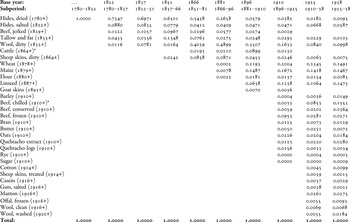
The various export price series were combined into a chained geometric Laspeyres index, which was used as a shorthand means to approximate a chained Fisher index.Footnote 102 Ten separate subperiods were calculated, then spliced together using the geometric mean of their overlapping years.Footnote 103 The weights assigned to the 31 different goods in each subperiod can be seen in Table A1.Footnote 104 They were assigned based on the values of goods exported in the indicated years, according to Argentina's trade statistics. As can be seen, the number of goods included in the index increases over time: from 1780 to 1821 it includes dry hides only; in 1822 salted hides are added; in 1829 jerked beef; and so on. This reflects both the paucity of price data and the increasing variety of goods that Argentina exported.
Weights in Argentina's Export Price Index, 1780–1938

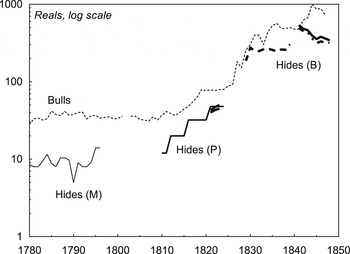
Particular attention should be paid to the series for dry hides, as it accounts for 100 per cent of the index until 1822. This is not ideal, although the index remains legitimate because hides had such a dominant position in Argentina's exports.Footnote 105 Colonial trade statistics indicate that hides made up well over 90 per cent of total merchandise exports,Footnote 106 while they remained at around two-thirds of exports in the 1820s,Footnote 107 when other products begin to be incorporated in the index. For this reason, coverage is not a major issue. Nonetheless, it is essential that the hide prices used are plausible, given their initial prominence in the index. To check this, in Figure A1 the hide prices collected for the first half of the nineteenth century are compared with the price of bulls. Both increased greatly following independence, although the price of bulls did not increase as much as the price of hides. This should be expected because the bull's meat would not have fetched such a high price, given the limited markets for beef during this period. Despite being so fragmentary, then, these series probably do reflect the evolution of hide prices with some accuracy.
Prices of Bulls and Dry Hides in Buenos Aires, 1780–1848

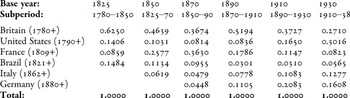
The proxy import price index, on the other hand, is quite crude. It is calculated from export price indices for six of Argentina's major trade partners: Brazil, Britain, France, Germany, Italy and the United States. With the exception of Brazil,Footnote 108 the export price indices were taken from the secondary literature,Footnote 109 then converted to sterling.Footnote 110 Again, they were combined into a chained geometric Laspeyres index, using the weights shown in Table A2, which were calculated using the value of the import of each country into Argentina. This proxy index is crude because it assumes that the composition of Argentina's imports from each of the six countries was similar to the composition of their exports to all countries. A better proxy could be constructed using prices for specific goods from each country, although calculating such an index is unlikely to make a great difference to the final result.Footnote 111 Rather, what is needed is an import price index calculated using prices from Argentina itself. As of yet, however, there are few series for the prices of imported goods in Buenos Aires, so that remains an agenda for future research.
Weights in Argentina's Proxy Import Price Index, 1780–1938