Introduction
Bulimia nervosa (BN), an eating disorder characterized by binge eating episodes, compensatory behaviors including self-induced vomiting, and overvaluation of body shape and weight, is associated with high rates of medical complications (Mehler, Reference Mehler2011), psychiatric co-morbidity (Wonderlich & Mitchell, Reference Wonderlich and Mitchell1997; Fichter et al. Reference Fichter, Quadflieg and Hedlund2008) and psychosocial impairment (Crow & Peterson, Reference Crow, Peterson, Maj, Halmi, Lopez-Ibor and Sartorius2003), along with significant mortality rates (Crow et al. Reference Crow, Peterson, Swanson, Raymond, Specker, Eckert and Mitchell2009). Although psychological and pharmacological treatments have been found to reduce bulimic symptoms (Mitchell et al. Reference Mitchell, de Zwaan and Roerig2003; Wilson et al. Reference Wilson, Grilo and Vitousek2007), treatment outcome studies have been characterized by partial response, significant attrition and considerable relapse, indicating that additional interventions are needed (Mitchell et al. Reference Mitchell, Hoberman, Peterson, Mussell and Pyle1996). In addition, the lack of implementation of evidence-based eating disorder treatments by clinicians in the community (Mussell et al. Reference Mussell, Crosby, Crow, Knopke, Peterson, Wonderlich and Mitchell2000; Wallace & von Ranson, Reference Wallace and von Ranson2011) and the notable drop-out rates across BN treatment outcome studies (Shapiro et al. Reference Shapiro, Berkman, Brownley, Sedway, Lohr and Bulik2007) suggest that a wider range of effective interventions are necessary to improve long-term efficacy, increase levels of treatment acceptability among clinicians and patients, and provide a broader range of evidence-based treatment options for dissemination.
One potential strategy to enhance treatment efficacy is to target mechanisms that are thought to cause and maintain psychopathology symptoms (Rieger et al. Reference Rieger, Van Buren, Bishop, Tanofsky-Kraff, Welch and Wilfley2010). Several studies, particularly those using ecological momentary assessment, have demonstrated that negative emotional states often precipitate bulimic symptoms (Smyth et al. Reference Smyth, Wonderlich, Heron, Sliwinski, Crosby, Mitchell and Engel2007; Haedt-Matt & Keel, Reference Haedt-Matt and Keel2011) and that negative emotions may temporarily subside after bulimic behaviors occur (Smyth et al. Reference Smyth, Wonderlich, Heron, Sliwinski, Crosby, Mitchell and Engel2007). These data suggest that binge eating and purging may serve as a self-regulation strategy for negative emotions and that addressing maladaptive coping in response to these emotions, and behavioral and cognitive patterns that elicit negative emotions, may reduce bulimic symptoms. Additional research indicates that a type of self-oriented cognition described as self-discrepancy, involving the magnitude of the difference between a person's self-perception and their self-evaluative standards, may be an important aspect of eating disorder symptoms (Higgins et al. Reference Higgins, Bond, Klein and Strauman1986; Strauman et al. Reference Strauman, Vookles, Barenstein, Chaiken and Higgins1991). Integrative cognitive-affective therapy (ICAT), a new psychotherapeutic treatment for BN, emphasizes the promotion of and exposure to adaptive eating, emotional cues for bulimic symptoms, adaptive coping, self-directed behaviors, interpersonal relationships and self-oriented cognitive patterns including self-discrepancy (Wonderlich et al. Reference Wonderlich, Peterson, Smith, Klein, Mitchell, Crow, Engel, Grilo and Mitchell2010). This treatment is based on a multi-dimensional model of bulimic symptoms that emphasizes momentary relationships between maintaining variables and bulimic behaviors (Wonderlich et al. Reference Wonderlich, Engel, Peterson, Robinson, Crosby, Mitchell, Smith, Klein, Lysne, Crow, Strauman and Simonich2008) and specifically focuses on these maintenance mechanisms during four phases of treatment (Wonderlich et al. Reference Wonderlich, Peterson, Smith, Klein, Mitchell, Crow, Engel, Grilo and Mitchell2010). The first phase of treatment emphasizes strategies that address treatment ambivalence (Miller & Rollnick, Reference Miller and Rollnick1991) in addition to the importance of emotions in maintaining bulimic symptoms. The second phase of treatment focuses on adaptive coping strategies, particularly for urge management, and targets nutritional deprivation through structured meal planning. The third phase of treatment is individualized to address one or more of three potential problems areas hypothesized to maintain bulimic symptoms by eliciting negative affect: (1) self-directed behavior styles including excessive self-control and self-neglect (Benjamin, Reference Benjamin1974, Reference Benjamin1993); (2) interpersonal problems, including submissiveness, withdrawal and blaming (Benjamin, Reference Benjamin1974, Reference Benjamin1993); and (3) self-discrepancy and evaluative standards (Higgins et al. Reference Higgins, Bond, Klein and Strauman1986; Strauman et al. Reference Strauman, Vookles, Barenstein, Chaiken and Higgins1991). The final phase of treatment emphasizes healthy lifestyle plans and relapse prevention. ICAT includes a psycho-educational patient workbook and eight ‘core skills' that are emphasized in treatment and provided to the patient in the form of laminated skill cards and portable technology.
The aim of the current investigation was to compare the efficacy of ICAT for the treatment of bulimic symptoms to a cognitive-behavioral intervention, ‘enhanced’ cognitive-behavior therapy (CBT-E; Fairburn, Reference Fairburn2008). Cognitive-behavioral treatment was selected as the most conservative and suitable comparison condition because this approach has been described as the treatment of choice for BN (Wilson, Reference Wilson2005) and has been given the highest rating in the National Institute for Clinical Excellence review of evidence-based treatments (NICE, 2004). Outcome measurement was based on bulimic symptoms, overall eating disorder severity and co-occurring psychiatric symptoms (i.e. depression, anxiety), in addition to measures of hypothesized maintenance mechanisms of BN including emotion regulation and cognitive self-discrepancy.
Method
Participants
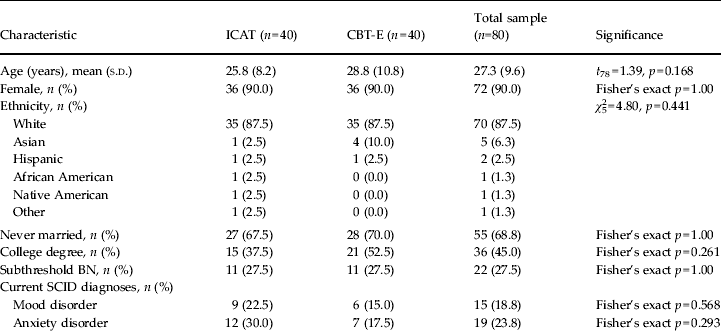
The sample included 80 adults (n = 72 females, 90%; see Table 1) from two USA clinical sites (Minnesota and North Dakota). Potential participants were recruited from the community using advertisements and by referrals from local eating disorder treatment clinics and other health professionals. Criteria were broadened to include participants with both DSM-IV (APA, 1994) and proposed DSM-5 criteria for BN and also individuals who reported compensatory behaviors, such as self-induced vomiting, accompanied by subjective bulimic episodes (Fairburn, Reference Fairburn2008) at least weekly for 3 months prior to enrollment. Broader inclusion criteria were used based on previous findings that individuals with subthreshold bulimic symptoms resemble those who meet full diagnostic criteria on eating disorder, psychiatric and impairment measures (Crow et al. Reference Crow, Agras, Halmi, Mitchell and Kraemer2012) and to increase the heterogeneity of the sample and potential generalizability. Diagnostic status was determined by trained interviewers using the Eating Disorder Examination (EDE; Fairburn, Reference Fairburn2008). Exclusion criteria included pregnancy or lactation, body mass index (BMI) < 18 kg/m2, lifetime diagnosis of bipolar or psychotic disorder, current diagnosis of substance use disorder, medical or psychiatric instability including acute suicide risk, and current psychotherapy. Participants on a stable dose of antidepressant medication for a minimum of 6 weeks were allowed to participate.
Baseline participant characteristics by treatment group (total n = 80)

ICAT, Integrative cognitive-affective therapy; CBT-E, enhanced cognitive-behavioral therapy; BN, bulimia nervosa; SCID, Structured Clinical Interview for DSM-IV; BMI, body mass index; s.d., standard deviation.
This study was approved by the institutional review boards at each of the recruitment sites, and by the University of Wisconsin where the Treatment Adherence and Acceptability Assessment Center was based. Written informed consent was obtained during the orientation meeting after the study had been described in detail to potential participants prior to data collection.
Measures
Treatment outcome assessment for bulimic symptoms included frequency of binge eating episodes and compensatory behaviors as measured by the EDE (Fairburn, Reference Fairburn2008), which was also used as a measure of associated eating disorder symptoms, including shape and weight concerns, abstinence from bulimic symptoms and global eating disorder severity. Previous studies have supported the reliability and validity of the EDE (Fairburn, Reference Fairburn, Cooper, Doll, O'Connor, Bohn, Hawker, Wales and Palmer2009; Berg et al. Reference Berg, Peterson, Frazier and Crow2012). Experienced, trained, master's and doctoral-level assessors who conducted the interviews were blind to participant randomization. Assessors were trained initially using didactics and role playing and communicated throughout the study by teleconference and email to prevent drift. Inter-rater reliability ratings based on audiotape ratings were conducted on a 20% random sample (n = 16) of the baseline EDE interviews. Overall inter-rater reliability (based on intraclass correlation coefficients) for the EDE subscales and global score ranged from 0.909 (weight concerns) to 0.999 (restraint). Frequency of bulimic behaviors (e.g. binge eating, purging) was also assessed through weekly written recalls of these symptoms that were provided by the participants at their regular treatment sessions throughout the trial. Additional outcome measures included the Beck Depression Inventory (BDI; Beck et al. Reference Beck, Ward, Mendelson, Mock and Erbaugh1961) to assess depressive symptoms, the Rosenberg Self-Esteem Scale (RSES; Rosenberg, Reference Rosenberg1979) to examine self-esteem, and the Spielberger State/Trait Anxiety Inventory (SSAI/STAI; Spielberger et al. Reference Spielberger, Gorsuch and Lushene1970) to measure anxiety. Several measures were also included to assess specific variables targeted by ICAT including the Selves Interview (Higgins et al. Reference Higgins, Bond, Klein and Strauman1986) to examine self-discrepancy, and the Difficulties in Emotion Regulation Scale (DERS; Gratz & Roemer, Reference Gratz and Roemer2004) to assess emotion regulation. Participants completed these measures at baseline, at the end of treatment (EOT) and at the 4-month follow-up. In addition, the Structured Clinical Interview for DSM-IV Axis I Disorders – Patient Version (SCID-I/P; First et al. Reference First, Spitzer, Gibbon and Williams2002) was administered at baseline to assess co-occurring psychopathology diagnoses.
Randomization
Participants were randomized to treatment condition by an independent biostatistician (R.D.C.). Randomization was performed in blocks of four participants stratified by site, diagnosis (full versus partial BN) and therapist.
Treatment
Both treatments consisted of 21 50-min individual psychotherapy sessions over 19 weeks, with twice weekly sessions for the first 4 weeks. As described earlier, ICAT (Wonderlich et al. Reference Wonderlich, Peterson, Smith, Klein, Mitchell, Crow, Engel, Grilo and Mitchell2010) includes four phases. The first phase emphasizes motivational interviewing techniques to encourage treatment engagement and reduce ambivalence (Miller & Rollnick, Reference Miller and Rollnick1991). In addition, the identification of emotional states and self-monitoring of eating patterns, behaviors and emotions are introduced. The second phase focuses on nutritional rehabilitation through meal planning along with adaptive coping strategies, particularly for managing urges to engage in bulimic behaviors. The third phase emphasizes modifying behaviors in response to stimulus situations and emotions, which are identified as antecedents of bulimic behavior. Interpersonal problems, self-directed styles (e.g. self-attack, extreme self-control) and self-discrepancy are discussed in the context of specific situations that elicit bulimic symptoms. The final phase of treatment emphasizes relapse prevention and healthy lifestyle strategies. CBT-E (Fairburn, Reference Fairburn2008; Fairburn et al. Reference Fairburn, Cooper, Doll, O'Connor, Bohn, Hawker, Wales and Palmer2009) is a revised version of CBT for binge eating (Fairburn et al. Reference Fairburn, Marcus, Wilson, Fairburn and Wilson1993) that has been adapted for transdiagnostic treatment of eating disorder symptoms. CBT-E was selected because initial data suggest that it may be associated with higher abstinence and remission rates compared to earlier versions of the treatment (Fairburn et al. Reference Fairburn, Cooper, Doll, O'Connor, Bohn, Hawker, Wales and Palmer2009), making it a potentially more rigorous comparison condition. The focused version of CBT-E (Fairburn, Reference Fairburn2008) was used and includes four stages: an introductory stage that emphasizes psycho-education, normalization of eating patterns and symptom self-monitoring; a second, brief stage to review progress and formulate plans for the subsequent treatment phase; a third stage that emphasizes the elimination of dieting, reduces shape checking and avoidance behaviors, educates about mood tolerance, and targets the overevaluation of shape and weight; and a final stage that focuses on maintaining progress and minimizing relapse risk.
Four Ph.D. psychologists (two at each site) who served as study therapists were initially trained in didactic sessions and conducted supervised training cases before administering the treatments for this study. All four clinicians administered both types of therapy, had been trained in cognitive-behavioral techniques for previous randomized controlled trials for BN (e.g. Mitchell et al. Reference Mitchell, Agras, Crow, Halmi, Fairburn, Bryson and Kraemer2011), and were retrained for both treatments used in this investigation. Study therapists met for weekly teleconference supervision with the study supervisors (S.A.W. and C.B.P.) throughout the trial.
Therapist adherence was evaluated for both treatment arms. A random sampling of audiotapes was reviewed by independent graduate student raters at the University of Wisconsin and supervised by one of the study investigators (T.L.S.). A modified version of a previous CBT measure (Loeb et al. Reference Loeb, Wilson, Labouvie, Pratt, Hayaki, Walsh, Agras and Fairburn2005) was used to evaluate CBT-E adherence. ICAT therapist adherence was evaluated with a measure designed for this study. Raters were three advanced doctoral students in psychology and one psychology undergraduate with research experience. Teams of two raters evaluated each treatment. Inter-rater reliability was established before raters began coding for study purposes. Inter-rater reliability for each team was acceptable (CBT-E = 0.90; ICAT = 0.81). Raters evaluated approximately 20% of randomly selected patient/therapist dyads, reviewing 15-min segments from three randomly selected audiotaped sessions for each selected dyad to capture data from early, middle and later phases of treatment. If a recording from a selected session was missing or inaudible, an adjacent session was rated. When ratings for a taped segment failed to meet an intraclass correlation coefficient of at least 0.80, raters created consensus ratings. Intraclass correlations were calculated in a two-way mixed model with absolute agreement. Overall, therapists demonstrated good adherence. CBT-E and ICAT therapists' mean ratings across all items were 6.2 and 3.0 on seven- and four-point Likert-type scales, respectively, where higher numbers indicate greater adherence.
Statistical analyses
Sample size calculations for this study were based on procedures described by Hedeker et al. (Reference Hedeker, Gibbons and Waternaux1999) for determining power in two-group longitudinal studies with attrition. Power estimates assumed a 20% attrition rate and a two-tailed α of 0.05. The enrolled sample size of 40 subjects per group (80 total) provided a power of 0.80 to detect an attrition-adjusted standardized effect size of 0.49.
All analyses were conducted using SPSS version 19.0.0 (SPSS Inc., USA). Significance tests were based on a two-tailed α of 0.05. Treatment groups were compared on baseline characteristics using independent-samples t tests for continuous measures, χ 2 for categorical measures and Fisher's exact tests for dichotomous measures. Treatments groups were compared on outcome measures at baseline using a generalized estimating equations (GEEs; Zeger & Liang, Reference Zeger and Liang1986) model with a negative binomial log link response function for behavioral count measures (objective and subjective bulimic episodes and also purging frequency), logistic regression for abstinence and global EDE categorization, and a general linear model for continuous measures. All models controlled for site and DSM-IV eating disorder diagnosis (i.e. BN versus subthreshold BN). Abstinence was defined as no objective binge eating, vomiting or laxative use in the past 4 weeks based on the EDE interview. Additional analyses were conducted on the global EDE scores, which were categorized according to whether participants were within 1 standard deviation (s.d.) of the community mean (i.e. below 1.74; Fairburn et al. Reference Fairburn, Cooper, Doll, O'Connor, Bohn, Hawker, Wales and Palmer2009).
Missing data for continuous outcome measures at EOT and follow-up were imputed using multiple imputation (MI) based upon fully conditional Markov chain Monte Carlo (MCMC; Schafer, Reference Schafer1987) modeling. The final analysis model was based upon the averaged values of 100 separate imputations (Rubin, Reference Rubin1987). Those participants with missing binge eating and purging (i.e. vomiting or laxative use) data at EOT or follow-up were considered not abstinent. Treatment groups were then compared separately at EOT and follow-up on measures of outcome and mechanism using GEEs, logistic regression or a general linear model comparable to those described above. Covariates included site, DSM-IV eating disorder diagnosis (i.e. BN versus subclinical variant) and baseline measurement (with the exception of abstinence). Analyses based on these same models were conducted separately for each treatment condition to evaluate change in outcome measures from baseline to EOT or the 4-month follow-up. A GEE model with a negative binomial response function was used to compare treatment groups on weekly binge eating and purging frequency based on symptom recall assessment, using all available data (i.e. no imputation of missing values). The model included effects for treatment group, session number (linear and quadratic components), baseline measurement, site and DSM-IV eating disorder diagnosis.
Results
Patient flow
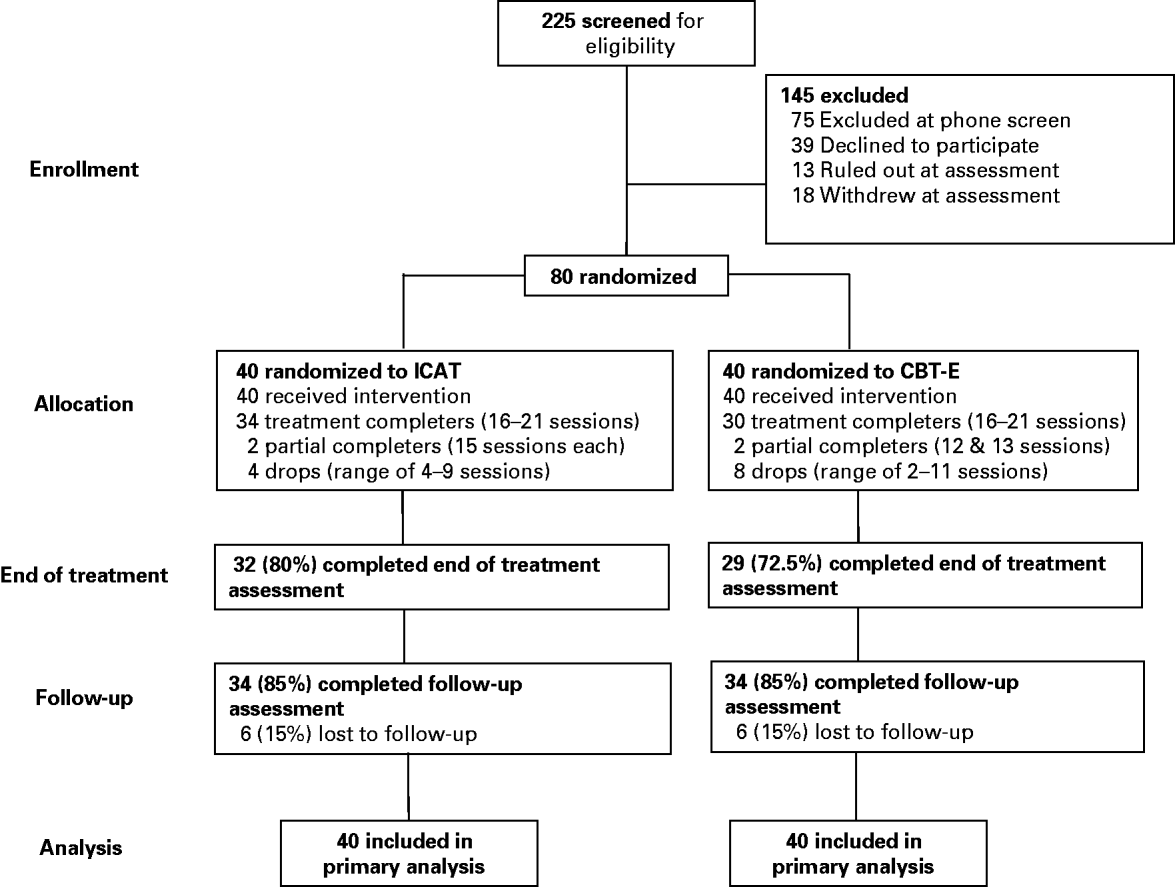
Figure 1 presents patient flow through the study. A total of 80 participants were randomized, 40 each to ICAT and CBT-E. A total of 64 participants (80%) completed treatment, defined as attending at least 16 sessions; four participants (5%) were classified as partial completers, defined as attending at least 12–15 sessions; and 12 participants (15%) were considered treatment non-completers, defined as attending up to 11 sessions. EOT assessments were completed for 61 participants (76.3%) and follow-up assessments were obtained for 68 participants (85%; treatment non-completers were invited to return for follow-up assessments).
Flow-chart of study participants.

Participant characteristics
Participant characteristics at baseline are presented in Table 1. Participants were predominantly female (90%) and white (87.5%), and the majority (72.5%) met full threshold DSM-IV criteria for BN. There were no significant differences between treatments or sites on any baseline characteristic.
Treatment retention
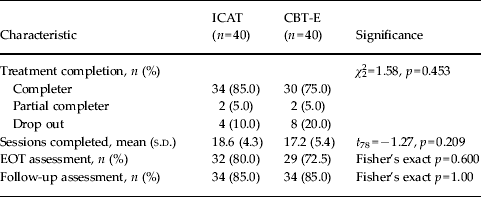
A total of 34 ICAT participants (85%) and 30 CBT-E participants (75%) completed treatment. Treatment conditions did not differ significantly in terms of completion rates, average number of sessions completed or the completion of EOT or follow-up assessments (Table 2).
Completion status by treatment group

ICAT, Integrative cognitive-affective therapy; CBT-E, enhanced cognitive-behavioral therapy; EOT, end of treatment; s.d., standard deviation.
Primary treatment outcome
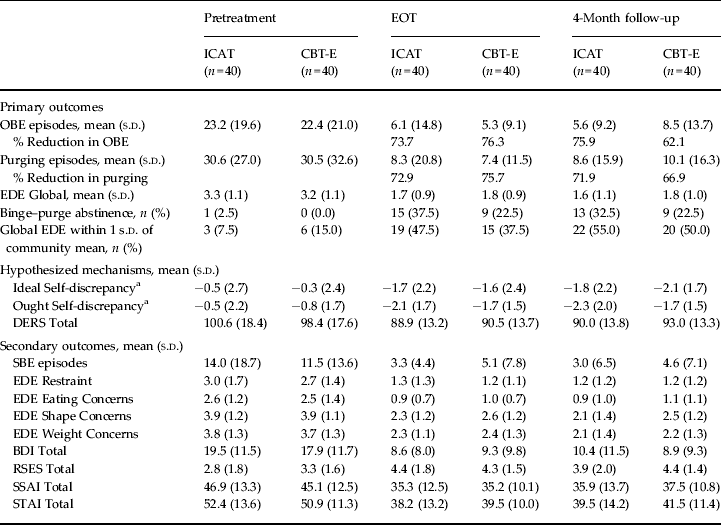
Table 3 presents descriptive information on primary measures of outcome, binge eating and purging frequency from the EDE, at baseline, EOT and the 4-month follow-up by treatment group. Treatment groups did not differ significantly at baseline on primary measures of outcome. No significant differences were found between treatment groups at EOT or the 4-month follow-up on binge eating or purging frequency (all p's > 0.17). In addition, no significant differences were found between treatment groups in the trajectory of binge eating or purging episodes reported through weekly symptom recall (all p's > 0.24).
Primary and secondary outcomes by treatment group

EOT, End of treatment; ICAT, integrative cognitive-affective therapy; CBT-E, enhanced cognitive-behavioral therapy; OBE, objective binge eating; EDE, Eating Disorder Examination; DERS, Difficulties in Emotion Regulation Scale; SBE, subjective binge eating; BDI, Beck Depression Inventory; RSES, Rosenberg Self-Esteem Scale; SSAI, Spielberger State Anxiety Inventory; STAI, Spielberger Trait Anxiety Inventory.
a From the Selves Interview.
Secondary outcome analysis
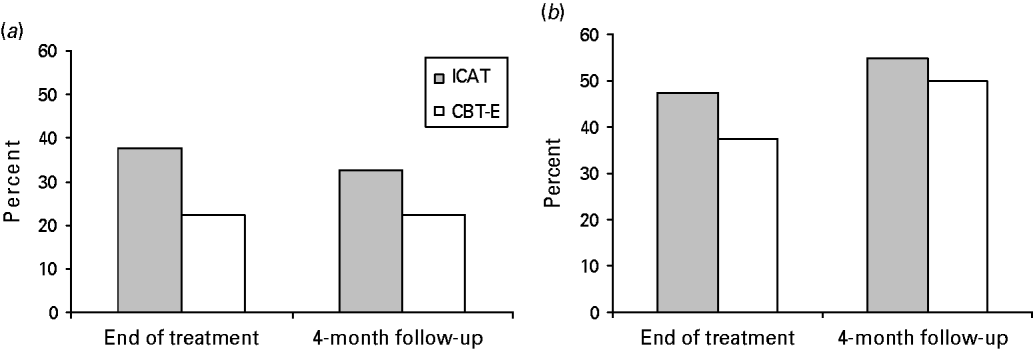
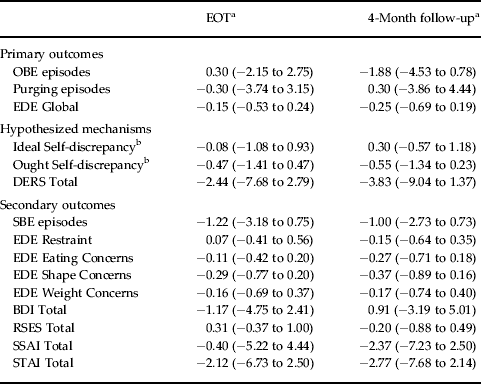
No significant differences were found on any secondary measures of outcome (i.e. eating disorder severity, co-occurring psychiatric symptoms, maintenance mechanisms) between treatment groups at EOT or at the 4-month follow-up (Table 3). Bulimic abstinence rates for ICAT were 37.5% at EOT and 32.5% at follow-up, compared to 22.5% at both EOT and follow-up for CBT-E (Fig. 2). The percentage of ICAT participants within 1 s.d. of the community mean on the EDE global score was 47.5% at EOT and 55.0% at follow-up, compared to 37.5% at EOT and 50% at follow-up for CBT-E (Fig. 2).
(a) Binge eating and purging abstinence and (b) percentage of participants within 1 standard deviation of the community mean on the global Eating Disorder Examination by treatment group [n = 80; integrative cognitive-affective therapy (ICAT) n = 40; enhanced cognitive-behavioral therapy (CBT-E) n = 40].

Both treatment groups showed significant within-group improvement at EOT and follow-up on all outcome measures (p < 0.05). Within-group effect sizes on eating disorder outcomes (i.e. objective bulimic episodes, purging episodes, EDE global scores) at EOT were in the range 0.83–1.50 for ICAT and 0.71–1.30 for CBT-E and at follow-up they were in the range 0.82–1.61 for ICAT and 0.63–1.32 for CBT-E.
Estimates of differences between treatments
Table 4 presents estimates of differences and 95% confidence intervals (CIs) between treatments at EOT and the 4-month follow-up on primary and secondary measures of outcome.
Differences on primary and secondary outcomes and 95% confidence intervals (CIs) between treatments

EOT, End of treatment; ICAT, integrative cognitive-affective therapy; CBT-E, enhanced cognitive-behavioral therapy; OBE, objective binge eating; EDE, Eating Disorder Examination; DERS, Difficulties in Emotion Regulation Scale; SBE, subjective binge eating; BDI, Beck Depression Inventory; RSES, Rosenberg Self-Esteem Scale; SSAI, Spielberger State Anxiety Inventory; STAI, Spielberger Trait Anxiety Inventory.
a Covariate-adjusted estimate (95% CIs) of difference between ICAT and CBT-E: positive values indicate the estimate for ICAT is higher than the estimate for CBT-E; negative values indicate the estimate for CBT-E is higher than the estimate for ICAT.
b From the Selves Interview.
Discussion
The results of this study indicate that both ICAT and CBT-E were associated with considerable improvements in BN symptoms, cognitive self-discrepancy, emotional regulation and co-morbid psychiatric symptoms, and that these treatment conditions did not differ significantly in their effects on these outcome variables. Baseline to EOT effect sizes for both treatments on measures of eating disorder symptoms were moderate to large. This study is innovative in that it compares a new psychotherapeutic treatment for bulimic symptoms to a version of the treatment that is currently considered the most empirically supported treatment for BN (NICE, 2004; Wilson, Reference Wilson2005) in a randomized controlled trial.
The findings for the present study may be considered reliable for the following reasons. First, the study had sufficient statistical power to adequately test the primary outcome measures including the reduction of core bulimic symptoms and eating disorder psychopathology. Second, both treatments were manualized and adherence was substantial, providing reasonable standardization of the interventions. Third, both treatments were regularly and rigorously supervised to promote adherence to the conceptual models and treatment techniques outlined for each treatment. Fourth, all four Ph.D. psychologists delivering the treatment had high levels of expertise in administering evidence-based treatments for eating disorders and had provided these types of psychotherapies in previous randomized controlled trials for BN. Finally, the study was conducted at two sites in a multi-site design, enhancing the potential generalizability of those findings.
The results suggest that there were no differences between the treatments on any outcome measure. In addition, the low levels of attrition indicate that the clinicians effectively delivered both treatments and that the participants found the treatment at least reasonably acceptable. Regarding bulimic symptomatology, there were no treatment-related differences in abstinence rates, frequency of binge eating and compensatory symptoms, or percentage of participants within 1 s.d. of the community mean on the global measure of eating disorder severity. Furthermore, the percentage of participants meeting a global severity criterion at follow-up (i.e. within 1 s.d. of the community mean on the EDE global score) was roughly comparable to a study using CBT-E to treat a transdiagnostic sample of participants with eating disorders (Fairburn et al. Reference Fairburn, Cooper, Doll, O'Connor, Bohn, Hawker, Wales and Palmer2009). Both treatments were also associated with significant improvements in measures of psychiatric symptoms (i.e. depression, anxiety) and with hypothesized mechanisms of action for ICAT (i.e. cognitive self-discrepancy, emotion regulation). It is notable that the treatments did not differ in these particular outcomes despite targeting different putative mechanisms of BN. Thus, there was no evidence that either treatment was superior to the other on any variable.
The findings should not be interpreted without considering limitations of the study. First, there was no wait-list control group or non-specific treatment condition in the design, thus making it impossible to rule out the possibility that the changes identified were due to the simple occurrence of treatment or to non-specific therapeutic factors. Although there is accumulating evidence to suggest that BN does not improve in wait-list conditions (Shapiro et al. Reference Shapiro, Berkman, Brownley, Sedway, Lohr and Bulik2007), it is possible that our effects are non-specific responses to treatment. Second, the sample size did not provide adequate statistical power to test dichotomous outcome measures (e.g. abstinence rates) and it is possible that, with a larger sample size, some of the statistical effects in the study may have reached a level of significance that would alter the conclusions. Third, we did not conduct an a priori non-inferiority statistical design and therefore cannot make statements about the relative comparability or equivalence of the results. Fourth, because the enhanced version of CBT was used as a comparison condition, these results would not necessarily generalize to CBT using an older version of the manual (Fairburn et al. Reference Fairburn, Marcus, Wilson, Fairburn and Wilson1993). Finally, because ICAT was intentionally designed to include some aspects of CBT (e.g. self-monitoring), the two treatments had some degree of overlap. However, the psychotherapies are distinct in several respects including ICAT's emphasis on motivational enhancement, emotional cues, self-discrepancy, self-directed style and interpersonal patterns, and also the underlying psychopathology model.
Conclusions
ICAT is a new treatment for symptoms of BN that is based on the premise that momentary functional relationships between emotional states and bulimic behaviors can be effectively targeted in treatment along with other hypothesized mechanisms of BN. Specifically, the model underlying ICAT based on ecological momentary assessment data posits that negative affect increases in the moments preceding bulimic behaviors and that, in turn, bulimic behaviors temporarily reduce negative affect (Smyth et al. Reference Smyth, Wonderlich, Heron, Sliwinski, Crosby, Mitchell and Engel2007). Although retaining some features of traditional CBT (e.g. self-monitoring, promotion of regular eating behavior; Fairburn et al. Reference Fairburn, Marcus, Wilson, Fairburn and Wilson1993; Fairburn, Reference Fairburn2008), ICAT uniquely targets factors hypothesized to precipitate negative emotion and risk for bulimic behaviors, including relationship problems, excessive personal self-standards associated with self-discrepancy, and harsh or rigid self-directed behaviors. The present findings suggest that ICAT is a promising new treatment for BN that warrants further study with larger samples in an effort to replicate the present findings and more rigorously examine the underlying conceptual model and possible mechanisms of action of this psychotherapy.
Acknowledgments
We thank T. Cook Myers, K. Miller and L. Swan-Kremeier for serving as therapists on the study, Z. Cooper and C. Fairburn for their consultation regarding psychotherapy administration, L. Cao and A. Erickson for their contributions to data analysis, and K. Berg, N. Durkin, S. Engel, L. Jappe, J. Lavender, C. Lystad, and H. Simonich for their assistance with data collection, assessment interviewing, and manuscript preparation. This work was supported by grants R01DK61912, R01DK61973 and P30DK60456 from the National Institute of Diabetes and Digestive and Kidney Diseases, grants R34MH077571, R01MH059674, T32MH082761 and K02MH65919 from the National Institute of Mental Health, and the Neuropsychiatric Research Institute. [Clinical Trials.gov Identifier: NCT00773617.]
Declaration of Interest
Drs J. E. Mitchell and C. B. Peterson receive royalties from Guilford Press. Dr S. J. Crow reports research support from Alkermes and Shire. Dr J. E. Mitchell reports research support from Eli Lilly, Pfizer and GlaxoSmithKline.