One proposal that has repeatedly generated debate among academics and policymakers is the need for an international lender of last resort (ILOR).Footnote 1 Those who argue in favor of an ILOR claim that such an institution would provide support to solvent countries facing liquidity crises. Since the 1990s financial crises it has been argued that this would improve the present financial “architecture” where problems of collective action impede investors from furnishing such support.Footnote 2 On the other side, those who argue against the establishment of an ILOR reference the potential problem of moral hazard, a point that has been raised as the main criticism of the International Monetary Fund (IMF).Footnote 3 A departure point for this debate in the history of financial crises is the 1982 debt crisis.Footnote 4 Literature has not provided a definitive answer as to whether moral hazard was the main problem that led to the crisis. This article provides new evidence based on rich archival material from a variety of sources, namely the archives of Société Générale, Lloyds Bank, National Westminster Bank, the Bank of England (BoE), the Banque de France, the Organisation for Economic Co-operation and Development (OECD), the National Archives (U.K.), and the IMF. Although the usual limitations connected with the use of primary sources should not be underestimated, this article demonstrates how the lending volumes of commercial banks to borrowers in developing countries were affected by the creditor governments’ interventions and by market failures, such as the absence of information and pressures stemming from international competition for export markets.
Mexico's moratorium announcement in August 1982 marked a historical turning point in the assessment of credit risk. The default by the Mexican government and the consequent rescheduling of its debt represented an abrupt end to the lending boom to developing countries that had begun after the oil shock of 1973. In looking for the causes behind the wave of defaults during the 1980s, a wide assumption emerged among scholars and policymakers that international banks, then the main financial intermediaries, had miscalculated the risk associated with loans granted to developing countries. Scrutinizing the state of country risk analysis during the 1970s, it has been argued that the banks’ assessments of country risk were flawed, underdeveloped, and limited by the lack of proper information on the debt and other variables of the borrowing countries.Footnote 5 The combination of these factors can be taken as the major cause that led to the wave of defaults in the late 1970s and early 1980s.
There is an abundance of literature that seeks to explain the banks’ overlending to high-risk countries in the 1970s. These studies assume that perverse incentives existed to deter banks from properly assessing the risk associated with these loans. The explanations given have favored factors such as competition, excess liquidity, and poor regulation.Footnote 6 Political scientists have also cited the banks’ decisions to lend on political grounds. According to several authors, home governments encouraged banks to increase loans to developing countries.Footnote 7 Risk analysis remained a secondary consideration, as banks expected that in the case of concern, either their governments or the IMF would intervene to support both themselves and the borrowing countries, thereby avoiding any potential losses.Footnote 8
Nevertheless, the argument—that is, overlending resulting from market failures—is never truly demonstrated and has been contradicted in other literature. There are also several texts that analyze how the late 1970s Euromarkets functioned.Footnote 9 Some of these have sought to identify the factors that justified the (low) interest rates that the banks charged for their loans. However, a major flaw in this literature is that it does not include the political variables taken into account in more recent literature on moral hazard in IMF lending, suggesting that such variables were irrelevant. Most of these works argue that macroeconomic fundamentals drove the risk premia charged by banks to sovereign borrowers in the 1970s and 1980s. They also find that overall there was no change in this phenomenon after the 1982 crisis.Footnote 10 Thus, there is no evidence for moral hazard or governmental interests, as was argued by political scientists. According to this literature, the 1982 crisis arose because of the sudden deterioration of macroeconomic fundamentals, tight monetary policies in creditor countries, and the deterioration in the terms of trade of borrowing countries.Footnote 11
In this article we provide new empirical evidence that shows how banks considered political factors in their decisions to lend. Contrary to previous works in political science, we deliver a comprehensive analysis of the role of all the main agents participating in the Euroloans market based on archival material from commercial banks, their home governments, borrowing governments, regulators, and international organizations. Today's scholars working on international finance may easily identify certain persistent elements that we highlight as central to the emergence of moral hazard in the 1970s Euromarkets. These include the close relationship between home governments and international banks and the alignment of incentives that fed the lending boom, which ended with the wave of defaults in the 1980s.
This article is organized as follows. The first section provides a brief literature review on international finance and the reasons behind the 1982 crisis. It establishes the “puzzle” (the term used in the literature) in which banks’ loan volumes and prices did not behave in accordance with increased macroeconomic imbalances in developing countries, as observed in the years that preceded the crisis. Thereafter we analyze whether flaws in information could have distorted banks’ risk analyses. We find that this was not the case, although improvements in risk analysis and information produced by the banks were the main concerns among national and international regulators. Next, we demonstrate through a set of case studies that commercial banks in the United Kingdom and France maintained a close relationship with their governments prior to granting a loan. The final price was determined by other factors, such as export contracts, national foreign policy, and competition.
Commercial Banks’ Underreaction to Macroeconomic Imbalances
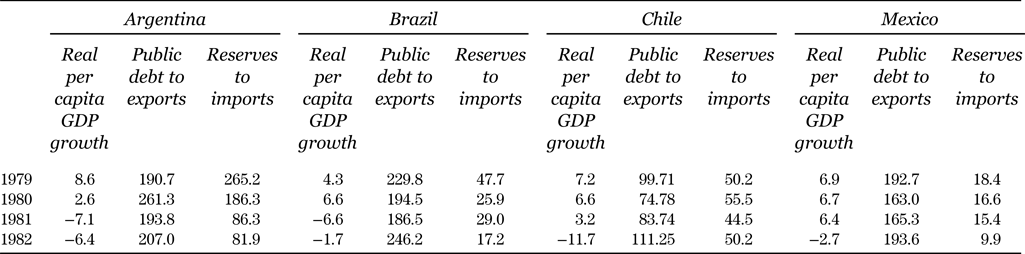
Did the banks ignore the alarm bells that sounded prior to the crisis? It is widely recognized that in the late 1970s, many borrowing countries experienced a rapid deterioration in their macroeconomic fundamentals (Table 1). William Cline shows the rapid growth of international debt among “non-oil” developing countries and new oil exporters, such as Mexico.Footnote 12 The growing debt problem was accompanied by a strong economic recession in Brazil starting in 1980.Footnote 13 In the case of Argentina, capital outflows began in 1980 and a banking crisis erupted in 1981.Footnote 14 Even in Chile and Colombia, which avoided the same type of debt service difficulties that affected most of the continent, macroeconomic imbalances were evident and translated into an economic and financial crisis in 1981, in the case of Chile, and balance-of-payment and banking crises starting in 1980, in Colombia.Footnote 15
Macroeconomic Indicators for Selected Countries

Sources: World Bank, World Debt Tables 1989–90: External Debt of Developing Countries (Washington, DC, 1989); World Bank, World Tables 1992 (Baltimore, 1992).
Note: Figures expressed as percentages.
Surprisingly, during the whole precrisis period, most developing countries continued to borrow in international markets on relatively good terms. Mexico, the first country to experience repayment problems, had been under an IMF Extended Fund Facility program in 1976. Subsequent IMF missions repeatedly expressed concerns regarding the generally high levels of inflation and public deficits in 1979.Footnote 16 The economic growth boom was influenced by an expansionary fiscal policy and by favorable oil prices, at a time when Mexico was exporting an increasing volume of oil. But by 1982, Mexico's fate depended on a combination of external and internal factors.Footnote 17 Starting in 1979, adverse conditions in the world economy affected the country through higher interest rates and lower economic growth. As a result, the public finances of Mexico's central government deteriorated, as most of the external debt was public (government, public firms, and private firms with public guarantees). Internal conditions were related to the overvaluation of the peso and the high budget deficits that had existed since the late 1970s.Footnote 18 Mexico's balance of payments, along with its public finances, suffered from a drop in oil prices in 1981.
One important question concerns the precise moment when capital markets reacted to developing countries’ increasing debt service problems. Jeffrey Sachs wonders why banks’ lending soured between 1980 and 1981 after the rise in world interest rates and argues that the late burst of lending is “difficult to justify.”Footnote 19 Within the literature focused on banking and finance, a comparison of bond and bank loan markets is used to test the relevance of different institutional settings and the nature of each market in terms of the possibility of concerted action and the relative weight of a renegotiation position in case of default.Footnote 20 However, previous studies of the bond market find only mixed evidence of an earlier reaction in the Euroloan markets. Jack Guttentag and Richard Herring, for instance, examine the weekly behavior of spreads over the London Interbank Offered Rate (LIBOR) of the floating rate notes of Nacional Financiera, a credit institution owned by the Mexican government. They demonstrate that while some investors began to react to an increased risk of default in May 1981, the risk was not fully appreciated until November 1981.Footnote 21 Conversely, David Folkerts-Landau shows that foreign bonds, denominated in either deutsche marks or U.S. dollars, did not demonstrate any peculiar behavior until August 1982, the month when Mexican authorities publicly announced their debt service difficulties.Footnote 22
The bond markets’ late and sudden reaction was consistent with Sebastian Edwards's findings that international financial markets only anticipated by a few weeks the Mexican debt crisis.Footnote 23 Nonetheless, a brief review of the press confirms that banks seemed to have reacted more rapidly than previously assumed, at least regarding the loans stemming from Mexican public entities’ increased need for liquidity. For instance, the Wall Street Journal published several articles on bankers’ concerns about Mexico's external debt as early as August 1981.Footnote 24 The terms of the loans also became less favorable; a loan in August 1981 on behalf of Pemex, Mexico's state oil company, reported a spread of 0.5, compared with the 0.375 spread of previous loans.Footnote 25 The deteriorating situation in Mexico's economy, including the fall in oil revenues following both a drop in the price of oil and the tightening of interest rates worldwide, reflected the “wider margins” that Mexican public entities had to pay for their borrowing, as the Financial Times reported.Footnote 26
It is striking that most discussions that followed the crisis were linked to the lack of information on developing countries. Several criticisms were raised against international organizations given the lack of timely and reliable data. The IMF and the Bank for International Settlements (BIS) rejected such accusations. As the crisis erupted and the IMF actively participated in the elaboration of a plan to support Mexico, its staff prepared a summary of the warnings expressed between 1980 and 1982 regarding the potential debt problems of developing countries. In one such speech, the IMF clearly emphasized that “there is no ‘umbrella’ and no lender-of-last-resort for unwise lending. Certainly, the Fund is not in the business of bailing out financial institutions that have run into difficulty.”Footnote 27
The BIS was heavily criticized for its delay in publishing statistics on the total amount loaned to borrowing countries.Footnote 28 The BIS responded by arguing that even though information was available, banks reacted too moderately. In its 1982 annual report, the BIS provided a general description of the evolution of the world economy that led to the crisis, along with the banks’ reactions. The BIS identified the nature of the lending boom as the main risk. This consisted of loans with floating interest rates that had much shorter maturity dates than loans granted in 1974 and before. The macroeconomic situation of most borrowing countries weakened, starting in 1979, after a second increase in oil prices and stronger anti-inflationary policies being undertaken by industrialized countries. Economic growth in developing countries came to a sudden halt in 1980. At the same time, their account deficits increased because of a drop in the price of raw materials and an increase in protectionist tendencies by industrialized countries.
Despite this macroeconomic evolution, the BIS described the banks as having “not strongly reacted” to the international payments situation.Footnote 29 They referenced central banks from the G10 countries and Switzerland that had expressed concerns as early as 1979 about the risks of international lending and the need to maintain adequate capital levels. The BIS reported that while banks did become more selective regarding individual borrowers and charged higher spreads to countries with high debt levels, “prime” countries continued to obtain credit on favorable terms. This was the case for oil producers such as Mexico.
According to the BIS, one of the most important indicators of increased debt service problems was the banks’ undisbursed international credit commitments, which started to decline in the second half of 1979 and then more rapidly beginning in 1982. This was particularly evident for major Latin American borrowers. Moreover, Alexandre Lamfalussy, who worked as economic adviser and head of the Monetary and Economic Department and then as assistant general manager at the BIS during that period, wrote that governments in borrowing countries were aware of the unsustainable pace of external borrowing well ahead of foreign lenders (banks and investors).Footnote 30 Lamfalussy argued afterward that the Falklands War, in April and May of 1982, had been the external shock whereby investors reacted to the true situation of developing countries’ debt problems, even if the maturity of their lending had already begun to shorten by 1980.Footnote 31
Risk Analysis and Banking Regulation in the Precrisis Period
Previous scholars have studied the role of competition and market concentration in the banking sector as the main factors that differentiate banks’ information production and risk analysis, as in the 1970s.Footnote 32 A report by the U.S. regulatory authority recognized that country exposure management systems were adequate for banks with “larger exposures,” although this was not the case for banks with smaller exposures.Footnote 33 Christine Bogdanowicz-Bindert and Paul Sacks describe the sovereign risk analysis of the 1970s as “soft” but insist that the problem was not a lack of information but rather the lack of use of available information.Footnote 34 Following these authors, some regional banks relied on the information included in the documents produced by the money center banks (primarily the “placement” memoranda), as international lending was a new activity for them. These documents included statistics on the political and economic situation of the country. The primary sources were mainly publications elaborated by the IMF, the World Bank, and the BIS.
Paul Mentré provides a detailed description of all available sources of information on developing countries.Footnote 35 Other publications besides those mentioned above existed on the markets and the economic and political situation of borrowing countries. A noteworthy contrast, as compared with today, was the minor importance placed on ratings awarded by rating agencies. Ratings on sovereign borrowers from these institutions were practically nonexistent; specifically, fewer than 10 percent of countries actively being financed through the Euromarkets were rated. For instance, in 1980 Moody's rated only Panama, Australia, New Zealand, Denmark, Canada, Venezuela, Austria, Finland, Sweden, Norway, and the United Kingdom.Footnote 36 Standard & Poor's rated seven countries in 1974 and Fitch rated none.Footnote 37
Other ratings were used, though they were directly dependent upon the conditions under which the market and the banks rated the borrowers. One of these was a ranking published by Euromoney, which created a rating system based on the conditions under which each borrower contracted a loan in U.S. dollars or deutsche marks, using the LIBOR as a reference rate.Footnote 38 This rating had seven categories based on the values of the “Euromoney index,” defined as the ratio of the spreads of the loans issued to their maturities (all concerning only the public sector). A major drawback was that this system did not add new information into the market; it simply reflected the conditions under which banks were lending.
How did the Euromoney ranking perform regarding the probability of default? In 1979, the best-ranked “future defaulter” was Mexico, placed thirty-fourth out of sixty-seven countries. Remarkably, Mexico was upgraded after the following year and ranked thirteenth—better than countries such as Norway (fifteenth), Iceland (nineteenth), and Spain (twenty-first). It was then downgraded in 1981, following a general trend of countries that later defaulted. Mexico was one of the first and largest defaulters of the 1980s, even though the country ranked higher than all other defaulting countries (twenty-second).Footnote 39 The relative borrowing terms of countries that would default in comparison with nondefaulting countries further confirm that banks reacted at least one year before the onset of the crisis. From 1980 to 1981, the average defaulter ranking was downgraded from 41 to 46.
The role of regulation during those years is a crucial issue. According to the IMF, increased competition contributed to banks’ refusals to collaborate with regulatory authorities.Footnote 40 In countries such as the United States and the United Kingdom, banks could not be forced to reduce their exposures or to alter their practices, although the regulations did influence the lending activities of banks in countries such as Germany and Japan. In 1980, the U.S. General Accounting Office reported that its recommendations (called “special comments”) had limited impact on restraining the increase in country exposures, which had become problematic over time.Footnote 41
Regarding the former, a general overview of contemporary publications, regulators’ reports, and bankers themselves showed that the risk analysis was full of flaws and that information on borrowing countries was lacking. Even worse, bankers active in the Euromarkets recognized ex post that pricing or lending decisions were not really taking country analysis into consideration.Footnote 42 The role of limited information had also been at the core of discussions between banks and the IMF in the years prior to the crisis. Jerôme Sgard describes how the IMF conducted continuous exchanges with banks regarding the economic situation of member countries in the 1970s but refused to share “sensitive” information.Footnote 43 Borrowing governments had only been willing to share this information because they believed it would remain confidential. Interestingly, the IMF had received an increased number of requests from commercial banks on the economic situation of different countries since at least 1977.Footnote 44 As a result, the IMF systematically registered the kind of information that the banks sought but was concerned as to whether these contacts went beyond routine inquiries and whether this information could have directly influenced banks’ lending decisions.Footnote 45
In fact, the banks’ requests in the early 1980s for better information blatantly contrasted with their initial position in the 1970s regarding regulation. The Burns questionnaire, an early attempt to improve the general state of information, illustrates this. In 1977, the BIS, along with the G10 group of central banks, prepared a questionnaire that established a list of questions that commercial banks were recommended—or even obligated, in some cases—to ask of potential borrowers before granting loans.Footnote 46 This questionnaire was distributed to the main banks in G10 countries and was also intended to capture the receptiveness of the banks to this initiative. The BIS organized visits to commercial banks in Belgium, Canada, France, Germany, Switzerland, the United Kingdom, and the United States. The checklist included questions that focused mainly on borrowing countries’ external indebtedness.Footnote 47 As expected, most banks rejected the idea on various grounds, and in general they felt they “did not need central bankers to teach them how to assess sovereign credit risks.”Footnote 48 The BIS archives provide precise reports on staff visits to some of the main creditor countries. They describe the attitudes of bankers as a national group or, as in the case of the United States, attitudes at the individual bank level.
A general overview of the reports established by the BIS on each of the visits undertaken in September and October 1977 shows the following. Swiss banks were the most openly hostile to any type of regulatory intervention, followed by U.K., Belgian, and U.S. banks.Footnote 49 Overall, there are important variations between national groups of banks, but we suspect that the same type of heterogeneity can be observed within each group. A closer look at U.S. banks demonstrates that the attitudes differed between small and large banks. Bank of America, Citibank, and Chase Manhattan, three of the most active banks in the Euromarkets, were the most averse to the Burns questionnaire. In 1975, they had ranked first, second, and fourth in the league tables of banking assets at a world level.Footnote 50 While this evidence would be noteworthy during the debt renegotiations of the 1980s, it was already relevant in the precrisis period in terms of information production, market share, and regulatory interests.
A final and still open question concerns the extent to which politics may have affected the commercial banks’ lending decisions in the decade that preceded the 1982 crisis. Literature on international bank lending during the late 1970s and early 1980s remains inconclusive regarding not only the impact of a particularly favorable political environment on the pricing of loans granted to developing countries but also whether the kind of potential pressures previously described could have contributed to the 1982 debt crisis. A major distortion was the probability of intervention by an external agent (similar to an ILOR), which became very relevant. Contemporary observers stressed the role of the IMF as an institution whose presence was supposed to “underpin confidence, just as a steady local central bank strengthens the domestic monetary system.”Footnote 51 Roland Vaubel expressed concerns regarding moral hazard on both the debtor and lender sides resulting from IMF lending practices. This institution, he argued, gave incentives to the countries not to remain solvent but instead to resort to continuously rescheduling their debts while also subsidizing the errors that banks had committed in the past.Footnote 52
In the same vein, Folkerts-Landau and Guttentag and Herring evoke the possibility of moral hazard among lenders as a result of herd behavior. Banks would have wanted to keep country exposure in line with other banks to increase the probability of government intervention in case of trouble, otherwise the entire banking system would have been in jeopardy.Footnote 53 Archival evidence shows that moral hazard was increasingly evoked in the years that preceded the crisis. The Bank of England had been monitoring the potential implications of a default for the British banking system since 1977. In February 1981, the BoE acknowledged that previous experiences with payment difficulties by sovereign borrowers had inflicted only negligible losses to lending banks and, as a result and in a context of strong competition, they had sustained and even accelerated lending to countries with potential to develop payment difficulties.Footnote 54 However, the main discussions still focused on the role of central banks as lenders of last resort to banking systems and a similar role to be pursued by the IMF regarding borrowing countries.Footnote 55
Commercial Banks’ Lending and Export Promotion: Some Case Studies
The lack of tight regulation and the relative disregard for information production prompt us to consider the possibility that other factors related to the peculiar economic context of the 1970s interfered in the banks’ lending decisions and their mispricing. As most governments in industrial countries started to feel the pressure of deteriorating balances of payments after the 1973 oil crisis, they looked desperately to new potential buyers for their exports. Potential buyers (often located in the developing regions of the world) could not afford an increase in their imports. At that point commercial banks became the crucial link to help Western companies win export contracts and grease the global wheels of commerce. Everyone was “passing the buck”: governments to commercial banks and banks to borrowers through syndicated Euroloans. As Odd Arne Westad remarks in his seminal work on the global Cold War, “The huge debts that began to be incurred around 1970 were created both because many Third World states needed to borrow and because credit was easily available.”Footnote 56
The fact that home politics and banking became so intertwined should not come entirely as a surprise. International financial policymakers had validated the privatization of the petrodollar-recycling process once it became apparent that official recycling channels like the IMF Oil Facility, arranged by IMF managing director Johannes Witteveen, were looked at with suspicion by oil-producing countries and the United States. An internal memo at the BoE described the attitude of the U.S. Treasury toward the Witteveen facility as “very hostile” and indicated that the United States was ready to make some “ill thought-out proposals” to counter the IMF.Footnote 57 Witteveen himself had stressed the importance of private markets such as the Euromarket. He claimed they would be the “main channel” through which to redress world imbalances by channeling the surpluses of the oil-producing countries to cash-starved oil-importing countries, as they offered the flexibility and anonymity that lenders in oil-producing countries desired.Footnote 58
With regard to the role of commercial banks, new archival evidence allows us to nuance the popular belief that banks were eager from the beginning to enter into the recycling process. Evidence shows that they were in fact fairly hesitant, at least at the outset. At the eighth meeting of the Standing Group on Oil Problems, which the BoE had created in January 1974 to keep under review all aspects related to the oil crisis and maintain a liaison with Whitehall, the main topic of discussion was “the capacity and willingness of the banks to continue to accept increasing flows of surplus oil funds as short-term deposits.” The BoE reported that “some UK banks” had already “expressed their concern at the effect of these flows on their liquidity ratios and maturity structures.”Footnote 59
Fears about the recycling process were also shared at the meeting of the Trilateral Commission in Brussels in 1974. After the meeting, Sir Philip de Zulueta, one of two British delegates and chief executive of the merchant bank Anthony Gibbs & Sons, wrote to the BoE governor that the bankers present, including David Rockefeller of Chase Manhattan, “expressed considerable worry about the capacity of the private banking system to recycle extra Arab oil money into medium-term credits.”Footnote 60 Rockefeller was particularly worried about four possible impediments to recycling petrodollars: the maturity mismatch between assets and liabilities; a potential credit exposure problem; the “fact that Arab investors would ultimately seek alternative investments to their short-term deposits in low-yielding accounts”; and “the simple fact that most developing countries were not credit-worthy.”Footnote 61 A. K. Rawlinson at the BoE reported to F. R. Barratt at the Treasury that his recent conversations with U.S. bankers in New York had left an “impression of considerable anxiety among New York bankers” and that “banking opinion in New York is worried,” as much of the oil money was placed on short-term deposits.Footnote 62
The BoE reacted favorably to these concerns. In 1974, the bank released a memo stating that “it is the job of central banks to ensure the effective operation of a highly leveraged banking system and above all to prevent its collapse. The prospect of back-stopping, even without any direct action, will go a long way toward providing such assurance” (emphasis added). The document clearly indicated that “by conventional standards” banks would surely make “bad loans” but that this was a necessary evil to “avoid a threat of economic collapse and a retreat into national postures of sauve qui peut.” If needed, the BoE would intervene to “back-stop” the twenty to thirty leading banks in order to “preserve the whole fabric of modern finance.”Footnote 63 In September 1974, the G10 met in Basel and adopted the BoE's view in an important press communiqué: “The Governors also had an exchange of views on the problem of the lender of last resort in the Euro-markets. They recognized that it would not be practical to lay down in advance detailed rules and procedures for the provision of temporary liquidity. But they were satisfied that means are available for that purpose and will be used if and when necessary.”Footnote 64 The communiqué would be reiterated in April 1980 when the G10 governors recognized “the important part played by the bank in recycling large surpluses which have arisen during the last few years. … In view of the present volume of international bank lending and of its prospective future role the Governors are agreed on the importance of maintaining the soundness and stability of the international banking system and of seeking to avoid any undesirable effect either worldwide or on the conduct of policy in particular countries.”Footnote 65
In both cases, although the final message remained cryptic to external observers, commercial banks felt reassured and began intermediating huge amounts of money across the globe by lending directly to foreign governments and expanding their international presence accordingly. This inaugurated a second wave of banking globalization. As the BIS pointed out, it was only after 1974 that the international banking sector “began to provide general balance-of-payments finance for oil-importing countries on an unprecedented scale, as well as development finance particularly for non-OPEC LDCs [less developed countries].”Footnote 66
The new role of commercial banks resulted in an exceptional increase in their international business after the rather subdued Bretton Woods era. Finally, banks were no longer backbenchers but the new stars of the financial game. For example, in 1970 the foreign activities of French banks represented only 14 percent of the total balance sheet; a decade later, according to the Banque de France, international activities accounted for 35 percent.Footnote 67 In the United States only 79 banks had foreign branches in 1970, with total assets of US$53 billion; by 1980, 159 banks had foreign branches and total assets had increased to more than US$340 billion.Footnote 68
In a context of stagnant economic growth in Europe and the United States, commercial banks became crucial in helping Western companies win contracts in the developing world in close connection with domestic governments. Accordingly, overseas offices closely followed the geopolitical preferences of home governments. French banks expanded in eastern Europe and across the Arab world, creating joint ventures with local banks such as Banque Franco-Arabe d'Investissements Internationaux (FRAB) and the Union des Banques Arabes et Françaises (UBAF). German banks were the largest lenders to eastern Europe and, depending on the year, the second or third largest to Latin America, where they helped finance the nuclear programs of the military regimes in Brazil and Argentina. The Social Democrat chancellor Helmut Schmidt had especially warm feelings toward the Brazilian military regime, hosting General Ernesto Geisel in Bonn in 1978 and reciprocating the visit in 1979. U.S. banks were especially active in Latin America and East Asia at least until the presidency of Jimmy Carter, who actively opposed official lending to military regimes. In those two regions, between 1975 and 1985 foreign branches almost doubled, from 133 to 216 in Latin America and from 112 to 202 in Asia.Footnote 69 U.K. banks had a similar focus, with Lloyds Bank and Midland Bank especially active in Latin America. Barclays was more interested in the Far East, southern Africa, and the Pacific region.Footnote 70
While authors such as Philip A. Wellons and Miles Kahler have previously described close cooperation between commercial banks and political powers, it has rarely been supported by archival evidence. Thanks to recently disclosed archival documents from several European banks, we can now provide empirical evidence for these claims through the use of certain illustrative and well-documented cases of U.K. and French banks active in Latin America and eastern Europe during the years preceding the debt crisis. Our selection of the case studies includes countries from the regions that would later experience debt repayment difficulties. In this regard, it must be highlighted that among the largest debtors in 1982 (i.e., countries with more than US$10 billion of foreign debt), five countries were located in Latin America (Mexico, Brazil, Argentina, Chile, and Venezuela), two in eastern Europe (Yugoslavia and Poland), and two in Asia (South Korea and the Philippines).Footnote 71
During the 1970s, South America became the most sought-after market for Western and European governments and banks. The authoritarian regimes governing the region were constantly looking for external sources of financing to support their development projects as a way to legitimize their rule. After the humanitarian turn in foreign affairs of President Jimmy Carter, officialized in his famous speech at the University of Notre Dame in May 1977, European governments started to flock to seal deals with military rulers. We have already mentioned Chancellor Schmidt, and the same was true for President Valéry Giscard d'Estaing of France, who visited Brazil in October 1978. Brazil undoubtedly played a prominent role in the region, and European governments were competing to get the biggest slice. Of the many examples that could be presented to show how banking and politics influenced lending decisions during the 1970s, the case of financing for the electrification of the Belo Horizonte-Itutinga-Volta Redonda railway, the so-called Steel Line, is particularly enlightening.
In 1976, after stopping for a couple of days in France, General Geisel paid a state visit to the United Kingdom. The presidential couple was welcomed by Queen Elizabeth and the Duke of Edinburgh and escorted to Buckingham Palace in a golden landau. On the economic front, the highlight of the visit was a morning reception held at Buckingham Palace convening the top echelons of the United Kingdom's financial establishment and the Brazilian economic establishment. The electrification of the Steel Line was one of the main topics of discussion between the Brazilian Railway Company (RFFSA), General Electric (GEC), and N M Rothschild. RFFSA had expressed the intention to enter into contracts with GEC for “goods and services imported from the United Kingdom” for electrification, signaling, and telecommunications on a negotiated basis, that is, without international tender. About 45 percent of the contract was expected to be bought outside GEC, with Balfour Beatty and British Rail Engineering as the main beneficiaries.
In direct contact with the U.K. Treasury, N M Rothschild and the U.K. export credit agency (ECGD) had already agreed to guarantee a loan of £115 million. However, the Brazilians had made it clear that they wanted dollars on a 1:1 ratio to complement the loan and that the two operations should be “inextricably linked.” This meant that the contract would “only become effective to the extent that the euro-dollars are forthcoming and, in turn, the first drawing on the euro-dollar loan [would] be made to pay the down-payment under the contract between RFFSA and GEC.”Footnote 72 N M Rothschild thus asked for the support of the four clearing banks, inviting them to syndicate and asking them to provide 25 percent of the total Eurodollar loan. Rothschild agreed to pay them part of the management fee on top of the additional front-end fee paid by GEC out of the down payment received by the Brazilians.
In the post-1973 world, marked by an increasing scramble for markets, Euroloans became a crucial element in obtaining export contracts for domestic industries that faced increasing competition in the West.Footnote 73 Borrowing countries were quick to adapt to the new scenario. When the British argued that such a loan was difficult to put in place, the Brazilians responded that they were not willing to enter into discussion with countries “whose banks were not prepared to support their industries.” In fact, Brazilian officials remarked that German banks had already agreed to provide US$700 million in Euroloans in support of nuclear power plants; the French had promised substantial Eurodollar loans to complement insured financing; and Italian, French, and German banks had agreed to loan US$900 million to support a consortium of leading electrical companies.Footnote 74 Both the French and the Germans had accepted, albeit with reluctance, the respective contracts being tied to forthcoming Euroloans.
All clearing banks were doubtful, as they felt that the conditions imposed by the Brazilians felt like “blackmail” and that the amounts involved “presented serious ‘country limit’ problems.” In this context, the clearers thought that if the whole operation was “for the public good,” the U.K. Treasury “should do more.” The Rothschild proposal, which involved the four clearing banks putting up US$50 million, was “not acceptable judged on normal commercial criteria.” As we have already pointed out, normal commercial criteria were not always the norm in the years preceding the debt crisis, as political and strategic considerations played a crucial role in determining where money should flow. Midland Bank recognized that “a number of very important ‘political’ considerations were involved.”Footnote 75
Rothschild countered these objections, arguing that a refusal to support the project would have “serious consequences for GEC and for the British interest.” After this first meeting, Rothschild approached the government saying that the clearers felt “the Government was not doing much in what is hardly a strictly commercial situation” (emphasis added).Footnote 76 Officials from the Treasury, the BoE, and ECGD continued to push the banks to support the deal but accepted a renegotiation of the terms of the deal, asking for US$100 million. The clearers continued to be hostile to the proposal but ultimately conceded. Midland Bank reported that “our thinking was to participate strictly in the National interest [sic].”Footnote 77 Each of the clearers agreed to put in a total of US$20 million and N M Rothschild agreed to find new underwriters.
The Steel Line case illustrates well how the banking sector was often pressured into underwriting important loans for political considerations. Of course, we may assume that this case was far from unusual and that several other multimillion-dollar and -sterling loans were subject to complex political negotiations. For example, less than a year before the Mexican default, in October 1981, Lloyds Bank International acted as lead manager and coordinator of a syndicate of U.K. banks that had committed to financially supporting five major development projects, which Brazil allocated to U.K. industries as a “sign of gratitude.” The agreement, which involved projects in the transport, energy, and defense sectors, “was backed by a government-to-government memorandum of understanding, signed by Minister Antonio Delfim Netto and Secretary of State for Trade, John Biffen.” The memorandum, known colloquially as “the Protocol,” concerned the suburban railway system for the city of Recife (£43 million in guaranteed credits and US$102 million in Euroloans), financing for the domestic shipbuilding program (£55 million in guaranteed credits and US$200 million in Euroloans), a thermoelectric plan in the state of Rio Grande do Sul, and a credit line to finance the Brazilian Navy's purchase of U.K. equipment (£105 million in guaranteed credit and US$121 million in Euroloans).Footnote 78 In the case of Lloyds Bank, these contracts managed to boost its revenues from £14.25 million to £34 million and dramatically increase its country exposure, from £268 million in May 1979 to £618 million in November 1981.Footnote 79
In subsequent years the Protocol would become a source of major troubles for British banks. In 1983, once the debt crisis had affected Brazil, finance had become scarce and Brazil had to resort to a multibillion-dollar IMF rescue package. The total financing gap for 1983 was US$12.7 billion; the IMF expected commercial banks to contribute around US$6.5 billion to the package, which created a rather violent reaction among international bankers. British clearers, during their monthly meeting with the BoE, actively lobbied to have their share reduced or, alternatively, to receive support from the British government. At the September 1983 meeting between the chairmen of the clearing banks and the newly appointed governor of the BoE, bankers asked for the governor's intervention to have their voice heard. The governor (former chairman of National Westminster) confirmed his support and suggested that the clearers provide him with “clear examples of situations” where banks had provided support “in response to government encouragement” so that he could persuade the government to “take a more overt supportive stance towards the participation by the British banks in the Brazilian financial package.”Footnote 80
Lord Boardman, National Westminster's chairman, wrote to his predecessor that “the most direct form of government encouragement relates to specific major export projects where finance was concluded following official government visits.” Specifically, following the 1976 presidential visits, “facilities totaling £27.75 million were agreed in addition to ECGD facilities in support of exports by two major UK companies.” In 1981, Lord Boardman went on, “after we, in this bank, had decided to constrain our exposure to Brazil, an intergovernmental agreement—the Protocol—was signed. … This covered deals involving US$500 million ECGD finance and US$535 million commercial bank finance and resulted in this bank agreeing finance of US$99 million in addition to ECGD facilities in support of various UK exporters.”Footnote 81
Lord Boardman also mentioned a number of loans channeled under the so-called Resolution 63, passed by the Brazilian government in 1967 to allow Brazilian banks or authorized domestic subsidiaries of foreign banks to obtain a loan abroad and reloan the proceeds to domestic borrowers after registering the loan with the Central Bank. While it was not possible to link Resolution 63 loans to U.K. exports, they could be seen “as an integral part of the ‘recycling process’ and without them Brazil's capacity to import from the UK would undoubtedly have suffered. … By way of example, UK exports to Brazil averaged $513 m p.a. in three years 1978 to 1980 compared with only $278 m in 1982.”Footnote 82
Primary sources seem to confirm the assumption that political influences affected bank lending behavior, loan pricing, and attitude toward risk as banks were under pressure from their domestic governments to make loans to support domestic industries in a context of economic uncertainties. In the specific case of National Westminster, governmental pressure to extend loans to the Brazilian government was particularly detrimental because, as the deputy general manager of the International Banking Division pointed out, it had occurred “at a time when we were actively seeking to reduce our Brazilian portfolio.” In fact, up to 1979, National Westminster had been increasing its Brazilian exposure as a part of the Latin American strategy but by early 1980 had decided to cut back exposure, and global limits had been reduced from US$985 million to US$760 million. Primary sources crucially expose the relevance of geopolitical motives behind continued lending to Latin America. The deputy general manager continued: “The Protocol and the Government's enthusiasm for encouraging U.K. exports occurred shortly after we had effectively called a halt and, therefore, our resultant Brazilian exposure is higher than it would have been had the Government not ‘encouraged’ us.”Footnote 83
From our perspective, official pressures should have raised serious doubts about the soundness of the investments that were already being influenced by the competitiveness of the financial sector, especially after the second oil crisis of 1979. Of course, these political pressures were not limited to U.K. banks but a common feature across Western countries, especially France. All major French banks listed the state as the sole shareholder and often saw their lending decisions imposed directly by the Ministry of Finance. Therefore, the degree of political intervention in lending decisions was even stronger in the French case. Being under direct control of the government (whose authority included appointing the president and the director general of all nationalized banks) implies that refusing certain loans was almost impossible despite managerial doubts.
For instance, in December 1980 the president of Crédit Lyonnais, Claude Pierre-Brossolette, wrote angrily to René Monory, the finance minister, because the major French banks had been compelled to lend US$150 million for seven years to the Yugoslavian Central Bank, “without having been previously informed.” Since all the large commercial banks were influenced by political power, the loan to finance balance-of-payments disequilibria was ultimately granted, even though Pierre-Brossolette remarked that “negotiations took place in a climate of implicit constraints.”Footnote 84 Nonetheless, pressure exerted on reluctant commercial banks was enormous. Philippe Lagayette of the Ministry of Finance said that “the Minister would not forget the banks who had refused to participate in the loan.”Footnote 85 It is worth remembering that Yugoslavia defaulted in 1982 and that an IMF program was negotiated, inflicting significant losses on the major French banks, which by the end of 1983 had a total exposure of more than US$500 million. Not surprisingly, political powers seemed more interested in fostering economic relations than in limiting risks. As Fritz Bartel remarked, “For Western states, guaranteeing loans to the Eastern Bloc served the political purpose of normalizing interstate relations and the economic interest of exporters.”Footnote 86 A new political climate, more conciliatory toward the Socialist Bloc and epitomized by Willy Brandt's “Neue Ostpolitik,” served as political justification to increased lending.
Société Générale was directly invited to open a branch in Prague. It was the first authorization of a foreign bank in more than thirty years, following prolonged discussions held directly with the government, which began in 1978 “with the objective of bringing our [French] exporters a local help.”Footnote 87 The office opened in September 1982 when the debt crisis had already exploded. The visit of Jacques Mayoux, Société Générale's president, preceded by fifteen days the visit of the French Minister of Foreign Trade, Michel Jobert. The rationale behind the opening of this new office in Czechoslovakia was the French government's perception that the trade between the two countries was not favorable to France, since it was experiencing persistent trade deficits. At the inauguration of the new office, Société Générale's president met with the Czech Minister of Finance and expressed the need to re-equilibrate bilateral trade, “as instructed by DREE [Diréction des affaires économiques extérieures, or Directorate of Foreign Economic Affairs, of the Ministry of Economy].” Mayoux then insisted that the facilities offered by the French banks to eastern Europe be used to purchase French equipment and materials and then, to the frustration of several French exporters including Poclain, saw their offers rejected in favor of German companies. Mayoux concluded by saying that “all the efforts of our bank shall be finalized at supporting French exports.”Footnote 88
Along with the guarantee of the G10 and the support of domestic governments, one final element that justified the scale of moral hazard during the 1970s should be mentioned. From the creation of the Council for Mutual Economic Assistance (Comecon) in 1949 to the beginning of the borrowing bonanza in the early 1970s, international financial circles accepted a tacit truth: in the event of a default by a Comecon member, the Soviet Union would step in and bail out the country. This perceived doctrine was known as the “Soviet Umbrella.”Footnote 89 In July 1978, during one of the weekly meetings with the banking community, Gordon Richardson, Governor of the BoE, despite warning the clearing banks to be wary of “relying on the so-called umbrella theory” and noting that they should “take into account the size of Poland's present debt before granting new loans,” was ultimately sure that “in the very end, which was not very likely to be reached, the Soviet Union might help [Poland].”Footnote 90 The inability of Poland, the largest debtor in eastern Europe, to repay its debt in the second quarter of 1981 and the subsequent regionalization syndrome that affected other Socialist countries, including Romania and Hungary, shattered the belief in the Soviet Umbrella and caught the major European banks by surprise. In December 1981, while analyzing the position of its bank in eastern Europe, Société Générale clearly remarked that “the crisis in Poland [that] started in August 1980 . . . led to the realization by the Western financial community that the theory of the Soviet ‘umbrella’ was not based on anything else than its own conviction artfully, although informally, supported by the Soviets themselves.”Footnote 91 In September 1982, during a meeting between Mayoux of Société Générale and Svatopluk Potac, president of the Czech Planning Committee, Potac ultimately recognized that “Czechoslovakia does not benefit from a guarantee from the Soviet Union, adding that if it had such a guarantee the country would be infinitely more indebted.”Footnote 92
Ultimately, the BIS acknowledged the pervasiveness of political considerations in lending to developing countries once the crisis had erupted, ultimately weakening its regulatory efforts. In its 1983 annual report, the BIS euphemistically remarked that “while supervisory authorities were tending to encourage a moderation in the pace of new lending, governments were not always averse to soliciting the participation of banks in export-related project financing.”Footnote 93 As we have shown the mispricing of risk that preceded the crisis of 1982 lies in large part in this coalescence of political and economic motives.
Conclusion
This article provides new evidence on bank behavior prior to the 1982 debt crisis. Banks’ decisions on prices and loan volume were not necessarily based upon macroeconomic indicators in borrowing countries, as previously argued. They also considered other factors such as competition, market liquidity, and to a large extent, a political environment that led to the general belief that in the case of repayment problems, lender of last resort facilities would be available. As we have demonstrated, although banks reacted to the deteriorating macroeconomic situation in the years immediately prior to the crisis, this reaction was related more to a general deceleration in lending than to borrowers’ macroeconomic conditions. The banks’ lending volumes appear to be more related to the conjuncture of high liquidity and strong competition. Even if the banks were concerned about the lack of information, the demand to improve information sources only took off in the year prior to the crisis. While banks reacted to this failure too late to have an effect on loan pricing, they were able to respond by becoming more selective regarding the identity of the borrowers. The drop in loan maturity demonstrates that banks were aware of potential problems in borrowing countries in the short term. Banks reacted promptly, however, following the realization that no supposed ILOR, such as the IMF, or the Soviet Union in the Soviet Umbrella case, would automatically intervene to support countries with repayment problems.
The results of this research suggest that bank lending patterns were related to political and commercial interests. The problem of moral hazard arose as a by-product of the encouragement by governments and international organizations to increase international credit. The primary goal of these parties was to boost exports and weather the effects of the oil shocks and the fall in economic growth that took place in the early 1970s. This does not mean, however, that policymakers were not concerned about the issue of overlending. Their concern is reflected in the regulatory attempts at both national and international levels and, later, in the efforts to involve the banks and bank funds in the debt rescheduling arrangements that followed the Mexican default. Nevertheless, official institutions continued to prefer the svelte intermediation of surplus funds from oil-producing countries to developing countries instead of any coherent regulation scheme. As a result, banks became the crucial element in world finance after the “financially repressed” Bretton Woods period. While the link between international finance, politics, and commercial relations may have evolved since that time, certain elements may still persist today.