

Introduction
A growing body of literature points toward an impulse to consider and engage in health behaviour changes early in the week (Ayers, Althouse, Johnson, & Cohen, Reference Ayers, Althouse, Johnson and Cohen2014; Ayers, Althouse, Johnson, Dredze, & Cohen, Reference Ayers, Althouse, Johnson, Dredze and Cohen2014; Erbas, Bui, Huggins, Harper, & White, Reference Erbas, Bui, Huggins, Harper and White2006; Johnson, Reference Johnson2011; Orsama et al., Reference Orsama, Mattila, Ermes, van Gils, Wansink and Korhonen2014; Telford, Cunningham, & Telford, Reference Telford, Cunningham and Telford2009). Analysis of Google smoking cessation queries reveals an early week spike for searches, with Monday search query volumes 25% higher than the combined average of Tuesday through Sunday (Ayers et al., Reference Ayers, Althouse, Johnson and Cohen2014). Calls to quitlines follow a similar pattern, with the highest volume of calls occurring early in the week (Erbas et al., Reference Erbas, Bui, Huggins, Harper and White2006; Johnson, Reference Johnson2011). Additionally, users were more likely to enrol in an online smoking cessation intervention on Mondays and Tuesdays over other days (Welding et al., Reference Welding, De Leon, Cha, Johnson, Cohen and Graham2016). These findings suggest that cessation behaviours may have a weekly rhythm.
Leveraging heightened interest in cessation at the beginning of the week to encourage quitting bears strong face validity, but the concept had not been tested. Our pilot is a first attempt to incorporate this approach into existing smoking cessation interventions. This pilot study of ‘Quit and Stay Quit Monday’ (QSQM) assesses whether participants enrolled in a smoking cessation group program that encourages the use of Monday as a day to quit/recommit-to-quit have improved quit outcomes as compared to participants in a standard program. Outcome measures include: (a) self-reported 7- and 30-day point-prevalence abstinence; (b) number of quits; (c) length of quit; and (d) self-efficacy in quitting. It was hypothesized that participation in QSQM, compared to the standard program, would increase abstinence, number of quits, length of quits, and self-efficacy in quitting.
Methods
Recruitment
Group smoking cessation programs that meet once per week over 6–8 weeks for approximately 1 h are administered by Harford County, Maryland. Individuals learn about the program through fliers, word-of-mouth, and advertisement on the county's Health Department website. Participants in this pilot were recruited between July 2014 and November 2015 from the first session of thirteen group smoking cessation programs. Individuals from the program were eligible to participate in the pilot if they were over 18-years old and were daily smokers. Informed consent was obtained for all participants.
Study design
This was a quasi-experimental pilot study that used pre- and post-tests to assess the relative effectiveness of a Monday-focused smoking cessation intervention within a group cessation program as compared to only the program. At the initial session, participants completed a baseline demographic survey and a survey regarding smoking behaviours. Participants were evaluated for level of dependence using the Heaviness of Smoking Index (HSI) (Heatherton, Kozlowski, Frecker, Rickert, & Robinson, Reference Heatherton, Kozlowski, Frecker, Rickert and Robinson1989).
The first follow-up occurred at the final program session. The self-report survey instrument asked participants about their smoking behaviours over the past 7 and 30 days, use of quit buddies, quit attempts during the program, quitting strategies, reasons for relapse, self-efficacy in quitting/staying quit, and about satisfaction with the intervention/program. Ninety days after the last session, participants completed a second follow-up survey regarding smoking behaviours and with an item about self-efficacy. Participants received a $10 gift card following the completion of the first and the second follow-up. All procedures were approved by the Johns Hopkins Bloomberg School of Public Health's Institutional Review Board.
Intervention
The curricula for the intervention and standard groups used a variety of techniques to support behaviour change, and did not vary beyond the addition of Monday framing. Groups that met on Mondays were assigned the QSQM intervention. Groups that met on other days were assigned QSQM or standard in order to balance the number of intervention/standard participants across the two main instructors. Participants in the QSQM condition received one hand-out and one wallet card at the first session, which explained the ‘Monday Method’, i.e. using Monday as a day to quit or recommit-to-quitting. Quit buddies were recommended in both groups, and QSQM participants were encouraged to check-in with quit buddies specifically on Mondays. In QSQM sessions, instructors tailored discussion to reinforce the use of the ‘Monday Method’ and offered a Monday ‘tip-of-the-week’ in the session and via email, which was not offered in the standard program. Cessation programs were primarily led by two different health educators, both of whom held master's level degrees in health behaviour related fields. A third, equally qualified, instructor was added late in the study, and only one participant was recruited from this instructor's program. QSQM materials can be found at http://www.iquitmonday.org/
Data analysis
Data were analysed using Stata statistical software (StataCorp, 2013). All available data were analysed. Differences in background characteristics of participants were compared parametrically (using t-tests with equal or unequal variance, as appropriate, and using Pearson's chi-squared tests). In cases where expected cell size was less than five, Fisher's exact tests were used.
Results
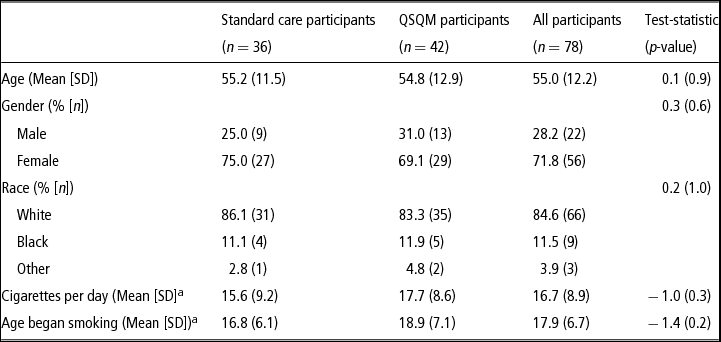
Of the total 78 participants (13 group programs) enrolled in the study, 42 participants (eight group programs) received QSQM, and 36 participants (five group programs) received the standard cessation program. There were no demographic differences between individuals in the intervention and standard program (Table 1). Standard group participants were more likely to have tried to quit smoking in the past year (p = 0.03) and intervention group participants were more likely to worry about second-hand smoke as a reason for quitting (p = 0.02).
Demographic characteristics of participants at baseline, by intervention group

a Missing for two participants from the QSQM group.
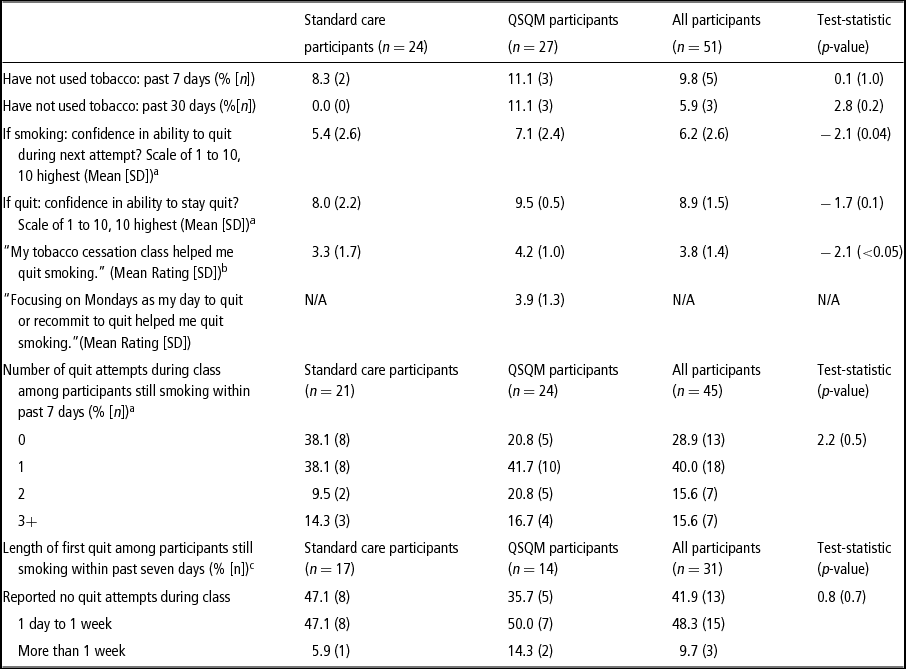
Of the 78 enrolled, 51 participants were available for follow-up at the final session. There were no observed differences in demographic characteristics, smoking behaviours, instructor, or intervention assignment between those retained and those lost to follow-up. Program instructor was not a statistically significant predictor of any outcomes in bivariate analysis, with the exception of self-efficacy of quitters in staying quit. Once controlling for treatment group, however, this relationship was no longer significant. There were no observed differences between the 7- and 30-day abstinence of smoking; number of quit attempts; or length of the first or second quit by treatment group, or the self-efficacy of quitters to stay quit (Table 2). Individuals in the intervention group who were still smoking had a higher self-efficacy of quitting on their next attempt as compared to those still smoking in the standard group (p = 0.04). Analysis of all cases with imputed values did not change these results.
Quitting behaviours at final group program session, by intervention group

a Missing for one participant.
b Missing for three participants.
c Missing for 14 participants, due to lack of participant quit and relapse date tracking (n=13) or because participants selected quit dates within 7 days of the last class (n=1).
Intervention participants rated their programs as more helpful in quitting smoking than those in standard care (p = 0.047), with an average rating of 4.2 (SD = 1.0) as compared to 3.3 (SD = 1.7) on a scale from one (lowest) to five (highest). Intervention participants rated the statement ‘Focusing on Mondays as my day to quit or recommit to quit helped me cut back or quit smoking’ an average of 3.9 (SD = 1.3) on a scale from one to five. Intervention participants were more likely to rate quit buddies as very helpful compared to those in standard care (p < 0.05).
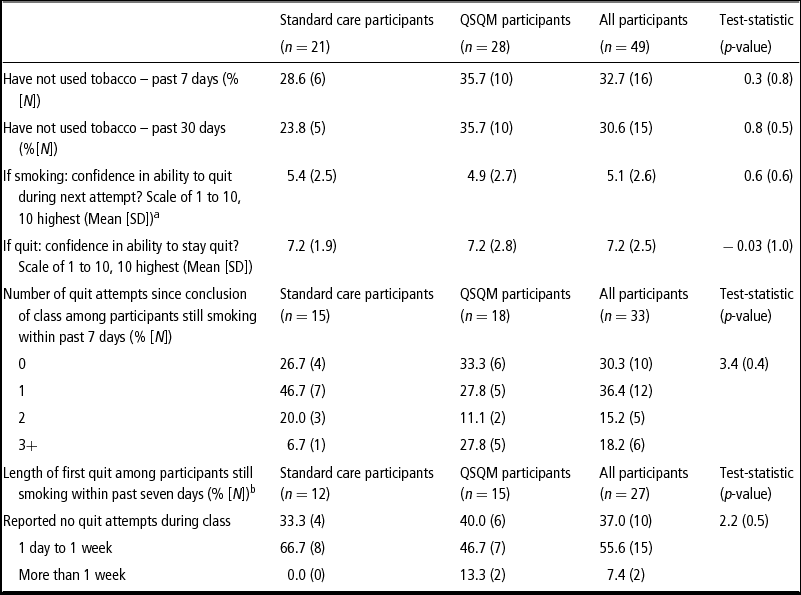
At the three-month follow up, there were no observed differences in the 7- or 30-day point prevalence of smoking between the two groups, number of quit attempts, length of quits, or in self-efficacy in successfully quitting or staying quit among smokers or quitters (Table 3).
Quitting behaviours at three month follow-up, by intervention group

a Missing for two participants.
b Length of first quit missing for six participants, due to lack of participant quit and relapse date tracking or because participants selected quit dates within seven days of the 90-days follow-up.
Discussion
This is the first study to assess Monday messaging in an existing cessation intervention. Those receiving Monday messaging were more confident in their ability to quit, rated their programs more highly, and found quit buddies to be more helpful than the comparison group.
This study is limited by its small sample size and the baseline differences in past year quit attempts between groups, which could occlude differences in outcomes of interest at the p = 0.05 level. Additionally, 30.3 % of the participants in the study did not attempt to quit, further limiting the sample of quitters from which to draw conclusions. Quit attempts were self-reported, and did not include biochemical verification. Loss to follow-up in the study was high, resulting in missing data. Finally, it is not possible to know if the intervention effect in the current investigation was the result of exposure to the Monday messaging as a whole, or the QSQM materials (such as the handout and wallet card) that participants received.
Despite these limitations, the results show the promise of Monday messaging. Given existing evidence of heightened interest in cessation early in the week (Ayers et al., Reference Ayers, Althouse, Johnson and Cohen2014; Welding et al., Reference Welding, De Leon, Cha, Johnson, Cohen and Graham2016; Johnson, Reference Johnson2011), the findings point to the potential of leveraging Monday to capitalise on this interest by increasing self-efficacy which has been associated with positive cessation outcomes (Schuck, Otten, Kleinjan, Bricker, & Engels, Reference Schuck, Otten, Kleinjan, Bricker and Engels2014). Further research is needed to determine whether these findings are generalisable, and to determine if a Monday message framing interacts with the day of the week a cessation program occurs. The use of Monday messaging could be incorporated into existing interventions with relative ease, and partnering with an existing cessation program could be a valuable way of testing this messaging strategy with a larger audience.
Acknowledgements
The authors thank the Harford County Health Department and Linda Pegram, MA, MPH, CTTS; Gregory Marsalek, MBA, CTTS; and Greta Brand, ScM for their collaboration and support.
Financial Support
This work was supported by a gift from The Monday Campaigns to the Johns Hopkins Bloomberg School of Public Health.
Conflict of Interest
The Monday Campaigns is the nonprofit agency responsible for designing and promoting the Quit and Stay Quit Monday program for smoking cessation.
Ethical Standards
The authors assert that all procedures contributing to this work comply with the ethical standards of the relevant national and institutional committees on human experimentation and with the Helsinki Declaration of 1975, as revised in 2008.