I. INTRODUCTION
In popular discourse, one often hears about a trade-off between economics and the natural environment. Historically, defining their discipline in terms of the science of material wealth and welfare, economists, too, have spoken in these terms, generally resisting economic analysis of the natural environment well into the 1950s. By the 1960s, however, as economists came to redefine their discipline in terms of opportunity costs and as environmentalism became wrapped up in a new aesthetic consumerism, the tension of economics versus the environment gave way to a new economics of the environment. More than any other economist, John Krutilla forged this intellectual development. In contrast to earlier work by natural resource economists, which focused on developing resources, Krutilla argued that preserving resources also had value. Because development came at the opportunity cost of those preservation values, a science weighing reciprocal opportunity costs had to consider both sides of the ledger.
This paper tells the story of these intellectual moves. It consists of three parts. Section II reviews the historical background of the conservation movement in the United States, and the prominent schism between Gifford Pinchot and John Muir, a background against which Krutilla himself would frame his new ideas. Section III briefly considers Aldo Leopold, an ecologist who wrestled with the inability of economics, as he saw it, to adequately justify the preservation of landscapes and ecosystems that he considered to have intrinsic value. In the face of the failure of economics to account for such values, Leopold advocated a new “land ethic” that would transcend economics. Section IV then turns to Krutilla, who admired Leopold and who wrestled with similar issues, but who came to a very different conclusion about the ability of economic science to defend preservation.
II. GIFFORD PINCHOT AND JOHN MUIR: CONSERVATION VS. PRESERVATION
A crucial feature of the intellectual context in which Krutilla worked is the long divide between what are sometimes known as the “conservation” and the “preservation” sides of American environmental thought and politics, though these terms themselves have been politically contested and fraught with confusion. Crudely speaking, the conservation side advocated that resources be managed for sustainable use; the preservation side advocated that they be sheltered from use and kept in their wild state (or “locked up,” as the conservation side would put it). Although demarked in America in these particular terms, the same dichotomy appears in other settings as well. Donald Worster (Reference Worster1977) contrasts the “imperial” approach epitomized by Carl Linnaeus with the “Arcadian” posture of Gilbert White. T. Christopher Smout (Reference Smout2000) discusses the two rival themes of “use” and “delight” in the history of Scottish and English conservation. Indeed, similar issues are at play in other aesthetic contexts as well, such as art (Goodwin Reference Goodwin, De Marchi and Goodwin1999).
In the US, the “conservation” and “preservation” sides of the coin were personified by Gifford Pinchot and John Muir, respectively. The son and grandson of wealthy real estate magnates and lumbermen, Gifford Pinchot (1865–1946) graduated from Yale University in 1889 and received post-graduate training in forestry at the École Nationale des Eaux et Forêts, making him one of America’s first professional foresters. His career grew swiftly: by 1898, he was appointed the second chief of the young US Division of Forestry (later to become the US Forest Service), and in 1900 he founded the Society of American Foresters. In the same year, he co-founded, with his father, the Yale School of Forestry. Eventually, he would become governor of Pennsylvania.
Pinchot advocated “wise use” of natural resources, which he interpreted in utilitarian terms, extending Jeremy Bentham’s maxim to emphasize the importance of maintaining resources for future generations. Following William J. McGee, he defined conservation as “the greatest good to the greatest number for the longest time” (Pinchot Reference Pinchot1910, p. 48; 1947, p. 327). Note here the subtle shift from Bentham’s “greatest happiness” to “greatest good.” Pinchot’s version of utilitarianism was narrowly materialistic as well as anthropocentric. He argued that “there are just two things on this material earth—people and natural resources” (1947, p. 325). In identifying threats to the wise use of resources, Pinchot emphasized Progressive Era concerns about waste and inefficiency as well as monopoly control, which concentrated natural wealth so that it would not flow to the greatest number (Pinchot Reference Pinchot1947, pp. 506–507).
John Muir (1838–1914) had a very different background. He was born in Scotland, moving to the Wisconsin frontier when he was eleven. He worked on the family farm with his father, then in a machine shop, where he was an expert on managing efficient work flows (Wolfe [Reference Wolfe1945] 2003). He always loved the wilderness, but led a fairly conventional life until an accident in 1867 left him blind for one month. After recovering, he decided life was too short to do anything but live for his passion, and so he went to the wilderness. He hiked 1,000 miles from Indiana to the Gulf of Mexico, then famously hiked the Sierra Nevada Mountains. There, he was inspired to think and write and, soon, to work on the signature project of his life: to preserve as wilderness the area that would become Yosemite National Park. That work yielded fruit in 1890 with the passage of the Yosemite Act, the first act of conservation explicitly tied to preserving land in its wild state.Footnote 1 Understanding the need to watch over this new treasure, Muir founded the Sierra Club in 1892 as an advocacy group and nascent political force.
In contrast to Pinchot’s utilitarianism, Muir was a transcendentalist, reworking his orthodox Christian upbringing into a spiritual faith in Nature (Nelson Reference Nelson2010). He hiked with a well-thumbed copy of Ralph Waldo Emerson’s essays, and his hero would eventually seek him out in Yosemite.Footnote 2 To Muir, leaves, rocks, and bodies of water are “sparks of the Divine Soul.” Landscapes are “blessed,” “waters will wash away sins as well as dirt,” and Nature shows material care ([1875] 1980, passim). Consequently, wilderness is the best avenue to divinity, for it best reflects God’s creation, untarnished by human hands: “The clearest way into the Universe is through a forest wilderness” (quoted in Nash Reference Nash1982, pp. 125–126).
Consistent with this spiritual view of Nature, Muir was explicitly opposed to anthropocentric world views like Pinchot’s. “No dogma taught by the present civilization,” he wrote, “seems to form so insuperable an obstacle in the way of a right understanding of the relations which culture sustains to wildness as that which declares that the world was made especially for the uses of man” ([1875] 1980, pp. 235–236). To the contrary, nature’s value was intrinsic, in the sense that it was non-instrumental but also in the sense that it had objective value independent of human valuation.Footnote 3 For example, to a question about what rattlesnakes are good for, “[a]s if nothing that does not obviously make for the benefit of man had any right to exist; as if our ways were God’s ways,” he answered that “they are good for themselves, and we need not begrudge them their share of life” ([1901] 1980, p. 200).
Holding one another in mutual respect, Pinchot and Muir initially were allies against the status quo and laissez-faire, which Muir referred to as the “gobble-gobble school of economics” (Wolfe [Reference Wolfe1945] 2003, p. 102). But that alliance began to unravel as the necessity of making specific land use decisions exposed their differences. For example, in 1891, the United States had established its first forest reserves, creating some thirteen million acres of federal forestland, but how those lands would be used was by no means clear. In 1896, Pinchot and Muir both were appointed to a committee of the National Academy of Sciences commissioned by the Secretary of the Interior to survey the newly created reserves and to make recommendations about their disposition. Muir envisioned them to be preserved as wild places, like Yosemite; Pinchot favored managed development for wise use. The committee could not agree on a recommendation, and individual members soon turned to working against one another in a game of political chess. In the end, the wise-use side won, as Congress declared the purpose of the reserves “to furnish a continuous supply of timber” plus ongoing mining and grazing. When they met later that year, a comment by Pinchot supporting the grazing of sheep on federal lands so enraged Muir, who had long viewed sheep as “hoofed locusts” that denuded natural landscapes, that Muir declared, “I don’t want anything more to do with you” (Nash Reference Nash1982, pp. 130–138). The fault line dividing the leading spokesmen for the romantic and the bureaucratic impulses in American environmentalism had widened to a cleft.
The final, epic battle between Muir and Pinchot was fought, appropriately enough for the history of American environmentalism, over a dam. In 1906, shortly after its devastating fire, the City of San Francisco petitioned the federal government to allow the damming of the Hetch Hetchy Valley, some 150 miles away in Yosemite, for municipal water supplies. In the end, the political forces in San Francisco carried the day, and the Hetch Hetchy was dammed, but not before a seven-year fight that further opened the divide between the conservation and preservation camps (Hays Reference Hays1959; Nash Reference Nash1982).
Muir and his allies launched a furious campaign to preserve their beloved Yosemite. They emphasized its spiritual significance. “Dam Hetch Hetchy!” exclaimed Muir, in the final words of his book The Yosemite. “As well dam for water tanks the people’s cathedrals and churches, for no holier temple has ever been consecrated by the heart of man” (Muir [Reference Muir1912] 1989, p. 218). Significantly, Muir and the “nature lovers” also appealed to Yosemite’s value as a place for recreation. As Roderick Nash (Reference Nash1982) argues, this was a tactical error, for the proponents of the dam could just as well turn this argument to their advantage, with the resulting reservoir providing many more recreational opportunities for boating and fishing. Interestingly, outdoor recreation would continue to be a vexing question for the evaluation of dams and a major driver of the development of environmental economics (Banzhaf Reference Banzhaf2010).
For his part, Pinchot appealed to science and posed the problem in terms of the utilitarian calculus rather than spiritual values. In his testimony to Congress, he framed the question as centering on “whether the advantage of leaving this valley in a state of nature is greater than . . . using it for the benefit of the city of San Francisco.” While he admitted the idea of preserving the valley was appealing when viewed in isolation, the city’s need was “overwhelming” (Nash Reference Nash1982, pp. 170–171).
The clash between Pinchot and Muir extended to the very definition of the word “conservation” and related vocabulary. Pinchot claimed to have personally coined the term (Pinchot Reference Pinchot1947, p. 326), though historians have considered that claim rather dubious (Hays Reference Hays1959, pp. 5–6). Using Pinchot’s vocabulary, “conservation” inherently meant the wise use of resources. Muir and his allies would be said to advocate “preservation” in contrast to “conservation.”Footnote 4 For their part, Muir and his allies were unwilling to concede the term “conservation” to Pinchot. In their rival vocabulary, the wise-use or utilitarian school and the preservationist school were two sides of the “conservation” coin.
It is tempting to reduce the differences between Pinchot and Muir to a simple difference in values: Pinchot valued timber, Muir preferred wilderness. But as John Meyer (Reference Meyer1997) argues, there are difficulties with that interpretation. Pinchot in fact first went into forestry as an act of propitiation, motivated by the sense of damage his family’s lumbering business had done to the woods (Miller Reference Miller1992). He frequently referred to the sublimity and beauty of nature. Describing his reaction upon first seeing the Grand Canyon, he wrote, “[A]we-struck and silent, I strove to grasp the vastness and the beauty” (quoted in Meyer Reference Meyer1997, p. 272). By the same token, Muir was hardly the prototype of the misanthropic deep ecologist as some would paint him. He frequently conceded the necessity of forestry and development.
On Meyer’s reading, the differences between Pinchot and Muir were as much about politics as values. Muir sought a space for wilderness sheltered from the pressures of political economy and self-interest. He built Tocquevillian mediating organizations like the Sierra Club. Given his spiritual view of wilderness, a reasonable comparison for the place of preservation in Muir’s politics would be to the space traditionally given to religion in American politics, and, for preservationist organizations, to institutions like churches. But just as some versions of modern liberalism would remove religion from politics and exile it to a realm of private feeling, Pinchot dismissed love of wilderness as private feelings that had no place in his technocracy. In the debate over the Hetch Hetchy, he conceded private feelings for the beauty of the wild valley, but gave no role to them in public decision making. “The fundamental principle of the whole conservation policy,” he testified to Congress, “is that of use, to take every part of the land and its resources and put it to that use in which it will serve the most people” (quoted in Nash Reference Nash1982, pp. 170–171). Since love of wilderness was by definition omitted from his version of the utilitarian calculus, Pinchot’s science of conservation management led inevitably to the recommendation to develop.Footnote 5
Thus, each side recognized the values espoused by the other but could make no room for them in its politics. According to Muir’s poetic and spiritual approach, one must serve either Nature or mammon; no one can have two masters. According to Pinchot’s scientific approach, spiritual values had no place in the utilitarian calculus.
As I shall argue, dissatisfaction with this dichotomy—and particularly the exclusion of non-material but no less real values from the utilitarian calculus—led Krutilla to introduce important reforms in natural resource economics. But Krutilla was hardly the first to wrestle with this problem. Earlier, Aldo Leopold, a more famous figure in the American environmental movement whom Krutilla greatly admired, wrestled with similar issues. Despite holding a position in a department of agricultural economics, Leopold was quite skeptical of the promise of economics to value natural preservation. Indeed, Krutilla’s moves can best be understood in contrast to Leopold’s own.
III. DO ECONOMISTS KNOW ABOUT LUPINES? ALDO LEOPOLD AND THE ENVIRONMENTAL TURN IN CONSERVATION
Aldo Leopold (1887–1948) knew he wanted to be a forester from an early age. He went to a college preparatory school specifically for the purposes of going to Yale so that he could enroll in the School of Forestry, which had recently been founded by the Pinchot family. He arrived at Yale in 1904, first taking courses in the Sheffield Scientific School as preparation for the forestry school, where he did his graduate work. At Yale, Leopold obtained an interdisciplinary education in resource management, which included a great deal of economics, with a particular emphasis on Bentham’s utilitarianism (Goodwin Reference Goodwin2008). He began his professional career at the US Forest Service in 1909, during a period of time when it was headed by Pinchot himself. In 1933, he took a position at the University of Wisconsin’s Department of Agricultural Economics, as a professor of game management. In 1935, he would co-found the Wilderness Society with Benton MacKaye, Bob Marshall, and others.
Leopold began his career firmly in Pinchot’s conservation camp. But during his time at the Forest Service into the 1920s, he increasingly came to feel that forests and other resources needed to be managed for multiple purposes, and moreover that gaming and non-consumptive recreational uses should be given more weight than they were relative to the extractive activities like lumbering (Nash Reference Nash1982; Callicott Reference Callicott, Covington and Debano1994; Newton Reference Newton2006). In this respect, Leopold was perfectly in step with trends in natural resource management. The Forest Service had recently commissioned a report from Frank Waugh, a landscape architect (and father of leading figure in agricultural and resource economics Frederick Waugh), which recommended recreation be given weight in management decisions.
While increasingly valuing these kinds of uses or purposes, Leopold still looked at the problem as a manager or economist would, as one of balance. He used marginal reasoning to think about the trade-offs between consumptive and non-consumptive uses. Said Leopold, “[W]hile the reduction of the wilderness has been a good thing, its extermination would be a very bad one.” Explaining by analogy, he continued,
What I am trying to make clear is that if in a city we had six vacant lots available to the youngsters of a certain neighborhood for playing ball, it might be “development” to build houses on the first, and the second, and the third, and the fourth, and even on the fifth, but when we build houses on the last one, we forget what houses are for. The sixth house would not be development at all, but rather … stupidity. (quoted in Nash Reference Nash1982, pp. 187–188)
Eventually, however, Leopold became disillusioned with this way of thinking. A decisive moment seems to have come when he and his colleagues killed a wolf, which until that point he had viewed only as a nuisance to deer and other game. As he witnessed at close range the “fierce green fire dying in her eyes” (Leopold [Reference Leopold1949] 1987, p. 130), he knew then instinctively that something had been missing from his calculations.
In some sense, it could be said that Leopold moved more to the preservation side of the spectrum from his start on the conservation side. He began as a forester, came to appreciate wilderness for its non-consumptive uses, and increasingly came to value wilderness for its own sake. But Leopold did not just shift positions in an existing intellectual landscape, he molded new ones. To Leopold, the conservation approach did not give enough credit to the intrinsic value of wildlife. By the same token, the preservation approach of “locking up” wildlife did not give enough credit to human beings. A third way was needed.
Leopold turned to the growing field of ecology as that third way. Man could live with wildlife as part of a complex web of interactions. This would require a new “ethic,” a “universal symbiosis with land, economic and aesthetic, public and private” (Leopold Reference Leopold1933, p. 639, quoted in Callicott Reference Callicott, Covington and Debano1994). At the end of his life Leopold proposed a new interdisciplinary research and teaching project in “ecological economics,” based on the premise that “industrialization is now bringing on a worldwide conflict between economics and conservation (ecology)” and that people from both sides of that conflict needed to be brought together to overcome the impasse (Lin Reference Lin2014, p. 110; see also Newton Reference Newton2006).
That Leopold, trained in conservation management and holding a position in a department of agricultural economics, would frame the problem in terms of a conflict between economics and ecology is telling, and helps to set Krutilla’s future moves in relief. To Leopold, economics—like Pinchot’s calculus—inevitably discounted the intrinsic values of wildlife (Goodwin Reference Goodwin2008). As he wrote in A Sand County Almanac:
Sometimes in June, when I see unearned dividends of dew hung on every lupine, I have doubts about the real poverty of the sands. On solvent farmlands lupines do not even grow, much less collect a daily rainbow of jewels. If they did, the weed control officer, who seldom sees a dewy dawn, would doubtless insist they be cut. Do economists know about lupines? (Leopold [Reference Leopold1949] 1987, p. 102)
As Muir defended the rattlesnake, Leopold defended the mere existence of creatures lacking narrowly construed utilitarian value (Callicott Reference Callicott, Covington and Debano1994; Goodwin Reference Goodwin2008). He understood that there were economic arguments for preserving nature, but he found them inadequate:
The emergence of ecology has put the economic biologist in a peculiar dilemma: with one hand he points out the accumulated findings of his search for utility in this or that species; with the other he lifts the veil from a biota so complex, so conditioned by the interwoven cooperation and competitions that no man can say where utility begins or ends. (Leopold Reference Leopold1939, p. 727)
Leopold had no doubts about the real choice in this dilemma. The search for arguments based in utility, while sometimes valid, were too often futile—too ridiculous, even—to be the intellectual basis for conservation. Expanding on this point, Leopold wrote:
One basic weakness in a conservation system based wholly on economic motives is that most members of the land community have no economic value. Wildflowers and songbirds are examples. Of the 22,000 higher plants and animals native to Wisconsin, it is doubtful whether more than 5 per cent can be sold, fed, eaten or otherwise put to economic use. Yet these creatures are members of the biotic community, and if (as I believe) its stability depends on its integrity, they are entitled to continuance. When one of these non-economic categories is threatened, and if we happen to love it, we invent subterfuges to give it economic importance. At the beginning of the century songbirds were supposed to be disappearing. Ornithologists jumped to the rescue with some distinctly shaky evidence to the effect that insects would eat us up if birds failed to control them. The evidence had to be economic in order to be valid. (Leopold [Reference Leopold1949] 1987, p. 210)
For Leopold, something beyond economics clearly was necessary to justify the preservation of natural ecosystems. Economics of course had a role to play in illuminating the incentives created by particular property rights and other institutions, but not in identifying values.
IV. JOHN KRUTILLA AND THE ENVIRONMENTAL TURN IN ECONOMICS
If Leopold’s distinctive move was to wed the romanticism of Emerson and Muir to the still ascending science of ecology, it was John Krutilla (1922–2003) who—improbably—wed it to economics. Krutilla was a wilderness advocate, an avid outdoorsman who eagerly took field trips to the wilderness areas he studied, hiking and camping, and who at other times escaped to his cabin in the Shenandoahs. He read Muir and Leopold, and was a friend of such figures as Margaret and Olaus Murie, leading US naturalists.Footnote 6 Eventually he would serve as trustee of the Environmental Defense Fund (1971 to 1974) and as an officer of Leopold’s Wilderness Society (1973 to 1976). Like Leopold, he would forge a new synergy of economics and environmental preservation. Indeed, Krutilla was instrumental in founding the Association of Environmental and Resource Economics in the late 1970s and served as its third president (AERE 1995). But in contrast to Leopold’s ecological economics, Krutilla’s environmental economics put economics at the center.
Krutilla grew up on a Washington farm and earned a BA in economics from Reed College. He earned a PhD from Harvard in 1952, working under Walter Isard (regional economics) and Alexander Gerschenkrom (comparative economic systems and development), with a dissertation titled “The Structure of Costs and Regional Advantage in Primary Aluminum Production.” He began his career working with a natural resources development team at the Tennessee Valley Authority (TVA), but went to Resources for the Future (RFF) in 1955, where he remained until his retirement in 1988.
Krutilla’s Early Work
With his background in regional and development economics, Krutilla’s early body of work represented a fairly conventional, albeit successful, application of economic theory to benefit-cost analysis, construed in narrowly materialistic terms. It included numerous pieces in applied journals and one in the Journal of Political Economy (1962). In one piece that would have important echoes later, Krutilla (Reference Krutilla1955) argued that regional development programs are better evaluated using benefit-cost analysis than by attempting to empirically estimate changes in regional output or income. He also suggested it would be useful to understand a program’s effect on the supply functions of factors (like power and water), which are inputs into the production of goods for which demand is likely to increase as income increases. He called these “strategic factors.”
Most notably among his early body of work, Krutilla co-authored the book Multiple Purpose River Development: Studies in Applied Economic Analysis with Otto Eckstein in 1958. The book was a cutting-edge application of benefit-cost analysis to water projects, which for a quarter-century had been the setting to which to apply benefit-cost analysis in the US (Banzhaf Reference Banzhaf2009, Reference Banzhaf2010; Porter Reference Porter1995). To detailed institutional considerations of water projects, it united a more sophisticated understanding of microeconomic theory than previous practitioners had brought to the topic, including discussions of capital markets, the cost of public funds, external economies, indivisibilities, and so forth. It then applied their analytical framework to four case studies, including Hells Canyon on the Snake River in the Columbia River tributary system (Krutilla and Eckstein Reference Krutilla and Eckstein1958, ch. V).
Hells Canyon was notable as a battleground between two rival philosophies of development: a progressive version of government investment spearheaded by the US Army Corps of Engineers and the Bureau of Reclamation, championed by New Deal Democrats; and a pro-business version led by Idaho Power and championed by Republicans (Brooks Reference Brooks2006). The Engineers proposed one massive dam, while Idaho Power proposed a series of three smaller dams. Eventually, Idaho Power’s plan prevailed, and the last of the three dams was completed in 1967.
In Multiple Purpose River Development, Krutilla and Eckstein evaluated the relative merits of the two rival projects. Considering the standard purposes of water development—hydroelectric power, flood control, and navigation—they found the Engineers’ plan to be more efficient, but found that a convex combination of the two, a hypothetical two-dam project, would be more efficient than either. Though the book in general and the application to the Hells Canyon specifically represented the frontier of benefit-cost analysis at the time, the times were rapidly changing. As Krutilla himself would later concede with a note of regret (Fisher, Krutilla, and Cicchetti Reference Fisher, Krutilla and Cicchetti1972), the book limited its consideration of economic factors to physical production. In particular, it treated the “preservation” of wilderness for its “aesthetic appeal” as an extra-economic consideration, a value “in addition to economic efficiency” rather than one factor in the economic efficiency calculation (Krutilla and Eckstein Reference Krutilla and Eckstein1958, p. 265).
Conservation Reconsidered
Sometime in the mid-1960s, Krutilla appears to have made a deliberate pivot to address that deficiency and to combine his outdoor avocation with his economics profession, an intellectual move that would characterize the rest of his career. With his wife, Shirley Krutilla, he began to take a series of courses offered by the US Department of Agriculture and the Audubon Society, courses on ecology, meteorology, geology, soil science, and so forth.Footnote 7
The intellectual fruits of this pivot first appeared in 1967, when Krutilla published the article “Conservation Reconsidered” in the American Economic Review (1967a) plus a more discursive version in Daedalus (1967b). In those articles, he borrowed the language of “conservation” and “preservation,” which still carried the historical echoes of the dispute between Pinchot and Muir and their respective intellectual heirs. Specifically, he argued that economists, by ignoring the concerns of the preservationists, implicitly had biased benefit-cost calculations in favor of wise-use conservationists.
In making this case, the most fundamental point that Krutilla made was that there was a trade-off between developing a resource and preserving it. In other words, developing a resource came at the opportunity cost of preservation, potentially meaning the loss of a unique or special landscape.Footnote 8 And these costs were very real. Said Krutilla, “When the existence of a grand scenic wonder or a unique and fragile ecosystem is involved, its preservation and continued availability are a significant part of the real income of many individuals” (1967a, p. 779; emphasis added). By these “individuals,” he clarified that he meant “the spiritual descendants of John Muir, the present members of the Sierra Club, the Wilderness Society, … and others to whom the loss of a species or the disfigurement of a scenic area causes acute distress and a sense of genuine relative impoverishment” (p. 779n7).Footnote 9 They valued the “mere existence of biological and/or geomorphological variety and its widespread distribution” (p. 781). Such values would come to be known as “existence values” or “non-use values” in the environmental economics literature—values for the simple existence of a thing rather than for what it could do. In this way, Krutilla brought the intrinsic values emphasized by Muir, Leopold, and others into the utilitarian calculus of economics. In contrast, natural resource economists had to that point omitted such considerations from their analysis, or at most treated them as qualitative factors outside economics.
To this overarching point that development came at the opportunity cost of preservation, Krutilla added two specific reasons why analysts should consider weighting the benefit-cost scales more in favor of preservation. The first centered on uncertainty about the future. Krutilla noted that whereas a decision to preserve always left open the possibility of developing later, in contrast a decision to develop had irreversible adverse consequences for preservation, since the landscape would be irretrievably lost, a point that would be further developed by Anthony Fisher, Krutilla, and Charles Cicchetti (1972), and taken up by Kenneth Arrow (Arrow and Fisher Reference Arrow and Fisher1974). Furthermore, drawing on Burton Weisbrod (Reference Weisbrod1964), Krutilla suggested that even if preservationists had no value for the resource at present, the possibility that they might in the future would generate an “option value” in the presence of such irreversibility. All this implied not only that benefit-cost analyses of development projects were biased in favor of development whenever they ignored these opportunity costs, but suggested that many market transactions involved the problem of free riding on the preservation side of the ledger.
The second reason Krutilla believed analysts should emphasize preservation was that private markets were quite adept at providing substitutes for those scarce resources that served as material or energy inputs in private production. Consequently, the value of developing natural resources was decreasing over time. Meanwhile, the value of preserving them was increasing, for two reasons. First, they were becoming more scarce, with markets underproviding environmental quality because of its public good nature. Second, demands for outdoor recreation and for the existence values of environmental quality appeared to be increasing over time. This logic reversed the traditional emphasis in natural resource economics on conservation. Said Krutilla,
[T]he traditional concerns of conservation economics—the husbanding of natural resource stocks for the use of future generations—may now be outmoded by advances in technology. On the other hand, the central issue seems to be the problem of providing for the present and future the amenities associated with unspoiled natural environments. (Krutilla Reference Krutilla1967a, p. 778; emphasis added)
Here, Krutilla seems to have been hearkening back to his earlier notion of “strategic factors,” in which he had suggested that public investments in development should target resources that were inputs into the production of outputs with growing demand (Krutilla Reference Krutilla1955). Only now, those inputs were reinterpreted more broadly to include preserved environmental amenities.
This reinterpretation seems to have been in part a response to Scarcity and Growth (1963), a recent book by Harold Barnett (a colleague of Krutilla’s at RFF) and Chandler Morse, and itself a milestone in the history of natural resource economics.Footnote 10 After documenting in the greater part of their book that the costs of food and natural resources had not increased over time, Barnett and Morse had reflected that natural resource scarcity could be overcome by self-generating technological change. As new resources and techniques substitute for old, they said, “the resource spectrum undergoes kaleidoscopic change through time” (p. 244). But in closing, they had suggested that issues related to quality of life, to the distribution of income, and “the intangible satisfactions derived from the appearance of the environment” (p. 252) may prove to elude substitution. What was needed, they suggested, was a more objective approach to our “value problem,” a way to incorporate the trade-offs between distribution, intangible benefits, and material wealth into the economic calculus. This was precisely the project Krutilla took up.
As V. Kerry Smith (Reference Smith2011) has noted, in “Conservation Reconsidered” we see Krutilla coming to grips with the same problems that so vexed Leopold. Leopold had argued that “one basic weakness in a conservation system based wholly on economic motives is that most members of the land community have no economic value…. When one of these non-economic categories is threatened, and if we happen to love it, we invent subterfuges to give it economic importance” (Leopold [Reference Leopold1949] 1987, p. 210). These concerns led Leopold to forge compromises between economics, ecology, and other disciplines into a new land ethic. In contrast, Krutilla argued that if indeed we do love one of these categories in the land community, then that constitutes economic value. In his taxonomy of subjective values, the “mere existence” of a beloved object is one category. For Krutilla, development brings benefits but comes at the opportunity cost of foregoing preservation values (and vice versa); thus, the choice between development and preservation was itself an economic question. That is, the question was no longer one of economics versus the environment, but one of the economics of the environment.
A Shifting Landscape of Economic and Environmental Thought
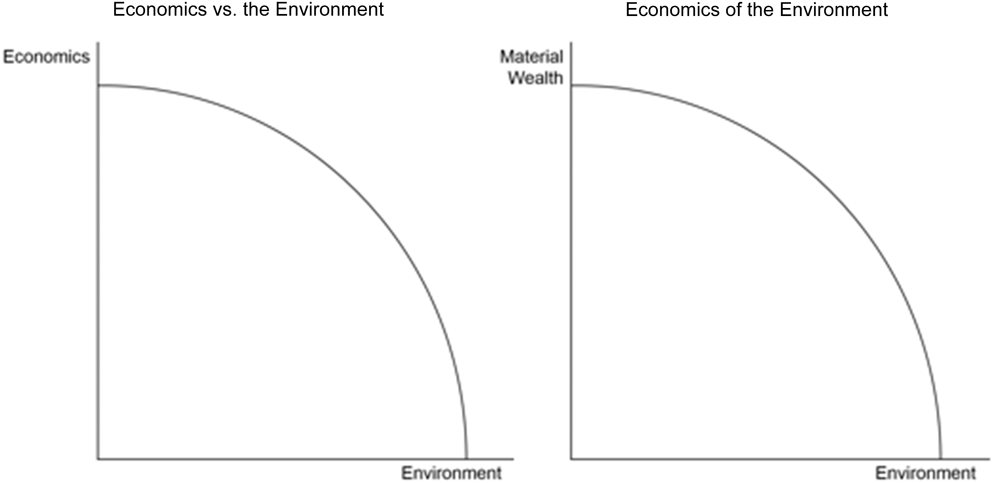
These changes in Krutilla’s thinking occurred within the context of larger intellectual developments both in economics and the environmental movement in the 1950s and 1960s. In economics generally, Lionel Robbins’s (1935) definition of the field in terms of opportunity costs was rapidly displacing rival “classificatory” definitions. Those classificatory definitions had demarked the territory of economics as limited to the business or material realms of life.Footnote 11 When viewed in those terms, what economists sometimes referred to as “spiritual” considerations such as the love of wilderness were decidedly non-economic (Banzhaf Reference Banzhaf2010). But when viewed through the lens of Robbins’s definition, natural resources are inherently scarce, so the choice to develop them or to preserve them entails opportunity costs, making it an economic choice. The distinction is illustrated in Figure 1.
Economics vs. the Environment contrasted with Economics of the Environment.

In the economics-as-material-welfare view, there is a trade-off between economics (material welfare) and wilderness. In the economics-as-opportunity-cost view, economics itself is about such trade-offs; it is elevated to govern the trade-off between material welfare and wilderness. As Roger Backhouse and Steve Medema (2009) have shown, economists on both sides of the Atlantic were coming to embrace this new definition in the late 1950s and 1960s. Thus, it is no coincidence that Krutilla’s intellectual journey from Multiple Purpose River Development to “Conservation Reconsidered” occurred at the same time that Gary Becker was pushing labor economics to consider crime, the allocation of time, and so forth. Both developments were an expansion of economics to new ranges of topics: opportunity costs were everywhere.Footnote 12
Additionally, US economists were, around the same time, increasingly embracing the idea of measuring economic values for environmental services and for other goods not traded in markets. Such work began with government economists incorporating outdoor recreation into benefit-cost analyses of dam projects, a context obviously important to Krutilla’s work, but by the time of “Conservation Reconsidered,” Krutilla’s RFF colleagues were rapidly developing these ideas in new directions (Banzhaf Reference Banzhaf2010). These earlier moves would have made the idea of measuring the economic values of foregone natural environments at least conceivable to Krutilla and his audience. At the same time, Krutilla’s idea of non-use values created a new category of values to be estimated, one that in turn elevated the importance of new measurement tools such as survey-based contingent valuation (Banzhaf Reference Banzhaf, Backhouse and Cherrier2017). Indeed, soon after “Conservation Reconsidered,” Krutilla began to lead a new Natural Environments Program at RFF to investigate methods for measuring the value of environmental amenities. Staffed by future leaders in the field such as Charles Cicchetti, Anthony Fisher, Kerry Smith, and others, the program further explored the idea of option value (Fisher, Krutilla, and Cicchetti Reference Fisher, Krutilla and Cicchetti1972; Krutilla and Cicchetti Reference Krutilla and Cicchetti1972; and Krutilla and Fisher Reference Krutilla and Fisher1975) (work that is discussed in the next section), the implications of congestion for the quality of a recreation experience and hence willingness-to-pay (Cicchetti and Smith Reference Cicchetti and Smith1973), and the generalization of recreation benefits to multiple sites (Cicchetti, Fisher, and Smith Reference Cicchetti, Fisher and Smith1976).
These changes in economics coincided with important historical developments in environmentalism. Indeed, properly speaking, one can hardly even speak of “environmentalism” before this period. Until World War II, the schism in American conservationism, represented by the rift between Pinchot and Muir, pitted natural resource managers pursuing efficiency against lovers of nature who approached nature on spiritual, rather than rational, terms. While those tensions remain with us today, the two categories of conservation and preservation rearranged and reconfigured themselves in important respects. On one side, elements from the “preservationist” camp dropped Muir’s spiritual focus and embraced the new science of ecology to bolster the case for preservation. For example, when Leopold transitioned from being a disciple of Pinchot to a lover of wilderness, he hardly dropped science in favor of spiritual transcendence. Rather, he fused a love of wilderness to new arguments for its importance drawn from ecology, while simultaneously urging people to abandon the zero-sum fight between development and preservation in favor of a new harmony between man and nature (Calicott 1994). At the same time, popular politics were giving stronger voice to conservation than ever before. The “conservationist” camp, which previously defined scientific management of resources only in terms of material uses, soon adapted to these political pressures (Banzhaf Reference Banzhaf2009, Reference Banzhaf2010; Hays Reference Hays1982). As but one small but revealing example, during this period many state agencies simply swapped out their shingles reading “game managers” for ones reading “wildlife managers” (Hays Reference Hays1982).
As Samuel Hays (Reference Hays1982) notes, the new “environmentalism” that emerged during this period was thus a fusion of ecology and the political economy of aesthetic consumption, rather than production. The changes in the applied economics of benefit-cost analysis reflected these broader trends. As I have shown elsewhere (Banzhaf Reference Banzhaf2010), starting from a focus on material development in the spirit of Pinchot, it was actually the political pressures to nudge benefit-cost ratios in favor of development that ironically forced economists to consider the recreation values of reservoirs in the late 1940s and 1950s—against their better judgment that economics should be limited to material considerations and avoid such spiritual intangibles. Once that threshold was crossed, however, it was no great leap to apply recreation benefits and related values to the preservation side of the ledger.
Shortly after “Conservation Reconsidered,” Krutilla and Cicchetti (Reference Krutilla and Cicchetti1972) made this point quite explicitly and succinctly, arguing that the “nub of the analytical problem” for many conservation questions was a trade-off between two alternative purposes.
One purpose, associated with extractive activities, would convert the natural environment into intermediate products to satisfy the requirements of industrial raw materials used in production of final consumption goods. The other purpose involves the retention of the natural environment for the provision of a flow of services which enter directly into the utility function of final consumers. (p. 2)
“Spiritual” values for nature could be handled by economics by reinterpreting nature as something that provided services directly to consumers, as well as to producers of material goods.
Hells Canyon Revisited
These broader intellectual currents rippled through the Snake River. In 1957, just about the time Multiple Purpose River Development appeared in print, Pacific Northwest Power, a consortium of four private utilities, proposed yet another project in Hells Canyon, downstream from the earlier three, at what was known as the High Mountain Sheep site. The Washington Public Power Supply System soon proposed a rival project nearby; then, in 1962, the Department of the Interior proposed an alternative federal project at the High Mountain Sheep site. Thus, three parties were rivals to develop the same area. In 1962, the Federal Power Commission (FPC) ruled in favor of Pacific Northwest Power. The Interior department, headed by Secretary Stewart Udall, sued the FPC over this decision, in part on grounds that Interior’s plan would better protect anadromous fish, as required by law. While an appeal to the FPC and a trial upheld the initial decision, the case eventually would go to the Supreme Court of the United States. In 1967, in Udall v. FPC, the court by a six-to-two decision remanded the case to the FPC, ordering it not only to reconsider which development proposal was in the public interest in light of further evidence about fish protection, but also whether any development was in the public interest in light of such concerns. The majority opinion stated,
The issues of whether deferral of construction would be more in the public interest than immediate construction and whether preservation of the reaches of the river affected would be more desirable and in the public interest than the proposed development are largely unexplored in this record. We cannot assume that the [Federal Water Power] Act commands the immediate construction of as many projects as possible. . . . The grant of authority to the Commission to alienate federal water resources does not, of course, turn simply on whether the project will be beneficial to the licensee. Nor is the test solely whether the region will be able to use the additional power. The test is whether the project will be in the public interest. And that determination can be made only after an exploration of all issues relevant to the “public interest,” including future power demand and supply, alternate sources of power, the public interest in preserving reaches of wild rivers and wilderness areas, the preservation of anadromous fish for commercial and recreational purposes, and the protection of wildlife. (Udall v. Federal Power Commission 387 U.S. 428 1967, p. 449)
For the first time in the bureaucratic turf wars over river development, preservationists now had a seat at the table. In a very real sense, the modern era of environmental politics in America was born.Footnote 13
When the case was remanded to the FPC, Krutilla entered as an expert “Friend of the Commission” in 1969.Footnote 14 In contrast to his earlier work on Hells Canyon in Multiple Purpose River Development (Krutilla and Eckstein Reference Krutilla and Eckstein1958), Krutilla now applied the arguments of “Conservation Reconsidered” to the problem. In particular, he emphasized the importance of option value, reflecting the asymmetry in the fact that preservation preserves the option to develop in the future, whereas developing the canyon would irreversibly harm the ecosystem. Along with Cicchetti and Fisher, Krutilla would continue to develop the idea of option value, and its application to the Hells Canyon case in particular, in a series of publications in the early to mid-1970s, including Fisher, Krutilla, and Cicchetti (Reference Fisher, Krutilla and Cicchetti1972); Krutilla and Cicchetti (Reference Krutilla and Cicchetti1972); and Krutilla and Fisher (Reference Krutilla and Fisher1975).
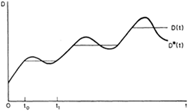
The basic argument outlined in Fisher, Krutilla, and Cicchetti (Reference Fisher, Krutilla and Cicchetti1972) is illustrated in Figure 2.
Irreversible Development Source: Fisher, Krutilla, and Cicchetti (1972, p. 609). Reproduced with permission.

The curve D*(t) is a hypothetical path of what the optimal development over time would be if, theoretically, it were possible to reverse development. The path shows periods of increasing development followed by periods of decreasing development. But since development is irreversible, the downward-sloping portions of this myopic path are impossible. Ruling those out, the optimal path becomes D(t). To maximize the present value of net benefits, the constraint imposed by irreversibility leads to a smoothed path, which, relative to the myopic one, undershoots development for a time where the myopic path would be at its peaks, but then overshoots it where the myopic path would be at its troughs. Fisher, Krutilla, and Cicchetti then assert that the gross benefits of preservation are growing over time, while the gross benefits of development are shrinking, as technological change reduces the costs of substitutes, a point made in Krutilla (Reference Krutilla1967a). Consequently, as an empirical matter, D*(t) is declining monotonically. Since that is impossible, the optimal D(t) entails a bang-bang solution with development in the present period and no further development in the future.
Fisher, Krutilla, and Cicchetti (Reference Fisher, Krutilla and Cicchetti1972) employ a fairly complicated simulation model to apply this analysis to Hells Canyon. The model involves parameters representing a rate of technological change in private substitutes for the natural resource, growth rates (and deceleration in growth) in intercept and slope terms of a demand function for preservation, population growth rates, plus the by-then-conventional benefit-cost parameters related to development benefits and costs and interest rates.Footnote 15 Fisher, Krutilla, and Cicchetti (Reference Fisher, Krutilla and Cicchetti1972) find that, given the simulated rates of change, a base-period annual preservation value of $52,000 to $147,000 would be enough to tip the balance toward preservation and away from further developing the Hells Canyon Dam. Since this was a fraction of the best estimates of recreation values, Krutilla et al. concluded that the economics supported preservation.Footnote 16 The road from Pinchot to Muir had come full circle. Rational utilitarian management of natural resources no longer presupposed development, as Pinchot had viewed it; it also could come out on the side of preservation.
V. CONCLUSIONS
Early debates over conservation policy in the US left a landscape in which rational calculation about material well-being was opposed to transcendent values for nature that defied quantification in material terms. In the postwar period, however, that dichotomy was becoming increasingly untenable. Initially all too happy to concede the impossibility of measuring such spiritual values, economists in government were being dragged by political pressures into including recreation values in their benefit-cost analyses (Banzhaf Reference Banzhaf2010). Economists more broadly were reinterpreting their field as the study of opportunity costs, rather than of material wealth (Backhouse and Medema Reference Backhouse and Medema2009). Preservationists following Aldo Leopold tried to build bridges between conservation and social sciences. Popular movements celebrated the natural environment with a new consumer spirit (Hays Reference Hays1982). At the crossroads of all these movements stood John Krutilla. Taking a little bit from all of them, he helped reorganize earlier debates framed in terms of economics-versus-the-environment into a new field studying the economics of the environment. In Krutilla’s view, so-called non-economic values of the environment were every bit as economic as anything else, if people treasured them and if choices had to be made to trade them off against material development.
In this way, Krutilla brought the intrinsic values emphasized by Muir, Leopold, and others into the utilitarian calculus of economics. As Krutilla himself showed, conservation values thus could be incorporated into benefit-cost analyses of government programs (Krutilla and Fisher Reference Krutilla and Fisher1975), a research project that is now routine for governments and intergovernmental agencies around the world. Such values also have been incorporated into litigation over environmental damages (e.g., Bishop et al. 2017) and even national- or global-level indices of landscapes (Bateman et al. 2013; Costanza et al. 2014). Many biologists and ecologists have applauded the quantification of such ecosystem services as a way to give the environment a seat at the economic table (e.g., Daily Reference Daily1997), precisely Krutilla’s objective.
But in the very act of incorporating the intrinsic values of nature into utilitarian economics, Krutilla narrowed the sense in which they could be considered intrinsic. They remained so in the sense that they could be viewed as ends in themselves (without any instrumental value, any particular “use”). But to be compatible with utilitarianism, their value had to be rooted in the subjective judgment of people, a position J. Baird Callicott (Reference Callicott1989, Reference Callicott1999) describes as “truncated” intrinsic value. (See Schröter et al. Reference Schröter, Zanden, Oudenhoven, Remme, Serna-Chavez, Groot and Opdam2014 for further discussion of such issues.) Accordingly, other ecologists remain highly skeptical of the anthropocentric commodification of nature that Krutilla’s research program advanced (McCauley Reference McCauley2006; Robertson Reference Robertson2006). Although Krutilla brought the concerns of Muir and Leopold into economics in his own way, not all “the spiritual descendants” of Muir or Leopold, whose values Krutilla strove to represent, would embrace that way.