


Introduction
Stable-water-isotope ice-core records from vast polar ice sheets are a well-recognized proxy for local condensation temperature (Reference JouzelJouzel and others, 1997). However, a major difference between the precipitation-sampling systems of polar ice sheets and mid-latitude ice-core sites must be stressed. Since the required cold-temperature regime at mid-latitude sites is maintained only at high altitude, the drill-site area will be relatively small and situated at an exposed (strongly wind-influenced) location. Consequently, several mid-latitude drill sites, such as in the European Alps, are subject to a substantial net loss of surface snow, especially during winter, rendering the ice-core records seasonally unrepresentative (Reference Wagenbach, Haeberli and StaufferWagenbach,1994).
When evaluating Alpine ice-core records, it is important to remember that the long-term net snow-accumulation rate is controlled by the upstream surface condition (Reference Alean, Haeberli and SchädlerAlean and others, 1984), making the conserved seasonal fraction of total precipitation systematically variable in space and time (examination of the impact of this effect is beyond the scope of this paper).
As with polar drill sites, a basic problem of stable-water-isotope records from Alpine sites concerns the spatial representativity of a given local temperature proxy signal. In the Alps this question is linked to the seasonal representativity of such ice-core records. the impact of climate-change-induced seasonality changes on the representativity of the recorded Alpine proxy temperature is discussed elsewhere (Reference Auer and MangeriAuer and others, 2001b). Consequently, investigations into the spatial representativity of a potentially recorded local temperature signal at drill sites are to be evaluated for different seasons. It is also necessary to evaluate to what extent seasonal temperature records may reflect mean annual temperature variability, which is one of the key parameters in climate research.
To tackle these questions, within the European Union project ALPCLIM (focusing, among other things, on the extension of Alpine climate records beyond the instrumental period by Alpine ice-core proxies (Reference WagenbachWagenbach and others, 1998), spatial correlation between instrumental air-temperature series is used to determine the spatial representativity of the ice-core stable-isotope-derived air-temperature signal. to overcome the problem of seasonal selectivity of ice-core records, the evaluation is divided into a summer and a winter period. the study underlines the favourable situation existing in Europe, where a dense network of long-term, well-documented instrumental climate records is available.
Instrumental Temperature Data
The network of Alpine long-term temperature time series was used to elaborate carefully homogenized gridded series of relative temperature changes in monthly resolution (Reference Böhm, Auer, Brunetti, Maugeri, Nanni and SchönerBöhm and others, 2001). the dataset covers the region 43–49˚N, 4– 18˚ E with 1˚ latitude/longitude spatial resolution and dates back to 1765 (hereafter denoted as ALPCLIM dataset). to consider vertical differences of Alpine climate variability the ALPCLIM series have been subdivided into high-elevation (>1500ma.s.l.) and low- elevation temperature series (hereafter denoted as ALPCLIM HE and ALPCLIM LE datasets, respectively).
Since there are no continuous long-term temperature measurements at the Colle Gnifetti (4450ma.s.l.; Monte Rosa, Western Alps) drill site, this temperature series was computed as described by Reference Auer and MangeriAuer and others (2001b) from the nearest ALPCLIM HE gridpoint (46˚N, 8˚E, representing approximately the central summit range of the Western Alps) temperature (hereafter denoted as CG instrumental air temperature). This air-temperature series dates back to 1818.
To assess the European-scale spatial representativity ofCG air-temperature series, the gridded temperature dataset of the Climatic Research Unit (CRU), University of East Anglia, U.K., which was derived from lowland station data (Reference JonesJones, 1994), is used as this is the only temperature series completely covering Europe and the data passed some homogeneity testing. As a compromise between the spatial coverage of Europe and gridbox data completeness we selected the region 75˚N, 30˚W to 15˚N, 35˚E (5˚ latitude/longitude gridbox spatial resolution) from the CRU database (hereafter denoted as CRU dataset). for comparison of the CRU and ALPCLIM datasets, the ALPCLIM dataset was upscaled from 1˚ grid-point resolution to 5˚ gridbox resolution.
The importance of climate-data homogenization (station relocations, instrumental alterations, etc.) for climate-change studies is discussed by, among others, Moberg and Alexandersson (1997), Reference PetersonPeterson and others (1998) and Reference Auer, Böhm, Schöner, Hagen, Szalai, Szentimrey and SzinellAuer and others (1999). Within this study the influence of possible inhomogeneities of the deployed CRU temperature time series is assessed against the extensively homogenized time series of the ALPCLIMLE dataset.
Spatial representativity of alpine air-temperature signal
Pearson’s correlation coefficient provides a good measure of the coincidence of time series in high-frequency variability (e.g. year-to-year changes). A high correlation also indicates a low-frequency coincidence (e.g. on the multi-decadal time-scale).
Taking mean temperatures of individual winters (October– March) and of individual summers (April–September) within the time period 1901–98, the correlation between each CRU gridbox and the CG instrumental air temperatures was calculated. Gridbox correlations were transferred to maps by means of an inverse distance-weighting interpolation procedure (as implemented in geographic information system software ArcView).
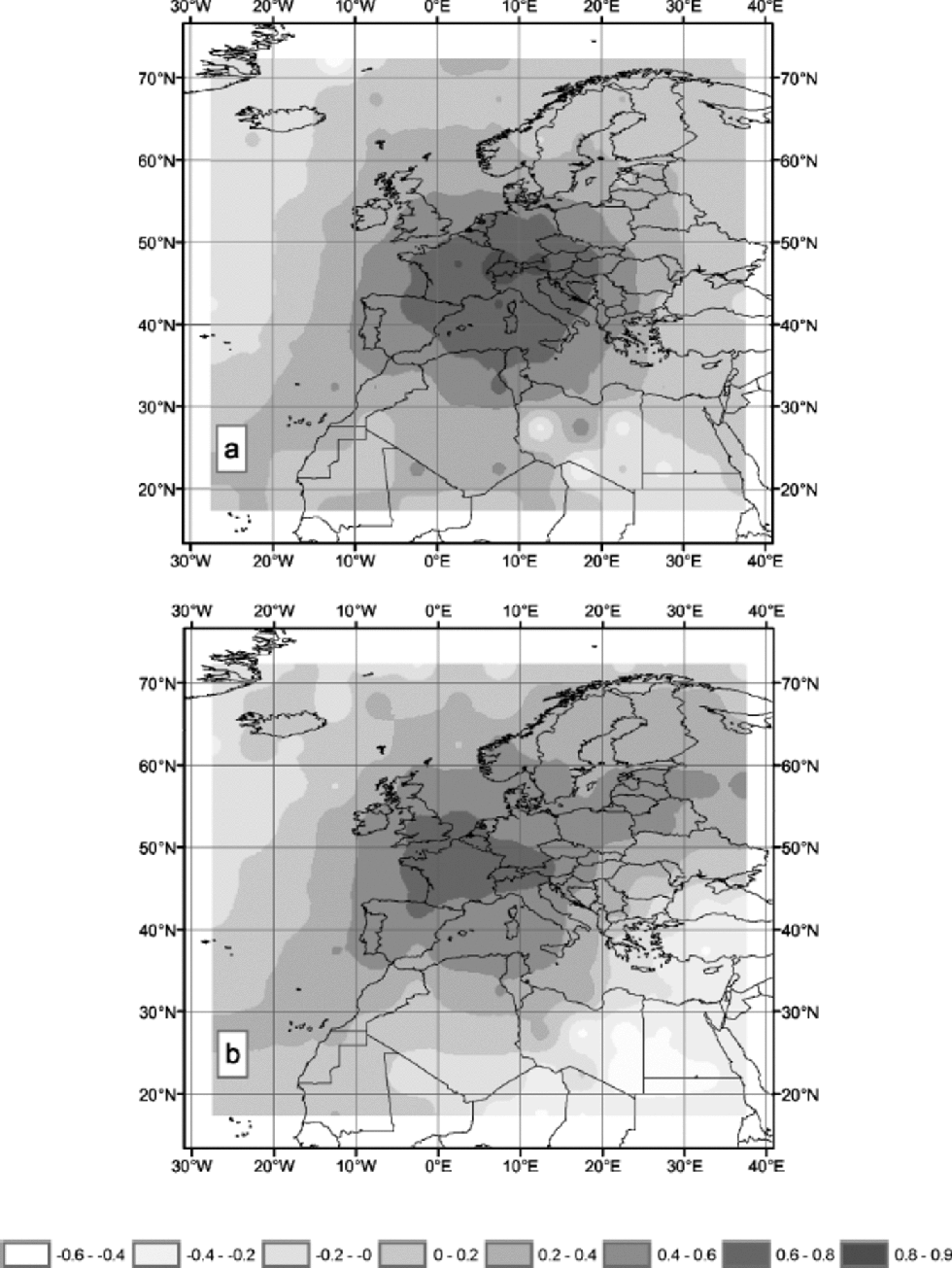
The correlation fields displayed in Figure 1a and b clearly indicate the generally high spatial persistence of the high-elevation Alpine air-temperature signal for central European lowland sites, for both the summer and winter periods. This finding is confirmed by Reference Auer, Böhm and SchönerAuer and others (2001a) who showed that a high correlation not only between high-elevation Alpine sites but also between high-elevation and lowland sites may be expected. As seen in the maps, in summer the spatial extension of the high-correlation category is larger, and the correlation between high-altitude temperatures and low-Alpine temperatures generally higher, than in winter. the weaker winter correlation can be explained by the decoupling of lowland areas from high-level sites due to temperature-inversion weather patterns. While the summer does not show a predominant direction in the temperature-signal persistence, the winter is dominated by an enhanced temperature-signal persistence for the directions west (weather types with cyclones from west to northwest) and northeast (weather types with continental high during winter).
Spatial correlation between ALPCLIM Colle Gnifetti temperature and European-wide CRU time series, 1901–98, (a) for summer means (April–September), (b) for winter means (October–March).
The difference between ALPCLIM and CRU air-temperature series (ALPCLIM minus CRU) for common gridbox 10/15E 45/50N (covering the southern part of Germany, parts of the Central and Eastern Alps and the Po plain) shows a strong temporal trend (Fig. 2). This contributes about 0.8˚C between 1940 and 1990 and is significantly larger than the last 100 years linear warming trend of 0.5˚C inherent in the CRU dataset. As shown by Reference Böhm, Auer, Brunetti, Maugeri, Nanni and SchönerBöhm and others (2001), the CRU dataset features several inhomogeneities which can explain the differences with the ALPCLIM dataset. Homogeneity problems with the CRU gridded temperature dataset are also reported for other regions by Moberg and Alexandersson (1997).
Difference between the CRU and the ALPCLIM temperature series (ALPCLIM minus CRU) for common gridbox 10/15E 45/50N (bold line: summer; thin line: winter).
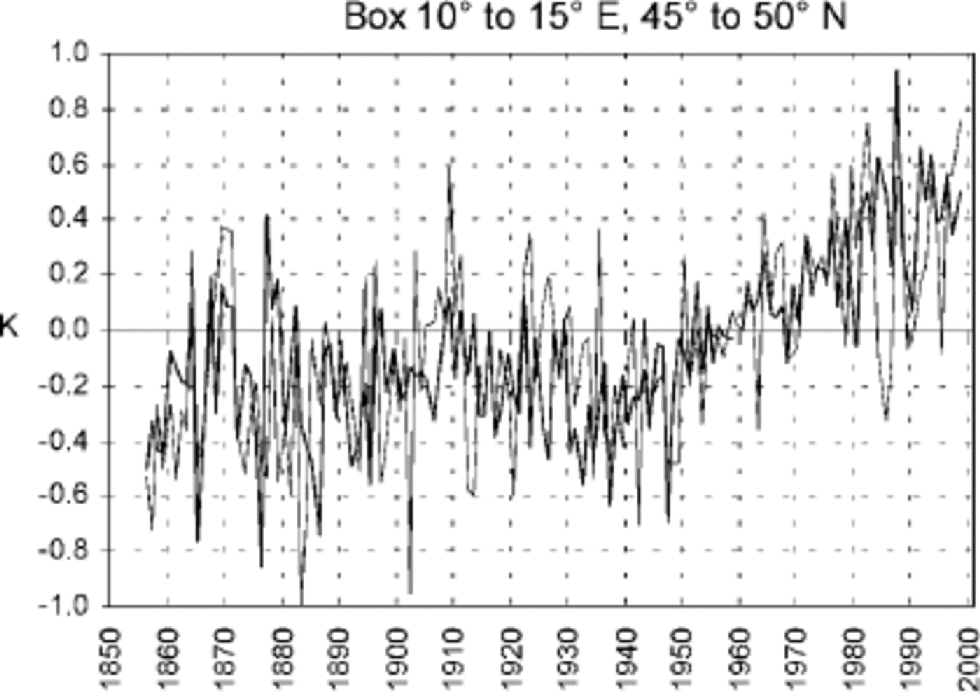
Figure 3 shows a comparison of spatial correlation between ALPCLIM Colle Gnifetti temperature series and CRU and ALPCLIM common gridboxes for the period 1901–98. Note the variations in the common area of the CRU and ALPCLIM gridboxes (Fig. 3c). Differences in spatial correlation are higher during winter, and close to statistical significance for gridboxes with a higher common-area ratio. We conclude that inhomogeneities in the CRU data series do not systematically influence correlation results and derived statements about spatial representativity.
Correlation between Colle Gnifetti temperature and ALPCLIM gridbox temperature in comparison to correlation between Colle Gnifetti temperature and CRU gridbox temperature for summer (a) and winter (b). (c) Common-area coverage of ALPCLIM and CRU gridboxes.

Seasonal Correlation of Instrumental Air Temperature
In order to determine the representativity of seasonal temperature series for the annual temperature variability, the relation between summer temperature and annual temperature and between winter temperature and annual temperature was compiled for the CG air-temperature series (see Fig. 4). Though the CG air-temperature series appears to be more closely correlated to the winter series than to the summer ones, the correlation coefficient of 0.73 (R2 = 0.53) between summer and annual series indicates that summer temperature variability provides an adequate approach to annual temperature variability.
Regression between annual temperature and seasonal temperatures calculated from the ALPCLIM dataset for the Colle Gnifetti gridbox (R2 means explained variance). Above: summer; below: winter.

Specific Features of Isotope Records in Alpine Ice Cores
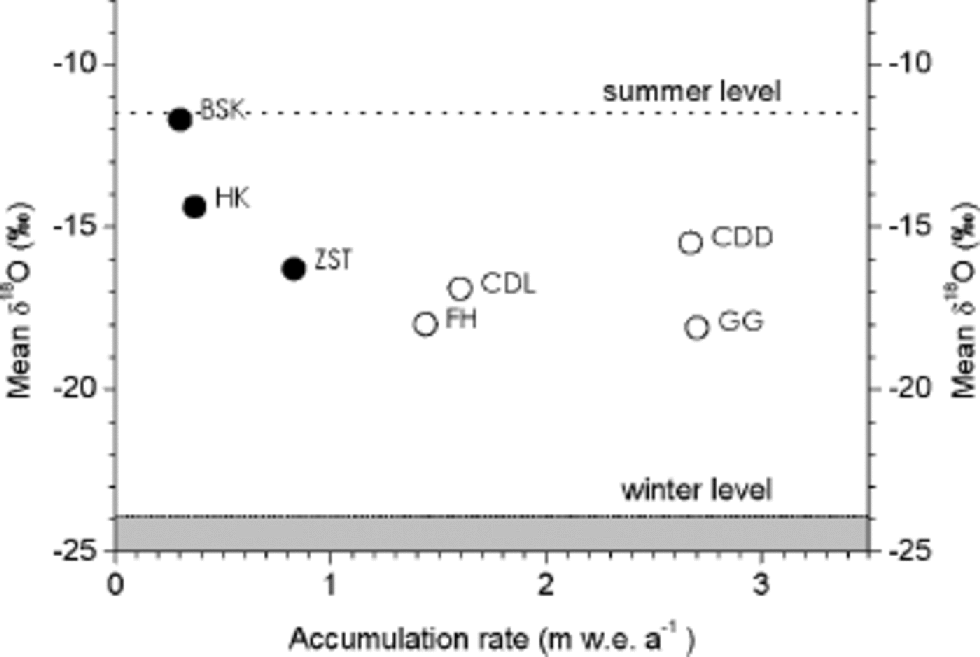
As shown in Figure 5, the seasonal apportionment of the conserved fraction of precipitation in a high-Alpine ice core may be roughly estimated by comparing its mean δ18O value with the expected typical winter and summer δ18O levels at the site. the wide range of δ18O core means can only be explained by extreme differences in the recorded section of the year. However, the core means approach the expected summer level for low accumulation rates (BSK in Fig. 5), indicating that the latter almost exclusively conserve the precipitation of summer months. Note that due to the wide range of snow-accumulation rates the long-term precipitation rate is assumed to be similar at all investigated drill sites. This wide range in the mean accumulation rate is directly linked to the snow-erosion rate. Long-term Alpine ice-core records over at least several centuries (Reference Wagenbach, Preunkert and BorellWagenbach and Preunkert, 1996) are expected to reflect predominantly summer conditions since they can only be obtained from low-accumulation sites.
Comparison of estimated typical summer and winter δ 18O levels at Colle Gnifetti with the mean δ 18O values from the 1983–91 time slices of three cores (BSK, HK and ZST)from Colle Gnifetti (dots) and with δ 18O core mean (circles) from: Col du Lys (CDL), Monte Rosa (personal communication from B. Stenni, 2001); Grenzgletscher (GG),Monte Rosa (Reference Eichler, Schwikowski and GäggelerEichler and others, 2001); Fiescherhorn (FH), Bernese Alps (Reference Schotterer, Fröhlich, Gäggeler, Sandjordj and StichlerSchotterer and others, 1997); and Col du Dome (CDD), Mont Blanc region (Reference Preunkert, Wagenbach, Legrand and VincentPreunkert and others, 2000). the estimated summer level of δ 18O is calculated from fresh snow samples at Colle Gnifetti, and the winter level from snow pits in the Monte Rosa region (Reference StichlerStichler and others, 1998). All levels are corrected by an altitude effect of 0.2 ‰ (100 m)–1 (Reference Schotterer, Fröhlich, Gäggeler, Sandjordj and StichlerSchotterer and others, 1997) to 4500 ma.s.l..
Comparison of Ice-Core δ 18O with Instrumental Temperature Records
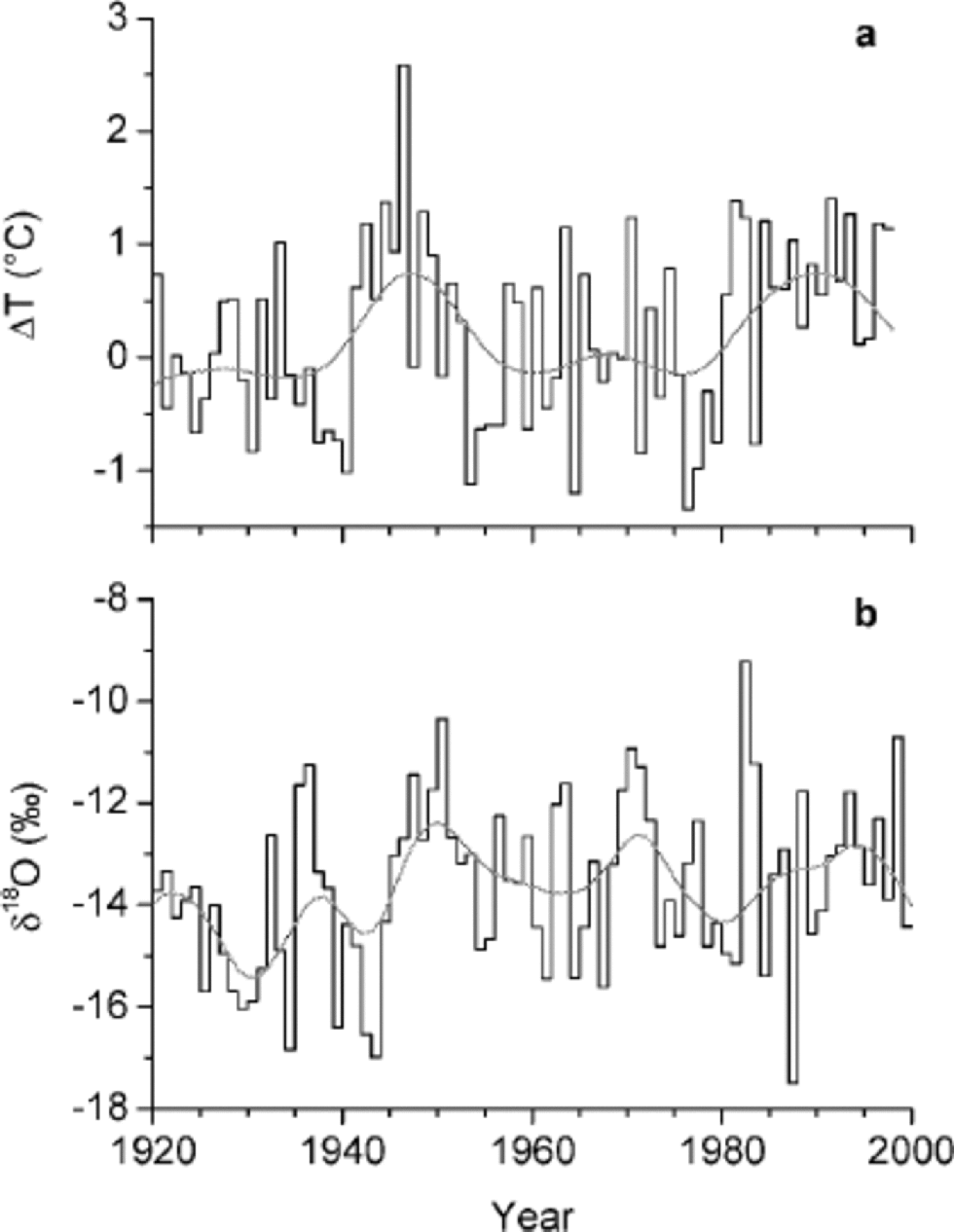
Ice-core climate proxy records from European high-Alpine sites offer the unique possibility of a comparison to long-term instrumental temperature time series. As outlined, it is most appropriate to compare ice-core records from low-accumulation sites with summer temperatures. Figure 6a and b show the 80 year record of formal annual δ18O means derived from an ice core drilled in a low-accumulation area (0.25mw.e. a–1) at Colle Gnifetti, along with the CG instrumental air temperatures. the large deviations between the individual years of the two time series are caused by the dating uncertainty of up to 3 years (Reference ArmbrusterArmbruster, 2000) as well as by depositional noise. By contrast, decadal trends of temperature and δ18O records (emphasized by a robust cubic-spline smoothing) are in fairly good agreement.
Comparison of individual years and decadal trends in (a) instrumental summer temperatures (near Colle Gnifetti high-level gridpoint of the homogenized ALPCLIM records) and (b) formal annual means derived from a δ 18O record ice-core record at the drill site.
Implications for Alpine Ice-Core Proxy Temperature
Long-term stable-isotope records from Alpine ice cores consist mainly of summer precipitation and thus reflect long-term trends in local high-elevation summer air temperature. the high correlation between high-Alpine air temperatures and central European lowland temperatures in summer implies that the ice-core temperature proxy data may approach the long-term central European summer temperature variability. Moreover, as high-Alpine summer temperatures are correlated to annual temperatures, information on trends in annual temperatures may be derived from Alpine ice-core records as well, though with a confined spatial representativity.
The typically conserved section of the year differs greatly from site to site and may systematically change over a multi-centennial time period. In view of the good spatial correlation during all seasons, this would be expected to have a minor impact on the spatial representativity of Alpine ice-core records.
Acknowledgements
The ALPCLIM project is funded by the European Community (ENV4-CT97-06389). We are grateful to the Laboratoire de Glaciologie et Géophysique de l’Environnement, Saint-Martin-d’Hères, France, to the Centre des Faibles Radioactivités, Gif-sur-Yvette, France, and to B. Stenni for providing us with unpublished data.



