Competition and cooperation are two somewhat opposed strategies for interpersonal social interaction that help us to achieve both individual and shared aims and objectives. Competition is an adaptive social behavior, which may be aggressive or defensive, and in which we seek to reach goals individually (biosocial model of status of Mazur, Reference Mazur1985). By contrast, cooperation is a social behavior that principally seeks to increase the probability of success in reaching common aims or objectives by collaborating with other members of a group (Kappeler & Van Schaik, 2006; Melis & Semman, 2010).
Regarding competition, there has been a considerable amount of psychobiological research. However, relatively few studies have analyzed the effects of laboratory cognitive tasks, such as reaction-time games, gambling, videogames and arithmetic tasks, activities known to induce social-evaluative threat (Dickerson & Kemeny, Reference Dickerson and Kemeny2004; Denson, Spanovic, & Miller, Reference Denson, Spanovic and Miller2009), on the hypothalamic-pituitary-adrenal (HPA) axis in terms of levels of its end product cortisol (Costa & Salvador, Reference Costa and Salvador2012; Costa, Serrano, & Salvador, Reference Costa, Serrano and Salvador2016; Hasegawa, Toda, & Morimoto, Reference Hasegawa, Toda and Morimoto2008; Oxford, Ponzi, & Geary, Reference Oxford, Ponzi and Geary2010). One of these few studies, which explored salivary cortisol (Csal) response in men to a Japanese chess competition, found that their Csal levels were higher after the competition (Hasegawa et al., Reference Hasegawa, Toda and Morimoto2008). Further, a study with a card game and competitive multiplayer video game found that Csal levels in men increased during the competition and also remained high after the game ended (Oxford et al., Reference Oxford, Ponzi and Geary2010). In contrast, a study based on women performing a competitive cognitive task found that Csal did not change between before and after the task, taking into account the outcome obtained (winning or losing; Costa & Salvador, Reference Costa and Salvador2012). Hence, it seems that sex plays an important role in the Csal response to laboratory competitive tasks.
Further, it has been hypothesized that outcome (winning or losing) is a possible modulator of the Csal response to a competitive situation (Salvador & Costa, Reference Salvador and Costa2009), although most of the research in this field is based on competitive physical sports. There is no consensus on the effects of outcome per se. Nonetheless, it has been suggested that obtaining a negative outcome or losing has an important activational effect on HPA axis activity when individuals perceive the situation to be uncontrollable (Salvador & Costa, Reference Salvador and Costa2009). Feelings of uncontrollability could affect social status in humans, in turn leading to substantial HPA activation. In fact, performing poorly or losing could reveal an inability to overcome a threat, and this would tend to increase Csal and anxiety levels (Dickerson & Kemeny, Reference Dickerson and Kemeny2004; Denson et al., Reference Denson, Spanovic and Miller2009). Moreover, the relationship between perceived control of a threat and Csal could be moderated by locus of control. People with a high internal locus of control perceive that they have control over the threat, and this has been associated with lower Csal levels (Bollini, Walker, Hamann, & Kestler, Reference Bollini, Walker, Hamann and Kestler2004). Regarding competitive laboratory tasks, no differences in Csal levels were observed between winners and losers in healthy young men (Hasegawa et al., Reference Hasegawa, Toda and Morimoto2008) or women (Costa & Salvador, Reference Costa and Salvador2012). On the other hand, an association was observed between post-competition appraisal and the outcome obtained. Specifically, the study with women revealed that winners have low state anxiety and a high internal locus of control after competition, while losers have high anxiety and a high external locus of control (Costa & Salvador, Reference Costa and Salvador2012).
Regarding cooperation, a type of social interaction that is widespread in all societies, most related research has taken a social approach, based on games involving ethical judgments or moral dilemmas, such as the prisoner’s dilemma, ultimatum games and the effect of punishment (Burton-Chellew & West, Reference Burton-Chellew and West2012; Velez, Mahood, Ewoldsen, & Moyer-Gusé, Reference Velez, Mahood, Ewoldsen and Moyer-Gusé2014). To our knowledge, only two studies have analyzed Csal response to a cooperative laboratory task such as Lego house-building (de Andrés et al., 2011; Moya-Albiol et al., Reference Moya-Albiol, de Andrés-García, Sanchis-Calatayud, Sariñana-González, Ruiz-Robledillo, Romero-Martínez and González-Bono2013). One of these compared Csal response in women who cooperated in the building of a Lego house with that in women who competed to perform this task, in both cases controlling for the effect of outcome. It was found that Csal levels fell significantly after the task in participants who cooperated and obtained a positive outcome (i.e., did the task well) as well as those who competed and obtained a negative outcome (i.e., lost; de Andrés et al., 2011). Furthermore, women who cooperated and obtained a negative outcome and those who won when competing showed a higher internal locus of control than the rest of the participants (de Andrés et al., 2011). The other study compared the Csal response of men and women who cooperated on this Lego task (Moya-Albiol et al., Reference Moya-Albiol, de Andrés-García, Sanchis-Calatayud, Sariñana-González, Ruiz-Robledillo, Romero-Martínez and González-Bono2013). Overall, Csal levels fell slightly when the outcome of the cooperative task was positive, while when the outcome was negative, there was a significant increase in Csal levels after the task followed by a progressive decrease. Moreover, it was observed that men with positive outcomes had lower Csal levels than women with a negative outcome (Moya-Albiol et al., Reference Moya-Albiol, de Andrés-García, Sanchis-Calatayud, Sariñana-González, Ruiz-Robledillo, Romero-Martínez and González-Bono2013).
With all this in mind, the main aim of this study was to explore which type of social interaction (cooperative or competitive) is more stressful for participants considering outcome (positive or negative) and sex as moderating variables and performance of the task while working alone as a control condition. For this purpose, we measured Csal and anxiety levels as psychobiological indicators of perceived stress in a sample of strangers who were set to cooperate or compete in face-to-face same-sex dyads. Firstly, we hypothesized that participants who competed or cooperated and obtained a negative outcome or lost would have higher levels of Csal, anxiety and external locus of control and less satisfaction than those who obtained a positive outcome or won (Costa & Salvador, Reference Costa and Salvador2012; de Andrés-García et al., 2011; Moya-Albiol et al., Reference Moya-Albiol, de Andrés-García, Sanchis-Calatayud, Sariñana-González, Ruiz-Robledillo, Romero-Martínez and González-Bono2013). Secondly, with respect to the role of sex, we hypothesized that men who cooperated and obtained a positive outcome would have lower Csal levels than women who cooperated and obtained a negative outcome (Moya-Albiol et al., Reference Moya-Albiol, de Andrés-García, Sanchis-Calatayud, Sariñana-González, Ruiz-Robledillo, Romero-Martínez and González-Bono2013). Finally, we expected to find a positive relationship between anxiety and Csal levels in all groups (Kirschbaum & Hellhammer, Reference Kirschbaum and Hellhammer1994). Analysis of these variables and their relationships may help to improve our understanding of interpersonal social interactions, including differences in biological responses.
Methods
Participants
We advertised in the University of Valencia for healthy young adults, establishing contact by email before screening applicants in interviews. The final sample consisted of a total of 178 students from the University of Valencia. In the preliminary session, all the students were given a general questionnaire about habits and various aspects of their health. We selected those who did not smoke, take medication or have addictive habits (coffee, tea, drugs), or have chronic, endocrine and/or cardiovascular diseases. In order to control for potential effects of hormonal influences/fluctuations (i.e., due to known effects on mood, physiological functions, etc.), female applicants who did not report at least a 3-month history of regular cycles lasting 21 to 35 days and/or were using oral contraceptives were excluded (Gómez-Amor, Martínez-Selva, Román, & Zamora, Reference Gómez-Amor, Martínez-Selva, Román and Zamora1990; Gómez-Amor, Martínez-Selva, Román, Zamora, & Sastre, Reference Gómez-Amor, Martínez-Selva, Román and Zamora1990). The final sample was composed of 88 women and 90 men, between 18 to 25 years of age (
 $\overline X$
= 20.42, SD = 1.64) with a body mass index (BMI) of 23.36 ± 3.30 kg/m2.
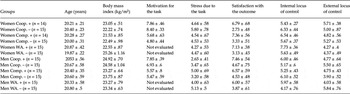
Sex-matched participants were randomly allocated to one of six experimental groups according to the type of task and the outcome obtained (positive or negative): cooperation with a positive outcome (Coop. +); cooperation with a negative outcome (Coop. -); competition with a positive outcome, i.e., winners (Comp. +); competition with a negative outcome, i.e., losers (Comp. -); working alone with a positive outcome (WA. +); and working alone with a negative outcome (WA. -). The groups had similar distributions in terms of age and socioeconomic characteristics. Table 1 shows the number of participants per group and summarizes participant characteristics by task, outcome and sex.
Mean (SD) of descriptive characteristics, psychological trait profiles, and appraisal scores by group, stratifying by type of interaction (task), outcome and sex

Coop.: cooperative task; comp.: competitive task, WA: working alone.
The study was approved by the university’s ethics committee and conducted in accordance with ethical principles for human research of the Declaration of Helsinki. All participants took part in the study voluntarily and signed an informed consent form before inclusion.
Procedure
After the participants arrived, anthropometric and demographic data were collected from each of them individually, and compliance with the instructions was checked. Further, they were asked about their activities during the 2 hours before the session and the previous night, and their menstrual cycle in the case of women.
Second, each participant was escorted to the room where the recording phase took place and where, for the cooperative and competitive tasks, he/she met the other participant, an individual who was previously unknown to him/her, minimizing emotional interference in the laboratory task. This was sound-proofed temperature-controlled (21 ± 2°C) room and light levels were kept constant throughout all sessions. Experimental sessions lasted for 2 hours and were held in the afternoon between 16:00 and 19:00 to minimize hormonal variations due to circadian rhythms. During these sessions, participants did not eat or drink stimulants (such as coffee, tea or alcohol). In cooperative and competitive tasks, the two participants (previously unknown to each other) were seated one in front of the other, maintaining visual contact. In the ‘working alone’ task, single participants performed the task on their own, serving as controls.
The experimental session began when participants were accustomed to the laboratory environment. During this session, anxiety and Csal levels of the participants were evaluated.
Firstly, participants were asked to remain relaxed and silent for 10 minutes. After this 10 min habituation period, a pre-task saliva sample was collected for measuring cortisol level (Csal-1), while the participants completed the psychological questionnaires for assessing pre-task states of anxiety. Subsequently, an experimenter of the same sex as the participants gave the task instructions, and then participants performed the task they had been set (cooperating, competing or working alone) for 10 minutes. Participants did not know how much time they had to complete the task.
At the end of the task period, two experimenters (one of each sex) assessed participants’ performance and assigned arbitrary and manipulated outcomes, thereby establishing two groups that differed in performance for each task: win vs. lose (for the competitive task) and positive vs. negative (for the cooperative task and working alone). Outcomes were assigned to balance the number of participants in each group and this was possible because the participants never finished the tasks (the 10 minutes allowed being insufficient in all cases).
Immediately after stopping work on the task, a saliva sample (Csal-2) was collected, while participants completed questionnaires for assessing post-task states of anxiety. In addition, at this time point, the task was appraised, in terms of perceived stress, satisfaction with the outcome, motivation for the task and internal and external attribution for the outcome. Finally, participants were escorted to the first room where saliva samples were collected 10, 30 and 45 min after the task (Csal-3, Csal-4 and Csal-5, respectively).
Instructions for tasks and their outcome
The core task was to build a copy of a model house with Lego pieces (de Andres-García et al., 2011; Moya-Albiol et al., Reference Moya-Albiol, de Andrés-García, Sanchis-Calatayud, Sariñana-González, Ruiz-Robledillo, Romero-Martínez and González-Bono2013), and this was the same in all the groups, the construction requiring the same visuospatial, psychomotor and cognitive skills. The difference between groups related to the type of instructions given. During the task period, participants were not allowed to talk. In the instructions, participants were forewarned that the evaluation criteria used by experimenters would be: the quality of the construction of the Lego or similarity to the model in all tasks, the errors in the placement of the pieces in the cooperative task and when working alone, and the theft of pieces in the competitive task.
Cooperative task
In this version of the task, each participant had his/her own box, and overall the two boxes had sufficient Lego pieces to build the model. They had to take turns to place pieces, with only visual communication, and before they started, it was explained that cooperating with their partner would facilitate good performance in the task.
Competitive task
In this version of the task, each participant had to build his/her own house, but they had a single common box with insufficient pieces for both of them to build a house like the Lego model. This forced them to compete to build their houses, prioritizing strategy and speed.
‘Working alone’ task
In this version of the task, a single participant had to build a house, and he/she had a box with sufficient pieces to complete it.
In all the tasks, the pieces of Lego had to be placed one at a time, and participants were only allowed to take one piece each time they reached into the box, with his/her dominant hand.
Materials
Cortisol analysis
To avoid a stress-induced increase in cortisol levels associated with venipuncture, we used saliva samples (Aardal & Holm, Reference Aardal and Holm1995). Csal concentration correlates well with free plasma cortisol concentration (Kirschbaum, & Hellhammer, Reference Kirschbaum and Hellhammer1994), and sample collection is non-invasive.
Saliva samples were collected with a Salivette system (cotton roll and two-part tube; Sastedt, Rommersdolf, Germany), immediately frozen at −20°C and stored at this temperature until thawed for use in radioimmunoassay analysis. All samples from each individual were run in duplicate in the same assay and values were averaged, provided that the inter-duplicate variation coefficient did not exceed 8%; else, the sample was analyzed again.
Radioimmunoassays were performed with a Coat-A-Count Kit (DPC-Siemens Medical Solutions Diagnostics, Bad Nauheim, Germany), which has a sensitivity of detection of cortisol levels as low as 1.4 nmol/l and uses a rabbit polyclonal antibody immobilized on the wall of a polypropylene tube. It is highly specific for cortisol (cross-reactivity with other peptide and steroid hormones being lower than 1%). The intra- and inter-assay variation coefficients were 4.3% and 5.2%, respectively.
Task and outcome appraisal scores
The task and the outcomes obtained were assessed with ad hoc questions rated on a 10-point scale. Participants were asked about their motivation for the task (“On a scale from 0 (not at all) to 10 (highly), how motivated did you feel to complete the task?”) and the stress it caused (“On a scale from 0 (no stress) to 10 (extreme stress), how much stress did you experience during the task?”). They also answered a series of questions related to satisfaction with the outcome (“On a scale from 0 (not at all) to 10 (highly), how satisfied are you with the outcome obtained in the task?”) and to their attribution for the outcome (internal and external locus of control) (“On a scale from 0 (not at all) to 10 (highly), how dependent do you feel the outcome of the task was on you, your cognitive abilities and your intelligence?”, and “On a scale of 0 (not at all) to 10 (highly), how dependent do you feel the outcome of the task was on external factors, the events that occurred during the session, and the type of task?”).
Psychological response to task
Anxiety was assessed using the State subscale of the Spanish version of the State-Trait Anxiety Inventory (STAI-S) (Seisdedos, Reference Seisdedos1982; Spielberger, Gorsuch, Lushene, Vagg, & Jacobs, Reference Spielberger, Gorsuch, Lushene, Vagg and Jacobs1983). This subscale is composed of 20 items ranked on a four-point Likert scale from 0 (not at all) to 3 (very much so) examining how participants feel at that moment. Cronbach’s alpha for this subscale was 0.72.
Data analysis
After assessing the normality of the data using the Kolmogorov-Smirnov test (p < .05), non-normal data were log10 transformed (only Csal levels). To examine group effects by task, outcome and sex, univariate analysis of variance (ANOVA) (3 x 2 x 2) with Bonferroni post-hoc tests was used to check for significant differences in anthropometric variables (age and BMI), appraisal scores (motivation for tasks, internal and external attribution, and satisfaction with task outcomes) and baseline cortisol (Csal-1). When any of these factors was found to be significant, it was considered as a covariate in subsequent analyses.
To assess differences in Csal levels within groups between time points, repeated-measures ANOVA was performed using a general linear model (3 x 2 x 2 x 5), with Time as the within-participant factor (at five levels: Csal-1, Csal-2, Csal-3, Csal-4 and Csal-5), and task (cooperating, competing and working alone), outcome (negative and positive) or sex (women and men) as the between-participant factor. Greenhouse–Geisser corrections for degrees of freedom and Bonferroni corrections for multiple comparisons were applied when a significant interaction effect was found in ANOVAs. In addition, partial eta squared (η p 2) is reported as a measure of effect size.
The magnitude of responses to tasks in terms of changes in Csal levels was estimated by calculating the area under the curve with respect to the increase (AUCi), using the trapezoidal rule (Pruessner, Kirschbaum, Meinlschmid, & Hellhammer, Reference Pruessner, Kirschbaum, Meinlschmid and Hellhammer2003). Specifically, AUCi is calculated with reference to the baseline measurement, ignoring the distance from zero for all measurements, and hence emphasizes changes over time. The group differences in AUCi were assessed with univariate ANOVA.
To assess differences in anxiety within groups between time points (pre-task and post-task), repeated-measures ANOVA was performed using a general linear model (3 x 2 x 2 x 2), with Time as the within-participant factor (at two levels: pre-task and post-task), and task (cooperating, competing and working alone), outcome (negative and positive) or sex (women and men) as the between-participant factor. As for the analysis of Csal, Greenhouse–Geisser corrections for degrees of freedom and Bonferroni corrections for multiple comparisons were applied where appropriate and partial eta squared (η p 2) is reported as a measure of effect size.
Lastly, linear regressions were used to examine relationships between the anxiety state levels and Csal response to the task.
All statistical analyses were performed with IBM SPSS for Windows Version 21.0. The alpha level was set at 0.05. Data are expressed as mean ± SD.
Results
Sample characteristics and appraisal scores
No significant differences were found in anthropometric variables (age and BMI) by task, outcome, sex or interactions between them (see Table 1). However, men had a higher BMI than women, F(1, 167) = 4.386, p = .038, η p 2 = .026.
Regarding appraisal scores, a significant group effect was found for motivation towards the task, F(1, 167) = 36.577, p < .001, η p 2 = .257, with higher scores in the cooperative group than the competitive group (p < .001).
Concerning satisfaction with outcome, participants with positive outcomes showed higher satisfaction than those with negative outcomes, F(1, 167) = 113.130, p < .001, η p 2 = .413. Moreover, there was a significant Outcome x Sex effect, F(1, 167) = 4.565, p = .034, η p 2 = .028 (see Table 1), men with negative outcomes reporting greater satisfaction than women with negative outcomes (p = .004).
On the other hand, analyzing attribution, participants with positive outcomes obtained higher internal locus of control scores than those with negative outcomes, F(1, 167) = 9.310, p = .003, η p 2 = .055, and women obtained higher internal locus of control scores than men, F(1, 167) = 7.581, p = .007, η p 2 = .045. Furthermore, there were significant Task x Outcome, Task x Sex and Task x Outcome x Sex effect, F(2, 167) = 5.249, p = .006, η p 2 = .061; F(2, 167) = 3.904, p = .022, η p 2 = .046; and F(2, 167) = 5.255, p = .006, η p 2 = .061; respectively (see Table 1). Moreover, post-hoc analysis showed that in the group working alone, participants with positive outcomes had a higher internal locus of control than those with negative outcomes (p < .001), and women showed a higher internal locus of control than men on this task (p < .001). Further, women working alone obtained greater internal locus of control scores than men working alone regardless of the outcome (p = .005 and p = .001, respectively), and women with negative outcomes on the cooperative task obtained greater internal locus of control scores than men with negative outcomes on this task (p = .008).
Psychobiological responses (Csal and anxiety) to the laboratory task
Csal response
For Csal, the laboratory tasks proved to be efficient in eliciting Csal changes, since Time showed a significant effect in the total sample, ε = .503, F(2.010, 353.840) = 104.947, p < .001, η p 2 = .374. Post-hoc analysis identified a significant difference between all periods (p < .001 in all cases), except between Csal-1 and Csal-2.
As groups did not differ in Csal baseline levels, F(2, 176) = 2.68, p = .071, η p 2 = .030, they were not included as a covariate. After dividing the sample by task type, Time was found to have a significant effect on Csal levels in all three groups, namely, those cooperating, competing and working alone: ε = .455, F(1.819, 108.736) = 25.502, p < .001, η p 2 = .305; ε = .488, F(1.953, 113.300) = 37.734, p < .001, η p 2 = .394; and ε = .557, F(2.227, 129.179) = 48.048, p < .001, η p 2 = .453, respectively. Post-hoc analysis of cooperative task data identified significant differences between all periods (p < .001 in all cases), except between Csal-1 and Csal-2, Csal-1 and Csal-3, and Csal-2 and Csal-3, and of competitive task data identified significant differences between all periods (p < .001 in all cases), except between Csal-1 and Csal-2, and Csal-1 and Csal-3. For the working alone group, post-hoc analysis identified significant differences between all periods (p < .05 in all cases).
Role of task
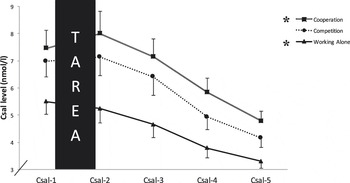
A main effect of Task was found, F(2, 167) = 5.540, p = .005, η p 2 = .063, with Csal levels being higher in the cooperative group than among those working alone (p = .004) (see Figure 1). No significant effect was found for Csal AUCi.
Levels of Csal over time in groups cooperating, competing or working alone to perform the task (M ± SEM). *p < .05

Role of outcome
With respect to the effect of participants’ outcome on Csal levels, there was a significant Time x Task x Outcome effect, ε = .509, F(4.075, 336.160) = 2.917, p = .021, η p 2 = .034. In the post-hoc analysis, it was found that Csal tended to be higher in participants that cooperated and obtained negative outcomes than those working alone with negative outcomes during all periods, except Csal-1 (p = .005, p = .002, p = .001 and p = .005, respectively).
Moreover, there was a significant Task x Outcome interaction for Csal AUCi, F(2, 165) = 3.878, p = .023, η p 2 = .045. Post-hoc analysis showed a smaller increase in Csal AUCi in participants who obtained negative outcomes cooperating than those who obtained negative outcomes competing or working alone (p = .027 and p = .042, respectively).
Role of sex
With respect to the effect of participants’ sex on Csal levels, we observed a significant Time x Sex effect, ε = .509, F(2.037, 336.160) = 8.936, p < .001, η p 2 = .051, with men presenting higher Csal-1 levels than women (p = .010). Considering the Csal AUCi, sex proved to be significant, F(1, 167) = 6.166, p = .014, η p 2 = .036, and post-hoc analysis showed a larger increase in Csal AUCi in men than women. Time x Task x Outcome x Sex and Task x Outcome x Sex. There was no significant Time x Task x Outcome x Sex effect in Csal levels or Task x Outcome x Sex interaction in AUCi Csal.
Anxiety responses
Role of task
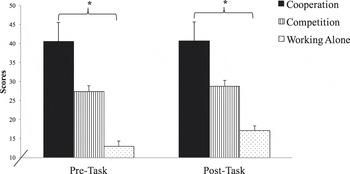
Regarding state anxiety, we found a significant Time x Task effect, ε = 1, F(2, 166) = 5.024, p = .008, η p 2 = .057. Post-hoc analyses identified a significant difference between all groups for both time points (p < .001 for all).
Furthermore, a main effect of Task was found, F(2, 166) = 94.937, p < .001, η p 2 = .534, with scores being higher in the cooperative group than among those competing or working alone (p < .001 in both cases) (see Figure 2).
State anxiety pre- and post-task in groups cooperating, competing or working alone to perform the task (M ± SEM). *p < .001

Role of outcome
A significant Time x Outcome effect was found in state anxiety scores, ε = 1, F(1, 166) = 5.099, p = .025, η p 2 = .030. Post-hoc analyses showed that participants with negative outcomes had significantly higher anxiety scores than participants with positive outcomes (p = .035). Nevertheless, non significant Time x Task x Outcome interaction were found, ε = 1, F(2, 166) = 1.721, p = .182, η p 2 = .020.
Role of Sex
Significant Task x Sex and Sex effects were found, F(1, 166) = 25.354, p < .001, η p 2 = .234, and F(1, 166) = 70.171, p < .001, η p 2 = .297, respectively. Post-hoc analysis showed higher anxiety scores in women than men (p < .001), and in cooperative women than other groups except competitive women (p < .001 for all).
Role of Time x Task x Outcome x Sex
There was no significant Time x Task x Outcome x Sex effect in anxiety levels.
Baseline anxiety levels as a predictor of Csal response to the laboratory task (AUCi).
The baseline anxiety levels predicted 7.3% of the AUCi Csal (β = .280, p < .01). After including task, sex and BMI as covariates, prediction remained significant (β = .267, p < .01).
Discussion
The main objective of our study was to assess which type of social interaction, between strangers in face-to-face same-sex dyads is more stressful: cooperation or competition. We found that participants who cooperated and obtained negative outcomes had higher Csal levels and self-reported state anxiety, these differences only being statistically significant with respect to working alone. Further, women who cooperated and obtained a negative outcome reported the highest motivation and internal locus of control and the lowest satisfaction. Finally, higher baseline anxiety levels were associated with larger Csal increases for all groups.
The tasks increased Csal and anxiety levels in all the participants. Moreover, in the competitive and cooperative tasks, there was an increase from pre-task to 0 min post-task levels, and then a progressive decrease in Csal levels which was significant in all cases other than between 0 and 15 min post-task. Notably, the Lego house-building task has been validated in three previous studies, which strengthens the ecological validity of our findings (de Andrés et al., 2011, Moya-Albiol et al., Reference Moya-Albiol, de Andrés-García, Sanchis-Calatayud, Sariñana-González, Ruiz-Robledillo, Romero-Martínez and González-Bono2013; Sariñana-González, Romero-Martínez, & Moya-Albiol, Reference Sariñana-González, Romero-Martínez and Moya-Albiol2016). Furthermore, we should underline that we found the lowest Csal and anxiety levels in participants who worked by themselves, indicating that the significant results are not attributable to the fact that the Lego construction task alone activates participants emotionally.
We hypothesized that participants who cooperated or competed and obtained a negative outcome would obtain the highest Csal levels (Costa & Salvador, Reference Costa and Salvador2012; de Andrés et al., 2011, Moya-Albiol et al., Reference Moya-Albiol, de Andrés-García, Sanchis-Calatayud, Sariñana-González, Ruiz-Robledillo, Romero-Martínez and González-Bono2013; Salvador & Costa, Reference Salvador and Costa2009). In fact, we found that only participants who cooperated and obtained a negative outcome had higher mean Csal levels than those in participants working alone. Furthermore, we expected that participants who competed and obtained a negative outcome would present the highest anxiety levels (Costa & Salvador, Reference Costa and Salvador2012). However, what we found was that women who cooperated and obtained a negative outcome showed the highest anxiety levels. Hence, our study suggests that cooperation between strangers is the most stressful type of task, at least compared to competing or working alone to perform a task in a laboratory.
In line with this, previous studies have established that knowing background information about one’s partner enables individuals to engage in cooperation and to benefit others. Among strangers, a lack of information regarding the reputation of others (based on their past actions) seems to limit cooperation, cooperative behavior being strengthened by providing information about partners’ actions in the immediate past (Balliet, Wu, & De Dreu, Reference Balliet, Wu and De Dreu2014; Bolton, Katok, & Ockenfels, Reference Bolton, Katok and Ockenfels2005; De Dreu, Reference De Dreu2012). Moreover, it has been hypothesized that stress-induced Csal elevations are inversely related to levels of interpersonal trust (Cesarini et al., Reference Cesarini, Dawes, Fowler, Johannesson, Lichtenstein and Wallace2008). That is, familiarity and trust are key drivers of social categorization, with familiar others being more likely to be categorized as in-group members (a group of people sharing similar interests and attitudes, producing feelings of solidarity, community, and exclusivity) than unfamiliar others, who could be categorized as out-group (people outside one’s own group; Mateo, Reference Mateo2004). Given this, future studies analyzing the hormonal correlates of social interactions should consider the variable familiarity and/or trust vs non-familiarity and/or absence of trust together with the rest of variables analyzed in our study.
Although our study makes a valuable contribution to understanding the psychobiological correlates of social interaction strategies, some limitations of the study should be taken into account in interpreting the results. Firstly, the main limitation of this study is that it is cross-sectional, so that individual differences may mask other effects evaluated at a single moment in life. Moreover, it is important to remark its marginal and exploratory nature, as in other recent work that has investigated the individual differences in the explanation of the relationship between competition/cooperation and cortisol (Wirth, Welsh, & Schultheiss, Reference Wirth, Welsh and Schultheiss2006; Zilioli & Watson, Reference Zilioli and Watson2013). Secondly, our data were derived from young and non-psychiatric populations and we have only analyzed two types of social interaction. In addition, future studies analyzing the type of psychobiological variables we have studied here should consider using two participants working in parallel, instead of a single participant working alone. Furthermore, we did not measure testosterone (T) and recent work suggests that levels of this hormone are involved in prosocial behavior such as cooperative tasks that are related to the pursuit of status (Eisenegger, Haushofer, & Fehr, Reference Eisenegger, Haushofer and Fehr2011; Liening & Josephs, Reference Liening and Josephs2010; Reimers, & Diekhof, 2013; Smeets-Janssen et al., Reference Smeets-Janssen, Roelofs, van Pelt, Spinhoven, Zitman, Penninx and Giltay2015; van Honk, Montoya, Bos, van Vugt, & Terburg, Reference van Honk, Montoya, Bos, van Vugt and Terburg2012). Moreover, HPA axis activity tends to show an inverse and reciprocal relationship with the hypothalamic-pituitary-gonadal axis and its end product, namely, T (Romero-Martínez & Moya-Albiol, 2016; Romero-Martínez, González-Bono, Lila, & Moya-Albiol, Reference Romero-Martínez, González-Bono, Lila and Moya-Albiol2013). Hence, future research should attempt to replicate our findings in a larger sample and including other variables such as levels of T, oxytocin, the hormone that promotes altruistic and cooperative behavior in humans (De Dreu, Reference De Dreu2012), and other indicators of the autonomic nervous system, for example, heart rate and heart rate variability. This would provide a more comprehensive view of individuals’ response to cooperation and competition. In addition, we should explore in more detail the role of variables that may have a moderating effect on cooperation, such as the outcome obtained, the satisfaction achieved, and the sex and age of participants. With regard to the last of these variables, to date, no studies have investigated whether age has an impact on cooperation, it being possible that level of maturity or training could influence responses.
The study of social interaction using psychophysiological markers may improve our understanding of emotional arousal, and it might be possible to extrapolate findings to negotiation and conflict resolution situations. Furthermore, research in this field would help us understand more about physiological responses of the body to different types of social interaction, such as cooperation and competition, providing an opportunity to establish interaction strategies that would be physiologically desirable, in order to promote our long-term psychophysiological wellbeing.
This work was supported by the Spanish Ministerio de Ciencia e Innovación (PSI2015–71076-P) and the Science Policy Unit at the Department of Education of the Valencian regional government under Grant PROMETEO/2015/200. This research is part of the doctoral dissertation project of the first author, financed by the Universitat de València (‘Atracció de Talents’ VLC-CAMPUS 2013). These funders had no further role in the study design, in the collection, analysis and interpretation of the data, in the writing of the report, and in the decision to submit the paper for publication. Authors also wish to thank ‘INC Servicios Lingüísticos’ for the revision of the English text.