Traumatic brain injury (TBI) is one of the leading causes of morbidity and mortality in children in the United States, accumulating over $1 billion in total annual health care costs (Arbogast et al., Reference Arbogast, Curry, Pfeiffer, Zonfrillo, Haarbauer-Krupa, Breiding, Coronado and Master2016) and affecting approximately 1.14 million children and young adults ages 0–24 years annually (Taylor et al., Reference Taylor, Bell, Breiding and Xu2017). TBI in childhood places children at higher risk of lifelong deficits across domains, including cognitive abilities, social competence (i.e., social information processing, social interaction, and social adjustment), and emotional outcomes (Anderson et al., Reference Anderson, Beauchamp, Yeates, Crossley, Hearps and Catroppa2013; Anderson et al., Reference Anderson, Beauchamp, Yeates, Crossley, Ryan, Hearps and Catroppa2017; Beauchamp et al., Reference Beauchamp, Vera-Estay, Morasse, Anderson and Dooley2019; Yeates, Reference Yeates, Yeates, Ris, Taylor and Pennington2010; Yeates et al., Reference Yeates, Bigler, Dennis, Gerhardt, Rubin, Stancin, Taylor and Vannatta2007). Risk for poorer outcomes has been associated with more severe injury (Prasad & Ewing-Cobbs, Reference Prasad and Ewing-Cobbs2014), younger age at injury (Anderson et al., Reference Anderson, Catroppa, Haritou, Morse and Rosenfeld2005; Ewing-Cobbs et al., Reference Ewing-Cobbs, Fletcher, Levin, Francis, Davidson and Miner1997; Ewing-Cobbs et al., Reference Ewing-Cobbs, Prasad, Kramer, Cox, Baumgartner, Fletcher, Mendez, Barnes, Zhang and Swank2006), and environmental risk factors, such as more maladaptive family functioning (Yeates et al., Reference Yeates, Swift, Taylor, Wade, Drotar, Stancin and Minich2004; Yeates et al., Reference Yeates, Taylor, Walz, Stancin and Wade2010), more harsh parenting behaviors (Narad et al., Reference Narad, Treble-Barna, Zang, Zhang, Smith, Yeates, Taylor, Stancin and Wade2019; Wade et al., Reference Wade, Cassedy, Walz, Taylor, Stancin and Yeates2011), and lower socioeconomic status (SES; Hackman & Farah, Reference Hackman and Farah2009; Noble et al., Reference Noble, Norman and Farah2005; Sarsour et al., Reference Sarsour, Sheridan, Jutte, Nuru-Jeter, Hinshaw and Boyce2011).
Executive functioning (EF) skills seem to be particularly sensitive to disruption following early TBI (Anderson et al., Reference Anderson, Godfrey, Rosenfeld and Catroppa2012; Beauchamp et al., Reference Beauchamp, Catroppa, Godfrey, Morse, Rosenfeld and Anderson2011). Extant research suggests that many neurobehavioral consequences of early pediatric TBI, such as cognitive impairments, academic difficulties, psychosocial maladjustment, and adaptive functioning declines, are in part caused by developmental issues of frontally guided, distributed networks (Casey et al., Reference Casey, Tottenham and Fossella2002; Diamond, Reference Diamond, Struss and Knight2002; Miller & Cohen, Reference Miller and Cohen2001) mediating the set of higher order cognitive abilities known as EF (Beauchamp et al., Reference Beauchamp, Catroppa, Godfrey, Morse, Rosenfeld and Anderson2011; Levin & Hanten, Reference Levin and Hanten2005). A meta-analytic study of 28 studies determined that areas of EF, including attention, problem solving, fluency, and processing speed, were impaired post-injury, which suggests that early TBI can be detrimental to the development of EF (Babikian & Asarnow, Reference Babikian and Asarnow2009). Furthermore, children who sustain TBIs in childhood (i.e., 8–12 years of age) demonstrate executive dysfunction both acutely and 24 months post-injury on measures of attentional control, problem solving, cognitive flexibility, and abstract reasoning (Anderson & Catroppa, Reference Anderson and Catroppa2005; Resch et al., Reference Resch, Anderson, Beauchamp, Crossley, Hearps, van Heugten, Hurks, Ryan and Catroppa2019). These disruptions in EF following pediatric TBI have been associated with social (Ganesalingam et al., Reference Ganesalingam, Yeates, Taylor, Walz, Stancin and Wade2011; Ryan et al., Reference Ryan, Anderson, Godfrey, Beauchamp, Coleman, Eren, Rosema, Taylor and Catroppa2014) and functional deficits (Arnett et al., Reference Arnett, Peterson, Kirkwood, Taylor, Stancin, Brown and Wade2013; Kurowski et al., Reference Kurowski, Wade, Kirkwood, Brown, Stancin, Cassedy and Taylor2013; Levin et al., Reference Levin, Hanten and Li2009). Furthermore, other environmental risk factors, such as lower SES and maladaptive parenting style, have been found to exacerbate EF problems post-injury (Potter et al., Reference Potter, Wade, Walz, Cassedy, Stevens, Yeates and Taylor2011; Schorr et al., Reference Schorr, Wade, Taylor, Stancin and Yeates2019), leading to a complex and extensive literature base focusing on executive dysfunction following pediatric TBI.
Effortful control (EC) is a closely related construct to EF, with origins in the developmental literature on temperament (Moran et al., Reference Moran, Lengua and Zalewski2013). Differences in temperament are understood as biologically based individual differences in reactivity and self-regulation. EC is conceptualized as a dispositional trait-level construct that represents the tendency to employ top-down control to self-regulate, including attentional focusing, attentional shifting, and inhibition/activation of behavior (Nigg, Reference Nigg2017; Rothbart et al., Reference Rothbart, Ellis, Rueda and Posner2003). Similar to EF, it has been measured through caregiver and self-report questionnaires (i.e., Rothbart’s questionnaires; (Rothbart et al., Reference Rothbart, Ahadi, Hershey and Fisher2001), laboratory tasks (e.g., Kochanska’s battery; Kochanska et al., Reference Kochanska, Murray and Harlan2000), and through direct observation. As highlighted in a review conducted by Nigg in Reference Nigg2017, EC and EF may best be captured under the broader concept of self-regulation with differences in terms and measurement largely reflecting differences across the fields of clinical and developmental science. EC shares many aspects of cognitive control that are typically associated with EF, especially executive attention. Within typically developing children, components of EC appear relatively stable across early years of life (Gaertner et al., Reference Gaertner, Spinrad and Eisenberg2008; Kannass et al., Reference Kannass, Oakes and Shaddy2006; Putnam et al., Reference Putnam, Rothbart and Gartstein2008), which is similar to the stability of EF over time (Zelazo & Carlson, Reference Zelazo and Carlson2012). Importantly, a large body of research documents associations of EC with socioemotional (see Eisenberg et al., Reference Eisenberg, Zhou, Spinrad, Valiente, Fabes and Liew2005; Choe, Reference Choe2021) and functional outcomes (Gal-Szabo et al., Reference Gal-Szabo, Spinrad, Eisenberg and Sulik2019; Nasvytienė & Lazdauskas, Reference Nasvytienė and Lazdauskas2021; Obradović, Reference Obradović2010; Valiente et al., Reference Valiente, Eisenberg, Haugen, Spinrad, Hofer, Liew and Kupfer2011) in children, including externalizing problem behaviors, internalizing symptoms, academic competence, and social competence. This pattern of associations is similar to that observed between EF and social/functional outcomes with respect to capturing cognitive control aspects of EF that are regulated by executive attention (Nigg, Reference Nigg2017; Zhou et al., Reference Zhou, Chen and Main2012).
However, some distinctions between the concepts of EC and EF are proposed. Nigg (Reference Nigg2017) theorized that EC is a narrower construct than EF, specifically that EC excludes more complex cognitions and strategies, such as working memory and planning. Zhou et al. (Reference Zhou, Chen and Main2012) noted that EC and EF are often studied in different contexts, with EC more focused on emotionally laden (“hot”) contexts within social settings, and EF on more emotionally neutral (“cool”) contexts that rely more on cognitive-based capacities. Clear delineations between the two constructs are still poorly understood and defined across fields, in part due to the ongoing discussions around how to conceptualize and operationalize EF (Baggetta & Alexander, Reference Baggetta and Alexander2016). Given the lack of studies exploring both factors together, additional research and statistical analyses (e.g., factor analyses) are needed in this area to better understand distinctions and similarities between the constructs of EC and EF.
EC has been studied rarely in an early TBI population and with mixed results. In a study by Ganesalingam et al. (Reference Ganesalingam, Yeates, Taylor, Walz, Stancin and Wade2011) using the Rothbart questionnaires, children with severe TBI (ages 3–7) had significantly impaired EC compared to the orthopedic injury (OI) group. Furthermore, highlighting the overlap between EC and EF, poorer performance on neuropsychological tests of complex EF involving mental flexibility (i.e., a Stroop task) were related to lower ratings of EC. Still, EC appeared to be a unique construct, given that performance on neuropsychological tests of EF involving the ability to anticipate contingency reversal and inhibition of a prepotent response did not account for unique variance in behavioral ratings of EC. Furthermore, EC predicted significant unique variance in two parent-reported measures of social skills, with higher levels of EC related to greater social competence. In another early TBI cohort (age: 36 ± 12 months) also using the Rothbart questionnaires, there were no pre-injury differences in EC and the trajectory of EC did not differ significantly across uncomplicated mild TBI, mild complicated/moderate/severe TBI, or OI groups up to 18 months post-injury (Seguin et al., Reference Séguin, Dégeilh, Bernier, El-Jalbout and Beauchamp2020). However, children with more severe TBI showed a lower rate of increase in another factor of temperament, surgency (or tendencies for high levels of positive emotionality/reactivity, novelty approach, engagement, and higher levels of motor activity and impulsivity), compared to children in the uncomplicated mild or OI groups.
Despite the dearth of studies examining EC following early pediatric TBI, the close association between EC, EF, and early attentional network systems which have been shown to decline following early brain injury, suggests that EC may also decline following injury. Furthermore, children injured at an earlier age appear to be the most vulnerable to negative outcomes, and this association appears likely to hold true for EC. Few studies have also explored the usefulness of EC above and beyond EF measures, or considered the influence of EC on resilience following injury. While the adverse effects of pediatric TBI have been well documented over the past two decades, research on resilience, or positive adaptation in the context of risk or adversity (Masten, Reference Masten2014), following injury is lacking. This approach would provide important information about what may be predictive of preserved functioning or could be useful in identifying individuals at greatest risk of poor outcomes (Beauchamp & Yeates, Reference Beauchamp and Yeates2019). Improving our understanding of protective factors could also help address longstanding recovery questions within the field, such as the well-known heterogeneity of recovery outcomes despite similar injuries (Taylor, Reference Taylor2004) and why some subgroups of those who sustain a severe TBI demonstrate a good recovery but not others (Fay et al., Reference Fay, Yeates, Taylor, Bangert, Dietrich, Nuss, Rusin and Wright2010). Extant studies from the child development literature suggest that higher levels of EC may exert a protective function for socioemotional and functional outcomes (Eisenberg et al., Reference Eisenberg, Zhou, Spinrad, Valiente, Fabes and Liew2005; Obradović, Reference Obradović2010; Riggs et al., Reference Riggs, Blair and Greenberg2004).
Despite significant conceptual overlap between EC and EF, few researchers have compared their predictive validity or explored outcomes across fields (i.e., developmental psychology and clinical psychology/neuropsychology). Clinically, given the strong associations of self-regulation with functional outcomes, and evidence that earlier age at injury is a significant risk factor for poorer outcomes, there is a critical need to understand how self-regulation is affected by early injury and what its effects are on long-term functional outcomes. Thus, the purposes of the present study were to: (1) examine changes in EC over time following early TBI (3–7 years) relative to a cohort who sustained OIs at similar ages; and (2) compare the predictive utility of early EC, as compared to early EF, on long-term functional and social outcomes (an average of 7 years post-injury).
Methods
Participants
Following institutional review board approval at each study site, individuals who had sustained an early childhood TBI, between the ages of 36 and 84 months (3–7 years), were recruited as part of a multi-center study (name and location of study blinded for review). The study prospectively evaluated cognitive, behavioral, neuropsychological, adaptive, and EF beginning shortly after injury (∼ 1 month after injury) with repeat assessments 6, 12, and 18 months later. Additional follow-ups were completed at 2 or more years post-injury (3.5 years average) and at emerging adolescence, approximately 7 years post-injury. Eligible participants who agreed to participate were mailed packets of paper-and-pencil measures to complete and either mail back to the study team or bring to their follow-up medical appointments. Phone interviews to collect the Child and Adolescent Functional Assessment Scale (CAFAS) were conducted at the final time point. Consistent with prior research, lowest recorded Glasgow Coma Scale (GCS) scores and imaging findings were used to define TBI severity with GCS scores of 13–15 with associated CT and/or MRI findings identified as complicated mild, GCS scores of 9–12 as moderate TBI, and GCS scores of 3–8 as severe TBI. Consistent with prior research, the complicated mild and moderate groups were combined (Petranovich et al., Reference Petranovich, Smith-Paine, Wade, Yeates, Taylor, Stancin and Kurowski2020) and will be referred to as the moderate group hereafter.
An OI comparison group was recruited to control for the individual and family factors that may predispose a child to traumatic injury (Stancin et al., Reference Stancin, Taylor, Thompson, Wade, Drotar and Yeates1998). Inclusion in the OI group required a documented bone fracture in an area of the body other than the head that required an overnight hospital stay, as well as the absence of any evidence of loss of consciousness or other findings suggestive of brain injury. Exclusion criteria in both groups included prior history of TBI, child abuse, neurological disorder, autism, or intellectual disability prior to injury, or a primary language other than English in the home. Children with premorbid Attention-Deficit/Hyperactivity Disorder (ADHD) were not excluded from this study, but they were evenly split across the OI/TBI groups.
A total of 206 participants were included in analyses (ns: complicated mild/moderate = 72; severe TBI = 21; OI = 113), with a mean age of injury of 5.2 years. The sample was mostly male (56%), non-Hispanic (96%), and Caucasian (72%). The TBI and OI groups only differed on injury type, in which children with OI were more likely to have sustained their injury from a sports or recreation accident, while children with severe TBI were more likely to have sustained their injury from a motor vehicle accident (see Table 1).
Demographic characteristics of participants by injury group

Note. TBI = traumatic brain injury, ns = not statistically significant.
Measures
The Children’s Behavior Questionnaire (CBQ; Ahadi & Rothbart, Reference Ahadi, Rothbart, Halverson, Kohnstamm, Martin, Halverson and Kohnstamm1994) is a parent-reported assessment of temperament in childhood which is designed to assess children from 3–7 years. An Effortful Control Index was created by summing scores on the Inhibition Control and Attentional Focusing scales, which are the two most theoretically and empirically salient components of the EC construct (Olson et al., Reference Olson, Sameroff, Kerr, Lopez and Wellman2005; Posne & Rothbart, Reference Posne and Rothbart2000; Rothbart & Bates, Reference Rothbart and Bates1998). Inhibitory control is described as “the capacity to plan and to suppress inappropriate approach responses under instructions or in novel or uncertain situations.” Attentional focusing is described as the “tendency to maintain attentional focus upon task-related channels” (Rothbart et al., Reference Rothbart, Ahadi, Hershey and Fisher2001). Sample items include the extent to which the child: “is good at following instructions,” “is quickly aware of some new item in the living room,” and “approaches places he/she has been told are dangerous slowly and cautiously.” Higher scores on the Effortful Control Index indicates better functioning. The CBQ has demonstrated satisfactory reliability and validity in previous research (Rothbart & Bates, Reference Rothbart and Bates1998). Parents completed the CBQ at the baseline assessment to reflect the child’s behavior pre-injury.
The Behavior Rating Inventory of Executive Function (BRIEF) is a parent-report instrument of EF behaviors (Gioia et al., Reference Gioia, Isquith, Guy and Kenworthy2000). The BRIEF is a widely used questionnaire designed to assess behavior related to EF in children. For children ages 5–18, the school-age version was used (BRIEF) and for children ages 2–5 years, the preschool version was used (BRIEF-P). The two versions are highly similar, but adjusted to reflect age-appropriate behaviors related to EF. Each version yields an overall measure of EF, the Global Executive Composite (GEC). The BRIEF preschool-age version is made up of 5 clinical scales, which form three indices including the Inhibitory Self-Control Index which measures the child’s ability to regulate their emotions and behaviors (scales: Inhibit and Emotional Control), the Flexibility Index which assesses the child’s ability to flexibly apply different emotional and behavioral reactions according to different situations (scales: Shift and Emotional Control), and Emergent Metacognition Index which represents the child’s ability to hold ideas in their mind and to execute problem solving (scales: Working Memory and Plan/Organize). The BRIEF school-age version is made up of eight clinical scales that form two broader indexes, Behavioral Regulation, which reflects the child’s ability to control their emotions and behavior (scales: Inhibit, Shift, and Emotional Control) and Metacognition, which encompasses a child’s ability to manage and complete cognitive tasks (scales: Initiate, Working Memory, Plan/Organize, Organization of Materials, and Monitor). Sample items include the extent and frequency with which the child “becomes upset with new situations,” “does not check work for mistakes,” “forgets what he/she was doing,” and “mood changes frequently.” Higher scores indicate worse EF behavior. The BRIEF was identified as a Common Data Elements supplemental instrument by the Pediatric TBI Outcomes Workgroup (McCauley et al., Reference McCauley, Wilde, Anderson, Bedell, Beers, Campbell, Chapman, Ewing-Cobbs, Gerring, Gioia and Levin2012) and is widely used in TBI research. Parents were asked to complete the BRIEF at the baseline assessment with respect to the child’s EF behaviors prior to the injury.
The CAFAS (Hodges, Reference Hodges1990) is a structured caregiver interview which was conducted with families over the phone designed to obtain information on functioning in eight domains: school (i.e., how child functions in group/classroom setting), home (i.e., following rules and performing developmentally appropriate tasks), community (i.e., acting lawfully in respect of others/property), behavior towards others (i.e., acting appropriately), mood/emotions (i.e., self-regulating emotions), self-harmful behaviors (i.e., coping without resorting to self-harm), substance abuse (i.e., extent to which substance use is inappropriate/disruptive), and thinking (i.e., ability to use rational thought). Functioning in each domain is rated on an ordinal scale ranging from 0 to 30 in 10-point increments, such that scores of 0 indicated “no/minimal impairment,” 10 indicated “mild impairment,” 20 indicated “moderate impairment,” and 30 indicated “severe impairment.” A total score is created by summing domain scores (range: 0–240), with higher scores indicating more impairment.
The CAFAS total score was used as the adaptive functioning outcome measure. The CAFAS has established validity and excellent inter-rater reliability ranging from 0.74 to 0.99 (Hodges & Wong, Reference Hodges and Wong1996). For the present study, the CAFAS was administered by two researchers with advanced degrees in psychology or counseling who were certified as CAFAS trainers. Additional raters were trained to achieve inter-rater reliability of greater than 80% and all raters were blind to the participant’s injury group. Ten percent of interviews were taped and jointly rated yielding an overall inter-rater reliability of 98.7%. The CAFAS was administered to parents at the final longitudinal assessment an average of 7 years post-injury.
The Home and Community Social Behavior Scales (HCSBS) is a 64-item, parent-report scale designed to assess social competence and antisocial behavior in children (Merrell et al., Reference Merrell, Streeter, Boelter, Caldarella and Gentry2001). Parents rate each item based on a five-point Likert-type scale, and two total scores are calculated measuring a child’s overall social competence (sample item: “interacts with a wide variety of peers”) and antisocial behavior (sample item: “bothers and annoys others”). The HCSBS has four subscales: peer relations, self-management/compliance, hostile/irritable, and antisocial/aggressive. The social competence total score was used as the outcome measure for social competence. The HCSBS has demonstrated high test–retest reliability, internal consistency, and validity (Merrell et al., Reference Merrell, Streeter, Boelter, Caldarella and Gentry2001). The HCSBS was administered to parents at the final longitudinal assessment an average of 7 years post-injury.
Data analysis plan
Mixed models (SAS PROC Mixed) were used to examine the effect of injury group (severe TBI vs. moderate TBI vs. OI) and time since injury on child EC over time post-injury. SES, as measured through a Z-score created using census tract income and parent education, and age at injury were included in all models as covariates. Next, using SAS PROC GLM, we examined the relationship of children’s early EC (pre-injury and 18 months post-injury, separately in the models as these were highly correlated, r = .70), independent of EF, in predicting functional outcomes and social competence in early adolescence (i.e., 7 years post-injury). To better understand how baseline levels of EC may influence functional impairment over and above the influence of EF, we included time congruent BRIEF-GEC scores in the models. The following covariates were included: SES, age at injury, and EF (i.e., time congruent BRIEF-GEC scores). EC and EF were highly correlated (rs = .65–.68), but VIF/tolerance values indicated no issues with multicollinearity (VIF’s = 2.66–2.86).
Results
EC over time
Consistent with our hypotheses, we found a significant injury group by time interaction for EC (p < .01; See Figure 1). The injury groups did not differ significantly on pre-injury EC. However, the severe TBI group significantly declined in EC from pre-injury to 6 months post-injury, with significantly lower EC than both the OI and moderate TBI groups at 6, 12, and 18 months post-injury (p < .01).
Effortful control over time by group. Note. OI = orthopedic injury, TBI = traumatic brain injury, CBQ = Child Behavior Questionnaire; *indicates p < .05, indicating that the severe TBI group effortful control significantly dropped from baseline to 6 months post-injury and had significantly lower effortful control than the OI group at the 6, 12, and 18 months time points.

EC at pre-injury predicting functional impairment
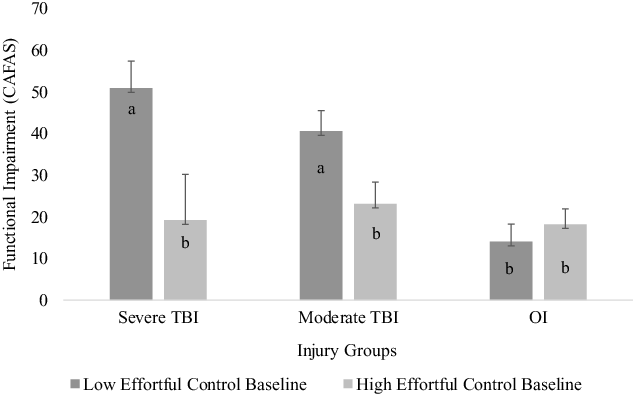
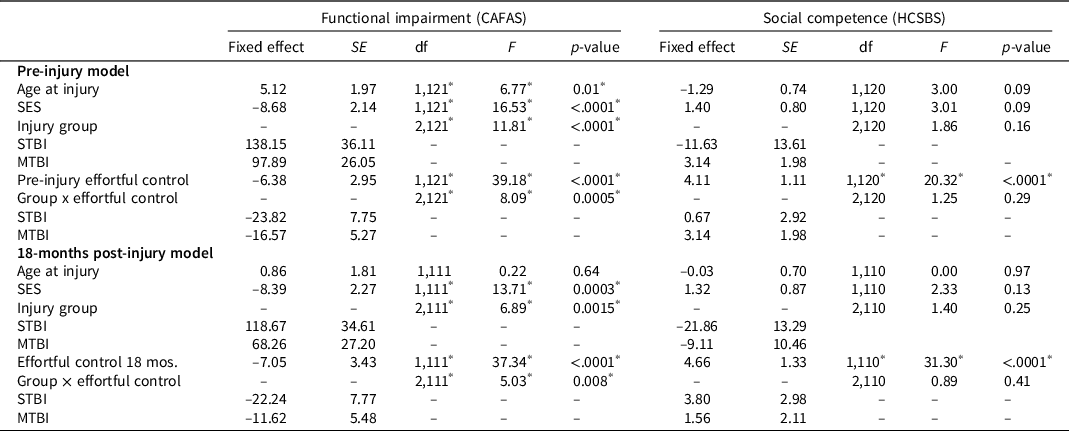
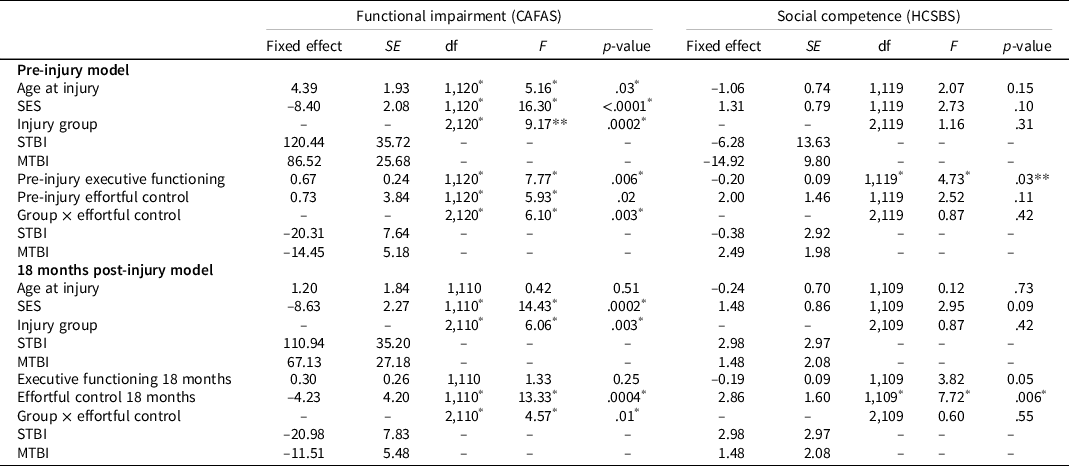
A significant interaction of EC at pre-injury and injury group on functional outcomes was noted, F(2, 121) = 8.09, p < .01 (see Figure 2 and Table 2). To better understand this interaction, a median split was used to group participants into high and low EC groups. Examination of this interaction revealed that, for children with TBI, pre-injury EC was related to long-term functional impairment as measured by the CAFAS total score, with lower levels of pre-injury EC predicting greater functional impairment following both moderate (low EC: M = 47.59, SE = 5.25; high EC: M = 17.11, SE = 5.49; p = < .0001, d = 1.69) and severe TBI (low EC: M = 58.07, SE = 6.92; high EC: M = 15.73, SE = 11.89, p = .003, d = 2.34). No impact of pre-injury EC on long-term functional impairment was noted in the OI group. Further, the effect of injury severity on functional impairment was only noted among those with low levels of pre-injury EC. Specifically, those with severe TBI were rated as having greater functional impairment than those with moderate TBI (p < .0001, d = .58) or OI (p < .0001, d = 2.11), whereas those with moderate TBI were rated as having more functional impairment than those with OI (p < .0001, d = 1.53). No group differences were noted among those with higher levels of pre-injury EC. When pre-injury EF was added to the models, the pattern of results was similar, with the exception of similar levels of functional impairments noted in both brain injury groups at lower levels of EC. This pattern of findings suggests that at lower levels of EC, brain injury severity did not differentially impact functional impairment when EF is considered; however, both the moderate and severe TBI groups had significantly greater levels of functional impairment compared to OI (d = 1.47 and d = 2.04 respectively), even when EF is considered (see Table 3).
Effortful control at pre-injury by group interaction for functional impairment on the CAFAS. Note. OI = orthopedic injury, TBI = traumatic brain injury, CAFAS = Child and Adolescent Functional Assessment Scale; Higher scores correspond to greater functional impairment; Scores above 50 indicate clinically significant impairment; the letters indicate statistical significance such that groups that share the same letter are not statistically different from one another (p > .05) while groups that have different letters are significantly different from one another (p < .05).

Mixed model results for pre-injury variables and 18-month variables predicting outcomes on functional impairments and social competence at an average of 7 years post-injury

Note. SE = standard error; STBI = severe traumatic brain injury; MTBI = moderate traumatic brain injury.
* Indicates p < .05.
Mixed model results for pre-injury variables and 18-month variables predicting outcomes on functional impairments and social competence at an average of 7 year post-injury, while controlling for executive functioning

Note. SE = standard error; OI = orthopedic injury; Mod. TBI = moderate traumatic brain injury.
* Indicates p < .05.
EC at pre-injury predicting social competence
Consistent with hypotheses, pre-injury EC was significantly associated with social competence, as measured by the HCSBS at 7 years post-injury, while accounting for age at injury, SES, and injury group, F(1, 120) = 20.32, p < .0001. In contrast to functional impairment, there was not a significant interaction between EC and group on social competence, indicating that individuals with lower EC had lower social competence (M = 46.66, SE = 1.23), as compared to those with higher EC (M = 53.17, SE = 1.72, d = .79), regardless of injury group.
When pre-injury EF was added to the models, there was a significant main effect of EF on social competence, F(1, 119) = 4.73, p = .03. However, there were no longer significant relationships between EC and social competence, nor between injury severity and social competence, indicating that EC may not play a role in social competence over and above the effect of EF.
EC at 18 months post-injury predicting functional impairment
There was a significant interaction of EC at 18 months post-injury and injury group on functional impairment (CAFAS total score), F(2, 111) = 5.03, p < .01 (see Figure 3). As in the pre-injury models, median splits indicated that EC was associated with different levels of functional impairment for children with a history of TBI, with children with lower levels of EC having significantly greater levels of functional impairment than those with higher EC in both the moderate TBI (low EC: M = 44.96, SE = 5.00; high EC: M = 19.10, SE = 5.52; p <.0001, d = 1.22) and severe TBI groups (low EC: M = 53.86, SE = 6.47; high EC: M = 4.42, SE = 16.98, p = .007, d = 2.71). In contrast, there was no effect of EC in the OI group. Additionally, the effect of injury severity was only noted among those with low levels of EC, with severe TBI experiencing greater functional impairment than those with OI (p < .0001, d = 1.63), and those with moderate TBI experiencing more functional impairment than those with OI (p < .0001, d = .98). There were no group differences between moderate and severe TBI when EC was low, nor injury group differences among those with high levels of EC.
Effortful control at 18 months post-injury by group interaction for functional impairment on the CAFAS. Note. OI = orthopedic injury, TBI = traumatic brain injury, CAFAS = Child and Adolescent Functional Assessment Scale; Higher scores correspond to greater functional impairment; Scores above 50 indicate clinically significant impairment; the letters indicate statistical significance such that groups that share the same letter are not statistically different from one another (p > .05) while groups that have different letters are significantly different from one another (p < .05).

When EF at 18 months post-injury was added to the models, the effect of EC on functional impairment was only observed in the severe TBI group, with children with higher EC with severe TBI demonstrating lower impairment than those with lower EC (p = .03, d = 2.07). Interestingly, the effect of EC on functional impairment following moderate TBI was no longer significant when EF was added to the model (p =.08). Additionally, the effect of injury severity was significant only in the low EC group, with the OI group demonstrating less functional impairment than both the moderate TBI (p = .02, d = .88) and severe TBI (p <.01, d = 1.27).
EC at 18 months post-injury predicting social competence
Consistent with hypotheses, EC at 18-month post-injury was also significantly associated with social competence at 7 years post-injury, F(1, 110) = 31.30, p < .0001. There was no interaction with injury group, indicating that individuals with lower EC had lower social competence (M = 46.56, SE = 1.10) than those with higher EC (M = 57.46, SE = 2.17, d = 1.37), regardless of injury type or severity.
When EF at 18 months was added to the models, there continued to be a significant effect for EC at 18 months, F(1, 109) = 7.72, p = .006, d = .90, suggesting an effect of post-injury EC above and beyond the effect of post-injury EF.
Discussion
We sought to extend our understanding of the effects of early childhood TBI on parent-reported EC and to examine the associations of self-regulation with long-term functioning and social competence. Consistent with hypotheses, we found significant declines in EC in children with severe, but not moderate, TBI following injury that persisted to 18 months post-injury. These findings suggest that despite the conceptualization of EC as a persistent, trait-like characteristic, it is vulnerable to disruption following severe TBI, similar to the disruption post-injury for EF. Importantly, our findings underscore the important role of both pre- and post-injury EC to long-term functioning following early TBI and highlight the possibility that children with poor pre-injury EC may be at especially high risk for poor outcomes following TBI. For children who sustained a TBI, poorer EC both prior to and following injury was associated with marked differences in long-term functioning on the CAFAS relative to those with OI. These differences were not observed among those with TBI and better EC. As discussed in greater detail below, these findings have important implications for screening and early identification.
Consistent with the broader developmental literature on the relationship between EC and social competence, we found main effects of EC on parent-reported social competence that did not vary by injury type. Interestingly, the unique contribution of parent-reported EC, above and beyond the effects of parent-reported EF, was evident for both functional impairments and social competence; although the latter association was only found when considering EC at 18 months post-injury. This discrepancy in findings may be due to the breadth of the construct of functional impairment which encompasses functioning across multiple domains, while social competence is narrower and more specific. However, further research is needed to better understand these relationships to understand the specificity of EC’s effect on outcomes. These findings suggest that examination of EC following early TBI provides important and unique predictive information. The present study suggests that EC, both pre- and post-injury, may be an important dimension of child resiliency following TBI that could allow us to better characterize children who recover optimally over time. As considered in greater detail below, the current findings add important new information to our limited understanding of the effects of early TBI on EC and the latter’s role in supporting long-term recovery.
Following severe TBI, parent-reported EC declined significantly and never returned to pre-injury levels nor to the levels of children with OI or less severe TBI. These findings suggest that early TBI contributes to persistent impairments in EC, which places children at higher risk for poorer social and functional outcomes as they grow. A proposed developmental biopsychosocial model, such as the socio-cognitive integration of abilities model (SOCIAL; Beauchamp & Anderson, Reference Beauchamp and Anderson2010), provides a framework regarding how disruption in attention-executive skills (including attentional control encompassed by EC) could lead to poorer social competence over time due to challenges with impulsivity and disinhibition in peer situations (e.g., inability to wait their turn to play a game, being verbally or physically aggressive when upset). Similarly, the behavioral manifestation of a low level of EC may be similar to a presentation of ADHD. Low EC may explain, in part, the high rates of secondary ADHD diagnoses in the pediatric TBI population, which has also been associated with poorer functional outcomes up to several years post-injury (Narad et al., Reference Narad, Treble-Barna, Zang, Zhang, Smith, Yeates, Taylor, Stancin and Wade2019; Narad et al., Reference Narad, Riemersma, Wade, Smith-Paine, Morrison, Taylor, Yeates and Kurowski2020).
Both pre- and post-injury parent-reported EC moderated the effects of TBI on long-term functional impairment, accounting for variance beyond that of EF. These findings suggest that adequate premorbid or well-preserved EC following TBI may serve to buffer against the well-documented adverse impacts of early TBI on functional outcomes. It is possible that EC’s role in recovery following TBI is mediated by the environmental response to the child, such that adequate EC or self-regulation allows the child to establish better relationships with parents and providers, making them better able to benefit from therapies and accommodations. Conversely, poor EC, characterized by dysregulated behavior and potential externalizing problems, may contribute to harsh and authoritarian parental or school responses (Lunkenheimer et al., Reference Lunkenheimer, Lichtwarck-Aschoff, Hollenstein, Kemp and Granic2016; Taylor et al., Reference Taylor, Yeates, Wade, Drotar, Stancin and Burant2001).
Recent studies in other pediatric populations with acquired brain injuries (ABIs) have explored factors related to resilience and wellness. Within the ABI literature, resilience has been explored by measuring psychological, academic, or behavioral resilience (Durish et al., Reference Durish, Yeates and Brooks2019, Taylor et al., Reference Taylor, Minich, Schluchter, Espy and Klein2019) while cognitive reserve has been measured with proxies such as maternal education (Donders & Kim, Reference Donders and Kim2019), wellness (i.e., absence of post-concussive symptoms and cognitive inefficiency), and the presence of good quality of life (Beauchamp et al., Reference Beauchamp, Vera-Estay, Morasse, Anderson and Dooley2019). In the present study, resilience as captured by EC may be conceptualized as an aspect of cognitive or behavioral reserve, or as a positive adaptive trait that reflects an individual’s capacity for social emotional regulation (Eisenberg et al., Reference Eisenberg, Smith, Spinrad, Vohs and Baumeister2011; Witt et al., Reference Witt, Theurel, Tolsa, Lejeune, Fernandes, de Jonge, Monnier, Graz, Barisnikov, Gentaz and Hüppi2014). Behavioral reserve is a term that has been suggested and supported empirically in the dementia literature, which reflects that individuals with higher self-control capacities prior to their dementia onset have fewer behavioral difficulties (Premi et al., Reference Premi, Garibotto, Gazzina, Grassi, Cosseddu, Paghera, Turla, Padovani and Borroni2013). We propose that this term could be considered and extended for pediatric TBI, as our results indicate that children with low premorbid EC were at higher risk for poorer outcomes. Future studies could provide valuable information about what factors influence recovery in a pediatric TBI population. Moreover, positive psychology approaches present exciting pathways for improving recovery following injury. Researchers have already started to explore the efficacy of positive psychology, such as positive parenting interventions and health and wellness programs for improving outcomes for individuals following ABI (e.g., Andrewes et al., Reference Andrewes, Walker and O’Neill2014; Ashworth et al., Reference Ashworth, Clarke, Jones, Jennings and Longworth2015; Brenner et al., Reference Brenner, Braden, Bates, Chase, Hancock, Harrison-Felix, Hawley, Morey, Newman, Pretz and Staniszewski2012; Wade et al., Reference Wade, Cassedy, Shultz, Zang, Zhang, Kirkwood, Stancin, Yeates and Taylor2017). The findings of the present study suggest that EC could be helpful in predicting more positive functional outcomes following recovery.
Limitations
The current findings must be understood in the context of several important limitations. We relied on retrospective parent report of pre-injury functioning, although this has been a common methodology in pediatric TBI outcome research (Catroppa et al., Reference Catroppa, Crossley, Hearps, Yeates, Beauchamp, Rogers and Anderson2015; Taylor et al., Reference Taylor, Orchinik, Minich, Dietrich, Nuss, Wright, Bangert, Rusin and Yeates2015), this retrospective report can be vulnerable to several biases. In addition, shared rater and method variance may have affected results as many measures relied on parent-report, or trained, blinded raters who based their ratings of functional impairment on clinical interviews with parents (CAFAS). Future studies could include additional ratings of functioning from other sources, such as teachers or peers, or include lab-based/performance-based measures of EC and EF. In addition, few studies have explored how EC overlaps with EF and other cognitive constructs (e.g., “g” or IQ) as assessed on neuropsychological measures or performance on academic achievement measures and how this compares to parent report of these constructs. Within the current study, parent-reported EC demonstrated a strong correlation with parent-reported EF, with correlations in the moderate range (rs = .65–.68). Our findings suggested that EC may be capturing unique skills above and beyond EF, which was unexpected given the proposed theory that EC is a similar, but narrower construct than EF, capturing the “hot” or Behavioral Regulation components of EF. Thus, further research is needed to understand the shared and unique factors between the measures of EC and EF utilized in this study, the psychometric properties shared between these measures, and their relationship to other cognitive constructs, and performance-based measures of EC and EF. The current study utilized the overall GEC score that was consistent across the different age versions of the BRIEF measures, however future studies could compare EC to individual subscales or indexes of the BRIEF, such as the Behavioral Control Index which may be more closely related to EC, to better understand the relationship between EC and EF.
Clinical implications and future directions
EC is a promising construct to explore for its clinical implications due to its association with more positive cognitive, adaptive, social, and academic outcomes. Beauchamp and Yeates (Reference Beauchamp and Yeates2019) also discussed the key distinction between resilience as defined by intrinsic versus extrinsic factors. EC may be a valuable construct to consider as it is an intrinsic factor that can be influenced by extrinsic interventions, such as those that target improving the parent–child relationship or family functioning. Parenting interventions are a particularly promising area to explore, as extant research suggests they could promote self-regulation in children (see Chang et al., Reference Chang, Shaw, Dishion, Gardner and Wilson2015; Morawska et al., Reference Morawska, Dittman and Rusby2019; Sanders & Mazzucchelli, Reference Sanders and Mazzucchelli2013). Furthermore, as discussed previously, there is likely a bidirectional relationship between children’s EC and parenting style that can be influenced in a more positive direction through interventions (Eisenberg et al., Reference Eisenberg, Taylor, Widaman and Spinrad2015).
Additional studies are needed to explore the efficacy of such interventions within a pediatric TBI population. Given the preliminary findings of Seguin et al. (Reference Séguin, Dégeilh, Bernier, El-Jalbout and Beauchamp2020), studying how other temperament factors, including surgency and negative affectivity, are affected by injury, as well as their role in outcomes post-injury, needs further exploration. Supportive parenting factors, such as warm responsiveness and positive parenting practices, have been shown to improve outcomes following injury (Wade et al., Reference Wade, Taylor, Walz, Salisbury, Stancin, Bernard, Oberjohn and Yeates2008, Reference Wade, Cassedy, Walz, Taylor, Stancin and Yeates2011). Further research is needed to explore whether similar interventions could improve EC in a pediatric population following injury. EC could also be examined as a possible moderator of treatment effectiveness following previously developed parent training interventions for TBI (e.g., I-Interact; Aguilar et al., Reference Aguilar, Cassedy, Shultz, Kirkwood, Stancin, Yeates, Taylor and Wade2019; Antonini et al, Reference Antonini, Raj, Oberjohn, Cassedy, Makoroff, Fouladi and Wade2014; Wade et al., Reference Wade, Cassedy, Shultz, Zang, Zhang, Kirkwood, Stancin, Yeates and Taylor2017). The utility of measures of EC as a screening tool to flag children with low EC for more intensive intervention should also be explored. Finally, further studies are needed to examine the contributions of EC to other outcomes following pediatric injuries that has been supported by the literature (e.g., academic outcomes).
Conclusions
These findings highlight the potential utility of EC as marker of long-term resiliency and target for intervention. Further, research is needed to better understand the interrelationships among EC, EF, and performance on neurocognitive measures. It will also be helpful to understand how EC impairments map on to emerging psychopathology following early TBI, including the development of secondary ADHD.
Acknowledgments
The authors would like to thank the families who participated in this study as well as the many research coordinators who assisted with data collection. We would like to especially thank Nori Minich for her invaluable contribution in managing the multisite OHIO database.
Author contributions
Julia Smith-Paine: Conceptualization, Methodology, Writing- Original Draft and Review/Editing; Emily L Moscato: Conceptualization, Methodology, Data Analysis, Writing- Original Draft and Review/Editing; Megan E. Narad: Data Analysis, Writing- Original Draft and Review/Editing; Josh Sensenbaugh: Writing - Original Draft and Review/Editing; Brandt Ling: Writing- Original Draft and Review/Editing; H. Gerry Taylor: Conceptualization, Funding Acquisition, Metholodology, Project Administration, Supervision, Writing- Review/Editing; Terry Stancin: Conceptualization, Funding Acquisition, Methodology, Project Administration, Supervision, Writing- Review/Editing; Keith O. Yeates: Conceptualization, Funding Acquisition, Methodology, Project Administration, Supervision, Writing- Review/Editing; Shari L. Wade: Conceptualization, Funding Acquisition, Methodology, Project Administration, Supervision, Writing- Original Draft and Review/Editing.
Funding statement
This project was supported by the National Institute of Child Health and Human Development (R01 HD42729, K02 HD44099, 1F32HD088011-1), United States Public Health Service National Institutes of Health (M01 RR 08084), State of Ohio Emergency Medical Services trauma research grants, National Center for Research Resources and the National Center for Advancing Translational Sciences, National Institutes of Health (8 UL1 TR000077–04).
Conflicts of interest
None.