Mesalamine (5-aminosalicylic acid)-containing products are often used as first-line treatment agents in inflammatory bowel disease. The exact mechanism of action of this medication in inflammatory bowel disease is not completely understood, and is likely multifactorial. Mesalamine has both anti-inflammatory and immunosuppressive properties, related to its effects on the cyclooxygenase and lipoxygenase pathways, as well as interference of tumour necrosis factor-α and interleukin synthesis. The most common adverse reactions to mesalamine are not only gastrointestinal in nature but also include headache and rash.Reference Bernstein, Fried and Krabshuis 1 , Reference Schroeder 2 Drug hypersentitivity has also been identified as a rare complication associated with mesalamine use, primarily in the adult patient population. Pericarditis, myocarditis, and ventricular dysfunction have been identified as very rare side effects of mesalamine therapy, with presentation in the paediatric population scarcely reported.Reference Atay, Radhakrishnan and Arruda 3 – Reference Perez-Colon, Dadlani and Wilmot 5 We present an extremely rare case of myopericarditis in a young male occurring soon after initiation of the mesalamine-containing medication, Pentasa.
Case presentation
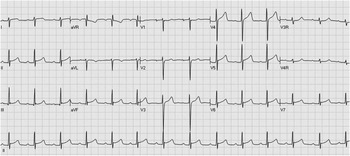
A 17-year-old white male presented to the emergency department with acute onset of pleuritic chest pain and facial numbness. The chest pain was exacerbated by lying flat and was alleviated by leaning forward. Past medical history was significant for a recent diagnosis of Crohn’s disease, approximately 5 weeks prior, and he was started on Pentasa and budesonide 4 weeks before presentation. His physical examination was unremarkable. The patient had normal vital signs, precordial activity, and heart sounds, without any murmurs, rubs, or gallops auscultated. The initial emergency department evaluation included an electrocardiogram, which showed ST segment elevations (Fig 1), and an elevated troponin-I level of 1 ng/ml (normal: 0–0.7 ng/ml), and elevated CK-MB of 5.3 ng/ml (normal: 0–5 ng/ml). A complete blood count revealed a normal white blood cell count. A transthoracic echocardiogram was performed that showed mildly decreased left ventricular systolic function (ejection fraction 45%) and mild global left ventricular hypokinesia. Thought not to be contributing to his clinical presentation, the patient was continued on his home medication regimen, which included twice daily oral Pentasa, and daily budesonide. The patient was also given morphine and started on a non-steroidal anti-inflammatory drug and admitted to the outside hospital for observation and supportive care. Approximately 5 hours after the initial evaluation, he continued to complain of mid-sternal chest pain. At that time, his troponin-I rose to 3.33 ng/ml, and CK-MB increased to 8.9 ng/ml. The patient was subsequently transferred to our hospital for further management of pericarditis.
Figure 1

At 20 hours after presentation, his troponin-I level increased to 6.3 ng/ml, but then trended downwards on repeat evaluation 4 hours later. A repeat electrocardiogram was performed, showing ST segment and T-wave abnormalities. An erythrocyte sedimentation rate was checked to evaluate for systemic inflammation as a possible aetiology of his cardiovascular symptoms, but this was found to be normal at 16 mm/hour. At 48 hours after presentation, after receiving his nightly dose of Pentasa, the patient began to have isolated premature ventricular contractions and ventricular couplets, and subsequently had an 8 beat run of non-sustained ventricular tachycardia. The patient remained haemodynamically stable during the arrhythmia. His troponin level had increased to 6.02 ng/ml from 3.2 ng/ml 12 hours prior. At this point, the Pentasa was discontinued because of the likelihood it was contributing to his symptoms. Over the following 24 hours, troponin-I levels decreased steadily. Cardiac magnetic resonance imaging was performed on hospital day 3 that showed normal left ventricular size, mass, left ventricular systolic function (ejection fraction 58%), and no areas of abnormal perfusion or delayed myocardial enhancement. He was discharged on hospital day 3 after normalisation of troponin-I levels and complete resolution of his chest pain.
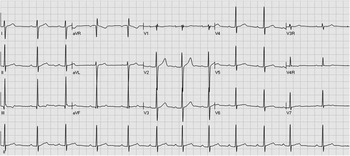
At outpatient follow-up 10 days after discharge, the patient reported no interim episodes of chest pain, and an echocardiogram revealed normal left ventricular systolic and diastolic function. An electrocardiogram showed non-specific T-wave changes that were improved from his prior electrocardiogram, suggestive of a resolving myopericarditis. A 24-hour Holter monitor was placed on his initial follow-up, which showed no significant ventricular arrhythmias or events. The patient had another outpatient evaluation 2 months after his discharge. At that time, his electrocardiogram showed normal sinus rhythm, with the previously noted ST and T-wave changes no longer present (Fig 2). An echocardiogram revealed normal left ventricular size and systolic function.
Figure 2

Discussion
Pericarditis and myocarditis have been recognised as very rare side effects in adult patients taking mesalamine-containing medications.Reference Schroeder 2 We present a case of mesalamine-induced myopericarditis in an adolescent patient with recent diagnosis of Crohn’s disease. This appears to be one of only a very few reported cases of mesalamine-induced myocarditis in the paediatric population. Although there are instances when myopericarditis spontaneously resolves, as might have been the case here, the fact that the patient’s symptoms and laboratory values worsened after administration of mesalamine, and quickly improved after stopping the medication, support the conclusion that mesalamine was the causative agent.
The pathophysiology of mesalamine-induced myocarditis is not completely understood. Previous reports of this drug effect have identified it as a possible toxicity or immune reaction. Humorally mediated hypersensitivity has been suggested as a possible mechanism, in which mesalamine antibodies cross-reacting with cardiac tissue result in inflammation.Reference Waite and Malinowski 6 Treatment includes prompt cessation of the causative agent, supportive care, and close monitoring for complete resolution of cardiovascular symptoms. It is also important to monitor for worsening gastrointestinal manifestations associated with the underlying inflammatory bowel disease, once the medication is stopped.
With these cardiovascular complications reported so rarely in the paediatric population, medical practitioners caring for young patients receiving mesalamine therapy are likely to be unaware of these life-threatening side effects. Knowledge of this entity is extremely important, owing to the increasing incidence of inflammatory bowel disease in children.Reference Rabizadeh and Dubinsky 7 Further complicating the matter, cardiovascular events, specifically ischaemic arterial events, are increased in patients with inflammatory bowel disease.Reference Ha, Magowan and Accortt 8 In patients with inflammatory bowel disease presenting with cardiac symptoms such as chest pain, the initial approach is often to rule out and treat extra-intestinal manifestations of the disease. Obtaining a thorough patient history, including recent medication changes, is vital in the acute management of any patient with inflammatory bowel disease presenting with chest pain, and this case illustrates the importance of establishing if cardiovascular complaints occur because of the underlying disease process, or as a serious adverse reaction to the treatment regimen. A multi-modality diagnostic approach is often warranted, as demonstrated in this case.
Acknowledgement
None.
Financial Support
This research received no specific grant from any funding agency, commercial, or not-for-profit sectors.
Conflicts of Interest
None.