Extensive research has established that regular participation in physical activity is an essential component of healthy aging (Public Health Agency of Canada, 2003; International Council on Active Aging, 2005; Butler-Jones, Reference Butler-Jones2010). Although rates of physical activity have risen modestly over the past few decades, the majority of middle-aged and older adults do not meet the recommended requirement of a minimum of 30 minutes a day of moderate intensity activity on most days of the week, and a significant proportion are sedentary (Wister & McPherson, Reference Wister and McPherson2014). The ability to remain active becomes more challenging with age, but does not lessen in its importance for maintaining good health during the aging process (American Geriatrics Society Foundation for Health in Aging, 2005). Furthermore, as the baby boomers continue to transition into their upper ages, the need for a more diverse set of activity options will be needed to align with the heterogeneity of that generation and the fact that they are more inclined to explore a wider array of modalities (Wister, Reference Wister2005; Canadian Fitness and Lifestyle Research Institute, 2008). While physical activity pertains to many forms of movement that enhance the health and well-being of individuals, exercise relates to specific routines that are planned and structured, aimed at improving or maintaining physical fitness (Wister, Reference Wister2005). This article focuses on yoga as one form of exercise that is being adopted by increasing numbers of adults.
Yoga is an ancient discipline that has been associated with cultural, religious, and physical activity for more than 2000 years (Rankin-Box, Reference Rankin-Box2015). Yoga originates from the Sanskrit term “yuj”, which means “to join” or “that which joins”. Yoga aims to “unite” or “bring” the physical, emotional, mental, and spiritual dimensions into balance. Today, modern yoga includes physical postures, meditation, breathing techniques, relaxation, and spiritual elements that enhance mental and physical health and mind-body connections (Iyengar, Reference Iyengar2001; Penman, Cohen, Stevens, & Jackson, Reference Penman, Cohen, Stevens and Jackson2008). Furthermore, yoga is a multifaceted and multidimensional form of exercise that also addresses many health concerns, such as posture, balance, muscle strength, coordination, bone density, flexibility, cardiovascular health, and psychosocial issues such as isolation, depression, and loneliness (Chen, Tseng, Ting, & Huang, Reference Chen, Tseng, Ting and Huang2007; Chen et al., Reference Chen, Chen, Hong, Chao, Lin and Li2008; Posadzki, Cramer, Kuzdzal, Lee, & Ernst, Reference Posadzki, Cramer, Kuzdzal, Lee and Ernst2014; Cho, Moon & Kim, Reference Cho, Moon and Kim2015). It is because of these health benefits that the past few years have seen a significant growth in research addressing the impact of yoga on health and well-being (Tekur, Nagarathna, Chametcha, Hankey, & Nagendra, 2012; Rankin-Box, Reference Rankin-Box2015).
Although there are a number of different styles of yoga practice with different levels of intensity and duration (e.g., Hatha, Ashtanga, Yin, Chair, Bikram), available clinical evidence suggests that many styles are beneficial for treating a variety of chronic conditions (Penman et al., Reference Penman, Cohen, Stevens and Jackson2008; Posadzki et al., Reference Posadzki, Cramer, Kuzdzal, Lee and Ernst2014) and enhancing multiple dimensions of health and quality of life (Oken, Zajdel, & Kishiyama, Reference Oken, Zajdel and Kishiyama2006; Tatum, Igel, & Bradley, Reference Tatum, Igel and Bradley2009; Ferrand, Martinent, & Bonnefoy, Reference Ferrand, Martinent and Bonnefoy2014). The fact that yoga is easily adapted to different settings, tailored to specific ages and abilities, and requires little or no equipment makes it an intriguing exercise option for further study (Kolasinski et al., Reference Kolasinski, Garfinkel, Tsai, Matz, Van Dyke and Schumacher2005; Waller, Reference Waller2006).
Most of the literature on yoga has addressed its health benefits to general populations based on quasi-experimental or randomized control trials (RCTs) (for reviews, see Buffart et al., Reference Buffart, Uffelen, Riphagen, Brug, Mechelen and Brown2012; Bussing, Michalsen, Khalsa, Telles, & Sherman, Reference Bussing, Michalsen, Khalsa, Telles and Sherman2012). This has left a void of social gerontological and community-based yoga research that addresses broader questions about yoga as an emerging health behaviour, especially among older adults and despite its increasing popularity (Birdee et al., Reference Birdee, Legedza, Saper, Bertisch, Eisenberg and Phillips2008; Chaoul & Cohen, Reference Chaoul and Cohen2010; Krucoff, Carson, Peterson, Shipp, & Krucoff, Reference Krucoff, Carson, Peterson, Shipp and Krucoff2010). Given the significant gaps in research pertaining to how, why, and when individuals of different ages engage in yoga as an alternative form of exercise, this article provides an exploratory, comparative study of middle-aged and older adults. Several questions guide this research: (1) What are the pathways by which middle-aged and older adults begin yoga? (2) Are there differences in motivations between the age groups and by gender? (3) What are the perceived barriers, unique to each group, to practicing yoga? and (4) Are there age and gender differences in the perceived health benefits of yoga? This research will provide novel groundwork into the behavioural dynamics and social contexts of yoga on an increasingly diverse aging population.
A Health Belief–Life Course Model
This study is framed by a synthesis of the health belief model (HBM) and life course theory (LCT). Rosenstock’s (Reference Rosenstock1974) HBM contended that individuals make health behaviour decisions based on perceived susceptibility, severity of potential illness, benefits of taking action, barriers to taking action, and cues to action. The HBM has been applied to exercise among older adults (Chou & Wister, Reference Chou and Wister2005), as well as to a variety of other health behaviours. Perceived susceptibility describes beliefs about the likelihood of acquiring a disease or reaching a harmful state. With regard to yoga, this might manifest as beliefs about one’s chance of developing sarcopenia due to inactivity, for instance. The more susceptible an individual feels, the more likely he or she will take preventative health action. Perceived severity, on the other hand, is one’s belief about the extent of negative consequences that could result from a harmful state due to a particular behaviour.
Perceived benefits refers to one’s belief about the advantages of a particular method (such as yoga) to reduce health risk. An individual may believe that yoga is more effective at improving flexibility than weight training, for example. Conversely, perceived barriers are beliefs concerning actual or imagined costs connected to following a new behaviour. Barriers to physical activity often mentioned by older adults include lack of age-appropriate classes (Wilcox, Oberrecht, Bopp, Kammermann, & McElmurray, Reference Wilcox, Oberrecht, Bopp, Kammermann and McElmurray2005), health limitations, inclement weather, and fear of falling (Penman et al., Reference Penman, Cohen, Stevens and Jackson2008). The final construct in the HBM is cues to action, described as precipitating forces that increase a person’s need to take action. These cues may be external (e.g., social interactions, media messages) or internal (e.g., perceptions of a bodily state, such as obesity). Depending on the level of perceived severity or perceived susceptibility, there may be variability in the intensity of stimuli needed to register as a cue to action.
Given our focus on age-related yoga practice, we have merged these HBM axioms with life course theory. LCT has a number of principles, but for the purpose of this research, we incorporated (a) the salience of human biography and agency, (b) the timing/circumstances of life events and their relative social context, and (c) the idea of health trajectories, all of which are age related (Mitchell, Reference Mitchell and Ponzetti2003; O’Rand, Reference O’Rand, Binstock and George2006; Mitchell, Reference Mitchell2012). With this lens, O’Rand (Reference O’Rand, Binstock and George2006) contended that opportunities, barriers, and decisions that are made throughout life are influenced by individual characteristics (e.g., age/cohort, gender, health status), circumstances (e.g., cost, time availability), and structural conditions (policy and programs that facilitate healthy lifestyles). For example, it is well-known that in the West, yoga is currently practiced more by women than men, and that these women tend to be White and of relatively higher socio-economic status (Birdee et al., Reference Birdee, Legedza, Saper, Bertisch, Eisenberg and Phillips2008). It is therefore expected that the pathways, motivations, and barriers into yoga may be very different for persons of a certain age or point in their life course, as well as by their gender/sexual orientation.
Studies also suggest that the exercise and health-related decisions of middle-aged adults are influenced by forms of social media, communication styles, and information channels different from those by which older adults are influenced (e.g., Korda & Itani, Reference Korda and Itani2013). Similarly, perceptions of motivations, benefits, and barriers to yoga are assumed to be different for persons who are middle-aged versus older, and for those who begin exercise regimens at younger rather than older ages (e.g., see Sims-Gould, Miran-Khan, Haggis, & Liu-Ambrose Reference Sims-Gould, Miran-Khan, Haggis and Liu-Ambrose2012). Moreover, as with other exercise, younger individuals and women may seek out yoga for addressing weight issues and as a mind-body therapy, whereas older males may be more interested in preventing or treating an injury or chronic illness (International Council on Active Aging, 2005). Thus, combining the HBM and LCT elucidates important age-related, gendered, and contextual circumstances that may underlie differential yoga patterns and experiences.
Review of Literature
Given that research is in its infancy on the potential health benefits of yoga, the ways in which older adults find their way into this form of exercise, and the barriers to and facilitators in adherence, we found it necessary to blend literature from several different sources (Quitly, Saper, Goldstein, & Khalsa, Reference Quitly, Saper, Goldstein and Khalsa2013).
Pathways into Yoga
We define pathways into yoga as informational cues to action, social network influences, or a health problem that leads a person to initially investigate and seek out this form of self-care. Given that yoga has gained popularity in recent years (Birdee et al., Reference Birdee, Legedza, Saper, Bertisch, Eisenberg and Phillips2008), there are likely age-related effects and gendered dynamics. Middle-aged adults (defined as persons aged 40 to 54) have been exposed to yoga and other alternative therapies (e.g., meditation, massage, tai chi, etc.) longer than the current generation of older adults (55 and older). Also, yoga began as a form of alternative exercise that targeted mainly younger people, but has shifted to be more inclusive across age groups.
Drawing from the HBM to understand the ways in which individuals learn about yoga, it is apparent that the various forms of the media have been important cues to action, exposing the public to new forms of exercise and their health benefits. The Internet and social media as informational cues to action are targeted to a younger or middle-aged audience (Pagoto, Schneider, Oleski, Smith, & Bauman, Reference Pagoto, Schneider, Oleski, Smith and Bauman2014), whereas older adults may be more exposed to yoga through print media such as community, local, and national newspapers, as well as TV. Social networks also are influential in affecting learning and adoption of new forms of exercise (Peterson et al., Reference Peterson, Lowe, Peterson, Nothwehr, Janz and Lobas2008). Whereas spouses influence middle-aged and older persons equally, older adults tend to be more influenced by neighbours and younger adults are more influenced by peer groups. In addition, the presence of health problems is associated with complementary and alternative forms of self-care among older persons but would likely be less relevant for middle-aged persons, given their lower prevalence of illnesses (Votova & Wister, Reference Votova and Wister2007; Manson et al., Reference Manson, Ritvo, Ardern, Weir, Baker and Jamnik2013). Given these patterns, the pathways into yoga are likely different for those starting yoga at younger ages compared to older ages.
Motivations/Reasons for Yoga
Similar to other forms of exercise, the maintenance of a yoga routine requires motivational impetus or a reason to practice (Culos-Reed, Stephenson, Doyle-Baker, & Dickinson, Reference Culos-Reed, Stephenson, Doyle-Baker and Dickinson2008). According to the HBM, actions to engage in yoga require weighing the benefits of exercise against personal susceptibility to illness if one does not engage in positive health behaviour. An examination of reasons to pursue yoga can provide insight into these behavioural assessments and intentions, although researchers recognize that initial pathways and motivations for longer-term maintenance of yoga may not be mutually exclusive. Individuals pursuing yoga frequently report a number of motivations or reasons, such as to increase muscle strength, balance, and flexibility; lose weight; prevent or reduce symptoms of chronic illness; and to manage stress (Fishman, Reference Fishman2009; Schmidt, et al., Reference Schmidt, Puymbroeck and Koceja2010). Similar to other forms of exercise, middle-aged adults would likely engage in yoga for body image reasons – for example, to improve muscle strength and to lose weight – whereas older adults would more likely do so to prevent illness or to reduce symptoms such as pain or reduced function (Tiggerman, Reference Tiggerman2009).
Perceived Barriers to Yoga
According to the HBM, the perception of barriers associated with behavioural change such as exercise is a centre-piece of the decision-making process. Numerous barriers to exercise over the life course have been identified in the literature, including social anxiety/isolation, restricted mobility/disability and/or health conditions, transportation, cost, availability, time, energy, and social support (International Council on Active Aging, 2005; Manson et al., Reference Manson, Ritvo, Ardern, Weir, Baker and Jamnik2013; Wister & McPherson, Reference Wister and McPherson2014). From a life course perspective, although many of these barriers affect middle-aged more than older adults, it is likely that cost and access barriers would be more limiting to middle-aged yoga participants, whereas health-related barriers would be more problematic among older ones. Perceived barriers are relevant not only to understand adoption, but also the timing of starting yoga among those choosing this form of exercise, as well as maintenance of the activity.
Health Benefits of Yoga
A large and growing literature demonstrates the health benefits of yoga (Bussing et al., Reference Bussing, Michalsen, Khalsa, Telles and Sherman2012; Buffart et al., Reference Buffart, Uffelen, Riphagen, Brug, Mechelen and Brown2012; Cote & Daneault, Reference Cote and Daneault2012; Ward, Stebbings, Cherkin, & Baxter, Reference Ward, Stebbings, Cherkin and Baxter2013). For instance, in a meta-analysis, Ward et al. (Reference Ward, Stebbings, Cherkin and Baxter2013) revealed a moderate effect size for yoga for functional health outcomes and for pain outcomes related to a number of chronic conditions. Yoga also has been shown to have positive psychosocial benefits, possibly through increasing brain gamma-aminobutyric levels that reduce anxiety, lowering blood pressure and heart rate, and improving affect and mood (Chaoul & Cohen, Reference Chaoul and Cohen2010; Streeter et al., Reference Streeter, Whitfield, Owen, Rein, Karri and Yakhind2010).
Furthermore, Ross and Thomas (Reference Ross and Thomas2010) conducted a review of studies that compared the effects of yoga and more traditional forms of exercise on a variety of health outcomes. Of the 12 comparison intervention studies, nine focused on adult and three on senior populations. Overall, the studies indicate that, in both healthy and diseased populations, yoga may be as effective as traditional forms of exercise at improving a variety of health-related outcomes. For example, in a six-month RCT, Oken et al. (Reference Oken, Zajdel and Kishiyama2006) discovered that a yoga group performed significantly better than the traditional exercise group on several outcomes including: levels of fatigue, quality of life, pain, and social functioning. Focusing specifically on older adults, Roland, Jakobi, and Jones (Reference Roland, Jakobi and Jones2011) reviewed a small number of studies and found that yoga resulted in moderate to strong improvements for gait, balance, upper/lower body flexibility, lower body strength, and weight loss.
In addition, Vogler, O’Hara, Gregg, and Burnell (Reference Vogler, O’Hara, Gregg and Burnell2011) demonstrated that an eight-week Iyengar yoga program among inactive people aged 55 and older improved muscle strength, active range of motion, physical well-being, and aspects of mental well-being compared to the controls. However, few studies exist in which comparisons of health benefits are made (Creswell et al., Reference Creswell, Irwin, Burklund, Lieberman, Arevalo, Ma and Breen2012; Schmidt et al., Reference Schmidt, Puymbroeck and Koceja2010). Although we did not employ an evaluation design in the present study, we can examine changes in perceived health benefits of yoga over time.
Overall, the growing evidence of the potential positive effects of yoga combined with its increasing popularity among older adults and aging baby boomers indicates that there is a need for health professionals to understand how and why older adults engage in yoga (Birdee et al., Reference Birdee, Legedza, Saper, Bertisch, Eisenberg and Phillips2008; Krucoff et al., Reference Krucoff, Carson, Peterson, Shipp and Krucoff2010; Roland et al., Reference Roland, Jakobi and Jones2011). We know very little about this field, however, because few studies have included enough older adults for individual study, and few community-based studies (versus clinical studies) have been conducted. Thus, the present study is unique in that it compares the experiences of middle-aged and older persons in terms of pathways into yoga, motivations for practicing yoga, perceived barriers, and perceived health benefits.
Methods
Design and Data Collection
The mixed methodology we used in this study included the use of quantitative and open-ended qualitative data collected from a structured survey questionnaire targeting older yoga participants aged 40 and older. This was followed by qualitative data that we obtained through face-to-face interviews with a quota sample selected from the survey. A large convenience sample of 452 yoga participants, aged 40 to 82, were recruited over a three-month period from July to September 2012 using flyers distributed to community centres and yoga studios around the Vancouver Regional District, as well as through Facebook networks. Computer logs indicated that 79 per cent of participants (83.9% of middle-aged participants and 71.3% of older participants) accessed the study website from Facebook, either by clicking on the study advertisement or following a link to the study posted on a friend’s Facebook wall. The remaining participants (21%) were recruited through information posters on community centre and yoga studio bulletin boards or by word of mouth. Participants were informed that their responses would be collected and encrypted to ensure privacy and security of information, and we provided them the option to end participation at any time. Although the sample is not purely random, the homogeneity of this population mitigates sampling biases. For this research study, the participants understood that the practice of yoga included asanas (postures), pranayama (breathing exercises), meditation, some chanting, and savasana (conscious relaxation).
Sample Characteristics
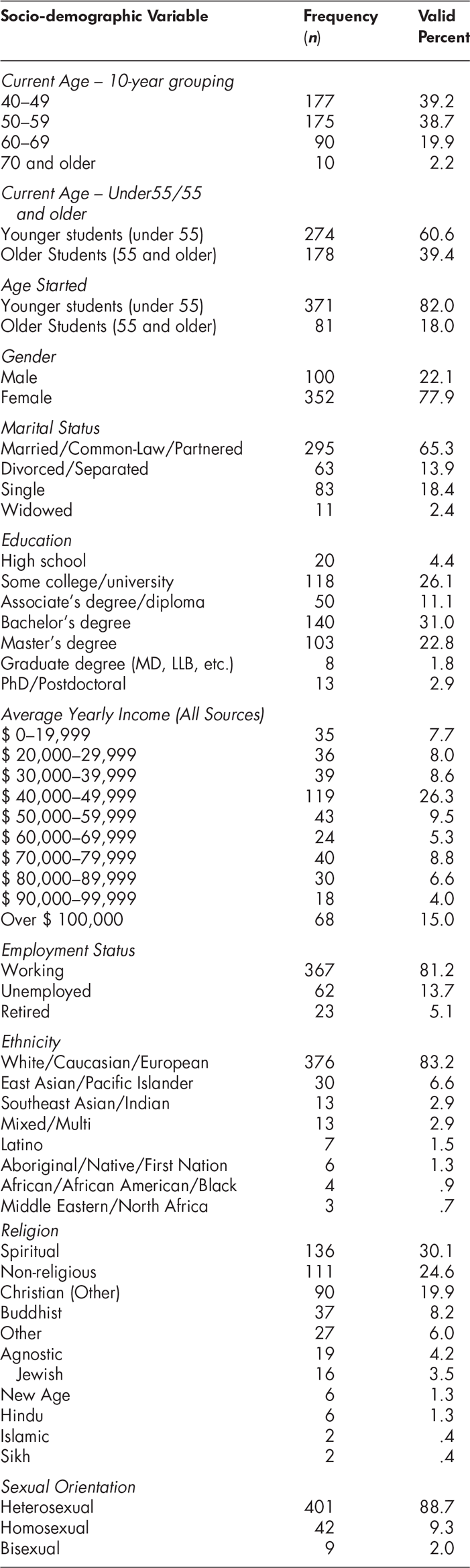
After cleaning, data were imported into IBM’s Statistical Package for Social Sciences (SPSS), Version 20. The sample (n = 452), ranging from 40 to 82 years of age, of whom only 10 (2.2%) were aged 70 or older (M = 52.7, SD = 8.6), was predominantly female (77.9%), married/partnered (65.3%), college- or university-educated (95.7%), middle class (26.3%), employed (81.2%), White/Caucasian/European (83.2%), spiritual (30.1%), and heterosexual (88.7%) (see Table 1). Participants tended to practice yoga in a studio (63.5%) for 60 minutes (33.4%), 2 times a week (21.9%) to improve flexibility (88.4%) and reduce stress (83.7%). The sample was also predominately healthy, with 73.9 per cent reporting no chronic health conditions, 32 per cent reporting good health, and 41.3 per cent reporting very good health.
Socio-demographic characteristics for total sample (n = 452)

Measurement
Age Measures
Given that the purpose of this study was to examine age differences and life course patterns in the practice of yoga, we treated age two ways: (1) current age was used to make comparisons across middle-aged and older yoga participants; and (2) age started a yoga practice was treated as an additional independent variable in order to explore life course timing of health beliefs and entrance into yoga. In order to test for age effects, it was decided to split both age variables into two groups (under 40–54, and 55 and older) representing middle-aged and older yoga participants, with the lower age coded as the reference category for the logistic regression analyses. The frequencies, percentages, and descriptive statistics for current age and age started yoga are presented in Table 1. Since yoga has only recently begun to be popular among persons older than age 65 (a more common age threshold used to study age-related patterns), and that it is a more common exercise modality among middle-aged persons, we selected age 55 as the arbitrary cut-off point for the age analyses.
Socio-demographic Co-variates
This study included a number of socio-demographic co-variates including gender, ethnicity, marital status, working status, and income. Measurement and frequency distributions for the total sample are shown in Table 1. For the logistic regression analyses, we coded gender as female, male (reference). In addition, we recoded several of the categorical co-variates due to small frequencies in some categories: Ethnicity was recoded into Not White (76, 16.8%) and White (376, 83.2%); Marital status into Not partnered (157, 34.7%) and Partnered (295, 65.3%); and Working status into Not working/retired (95/21.0%) and Working (357, 79%).
Yoga Pathways
Three sets of questions tapped into pathways. First, we asked participants: “Did someone suggest that you try yoga?” Set responses included the following: health care provider, family member, friend, neighbour, no one, and other (filled in by participant). Participants were informed that they could check all that apply; therefore, we created dichotomous variables for each response. Categories with fewer than 20 cases were regrouped into “other”. Second, participants were asked, “Did any external factors influence your decision to try yoga?” Set responses included the following: article in newspaper/magazine, reading about yoga (books, journals), public poster, advertisement on radio, advertisement on TV, Internet, community events (wellness fair, health workshop, conference), and other. Again, participants were informed that they could choose more than one response. Third, participants were asked, “Did any health-related events help you make the decision to try yoga (i.e., medical diagnosis, losing your balance, having difficulty getting up from a chair, pain, etc.)?” We coded this variable into yes/no for the analysis.
Yoga Motivations/Reasons
We asked participants, “What are the reasons for practicing yoga?” They were provided with set lists covering reasons for practicing yoga and asked to select all that applied. These included the following: increase muscle strength, improve balance, improve flexibility, reduce stress, manage menopause symptoms, explore spirituality, social interaction, increase endurance, increase range of motion, improve attention and awareness, improve breathing, gain confidence, embrace yoga philosophy, lose weight, manage chronic illness, prevent osteoporosis, meditation, and other (filled in by participant). Because participants could select all that apply, we coded variables into dichotomies.
Perceived Barriers to Practicing Yoga
Participants were asked, “If you perceive any barriers to be standing in the way of practicing more yoga, what are they?” Set responses included the following: social anxiety, health issues, mobility/disability, transportation, financial, availability of classes, not enough time because of work, caregiving obligations, insufficient support from family or friends, and other (filled in by participant). Participants could again select all that apply, and we coded those into dichotomous variables.
Perceived Change in Self-rated Health Status
Participants were also asked to self-rate their health status before starting yoga and currently. The response categories included poor, fair, good, very good, and excellent. We constructed a variable in which we subtracted current from starting perceived health to estimate positive change in perceived health over time. Given that most participants perceived some positive change in health, we dichotomized this variable into negative or no change (0) and positive change (1) in which any improvement was coded as positive change in self-rated health status since practicing yoga.
Quantitative Analytic Approach
We estimated a series of logistic regression models based on the just-described dependent variables. Because the dependent variables allowed for multiple answers, we generated a series of dichotomous dependent variables. Separate models were also estimated for current age and age started yoga (divided into middle-aged and older adults: under 55, and 55 and older). The co-variates gender, marital status, education, average income from all sources, and employment status were included in each model. Given the large number of dependent variables, only odds ratios (OR) and confidence intervals (CI) are reported in the logistic regression tables. Models in which there were no age differences and/or ones in which there was not a statistically significant model based on the model χ2 are not presented in the tables (full analyses are available from authors upon request). Because the independent variables were dichotomized, comparisons can be made of odds ratios across the models.
Qualitative Study Design and Sample
Of the 452 participants in the quantitative survey, 268 indicated interest in the supplementary qualitative interview process. Of these, we selected and emailed 10 middle-aged and 10 older-aged yoga participants, with equal numbers of males and females, to confirm their willingness to be interviewed about their yoga practice, all of whom agreed. We included equal numbers of age and gender groups to allow for examination of these contextual dimensions. No additional interviewees were solicited, since analytic saturation was reached based on the thematic analysis. Semi-structured, in-depth interviews were conducted at coffee shops that the participants selected between March and July of 2013. These interviews were approximately 45 minutes in duration and were directed by a semi-structured interview guide.
All participants verbally consented to the recording of their interview, which was subsequently transcribed verbatim. We used pseudonyms in the results to ensure confidentiality. Thematic analysis was conducted beginning with line-by-line coding. These codes were selected and based on topics and concepts found in the data. We conducted open coding by keeping track of possible emergent themes and patterns. In addition, journaling was conducted immediately after each interview so that we could record overall impressions and observations that might otherwise have been lost in transcriptions. The primary researcher also engaged in reflexivity during the journaling process on the premise that “knowledge cannot be separated from the knower” (Steedman, Reference Steedman and Steier1991).
Quantitative Results
Logistic Regressions: Yoga Pathways
Three pathway associations with the variable age started yoga resulted in relatively weak (small odds ratios) but statistically significant associations – neighbour suggested yoga, influenced by reading, and influenced by health (shown in Table 2). Note that odds ratios over unity (1.0) indicate a positive association and increased likelihood, whereas the ORs under unity represent decreasing probabilities. First, the likelihood of having a neighbour suggesting yoga (compared to not suggesting) was increased by a factor of 1.12 (CI = 1.03–1.21) for older yoga participants compared to middle-aged ones, controlling for all co-variates. Second, the probability of being introduced to yoga through reading (compared to not) was decreased by a factor of .98 (CI = .96–1.0) for older yoga participants compared to middle-aged ones. Third, the likelihood of being influenced (compared to not) by health-related events, such as a medical diagnosis, was increased by a factor of 1.02 (CI = 1.0–1.04) for older yoga participants compared to middle-aged ones.
Logistic regression odds ratios of pathways to starting yoga by age started yoga and socio-demographic variables
Confidence Intervals in parentheses
*p < .05, **p < .01, ***p < .001
None of the logistic regressions for pathways and current age, however, resulted in statistically significant associations, and none of the co-variates were statistically significant for any of the models.
Logistic Regressions: Yoga Reasons/Motivations
Three reasons/motivations for yoga were associated with current age and two associations with age started yoga. First, the likelihood of identifying increasing muscle strength (compared to not) as a reason for beginning yoga (Tables 3 and 4) was substantially decreased by a factor (odds ratio) of .52 (CI = .33–.82) or about by half, for older yoga participants compared to middle-aged ones, net of the co-variates. Similarly, the probability of engaging in yoga to lose weight (compared to not) was decreased by a comparable factor of .53 (CI = .32–.88) for older yoga participants compared to middle-aged ones. These two associations can be presented as middle-aged adults being twice as likely to report these motivations as older adults are. Finally, the likelihood of engaging in yoga to prevent osteoporosis (compared to not) was increased by a factor of 1.65 (CI = 1.03–2.66) for older yoga participants compared to middle-aged ones. All of these associations were found to be strong as indicated by the size of the odds ratios. We also uncovered two associations for co-variates. Females (compared to males) were considerably more likely (OR = 2.19, CI = 1.34–3.6) to start yoga to increase muscle strength, as well as to prevent osteoporosis (OR = 2.81, CI = 1.42–5.55).
Logistic regression odds ratios of reasons for practicing yoga by current age and socio-demographic variables
Confidence Intervals in parentheses
*p < .05, **p < .01, ***p < .001
Logistic regression odds ratios of reasons for practicing yoga by age started yoga and socio-demographic variables
Confidence Intervals in parentheses
*p < .05, **p < .01, ***p < .001
In considering age when starting yoga, we found that the likelihood of pursuing yoga to explore spirituality (compared to not) was decreased by a factor (odds ratio) of .97 (CI = .95–.99) for older (55 and older) yoga participants compared to those starting before age 55. Also, the probability seeking yoga in order to meditate was also decreased by a factor of .97 (CI = .96–.99) for older yoga participants compared to younger ones. Both of these associations were weak based on the size of the odds ratios, and none of the co-variates were associated with the dependent variables.
Logistic Regressions: Barriers to Yoga
Social anxiety/embarrassment was the only barrier that exhibited an association with current age (Table 5). The likelihood of viewing social anxiety or embarrassment as a barrier to yoga (compared to not) was decreased by a factor (odds ratio) of .32 (CI = .15–.70) for older yoga participants compared to middle-aged ones, indicating that this barrier strongly inhibits middle-aged adults in comparison to older adults. In addition, the probability of perceiving social anxiety/embarrassment as a barrier was decreased by more than half (OR = .45, CI = .24–.85) for adults who were partnered compared to not partnered (i.e., single persons were more influenced by this barrier).
Logistic regression odds ratios of barriers to practicing yoga by current age and socio-demographic variables

Confidence Intervals in parentheses
*p < .05, **p < .01, ***p < .001
There was also only one barrier associated with age started yoga (Table 6). The likelihood of viewing class availability as a barrier diminished slightly by a factor of .97 (CI = .95–1.0) for those starting yoga older (55 and older) than younger, controlling for all co-variates. Class availability was also found to be an influential barrier (OR = 2.39, CI = 1.03–5.55) for females (compared to males); and at a higher rate for those with higher incomes than lower ones (OR = 2.29, CI = 1.27–4.14). Thus, class availability surfaced as a barrier for those starting yoga at ages younger than 55, for females, and for those reporting higher incomes.
Logistic regression odds ratios of barriers to practicing yoga by age started yoga and socio-demographic variables

Confidence Intervals in parentheses
*p < .05, **p < .01, ***p < .001
Logistic Regressions: Perceived Health Benefits
Only one dependent variable was examined as a measure of the change in perceived health benefit of yoga, at the time of the survey compared to before they started yoga. The likelihood of perceiving a positive health benefit in yoga exercise was decreased by a factor (odds ratio) of .60 (CI = .40–.89) for older yoga participants compared to middle-aged ones, suggesting that older adults observe less health benefit than middle-aged adults, and vice versa (Table 7). No association was supported when repeating this analysis using age started yoga (Table 8).
Logistic regression odds ratios of change in health status by current age and socio-demographic variables

Confidence Intervals in parentheses
*p < .05, **p < .01, ***p < .001
Logistic regression odds ratios of change in health status by age started yoga and socio-demographic variables

Confidence Intervals in parentheses
*p < .05, **p < .01, ***p < .001
Qualitative Results
In line with the research questions, we divided the qualitative interview data into four main sections for thematic analysis: (1) initial pathways into yoga, (2) current yoga practice experiences (including motivations/reasons), (3) barriers to yoga practice, and (4) additional comments or personal stories. We also analyzed responses to the open-ended, unstructured survey questionnaire items.
Research Question 1: Pathways into Yoga
The three main themes we identified were connected to initial pathways into yoga practice and were similar between the two age groups: (a) social contagion (i.e., the influence of social networks); (b) intergenerational influence; and (c) the media (e.g., through reading books, posters). In the following discussion, verbatim quotes are used to illustrate these themes.
Social Contagion: ‘A Little Help from My Family/Friends’
It was noted in about half of the qualitative interviews that individuals found their path into yoga through a family member or friend. Bob, a 67-year-old male yoga student, explained that he “blew out” his ACL (anterior cruciate ligament) running, and his friend suggested yoga as an alternative exercise. This student went on to explain how he adapted yoga to meet his needs and that his range of motion has increased and he feels more flexible. Phillip (aged 53) stated, “When I was in my 20s a friend introduced me into Tai Chi, which opened me up to trying yoga.” Another interviewee, Don, 56 years old, explained that “[my] personal trainer suggested I try yoga for help with my shoulder injury.”
Intergeneration Influence: ‘Teach Your Children’
Interestingly, in a majority of the interviews in which a family member shaped a decision to try yoga, it was a member of a different generation. Diana (aged 51) stated:
I’m from a small town in Ontario and my mom was a front runner in fitness. My mom got a number of different books from a Canadian yoga instructor. I couldn’t get enough of these books, when I was 12. I loved them and I would practice with these books.
Michael (aged 43) explained:
When I was 4 or 5 my grandfather and I would meditate in the early hours of the morning. Then we would do exercises. I did not know these exercises were yoga. He did not tell me the names of the poses. Then at 14, I watched a TV program on yoga with my sisters. They went to a class and showed me how to do more poses.
For Phillip (aged 53), the pathways routed from him to his mother, “A year and a half ago I had an aunt die from MS. I’m thinking, what kind of exercise did she do in her 40s? I look at my mom who is a senior and encouraged her to do a senior yoga class.”
Media Cues and TV Gurus: ‘Sign, Sign, Everywhere a Sign’
Another common theme was the powerful influence of the media in its various forms. One older female yoga student described doing TV yoga in her 20s. Nitia (aged 50) explained, “My first yoga experience was with a woman named Zebra who taught yoga on television in the seventies … She was the first to entice me into yoga.” Susan (aged 57) said that “I saw a creative poster for yoga at university and decided to attend.” Adella (aged 66), similarly, said that “I saw a poster at my aerobics studio for a Hatha yoga class. I found the evening Hatha yoga classes very relaxing and yoga not so hard on my body. The more I went to yoga, the more I wanted to go!” Linda, a middle-aged participant (48 years old) explained how she saw an intriguing ad for Bikram yoga that caught her attention and got her thinking about trying something new. She practised Bikram yoga for a few months and then transitioned to Hatha yoga classes, stating that “I need a feeling of connection to something beyond.”
Research Question 2: Motivations/Reasons for Current Yoga Practice Experiences
The next interview question explored participants’ motivations connected to their current yoga practice. Questions and probes included, “How do you get motivated?” “How does this make you feel?” “Do you do it alone?” “Why do you try different types of yoga?” A wide variety of reasons and many interesting themes arose, capturing the important dimensions of seeking a sense of community, meaning in life, as well as sexual orientation and gender-specific motivations. The following excerpts from individual interviews illustrate these thematic findings.
Building Community: Feeling Connected
Participants conveyed that there are many bonuses to be had with yoga – community, social support, getting out of the house, reducing isolation, and having new experiences with each yoga class. Seniors, in particular, need a sense of community to address feelings of loneliness and isolation especially when role transitions and shrinking friendship networks occur. Adella (aged 66) stated that “I like going to the studio and being with other people, I found it gave me energy.” She went on to say, “I felt the connectedness of like-minded people, we were all on our mats together connected –it is a beautiful thing! I think yoga is about compassion and understanding each other … the oneness, the divine nature within ourselves”. Susan (aged 57) articulated it simply: “I see many of the same people, not so much friends outside of the group. You know, I recognize people and ask how they’re doing. It becomes a community gathering [being at the Rec Centre].” Several interviewees also identified yoga teachers as their “inspiration to join the yoga community.” The sense of community and belonging needs to be balanced with individual motivations.
Several interviewees emphasized that they purposefully go to yoga alone, without their respective spouses/partners. This behaviour supports other participants’ comments that yoga is an “individual practice” with a community feeling, or better said by one interviewee: “Yoga is an internal art; I am alone (practicing Mysore-style yoga) but in a room full of people.” Diana (aged 51) stated that “I think people are forgetting that this is an individual practice as well … I know being in the community is wonderful but you have to find time on your own mat. Your own mat is the practice.”
Yoga off the Mat: ‘You Can Take It with You’
This was another theme that surfaced during these interviews. One senior interviewee (Adella, aged 66) stated, “Once you have yoga in your life, even if you aren’t on your mat, you’re doing it! You become more accepting of what you can and cannot change.” Others commented on how they can bring yoga into their life; that they can live the yoga that begins on the mat (or chair). One participant put it this way: “I feel more balanced.” Phillip (aged 53) simply said: “If you have yoga, you can hopefully go with the flow with other parts of your life.”
LGBT Community: ‘I’m Okay, You’re Okay’
Three male interviewees emphasized the sense of community created by attending yoga classes in which “being gay” is accepted. Adrian (aged 69) explained how “Being queer in a hostile environment, my salvation was that I was bright enough to manage my own world … and I kept everyone away and I controlled everything around me.” He also said that “practicing this way allows and encourages introspection, self-learning, self-awareness – all the things you struggle with as you grow up.” Another gay man, Stephen (aged 44) explained:
A colleague of mine was going to a men’s yoga class. This was in Vancouver. He brought me to the class and I really liked it. I was working in a very stressful occupation –high-intensity job. And I was able to go to the class and feel as if my mind was completely cleared. I was zoned out a bit. It felt great … Very supportive atmosphere. Mostly gay men and all body types and sizes. Everybody was very accepting. I was quite overweight at the time; I lost 67 pounds. I felt uncomfortable with my size, but I didn’t feel as if anyone was judging me. The people who go there have a very positive image about their own bodies and sexualities.
Phillip (aged 53) was drawn to a gay yoga class and said:
There was another posting for a group which is a gay men’s group. They had yoga, by donation, Friday nights, 7 p.m. I needed to go back and this was a good excuse. It was the same instructor from the YMCA. I’ve been pretty regular over there on Fridays. It’s a social thing.
Gender-Specific Mind-Body Motivations
The thematic analysis also found that, in general, men were motivated to practice yoga for physical body health, whereas women were more likely to speak about meditation, relations, and other, feeling states. A 56-year-old male (Don) explained:
I separated my shoulder years ago – sports injury. It was operated on but never got back to what it used to be. [It] got worse as I got older; was seeing a chiropractor and was not happy with it. Then had a personal trainer who suggested yoga. Didn’t want to go because I thought it wasn’t a guy thing, but then decided to try it. First tried hot yoga at 6:30 in the morning;, didn’t think there would be many people there. Met a linebacker from Queen’s University who went to yoga and had to do it to get ready for Winnipeg Blue Bombers training camp. Told the guys from work about this: they said, “maybe yoga’s alright then”.
Rod (aged 53) commented:
I was 37 and I was doing a lot of weight lifting and in excellent aerobic shape. I had a rotator cuff injury and I kept going to the gym. I went to Banff for a retreat and I didn’t think I could walk up a hill. When I went back to Vancouver, I got rid of my futon and got a new bed and went to my first yoga class … and faithfully did yoga.
With respect to comments by some of the women, Margaret (aged 60) said it most succinctly: “I’m interested in mindfulness and meditation.” Susan (aged 57) observed:
I am an introvert, so yoga gives me permission to ‘go inside.’ This grounds me, brings me back to the day and the time and doing something for myself. I’m not dealing with any emotional problems now. It was 6 years ago. I needed to focus on myself rather than the person I was trying to control.
Susan explained how yoga combines her body, mind, and soul together, and because of this, she feels grounded. Indeed, many interviewees explained how yoga has helped them reduce their stress and anxieties and cope with demands of an urban life.
Research Question 3: Barriers — Current Yoga Practice
The next section of the interview focused on barriers experienced in the pursuit of yoga. We asked participants, “Can you tell me about the barriers you may have encountered?” “Are they more or less an issue now?” “How do you get past these barriers?” The interviewees expressed a variety of barriers that were organized into two themes: time constraints, and financial concerns.
Time Barriers: ‘No Time Left for You’
“Not enough time” was the most popular barrier. Interviewees spoke about time constraints to practicing yoga more often, which is consistent with the fact that 83.2 per cent were working. Family obligations and work constraints were the most common reasons regardless of age, and at times, the accessibility of classes posed schedule problems as found in the quantitative analyses. Rod (aged 53) said, “When I retire, I am going to do yoga every day, because I will have the time!” Stanley simply said, “I would do more yoga but I don’t have the time. The deal is to retire and join a gym/community centre and go 4 or 5 days a week. Do moderate exercise and then noon hour yoga.” And Susan (aged 57) elaborated about scheduling problems: “I would adjust my schedule to make it to classes. Do shift work, two nights a week. Can do morning or evening and they had classes at both of those times. Convenience was a big thing at the time.” However, a few of the interviewees also acknowledged that their laziness or lack of motivation/discipline was the root barrier for not making the time to practice.
Financial Constraints: ‘Money, It’s a Crime …’
Interviewees also spoke about cost impediments to yoga classes. Many participants felt that private yoga schools were too expensive. A few participants explained that they are offered yoga through work, or, to keep the cost down, they go to community centres or recreation centres for classes. Suzan (aged 57) explained that she gets a Fitness Pass (costing $117 per year) through her library work, and she chooses weekly yoga classes with this pass. Laura (aged 48) indicated that she experienced difficulty of supporting her daughter’s gymnastic interests and having enough money left over to pay for her yoga classes. Yet, others found deals, such as Don (aged 56): “I go 3–4 times a week to yoga. I work shift work so it’s just when I can fit it in. I have a monthly, unlimited membership for $112 per month.” Although this is inexpensive for a frequent practitioner per class, $1,300 per year is restrictive to some individuals for exercise programs.
In summary, the in-depth, semi-structured interviews allowed for detailed discussion about the thematic foci, as well as additional thoughts, feelings, and perspectives on their yoga experiences, thereby providing additional contextual insights.
Discussion
Yoga as a form of exercise has gained enormous popularity in North America in recent years, a pattern against which early phases of research have primarily addressed disease-based health benefits and clinical significance. The purpose of this exploratory multi-method study was to investigate the yoga experiences of middle-aged and older adults, focusing on potential differences and similarities in pathways into yoga, motivations for continued practice, perceived barriers, and self- reported health benefits. A synthesis of the health belief model and life course theory framed the research. Retrospective data on age started yoga as well as current age afforded an opportunity to examine associations embedded within earlier life course experiences, coupled with qualitative data that provided deeper contextual depth to the analysis.
On the basis of our convenience sample of 452 yoga participants aged 40 and older, we found that study participants were predominantly female, married/partnered, college- or university-educated, middle class or above, employed, White/Caucasian/European, and healthy. Most participants practiced a variety of styles of yoga, tended to do so in a studio, for 60 minutes, 2 times a week. The extent to which these characteristics reflect the population of middle-aged and older yoga participants needs to be corroborated with future research.
This study showed many similarities between the two age groups in terms of the developmental and experiential patterns of yoga, although there were some notable age-related associations. With regard to the life course pathways into yoga practice, it was not surprising that the only age-related associations found were for age started yoga (rather than current age). Individuals beginning yoga at age 55 or older were more likely to be influenced by acquaintances/neighbours or a health issue than those starting yoga at younger ages. Being older when entering into yoga appears to be influenced by the presence of social connections to neighbours, reflecting different levels of community connectedness that is more common among older persons. They are also more likely to be hearing about yoga as a form of self-care to treat a chronic illness. On the contrary, those starting yoga under age 55 (compared to older) were more affected by reading as a cue or pathway into yoga, which may in part reflect more traditional (i.e. reading) information cues, supporting the media’s impact on health promotion and behaviour change (Korda & Itani, Reference Korda and Itani2013).
The qualitative findings substantiated this finding, in which it was articulated that reading books about yoga and exposure to advertising posters acted as influential cues to starting yoga practice. Other pathways into yoga, such as friends, family, TV, and so on, were not distinguished by the age of the individual in the quantitative analysis but surfaced in the qualitative analysis as generic pathways into yoga. For instance, regardless of age, social contagion via one’s friendship and family network, as well as intergenerational influences (i.e., parents, children, grandparents, etc.), were found to play a role in the ways in which individuals discover yoga. Taken together, pathways into yoga appear to be multifaceted, with only circumscribed age-related patterns connected to either the time period when exposed or age-related health contexts.
Interesting motivational differences appeared, however, between the age groups. Notably, current older adults were more likely than were middle-aged adults to engage in yoga as a means for preventing osteoporosis, especially for women, aligning with other research on this topic (Kolasinski et al., Reference Kolasinski, Garfinkel, Tsai, Matz, Van Dyke and Schumacher2005; Fishman, Reference Fishman2009). This finding is consistent with the notion that older participants may be experiencing and being motivated by age-related chronic health issues more than middle-aged participants. It is also illustrated in the qualitative interviews whereby many participants practiced yoga as a form of self-care treatment for ailments or injuries, more frequently experienced among older adults. In contrast, as evidenced in the quantitative results, middle-aged persons appear motivated to practice yoga to increase muscle strength and for weight loss, reasons that reflect body image primacy. In addition, those who started yoga earlier in life were considerably more likely to be motivated by spiritual or meditative reasons than those starting later in life.There were also motivational similarities across the age groups.
In the quantitative section of this study, we asked respondents for their reasons for practising yoga. Social interaction was selected by a quarter of both middle-aged and older persons as a motivating reason to continue yoga practice. Key words and phrases such as “belonging”, “feeling of community”, “connectedness”, “community gathering”, “a kind of electricity that flows”, “a positive energy”, “a little bit of community”, were shared by many of the interviewees. Indeed, staying connected to one’s community has been shown to be an important investment at any age, and can be cumulative in its life course effect (O’Rand, Reference O’Rand, Binstock and George2006). In addition, the qualitative findings uncovered a gender dimension to mind-body motivations. Male interviewees appeared to focus more on physical health benefits of yoga exercise, whereas females were motivated more by the mind-body (i.e., meditative, spiritual) experience. Future research is needed to further explore these and other gender dimensions in motivations to engage in yoga over the life course.
With respect to perceived barriers, the quantitative results revealed that middle-aged adults were more influenced by social anxiety/embarrassment related to practicing yoga than older adults were. Preliminary analyses uncovered a statistically significant relationship between the location for yoga practice and the age groups of the participants. Middle-aged participants were more likely than older participants to practice in a yoga studio, which may account for some of this association. Also, starting yoga earlier in life was affected by availability of yoga classes, which may in part be due to the developmental phase of this alternative exercise modality as well as work role demands.
The qualitative analysis pointed to a number of additional barriers. Many men interviewees, especially older ones, articulated gendered health beliefs of the perceived masculinity versus femininity of yoga as a form of exercise. Younger men appeared to be less gender-conscious, although some of these interviewees were gay and likely less concerned with the extent to which yoga appeared “masculine”. The time, energy, and financial costs of yoga limited individuals of all ages, but appeared more of a concern to middle-aged than older yoga participants. Yoga classes typically range from one to two hours and thus require a significant time investment, especially if practiced regularly. Some interviewees described how it was necessary to utilize flexibility in their work schedules to fit in yoga classes, while others emphasized class availability as barriers. Costs can also be restrictive, although our sample comprised highly educated adults, many of whom would fall into the middle and upper socio-economic (SES) categories. A cost of $10 to $15 per class would be especially constraining for persons with more limited financial means.
A more positive perceived change in health status was revealed for middle-aged adults rather than older ones in the quantitative analyses. Whether this resulted from the frequency, intensity, or type of yoga is not certain. Yet, supplementary bivariate analyses (not shown in tables) showed that middle-aged adults were more likely than older adults to try more intensive Bikram or other hot yoga, Ashtanga vinyasa yoga, and Kundalini yoga; whereas older participants were more likely to practise less intense styles, such as Hatha, Gentle Chair, Iyengar, Kripalu, Yin, Laughter, or Yoga Therapy. This is consistent with our results showing that middle-aged adults tended to be motivated by weight loss concerns that may require more intense yoga styles, whereas older ones more likely practiced yoga to address chronic disease management, which in some cases may demand less intensity. Clearly, the reasons for yoga are multifaceted, since we also found that middle-aged adults also sought yoga for meditation and spirituality. Research is needed to elucidate whether these patterns are due to chronological age, period, or age cohort. Finally, exploring the frequency and length of practice did not uncover any statistically significant associations between the age groups.
Taken together, these findings suggest that there are unique yoga patterns and experiences when comparing middle-aged and older yoga participants. Some of these differences reflect age-related chronic illness prevalence and self-care actions and health beliefs linked to treatment benefits, such as maintaining functional status and slowing down age-related decline. Other differences are likely connected to the time period and age when starting yoga, especially with respect to life course pathways into this form of non-traditional exercise. This includes the acceptability, availability, and style of yoga as a form of exercise during a particular developmental period in time as well as the age of the participant when exposed to these contexts. On the other hand, there are many dimensions of yoga that appear to be generic processes that are not necessarily age-dependent, such as the desire to feel connected to a yoga community.
Program and Service Recommendations
Our findings have a number of implications for the design of health promotion programs targeting older populations. First, yoga programs interested in expanding their membership across different age groups need to consider the advertising messaging of benefits, including differences in the motivations of yoga observed for men and women of different cohorts. For instance, physical health benefits among men compared to the mind-body attraction among women; and the perceived chronic illness self-care benefits among older adults, even to maintain function in the face of age-related decline, are likely salient health promotion dimensions. These health beliefs and motivations are relevant whether programs seek to target particular populations or whether they are attempting to attract a heterogeneous population. Second, the social and community aspects of yoga may be particularly important for older adults who may become more socially isolated due to shrinking social networks. Yoga may be used to foster social capital and strengthen community engagement over the life course (Mitchell, Reference Mitchell and Ponzetti2003). Third, recognition of the time, energy, and cost constraints are important in attracting older participants (Sims-Gould et al., Reference Sims-Gould, Miran-Khan, Haggis and Liu-Ambrose2012). It is necessary for programs to address these constraints in order to tap into harder to reach populations, such as certain ethnocultural groups (e.g., due to language barriers) or socially isolated marginalized elders. Finally, the importance of yoga instructors who can attract and retain participants of all ages, and who can motivate participants to routinize yoga into their lifestyles, should also be recognized by program coordinators and yoga studios.
Limitations, Future Research, and Summary
This study has a number of limitations. First, selection bias associated with the sampling method may have affected the sample’s representativeness. Since data for this study were collected by means of an online questionnaire, advertised on Facebook and on posters with a link to a website, there was a bias towards individuals who have access to a computer. Indeed, the participants were generally healthy, White, female, relatively well-off, urban, and more well-educated than the general population. Although our sample characteristics resemble those of other studies (Quitly et al., Reference Quitly, Saper, Goldstein and Khalsa2013; Ross, Friedmann, Bevans, & Thomas, Reference Ross, Friedmann, Bevans and Thomas2012), a number of groups appear to be underrepresented such as those of lower socio-economic status, non-White ethnic/racial groups, and those living in less urban communities. Second, findings are limited to the age groups used in the analysis, and the comparisons in this study (split at age 55) were arbitrary. Third, the absence of a comparison group of persons not engaged in yoga limited the analysis and interpretations. Fourth, our sample did not afford an opportunity to examine different types of yoga. Ross et al. (Reference Ross, Friedmann, Bevans and Thomas2012) for example, note that styles of yoga differ in styles, frequency, duration, and intensity, which require individual study.
Yoga research is still in its infancy – in particular, research that focuses on the yoga experiences of older adults. The fact that yoga has become a popular non-traditional form of exercise with a variety of styles opens the door for a number of research programs. Clearly, there is a need to extend our analyses of life course pathways, barriers, and experiences of yoga across various age categories (as well as gender, SES, ethnicity, yoga types, etc.) using quantitative and qualitative longitudinal designs. Studies also suggest that rural/urban residency can affect opportunities to engage in gendered and age-related healthy lifestyles (e.g., see Wanless, Mitchell & Wister, Reference Wanless, Mitchell and Wister2010). Inclusion of these contextual effects would afford opportunity to examine the dynamic interplay among these factors and other processes identified in this research – long-term versus intermittent yoga adoption and adherence; and differentiating between age, period and cohort effects. Indeed, the research opportunities in this emerging field of study are both extensive and exciting.
In summary, this exploratory study uncovered important patterns and contexts related to how and why people initially seek out and practice yoga, and what they contend are short and long-term benefits against the backdrop of barriers. Yoga appears to be an age-related and gendered activity that extends beyond the yoga class itself. In particular, yoga offers ways for individuals to take control over and address physical health outcomes, and thus, can be understood as a form of self-care, such as falls prevention. Older adults and females appear to seek physiological benefits that may address chronic illnesses, such as osteoporosis, arthritis, or other chronic conditions (National Institute of Health Osteoporosis and Related Bone Diseases, 2005), and middle-aged adults appear motivated to participate in yoga to build muscle strength and for weight loss, which can be viewed as investments into their current and future health. Clearly, the social dimensions of yoga form the axis around which friendships are formed, and they render a sense of community connectedness and meaning in people’s lives.