Introduction
Suicidal ideation in later life was globally considered as a serious public health problem and was found increasingly following increasing age (Ju et al., Reference Ju2016). Although later studies have reported that the rate of suicidal ideation among older people has fallen to the same rate as that among adults, suicidal ideation in later life is more strongly related to suicidal intent (Choi et al., Reference Choi, DiNitto, Marti and Kaplan2017). Related reports found that older people with strong intention of suicidality are likely to suffer from health problems and use lethal means. While people using lethal suicide methods such as self-poisoning, use of firearms, and hanging were found related to lower rate of suicidal idea disclosure, the elderly people with physical health problems were found to disclose their suicidal thoughts (Choi et al., Reference Choi, DiNitto, Marti and Kaplan2017; Jokinen et al., Reference Jokinen, Mattsson, Nordström and Samuelsson2016). We think that suicidal ideation and suicidal attempt among the elderly seem feasible to be prevented by modifying and exploring predicting factors.
Related studies on suicidal ideation suggested both physical and psychosocial causes during later life due result in tremendous changes in these aspects. Regarding the physiological part, one study suggested that executive deficits are broadly associated with suicidal ideation and suicidal attempt among older depressed adults (Gujral et al., Reference Gujral, Dombrovski, Butters, Clark, Reynolds and Szanto2014). Physical disability, pain, and opioid use were found to be associated with suicidal ideation and suicidal attempt among the elderly (Calati et al., Reference Calati, Olié, Ritchie, Artero and Courtet2017; Fässberg et al., Reference Fässberg2016; Vancampfort et al., Reference Vancampfort2018).
Other than physical factors, psychological illness especially anxiety and depression, depression comorbid anxiety disorders were found to be strongly related to suicide ideation (Shin et al., Reference Shin2013; Suradom et al., Reference Suradom2019). Suicidal ideation can be directly affected by depression or other negative feelings that individuals perceived (Tan and Wong, Reference Tan and Wong2008). Particularly among the elderly, subjective negative experiences of aging such as a feelings of being in a unknown place, absence of acceptance of losses or feelings of uselessness were all were associated with negative emotions and suicidality (Gutierrez et al., Reference Gutierrez, Sousa and Grubits2015; Kiosses et al., Reference Kiosses, Gross, Banerjee, Duberstein, Putrino and Alexopoulos2017).
Interpersonal relationship patterns seemed to play important roles in depression and suicide across ages most remarkably among the elderly. Attachment styles were found to be closely related to depression concerning several contexts. According to Bartholomew, attachment style can be categorized in two dimensions: attachment anxiety and attachment avoidance. High levels of attachment anxiety included fearful and preoccupied attachment, while a high level of avoidance reflected fearful and dismissing attachment (Bartholomew and Perlman, Reference Bartholomew and Perlman1994).
An extensive literature review found evidence that adverse attachment experiences in early life and subsequent insecure attachment during adolescence and adulthood would lead to low self-esteem, hopelessness, pessimism, and result in suicidality. (Miniati et al., Reference Miniati, Callari and Pini2017) Suicide attempts were more common among depressive patients with fearful attachment as a result of more insecure attachment reported in a patient with depression (Ozer et al., Reference Ozer, Yildirim and Erkoc2015). Fearful attachment style (high anxiety and high avoidance attachment) among adults was found to be associated with suicidal behavior (Li et al., Reference Li2017; Woosley et al., Reference Woosley, Lichstein, Taylor, Riedel and Bush2014). Related studies denoted the relationship of attachment anxiety, depression, and suicidal ideation in an adult population, by that, attachment anxiety was prospectively associated with higher levels of depression (Kidd et al., Reference Kidd, Poole, Ronaldson, Leigh, Jahangiri and Steptoe2016). Furthermore, attachment anxiety predicts an unfavorable course of depression in terms of lower remission and higher relapse (Conradi et al., Reference Conradi, Kamphuis and de Jonge2018).
With regard to mediators between attachment and suicidality, Li et al. (Reference Li2017) found that perception of entrapment mediated the relationship between fearful attachment and suicidal behavior. Other investigators found that self-criticism, but not dependency, mediates the link between insecure attachment (anxiety and avoidance) and suicide-related behaviors (Falgares et al., Reference Falgares2017). While insecure attachment is related to both depression and suicidality as mentioned earlier, none has examined the role of depressive symptoms as mediators. In addition, most studies have been conducted solely in adult and adolescent populations.
The relationship between depression and suicidality has long been investigated. The growing evidence in the mediation study between depression and suicidal ideation among adults has suggested that hopelessness and entrapment were significant mediators between depression and suicidal ideation. Relevant to findings in Chinese and US populations, perceived social support mediated the effect of attachment anxiety on depressive symptoms as well as linked attachment avoidance and depression in both samples (Zhu et al., Reference Zhu, Wang and Chong2016). A study in an Asian population reported similarly that social support was significantly associated with suicidality and depression severity partially mediated the association of poor social support with suicidality among female patients with depressive symptoms (Park et al., Reference Park2015). Beyond the mediating effect, investigators found that perceived social support moderated the effect of depression on suicidal behavior (Brausch and Decker, Reference Brausch and Decker2014). Social support among older people seems to play an important role in modifying these risk factors of suicidal ideation. One study suggested that an enhanced quality of social relationships could protect people from suicidal risk and remarkably decrease the severity of depression and suicidality among women with depressive symptoms. Furthermore, the harmful effect of depressive symptoms was ameliorated as the perceived quality of social relationships increased (Lee, Reference Lee2016).
From these literature reviews, we became interested in exploring the relationships among attachment, depression, perceived social support, and suicidality. Based on our previous research conducted among the elderly, we found a significant relationship in only attachment anxiety, not avoidance. We found an association among depression, perceived social support, and suicidality as aforementioned. Importantly, we were interested in suicidal ideation as we thought it served as a precursor to other more serious suicidal behaviors. However, regarding findings from related studies, few have come from an older adult sample. Attachment is a lengthy life process, carrying over from childhood to old age. Whether the effect of attachment remains as a related variable as found among younger subjects remains unknown. Therefore, the aim of the study was to examine the relationships among attachment anxiety, depression, and perceived social support concerning suicidal ideation during 1 month among the elderly. Thus, we hypothesized that (a) depression would mediate the association between attachment anxiety and suicidal ideation, (b) perceived social support would be negatively associated with attachment anxiety, depression, and suicidal ideation, and (c) perceived support would moderate the associations between attachment and suicidal ideation, between attachment anxiety and depression, and between depression and suicidal ideation. Demographic variables such as sex and age were controlled for in our proposed moderated mediation model.
Methods
Study design
This secondary analysis was conducted by including baseline data from elderly outpatients from two sources of existing primary results conducted in Thailand called “Thai-SAD” and “DAS”. (Wongpakaran et al., Reference Wongpakaran2019; Reference Wongpakaran2014) The “Thai-SAD” or “Thai Study of Affective Disorders” was a study aimed to investigate the baseline characteristics of these depressed patients. The Thai-SAD was conducted throughout psychiatric outpatient clinics at eight tertiary hospitals in Thailand from March 2011 to August 2012. Another study entitled, “DAS” investigated the prevalence of depressive disorders, anxiety disorders, and suicidality (DAS) along with baseline clinical and psychosocial characteristics among the elderly. These elderly patients were included from four different tertiary care hospitals across Thailand, i.e. Maharaj Nakorn Chiang Mai Hospital, Prince of Songkla University Hospital, Songkla Rajanagarindra Psychiatric Hospital, and Prasart Neurological Institute from October 2012 to March 2015.
Participants and procedures
We enrolled patients aged over 60 years who were able to communicate orally in Thai and met the inclusion criteria of DAS and Thai-SAD. We excluded patients who had conditions that interfered with the interview process. We finally obtained 191 participants for this analysis.
The participants were asked to complete all questionnaires within one visit, including demographic data and self-reported questionnaires. They were structurally interviewed by trained research assistants (Mini-Neuropsychiatric Interview for DSM-IV-TR Module C). The study protocol was approved by the research ethics committee. After the study details had been fully explained, informed consent was obtained from all patients and the details of the study were fully explained by the research team. All information provided was kept confidential at each center and personal information was kept confidential and undisclosed to any third party without the patient’s consent.
Assessments
The revised Experience of Close Relationships Questionnaire (ECR-R-18)
This instrument was used to investigate close relationship experiences regarding attachment anxiety and attachment avoidance. The measurement was used to assess the level of attachment anxiety among the selected participants. The revised Experience of Close Relationships Questionnaire (ECR-R-18) demonstrated good validity and reliability (Wongpakaran et al., Reference Wongpakaran, Wongpakaran and Wannarit2011) and in the present study showed a Cronbach’s alpha of 0.85.
The (International) Mini-Neuropsychiatric Interview for DSM-IV-TR MINI (M.I.N.I., 5.0.0)
The M.I.N.I. is a semi-structured interview used to diagnose psychiatric disorders according to the DSM-IV (Sheehan et al., Reference Sheehan1998). Suicide was assessed using Module C of the M.I.N.I. to determine the risk of suicide, categorized as either “at risk” or “without risk”. In this study, we focused on “suicidal ideation within one month” in Module C to investigate the relationships among attachment anxiety, depression, and suicidal ideation. The Thai version showed sufficient reliability (Kittirattanapaiboon and Khamwongpin, Reference Kittirattanapaiboon and Khamwongpin2005).
Geriatric Depressive Scale (GDS)
The Geriatric Depressive Scale (GDS) is a 15-item tool using true-false items to assess depressive symptoms among the elderly. The Thai version of the GDS demonstrated sufficient validity and reliability (Wongpakaran et al., Reference Wongpakaran, Wongpakaran and Van Reekum2013). The present study exhibited a Cronbach’s alpha of 0.84.
Multidimensional Scale of Perceived Social Support (MSPSS)
The Multidimensional Scale of Perceived Social Support (MSPSS) is a 12-item, 7-level Likert scale self-reporting tool, used to measure the extent to which a participant perceives social support from three sources: significant others, family members, and friends (Wongpakaran et al., Reference Wongpakaran, Wongpakaran, Sirirak, Arunpongpaisal and Zimet2018; Zimet et al., Reference Zimet, Powell, Farley, Werkman and Berkoff1990). The Thai version of the MSPSS demonstrated adequate validity and reliability (Wongpakaran et al., Reference Wongpakaran, Wongpakaran, Sirirak, Arunpongpaisal and Zimet2018; Zimet et al., Reference Zimet, Powell, Farley, Werkman and Berkoff1990).
Data analysis
Descriptive analysis, i.e. mean/standard deviation and percentage, was used for demographic data, i.e. age, sex, years of education, and for other psychosocial variables, rating scales i.e. MSPSS and PSS. Variables were examined for normal distribution. All were within normal limit in that skewness, and kurtosis was ≤ ± 1 because suicidal ideation was a binary outcome.
We performed two mediation analyses and moderation analyses separately using the product-of-coefficients approach (MacKinnon et al., Reference MacKinnon, Lockwood, Hoffman, West and Sheets2002). In the first mediator analyses, the predictor was attachment anxiety, depression was the mediator, and suicidal ideation was the outcome. The effect of predictor on mediator was reported using the a path, while the effect of mediator on the outcome was reported using the b path. The direct effect of the predictor on the outcome was reported using the c path, while the c’ path was the direct effect when controlling for the remaining variables. The indirect effect of attachment anxiety on suicidal ideation was calculated using the ab, where the significant indirect effect was determined by testing whether the αβ product differed from zero using the bias-corrected bootstrap method (MacKinnon et al., Reference MacKinnon, Lockwood and Williams2004). In moderation analysis, we explored two moderation effects of perceived social support on the suicidal ideation by testing the interactions between MSPSS × Depression, and between MSPSS × Attachment anxiety on suicidal ideation using univariate analysis of the generalized linear model (with a logit link).
For the second mediation analysis, we integrated the proposed moderator variable, i.e. perceived social support, into the mediation model and tested the moderated mediation hypothesis. Because the models included a mixture of variable types (binary and continuous), we used weighted least squares with mean and variance adjusted stimators, which were robust to deviations from the model (Muthén and Muthén, Reference Muthén and Muthén2012). In evaluating model fit, comparative fit index (CFI), Tucker-Lewis fit index (TLI), and root mean square error of approximation (RMSEA) were used. The criteria determining good fit were when the CFI and TLI were >0.95, and the RMSEA was <0.06 (Hu and Bentler, Reference Hu and Bentler1999; Kenny and McCoach, Reference Kenny and McCoach2003).
SPSS, Version 22.0 was used for descriptive, correlation, and moderation analyses. Moderated mediation analysis was performed with 10,000 bootstrap sampling for bias-corrected confidence intervals, using Mplus, Version 8.2 for Windows (Muthén and Muthén, Reference Muthén and Muthén2012). The significance criterion was p < .05, two-tailed.
Results
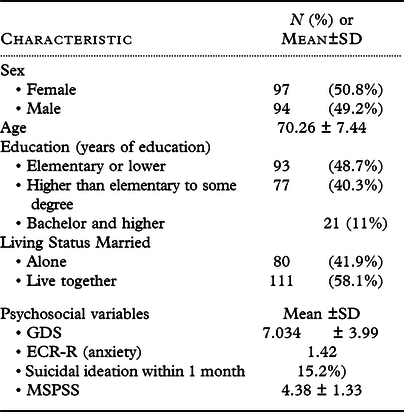
Among all 191 participants, 97 were females (50.8.5%) with a mean age of 70.26 years (SD = 7.4), 15.2% reported suicidal ideation in the past 1 month. Comparing between males and females regarding variables, no difference for sex was found for suicidal ideation, GDS, and MSPSS. However, males had a significantly higher level of anxiety attachment than females. Hence, we controlled for sex in subsequent model testing (Table 1).
Characteristics of the selected participants (N = 191)

Abbreviations: GDS, Geriatric depression scale; ECR-R-18, revised Experience of Close Relationships Questionnaire 18 items; MSPSS, Multidimensional Scale of Perceived Social Support.
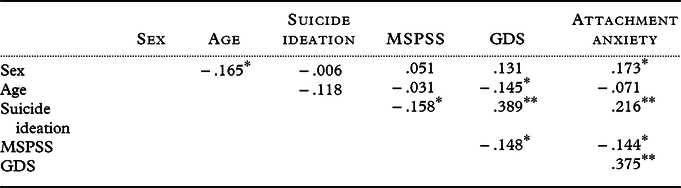
Table 2 displays the bivariate correlations for all variables. Sex was significantly related to attachment anxiety, in that males had higher levels of attachment anxiety than females (r = 1.73, p <.05), while younger age related to a higher level of depressive symptoms (r = −.145, p <.05). Depression, perceived social support, and attachment anxiety were significantly associated with each other and justifiably supported further analysis of the moderated mediation.
Zero-order correlation between variables

*p < .05, **<.01.
Abbreviations: GDS, Geriatric Depression Scale; MSPSS, Multidimensional Scale of Perceived Social Support; SD, Standard Deviation.
Test of the mediation
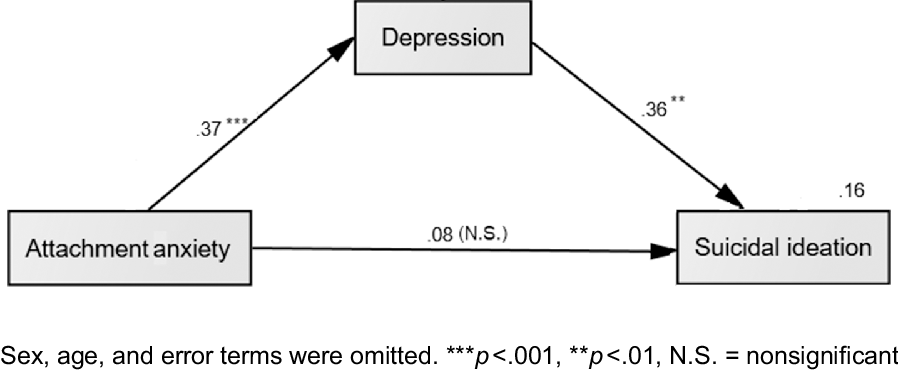
In testing the hypothesis of the mediational model, we conducted a mediational analysis to see whether GDS mediated attachment anxiety. GDS was positively associated with suicidal ideation after controlling for sex, attachment anxiety, β = 0.528, p <.0001, while attachment anxiety was positively associated with GDS after controlling for sex, β = 0.375, p <.0001. Attachment anxiety was not significantly associated with suicidal ideation after controlling for sex and GDS, β = 0.076, p = .442. This indicated a full mediation of GDS on the relationship between attachment anxiety and suicidal ideation. GDS and attachment anxiety accounted for 16% of the model (Figure 1). The data fit well with the model with a CFI of 0.998, TLI of 0.995, RMSEA of 0.017, Chi-square = 2.105, and df = 2, p =.345.
Standardized regression coefficients for the mediation model for attachment anxiety, depression, and suicidal ideation.

Testing for moderation model
To test whether perceived social support moderated depression or attachment anxiety on suicidal ideation, we performed univariate analysis of the general linear model. In the first analysis, we found that the interaction between depression and perceived social support significantly predicted suicidal ideation (F1, 187= 8.44, p = .004), while the interaction between attachment anxiety and perceived social support did not (F1, 187= 0.707, p = .402). No moderation effect between attachment anxiety and suicidal ideation concerning perceived social support was observed as well (F1, 187= 0.662, p = .417).
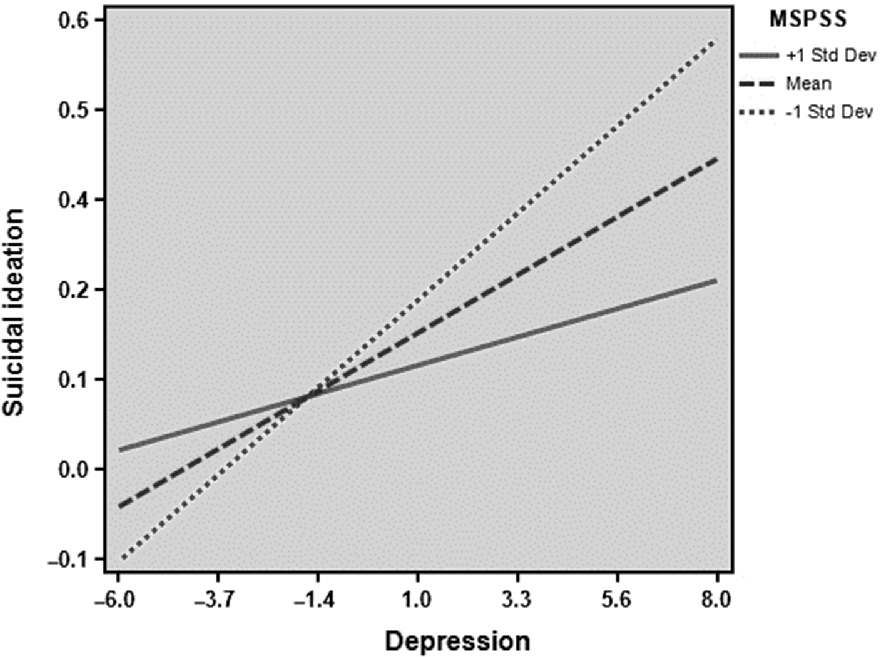
The outcome of the interaction between depression and perceived social support on suicidal ideation is presented in Figure 2. Depression differentially predicted suicidal ideation as a function of perceived social support. The significant interaction term (β =−.187, p =.004) and the slopes indicated that depression had a significant and positive correlation with suicidal ideation at below average levels of social support (at 1 SD below the mean of social support, β = 0.555, SE = 0.051, p <.0001), and an average or at the mean levels of social support, this relation was statistically significant (β = 0.368, SE = 0.067, p <.0001); however, at above average (+1 SD) of social support, this relation was not statistically significant (β = 0.180, SE = 0.093, p = .056.).
Interaction effect for depression and perceived social support on suicidal ideation. MSPSS: multidimensional scale of perceived social support, Std Dev: standard deviation, dotted line: low MSPSS score, dash line: mean MSPSS score, solid line: high MSPSS score.

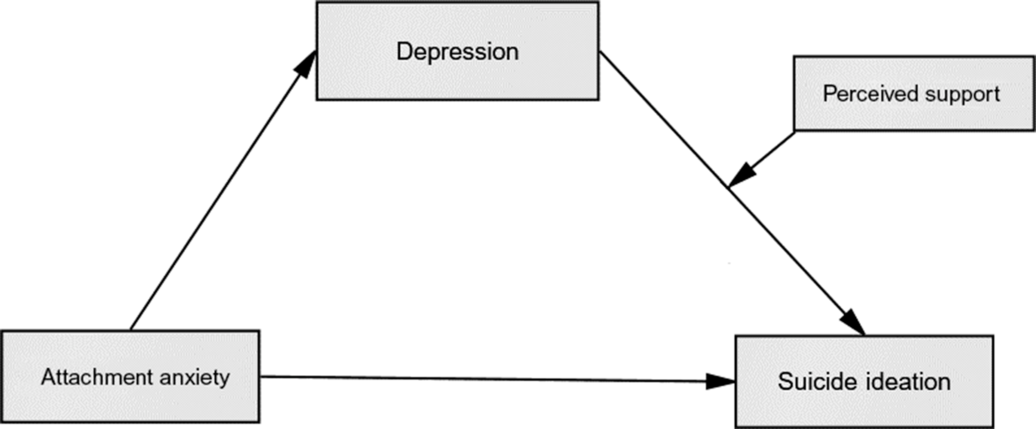
The results thereby supported our hypothesized moderated mediation model in Figure 3.
Proposed moderated mediation model of attachment anxiety, depression, and perceived social support on suicidal ideation.

Test of full moderated mediation
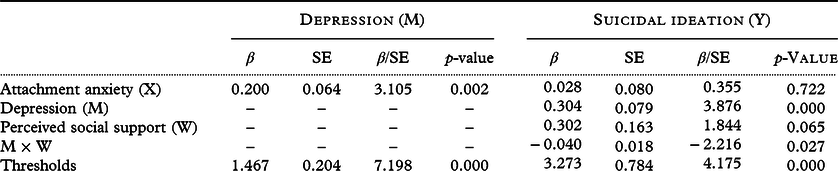
To test the full moderated mediation model (Figure 3.), we found that both depression and the interaction between depression and perceived social support (M × W) were significantly associated with suicidal ideation (β = .304, p <.0001 and β = −.040, p =.027, respectively). Perceived social support was not directly associated with suicidal ideation (β = .302, p =.065). Attachment anxiety was fully mediated by depression (from b =0.2, p =.002 to b = .028, p =.722), which was moderated by perceived social support. To put in other words, attachment anxiety had an indirect effect on suicidal ideation but not a direct effect holding sex, depression, and perceived social support constant (Table 3). Adding the interaction between perceived social support and depression in the mediation model increased the variance explained by 19%. The data fitted well with the model with a CFI of 0.998, TLI of 0.988, RMSEA of 0.049, Chi-square = 4.346, and df =3, p =.226.
Standardized coefficients with standard error estimating depression and suicidal ideation

Discussion
The present study confirmed our hypothesis of attachment anxiety, depression, and perceived social support influencing suicidal ideation among older people. To the best of our knowledge, this is one of the earlier studies testing relationships in an older age group. First, we will address how related studies mentioned attachment anxiety’s role in depression and suicidal ideation but only in an adult population (Miniati et al., Reference Miniati, Callari and Pini2017). These results have confirmed that the effect of these variables and their relationships may span adult age groups to older age groups.
Second, attachment, as we have previously discussed, is the pattern of relationships formed since childhood. Insecure attachment relates to a maladaptive cognitive schema and poor coping mechanism, leading to interpersonal problems, loneliness, poor sense of belonging, and anxiety disorders, all of which result in suicidal ideation. (Levi-Belz et al., Reference Levi-Belz, Gvion, Horesh and Apter2013; Li et al., Reference Li2017; McLaren et al., Reference McLaren, Gomez, Gill and Chesler2015; Palitsky et al., Reference Palitsky, Mota, Afifi, Downs and Sareen2013). Insecure attachment anxiety also relates to subsequent personality disorders, which affect suicidal ideation, regardless of the type of personality disorder present (Szücs et al., Reference Szücs, Szanto, Aubry and Dombrovski2018). Current findings in suicidality confirmed that attachment anxiety was mediated by depression. The close relationship between suicidal ideation and depression, regardless of age, demonstrated a central key linking preexisting insecure attachments or personality disorders to suicidal ideation, especially among older people (Alexopoulos et al., Reference Alexopoulos2009; Jahn et al., Reference Jahn, Poindexter and Cukrowicz2015; Okolie et al., Reference Okolie, Dennis, Simon Thomas and John2017). This finding could clinically imply that attachment anxiety alone may not cause suicidal ideation but that depression could also play an important role. As shown in the final model, 19% of those exhibiting attachment anxiety experienced suicidal ideation; consequently, this finding introduced new insight regarding suicide in an older population. Routine assessment for attachment style in a geriatric clinical setting could minimize suicidal risk: Evidence in primary mental health care revealed that attachment type influenced the doctor–patient relationship, the pursuit of care, and the clinical outcomes (Hooper et al., Reference Hooper, Tomek and Newman2012). Additionally, research revealed that identifying attachment style helped determine appropriate intervention, such as attachment-based psychotherapy or suicide narrative interview (Diamond et al., Reference Diamond2019; Zisk et al., Reference Zisk, Abbott, Ewing, Diamond and Kobak2017). However, since these clinical implications are most prevalent in adolescent and adult care, the implications for geriatric patients should be explored.
Third, as expected, perceived social support affected depression and suicidal ideation (Brausch & Decker, Reference Brausch and Decker2014; Findlay, Reference Findlay2017; Harrison et al., Reference Harrison2010). Compared with individuals who reported high levels of perceived social support, those who reported low levels were inclined to display increased suicidal ideation and depression. This finding was consistent with other related studies conducted among different age groups (Casale et al., Reference Casale, Boyes, Pantelic, Toska and Cluver2018; Lien et al., Reference Lien, Hu and Chen2016; Siegmann et al., Reference Siegmann2018), but the finding was not present in all studies (Cohen et al., Reference Cohen, Hammen, Henry and Daley2004). Furthermore, perceived social support was found to produce either a mediating effect or a moderating effect on depression (Lee, Reference Lee2016; Nam and Lee, Reference Nam and Lee2019). However, the moderating effect, rather than the mediating effect, was observed in the present study. Despite its small moderation effect in this study, perceived social support is clinically significant based on the interpersonal theory of suicide (Bernier et al., Reference Bernier, Lapierre and Desjardins2020), especially in Asian populations (Wang et al., Reference Wang, Chu, Sun, Zhang, Guo and Jia2017), which are dominantly collectivist societies, where the feelings of family togetherness and support hold greater value than those in Western populations (Hsu et al., Reference Hsu, Hailey and Range1987; Jensen et al., Reference Jensen, Smith, Bombardier, Yorkston, Miró and Molton2014; O’Riley et al., Reference O’Riley, Nadorff, Conwell and Edelstein2013). Consistent with other related studies, thoughts about death and self-harm in old age are associated with the presence of depression and poor social support, with social disconnectedness and stress attributing to a greater proportion of cases than depression (Almeida et al., Reference Almeida2012). Although another study viewed perceived social support as a positive psychological factor because community-residing older adults demonstrated fewer tendencies toward suicide ideation, perceived social support should be considered with other negative factors, such as depression, anxiety, loneliness, and a perception of being burdensome (Heisel et al., Reference Heisel, Neufeld and Flett2016; Troya et al., Reference Troya2019).
To our knowledge, this study was among the few concerning attachment anxiety and suicidal ideation in an older Asian population. We included data from tertiary care centers, which demonstrated the influence of both predisposing (attachment) and precipitating (depression and perceived social support) factors on the clinical significance and interest of suicidal ideation. Furthermore, the moderated mediation model demonstrating the relationship among variables established a greater understanding of the relationships among these variables and made an integrative exploration of the relationships involving current psychological status, attachment styles, and suicidal ideation.
Limitations
Notably, some limitations should also be addressed. Because certain types of data, such as attachment anxiety data, are retrieved by memory, recall bias may be an inevitable weakness. Compared to the previous study, our study included only two psychosocial factors that may have been involved in the association. Some of the potential data, e.g. psychiatric comorbidities or other types of personality traits, which might have extensively explained our hypothesis, were unavailable. These results might not be generalized in primary care or community settings; therefore, further studies with more extensive data and different settings are warranted.
Implications
According to the present study, attachment anxiety was shown to indirectly affect suicidal ideation via depression and perceived social support. Intervention for modifiable factors such as depression and perceived social support would prove beneficial. As in younger populations, identifying older individuals with insecure attachments and providing appropriate interventions should be encouraged. The outcome of the intervention in the group of older people was at least comparable to that in the group of younger people (Hobbs et al., Reference Hobbs, Joubert, Mahoney and Andrews2018).
Conclusion
This study demonstrated the effects of attachment anxiety, depression, and perceived social support on suicidal ideation. The moderated mediation model showed that attachment anxiety indirectly affected suicidality through depressive symptoms and perceived social support. A higher level of perceived social support, however, had a moderating effect in reducing the harmful effects of severe depression. The present study provided new insights into and discussed the clinical implications of the role of perceived social support among an older population.
Conflicts of interest
None.
Description of authors’ roles
Oonarom A, Wongpakaran T, and Wongpakaran N formulated research questions and designed the study. Kantawong P collected the data and assisted in manuscript preparation. Wongpakaran T was responsible for statistical design and statistical analysis. Oonarom A wrote the manuscript supervised by Wongpakaran T and Wongpakaran N.
Acknowledgment
Both the DAS program and Thai-SAD were funded by the National Research Council of Thailand. The Faculty of Medicine partially funded the Thai-SAD. The authors would like to express their gratitude to contributors to the two studies of which this work was a part – the Depressive Disorders, Anxiety Disorders, the Suicide Risk and the Associated Factors among Elderly People (DAS) Program and the Thai Study of Affective Disorders (Thai-SAD) studies.