It is widely acknowledged that welfare states have come under increasing pressure from various sources in the past decades. In terms of demography, ageing populations and changes in traditional family structures challenged existing welfare state arrangements. At the same time, changes in macro-economic circumstances including deindustrialisation, labour market restructuring and globalisation put further strains on traditional welfare state structures (Pierson, Reference Pierson1998, Reference Pierson and Pierson2001b; Bonoli et al., Reference Bonoli, George and Taylor-Gooby2000; Taylor-Gooby, Reference Taylor-Gooby2001, Reference Taylor-Gooby2004). Retrenchment became the catchphrase most commonly employed to characterise the direction of welfare state reform in the light of these challenges (Pierson, Reference Pierson1994). While retrenchment is an important trend, not all reforms in social policy can be subsumed under this label. Some of the above developments have ambiguous effects, and some even call for welfare state expansion rather than cutbacks (Pierson, Reference Pierson1998, Reference Pierson and Pierson2001a; Palier, Reference Palier and Clasen2001; Meier Jæger and Kvist, Reference Meier Jæger and Kvist2003; Clasen, Reference Clasen2005). This is particularly true for adapting welfare states to so-called new social risks (Esping-Andersen, Reference Esping-Andersen1999; Taylor-Gooby, Reference Taylor-Gooby2004; Armingeon and Bonoli, Reference Armingeon and Bonoli2006).
The need for welfare state change raises the question of how politics reacts to it, and which political and institutional factors account for differences in political responses. Answers to these questions remain controversial (Green-Pedersen and Haverland, Reference Green-Pedersen and Haverland2002; Starke, Reference Starke2006). The dispute over whether government partisanship still matters is far from settled (Huber and Stephens, Reference Huber and Stephens2001; Pierson, Reference Pierson2001b; Korpi and Palme, Reference Korpi and Palme2003; Allan and Scruggs, Reference Allan and Scruggs2004), and the same applies to the question of whether veto points block welfare state reforms or not (Bonoli, Reference Bonoli2000; Obinger et al., Reference Obinger, Leibfried and Castles2005; Immergut et al., Reference Immergut, Anderson and Schulze2006).Footnote 1 This article looks at the topic from a new angle. It theorises and analyses the influence of veto players in social entitlement legislation at the level of individual bills. Many changes with regard to social entitlements are legislated in parliament. Therefore, a focus on legislative processes allows us to study the mechanisms of welfare state change themselves. One advantage of such a meso-level approach lies in the fact that it does not need to make any assumptions about how political factors (for example, the partisan colouring of the government) are linked to changes in welfare state outcomes (Green-Pedersen, Reference Green-Pedersen2004; Plümper et al., Reference Plümper, Troeger and Manow2005); political processes per se are the phenomena to be explained.
This article answers three questions. The first two are rooted in standard veto player theory (Tsebelis, Reference Tsebelis2002). Does a greater number of government parties and increasing ideological distance between them affect the duration and outcome of social entitlement bills? How does the second chamber influence legislation? In addition, the relationship between policy context and the politics of legislation is analysed. If the direction of political change differs across policies, so should the politics of legislation. In those policy areas experiencing pressure to shift policies to the right, does the most leftwing government party become decisive for the passage of social security reforms in parliament? The empirical testing of the theoretical arguments is based on an application of event history models to new data on social entitlement bills from Belgium, Germany and the UK initiated between 1987/88 and 2002/03.
The analysis of cabinet bills and proposals originating from government parties on the floor yields the following results. Firstly, a higher number of government parties or increasing ideological distance between these parties makes the passage of government party bills more difficult but does not affect cabinet proposals. Secondly, bicameralism delays legislation only when three conditions are met: the opposition holds a majority in the second chamber, approval by the second chamber is formally required and the bill originates from the government parties on the floor. Cabinet bills do not experience delay even in the adverse circumstances of divided government and mandatory approval. Thirdly, the argument concerning the influence of the left veto player yields no support. Bills dealing with social entitlements that are under pressure to be cut back are not adopted more quickly if the leftmost government party is located further to the right. On the contrary, it is found that bills referring to expansionary or mixed policies are delayed if the position of the leftmost government party is further to the right. Again, this result applies only to government party, not to cabinet bills.
The results imply that it is important to distinguish between cabinet bills and government party bills since cabinets resolve conflicts at the pre-parliamentary stage and behave strategically in adverse institutional constellations. In addition, the findings demonstrate that the influence of second chambers depends on institutional context. While this study is only a first step in analysing social entitlement legislation in a quantitative manner, it shows that such an approach can contribute to our understanding of the politics of welfare state change from a new perspective. The remainder of the article is organised as follows. The following section discusses recent literature on the influence of parties and veto players in welfare state change as well as studies dealing with the passage of legislation. In the next section, the theoretical arguments are developed, which are then tested using event history modelling. The final section discusses the findings and points to avenues for further research.
Parties, veto points and welfare state change
Political parties and institutions are among the central factors explaining development and change of welfare states, and there is little disagreement about their role during the era of expansion. Classic arguments posit that left party government has been a motor of welfare state growth (for example, Esping-Andersen, Reference Esping-Andersen1985), and that ‘aspects of constitutional structure that disperse power and offer multiple points of influence’ (Huber et al., Reference Huber, Ragin and Stephens1993: 722) have slowed down welfare state expansion. For both relationships, there is considerable empirical evidence of a qualitative and quantitative nature (Myles and Quadagno, Reference Myles and Quadagno2002). In addition, it is widely accepted that the golden era of the welfare state came to an end in the late twentieth century (Pierson, Reference Pierson1994; Huber and Stephens, Reference Huber and Stephens2001; Taylor-Gooby, Reference Taylor-Gooby2001; Kittel and Obinger, Reference Kittel and Obinger2003; Starke, Reference Starke2006). Developments in the macro-economy (such as deindustrialisation and globalisation) as well as demographic trends (most importantly, population ageing and changes to traditional family structures) put existing welfare state arrangements under pressure. From this period onwards, social policy making has been characterised as taking place in a context of ‘permanent austerity’ (Pierson, Reference Pierson1994).
However, the argument that contemporary welfare state change is mostly about cutbacks has been qualified (Palier, Reference Palier and Clasen2001; Green-Pedersen, Reference Green-Pedersen2004; Clasen, Reference Clasen2005). While the pattern of retrenchment is a key tendency in recent social policy making, it has been accompanied by other significant developments. For instance, Pierson (Reference Pierson1998, Reference Pierson and Pierson2001a) proposed in later work that reforming welfare states also entails cost containment, recalibration and recommodification. What is more, the pressure arising from demographic and macro-economic change does not necessarily require cutbacks (Meier Jæger and Kvist, Reference Meier Jæger and Kvist2003). On the contrary, some policies need to be expanded in order to adapt welfare states to the changing background conditions. The demand for expansion especially concerns coverage against so-called new social risks (Esping-Andersen, Reference Esping-Andersen1999; Taylor-Gooby, Reference Taylor-Gooby2004; Armingeon and Bonoli, Reference Armingeon and Bonoli2006). Traditional welfare state schemes provide transfers in case of loss of earned income: for example, in old age or during periods of sickness or temporary unemployment (Meier Jæger and Kvist, Reference Meier Jæger and Kvist2003: 27–28). They are ill equipped to deal with problems typically occurring in post-industrial labour markets, such as the need for workforce activation or the training of low-skilled individuals. Also, many traditional schemes were first created when tasks such as child care or care for older people were typically fulfilled within families. Due to changing family structures, such policies require an expansion of state provision in contemporary welfare states.
Given that welfare states have to adapt to changing background conditions, how do political parties and institutions shape reform outcomes? This question is asked mainly in relation to effects on the amount of retrenchment, and remains fiercely debated (for reviews, see Green-Pedersen and Haverland, Reference Green-Pedersen and Haverland2002; Starke, Reference Starke2006). The seminal argument by Pierson (Reference Pierson1996) claims that in a context of austerity a ‘new politics of the welfare state’ emerges. Partisan differences disappear, since all governments face the same task of blame avoidance when implementing retrenchment. There are quantitative empirical results which indeed suggest an end of partisanship (Huber and Stephens, Reference Huber and Stephens2001), but other studies challenge the notion both theoretically and empirically (Korpi and Palme, Reference Korpi and Palme2003; Allan and Scruggs, Reference Allan and Scruggs2004). The results of the latter two studies suggest that right party strength is indeed associated with higher cutbacks in social entitlements. In addition, qualitative work has repeatedly refused the thesis of an end of partisanship (Levy, Reference Levy1999; Ross, Reference Ross2000).
Regarding veto points, Pierson (Reference Pierson1996, Reference Pierson2001a) proposes ambiguous effects in the context of the ‘new politics’. Veto points may enable divergent interests to block attempts at retrenchment or they may actually favour it by allowing blame to be shared and to obfuscate responsibility. Thus, it is not surprising that the two outstanding recent quantitative studies do not find clear-cut effects of veto players on retrenchment (Korpi and Palme, Reference Korpi and Palme2003; Allan and Scruggs, Reference Allan and Scruggs2004). A mixed picture also emerges from qualitative work. Bonoli (Reference Bonoli2000) argues that there is no linear relationship between veto points and social policy reform, since it matters whether governments choose a unilateral or negotiated approach to reform. Kitschelt (Reference Kitschelt and Pierson2001) concludes that veto point explanations account well for the developments in Anglo-Saxon countries, but do not apply to other cases such as France and Japan. The case studies in Obinger et al. (Reference Obinger, Leibfried and Castles2005) attest that federalism has a hampering effect on welfare state cutbacks, but point to intervening country-specific factors. Finally, the studies in a recent volume edited by Immergut et al. (Reference Immergut, Anderson and Schulze2006) highlight the importance of political competition in shaping the influence of institutions on pension reform.
The empirical ambiguities delineated above are very likely also connected to methodological issues. Regarding quantitative studies, three issues are worth noting. Firstly, in most statistical models partisanship is measured as right or left party cabinet strength, which may be too crude an indicator of government preferences (Bräuninger, Reference Bräuninger2005). Secondly, veto points are usually just counted, as in the widely employed index developed by Huber et al. (Reference Huber, Ragin and Stephens1993). This leads to two shortcomings, even if the relevant veto players are correctly identified (Ganghof, Reference Ganghof2003). The preferences of actors are not measured, and all veto points are considered equal or attributed more or less arbitrary weights. The third issue is related to the ‘dependent variable problem’ (Green-Pedersen, Reference Green-Pedersen2004) in comparative welfare state research. One of the several weaknesses of widely used social spending data is the fact that they are influenced by a host of factors other than politics, which are not easy to control for. While this problem is overcome using entitlement data, the link between politics and outcomes remains indirect in temporal respect (Plümper et al., Reference Plümper, Troeger and Manow2005). Which government is responsible for a decline in generosity in a certain year? Such questions are very hard to answer, especially in the field of old age security, where effects of reforms may be visible only in the very long run.
As a response to the above-stated problems, we may turn to qualitative research strategies (Obinger et al., Reference Obinger, Leibfried and Castles2005; Immergut et al., Reference Immergut, Anderson and Schulze2006). This study takes a completely different stance: it analyses duration and outcome of the legislative process of social entitlement bills in parliament. The focus lies on the impact of two types of veto players: government parties on the floor and second chambers. Analysing the passage of social entitlement legislation in a large N setting enables the study of political mechanisms at the meso-level to be carried out in a fully replicable way. The main aim here is not to explain welfare state outcomes but rather to seek to open the black box of how social policy reforms come into existence. Studying legislation in a quantitative way as such is not new. Analysing the extent of legislation is a straightforward application of veto player theory (Tsebelis, Reference Tsebelis2002), and there are several recent studies focusing on the passage of legislation. Martin and Vanberg (Reference Martin and Vanberg2004, Reference Martin and Vanberg2005) centre on the role of parliamentary scrutiny as a means to implement coalition contracts in multi-party government. Analysing legislation in Germany and the Netherlands, they report that bills dealing with issues where coalitions show high divisiveness take more time until adoption and are more frequently changed. The opposition, in contrast, seems to have hardly any influence in the legislative process. Becker and Saalfeld (Reference Becker, Saalfeld, Döring and Hallerberg2004) also deal with the duration of the legislative process, yet with a focus on veto players and institutional rules in parliament. They find no support for a delaying effect of veto players when considering the passage of legislation as a single episode. However, the study assumes that the effects of the independent variables are the same for government and private bills, which is theoretically (and, as will be shown below, also empirically) inappropriate.
What all the above-mentioned studies on legislation share is a lack of interest in the policy background of the bills analysed. This factor is used only to choose the measures of policy positions (Martin and Vanberg, Reference Martin and Vanberg2004, Reference Martin and Vanberg2005), or to keep potential policy area-specific influences constant (Döring, Reference Döring1995; Döring and Hallerberg, Reference Döring and Hallerberg2004). The field of social entitlement legislation is especially well suited to an examination of the influence of policy on politics. Some programmes are likely to be cut back while others tend to be expanded. As a consequence, legislative politics should vary depending on the kind of entitlement a bill deals with.
Government parties and second chambers as veto players
The cabinet and its supporting parties are the central actors in legislation in parliamentary systems. Cabinets initiate most of the successful bills, and the supporting parties guarantee majority support for these bills on the floor. According to Tsebelis, ‘veto players are individual or collective actors whose agreement is necessary for a change of the status quo’ (2002: 19). Then, if we conceive of parties as unitary actors and neglect the possibility that opposition parties may support government proposals as well, any of the parliamentary parties supporting the government constitutes a veto player.Footnote 2 In many countries, second chambers form a part of the legislative institutions. The influence of a second chamber crucially depends on two factors: its ideological composition compared to the first chamber and its formal rights (Lijphart, Reference Lijphart1999). It is important to note that the two factors are not invariant institutional features. The ideological composition of the second chamber may alter over time, and its formal rights can vary from bill to bill, as is the case in German and Belgian federal legislation.Footnote 3 Theorising welfare entitlements legislation, however, should go beyond standard veto player predictions. Policy influences politics (Lowi, Reference Lowi1972), and so we can expect political processes to vary with the direction of policy change. When it comes to policies that are characterised by retrenchment tendencies, the leftmost government party should become the decisive veto player for passing welfare state reforms.
Before elaborating on these arguments, three remarks regarding the limitations of focusing on the legislative process in parliament are indicated. Firstly, there are decisions affecting social entitlements that are not taken through parliament. For example, bureaucrats have considerable discretion in applying the law, from ministers who can fix certain rules by decree down to clerks in the local welfare office who make decisions in specific cases. While it is a drawback that non-legislative decisions cannot be captured here, this problem may be alleviated by the fact that it is laws that frame policies, determine the level of discretion in the first place and may alter it at any time. Secondly, in some political systems institutions exist that allow the cabinet to reduce the legislative powers of parliament. The Belgian constitution provides for several forms of ‘delegated legislation’ (de Winter and Dumont, Reference de Winter, Dumont, Strøm, Müller and Bergman2006: 254). Among them are ‘task laws’, which allow the cabinet to decide on matters that usually fall under the competence of parliament, and ‘royal decisions’, which are specific regulations by the cabinet referring to the implementation of laws already approved by parliament. Delegated legislation is problematic since cabinets are more likely to use it in adverse veto player constellations. Two factors ease the problem, however. The resulting bias is against finding veto player effects, and the analysis below includes the bills that grant the cabinet ‘task law’ competence and those confirming ‘royal decisions’ in the sample, and adds two control variables to the statistical model. Thirdly, important and mostly informal decision-making processes take place at the pre-parliamentary level, and they will affect the passage of legislation. The lack of information on the pre-parliamentary stage cannot be overcome here, but the theoretical arguments try to take account of varying pre-parliamentary politics by differentiating between bills initiated by the cabinet and those originating from the government parties on the floor, as will be discussed in more detail below.
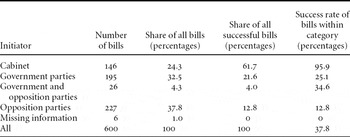
The phenomenon of interest here is the passage of legislation on social entitlements initiated by the government (in a wide sense of the word). Table 1 gives an overview of social entitlement bills in Belgium, Germany and the UK in the period from the mid to late 1980s to the early 2000s, broken down into type of initiator.Footnote 4 It can be seen that cabinet bills amount to only 24.3 per cent of all initiated bills, but rarely fail (success rate 95.9 per cent) and thus constitute 61.7 per cent of the final laws in the given policy domain. A significant number of proposals (32.5 per cent) are what I call government party bills. These are private bills initiated by MPs from the government camp as regards Belgium and the UK, and proposals by party groups supporting the government in Germany, where individual MPs lack the right to initiative (Patzelt, Reference Patzelt, Longley and Hazan2000). The success rate of 25.1 per cent for government party bills is much lower than the one for cabinet bills, but government party bills still constitute a share of 21.6 per cent of all final laws. If we add the figures for cabinet and government party bills, their share amounts to 56.8 per cent of all initiated bills, and 83.3 per cent of all successful proposals.
Social entitlement legislation in Belgium, Germany and the UK, 1987/88–2002/03, by initiator

Note: For details on data see text and Appendix 1.
Table 1 confirms the conjecture that opposition bills and bills initiated jointly by the government and the opposition are distinct from other kinds of legislation. While it might be interesting to analyse also opposition bills and especially jointly initiated bills, which may constitute means for blame avoidance in the context of retrenchment, this article focuses exclusively on cabinet and government party bills. For studying these, the descriptive statistics bear two further implications. Firstly, while any argument should refer to both cabinet and government party bills, it is important to keep in mind that these types of bills differ in several respects. Cabinet bills are drafted in the government departments. This means that experts prepare the proposals in detail, and that they are coordinated with organised interests and other political actors. Additionally, the cabinet discusses and possibly changes draft legislation before introducing it into parliament. The extent to which ministers have discretion vis-à-vis the cabinet is not theorised here, but, in any case, the cabinet as a collective body has agreed to support a bill originating from it. Thus, it is likely that it reflects a policy that is pareto improving for the government parties.
The second implication of Table 1 relates to the question of which phenomenon should be explained. Standard veto player theory is concerned with the ‘ability to change the status quo’ (Tsebelis, Reference Tsebelis2002). Consequently, the mechanism underlying the veto player logic is the blocking of legislation. Tsebelis (Reference Tsebelis2002) defines veto players as having absolute veto power in the classical meaning of the term. When studying the real-world passage of legislation, however, absolute veto power may not necessarily mean that a bill is blocked outright. As seen above, cabinet bills rarely fail. This has to do with the strong position of cabinets vis-à-vis their supporting parties on the floor. The cabinet, with the help of the party leaders, can apply pressure on MPs in various ways. Furthermore, bargaining may prevent absolute vetoing. However, all of these measures against absolute vetos take time, and the observable effect of veto players may be in delaying rather than blocking legislation. Thus, the ability to change the status quo is not only about whether bills are passed, but also about how long the parliamentary process takes.
The seminal argument by Tsebelis (Reference Tsebelis2002) can be summarised as follows: firstly, with an increasing number of veto players, the ability to change the status quo never increases. It need not necessarily decrease, since additional players may be ‘absorbed’ if their positions fall in between the two extreme players.Footnote 5 Thus, the ideological range between the veto players is the more comprehensive measure. Higher veto player distance leads to less policy change, since the status quo is more likely to fall in between the extreme players.Footnote 6 Applied to the passage of legislation and considering the two qualifications made above, we obtain two hypotheses:
The greater the number of government parties/the greater the ideological distance between them, the longer the duration of the legislation process and the lower the chance of the proposal becoming law. This effect is weaker for cabinet bills than for government party bills (H1/H2).
The influence of the second chamber on legislation can be described in terms of two factors: composition and formal rights (Lijphart, Reference Lijphart1999). The decisive aspect of composition is whether the government enjoys a majority in the second chamber (unified government) or not (divided government). In case of unified government, the second chamber is expected to pass government bills without difficulties, since the majorities are congruent. If the opposition controls the second chamber, it may aim at blocking government proposals. Whether this is effective, however, depends on the formal rights of the second chamber: more specifically whether its approval is necessary (mandatory legislation) or not (non-mandatory legislation).
If the approval of a bill by the second chamber is not necessary – for example, since the veto can be overridden – divided government may or may not lead to a delay in legislation but it should not diminish the chances of a bill becoming law. Similarly, in situations of unified government, it should not make much of a difference whether legislation is mandatory or non-mandatory. When divided government and mandatory legislation coincide, however, we can expect that a bill will be delayed and have a lower chance of being adopted. The approval by the second chamber is necessary, and therefore the divergent majority is in a strong position to block government legislation. Again, the consequences of divided government and the type of legislation are expected to be different for cabinet and government party bills. The cabinet is likely to sound out the stance of the opposition before introducing a policy proposal into parliament. Since this is less likely for government party bills, the delaying effects of divided government and mandatory legislation are expected to be weaker for cabinet bills than for government party bills. Taken together, this yields:
Divided government without mandatory legislation (and vice versa) delays the legislation process and reduces the chance of approval; this effect is small, however, and it is weaker for cabinet bills than for government party bills (H3).
If divided government and mandatory legislation coincide, they delay the legislation process and reduce the chance of approval. This effect is weaker for cabinet bills than for government party bills (H4).
Analysing social entitlement legislation should go beyond testing general veto player arguments. How does the specific policy context influence the politics of legislation? The literature review above suggested that welfare state schemes have to be adapted to changing background conditions, although this pressure is not uniform. Some entitlement programmes experience pressure in the direction of retrenchment. Among these are pension schemes, which due to rising life expectancy and shrinking birth rates cannot sustain generosity levels (Bonoli and Shinkawa, Reference Bonoli and Shinkawa2005). To the same group belong other traditional schemes such as sick pay and unemployment benefits (Korpi and Palme, Reference Korpi and Palme2003). On the other hand, care for older people and support for families constitute policies which require expansion and more state involvement (Meier Jæger and Kvist, Reference Meier Jæger and Kvist2003; Castles, Reference Castles2004). Other policy areas are difficult to classify. An example is welfare in a narrow sense, where fiscal pressure and the wish to create workforce activation incentives may push towards retrenchment, but the need to provide sufficient basic social security counterbalances this effect.
These policy tendencies can inform predictions from the veto player framework. Let us assume a unidimensional policy space, on which the position of the government parties, the status quo and the policy proposed by a certain bill can be located. To start with, consider policy areas featuring pressure in the direction of retrenchment. This pressure can best be thought of as a threshold at a certain point on the scale. All status quo points, which lie to the left of this point. are deteriorating due to exogenous reasons (compare Vis and van Kersbergen, Reference Vis and van Kersbergen2007). Now the political actors have to shift all affected policies to the position of the threshold or to the right of it, even if they actually prefer a policy to the left of the threshold and the rightwards shift is risky in electoral terms. It is important to note that not all policies are under pressure, but only those to the left of the threshold. Yet it makes sense to assume that the distribution of the status quo is skewed in policy areas experiencing pressure for retrenchment. A considerable number of policies lie to the left of the threshold, and proposed legislation needs to move them to the right. This is different in policy areas not characterised by pressure for retrenchment. In fields where the main policy trend is ambiguous or can be characterised as expansion, we do not expect the position of the leftmost party to be decisive.
Therefore, in those policy areas where pressures in the direction of retrenchment are present, the leftmost parliamentary party in support of the government becomes the decisive veto player. For those bills which imply a rightwards shift, full consent will be achieved as soon as the leftmost party has approved the bill. It is plausible that the issues where exogenous forces necessitate retrenchment are mainly addressed by the cabinet. It is not attractive for single parties or individual parliamentarians to take the blame for cutbacks in social entitlement. Following this logic, the importance of the left veto player is supposedly higher for cabinet bills. However, this is probably counterbalanced by the fact that the cabinet proposals have already been agreed by ministers of all parties. In sum, these effects may cancel each other out, and so we can expect the following relationships:
In policy areas that are shaped by pressure for retrenchment, the position of the leftmost government party matters. The more to the right its position is located, the shorter is the duration of the legislative process and the higher the chance of the proposal becoming law. This effect does not differ between cabinet bills and government party bills. In policy areas that are not shaped by pressure for retrenchment, the position of the leftmost government party does not matter (H5).
Above, I introduced the argument that the position of the left veto player becomes crucial for the passage of welfare state reforms implying retrenchment. A good illustration of this claim constitutes the fate of the second government of German chancellor Gerhard Schröder.Footnote 7 The notorious reform package called ‘Agenda 2010’, which among other things introduced cuts in unemployment benefits, created considerable conflict within the government. The policy proposals of the cabinet met with opposition especially within the Social Democratic Party, the left veto player, and even led to a disintegration of its left wing. The fact that majority building in parliament proved increasingly difficult was one of the main reasons why Schröder finally called early elections in summer 2005 (Wüst and Roth, Reference Wüst and Roth2006: 441–3).
Empirical analysis
In this section, the theoretical arguments are empirically tested with a new dataset on the passage of social entitlement legislation in Belgium, Germany and the United Kingdom. Information about individual bills is taken from the dataset by Bräuninger et al. (Reference Bräuninger, Debus and Brunner2007), which covers the universe of legislative proposals initiated in the three countries between 1987/88 and 2002/03. Starting from those data, 600 bills referring to social entitlement legislation were identified. Details of the selection process are given in Appendix 1. Social entitlement legislation as defined here comprises bills related to qualifying conditions and generosity of the following benefits (in a wide sense of the word): old age and survivor pensions, incapacity benefits, family benefits, care for older people and welfare (in a narrow sense). Each bill identified is associated with one of the listed categories; a residual group contains cases that are general or cut across policies. From the 600 bills, 341 originate from the cabinet or the government parties and are included in the analysis below.
In terms of countries and time periods, the sample of bills is the result not of intentional selection but of data availability. Nevertheless, it has an important strength, since the independent variables of interest show considerable variance. On the one hand, there is the case of the UK, a prototype of majoritarian democracy with single party cabinets and a second chamber with weak formal rights. On the other hand, the sample contains Belgium, a consociational democracy with often oversized coalitions. Moreover, around the midpoint of the observation period, a constitutional reform drastically diminished the legislative rights of the Belgian second chamber. Finally, Germany falls in between on the majoritarian-consensus democracy dimension and has a second chamber, whose influence heavily varies with context. In addition, the countries have been ruled by governments of quite different partisan hue during the observation period. Thus, the data allow for an interesting test of the theoretical claims made above. The next section deals with the operationalisations of the independent variables. The choice of the dependent variable will be discussed in context of the specification of the statistical model.
Operationalisations and data sources
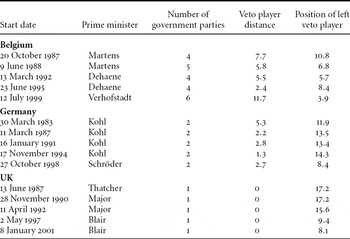
Two operationalisations of the veto player concept are employed: first, the number of government parties and second, the veto player distance, which equals the ideological range between the most leftwing and the most rightwing government party. The policy dimension chosen is the socioeconomic left–right dimension: specifically, the taxes versus spending dimension, which dates back to Laver and Hunt's (Reference Laver and Hunt1992) expert survey. In order to take the dynamics of party positions over time into account, data from Debus (Reference Debus2008) based on the wordscores method (Laver et al., Reference Laver, Benoit and Garry2003) are used. The same data serve as a basis for calculating the position of the left veto player.Footnote 8 An overview over the political variables for the cabinets of the analysis period is given in Table A1 in Appendix 2.
The impact of bicameralism is measured by two dummy variables. For Belgium and the UK, divided government equals one if the government parties hold fewer than half of the seats in the second chamber. In the more complicated case of the German Bundesrat, divided government is one in the situation where those states governed by cabinets composed only of federal government parties do not have a majority. Moreover, in the German case the composition of the second chamber can change with every state-level election. Since evaluating the composition of the second chamber at the initiation date of a bill only would lead to bias, the models below are estimated with a time-varying variable for divided government for the German cases.Footnote 9Mandatory legislation amounts to one if a given bill necessarily requires approval by the second chamber. In the UK, there is no mandatory legislation at all. Belgian bills all fell in the realm of mandatory legislation before the constitutional reform in 1995. Since the reform, the feature is bill-specific, but mandatory legislation is the exception. In Germany, too, the variable is bill-specific, depending on whether state-level policies are affected by the federal policy proposal. Information regarding mandatory legislation and the following additional control variables is contained in the ‘Comparative Legislation’ dataset (Bräuninger et al., Reference Bräuninger, Debus and Brunner2007).
Time until expiration is the number of days until a bill expires if there is no final vote on it, corrected for summer and Christmas breaks of parliament. This measure aims to control for the time frame within which a bill has to be dealt with.Footnote 10 In addition, a dummy variable, which measures whether a restrictive procedure has been applied by the government at any time during the passage of the bill, is included. Two variables account for peculiarities of the Belgian legislative process. The variable task law identifies bills that grant the cabinet the power to regulate certain matters usually part of parliament's responsibility, and confirmation of royal decision marks bills that ratify specific implementation decisions by the cabinet. Finally, the bills are grouped into three subfields according to policy direction. Old age and survivor pensions as well as incapacity benefits form retrenchment fields; family benefits and care for older people comprise expansion fields; and welfare as well as general/cross-cutting bills constitute the mixed fields category.
Statistical model
The phenomenon of interest in this study is the duration and the outcome of the legislative process. This suggests the use of event history analysis, since it allows one to consider both phenomena in a single model (Box-Steffensmeier and Jones, Reference Box-Steffensmeier and Jones2004: 8). The dependent variable is the duration of the legislative process starting from the day of initiation of a bill until the day of its adoption as a law. Bills that are explicitly refused and bills that expire at the end of the legislative session without being voted on are treated as censored cases.Footnote 11 It was argued above that the effects of the independent variables differ between cabinet bills and government party bills. Therefore, the models are estimated for a pooled sample of bills including an interaction effect for type of bill for every independent variable. This is not only statistically more efficient, it also allows for a direct statistical test of parameter differences between the type of bills (Franzese and Kam, Reference Franzese and Kam2007). Interaction effects are also used to account for the fact that the influence of the left veto player should vary across policies.
For the estimation of the event history model, a parametric specification of the log-logistic form is chosen.Footnote 12 The log-logistic form of parameterisation was selected since it yielded the lowest AIC, which is a standard measure employed to choose among different parametric event history models (Box-Steffensmeier and Jones, Reference Box-Steffensmeier and Jones2004: 44–5). The log-logistic model can be expressed as an estimation of the logarithm of time until the event occurs. Formally, this can be stated as

whereby ε follows a logistic distribution, and σ is a parameter to be estimated from the data (Box-Steffensmeier and Jones, Reference Box-Steffensmeier and Jones2004: 31–2). This parameter determines the shape of the baseline hazard. Since it is theoretically assumed that cabinet bills and government party bills have, even given the covariates, other life cycles, the baseline hazard is additionally allowed to vary with type of initiator. As already mentioned above, the German bills are split into multiple episodes due to the frequently changing composition of the Bundesrat, which makes it necessary to use standard errors accounting for this clustering. Finally, the models include dummy variables for countries and policy direction (retrenchment/expansion) to control for unobserved heterogeneity, notably also the number of other veto players.
Results
Table 2 presents the results of the log-logistic event history models. When both the scale and the shape of the hazard rate are allowed to be influenced by covariates, the absolute values of the estimated coefficients are difficult to interpret in substantive terms. Therefore, only the signs of the coefficients will be considered. Positive coefficients imply that the time until the adoption of a bill increases, which also implies that the chances of adoption decrease. Negative coefficients, on the other hand, indicate that an independent variable accelerates the legislative process and raises the chances of adoption.
Results of log-logistic event history models
Note: GPBs: Government parties’ bills. CBs: Cabinet bills. Log-logistic event history model, dependent variable is the time between introduction of a bill and its adoption. Pooled estimation with full interactions for type of bill. Fixed country and policy direction effects (also in interaction) included, but not reported. Reference category are Belgian proposals in the category ‘mixed’. German bills are split into multiple episodes if the composition of the second chamber changes while they are pending. Z-statistics (based on standard errors adjusted for episode clusters) in parantheses, * = significant at 5%, ** = significant at 1%.
Model 1 uses the number of government parties as its veto player measure, whereas model 2 employs the veto player distance. Both models are presented showing the estimated effects for government party bills (hereafter GPBs) in the first column, the estimates of the effects for cabinet bills (CBs) in the third column, and the linear difference of the coefficients in between. Both in model 1 and model 2, the standard veto player variables are statistically significant for GPBs, but not for CBs. The more government parties there are, or the greater the ideological distance between them, the longer the legislative process takes for GPBs, and the lower their chances of being adopted. CBs are significantly different from GPBs in this regard; the estimated effect of the veto player variables is virtually nil for CBs. This means that cabinets indeed resolve conflicts about policies before introducing a bill, and that severe objections of coalition partners are addressed at the pre-parliamentary stage. Leaving aside the question of adoption as such, there is no evidence that cabinets have to resort to time-consuming measures to secure the passage of a bill with more government parties or greater distance in policy positions between them. For bills originating from among the government parties, on the other hand, the veto player explanation works well. These bills are not at all or only to some extent coordinated with other coalition parties, and therefore they are pending for a longer time and are less likely to be adopted if there are more government parties or the ideological distance between the parties increases. Taken together, H1/H2 are supported, with the qualification that the effect is not only weaker for CBs but also practically non-existent.
Divided government does not affect duration and outcome of a bill if the approval by the second chamber is not necessary. Similarly, whether legislation is mandatory or not has no effect if the government also controls a majority in the second chamber. The coefficients are statistically insignificant for both types of bills, as is the difference between the effects. Although the obtained point estimates of the effects for GPBs and the linear difference may be due to chance, they correspond to the theoretical expectations. As stated in H3, it was expected that the effect is small overall and weaker for CBs than for GPBs. Indeed, if divided government or mandatory legislation appear separately from each other, they do not affect the legislation of either type of bills in a statistically significant way.
When divided government and mandatory legislation coincide, they make a difference. GPBs are clearly delayed and less likely to be passed. For CBs, again, this effect is not only weaker, but completely absent. This suggests that cabinets anticipate the problems their bills will face, and introduce only proposals that are coordinated with the opposition and therefore not blocked in the second chamber. Both the effect for GPBs and the difference of the effect between GPBs and CBs are statistically significant. Therefore H4 yields support, with the qualification that the effect varies so heavily between GPBs and CBs that the latter are not affected by the joint occurrence of divided government and mandatory legislation at all.
Most surprising are the results regarding the position of the left veto player in the government coalition. It was expected that in subfields characterised by retrenchment, bills would be passed more smoothly when the leftmost party was located further to the right. This is not the case. For bills falling in the retrenchment group, the position of the left veto player has no statistically significant effect. When it comes to bills from mixed or expansion fields, we find again significant differences between GPBs and CBs. With a more rightwing left veto player, GPBs experience delay and show smaller chances of being adopted, while CBs are again not influenced at all. The story is therefore not one of left cabinets having problems getting retrenchment oriented bills passed. Rather, for bills that are initiated from the floor and aim at making social entitlements more generous, chances of (quick) passage are lowered if the most pro-welfare government party is further on the socio-economic right. This interpretation is sound given the size of the coefficients of the position of left veto player variable for GPBs. The point estimate is largest and statistically significant at the 1 per cent level with regard to expansion fields, slightly lower and statistically significant at the 5 per cent level as far as mixed fields are concerned and insignificant when it comes to bills in retrenchment fields. In sum, the findings contradict H5. A more right-wing left veto player does not facilitate the passage of retrenchment bills, but makes it more difficult for GPBs dealing with expansion and mixed policies.
Due to space constraints, other findings are only very briefly discussed. Bills that are introduced earlier in the legislative session and therefore have a longer time horizon before they expire partly take more time until adoption, but there are differences between GPBs and CBs and between countries due to different rules regarding session length. With regard to the effect of restrictive procedures, the results do not indicate significant effects. Findings for the Belgium-specific variables are mixed. Bills referring to the confirmation of royal decisions do not appear different, but so-called task law bills are passed significantly more quickly.Footnote 13 Comparing the fit across the two models, there are only minor differences, with model 1 doing slightly better (lower AIC, higher Cox–Snell R2). This suggests that the veto player distance does not perform better than the mere number of parties as a predictor in the case at hand; in fact, it performs less well.
Discussion and conclusion
What can be learnt from the first large N study focusing on the passage of social entitlement legislation in parliament? To start with, the results show that the influence of second chambers depends on context. Only the joint occurrence of incongruent majorities and mandatory approval leads to bills being delayed. However, this is not the case for cabinet bills, which leads to the second important issue. In general, effects sharply differ between cabinet bills and government party bills. Not only are effects weaker for cabinet proposals, they are also virtually nil. There are several possible explanations for this pattern. Firstly, cabinets seem to behave strategically in adverse institutional settings. They tend to introduce only bills that are a priori known to be passed without difficulty; they may ‘disguise’ bills by passing them to MPs or party groups for initiation (Marsh and Read, Reference Marsh and Read1988; Arter, Reference Arter2006); or, if possible, they may use institutional devices to reduce the powers of parliament. Secondly, especially in situations with many veto players, be they government parties or others, it may be difficult for actors to undermine compromises reached at the pre-parliamentary stage. According to this logic, reforms that are more broadly negotiated at the pre-parliamentary stage are more likely to be passed in parliament. This would counterbalance veto player effects at the parliamentary stage. It is therefore also premature to say that parliaments have little influence in social entitlement legislation. The result that cabinet bills are passed so smoothly may also have to do with the fact that MPs and party groups are granted a voice at the pre-parliamentary stage. To answer this and other questions, future work should try to take pre-parliamentary decision-making into account, although this is a formidable task if the number of bills is large.
This study moved beyond testing standard veto player arguments and examined the effect of the position of the left veto player in passing social entitlement bills. There is no evidence that policies experiencing retrenchment pressure are passed more quickly if the most leftwing government party is more rightist. In other words, left cabinets do not face more problems in passing bills dealing with policies under retrenchment pressure. Why this is the case is hard to say. As with the standard veto player variables, the supposed effect may be counterbalanced by other mechanisms. It is also possible that the bills on average entail much fewer shifts to the right than expected. Easier to explain is the finding that government party bills dealing with mixed or expansionary policies face more difficulties with the left veto player being more rightist. It seems that under more rightwing governments the floor initiates bills that are delayed since they imply a shift to the left. The respective bills could be responses to the increased need for state provision in fields such as family policy, care for older people or welfare. Also, a desire to address constituency interests may be a reason for initiating these bills.
To conclude, many research questions remain beyond the scope of this first quantitative study of political processes in social policy. Further development of such an approach seems promising, though, since case studies are limited to a small N of one or a few big pieces of reform, and cannot provide the full picture of legislative activity. Collecting more data – especially regarding the pre-parliamentary stage and the content of the bills – appears to be a way forward. Also, it would be interesting to examine the extent to which decisions with regard to social entitlements are formally made in parliament. Though resource consuming, efforts in those directions are worthwhile, since they will shed light on the politics of the welfare state from a new angle. Finally, this study bears a more general implication for comparative welfare state research. It shows that quantitative approaches need not be restricted to calculating left (or right) party cabinet shares and counting veto points. This applies regardless of whether the goal is to explain aspects of the legislative process, spending patterns or generosity levels. Given that much effort has been spent on replacing social expenditure with better indicators, it seems necessary also to tackle the independent variable problem in quantitative comparative welfare state research. Richer theoretical explanations than those currently prevailing can be both theoretically developed and empirically tested.
Appendix 1: Selection of social entitlement billss
The starting point is the dataset by Bräuninger et al. (Reference Bräuninger, Debus and Brunner2007), which provides information on all bills initiated in Belgium between 26 January 1988 and 9 April 2003, in Germany between 17 February 1987 and 6 September 2002 and in the UK between 26 June 1987 and 19 November 2003 (Brunner and Debus, Reference Brunner and Debus2006: 6). The original aim was to identify social entitlement legislation understood as related to qualifying conditions and generosity of benefits that support households and individuals ‘during circumstances which adversely affect their welfare’ (OECD, 2004). The final dataset, however, includes only bills falling into one of the following categories: old age and survivor pensions, incapacity benefits, family benefits, care for older people, or welfare (in a narrow sense). An additional category comprises bills that cut across the listed policy fields, or could not be clearly coded into one of the main categories. Other welfare state schemes such as unemployment and work accident benefits or active labour market programmes could not be considered, since it proved very difficult to identify relevant and exclude irrelevant bills in these fields.
Cases were selected by examining all bills from potentially relevant policy areas in the original dataset, and bills containing relevant keywords in the title or official classification. In addition, secondary literature (Child Poverty Action Group, 2003; Direction Générale Politique Sociale, 2006; Immergut et al., Reference Immergut, Anderson and Schulze2006, Steffen, Reference Steffen2006) and the ILO's NATLEX database were used to check for completeness. The selection of bills aimed at legislation dealing specifically with entitlements; bills with clear and exclusive focus on regulatory or administrative issues were excluded. For example, the Belgian ‘act with regard to the modernisation of the administration of social security’ from 2003 was excluded, but the UK ‘social security administration act’ from 1992 was included, since the latter also concerns entitlements. Legislation referring to social rights of special groups was considered if the groups were significant in numerical terms (for example, legislation with regard to the self-employed was taken into account, but not bills referring to pensions of civil servants working for the EU). Because of their special status, benefits related to consequences of war were also excluded.
Another issue appearing during the selection process was that very broad bills may include one or a few sections relevant to social entitlements. Such proposals were not selected unless they contained very important provisions. According to this principle, the German ‘act on the promotion of small-scale agriculture’, which also changes laws regarding old age security of farmers, was excluded, but the German ‘budget act 1993’ was selected, since it changed the contribution rate for pension insurance. Social benefits may be provided as direct payments, as well as through the tax system. In general, legislation referring to taxation issues, such as allowances and changes in taxation of pensions, was not taken into account. Some of the tax credits introduced in the UK in 1999 and 2002, however, are comparable to standard benefits, and therefore these acts were included. In sum, the selection yielded a dataset including 600 cases. Of these 341 were initiated by the cabinet or from among the government parties and are included in the analysis for this study. The dataset is available on request.
Appendix 2: Characteristics of governments included in the analysis
Veto player constellation of governments in sample

Sources: Cusack and Engelhardt (Reference Cusack and Engelhardt2002); Debus (Reference Debus2008). Policy dimension is taxes vs. spending (Laver and Hunt, Reference Laver and Hunt1992), where 1 indicates most leftwing and 20 most rightwing. The Kohl 1983 and Martens 1987 cabinets are listed here, since a few bills of the sample were introduced after the respective elections of 1987, but before the successor governments had formed.
Acknowledgements
I would like to thank Thomas Bräuninger, Rory Costello, Marc Debus, Jane Suiter and Matt Wall for helpful comments. Parts of this article were written while the author was a junior research fellow in the project ‘Comparative Legislation’ at the University of Konstanz. Support from German Research Foundation (grant number BR1851/3-2/3) as well as from Gottlieb Daimler- and Karl Benz-Foundation (grant number 02-19/06) is gratefully acknowledged. Statistical results were obtained using STATA 9. A replication dataset and do-file are available from the author.