


In parliamentary democracies, individual ministers play the central role in policy formulation and implementation. Policymaking success therefore requires that governing parties assign well-qualified individuals to key cabinet posts, and that these ministers remain in office long enough to do their jobs effectively. If ministers are incompetent, or if competent ministers are removed from office before they have an opportunity to make an impact on their departments, it will be difficult for governing majorities to develop and implement their preferred policy programs.
The quality of policymaking processes should therefore be influenced by turnover among ministers, which can impede the accumulation of experience necessary for effective governance. At one extreme, if ministers in key portfolios were replaced daily, it would be impossible for parties to achieve their policy objectives. But changes in ministers are not always a bad thing. At the other extreme, if ministers were never replaced, regardless of their performance, this should hardly be viewed as good for democracy. In fact, turnover can help governments improve the public's confidence in their performance (Dewan and Dowding Reference Dewan and Dowding2005) and can serve as a tool to control the ministers responsible for the most powerful and organizationally complex departments (Indridason and Kam Reference Indridason and Kam2005, Forthcoming). Turnover can reflect the need for innovation and renewal in policymaking or it can reflect underlying conflict and instability. Hence, the relationship between turnover and political performance should depend crucially on the underlying causes of turnover.
This paper examines the stability of individual ministers in parliamentary systems. One source of instability is government failure, and our study is therefore related to the well-developed literature on cabinet instability, which examines the factors that lead to government terminations.Footnote 1 But the degree to which the cabinet instability literature helps us to understand the stability of individual ministers depends on how closely the fate of individual ministers is tied to the fate of the governments in which they serve. There should obviously be a relationship between factors that lead to the termination of cabinets and to the termination of individual ministers, and if this relationship is sufficiently strong, there is little need to study the stability of individuals separately from the stability of cabinets. But we know little about the relationship between government failures and minister failures. Do ministers tend to enter and leave the government primarily in response to bargaining failures that bring down the government? Or are patterns of minister termination and survival only weakly connected to patterns of government termination and survival? The first objective of our analysis is to present evidence demonstrating that terminal events for cabinets are often weakly related to terminal events for individual ministers, which suggests that theories of cabinet duration can at best contribute to a partial understanding of stability among individual ministers.
The second goal of our analysis is to offer an argument about factors unrelated to government termination that affect the survival of individual ministers. The argument rests on the premise that individual politicians differ in their ability and incentives to accomplish the goals of party leaders, making the selection of “desirable” individuals a central challenge during government formation. “Desirability” has a number of dimensions. Ministers often need technical expertise regarding which policies will yield desired outcomes in a particular portfolio. Such expertise, for example, might relate to which particular tax rates will result in the optimal combination of economic growth and social justice. Ministers also need the political skills necessary to broker compromises with key actors (such as other parties or party factions), to interact effectively with the press, to defend government policies before parliament, to manage civil servants, to interact with courts, and to perform other activities that significantly influence the general success of the government. And in selecting cabinet ministers party leaders must, of course, “watch their backs,” warding off challengers to their authority. Because party leaders cannot always directly observe which individuals have the qualities that will lead to the success of the government, the government formation process will invite mistakes, where “undesirable” rather than “desirable” individuals are chosen for cabinet posts.
The political context, we argue, affects the probability of such mistakes, as well as the capacity of politicians to respond to them, thereby shaping patterns of ministerial duration. Our argument therefore suggests that minister terminations can be positive for governments, as they signify responses by party leaders to new information about the capacity of current ministers to perform in a competent and trustworthy fashion. Constraints imposed on party leaders' ability to freely change the composition of the cabinet can therefore prevent party leaders from removing individuals who are ill-suited to their posts and replacing them with individuals who are more likely to succeed.
The paper proceeds as follows. We begin by describing empirically the relationship between government failures and minister terminations. The analysis establishes that many ministers do not fall when governments terminate, and many ministers are terminated outside the timing of government failures. We then describe our theoretical argument about how moral hazard and adverse selection problems should influence patterns of individual turnover. After laying out our theoretical arguments, we test them empirically using survival analysis. We conclude by summarizing the results and discussing their implications.
THE RELATIONSHIP BETWEEN CABINET TERMINATIONS AND INDIVIDUAL TERMINATIONS
The study of cabinet instability has traditionally focused on terminal events. Scholars develop criteria for identifying government terminations, which typically include formal defeats in confidence votes, voluntary resignations, changes in party composition, interventions by the head of state, and, sometimes, elections. After identifying terminal events, one can measure the duration of cabinets as the time elapsed between events, and these data can then be used to test arguments about variables that influence their likelihood. The factors that result in government terminations should obviously be related to cabinet turnover as well. If an election changes the majority party, to take the starkest example, there will be complete turnover in the individuals that staff particular portfolios.
But the degree to which one can use theories of cabinet instability to understand patterns of individual turnover depends on the empirical relationship between cabinet turnover and cabinet instability. Huber and Martinez-Gallardo (Reference Huber and Martinez-Gallardo2004) show that aggregate levels of cabinet turnover across parliamentary democracies are not closely related to aggregate levels of cabinet instability. This is true because there is a great diversity of consequences that can follow terminal events. After a government falls, for example, the same parties or individuals might remain in the same portfolios, completely new parties or individuals might take office, some parties or individuals might leave and others enter, or the same parties might stay in office but change which parties or which individuals control portfolios.
In this section, we present microlevel data on individual minister terminations to demonstrate that the relationship between terminal events of governments and terminal events for individual ministers is typically quite weak. Our data on cabinet turnover are from 19 parliamentary democracies between 1945 and 1999.Footnote 2 Drawing on Keesing's Record of World Events and the European Journal of Political Research, we record when individuals enter and leave cabinet portfolios. To maximize comparability across countries, we have included in the dataset the nine most important portfolios, plus the prime minister (whom we exclude from the empirical analysis). To determine the most important portfolios for each country, we constructed an index measuring the number of days that each portfolio was occupied in the years of our study and combined it with the rankings constructed by Laver and Hunt (Reference Laver and Hunt1992), who asked country experts to rank the five most important portfolios in each country. The idea behind our index is that the most important portfolios will tend to be the most consistently occupied as well. Our index and the rankings in Laver and Hunt often coincide, and by using both criteria we are able to include portfolios beyond the ones mentioned in their ranking and to include portfolios that might have been important in the years before their survey.Footnote 3 Excluding ministers from caretaker governments as well as nonpartisan ministers, there are 2,477 ministerial terminations in our data set. This does not mean there are 2,477 individuals who are ministers. Instead, if a minister leaves the government and returns after some time, we count this return as a new observation.Footnote 4
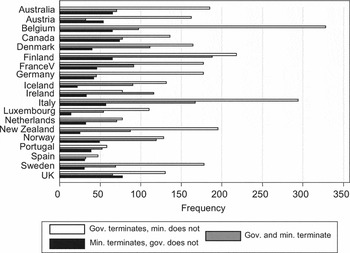
Figure 1 depicts for each country the number of ministers who fall into three different categories. The top bar for each country is the total number of ministers who remain in their portfolio following a government termination. The middle bar is the total number of ministers who leave the government at the time of a government termination. And the bottom bar is the total number of ministers who lose their job between the births and deaths of governments.
Minister Terminations and Government Terminations

If we compare the top two bars, which depict the fate of ministers at the time of a government termination, we can see that in every country but Ireland, the number of ministers who stay in their posts is higher than the number of ministers who leave the government. In many countries, the number is much higher: in eight countries the number of ministers who survive government terminations is more than double the number who are terminated. These data therefore suggest that factors affecting government terminations should be only loosely related to factors affecting ministerial terminations because governments often fall without bringing ministers down with them.
If we compare the middle and bottom bars in each country, which depict the ministers who are terminated, we see that there is substantial variation in the number of minister terminations that occur outside government terminations (the bottom bar in each country). In the aggregate, approximately one third of all terminations occur between the beginning and the end of a government, but the cross-national variation is considerable. The percentage terminated outside the time of government failure ranges from a low of 11% (Ireland) to a high of 62% (Austria), and in Austria and the UK more ministers lose their jobs outside the time of government terminations than leave at that time of government failures.
The data make clear that the relationship between government terminations and minister terminations is quite variable. Government terminations can obviously lead to the loss of posts for some ministers, but for many more it does not. And many ministers lose their posts when no government termination has occurred. It is therefore important to consider what factors, unrelated to government terminations, can explain the duration of individual ministers.
MORAL HAZARD AND ADVERSE SELECTION AS CAUSES OF MINISTER TURNOVER
We explore the effect on minister duration of adverse selection and moral hazard problems associated with naming and dismissing ministers. The adverse selection problem stems from uncertainty about an individual's incentives and ability to execute party policy as a minister, which opens the door to the appointment of “undesirable” ministers. The problem becomes more severe as uncertainty about the incentives and abilities of individuals increases. If performance in office reveals that particular individuals are ill-suited to their posts, then turnover should be highest in contexts where the adverse selection problem is most severe (because in such contexts, more mistakes will be made, and thus more individuals will need to be replaced).
The moral hazard problem stems from the fact that after they are appointed, some ministers, through either incompetence or political preference, will take actions that work against the interest of their party. Party members in the cabinet and parliament can attempt to discover such actions through proactive monitoring, and political events (“fire alarms”) may also reveal the unwanted actions. When such actions are discovered, the appropriate response will often be to replace the troublesome minister. Whether this is possible should depend on the political context, which determines how difficult it is to replace ministers after they are appointed. This argument about moral hazard has been central in the work of Indridason and Kam (Reference Indridason and Kam2005, Forthcoming), who suggest that prime ministers should be most likely to replace ministers when direct monitoring of ministers is most difficult, and when institutions make prime ministers strong within their own party. If we assume, then, that the normal course of parliamentary government will lead to the discovery of problematic ministers, turnover should increase as it becomes easier to replace ministers ex post.
Our central theoretical challenge is therefore to develop arguments about factors that affect the severity of adverse selection and moral hazard problems. To this end, we assume that decisions about appointments and dismissals are made by party leaders. The leader of each party who participates in government should have a strong say regarding ministerial appointments within his or her party and, among them, the most influential should be the prime minister, who has institutional advantages that leaders of coalition partners do not. Although we feel this general assumption is useful and reasonable, we recognize that it oversimplifies issues of bargaining across and within parties. An obvious pathway for future work should be to examine cross-national variation in how prime ministers are constrained vis-à-vis the appointment decisions of other party leaders and in how decision rules within political parties affect the ability of party leaders to act unilaterally in changing the composition of the cabinet.
The severity of the adverse selection problem depends on ex ante uncertainty about which ministers will perform well, and on incentives politicians have to engage in ex ante screening before portfolio allocation decisions are made. Uncertainty about potential ministers' skills should be influenced by factors affecting intra-party competition for leadership positions. If such competition is strong, it should decrease the adverse selection problem by winnowing out individuals who are least qualified for minister positions. It is difficult to measure the quality of such competition directly, but the size of the minister's political party should be relevant. Larger parties should have a larger number of well-qualified individuals to draw on, and stronger, more institutionalized competition for advancement within the party. Thus, other things equal, ministers from large parties should be associated with lower risks of termination.
The degree to which adverse selection problems lead to instability should also be affected by incentives to carefully screen potential ministers during the government formation process. More scrutiny at the stage of government formation should lead to better appointments and should reduce the need for cabinet changes later on, thus increasing the stability of ministers. In general, incentives to screen ministers ex ante should be largest when ministers have the greatest potential to influence outcomes ex post. The policy influence of ministers should vary both across countries and across portfolios. Ministers should have the greatest policy influence in political systems that give the most policymaking power to ministers, and when they hold the portfolios that are most central to the government's policy agenda.
The ability of ministers to use their positions to influence policy clearly varies across polities (e.g., Laver and Shepsle Reference Laver and Shepsle1994; Strom Reference Strom1990a, Reference Strom1990b). In some countries, ministers have considerable autonomy to shape policy, both during policy formation and policy implementation. In other countries, ministers have a much more administrative role, with major policy decisions being made by the prime minister or the collective cabinet. Ministerships in such systems are considered more of a payoff to individuals than as the strong delegation of policymaking autonomy. We should expect that the screening of individuals should be most careful in political systems where opportunities for policy influence ex post are greatest.
Second, just as some political systems create greater opportunities for ministerial influence on policy, some portfolios also create greater opportunities to influence policy outcomes, and typically require greater technical and political experience. In many countries the cabinet posts that provide the greatest opportunity to influence policy are Finance and Foreign Affairs. In some countries, other portfolios are more central to policymaking. Whenever the characteristics of the political system or the portfolio create greater opportunities for policy control, we should expect the assignment of such portfolios to be subject to the most intensive screening processes, and thus to have a higher probability of being allocated to individuals who will perform well for the party. This ex ante screening should lead to more stable ministers.
Third, incentives for ex ante screening should be greatest for individuals from parties that are far from the ideological center of gravity of the government. Because they represent parties that are distant from the coalition's mainstream, such ministers are in a position to do “policy damage” to the mainstream coalition parties. Thus, when individuals from parties that are “ideologically distant” (vis-à-vis other parties in the coalition) are selected to be ministers, they should be subject to more intense scrutiny than ministers from more mainstream parties. Such screening should lower the probability that these individuals will need to be replaced later on.
The ability to minimize the moral hazard problem should be determined by the constraints on the appointment powers of party leaders in general, and on the prime minister in particular. We focus in this paper on the constraints derived from political bargaining among parties. As Budge (Reference Budge1985) has argued, one of the most important constraints on the ability of leaders to replace ministers should be the existence of coalitions. Coalition agreements might impose constraints on personnel changes by ensuring that such changes can occur only if a costly, more general renegotiation of the entire coalition bargain occurs. Negotiations between coalition partners should further enhance the stability of ministers by revealing information on candidates for jobs and thus providing more thorough screening of potential ministers.
One implication of our assumption that party leaders are responsible for changes to cabinet members from their own party, and that the prime minister has more power over appointments, is that ministers are most vulnerable to replacement when they belong to the prime minister's own party. If the Christian Democrats and Liberals form a coalition headed by a Liberal prime minister, then the prime minister should have more discretion to make changes in portfolios controlled by Liberal ministers than in portfolios controlled by Christian Democrat ministers. Thus, as the ability and incentives of ministers is revealed and the need for change becomes clear, if coalition agreements impose constraints on such change, then we should see more turnover among members of the prime minister's party. Of course, if coalition agreements give party leaders the authority to replace ministers in their own party, then ministers from the prime minister's party will not be more subject to replacement than ministers from other parties.
Viewing ministerial stability through the lens of adverse selection and moral hazard problems leads to a quite different set of expectations about some of the same variables that are prominent in the cabinet stability literature. If turnover is influenced by efforts to address the uncertainty associated with assigning the most desirable individuals to the most important cabinet posts, then we must consider how the political context interferes with this process. Thus, factors that create the most freedom for prime ministers to change the cabinet as ministers' skills and incentives are revealed, like single-party majorities, should be associated with high turnover even when they also tend to lead to more stable governments. Similarly, variables like coalition government, which are held to increase cabinet instability, will reduce individual turnover by putting breaks on the ability of party leaders to assign and reassign individuals to portfolios.
THE EXPLANATORY VARIABLES
The arguments presented above point to the importance of variables that affect (1) the pool of individuals with the ability to serve well as ministers, (2) incentives party leaders have to conduct ex ante screening of potential ministers, and (3) the ability of party leaders to replace ministers. This section describes the specific measures we use for these variables in the duration models estimated below. We also describe measures from the cabinet duration literature that one should expect to influence minister duration.
To measure which parties will face the greatest uncertainty about the likely performance of a potential minister, we use the size of the minister's party. Party Size is the proportion of seats that the minister's party holds in parliament, and it should have a positive effect on minister duration if large parties have a stronger pool of capable ministers and more intense competition for leadership positions. We examine four variables that affect incentives for intensive ex ante screening of ministers. Ministerial Autonomy is a survey response by country experts who were asked to place their country on a scale that goes from 1 (where ministers have the least autonomy) to 9 (where ministers have the most autonomy) (see Laver and Hunt Reference Laver and Hunt1992). Policy Value of Portfolios is also a survey response from Laver and Hunt to the question: “Are cabinet portfolios valued more as rewards of office or as a means to affect policy?” The scale ranges from 1 to 9, where 1 indicates that portfolios are valued as rewards of office and 9 indicates that they are valued as means of affecting policy. In countries that give more policy power to ministers to affect policy, we expect screening to be more intensive and, as a consequence, individual ministers to be more stable.Footnote 5
Important Portfolio is a dummy that takes the value 1 if the minister occupied one of the two portfolios ranked in Laver and Hunt (Reference Laver and Hunt1992) as the most important in each country. If candidates for the most important portfolios are subject to the most intensive screening, and are awarded to the most capable individuals, ministers who hold these posts should have a longer duration than other ministers. Finally, Ideological Distance is the ideological distance of the minister's political party from the weighted left-right location of the government, using a 10-point left-right scale.Footnote 6 If coalition partners subject ministers from ideologically distant parties to the most intensive screening, ministers from such parties should be more stable than other ministers.
To measure the ease with which the Prime Minister or party leaders can replace ministers after they are appointed, we focus on the coalition status of the government. Coalition Majority takes the value 1 if the government is a coalition majority and PM's Party takes the value 1 if the minister is from the same party as the Prime Minister. Below, we also examine the impact of coalitions during minority government.
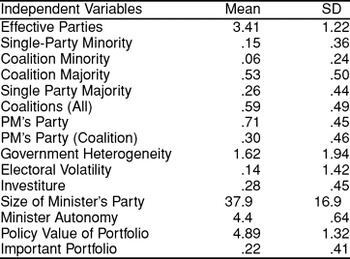
Ministerial turnover can also occur at the time of government terminations, making it important to examine the effect of standard variables in the cabinet stability literature on minister stability. Previous research suggests that minority and coalition governments are more unstable than single-party majorities. As noted above, Coalition Majority is included in the analysis, and we also include Minority Coalition and Single-Party Minority dummy variables. More fractionalized legislatures are also associated with less stable cabinets, and we include Effective Number of Parties, which is a standard fractionalization measure calculated based on the number of parties in parliament and their share of seats. More ideologically diverse governments are also associated with less stable governments, and our empirical tests include the variable Government Heterogeneity, which measures the ideological distance between the right-most and left most-party in the government using the data described for Ideological Distance. The existence of investiture votes is also found to be related to cabinet stability, and we include a dummy variable that takes the value 1 if a formal vote of investiture is required in a country. Finally, Electoral Volatility is the proportion of seats in the assembly that were gained and lost by all parties in government during the previous three weeks. This variable allows us to control for the impact of electoral change on portfolio turnover (rather than simply censoring ministers who “die” because of election results). Descriptive statistics for all variables are shown in Table 1.
Independent Variables: Descriptive Statistics

ESTIMATING DURATION MODELS OF MINISTER SURVIVAL
In contrast with previous work that studies the duration of cabinets, we are interested in the duration of individual ministers in their portfolios. We want to explore if the tenure of ministers in office is related to the challenges that party leaders and prime ministers face when deciding which individuals to appoint to ministerial posts, and to their ability to dismiss ministers when necessary. As we argued, if uncertainty about which individuals are most capable is reduced, or if particular institutional variables increase the ability of ministers to shape policy outcomes or constrain the ability of leaders to change the cabinet, we would expect to see lower individual turnover.
Duration or survival models are useful precisely when the dependent variable of interest is the time to the occurrence of a terminal event (or a failure)—in this case the exit of a minister from the cabinet. These types of models have become popular in political science and have gained remarkable prominence among scholars of cabinet duration in parliamentary politics.Footnote 7 In general, the main interest in duration analysis is to estimate the relationship between a vector of covariates and the time to the occurrence of an event (such as the termination of a minister). We are particularly interested in the hazard function, which gives us the probability that an individual minister survives to time t, given that she has not exited the government prior to that time.
A first issue involved in specifying the hazard function is that it can take different forms, depending on the assumptions we are willing to make about how the risk of failure changes over time. We can assume that the risk of an event happening is decreasing or increasing with time, or we can expect this risk to be constant over time. In fact, there has been much debate in the literature on cabinet duration about the relationship between time dependency and the processes that lead to the collapse of a government, and much of it has centered on the shape of the baseline hazard.Footnote 8
In the case of individual turnover, however, it is not clear that there is a simple relationship between time and the risk to a particular minister of leaving the cabinet. On one hand, we could hypothesize that with time, party leaders will master portfolio allocation decisions and thus the risk of failure for an individual minister will decrease over time. Even in this case, it would be hard to specify the shape of the decreasing hazard since we would have to determine exactly what the point in time is when party leaders have overcome the challenge of finding the appropriate people to staff the cabinet. On the other hand, if external shocks tend to reveal weaknesses in current appointees, and if these shocks are randomly distributed over the lifetime of a government, party leaders would need to respond to these changes throughout the term and we would not observe a systematic relationship between time and the risk of failure. Consequently, because we do not have clear ex ante expectations about the distribution in time of the risk of exiting the government, the duration models we estimate are semiparametric Cox (Reference Cox1972) proportional hazards models, which allow us to relate our covariates to ministerial tenures without having to make specific assumptions about the shape of the hazard function.
A second issue involved in model specification is the possibility that the lifetimes (or tenures) of ministers in the same country are not independent observations. The Cox (Reference Cox1972) proportional hazards model assumes that all individuals in the sample are subject to the same underlying risk. However, there are good reasons to believe that ministers in one country might be more or less susceptible to failure than ministers in a different country due to factors that are unobservable or difficult to measure. In practice, this would mean that ministers in high-risk countries might have a different hazard rate than ministers in low-risk ones, and by not controlling for the source of these differences (thus estimating a single hazard rate for low- and high-risk ministers) we might be estimating biased parameters or we might get misleading estimates of duration dependency (Hougaard Reference Hougaard2000).
As with other models, unit- or group-specific effects can be incorporated into duration analysis through fixed or random effects. Here we estimate a random-effects, or shared frailty, model in which all individuals in the cluster (country) are assumed to share a frailty term that is common for ministers in a country but that might differ from country to country. These models are similar to multilevel models, which have cases nested within “higher level” units (e.g., regional units nested within countries), and have been used in political science to study duration when there are “multilevel” independent variables (e.g., Epstein et al. Reference Epstein, Bates, Goldstone, Kristensen and O'Halloran2006). In these models, the frailty term is assumed to be an independent sample from a distribution, most typically the gamma distribution, with mean 1 and variance θ. Below, we estimate θ for each model and in every case find significant random effects.
A last issue involved in model specification concerns whether to treat all minister terminations as emerging from the same set of risk factors, or whether to treat ministers who are terminated at the time of government formation as being subjected to different risks than ministers who are terminated between the births and deaths of governments. On one hand, the data above suggest that pooling the risks may be a useful approach. First, the data show that when governments terminate, some ministers also lose their jobs, but many more typically stay in their posts. Second, many ministers leave the government outside the time of government terminations. Given the loose connection between minister and government terminations, it is perfectly plausible that the moral hazard and adverse selection variables could operate at any time, with party leaders replacing weak ministers at the time of a government termination or between terminations. Thus, it is useful to examine models where risks are pooled.
On the other hand, even though the events that produce government terminations often do not result in the termination of individual ministers, one would think that the factors associated with government terminations should be most helpful in explaining terminations that occur at the time of government failure than those that occur at other times. We might therefore assume that the dynamic that underlies minister terminations at the time of a government failure is different from the dynamic that leads to terminations between government failures. This assumption points one to a competing risks framework, which makes it possible to explore separately the factors that increase the likelihood that ministers will exit the government through either of these events.Footnote 9 Using this approach, we can test whether arguments about bargaining failures and arguments about adverse selection and moral hazard apply to both types of exits or whether each separate risk responds to a different set of explanatory variables.
In general, competing risks models allow us to explore the relationship between a set of variables and the rate of occurrence of failures of more than one type. When the terminating event causes the individual to leave the study completely (as we assume here ministers do when they leave their position), we can only observe a minister fail from whichever terminal event happens first and standard duration analysis does not allow us to know how the variables of interest affect the likelihood of failing from other risks. This means that we have no way of separating the effect of the government's majority status, for example, on the risk of a minister leaving due to a cabinet failure and on the risk of a minister leaving at any other time—which potentially would have happened had we been able to observe the minister after the first type of failure.
Assuming independence among risks, the estimation of the model is straightforward. Because each risk enters the likelihood function separately, the likelihood can be estimated as a standard duration analysis, calculating a separate duration model for each risk and treating all failure types different from the failure type of interest as censored at the time of the individual's failure. In our case, we estimate (1) models of minister failures that occur at the time of a cabinet failure (treating all other minister terminations as censored) and (2) models of minister failures that happen between government terminations (treating all other terminations as censored).
The practical problem we face in estimating these models is the same that others have faced in similar efforts—that is, the assumption of independent risks. In our context, this assumption implies that the risk of an individual exiting the cabinet at the time of a government failure is independent of his or her risk of leaving the cabinet between government terminations. As we have noted above, it may be that factors related to bargaining failure, uncertainty, and constraints on prime ministers may work differently for each type of failure, justifying the independence assumption. But we recognize that this assumption is quite strong, and when violated can lead to inconsistent parameter estimates and artificially small standard errors (Gordon Reference Gordon2002). However, we know of no practical alternative to making the independence assumption in estimating the competing risks models, and Gordon's study of stochastic independence of risks finds that violations of this assumption might have trivial consequences for the results on cabinet duration. Because the logic of the competing risks framework seems relatively obvious from the perspective of the cabinet stability arguments (though less obvious from the perspective of the moral hazard and adverse selection arguments) we explore both approaches, first looking at a model where we pool the risks, and then examining models where we assume competing risks.
EMPIRICAL RESULTS: POOLED AND COMPETING RISK MODELS
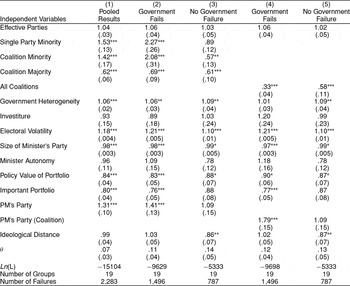
Column 1 of Table 2 shows the results of the duration model when we pool all minister terminations. The dependent variable is ministerial duration in weeks. If minister X enters the government in portfolio A on January 1, 1950, and leaves the government on January 1, 1952, the value for the dependent variable is the number of weeks minister X was in government, or 104. The coefficients in Table 2 are displayed as hazard ratios; a hazard rate above 1 is associated with an increase in the likelihood of failure, given a one-unit increase in the relevant independent variable; a hazard rate lower than one is associated with a decrease in this likelihood.
Results from Duration Models

Note: The dependent variable is the duration of ministers in weeks. Standard errors in parentheses. The omitted category in all models is single party majority government.
* Significant at .10.
** Significant at .05.
*** Significant at .01.
The bargaining failure variables have mixed success in explaining individual duration. As we would expect from the cabinet instability literature, minority governments have higher levels of turnover than single-party governments (which is the omitted category in all of the models we present), and more heterogeneous governments also have more unstable ministers. The number of effective parties in the legislature, however, is not a significant determinant of individual risk, nor is the existence of investiture votes. However, majority coalition governments, which typically have shorter cabinet duration than single-party majority governments, have individual ministers who last longer in office than do ministers in single-party majority governments. Although unexpected from the perspective of cabinet stability, this finding about coalitions is precisely what we would expect if coalition governments make it difficult for party leaders to respond to incentives to replace ministers who perform poorly.
The results also show considerable support for the moral hazard and adverse selection arguments. We argued that ministers should be more stable during coalition governments because coalition politics makes it more difficult for party leaders to replace ministers from their own parties. As noted above, the data show that ministers from coalition majorities are more stable than ministers from single-party majorities, and the substantive effect is quite large. The likelihood of leaving the cabinet is reduced by almost 40% for ministers in a coalition government when we compare them to ministers in single-party majority governments (the baseline category). Consistent with this same argument about the ease of replacing ministers, we also find that individuals from the prime minister's party are about 30% more likely to be replaced than ministers from other parties.
We argued too that ministers should be more carefully screened when they are from ideological outlying parties, when they hold important portfolios, and when they are in countries where the opportunities for policy influence are high. The results in column 1 for Important Portfolio and Policy Value of Portfolio support these arguments. An increase of one point on Laver and Hunt's 9-point ranking toward viewing portfolios as means of affecting policy decreases the hazard around 16%. Similarly, the risk of being terminated decreases around 20% for ministers who hold one of the two most important portfolios. However, we do not find support for these arguments for Ideological distance or for Ministerial Autonomy. The null result for Ministerial Autonomy is perhaps unsurprising as this variable varies little across countries.Footnote 10 Finally, the results indicate that ministers from larger parties are more stable, which is consistent with our argument that larger parties have a larger pool of talented individuals, leaving less occasion for replacement. Larger parties might also simply be dominant in the bargaining process, thereby stabilizing their ministers. We have some evidence that this is not the mechanism at work, however, because ministers from majority parties are actually less stable than ministers in majority coalitions.
The pooled results suggest that ministerial terminations cannot be explained based only on existing theories about cabinet stability and that the variables emerging from the moral hazard and adverse selection arguments play an important role in helping understand the duration of individual ministers. As noted above, however, it is also important to consider a competing risks framework, exploring separately the factors that increase the likelihood that ministers will be terminated (1) at the time of cabinet terminations and (2) between cabinet terminations. Again, we want to test empirically whether arguments about bargaining failures and arguments about adverse selection and moral hazard apply to both types of exits, or whether each type of exit responds to a different set of variables.
Consider first the results in column 2, which models minister terminations for ministers who exit the government at the time of a government failure. The results are almost identical to the ones from the pooled model in column 1. As before, bargaining failure variables have only limited success in explaining why ministers fail at the time of a government failure, which is in many respects unsurprising, given that such a large proportion of ministers do not exit the government when a government failure occurs. Government heterogeneity and minority status work in the expected direction, but coalition majority status, the number of effective parties and investiture votes do not. Results for the variables from the moral hazard and adverse selection arguments are also consistent with those in the pooled analysis. Ministers are more stable if they are in larger parties, in majority coalition governments, in countries where portfolios are valued as a means to affect policy, hold important portfolios, are not in the prime minister's party, and are in large parties. The coefficients on ministerial autonomy and ideological distance are not precisely measured.
Column 3 presents results for the ministers that fail outside the time of a government termination. The results for this type of termination tell a story that differs substantively from results in column 1. First, consistent with the expectation that bargaining failure variables would have less relevance for terminations that occur between government terminations, the only variable from the cabinet duration literature that has the effect predicted by this perspective is government heterogeneity. Ideological diversity of coalitions increases the risk of minister termination at all times, not just at the time of government failure. For the other cabinet duration variables, the most interesting difference between column 2 and 3 is the effect of minority government status on this type of minister termination. Although minority governments are widely recognized as the most unstable governments, ministers in single-party minority governments are no more at risk of dying between government terminations than are ministers from single-party majorities. But ministers in coalition minority governments are actually more stable between the births and deaths of governments than are ministers in single-party majorities. These results are consistent with our hypotheses about coalitions: whether a coalition is minority or majority, it constrains the ability of party leaders to make changes to the cabinet during the length of their term.Footnote 11
Other results support the arguments about adverse selection and moral hazard. Ministers in political systems where portfolios are more highly valued as means to affect policy, and ministers in larger parties are more stable. And unlike in the pooled results, we find support for the argument that ministers from ideological outlying parties are likely to undergo more thorough scrutiny and are thus less likely to be replaced in the course of the term. Given that this variable takes the value 0 for all single-party governments, the result indicates that ministers who are relatively distant from the center of gravity of governments are more stable than ministers from single-party governments or relatively centrist coalition ministers. We do not find, however, support for the hypothesis that ministers from the prime minister's party are more likely to be reshuffled that other ministers, nor do we find evidence to support the idea that ministers selected for the most important portfolios are less likely to be replaced than other ministers. Important Portfolio has the expected sign, but it is not significant at conventional significance levels (p=.14).
In columns 2 and 3, PM's Party takes the value 1 for all ministers who are in the same party of the prime minister, regardless of the majority or coalition status of the government. The variable therefore compares the duration of ministers who are not in the prime minister's party during coalitions with all other ministers. A more interesting comparison may focus within coalitions: between ministers in the prime minister's party and ministers in other coalition parties.Footnote 12 If, as we have argued, the prime minister has more power than other party leaders, and if the prime minister has more power over ministers in his or her own party than ministers in partner parties, then during coalitions, regardless of the government's majority status, ministers from the prime minister's party should have a higher risk of termination. To explore this possibility, the variable All Coalitions takes the value 1 if the minister is from a coalition majority or coalition minority government. The variable PM's Party (Coalition) takes the value 1 if the minister is from the prime minister's party during a majority or minority coalition government (i.e., it is Any coalition interacted with PM's Party). Because ministers in single-party governments are always from the prime minister's party, by substituting PM's Party (Coalition) for PM's Party, we can examine directly the difference in duration of ministers in coalitions who are in the prime minister's party with the duration of ministers in coalitions who are not in the prime minister's party.
Columns 4 and 5 present the competing risks results for the new models that include All Coalitions and PM's Party (Coalition). Column 4 examines ministers who fail at the time of a government termination, and column 5 examines ministers who fail between government terminations. Consistent with the moral hazard and adverse selection arguments, in both specifications, coalitions have more stable ministers than single-party governments, both at the time of government terminations and between the births and deaths of governments. In addition, we find that in coalition governments, ministers from the prime minister's party have a higher likelihood of being replaced at the time of a government termination than do ministers from other parties in the coalition. As in column 3, however, ministers from the prime minister's party are not more likely to be replaced between the birth and death of government than are ministers from other parties. That is, our data suggest that, during coalition government, all party leaders have similar opportunities to replace ministers from their parties between the births and deaths of government, but at the time of a government termination, ministers from the prime minister's party have a greater risk of replacement.
One might imagine that this greater risk for individual ministers at the time of government termination could be due to a greater probability that the prime minister's party leaves the government altogether. But in fact the opposite is true. If we look at government terminations for majority coalitions, the prime minister's party stays in power 80% of the time, whereas the other parties stay in government only 64% of the time. Our results, then, suggest that the termination of a coalition government is likely to lead to significant personnel changes in the prime minister's party, but such events do not effect significant changes in portfolios held by parties outside the prime minister's party. Results on all other variables are largely the same as results in columns 2 and 3.
CONCLUSION
We have shown that cabinet duration (defined by terminal events) and cabinet turnover (defined by the replacement of individuals within cabinets) are distinctive elements of government stability in parliamentary systems. The data reveal wide variation in the extent to which government terminations result in the termination of individual ministers, and in the extent to which minister terminations occur at the time of government failures as opposed to between the birth and death of governments. Consequently, the degree to which we can understand minister terminations by relying on insights derived from the study of cabinet duration is limited.
A wide range of factors will obviously influence the termination of individual ministers, many of which we have been unable to explore directly here, such as the popularity of the government, the personal traits of individual ministers, or the options outside of government for ministers, to name but a few.Footnote 13 Thus, this paper only begins to illuminate the complicated factors that influence minister duration. But by focusing on arguments about adverse selection and moral hazard, we hope to have set the study of individual duration down a useful path. Specifically, we have focused on how ministerial duration may be affected by the uncertainty party leaders have about which specific individuals will become successful ministers, the incentives party leaders have for conducting rigorous ex ante screening of ministers, and the opportunities and constraints party leaders face when they wish to replace particular ministers. Such factors affect the likelihood that strong ministers will be appointed, and that weak ones can be replaced.
Our empirical tests reveal that variables related to adverse selection and moral hazard problems help explain patterns of individual turnover. These variables include the policymaking power of ministers, the importance of the portfolios they hold, the ideological distance of ministers from the mainstream of the government, whether the ministers are in the prime minister's party, the size of the minister's party, and the coalition status of the government. We also find that variables from theories of cabinet stability are of limited importance to helping us understand individual turnover, particularly turnover that occurs between government terminations. Two variables that are central to this literature, minority government and the ideological heterogeneity of cabinets, do influence turnover in the expected direction, particularly when we pool all types of failures. But other variables that influence cabinet duration systematically, like investiture votes and the effective number of parties, have no effect on individual turnover. In particular, we find that ministers in coalition governments are less likely to be replace than ministers from single-party majority governments, which is not what we would expect from the cabinet duration literature but is consistent with arguments we have made about the constraints coalitions impose on party leaders who want to change their cabinet. Indeed, we find the constraints that coalitions impose on minister changes are present regardless of whether the coalition has majority or minority status, regardless of whether the coalition is minimum winning or has surplus parties, and regardless of whether terminations occur at the time of government terminations or between government failures.
Our finding regarding the relative stability of coalitions calls into question the way normative debates about forms of parliamentary government are framed. Coalition governments are extolled for their inclusiveness, which is said to come at a cost to cabinet stability. Single-party majorities are extolled for their stability and decisiveness, which is said to come at a cost to inclusiveness. Thus, implicit in this debate is the notion that stability is desirable. The analysis above suggests that both the empirical understanding and the normative interpretation of stability could be misguided. In fact, much of the cabinet “instability” in coalition governments is unrelated to actual turnover of individuals within the cabinet, with coalition ministers—even during minority government—actually being substantially more stable than ministers in single-party majority governments. Thus, focusing solely on cabinet terminations has limited our empirical understanding of underlying individual stability.
But are lower levels of turnover in coalitions good for policymaking? The analysis calls into question the normative premise that stability of ministers in office is always desirable. The empirical results presented above indicate that as it becomes easier for party leaders to make cabinet changes, more cabinet changes occur. Indeed, duration is lowest when prime ministers have the fewest constraints—that is, when prime ministers enjoy a single-party majority, or when they are dealing with ministers in their own parties. Party leaders, then, seem to welcome the opportunity to change ministers, and the evidence shows they take advantage of such opportunities when they exist. If one assumes that the uncertainty about which individuals will be the most effective ministers requires that party leaders adjust course by making personnel changes, then the constraint that coalitions impose on changes may prevent “good turnover” that is the result of weeding out less able individuals and putting the best agents into the most important positions. We are not arguing, of course, that turnover is always good, but rather that arguments about the effects of instability have tended to be one-sided, and that the analysis here draws into sharp relief some of the possible benefits of allowing “failures” to happen more rather than less often.
Although it is beyond the scope of this paper to analyze the effects of turnover on policymaking, a central theme emerging from the analysis is that the effects of turnover should depend on the political context. Turnover, for example, is highest in institutional contexts where prime ministers have the least impact on policy. It follows that the impact of turnover on policy should be greatest when it occurs in situations where ministers can use their position atop their departments to exercise strong influence on policy. An important pathway for future research is to explore how cabinet turnover influences policymaking. Because cabinet turnover is clearly distinct from cabinet instability, the effect of these two variables on policymaking should also be distinct. Given the noisiness of instability measures, we feel it makes more sense to focus on turnover. But the analysis here underlines that the impact of turnover on policymaking should not be constant across time and place. Instead, it should depend in systematic ways on the political factors that cause turnover in the first place.



Comments
No Comments have been published for this article.