


Non-technical Summary
Macroalgae (‘seaweeds’) are only very rarely preserved as fossils. Here, two new species of fossil macroalgae are described from Silurian-age rocks, ~436 million years old, in the Upper Peninsula of Michigan. One of the new species, Archaeobatophora gulliverensis, shows strong similarities to a living green alga called Batophora, a delicate seaweed common today in the warm shallow seas around the Florida Keys. The other new species, Earltonella swinehartii, is broadly similar to the abundant and widespread living green alga Caulerpa, a species of which (Caulerpa taxifolia), known as ‘killer algae,’ is currently causing considerable harm to the native Mediterranean Sea ecosystem. In addition, a macroalgal species previously known from northern Michigan, but only from Schoolcraft County, is reported from rocks of the same age in neighboring Mackinac County. This new occurrence of Thalassocystis striata, which broadly resembles a living green alga with the common name of dead man’s fingers (Codium), extends the geographic range of this species in northern Michigan by some 12 km to the east. In broader terms, the two new species help to enhance our understanding of seaweeds shortly after a critical episode in the history of life known as the Great Ordovician Biodiversification Event (GOBE). This event, which refers to the relatively rapid evolution of many new types of animals, has recently been shown to be associated with a major ‘revolution’ among seaweeds, in which an array of macroalgae with complex forms arose and largely replaced the relatively simple forms that had previously dominated the seas. Both of the new fossil macroalgal species from Michigan have complex forms and thereby add to the diversity of such forms that evolved at this time, perhaps, in part, to adapt to new and more effective types of algae-eating animals that arose during the GOBE.
Introduction
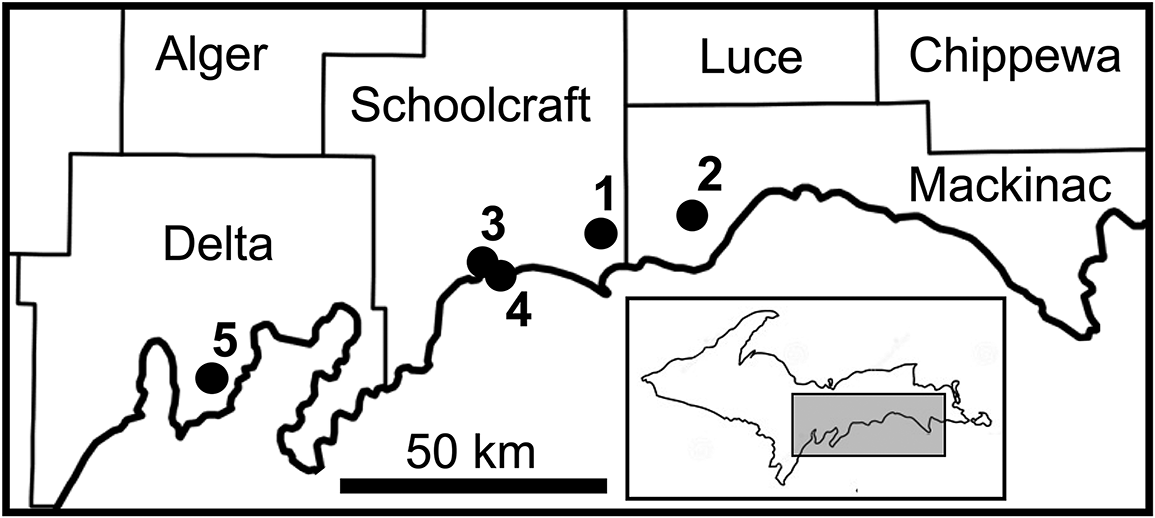
The upper Llandoverian (Telychian) Schoolcraft Formation in Schoolcraft County, northern Michigan, is notable for including several intervals of exceptional preservation, each of which is an algal-Lagerstätte characterized by locally abundant specimens of Thalassocystis striata Taggart and Parker, Reference Taggart and Parker1976, a noncalcified taxon with a thallus architecture broadly comparable to that of the extant bryopsidalean green alga Codium Stackhouse, Reference Stackhouse1797 (LoDuca et al., Reference LoDuca, Swinehart, LeRoy, Tetreault and Steckenfinger2021). In this report, two new noncalcified macroalgal species are proposed on the basis of material recovered from this unit in Schoolcraft County and a new Thalassocystis striata occurrence is documented within this unit in neighboring Mackinac County, expanding eastward the geographic range of the species within the northern part of the Michigan Basin (Fig. 1).
Localities and counties in the Upper Peninsula of Michigan (inset) mentioned in the text. Locality numbers: 1, Carmeuse Lime and Stone quarry; 2, Mackinac County Road Commission quarry; 3, Inland Lime and Stone Company quarry, Manistique; 4, type locality for Thalassocystis striata; 5, type locality for Archaeobatophora typa. See text for additional details.

One of the new species closely resembles the vegetative thalli of the extant dasycladalean green alga Batophora Agardh, Reference Agardh1854. Descriptions for, and interpretations of, this taxon were informed by detailed comparisons with the two living species of Batophora, including aspects of their ontogeny, and with similar noncalcified macroalgal taxa from Upper Ordovician and Silurian strata, including species belonging to Primicorallina Whitfield, Reference Whitfield1894, Callithamnopsis Whitfield, Reference Whitfield1894, and Archaeobatophora Nitecki, Reference Nitecki1976. Notably in this regard, the type species of the latter, Archaeobatophora typa Nitecki, Reference Nitecki1976, is known only from Delta County, Michigan, immediately to the west of Schoolcraft County (Fig. 1), where it occurs in the Upper Ordovician (Katian) Big Hill Formation in the context of the Big Hill Lagerstätte (Lamsdell et al., Reference Lamsdell, LoDuca, Gunderson, Meyer and Briggs2017). The other new species shows a thallus architecture comparable to that of the extant bryopsidalean green alga Caulerpa Lamouroux, Reference Lamouroux1809. Descriptions for, and interpretations of, this taxon were informed by detailed comparisons with living species belonging to this genus, particularly those with pinnate fronds, and with the Silurian taxon Earltonella fredricksii LoDuca in LoDuca et al., Reference LoDuca, Meacher, Pepper, Brett and Isotalo2023, which was recently described as a new genus and species of bryopsidalean alga on the basis of material from Telychian strata in the Lake Timiskaming area of Ontario (LoDuca et al., Reference LoDuca, Meacher, Pepper, Brett and Isotalo2023).
A further aim of this paper is to examine the two new species in the broader context of macroalgal evolutionary history. In this regard, the new species were viewed from the perspectives of (1) a large-scale morphological pattern documented in the evolutionary history of early Paleozoic macroalgae by LoDuca et al. (Reference LoDuca, Bykova, Wu, Xiao and Zhao2017), and (2) an emerging understanding of major radiations of bryopsidalean and dasycladalean algae that began during the Ordovician and continued into the Silurian (LoDuca, Reference LoDuca2024).
Geologic setting
Macroalgal material described herein from the Carmeuse Lime and Stone quarry near Gulliver (Fig. 1, locality 1) was collected from a thin interval of thin-bedded to laminated, finely crystalline dolostone within the lower part of the Schoolcraft Formation that, at the time of collection, formed the cap unit (i.e., the uppermost bedrock interval) in the area of the quarry that yielded the specimens. This interval, which was described in detail at this locality by LoDuca et al. (Reference LoDuca, Swinehart, LeRoy, Tetreault and Steckenfinger2021), is the lowermost of three stratigraphic intervals in the Schoolcraft Formation within Schoolcraft County known to produce specimens of Thalassocystis striata. Associated macrofaunal elements include ostracods, nautiloids, crinoids, graptolites, pentamerid and atrypid brachiopods, and styginid, encrinurid, and calymenid trilobites (mainly isolated cephala and pygidia), all of which are rare. Chitinozoans and scolecodonts are also present.
Specimens of Thalassocystis striata described herein from Mackinac County were collected at a Mackinac County Road Commission quarry located on the eastern side of Gould City Road, 1.5 km south of Gould City (Fig. 1, locality 2). The specimens were recovered from a thin interval of dark-colored, fine-grained and chert-rich dolostone in the upper part of the Schoolcraft Formation, ~2 m below the contact with the overlying Cordell Formation. At the time of collection, this interval formed the quarry floor on the western side of the pit. Associated fossils were sparse but included pentamerid brachiopods. This alga-bearing interval could correlate with the uppermost Schoolcraft occurrence of T. striata in the Manistique area, which was described by Ehlers (Reference Ehlers1973, p. 129) as the upper of two occurrences of “Inocaulis manistiquensis” in the Inland Lime and Stone Company quarry (Fig. 1, locality 3).
Material and methods
Material utilized from the Carmeuse Lime and Stone quarry comprised a total of 10 specimens distributed across seven slabs collected in 2018, 2021, and 2023; material utilized from the Mackinac County Road Commission quarry comprised a total of five specimens, each on a separate small slab, collected in 2023. Material was obtained by splitting slabs that were either pried from the quarry floor or had been previously dislodged by blasting carried out by the quarry operation.
High-resolution morphometric data were obtained from digital images using the open source program ImageJ (Schneider et al., Reference Schneider, Rasband and Eliceiri2012). Specimens were photographed with a Canon digital camera fitted with a macrolens. In some cases, submersion of specimens in water was used to enhance contrast.
Morphological terminology applied herein is that for algae. Dasycladales terminology follows Berger and Kaever (Reference Berger and Kaever1992); Bryopsidales terminology follows Taylor (Reference Taylor1960).
Repositories and institutional abbreviations
Types, figured, and other specimens examined in this study are deposited in the Field Museum of Natural History (FMNH), Chicago, Illinois, USA; Smithsonian Institution National Museum of Natural History (USNM), Washington, D.C., USA; D.M. Fisk Museum of Natural History (DMF), Hillsdale, Michigan, USA; University of Michigan Invertebrate Paleontology Collection (UMMP), Ann Arbor, USA; University of New Hampshire Macroalgal Collection (NHA), Durham, USA; and Royal Ontario Museum (ROM), Toronto, Canada.
Systematic Paleontology
Division Chlorophyta Reichenbach, Reference Reichenbach1828
Order Dasycladales Pascher, Reference Pascher1931
Family Triploporellaceae (Pia, Reference Pia1920) Granier and Bucur in Granier et al., Reference Granier, Dias-Brito, Bucur and Tibana2012
Genus Archaeobatophora Nitecki, Reference Nitecki1976
Type species
Archaeobatophora typa Nitecki, Reference Nitecki1976 (Fig. 2.1, 2.2), by monotypy, from the Big Hill Formation in a quarry on the western side of Delta County Route 511, ~13 km south of Ensign, Delta County, Michigan (Fig. 1).
Archaeobatophora typa and similar Batophora-like taxa from the Ordovician and Silurian: (1) Archaeobatophora typa Nitecki, Reference Nitecki1976, Ordovician (Katian), Big Hill Formation, Delta County, Michigan, holotype is large thallus at top, FMNH PP 18122; (2) enlargement of thallus marked by arrow in (1) showing details of main axis morphology and terminal tuft; (3) Callithamnopsis fruticosa (Hall, Reference Hall1865), Ordovician (Sandbian), Platteville Formation, Platteville area, Wisconsin, lectotype, USNM P 41089; (4) Primicorallina trentonensis Whitfield, Reference Whitfield1894, Ordovician (Katian) Trenton Group, Middleville, New York, USNM 458672; (5) Diplospirograptus goldringae Ruedemann, Reference Ruedemann1925, Silurian (Wenlockian) Goat Island Formation, Gasport, New York, UMMP 84854; (6) Eocladus xiaoi LoDuca, Melchin, and Verbruggen, Reference LoDuca, Melchin and Verbruggen2011, Silurian (Ludlovian) Cape Phillips Formation, Cornwallis Island, Canada, paratypes, ROM 59912a, b. Scale bars = 5 mm (2); 10 mm (1, 3–6).

Diagnosis
Thallus noncalcified, comprising an upright main axis with branched laterals in whorls (euspondyl) spaced at intervals of 0.4–1 mm. Main axis cylindrical; widest at whorls and with subtle and gradual narrowing between whorls; unbranched or with bifurcation. Laterals branched up to the fourth order; primaries cylindrical (acrophore) with widths of 0.08−0.2 mm and lengths five to seven times the width; secondaries and higher-order segments hair-like; terminal tuft conspicuous, comprising a dense array of upward-directed laterals. Gametophores and other external reproductive structures lacking.
Occurrence
Ordovician (Katian) and Silurian (Telychian); Michigan, USA.
Remarks
Nitecki (Reference Nitecki1976) erected Archaeobatophora typa as a new genus and species on the basis of four thalli preserved on the bedding plane surface of FMNH PP 18122 (Fig. 2.1), a small slab measuring ~12 cm by 17 cm recovered from the Ordovician (Katian) Big Hill Formation in Delta County, Michigan (Fig. 1). In the many years since publication of that report, the specimens on FMNH PP 18122 have not received further in-depth study based on direct examination, and no additional material of this species has come to light despite intensive collecting of, and quarrying activity in, the Big Hill Formation at the type locality (Lamsdell et al., Reference Lamsdell, LoDuca, Gunderson, Meyer and Briggs2017, Reference Lamsdell, Gunderson and Meyer2019; LoDuca, Reference LoDuca2019). During the current investigation, this slab was examined in the FMNH collections and high-resolution digital images were acquired.
The four thalli on FMNH PP 18122 are preserved as carbonaceous compressions and, from a taphonomic standpoint, are comparable to specimens considered herein from other Ordovician and Silurian deposits. Measurements of key thallus parameters obtained with ImageJ (Table 1) do not differ appreciably from those provided by Nitecki (Reference Nitecki1976). Two aspects of Nitecki’s description, however, both pertaining to the main axis, were found to be in need of clarification and modification. First, Nitecki (Reference Nitecki1976, p. 34) described the main axis as being “regularly constricted between the whorls.” This is indeed the case, but to this observation it is important to add that this change is subtle and gradual, rather than an abrupt pinching, and amounts to a total reduction in diameter between the whorls of only ~20% (Fig. 2.2). Second, Nitecki (Reference Nitecki1976, p. 34) described the presence of “weak calcification” along the main axis. During the present investigation, evidence of calcification, e.g., mineralized crust or film, was not observed on any of the thalli on FMNH PP 18122 (Fig. 2.1, 2.2). Notably in this regard, the shelly fauna of the Big Hill Lagerstätte, which includes trilobites, bivalves, gastropods, and nautiloids, shows significant decalcification, with many specimens surviving solely as molds (Lamsdell et al., Reference Lamsdell, LoDuca, Gunderson, Meyer and Briggs2017). Thus, it is unlikely that a thin coating of calcium carbonate, had it been present in life, would have been preserved for the Archaeobatophora typa material.
Morphometric data for Archaeobatophora typa and similar fossil and living species. Abbreviations as follows: N = number of primaries per whorl; na = not applicable. Numbers for primary lateral form: 1 = cylindrical, 2 = expanded proximally. Morphometric data for Batophora oerstedii and B. occidentalis from measurements and images provided by Berger and Kaever (Reference Berger and Kaever1992). Values in parentheses are maxima for the species. All measurements in mm

In view of these findings, the genus diagnosis presented above largely follows the ‘definition’ provided by Nitecki (Reference Nitecki1976, p. 34), but details pertaining to main axis morphology have been revised, and main-axis calcification is no longer included. In addition, on the basis of material assigned herein to a new species of Archaeobatophora, constraints pertaining to size have been removed or modified, and the possibility of main-axis branching has been added.
As conveyed by the name, Archaeobatophora resembles the living dasycladalean alga Batophora. Nitecki (Reference Nitecki1976) listed the following characteristics of the former as distinguishing it from the latter: (1) main axis calcified and with constrictions between the whorls; (2) closely-spaced whorls; (3) whorls of laterals bearing higher-order segments along the entire main axis, including the lower part; (4) laterals with short primary segments and branched only to the fourth order; and (5) pronounced terminal (apical) tuft comprising a dense array of upward-directed laterals at the top of the main axis. During the current investigation, however, it was found that these items vary little if at all between these taxa. In this regard, the subtle between-whorl narrowing of the main axis noted above for A. typa is also evident in Batophora oerstedii Agardh, Reference Agardh1854 (e.g., Berger and Kaever, Reference Berger and Kaever1992, fig. 3.19a); whorl spacing for A. typa overlaps with that of Batophora occidentalis (Harvey, Reference Harvey1858) Berger and Kaever, Reference Berger and Kaever1992, ex M.J. Wynne (Table 1); one of the A. typa thalli on FMNH PP 18122 lacks higher-order lateral segments on the lower part (Fig. 2.1) and well-developed whorls are present along the lower part of Batophora thalli until late in ontogeny, when most higher-order lateral segments are shed (e.g., Fig. 3.7); the primary lateral segments of A. typa are only marginally shorter than those of B. occidentalis (1.0 vs. 1.5 mm; Table 1) and although the laterals of Batophora can branch to the seventh order, “the laterals branch mostly to the fourth [order]” (Berger and Kaever, Reference Berger and Kaever1992, p. 86); and the terminal tuft of A. typa is only slightly more conspicuous than that frequently developed by both species of Batophora (e.g., compare tuft-bearing thalli in Figs. 2.1 and 3.7). From a taxonomic standpoint, then, it is concluded that the items listed by Nitecki (Reference Nitecki1976) are not sufficient to preclude assignment of A. typa to Batophora. Main-axis width for A. typa is somewhat wider than those displayed by each of the living Batophora species (1.0 vs. 0.5 and 0.3 mm, respectively; Table 1), but this difference, as with those listed above, is not regarded as sufficient to warrant separation of these taxa at the genus level. Moreover, material assigned herein to Archaeobatophora as a new species shows a main axis width (0.3 mm) that matches that of B. occidentalis.
(1−6) Archaeobatophora gulliverensis n. sp., Schoolcraft Formation (Llandoverian), Carmeuse Lime and Stone quarry, Gulliver, Michigan: (1) thallus showing complete array of intact laterals and conspicuous terminal tuft, holotype, UMMP 84855; (2) thallus showing bifurcation of main axis and loss of most higher-order lateral segments, paratype, UMMP 84855.001; (3) nearly complete thallus, paratype, UMMP 84856; (4) nearly complete thallus, paratype, UMMP 84856.001; (5) thallus with poorly preserved laterals, paratype, UMMP 84855.002; (6) thallus showing significant loss of higher-order lateral segments along the lower part of the main axis, paratype, UMMP 84857. (7) Herbarium specimens of Batophora occidentalis (Harvey, Reference Harvey1858) Berger and Kaever, Reference Berger and Kaever1992, ex M.J. Wynne, San Salvador Island, Bahamas, NHA-624074 (image from macroalgae.org; usage rights: http://creativecommons.org/licenses/by-nc/3.0/). Scale bars = 5 mm (1–6); 10 mm (7).

A marked difference between Archaeobatophora and Batophora is evident, however, with regard to the development of gametophores. In Batophora, these external reproductive structures are arrayed as conspicuous clusters laterally attached to the ends of primary and secondary lateral segments in the upper part of mature thalli. In contrast, no external reproductive structures of any kind have been observed in material of Archaeobatophora, including new specimens described herein as representing a new species within the genus and showing different ontogenetic stages, including one expected to be associated with gametophore development (see below). This lack of gametophore development definitively establishes Archaeobatophora as a genus distinct from Batophora. Notably, Nitecki (Reference Nitecki1976) assigned Archaeobatophora to the family Dasycladaceae and placed it alongside Batophora within the tribe Batophoreae. This assignment was rejected by Berger and Kaever (Reference Berger and Kaever1992) and Granier et al. (Reference Granier, Dias-Brito, Bucur and Tibana2012) owing to a lack of gametophores among material of A. typa. Here, on the basis of its euspondyl lateral arrangement and endosporate or cladosporate, as opposed to choristosporate, reproduction, Archaeobatophora is formally transferred to Triploporellaceae.
The only fossil taxon compared against Archaeobatophora by Nitecki (Reference Nitecki1976) was Chaetocladus Whitfield, Reference Whitfield1894. This noncalcified alga is known from Upper Ordovician through Lower Devonian strata (LoDuca, Reference LoDuca1997) and was documented by LoDuca (Reference LoDuca2019) to co-occur with A. typa at the type locality for the latter. As noted by Nitecki (Reference Nitecki1976) and supported by an in-depth study of Chaetocladus by LoDuca (Reference LoDuca1997), the two taxa differ markedly with regard to lateral morphology, because the laterals of Archaeobatophora branch whereas those of Chaetocladus are strictly unbranched. Nitecki (Reference Nitecki1976, p. 38) also remarked in the ‘Relationships’ section of his report that “Callithamniopsis [sic] and Primicorallina are too poorly known to warrant comparison with Archaeobatophora.” Callithamnopsis has since been redescribed on the basis of newly collected material of the type species, Callithamnopsis fruticosa (Hall, Reference Hall1865), together with re-examination of the type material from the Ordovician (Sandbian) Platteville Formation of southwestern Wisconsin (LoDuca, Reference LoDuca2019). From that redescription, it is clear that the general habit of this taxon is very similar to that of Archaeobatophora, including euspondyl arrangement of the primary laterals (Fig. 2.3). Indeed, the only differences of note are that Callithamnopsis lacks an apical tuft and is characterized by primary laterals that are distinctly expanded proximally, adjacent to the main axis, as opposed to having a simple cylindrical form (Table 1). On the basis of these differences, Archaeobatophora is herein maintained as a genus separate from Callithamnopsis.
Specimens of the type and only known species of Primicorallina, P. trentonensis Whitfield, Reference Whitfield1894, from the Ordovician (Katian) Trenton Group at the Middleville, New York, type locality, were examined as part of the present study. These specimens unambiguously show primary laterals with an aspondyl, as opposed to euspondyl, arrangement (Fig. 2.4). Such an arrangement is shown in line drawings provided by Whitfield (Reference Whitfield1894, pl. 9, figs. 14–16) and is evident in images presented by Johnson (Reference Johnson1961, pls. 19, 20), but the reconstruction provided by Ruedemann (Reference Ruedemann1909, pl. 1, fig. 2) conveys a euspondyl arrangement and is idealized in this regard. This difference in primary lateral arrangement serves to distinguish Archaeobatophora from Primicorallina. Notably, as with Callithamnopsis, this taxon differs from Archaeobatophora in lacking a terminal tuft, and a further difference concerns the form of the terminal lateral segments, these being robust, with a “pyriform” shape (Ruedemann, Reference Ruedemann1909, p. 199), rather than thin and hair-like.
Archaeobatophora also bears a marked similarity to the Silurian taxon Diplospirograptus Ruedemann, Reference Ruedemann1925 (Fig. 2.5). The type and only known species, Diplospirograptus goldringae Ruedemann, Reference Ruedemann1925, is known only from the Wenlockian Goat Island Formation at the type locality near Gasport, New York (LoDuca, Reference LoDuca1995; LoDuca and Brett, Reference LoDuca, Brett, Brett and Baird1997). It was originally described as a graptolite, but Mierzejewski (Reference Mierzejewski1986) and LoDuca (Reference LoDuca1995) regarded it as an alga similar to Batophora. As with both Callithamnopsis and Primicorallina, this taxon differs from Archaeobatophora in lacking a terminal tuft and, as with Primicorallina, the terminal lateral segments differ markedly from those of Archaeobatophora, in this case having the form of stout cylinders. Notably, Diplospirograptus can show thalli with ramified (bifurcated) main axes (e.g., Ruedemann, Reference Ruedemann1925, pl. 7, fig. 1) and the same is noted herein among specimens assigned to a new species of Archaeobatophora.
Two other Silurian noncalcified dasycladalean genera, Inopinatella Elliott, Reference Elliott1971 and Eocladus LoDuca, Melchin, and Verbruggen, Reference LoDuca, Melchin and Verbruggen2011, are characterized by a thallus morphology similar to Archaeobatophora. Inopinatella, erected on the basis of material from the Ludlovian of England (Elliott, Reference Elliott1971) and possibly also occurring in the Llandoverian (Aeronian) of Estonia (Tinn et al., Reference Tinn, Meidla, Ainsaar and Pani2009), differs from Archaeobatophora in lacking a terminal tuft and in the shape of the primary lateral segments, with those of the type species (Inopinatella lawsoni Elliott, Reference Elliott1971), as with those of Callithamnopsis, being distinctly expanded adjacent to the main axis (Table 1). Indeed, Inopinatella might well be a junior synonym of Callithamnopsis because, in the re-examination of the Callithamnopsis type species by LoDuca (Reference LoDuca2019), the primary laterals were identified as having a euspondyl arrangement at all levels and the only other key distinction noted by Elliott (Reference Elliott1971, p. 640)—the ‘jointed’ morphology of the main axis mentioned in Whitfield’s (Reference Whitfield1894, p. 354) description—was determined to be a taphonomic artifact. Eocladus, which is known from the Ludlovian of Arctic Canada (LoDuca et al., Reference LoDuca, Melchin and Verbruggen2011) as well as the Upper Ordovician (Sandbian) of Estonia (Kröger et al., Reference Kröger, Tinn, Rikkinen, Jolis, Butcher, Toom and Hints2023), emerges as showing the greatest degree of similarity to Archaeobatophora of all Ordovician and Silurian noncalcified dasycladalean taxa. In erecting Eocladus, LoDuca et al. (Reference LoDuca, Melchin and Verbruggen2011) pointed to main-axis morphology as the key distinguishing characteristic between it and Archaeobatophora, with the main axis of the type species, Eocladus xiaoi LoDuca, Melchin, and Verbruggen, Reference LoDuca, Melchin and Verbruggen2011 (Fig. 2.6), maintaining a uniform width between whorls. The secondary segments of this species are also longer than those observed in all of the other aforementioned Batophora-like genera by a factor of no less than 3.5.
Viewed in broader terms, the forgoing indicates that genera similar to Batophora were common, diverse, and widespread during the Late Ordovician and Silurian, although further study and additional material could reveal some synonymies within this large complex of Batophora-like taxa. Notably, the lack of external reproductive structures in all of these fossil genera points to a post-Silurian origin of the gametophore-bearing Batophoreae.
Archaeobatophora gulliverensis new species
Ontogenetic sequence of Archaeobatophora gulliverensis n. sp., Schoolcraft Formation (Llandoverian), Carmeuse Lime and Stone quarry, Gulliver, Michigan: (1) Stage 1 thallus showing complete array of intact laterals, holotype, UMMP 84855; (2) Stage 2 thallus showing significant loss (shedding) of higher-order lateral segments along the lower part of the main axis, paratype, UMMP 84857; (3) Stage 3 thallus showing complete loss of higher-order lateral segments, paratype, UMMP 84856.002. See text for details. Scale bar = 2 mm (all).

Holotype
UMMP 84855 (Figs. 3.1, 4.1) from an exposure of the Schoolcraft Formation in the Carmeuse Lime and Stone quarry, Schoolcraft County, Michigan (Fig. 1).
Diagnosis
Archaeobatophora of small stature and delicate construction; thallus up to 30 mm in height and 5 mm in width; main axis 0.3 mm wide; widths of primary and terminal lateral segments 0.08 mm and 0.02 mm, respectively.
Occurrence
Schoolcraft Formation of the Manistique Group (Llandoverian) in the Carmeuse Lime and Stone quarry, Schoolcraft County, Michigan (an expansion of Ehlers’ [1973] locality 73) (Fig. 1). UMMP 84855, 84855.001, 84855.002, 84856, 84856.001, 84856.002, and 84857 were collected in the vicinity of 46°02’40.4”N, 85°53’59.2”W; DMF 7395.1, 7395.2, and 7395.3 were collected at 46°03’39.65”N, 85°49’27.28”W.
Description
Thallus of holotype (UMMP 84855; Figs. 3.1, 4.1) noncalcified, preserved as a carbonaceous compression on bedding plane surface, small, delicate, 25 mm in height, 5 mm in width, comprising a central main axis around which, for most of its length, branched laterals are disposed in whorls (euspondyl); ~4 primary laterals per whorl; vertical spacing between whorls 0.4 mm. Main axis cylindrical, 0.3 mm in diameter, with subtle narrowing between each whorl, hollow. Laterals branched up to fourth order, most branched to third order; primaries cylindrical (acrophore), 0.5 mm in length, 0.08 mm in width; higher-order segments hair-like, slightly decreasing in width at each successive level; width of terminal segments 0.02 mm. Upper part of thallus showing conspicuous terminal (apical) tuft formed of dense array of upward-directed laterals with extensive branching. External reproductive structures lacking. Thalli of UMMP 84855.001, 84855.002, 84856, 84856.001, and 84857 similar to those of holotype, but 84855.001 showing bifurcation of main axis and significant loss (shedding) of higher-order lateral segments (Fig. 3.2); 84855.002, 84856, and 84856.001 are less well preserved (Fig. 3.3–3.5); 84857 showing significant loss of higher-order lateral segments along lower part of thallus but retaining prominent and well-preserved terminal tuft (Figs. 3.6, 4.2). Thallus of UMMP 84856.002 comprising main axis for which almost all higher-order lateral segments have been lost through shedding (Fig. 4.3).
Etymology
Named for the town of Gulliver, Michigan, which is located near the quarry that produced the material.
Materials
Holotype: UMMP 84855 (Figs. 3.1, 4.1); paratypes: UMMP 84855.001 (Fig. 3.2), 84855.002 (Fig. 3.5), 84856 (Fig. 3.3), 84856.001 (Fig. 3.4), 84856.002 (Fig. 4.3), 84857 (Figs. 3.6, 4.2); non-type specimens: DMF 7395.1, 7395.2, 7395.3.
Remarks
The Silurian material assigned herein to a new species of Archaeobatophora differs from A. typa primarily in its smaller size and more delicate construction, this being most evident in terms of thallus height (17–30 mm vs. 40–95 mm), thallus width (5 mm vs. 10–15 mm), main-axis width (0.3 vs. 1.0 mm), and the width and length of the primary lateral segments (0.08 and 0.5 vs. 0.2 and 1.0 mm) (Table 1). Whorl spacing also differs somewhat, this being somewhat tighter in the new species (0.4 vs. 1 mm) (Table 1). Notably, differences in thallus height and width between the new species and A. typa accord with those between the two living Batophora species. Specifically, A. typa is a close match in these regards with B. oerstedii and the new species compares closely with B. occidentalis (Fig. 3.7; Table 1).
The new species also differs from Archaeobatophora typa in that the main axis can show bifurcation (Fig. 3.2). Such a morphology, which is known for a single specimen, does not, however, preclude inclusion of the new species within Archaeobatophora for two reasons. First, the living dasycladalean genus Dasycladus Agardh, Reference Agardh1828 develops a vegetative thallus very much like that of Batophora and includes species with unbranched and branched main axes (Berger and Kaever, Reference Berger and Kaever1992). Second, A. typa is known from extremely limited material (a single cluster of thalli). Therefore, the possibility of main axis branching in this taxon cannot be definitively excluded.
The main axis of the new species, as with that of Archaeobatophora typa, is hollow. For the holotype and other specimens, this is evident where, in localized instances, the plane of the split passed through the axis (Fig. 4.1, 4.3). A hollow main axis has also been noted for thalli of the similar early Paleozoic taxa Inopinatella, Callithamnopsis, and Primicorallina (Whitfield, Reference Whitfield1894; Ruedemann, Reference Ruedemann1909; Elliott, Reference Elliott1971; LoDuca, Reference LoDuca2019).
A phylogenetic affinity for the new species, and for Archaeobatophora in general, within Dasycladales is indicated by (1) the general thallus architecture, comprising an upright central axis bearing whorls of branched laterals; (2) the hollow and nonseptate nature of the main axis (and, presumably, the lateral segments as well), indicating siphonous construction; (3) the close morphological similarity in all respects to the vegetative thalli of Batophora; and (4) details of the ontogeny. With regard to the last, material of the new species allows for reconstruction of the latter part of its ontogeny, as shown sequentially in Figure 4. The sequence begins with a fully formed vegetative thallus that bears whorls of complete (intact) laterals along most of the length of the main axis and a prominent terminal tuft (Stage 1; Fig. 4.1). This is followed by a stage in which most of the higher-order lateral segments are shed except those along the upper part of the main axis (Stage 2; Fig. 4.2). Ontogeny culminates with the loss of the remaining higher-order lateral segments, this leaving a largely bare main axis (Stage 3; Fig. 4.3). A comparable sequence of lateral shedding is known during the ontogeny of Batophora (Berger and Kaever, Reference Berger and Kaever1992, p. 87). This, too, then serves to bolster a dasycladalean interpretation for Archaeobatophora, and an ontogenetic sequence involving lateral shedding has also been documented for the Silurian noncalcified alga Wiartonella nodifera LoDuca and Tetreault, Reference LoDuca and Tetreault2017, interpreted as a dasycladalean alga by LoDuca and Tetreault (Reference LoDuca and Tetreault2017). In Batophora, Stage 2 thalli commonly show an abundance of gametophores (e.g., Berger and Kaever, Reference Berger and Kaever1992, fig. 3.16d). The absence of gametophores in Stage 2 thalli of Archaeobatophora (Figs. 3.6, 4.2) thus provides particularly compelling evidence in favor of a nonchoristosporate interpretation for this taxon. Nonetheless, Stage 2 thalli of Archaeobatophora might still correspond to the reproductive stage, with the gametes occupying the main axis or, perhaps, the lateral segments in the upper part of the thallus. Further shedding of lateral segments during Stage 3 and subsequent breakdown of the main axis would then have allowed for release of the gametes into the water column.
Although this species is known only from the Carmeuse quarry near Gulliver, Ehlers (Reference Ehlers1973) might have found specimens belonging to this species within the upper part of the Schoolcraft Formation in the Inland Lime and Stone Company quarry in Manistique and referred to them under the manuscript name Hippurograptus ruedemanni. Unfortunately, it is not possible to determine this with certainty, because no specimens labeled with this name or with a form similar to the new species could be located in the UMMP collections (personal communication, D. Miller, 2019).
Order Bryopsidales Schaffner, Reference Schaffner1922
Genus Earltonella LoDuca in LoDuca et al., Reference LoDuca, Meacher, Pepper, Brett and Isotalo2023
Type species
Earltonella fredricksii LoDuca in LoDuca et al., Reference LoDuca, Meacher, Pepper, Brett and Isotalo2023, by monotypy, from the Earlton Formation (Llandoverian) at the Dionne Concrete Products quarry near Earlton, Ontario.
Remarks
LoDuca (in LoDuca et al., Reference LoDuca, Meacher, Pepper, Brett and Isotalo2023) erected Earltonella as a monotypic taxon on the basis of Earltonella fredricksii from the Llandoverian (Telychian) Earlton Formation in the Lake Timiskaming area of Ontario, Canada. In that report, based in part on a thallus architecture comparable to that of living pinnate members of the Caulerpaceae, the genus was interpreted as a member of the green algal order Bryopsidales.
Earltonella swinehartii new species
Holotype
UMMP 84858 (Fig. 5), Schoolcraft Formation (Llandoverian), Carmeuse Lime and Stone quarry, Schoolcraft County, Michigan (Fig. 1).
Earltonella swinehartii n. sp., Schoolcraft Formation (Llandoverian), Carmeuse Lime and Stone quarry, Gulliver, Michigan; black arrows mark stolon (1, area enlarged in Fig. 6.1; 2, area enlarged in Fig. 6.2); upper white arrow, frond enlarged in Figure 6.3, lower white arrow, frond enlarged in Figure 6.4, holotype, UMMP 84858. Specimen photographed submerged in water. Scale bar = 10 mm.

Diagnosis
Earltonella with hirsute stolon and pinnate fronds ~60 mm in height bearing cylindrical pinnules 3–4 mm in length and 0.1–0.2 mm in width arranged in opposite to subopposite fashion and showing highly irregular spacing.
Occurrence
Schoolcraft Formation of the Manistique Group (Llandoverian) in the Carmeuse Lime and Stone quarry, Schoolcraft County, Michigan (an expansion of the quarry of Ehlers, Reference Ehlers1973, locality 73) (Fig. 1). UMMP 84858 was collected at 46°02’42.30”N, 85°53’59.52”W; DMF 7396 was collected at 46°03’39.65”N, 85°49’27.28”W; UMMP 84859 was collected in the vicinity of 46°02’40.4”N, 85°53’59.2”W.
Description
Thallus of UMMP 84858 (Fig. 5) noncalcified, preserved as a carbonaceous compression on bedding plane surface, comprising an elongate and creeping stolon (runner) bearing numerous pinnate fronds with maximum height ~60 mm, oriented roughly orthogonal to stolon. Stolon sinuous, bearing dense covering of hair-like processes, showing single branch point; main portion with length of ~140 mm, width of 0.6–0.8 mm (Figs. 5, 6.1, 6.2). Fronds consisting of central axis (rachis) with pinnules arrayed in opposite to subopposite fashion; central axis cylindrical, with proximal width of 0.3 mm, expanding slightly distally to width of 0.4 mm along most of length, rounded at tip, margin smooth, lacking cross-walls and other evidence of segmentation; pinnules separated by intervals of 0.7–1.2 mm, spacing highly irregular (uneven) within and between individual fronds; junction between pinnules and central axis continuous, without evidence of cross-walls, forming angles between 70 and 90° (Figs. 5, 6.3, 6.4; Table 2). Pinnules roughly cylindrical, with width of 0.1–0.2 mm, showing subtle and gradual distal expansion, without basal constriction; endings blunt; length typically 3.2 mm (3–4 mm); fairly straight along length but in some cases showing gentle upward curvature; margins smooth, without serrations; distal end occasionally showing bifurcation, with resulting ramuli having width one-half that of pinnule and length of ~1 mm (Fig. 6.5, 6.6; Table 2). DMF 7396 comprising short fragment of stolon 20 mm in length, this bearing lowermost parts of a few fronds; at one end, where hairs are lacking, stolon tube showing width of 0.7 mm (Fig. 6.7). Thallus of UMMP 84859 comprising partial stolon 60 mm in length and lower parts of several poorly preserved fronds (Fig. 6.8).
Earltonella swinehartii n. sp., Schoolcraft Formation (Llandoverian), Carmeuse Lime and Stone quarry, Gulliver, Michigan: (1) detail of thallus at black arrow 1 in Figure 5, showing stolon with hair-like covering and lower parts of fronds; (2) detail of thallus at black arrow 2 in Figure 5 showing branching of stolon (white arrow); (3) detail of frond at upper white arrow in Figure 5 (arrow marks area enlarged in 5); (4) detail of frond at lower white arrow in Figure 5 (arrow marks area enlarged in 6); (5) detail of frond at level of arrow in (3) showing pinnule with distal bifurcation (white arrow); (6) detail of frond at level of arrow in (4) showing pinnule with distal bifurcation (white arrow); (7) partial thallus preserving a portion of the stolon and the lower parts of a few fronds (white arrows), paratype, DMF 7396; (8) partial thallus preserving a portion of the stolon and lower parts of fronds, paratype, UMMP 84859. Scale bars = 1 mm (5, 6); 2 mm (2); 4 mm (1, 3, 4); 5 mm (7); 10 mm (8).

Morphometric comparison between Earltonella fredricksii LoDuca in LoDuca et al., Reference LoDuca, Meacher, Pepper, Brett and Isotalo2023 and Earltonella swinehartii n. sp. All measurements in mm.

Etymology
Named in honor of Dr. Anthony Swinehart, Professor of Biology at Hillsdale College, the discoverer of the holotype specimen.
Materials
Holotype: UMMP 84858 (Figs. 5, 6.1–6.6) and DMF 6826 (counterpart); paratypes: DMF 7396 (Fig. 6.7), UMMP 84859 (Fig. 6.8).
Remarks
Earltonella was previously known only from specimens of Earltonella fredricksii collected from the Earlton Formation at the type locality in the Lake Timiskaming area of Ontario (LoDuca et al., Reference LoDuca, Meacher, Pepper, Brett and Isotalo2023). The Michigan material closely resembles Earltonella fredricksii in terms of thallus architecture (i.e., elongate runner bearing upright fronds) and several key details of frond morphology, with the fronds in each case consisting of a cylindrical central axis with narrow cylindrical pinnules arranged in opposite to subopposite fashion and showing, in some cases, distal bifurcation. In these key details, the Michigan specimens fully conform to the diagnosis of Earltonella and are herein assigned to the genus on this basis. Notably, the Michigan occurrence of Earltonella, as with the Ontario occurrence, is within uppermost Llandoverian strata. Thus, this assignment does not significantly expand the stratigraphic range of the genus.
Marked differences pertaining to several areas of thallus morphology are, however, evident between the Michigan material of Earltonella and Earltonella fredricksii. Among these is maximum frond height. For the sole Michigan specimen with fronds preserved well enough to estimate this parameter (UMMP 84858; Fig. 5), an accurate measurement of frond height is still hampered by incomplete preservation, but continuous central axes are present with lengths of 60 mm, thereby establishing that some of the fronds reached at least that height. By contrast, maximum frond height for Earltonella fredricksii is 35 mm (LoDuca et al., Reference LoDuca, Meacher, Pepper, Brett and Isotalo2023). Other key differences include pinnule spacing (0.7–1.2 vs. 0.3–0.8 mm) and pinnule length, the latter for UMMP 84858 being greater than that of Earltonella fredricksii by a factor of no less than two (3–4 vs. 1.1–1.5 mm) (Table 2). Finally, the Michigan specimens show a stolon that is hairy (hirsute) rather than smooth (glabrous). On the basis of these differences, particularly those pertaining to frond morphology, the Michigan specimens are herein regarded as a new species of Earltonella. In similar fashion, some extant pinnulate species of Caulerpa are distinguished by comparable differences in frond morphology. For example, both Caulerpa ashmeadii Harvey, Reference Harvey1858 and Caulerpa sertularioides Howe, Reference Howe1905 produce complanate fronds with narrow cylindrical pinnules but differ in terms of maximum frond height (300 vs. 200 mm), pinnule spacing (widely vs. closely spaced), and pinnule length (7–18 vs. 3–11 mm), together with details pertaining to pinnule termination (rounded vs. apiculate) (Dawes and Mathieson, Reference Dawes and Mathieson2008).
Notably, the pinnules of the new species appear to show distal bifurcation (Fig. 6.5, 6.6), and pinnule branching of this nature is present in Earltonella fredricksii. For the new species, this aspect of pinnule morphology is poorly preserved and is lacking for all but a few pinnules. However, given that the resulting ramuli are very thin, their absence might reflect a failure of preservation as opposed to original absence. The ramuli of the new species differ somewhat from those of Earltonella fredricksii in terms of size, these being somewhat shorter (~1 vs. 2–2.5 mm).
The hairs on the stolon of the new species could represent rhizoidal elements. This hair-like covering in nearly all cases thoroughly obscures the stolon tube but, in the few areas where it is visible, it shows a width comparable to that of Earltonella fredricksii (Table 2). This hair-like covering also obscures details pertaining to how the fronds are arranged along, and connected to, the stolon.
Earltonella swinehartii n. sp. occurs in close association with Thalassocystis striata and Archaeobatophora gulliverensis n. sp. At the Ontario type locality, Earltonella fredricksii also occurs in close association with T. striata (see LoDuca et al., Reference LoDuca, Meacher, Pepper, Brett and Isotalo2023) but, to date, examples of Archaeobatophora or other Batophora-like taxa have not been recovered from this locality.
Genus Thalassocystis Taggart and Parker, Reference Taggart and Parker1976
Type species
Thalassocystis striata Taggart and Parker, Reference Taggart and Parker1976, by monotypy.
Thalassocystis striata Taggart and Parker, Reference Taggart and Parker1976
Thalassocystis striata Taggart and Parker, Reference Taggart and Parker1976, Schoolcraft Formation (Llandoverian), Mackinac County Road Commission quarry, Gould City, Michigan: (1) UMMP 84860; (2) UMMP 84861; (3) UMMP 84862; (4) UMMP 84863; (5) UMMP 84864; (6) detail of axis at arrow in (2) showing medullary tubes (black arrows) with short cortical tubes (white arrows); (7) detail of counterpart of specimen in (4) showing bundled medullary tubes in lower part of thallus, UMMP 84863.001. Scale bars = 2 mm (6, 7); 10 mm (1–5).

Holotype
FMNH 43982 (Taggart and Parker, Reference Taggart and Parker1976, fig. 1) from the Schoolcraft Formation (Llandoverian) in an exposure along the Lake Michigan shoreline 3 km east of Manistique, Michigan (Fig. 1).
Description
Thallus of UMMP 84860 (Fig. 7.1) noncalcified, unsegmented, 64 mm in height, comprising dichotomously branched axes; branching irregular (anisotomous); individual axes bulbous, with lengths of 22–28 mm, narrow proximally, with widths of 1–3 mm, then expanding rapidly to maximum width of 8–10 mm; terminations obtuse; angle between axes at bifurcation 30–40°. Thalli of UMMP 84861–84864 generally similar to those of 84860, but 84861 shows only single bifurcation, axes with maximum widths of 17 mm, medullary tubes with widths of 0.1–0.15 mm and, rarely, cortical tubes, these being poorly preserved and having widths of 0.06 mm, lengths of 0.08–0.1 mm, and roughly cylindrical form (Fig. 7.2, 7.6); 84862 shows axes with maximum width of 16 mm and papillate texture on axis surfaces (Fig. 7.3); 84863 shows axes with maximum width of 18 mm (Fig. 7.4) and counterpart (84863.001) shows faint remnants of medullary tubes in basal part of thallus with width of 0.2 mm (Fig. 7.7); 84864 shows axes with maximum width of 10 mm and remnants of holdfast, this composed of a bundle of thin tubes, each with width of 0.2 mm (Fig. 7.5).
Materials
UMMP 84860 (Fig. 7.1), 84861 (Fig. 7.2, 7.6), 84862 (Fig. 7.3), 84863 (Fig. 7.4), 84863.001 (Fig. 7.7), 84864 (Fig. 7.5).
Remarks
At the Mackinac County Road Commission quarry near Gould City (Fig. 1, locality 2), this species is fairly rare and shows a patchy distribution. In all key aspects of thallus architecture and morphology, the Thalassocystis striata material from this new occurrence is consistent with material from the Lake Michigan shoreline type locality (Fig. 1, locality 4), with other Schoolcraft County material assigned to the species by LoDuca et al. (Reference LoDuca, Swinehart, LeRoy, Tetreault and Steckenfinger2021) from the Carmeuse quarry near Gulliver and the Inland Lime and Stone Company quarry in Manistique (Fig. 1, localities 1, 3), and with material from the Lake Timiskaming area of Ontario that was assigned to the species by LoDuca et al. (Reference LoDuca, Meacher, Pepper, Brett and Isotalo2023). As with material from the type locality, medullary tubes are conspicuous in some specimens, but cortical tubes are poorly preserved and only rarely evident. LoDuca et al. (Reference LoDuca, Swinehart, LeRoy, Tetreault and Steckenfinger2021) noted two variants of this species characterized, respectively, by wide (bulbous) and narrow axes. Both are present at the new locality, but the wide-axis variant is by far more common, whereas the opposite appears to be the case at the Carmeuse quarry locality. Axes in most cases show the distinctive ‘compression rims’ characteristic of flattened T. striata specimens from other localities as well as herbarium specimens of Codium. These are formed of a thickened and, in some cases, slightly upturned portion along the margin. Notably, T. striata specimens from the new locality do not show the degree of three-dimensional preservation described for specimens from other localities (LoDuca et al., Reference LoDuca, Swinehart, LeRoy, Tetreault and Steckenfinger2021, Reference LoDuca, Meacher, Pepper, Brett and Isotalo2023).
The new Mackinac County occurrence of Thalassocystis striata extends the geographic range of this taxon along the northern rim of the Michigan Basin by some 12 km to the east (Fig. 1) and indicates a total east-west within-basin distribution across a distance of at least 45 km. When combined with the fact that this species is also known from the Lake Timiskaming area of Ontario (Timiskaming Rift), it is clear that this was a widespread and abundant alga in the shallow mid-Silurian seas of Laurentia.
Broad-scale evolutionary perspectives
Focusing on the fossil record of noncalcified taxa, LoDuca et al. (Reference LoDuca, Bykova, Wu, Xiao and Zhao2017) documented a large-scale morphological pattern within the early Paleozoic evolutionary history of macroalgae in which the so-called Cambrian Flora was replaced, roughly concomitant with the Great Ordovician Biodiversification Event (GOBE), by the Ordovician Flora, which then continued through the Silurian. The Cambrian Flora is characterized by thalli with simple morphologies, including unbranched tubes, ribbons, and spheres together with delicately dichotomously branched forms, these corresponding, respectively, to morphogroups (MGs) 1–4. In contrast, the Ordovician Flora is characterized by thalli with comparatively complex morphologies, corresponding to MGs 5–9. As hypothesized on the basis of functional morphology considerations by LoDuca et al. (Reference LoDuca, Bykova, Wu, Xiao and Zhao2017), this pronounced increase in thallus complexity, which is coupled with a steep rise in the abundance of calcified macroalgal taxa, could signal a marked increase in herbivory by marine invertebrates associated with the GOBE. In this context, the new bryopsidalean and dasycladalean species from the Schoolcraft Formation are significant in that they belong to MG-6 and MG-9, respectively, and thereby serve to bolster this important morphological pattern in the early Paleozoic history of macroalgae. Viewed in more detail, the complex thallus of the new bryopsidalean species, as with other members of MG-6, consists of a horizontal stolon that bears a series of upright elements. The latter, which are expendable, engage in photosynthesis and nutrient uptake whereas the stolon is protected by overlying sediment and, in the case of the new species as well as some living species of Caulerpa, by a dense covering of hair-like processes. In the new dasycladalean species and other members of MG-9, the vital main axis is upright but protected (shielded) by laterals with complex morphologies densely arrayed in radial fashion. Notably, for dasycladalean and bryopsidalean algae belonging to these morphogroups, as well as MGs 5, 7, and 8, the cytoplasm of these siphonous forms can be withdrawn into protected primary parts of the thallus (e.g., stolon, main axis, medullary tubes) that can be further fortified by thickening of the walls of these elements, and breaches can be plugged in the event that secondary elements (e.g., fronds, laterals, cortical tubes) or portions thereof are removed by grazers (LoDuca and Behringer, Reference LoDuca and Behringer2009).
As recently noted by LoDuca (Reference LoDuca2024), it is emerging that dasycladalean algae achieved nearly the full suite of thallus morphologies shown by living members of the group, albeit exclusive of gametophores, as well as an array of forms that lack living counterparts, during a previously unrecognized major radiation that began during the Ordovician and extended into the Silurian. In this context, the new dasycladalean species from the Schoolcraft Formation is significant in that it provides a further variation on the theme of a Batophora-like form. In similar fashion, evidence is accumulating that many of the various complex thallus architectures shown by living bryopsidalean algae were achieved during a previously unrecognized major radiation of this group that unfolded across the same timeframe. These include, at least in broad terms, architectures characteristic of Codium, Caulerpa, and taxa with a ‘stalked-blade’ thallus form (LoDuca, Reference LoDuca2024). Here, the new bryopsidalean species from the Schoolcraft Formation is significant in that it provides a further variation on the theme of a Caulerpa-like form. Some key phylogenetic details of these radiations remain to be resolved, a task complicated by the strong potential for convergent evolution within each of these groups. It is becoming clear, however, that by the mid-Silurian, these radiations produced diverse assemblages of dasycladalean and bryopsidalean algae, including the Thalassocystis-Archaeobatophora-Earltonella association of the Schoolcraft Formation, broadly similar to those that thrive today in Florida Bay and the Bahama Banks.
Acknowledgments
Assistance with museum specimens and collections was kindly provided by J. Bauer, D. Miller, A. Rountrey (University of Michigan); A. Swinehart (D.M. Fisk Museum of Natural History at Hillsdale College); J. Wingerath, F. Cochard, D. Erwin, K. Hollis, M. Florence (Smithsonian); L. Amati (New York State Museum); J.-B. Caron, M. Akrami, D. Rudkin (Royal Ontario Museum); and P. Mayer (Field Museum). Special thanks to D. Troyer for providing access to, and facilitating studies at, the Carmeuse Lime and Stone quarry, and to A. Swinehart (Hillsdale College) for bringing this site to the attention of the author and for providing specimens. This manuscript was improved by thoughtful reviews and comments provided by B. Granier, S. Xiao, P. Noble, and E. Hermsen.
Competing interests
The author declares none.