Background
It is estimated that 24 million people are living with dementia worldwide and that this number will increase to 81 million by 2040.Reference Ferri, Prince, Brayne, Brodaty, Fratiglioni and Gnaguli1 In developed countries, as life expectancy increases and mortality rates for other diseases reduce, dementia is becoming a major cause of death.Reference Mitchell, Teno, Kiely, Shaffer, Jones and Prigerson2
The course and trajectory of dementia can be protracted and unpredictable.Reference Lunney, Lynn and Hoga3, Reference Small, Froggatt and Downs4 People with dementia often experience ‘gradual death’ (Reference Small, Froggatt and Downs4; p8), with progressive physical and cognitive losses that result in increased dependency. As a result, a person with dementia requires escalating levels of care,5 making admission into a long-term care setting such as a nursing home or care home common,6 particularly in the last year of life.Reference McCarthy, Addington-Hall and Altmann7
In this paper we use the term ‘care home’ to refer to a long-term care facility for elderly people, offering personal care alone, or nursing and personal care. It is difficult to estimate the number of people with dementia who die in care homes, and figures can be misleading. Cox and CookReference Cox, Cook, Hockley and Clarke8 describe three ways of ‘dying with dementia’: those who reach the end of their lives with dementia but die as a result of another identified condition, e.g. cancer; secondly, those who reach the end of life with a mixture of physical and mental conditions, but cognitive impairment is not advanced; and thirdly, those who die as a result of the complications of dementia. This review is largely concerned with this third category.
People with dementia are frequently not recognized to be dying, and are admitted to acute hospitals in the final few days or weeks of life for the treatment of conditions such as pneumonia or urinary tract infection.Reference Sampson, Blanchard, Jones, Tookman and King9 This is despite evidence to suggest that acute hospital admission can be detrimental to people with dementia and stressful for their carers.Reference Sampson, Harrison-Denning, Greenish, Mandal, Holman and Jones10 Estimates of death rates are further impeded by under-diagnosis of dementia.Reference Sampson, Blanchard, Jones, Tookman and King9 However, the proportion of people with dementia who die in nursing or residential care homes is estimated to be 70% in the USA.Reference Mitchell, Teno, Miller and Mor11 In the United Kingdom (UK) it is estimated that 40% of older people with dementia die at home or in a care home without on-site nursing care.Reference Macdonald and Cooper12, Reference Kay, Forster and Newens13
The specific nature of dementia and, following a medical model, its degenerative trajectory, makes the context of care-giving specific and constantly evolving. Family carers have to cope with multiple losses over a long period, resulting in high levels of anxiety and ‘pre-death grief’.Reference Kiely, Prigerson and Mitchell14 With the progressive loss of cognitive function experienced by people with dementia, family carers are called upon to contribute to decision-making on behalf of their relatives. Currently, the literature on family carers of people with dementia overwhelmingly focuses on their needs in the home care setting,Reference Gaugler, Kane and Newcomer15, Reference Gaugler, Kane, Kane and Newcomer16 with coping,Reference Rudd, Viney and Preston17, Reference Mausbach, Aschbacher, Patterson, Kanel, Dimsdale and Mills18 stress,Reference Diwan, Hougham and Sachs19 quality of lifeReference Gaugler, Kane, Kane and Newcomer16, Reference Russell, Middleton and Shanley20 and interventions to ease care-giver burden and pre-death griefReference Kiely, Prigerson and Mitchell14, Reference Rudd, Viney and Preston17, Reference Sanders and Corley21, Reference Dupuis22 to the fore. Care-giver resilience and predictors of care-giving transition from home to care home are also areas receiving significant attention.Reference Gaugler, Kane and Newcomer15, Reference Mittleman, Haley, Clay and Roth23, Reference Caron, Ducharme and Griffith24 The specific literature on family carers of people with dementia living in care homes mirrors the interest in transitions of careReference Strang, Koop, Dupuis-Blanchard, Nordstrom and Thompson25, Reference Kellett26 and extends to explore relationships between family carers and professional care staff.Reference Hertzberg and Ekman27–Reference Brown Wilson29
Within dementia care and care homes, end of life issues are increasingly recognized and are highlighted in the policy debate.30, 31 Research on palliative care in care homes is centred on the provision and quality of care,Reference Scott and Pace32–Reference Froggatt35 the experiences and attitudes of professionalsReference Waldrop and Kirkendall36–Reference Kaasalainen, Brazil, Ploeg and Martin38 and their educational needs.Reference Gnaedinger, Robinson, Murray and Vandergoot39–Reference Arcand, Monette, Monette, Sourial, Fournier and Gore41 Where the views and experiences of family carers have been sought, it is usually to evaluate quality of life, quality of death and proxy views regarding a good death, on behalf of their relative, post-bereavement.Reference Russell, Middleton and Shanley20, Reference Shega, Hougham, Stocking, Cox-Hayley and Sachs42–Reference van der Steen, Gijsberts, Knol, Deliens and Muller45 Rarely have the views and experiences of family caregivers in their own right been elicited.
This literature review aims to identify, synthesize and evaluate current knowledge about family carers’ experiences and needs regarding end of life and dying in care homes for people with dementia. Recommendations for future research will be made in the areas of practice, education and policy.
Search strategy and selection criteria
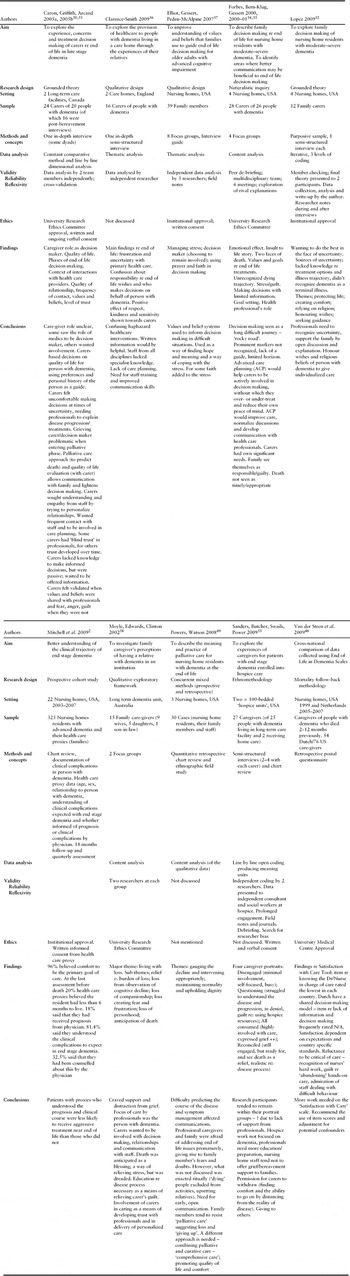
A systematic literature review was conducted.46 The search strategy included the search of thirteen electronic databases, eighteen web sites, a hand search of five key journals, examination of papers recommended by experts working in the field and a hand search of reference lists from relevant papers. A range of subject headings, key words and phrases were used to maximize the number of relevant papers. The search was carried out between May and October 2009 and revealed a total of 544 references. Empirical research papers that employed qualitative and/or quantitative research methods, ‘grey’ literature and case studies were identified and selected for this review. Following a meta-ethnographic approach,Reference Noblit and Hare47 lists summarizing the original authors’ findings, using their terms and concepts, were drawn up for each of the papers and the information was added to the research summary sheet (Table 1). Themes and findings were compared across studies to indicate relationships. Concepts that encompassed the papers being synthesized were derived, resembling second-order constructs in the analysis of primary qualitative research data. The results of the synthesis were shared and discussed by the authors to develop the final integrative review of the literature. Further details of the search methods and selection criteria are available from the corresponding author.
Summary of papers included in review

Results
Twelve papers, reporting ten research studies, were identified and met the inclusion criteria. One study was conducted in Australia, one in England and one paper reports a cross-national comparison of data collected in The Netherlands and USA; the remaining seven studies were North American (Canada n = 1; USA n = 6). One paper reports survey data that used End of Life in Dementia Scales, but this review only includes findings from the ‘Satisfaction with Care Tool’ used to elicit family perspectives within the study.Reference van der Steen, Gijsberts, Muller, Deliens and Volicer48 Three of the studies were longitudinal, two of which collected qualitative data. One study used a concurrent mixed methods designReference Powers and Watson49 and one used a prospective cohort study design.Reference Mitchell, Teno, Kiely, Shaffer, Jones and Prigerson2 The remaining nine papers report exploratory studies using individual interviews or focus groups with family carers. Eleven of the papers describe the setting as either ‘nursing homes’ or ‘long-term care facilities’. Whilst the twelfth was conducted in a ‘hospice unit’, the majority of research participants were care-givers of people with dementia living in a long-term care facility and receiving care/support from a hospice service.
Clearly, each of the studies was conducted within the context of its own policies, and legal and health care system, all of which have an impact on decision-making processes; but despite obvious differences, the care of family members of people with dementia at an individual level appears to be an issue of concern in the developed world.
The concepts derived from the synthesis of the findings are presented under three main themes: unfamiliar territory, making decisions and the grieving carer.
Unfamiliar territory
Under the theme of unfamiliar territory three categories of experience are described: lack of knowledge and experience; poor or lack of communication with professionals; and opting for active interventions in an effort to ‘do the best’ for the dying relative. Family carers felt that they lacked knowledge of the dying process and wanted to understand what was happening;Reference Caron, Griffith and Arcand50 they needed professionals to explain the disease progression and treatment options.Reference Caron, Griffith and Arcand51–Reference Sanders, Butcher, Swails and Power53 Family carers tended not to regard dementia as a terminal illness,Reference Lopez52 and the process of dying was not recognized.Reference Powers and Watson49, Reference Lopez52, Reference Gessert, Forbes and Bern-Klug54, Reference Forbes, Bern-Klug and Gessert55 Forbes et al. used the analogy of ‘travelling on a journey’ and caring for the person with dementia being likened to a ‘rocky road’ (Reference Forbes, Bern-Klug and Gessert55; p. 256). The horizon on the journey tended to be limited, with family care-givers focusing on small, day-to-day changes in the person's condition, rather than seeing the ‘bigger picture’ and the general decline, indicating that their relative would die.
Family carers described worries about discussing end of life care prematurely, which affected their communication with professionals.Reference Powers and Watson49 From the family carer perspective, there was often a lack of verbal communication between professionals and themselves about end of life issues. However, the family carers described the implicit ways in which they learnt that the condition of their relative with dementia was worsening. For example, people with dementia who were thought to be dying were excluded from the usual social activities, leaving relatives feeling anxious and confused about their lack of inclusion in daily activities.Reference Mitchell, Teno, Kiely, Shaffer, Jones and Prigerson2, Reference Powers and Watson49, Reference Clarence-Smith56
The studies revealed that poor, or non-existent, staff–family carer communication combined with a lack of knowledge or understanding about the end of life process in dementia, resulted in family carers constructing palliative care as being ‘sub-optimal’ and as ‘giving up’. As a result, there was a tendency to opt for active interventions such as hospital admission, antibiotic therapy for pneumonia and tube feeding, which have little proven benefit.Reference Mitchell, Teno, Kiely, Shaffer, Jones and Prigerson2, Reference Powers and Watson49, Reference Lopez52 When communication did occur, it tended to be during times of crisis, resulting in rushed decision-making,Reference Mitchell, Teno, Kiely, Shaffer, Jones and Prigerson2, Reference Clarence-Smith56 over- or under-treatment,Reference Forbes, Bern-Klug and Gessert55 unnecessary hospital admissions and further distress for relatives.Reference Mitchell, Teno, Kiely, Shaffer, Jones and Prigerson2, Reference Clarence-Smith56 Conversely, there is evidence that if family carers understand the prognosis, then their relatives with dementia are less likely to undergo interventions of dubious benefit and are more likely to receive care aimed at offering comfort.Reference Mitchell, Teno, Kiely, Shaffer, Jones and Prigerson2
Making decisions
The role of the family carer in decision-making for the person with dementia living in care homes is currently ill-defined and unclear.Reference Caron, Griffith and Arcand51, Reference Clarence-Smith56 Family carers in the studies reviewed generally wished to remain involved in the decision-making process.Reference Caron, Griffith and Arcand50, Reference Caron, Griffith and Arcand51, Reference Sanders, Butcher, Swails and Power53, Reference Elliott, Gessert and Peden-McAlpine57, Reference Moyle, Edwards and Clinton58 Those who did not wish to be involved in decision-making still wanted their values to be reflected in decisions made by professionals on their behalf.Reference Caron, Griffith and Arcand51 At times of uncertainty, family care-givers felt uncomfortable in their decision-making roleReference Caron, Griffith and Arcand51 and expressed feelings of stress, guilt,Reference Gessert, Forbes and Bern-Klug54, Reference Forbes, Bern-Klug and Gessert55 fear, doubtReference Powers and Watson49 and anxiety.Reference Sanders, Butcher, Swails and Power53 They felt uncomfortable making decisions that might be seen to hasten death.Reference Gessert, Forbes and Bern-Klug54
Family care-givers used a range of values to underpin the decision-making process, including quality of life,Reference Caron, Griffith and Arcand51, Reference Forbes, Bern-Klug and Gessert55 honouring previously expressed wishes,Reference Caron, Griffith and Arcand51, Reference Lopez52 the personal history of the person with dementia,Reference Caron, Griffith and Arcand51 the preservation of dignity and the provision of comfort.Reference Mitchell, Teno, Kiely, Shaffer, Jones and Prigerson2, Reference Powers and Watson49, Reference Forbes, Bern-Klug and Gessert55 Religious faith was also used as a guiding force for some,Reference Lopez52, Reference Elliott, Gessert and Peden-McAlpine57 being used to make and confirm a wide range of decisions including the withholding, continuance or withdrawal of treatment.Reference Elliott, Gessert and Peden-McAlpine57 The religious faith of the person with dementia was also used as a guide when planning individualized care.Reference Lopez52
Where active communication between people with dementia, their families and professionals is ongoing, and models of shared decision-making are employed, decision-making appears to be less problematic for family members. Family carers frequently rated an item on information and decision-making as not applicable in a study from the Netherlands where a model of shared decision-making is in place.Reference van der Steen, Gijsberts, Muller, Deliens and Volicer48 Family carers’ responses indicated that they were well informed regarding the condition of their relative and that decisions were shared between family carers and professionals. This shared decision-making model is characterized by family involvement from the moment of admission of the person to the nursing home and open ongoing dialogue between family members and professionals.Reference The, Pasman, OnwuteakaPhilipsen, Ribbe and Van Der Wal59
The grieving carer
Family carers often find themselves in the unenviable situation of both grieving for their relative and being required to make decisions on their behalf regarding care and treatment towards the end of life. The dual role of grieving carer and decision maker has been described as being problematic when entering the palliative phase, due to unresolved grief.Reference Caron, Griffith and Arcand51
Family carers had strong personal needs during this period: they wanted frequent contact with staff,Reference Caron, Griffith and Arcand50 they sought empathy, reassurance,Reference Forbes, Bern-Klug and Gessert55 understanding, guidanceReference Lopez52 and communication.Reference Moyle, Edwards and Clinton58 They attempted to meet their own needs by trying to personalize relationships with professionals.Reference Caron, Griffith and Arcand51 As mentioned above, family carers described themselves as travelling in unfamiliar territory ‘filled with unrecognisable landmarks’ (Reference Forbes, Bern-Klug and Gessert55; p. 256); they expressed a desire for a companion on the journey, someone who had experience of travelling over similar terrain, who was able to support the traveller on the road.
Carers felt validated when values and beliefs were shared by professionalsReference Caron, Griffith and Arcand51, Reference Moyle, Edwards and Clinton58 and fear, anger and guilt when they were not.Reference Caron, Griffith and Arcand50 They wanted ‘peace of mind’; knowing that ‘I did everything I could’ (Reference Forbes, Bern-Klug and Gessert55; p. 255), and did not want to be regarded as ‘giving up’ on their relative (Reference Powers and Watson49; p. 324); they also had a desire to ‘do what's best’ (Reference Lopez52; p. 619). Family carers feared that they would judge themselves as guilty or responsible if death occurred following withdrawal of a treatment, rather than seeing the death as timely and appropriate.Reference Gessert, Forbes and Bern-Klug54 The death of the person with dementia was seen both as a blessing and a tragedy.Reference Lopez52, Reference Forbes, Bern-Klug and Gessert55, Reference Moyle, Edwards and Clinton58 Religion was used as a source of meaning and hope;Reference Elliott, Gessert and Peden-McAlpine57 some found their faith to be a source of comfort, whilst others found that it provoked anxiety.Reference Elliott, Gessert and Peden-McAlpine57
There is evidence that family care-givers were often disappointed by the lack of contact with professionals caring for their relative.Reference Sanders, Butcher, Swails and Power53, Reference Moyle, Edwards and Clinton58 This is despite data suggesting great need and efforts on the part of carers to meet those needs. In survey data, family care-givers rated the lowest an item regarding knowing the doctor or nurse in charge of the care of their relativeReference van der Steen, Gijsberts, Muller, Deliens and Volicer48 and as few as 18% of relatives said that they had been given the prognosis by a physician,Reference Mitchell, Teno, Kiely, Shaffer, Jones and Prigerson2 suggesting lack of communication with professionals.
The encouragement of ‘hands on caring’ by family members is suggested as a means of developing relationships and trust with professionals.Reference Moyle, Edwards and Clinton58 A hands-on caring strategy was used by some family care-givers, and in addition to assisting in the development of relationships with professionals, it was reported to reduce their feelings of loss and levels of stress.Reference Sanders, Butcher, Swails and Power53
In their conclusions, authors suggest that the palliative care/curative care dichotomy is an unhelpful approach in this setting. A model of ‘comprehensive care’ with an emphasis on ensuring a good quality of life with comfort care is proposed.Reference Powers and Watson49, Reference Caron, Griffith and Arcand51 Quality of life for the person with dementia can only be achieved by early and open discussion between professionals, the person with dementia and their family members. However, hospice staff lacked skills and knowledge in dementia care.Reference Sanders, Butcher, Swails and Power53, Reference Clarence-Smith56 Whilst care home staff tend to have experience and skills in dementia care, they lack counselling and communication skills.Reference Powers and Watson49, Reference Sanders, Butcher, Swails and Power53 Through improved communication, wishes can be ascertained, individualized care delivered and decision-making lightened for family members towards the end of the life of their relative.Reference Powers and Watson49, Reference Caron, Griffith and Arcand51, Reference Lopez52
ForbesReference Forbes, Bern-Klug and Gessert55 and GessertReference Gessert, Forbes and Bern-Klug54 propose the continued use of the advance care planning model with the appointed proxy as a way of normalizing discussions and developing communication with family members.
This literature review highlighted a group of family members who were only described by one group of authors. Sanders et al.Reference Sanders, Butcher, Swails and Power53 describe four care-giver portraits: questioning, all-consumed, reconciled and disengaged. Whilst three of the portraits are described in the findings of other researchers, the disengaged care-givers are not. The disengaged care-givers were ‘emotionally disconnected’ (Reference Sanders, Butcher, Swails and Power53; p. 537) from their family member with dementia, and were engaged with their own lives, families and work. Characteristic themes within the portrait of the disengaged care-giver were: conflict between person with dementia and the family care-giver, focus on self and career, minimal involvement in care and being prepared for the death of their relative. They were a group who were exclusively adult children of the person with dementia of either gender, with a mean age of 50 years.
Discussion
This literature review has highlighted the fact that there is limited research in the area, but it is clear that there are high levels of unmet need,Reference Sanders, Butcher, Swails and Power53, Reference Clarence-Smith56, Reference Moyle, Edwards and Clinton58 a finding that is supported by Scott and Pace.Reference Scott and Pace32 The issues raised by this review of the literature are multifaceted and therefore need to be addressed at various levels, through research, policy, education and practice.
From a research perspective there is limited research in the area, a lack of longitudinal studies and a lack of studies involving interventions or clinical trials. The ‘disengaged carer’ is identified and described in only one study,Reference Sanders, Butcher, Swails and Power53 raising the question: ‘Is this a unique finding or have other studies failed to recognize this group, due to the methods of recruitment or to the research approach?’
For individual family members the review of the literature shows that families wanted communication, information and support in their decision-making. It is encouraging that there are many examples of good practice that are currently being evaluated.Reference Scott and Pace32, Reference Arcand and Caron60 There are also models of practice where memory clinics are involved in giving the diagnosis to the person with dementia and their families. In this setting, open communication is developed and care is tailored to individual needs.Reference Sampson, Harrison-Denning, Greenish, Mandal, Holman and Jones10 It is at this early stage in the disease process that proxy decision makers may be appointedReference Mitchell, Teno, Kiely, Shaffer, Jones and Prigerson2 and the values and wishes of the person with dementia can be elicited and shared. This may be done as part of post-diagnostic work, in clinics or in the home, by members of the community palliative care team or general practitioner.Reference Sampson, Harrison-Denning, Greenish, Mandal, Holman and Jones10, Reference Evans61 Admiral Nurses may also take on this role. They are specialist dementia care nurses in the UK, who have a registered mental health nursing qualification and who practice in the community. The casework of the Admiral Nurse focuses primarily on the needs of the family and its wider network in the support, care and empowerment of the person with dementia. Whilst Advanced Care Planning is recommended by some authors,Reference Forbes, Bern-Klug and Gessert55 others have found that doctor's decisions were influenced more by the patient's condition, assumptions about the quality of life of the individual as indicated by information gleaned from a wide range of sources and involving the family, and less on advanced care planning directives.Reference The, Pasman, OnwuteakaPhilipsen, Ribbe and Van Der Wal59
From an educational perspective, the review has highlighted that family members perceived professionals as lacking preparation and education for their role in guiding and supporting family care-givers in their decision making.Reference Caron, Griffith and Arcand51, Reference Forbes, Bern-Klug and Gessert55, Reference Clarence-Smith56 Professional carers were also perceived to lack communication and counselling skills.Reference Powers and Watson49, Reference Sanders, Butcher, Swails and Power53 Inconsistency of care provider and lack of care planning resulted in rushed, poor decision making at times of crisis.Reference Mitchell, Teno, Kiely, Shaffer, Jones and Prigerson2, Reference Sampson, Harrison-Denning, Greenish, Mandal, Holman and Jones10, Reference Clarence-Smith56 In keeping with these findings, hospital staff in acute settings have reported themselves to be ill-equipped to cope and respond to the needs of people with dementia, tending to rely on family members to provide nursing care.Reference Sampson, Harrison-Denning, Greenish, Mandal, Holman and Jones10 In the UK, national minimum standards have been set for the inclusion of dementia-specific training of staff in both health and social care settings.Reference Knapp and Prince62
At a policy level, it is important that the general public are encouraged to think and speak about their values and wishes regarding end of life care, during the course of ‘normal conversations’. This will have the dual effect of informing others regarding their wishes and views, but will also normalize such discussions and remove the associated stigma. Recently published policy documents have encouraged public awareness of dementia and end of life issues.30, 31 In the UK the National Council on Bioethics have issued a Consultation paper to stimulate discussion, collect views and develop policies.63 The National Council for Palliative Care have also been working to develop collaborations between the disciplines of palliative care and dementia care.64 Also on a more individual level, several public figures have openly discussed their own diagnosis of dementia and their future care wishes,65 or their role in caring for a family member with dementia.Reference Bennett66 Whilst there is a long way to go, this has helped open the public policy debate and has started to bring the ‘unfamiliar territory’ into the public domain.
Conclusion
This literature review has identified little literature, but indicates high levels of unmet need. Family members find themselves in an unfamiliar situation about which they lack knowledge and experience. They find end of life decision making in the face of uncertainty stressful. They also have personal needs, as they are simultaneously grieving and caring. There is evidence that family care-givers seek communication, guidance and companionship from professionals, but are frequently disappointed. There is a need for more research, especially longitudinal studies, in order that the needs and experiences of this group of care-givers might be better understood.
Acknowledgements
JH was funded to write this literature review by a scholarship from the Cancer Experiences Collaborative, a palliative and supportive care research funded collaborative funded by the UK National Cancer Research Institute (NCRI).
Conflicts of interest
The authors declared no conflicts of interest.