Introduction
In the area between the temperate and tropical climatic regions, persistent combinations of pasture grasses and legumes are rare and monocultures are common (Muir et al., Reference Muir, Pitman and Foster2011). In sub-tropical and warm-temperate latitudes, a wide range of persistent warm-season perennial grasses commonly occurs as near-monoculture grass pastures or as naturally occurring, mixed-species, grass-dominated rangeland. Forage legumes are often introduced into ruminant systems in order to reduce production costs regarding biological nitrogen fixation (N) and to add nutritional value to the diet (Ferreira et al., Reference Ferreira, Maurício, Fernandes, Carvalho, Ramos and Junior2012; Foster et al., Reference Foster, Vera, Malhi and Clarke2014; Mangaravite et al., Reference Mangaravite, Passos, Andrade, Burak and de Mendonça2014). Although organic N in soil is partially mineralized by microbial activity, its quantity is not enough to significantly increase pasture quality and availability to enhance animal production. Therefore, it is often necessary to use a combination of different technologies, such as consortia of grasses and legumes, nitrogen fertilization and food supplementation.
Among the benefits of using legumes is the increase in pasture yield because of the increase in soil N availability (Ali et al., Reference Ali, Schwenke, Peoples, Scott and Herridge2002), which may supply nitrogen to the system via biological fixation resulting from symbiosis between the legumes and the Rhizobium spp. bacteria (MacLean et al., Reference MacLean, Finan and Sadowsky2007; Maróti and Kondorosi, Reference Maróti and Kondorosi2014). The symbiosis between legumes and Rhizobium spp. is of high biological and ecological importance because of its contribution to the global N cycle, serving as a model for studying interactions between plants and microorganisms (Okazaki et al., Reference Okazaki, Tittabutr, Teulet, Thouin, Fardoux, Chaintreuil, Gully, Arrighi, Furuta, Miwa, Yasuda, Nouwen, Teaumroong and Giraud2016). Moreover, the use of legumes in pasture mixture promotes an increase in animal production by increasing the quantity and nutritional value of the forage offered (Beck et al., Reference Beck, Hess, Hubbell, Jennings, Gadberry and Sims2016). This high-nutritional value results from the high levels of crude protein (CP) and high digestibility of legumes (Lüscher et al., Reference Lüscher, Mueller-Harvey, Soussana, Rees and Peyraud2014).
Alencar et al. (Reference Alencar, Vendramini, dos Santos, Silveira, Dubeux, Sousa and Neiva2018) considered the pintoi peanut (Arachis pintoi Krapovickas and Gregory) as a potential viable candidate to be used in mixed stands in tropical regions because of its superior nutritional value, persistence, soil cover, tolerance to shading and fast establishment. In the current study, it was hypothesized that adding N-fixing legumes in mixed temperate-tropical pastures overcomes N-fertilizer reductions, providing similar or greater levels of animal performance. In order to test the hypothesis, productive grazing parameters, performance and ingestion behaviour of animals kept in pasture were assessed.
Materials and methods
Location
The experiment was carried out between December 2015 and October 2016, and was divided into two evaluation periods: summer (December 2015 to March 2016) and winter (June to October 2016). The experimental area belongs to the Universidade Tecnológica Federal do Paraná-Campus Dois Vizinhos-PR and is situated at an elevation of 520 m, 25° 44″ South and 53° 04″ West. The climate of the region is characterized as sub-tropical humid mesotherm (Cfa) according to the Köppen classification (Köppen, Reference Köppen1948). The soil of the region is classified as Red Latosol or dystroferric with clayey texture (Bhering et al., Reference Bhering, dos Santos, Bognola, Curcio, Carvalho Junior, Chagas, Manzatto, Áglio and Souza2009).
Area and experimental design
The experimental area spanned over 6.3 ha and was divided into nine paddocks with an average area of 0.7 ha, besides an additional adjacent area for accommodating the regulating animals. Aruana grass and forage peanut plants were planted in September 2014. Liming and correction fertilization were performed based on soil analysis (Table 1), as recommended by CQFS RS/SC (2004) for the grass and legume mixes of summer.
Chemicals characteristics of soil (0–20 cm) in the experimental field

a pH on soil buffer as Shoemaker-McLean-Pratt; Fonte: Laboratório de Análise de Solo, UTFPR-Dois Vizinhos.
The design was a randomized complete block design with three replicates. The treatments were N200 (200 kg N/ha per season), 100N + PE (100 kg N/ha per season plus pasture mixture with peanut – A. pintoi) and N100 (100 kg N/ha per season). The grassland used during summer was Aruana grass (Panicum maximum Jacq ‘Aruana’). At the end of the summer cycle (March 2015), the animals were removed from pasture to allow the overseeding of the winter pasture. On 6 April 2015, oats were overseeded using the direct seeding system (Avena strigosa Schreb. ‘IAPAR 61’), at a sowing density of 60 kg/ha of pure and viable seeds with a line spacing of 17 cm. On the same day, 30 kg of pure and viable seeds of diploid ryegrass (Lolium multiflorum L. ‘Fepagro São Gabriel’) were seeded.
Management and evaluation of pastures
The addition of N in the form of urea (45% N) to the pasture cover in summer was carried out in four phases: 6 December 2015, 7 January 2016, 31 January 2016 and 28 February 2016. In winter 2016, this was performed in five phases: 1 June, 25 June, 21 July, 19 August and 3 September. A total of 100 or 200 kg of N per season were added, according to the treatment. The application of phosphorus pentoxide (P2O5) and potassium oxide (K2O), based on soil analysis and recommendations for the experimental combinations of grasses and legumes (CQFS RS/SC, 2004), was performed together with the first nitrogen fertilization. In summer, 70 kg/ha of P2O5 were applied to the pasture cover in the form of single superphosphate. A total of 470 kg/ha of simple superphosphate (P2O5) and 170 kg/ha of potassium chloride (KCl) were associated with the first fertilizer application in winter. All fertilizations were applied always after a minimum precipitation of 30 mm.
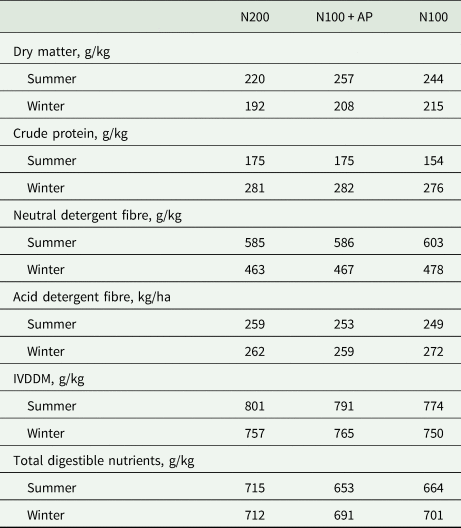
Forage mass (FM) was estimated every 28 or 21 days (four times in summer, six in winter) using the double sampling technique (Wilm et al., Reference Wilm, Costello and Klipple1944). Five cuts were randomly assessed from an area of 1.0 m2 (summer) or 0.25 m2 (winter) in each experimental unit (paddock). FM represents the total dry weight of forage per hectare above the ground level, expressed in kg DM/ha. At each evaluation sward heights were measured. Daily forage accumulation rate (DM, kg DM/ha) was measured using two exclusion-grazing cages by paddock. All samples were cut at the ground level. To characterize the pasture, a sub-sample of FM was separated into leaves (leaf blade), stems (for grasses) and dead material. Peanut plants were not structurally separated. Based on these results, the leaf : stem ratio and available leaf quantity were calculated. To evaluate the chemical composition of the pasture (Table 2), samples were obtained by simulation grazing (Moore and Sollenberger, Reference Moore, Sollenberger and Gomide1997) collected twice per trial period.
Nutritional composition of simulated grazing samples of steers' diet on pasture of Panicum (cultivar Aruana), in summer, and overseeded with oats and ryegrass mixture, in winter, with legume and/or fertilized with nitrogen
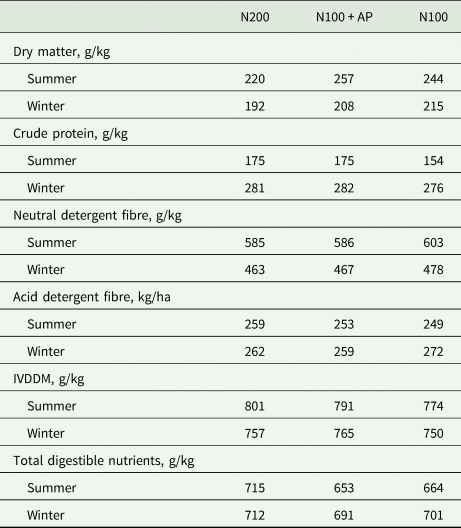
Treatments: N200 = 200 kg N/ha; N100 + AP = 100 kg N/ha + A. pintoi; N100 = 100 kg N/ha.
Samples were dried at 55 °C until constant weight. They were crushed in a grinder (type Wiley) using a 1-mm sieve. Dry matter (DM), ash, organic matter (OM) and CP of samples were determined based on AOAC (1998); neutral detergent fibre was determined using the Van Soest et al. (Reference Van Soest, Robertson and Lewis1991) method adapted for the ANKOM2000 methodology (ANKOM 2000 Fibre Analyser, ANKOM Technology Corporation, Fairport, NY, USA), using filter bags (Komarek, Reference Komarek1993). In vitro digestibility of the DM (IVDDM) was estimated following Tilley and Terry (Reference Tilley and Terry1963), with filter bags (Komarek, Reference Komarek1993), using TECNAL® TE-150 artificial in vitro incubator, modified according to Goering and Van Soest (Reference Goering and Van Soest1970), through detergent solution treatment, using the ANKOM® Fibre Analyser A2000. Total digestible nutrient (TDN) was calculated according to the method of Kunkle and Bates (Reference Kunkle and Bates1998), using the following equation:

where IVOMD is in vitro digestibility of OM.
Stocking rate (SR) varied during the experiment and was adjusted (every 28 days in summer or 21 days in winter) according to the available FM and daily accumulation rate. It was calculated using the equation of Heringer and Carvalho (Reference Heringer and Carvalho2002) to maintain an herbage allowance of 9 kg DM 100 kg/body weight ha:

Animal measurement
The first stage of the experiment (summer) was carried out between December 2015 and March 2016, including 112 days of evaluation and 14 days of adaptation. In winter the experiment was conducted from June to October 2016, totalling 127 days – the first 18 days of adaptation and 109 days of evaluation. The animals were removed from the pasture at the end of March for the overseeding of the winter pasture. During this period the animals remained in an adjacent Aruana grass pasture receiving silage and mineral salt so that their live weight was maintained; they had free access to water and a mineral salt containing (g/kg): calcium, 100; phosphorus, 45; sulphur, 4.1; sodium, 205; cobalt, 0.025; copper, 0.450; iron, 1.5; iodine, 0.05; manganese, 1.0; selenium, 0.009; zinc, 2.52 and fluorine, 0.45.
A total of 42 15 ± 2.2-month old steers (1/4 Marchigiana, 1/4 Aberdeen Angus, 2/4 Nellore) with a mean initial weight of 330 ± 7.9 kg were used. For performance evaluations, two groups of animals were defined: testers and regulators (Difante et al., Reference Difante, Euclides, Nascimento Júnior, da Silva, Torres Júnior and Sarmento2009). In summer and winter, 27 and 18 testers were used, respectively. At the beginning of winter, testers of similar weight were removed from each group because of the animals' greater weight and the pasture's lower support capacity during that period. The average daily gain (ADG, kg/animal) of each tester animal during the entire grazing period was evaluated by two weightings, one at the beginning and one at the end of the experimental period (each 28 days in summer and each 21 days in winter). Animals were fasted for 14 h prior to weighing. ADG was defined as the difference between the initial and final weight divided by the total number of days spent in grazing. The average weight gain per area was obtained as the product of the tester animals' ADG and SR (Euclides et al., Reference Euclides, da Conceição Lopes, do Nascimento Junior, da Silva, Difante and Barbosa2016). SR was calculated as the product of total body weight (tracers and regulators) and the number of days the animals remained in each paddock.
Evaluation of animal behaviour
Eight 24-h evaluations, with notes every 10 min, were carried out per season. All animal testers were evaluated. The parameters were: time of grazing, number of chews and rumination and number of bites. During 10-min intervals, the most frequent activity among grazing, rumination and idleness was recorded (Jamieson and Hodgson, Reference Jamieson and Hodgson1979). Grazing time was defined as the time spent on selecting and seizing forage, including the period of displacement for the selection of the diet. Rumination time was identified at the end of grazing and chewing; it is an activity of leisure and is considered the period in which the animal remains at rest (Forbes, Reference Forbes1988). The recorded activities were expressed in total minutes per day; visits to the salt trough and water fountain were recorded as number of visits per day.
In addition to the most frequent activities, the time required for the animals to perform 20 bites was recorded in the morning and afternoon, three times per experimental period (Hodgson, Reference Hodgson and Leaver1982); the number of chews per minute and chews per ruminal cake were also recorded (Johnson and Combs, Reference Johnson and Combs1991).
Statistical analysis
Data regarding pasture characteristics and animal performance were subjected to analysis of variance using GLM procedure of SAS University edition 2013. For behavioural variables, the MIXED procedure was used; the restricted maximum likelihood method was employed by choosing the variance and covariance matrix that best fits the data, using the corrected Akaike value (AICc) (Littell et al., Reference Littell, Milliken, Stroup, Wolfinger and Schabenberger2006). The matrices were tested for variance compounds (VC), unstructured (UN), compound symmetry (CS) and autoregressive of first order (AR(1)). To compare means values, Tukey's test was applied at 5% level of error probability.
Results
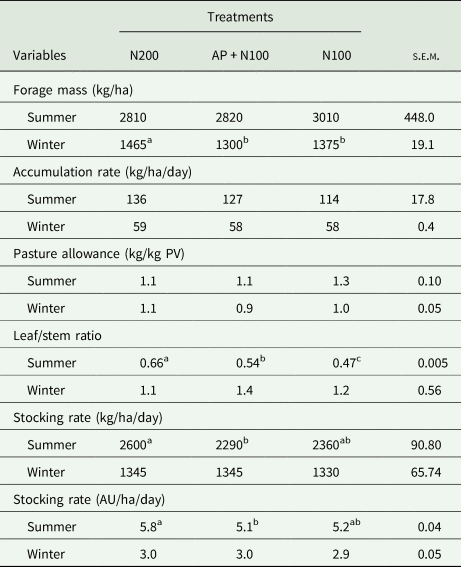
The FM was affected (P < 0.05) only during winter, when the N200 treatment presented greater mass than the other treatments (Table 3). This difference was minimized by adjusting the SR, as pasture allowance was the same for all treatments. During summer, FM and the accumulation rate were not affected by the treatments. However, there was a higher SR in the N200 treatment compared to the N100 + AP.
Characteristics of the pasture of Panicum (cultivar Aruana), in summer, and overseeded with oats and ryegrass mixture, in winter, with legume and/or fertilized with nitrogen
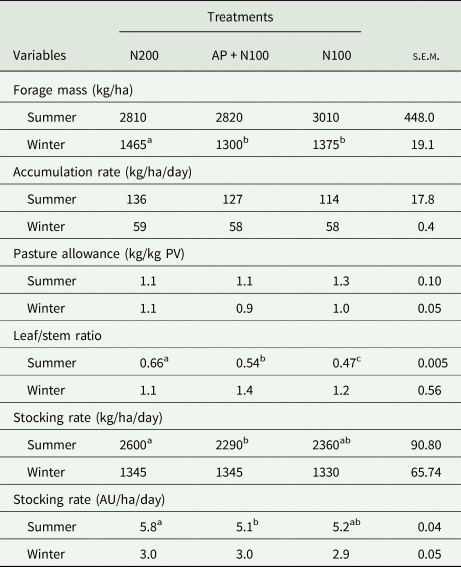
s.e.m., standard error of the mean.
Different letters indicate statistically significant differences in line (P < 0.05, Tukey's test).
Treatments: N200 = 200 kg N/ha; N100 + AP = 100 kg N/ha + A. pintoi; N100 = 100 kg N/ha.
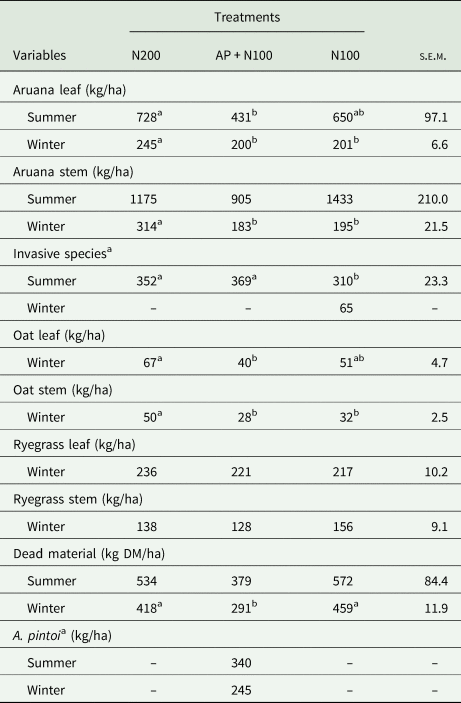
During summer, there was a higher leaf/stem ratio of grass of the treatment N200, the AP + N100 presented intermediate values, and the N100 presented a lower proportion of leaves in relation to the stem (Table 3). The presence of forage peanut provided an increase in the number of leaves, but not enough to resemble the results of the N200 treatment (Table 4). In both seasons, a larger mass of leaves in the N200 treatment was observed; this partly explains the higher leaf/stem ratio of this treatment in summer. During winter, the N200 provided a higher mass of leaves of Aruana grass and oats compared to the other treatments. Forage peanuts represented proportions of 0.12 and 0.18 of the total FM during summer and winter, respectively.
Structural forage components, leaf/stem relation (L/S) and A. pintoi and vetch mass offered for beef cattle reared in Aruana grass pasture overseeded with temperate climate grasses and combined with legume and/or nitrogen fertilization
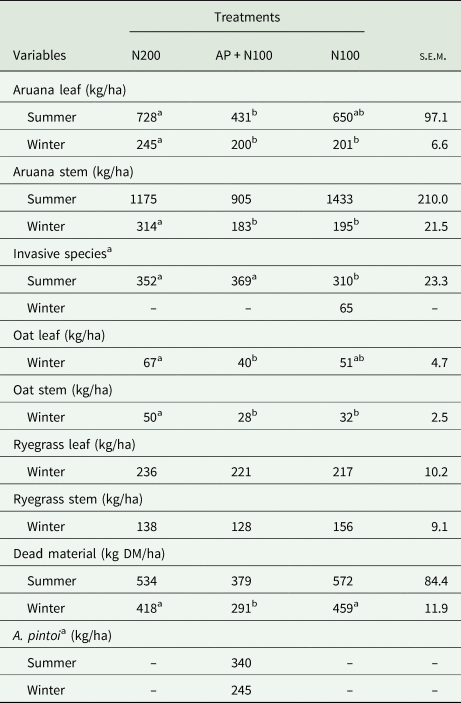
s.e.m., standard error of the mean.
Different letters indicate statistically significant differences in line (P < 0.05, Tukey's test).
Treatments: N200 = 200 kg N/ha; N100 + AP = 100 kg N/ha + A. pintoi; N100 = 100 kg N/ha.
a Urochloa plantaginea in summer; Vetch in winter.
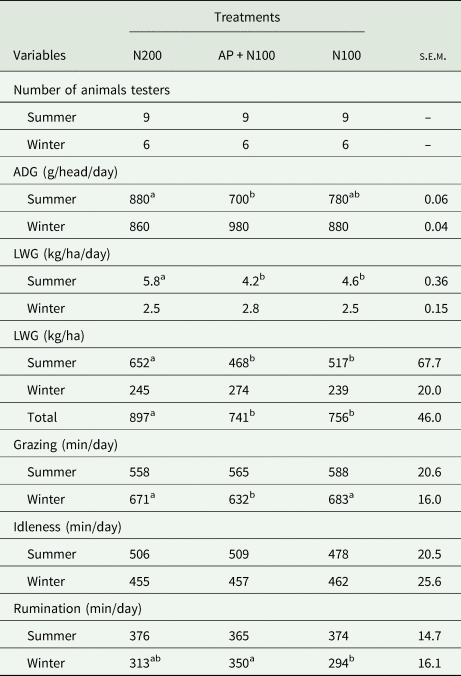
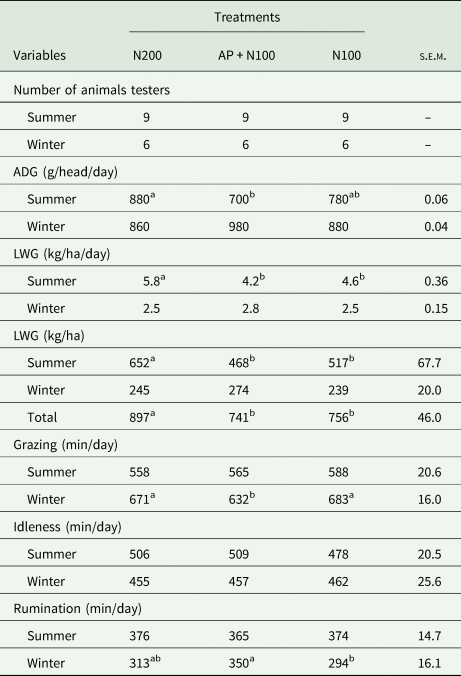
Final weights were similar (P > 0.05) for the grass–legume mixture (AP + N100) and the fertilization groups in both seasons (Table 5). In summer, the ADG was 27% higher for the 200 kg of the N/ha treatment compared to the grass–legume mixture. Greater SR and ADG contributed to the higher live weight gain (LWG) per ha of the N200 treatment during summer. In winter, treatments did not influence individual or area weight gain parameters. At the end of the two seasons (summer + winter), the N200 treatment produced 21% more kg of animal per hectare than the treatment with forage peanuts.
Productive parameters of beef cattle on Aruana grass pasture overseeded with oats and ryegrass mixture with legume and/or fertilized with nitrogen
s.e.m., standard error of the mean.
Different letters indicate statistically significant differences in line (P < 0.05, Tukey's test).
Treatments: N200 = 200 kg N/ha; N100 + AP = 100 kg N/ha + A. pintoi; N100 = 100 kg N/ha.
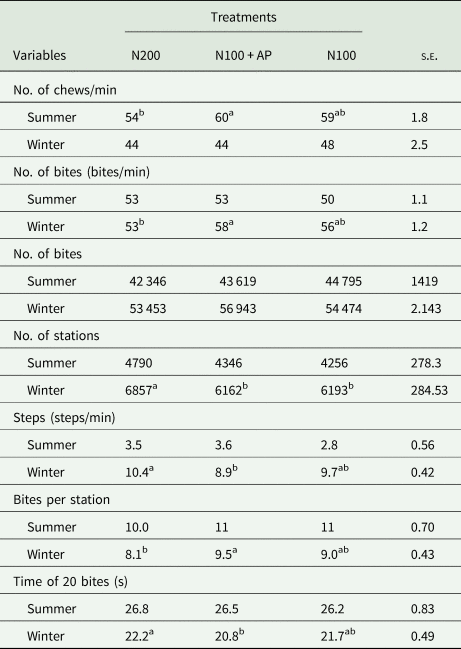
During summer, the behavioural activities were not different among treatments, with the exception of number of chews (Table 6). In contrast, during winter, grazing time was shorter in the treatment with forage peanut (Table 5). Thus, rumination time of the animals on the pasture with peanuts was higher than the others. However, the animals of the AP + N100 treatment showed a higher number of chews per minute in comparison to those of the N200 treatment. The presence of forage peanut in the pasture (AP + N100) caused the animals to present a larger number of bites per minute and per station then in the N200 treatment. However, the animals from AP + N100 showed a smaller number of steps per minute, shorter time for 20 bites and lower number of stations visited than those from the N200 treatment. The animals from N100 showed intermediate values for the studied variables.
Ingestive behaviour from beef cattle finished in pasture of Aruana grass overseeded with grass and combined with legume and/or nitrogen fertilization

s.e., standard error.
Different letters indicate statistically significant differences in line (P < 0.05, Tukey–Kramer test).
Treatments: N200 = 200 kg N/ha; N100 + AP = 100 kg N/ha + A. pintoi; N100 = 100 kg N/ha.
Discussion
High weight gains per individual and area are normally the goals of a producer when choosing the system of breeding (pasture management or alternative food) as, at the end of the productive cycle, the animals must be suitable for slaughter, and the costs per area is linked to the number of kilos produced. In the current study, the high amount of N applied to the pasture during summer provided a high carrying capacity and pasture quality, resulting in high individual and area weight gain. These results are related to the higher productivity and quality of the pasture consumed by the animals. In pastures with high N fertilization (e.g. N200), the increase of N tends to increase the production of new leaves as a result of the production of new cells.
Although the high amount of N in the pasture (N200) did not result in a high accumulation rate, the numerical difference observed was enough to significantly influence the FM values. This biomass increase is explained by plant growth acceleration under N fertilization, which includes more tillering and leaf production improving the CP content of the pasture (Pavinato et al., Reference Pavinato, Restelatto, Sartor and Paris2014; Restelatto et al., Reference Restelatto, Pavinato, Sartor and Paixão2014; Venturini et al., Reference Venturini, de Menezes, Montagner, Paris, Schmitz and Molinete2017). In grasses, the additional N increases pasture nutritional value, especially its CP content, because the plant absorbs N in the form of ammonia, combines it with sugars and generates amino acids to form proteins (Andrews et al., Reference Andrews, Raven and Lea2013). However, the proportion of leaves in the pasture – reflected by the leaf/stem ratio – improved with the application of the highest N dose (N200) in the current study. The application of N to pastures increases leaf/shoot ratio and, consequently, the production and the quality of forage as a result of the increase of emission of new tissues.
The presence of legume in the AP + N100 treatment, even if low (a proportion of 0.12 of the total biomass in summer), improved the leaf/stem ratio of the pasture compared to N100, mainly as a result of the greater presence of Alexander grass (herein considered as an invasive species). The forage peanut was implanted in no-tillage, in dried strips of the Aruana grass, which allowed the growth of the Alexander grass. According to Venturini et al. (Reference Venturini, de Menezes, Montagner, Paris, Schmitz and Molinete2017), the Alexander grass has high uniform emergence and rapid development.
The animals on the AP + N100 pasture showed the lowest weight gains; the intake of tropical legumes under grazing is low as a result of the selection and preference of the animals based on the grass (Barcellos et al., Reference Barcellos, Ramos, Vilela and Martha Junior2008), which often lowers individual performance. Animals graze selectively, choosing the best (in terms of quality) and easiest forage for their diet (Baumont et al., Reference Baumont, Prache, Meuret and Morand-Fehr2000). Thus, peanuts with lower growth rates and height tend to be less consumed by cattle. In the current study, although the animals apparently consumed the feed peanut, which was noted based on the increase in nutritional quality of the diet consumed in comparison to that of the N100 treatment, there was probably a deleterious effect on the total DM intake.
According to Phelan et al. (Reference Phelan, Moloney, McGeough, Humphreys, Bertilsson, O'Riordan and O'Kiely2015), the main advantage of forage legumes over other forages is their ability to reduce fertilizer costs; however, the main disadvantage is usually lower intensity of animal production per area. This assertion was confirmed in the current study, because LWG/ha was higher in 200 kg of the N/ha treatment group compared to the mixed grass–legume treatment. This is a reflection of the lower SR and lower ADG presented by this treatment (AP + N100). Despite the similar total FMs presented among the treatments, in AP + N100, 0.12 of mass (340.1 kg DM) was obtained from forage peanuts. Forage peanut has a typical prostrate growth; it occupies the stratum closest to the soil surface, which allows vegetative propagation through rooting and production of new stolons in nodes that are in contact with the soil (Tamele et al., Reference Tamele, Lopes de Sá, Bernardes, Lara and Casagrande2018). This complicates the consumption of peanut compared to that of Aruana grass. The low proportion of forage peanuts corroborates the observations of de Andrade et al. (Reference de Andrade, Garcia, Valentim and Pereira2006), who verified proportions of 25.5, 10.6 and 6.4% in a pasture mixture with Massai grass (P. maximum × P. infestum) with three daily herbage allowance levels (9.0, 14.5 and 18.4% of live weight). This reinforces the fact that the grasses with cespitosum habit suppress the legumes with prostrate habit; this suppression is increased by the increase in the supply of fodder. Thus, in the current study, an increase in the proportion of the legume during the evaluation (summer–winter) was observed. Despite presenting low FM, during winter the proportion of forage peanuts was high (0.18).
Chewing activity not only stimulates saliva secretion, but it is also closely associated with solubilization of feed DM and physical breakdown of feed particles, which facilitate the rumen fermentation process and passage of digesta from the rumen. In summer, the presence of the forage peanut caused the animals to present a greater number of chews/minute than in the treatment with greater amount of N (N200). This result is in agreement with the amount of leaves present in the pasture; i.e. animals on grass with more leaves chewed less than those in areas with less leaves. Chewing during eating and ruminating accounts for >0.80 of total particle size reduction.
Different from summer, during winter the treatments did not affect individual performance and animal production by area. This can be explained by the high quality of the winter pasture and its low fibre content, which was not limiting for the performance of the animals (Silva et al., Reference Silva, Pereira, Silva, Valadares Filho, Ribeiro and Santos2018). In addition to nutritional quality, forage production was adequate. Restelatto et al. (Reference Restelatto, Pavinato, Sartor, Einsfeld and Baldicera2015) recommended a black oat forage production with high N efficiency levels of approximately 120 kg N/ha, a value close to the 100 kg used in the current experiment.
During summer, the grazing height of the Aruana grass allowed the animals to select more grass; in contrast, during winter, the grazing height of temperate species was closer to that of the forage peanut. As a result, the animals consumed more legumes, which have a higher nutritional value. Nevertheless, such consumption may not have been sufficient to express significant differences in animal performance. de Andrade et al. (Reference de Andrade, Garcia, Valentim and Pereira2006) reported that grass height can influence Arachis proportions when combined with other plants; according to those authors, the taller the grass, the lower the persistence of legumes in pasture. Importantly, forage peanuts are originally from a tropical climate; therefore, their development is hampered during the coldest periods of the year. Olivo et al. (Reference Olivo, Ziech, Both, Meinerz, Tyska and Vendrame2009) observed a lower participation of forage peanuts in July–October (e.g. period similar to the winter period in the present experiment).
FM was higher in the 200 kg N/ha treatment compared with the treatment with A. pintoi; this difference can be attributed to the greater availability of mineral N provided by fertilization, which is quickly used by forage plants and increases population density of tiller in the pasture. High levels of fertilization did not affect the rate of forage accumulation; however, the tiller size/density compensation mechanism (Duchini et al., Reference Duchini, Guzatti, Ribeiro Filho and Sbrissia2014) explains the greater FM. According to Hirata and Pakiding (Reference Hirata and Pakiding2002), tiller mass and density inside a pasture are major drivers of variations in FM.
The reduced grazing time in pastures containing Arachis was most likely because of the smaller proportion of dead material present in this system and of the 0.18 of Arachis, which facilitates diet selection by animals when planted in tracks. Becoming more selective is a common strategy of livestock when faced with unfavourable grazing conditions (e.g. reduction in the proportion of leaves and increase in stems and dead material) and is often accompanied by increasing grazing time as a compensating mechanism (Dumont et al., Reference Dumont, Garel, Ginane, Decuq, Farruggia, Pradel, Rigolot and Petit2007).
The average time of inactivity did not differ (P > 0.05) among the pastoral systems, possibly because this phase involves activities such as thermoregulation and social interactions, on which differences in food conditions have little effect (De et al., Reference De, Kumar, Saxena, Thirumurugan and Naqvi2017). Rumination time was higher among steers feeding in mixed pastures with Arachis. This behaviour was opposite to that of the grazing period, which, according to Carvalho et al. (Reference Carvalho, Ribeiro Filho, Poli, de Moraes, Delagarde, Mattos, Faria, Silva, Nussio and Moura2001) can be attributed to the mutual exclusivity of the activities; i.e. a reduction or increase in the time spent on grazing results in changes in time spent on other behaviours.
The time necessary for 20 bites was calculated as the inverse of the number of bites per minute. Steers in the Arachis treatment exhibited shorter bite period but with a greater number of bites compared to those in 200 kg N. This behaviour is related to the high proportion of Arachis in the forage canopy. According to Orr et al. (Reference Orr, Rutter, Yarrow, Champion and Rook2004), the time spent performing a bite is dependent on the mass consumed per bite, pasture structural composition and the chemical characteristics of the plant. However, it is clear that the pastures and animals can adjust quickly to imposed conditions, as differences were observed among pasture structural characteristics and the ingestion behaviour of the animals; the average per day and per hectare gains were similar. This indicates that proper management of pastures, mixture grass and legumes using applications of 100 kg N/ha can stimulate the productive performance, reaching a performance similar to that of applications of 200 kg N/ha in winter.
At the end of the cycle (summer + winter), there was a weight surplus of 141 kg in the treatment where more nitrogen was placed (N200). The treatment that included the introduction of forage peanuts showed the lowest result. However, since it was only the first year of its implementation, legume proportion was low (0.12). There was an increase in the performance of the animals in the presence of forage peanuts during winter, probably because of the greater proportion of the legume in the composition of the pasture (0.18). Tamele et al. (Reference Tamele, Lopes de Sá, Bernardes, Lara and Casagrande2018) observed a substantial increase in the amount of forage peanuts from the second year of use.
Nitrogen becomes available for the growth of crop plants and soil organisms through nitrogen fixation, nitrogen fertilizer applications, mineralization of manure returned to the land and through the mineralization of OM in the soil (Bellows, Reference Bellows2001). Nitrogen fixation occurs mainly in the roots of legumes that form a symbiotic association with a type of bacteria usually from rhizobium.
However, the benefit of the partner plant (grasses) will be over time. Høgh-Jensen and Schjørring (Reference Høgh-Jensen and Schjørring1997) observed that on average, the transfer amounted to 0.04, 0.16 and 0.31 of the accumulated N in ryegrass in the first, second and third production year, in a white clover–ryegrass mixture. In addition, Høgh-Jensen and Schjørring (Reference Høgh-Jensen and Schjørring1997) concluded that white clover–ryegrass mixtures are able to extract additional amounts of inorganic N from the soil profile compared to pure stands of the two species. This transfer may be delayed in the microbial biomass but was subsequently increased with time from 0.05 the first year averaged over N treatments to 0.19 and 0.48 in subsequent years.
In the first year of use under grazing conditions, a major part of the removed herbage N is returned because ruminants excrete approximately 0.50–0.60 of total ingested N as urea in the urine and 0.20 as organic N in faeces (Høgh-Jensen and Schjørring, Reference Høgh-Jensen and Schjørring1997). On the other hand, removal of legume leaf area decreases nitrogen fixation by decreasing photosynthesis and plant competitiveness with grasses. Urine deposition decreases nitrogen fixation by adjacent plants since it creates an area of high soluble-nitrogen availability (Bellows, Reference Bellows2001).
Thus, the low participation of legumes in the pasture and the similarity in the CP content of the pasture consumed by the animals explains the lack of effect of the presence of forage peanuts in this first year of study.
Conclusion
Forage peanuts do not satisfactorily replace nitrogen fertilization in this first year of utilization. Besides that, the performance of steers on pasture fertilized with 200 kg of N was higher than in the other treatments, reflecting the response to fertilization during summer. Already in winter, there was no effect of nitrogen fertilization on the performance of the animals, indicating that in this period there may be a reduction in the amount of nitrogen applied, with or without the use of legumes.
Financial support
This study was financed in part by the Coordenação de Aperfeiçoamento de Pessoal de Nível Superior – Brasil (CAPES) – Finance Code 001 and National Council for Scientific and Technological Development (CNPq) – Brazil – Process 477966/2013-6.
Conflict of interest
The authors declare there no conflicts of interest.
Ethical standards
The study was conducted according to the guidelines of the Ethical Committee on the Use of Animals (CEUA), following protocol number 2015-22 of the Universidade Tecnológica Federal do Paraná.