Introduction
The camel (Camelus dromedarius) is an important multipurpose animal in Iran, and more than 200,000 dromedary camels are living in the arid and semi-arid deserts of the eastern part of Iran, including Khorasan and Sistan and Blouchestan provinces (Borji et al., Reference Borji, Razmi and Parande2009). Due to its physiological attributes, the camel is the most suitable domestic mammal for use in these climatic extremes.
Among diseases that are not apparent to farmers, but are of considerable economic and public health importance, is hydatidosis. Hydatidosis is endemic in Iran and is maintained in three distinct cycles, a livestock/dog domestic cycle, a desert cycle between dogs and camels, and a sylvatic cycle between wild carnivores and wild ruminants (Dalimi et al., Reference Dalimi, Motamedi, Hosseini, Mohammadian, Malaki, Ghamari and Ghaffari2002; Rokni, Reference Rokni2009).
There are few data about the prevalence of hydatidosis in dromedaries from Middle Eastern countries including Iran (Abdul-Salam & Farah, Reference Abdul-Salam and Farah1988; Ahmadi, Reference Ahmadi2005), and information on the prevalence of hydatidosis in the dromedaries in this region's abattoirs is very limited. The main aims of the present study were to determine the prevalence and possible trends of hydatidosis in dromedaries of this area.
Materials and methods
The study was based on a retrospective survey covering data of a 6-year period (20 March 2004 to 19 March 2010) from abattoirs in Khorasan province, in north-eastern Iran. Meat-inspection records from these abattoirs were used as the sources of data from which prevalence of liver and lung condemnations due to hydatidosis were extracted on a monthly basis.
Data were analysed by SPSS software package, version 16 (SPSS Inc., Chicago, Illinois, USA). The 6-year period trend was analysed using the chi-square test and the odds ratio was calculated (odds of condemnation due to hydatidosis in successive years). The seasonal pattern was investigated with the chi-square test. A P value of ≤ 0.05 was considered significant.
Results
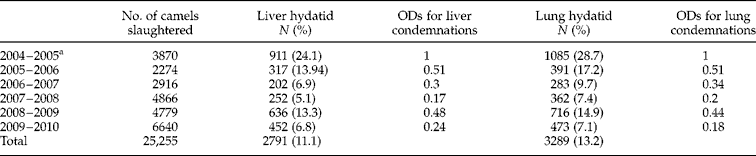
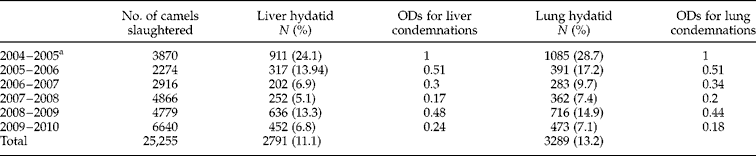
Over the 6-year study period, 25,255 dromedaries were slaughtered in the surveyed abattoirs and a total of 2791 livers (11.1%) and 3289 lungs (13.2%) of dromedaries were condemned due to hydatidosis.
Rates of annual prevalence of infection in the 6-year period are shown in table 1. The overall trend showed a significant decline in the prevalence of hydatidosis over the study period except for 2008–2009. The annual prevalence of liver condemnations due to hydatidosis was decreased from 24.1% to 13.3% in 2009 and to 6.8% in 2010. The corresponding figures for condemned lungs due to hydatidosis were relatively higher than for liver, declining from 28.7% in 2004–2005 to 14.9% in 2009 and to 7.1% in 2010. Condemnation of livers was significantly more prevalent in spring than other seasons. Moreover, lungs were condemned significantly more than livers, and had relatively more seasonal fluctuation.
Proportions of liver and lungs condemned due to hydatid disease and adjusted odds ratios (ODs) for the number of liver and lung condemnations, after controlling for seasonal variation between 20 March 2004 and 19 March 2010. N, number of camels infected; %, prevalence of infection.
a Assuming the 2004–2005 year ODs = 1.00 as the basis for comparison.
Discussion
Although abattoir surveys have limitations, they are an economical way of gathering information on livestock diseases. A feedback from the slaughterhouse to the individual farm is of great value in the field of preventive medicine. The prevalence of Echinococcus granulosus infection recorded in the present study, in the slaughtered dromedaries, was, in general, higher than that reported from Jordan (Abdel-Hafez & Al-Yaman Said, Reference Abdel-Hafez and Al-Yaman Said1986) and Morocco (Azlaf & Dakkak, Reference Azlaf and Dakkak2006) but lower than that reported from the neighbouring countries of Kuwait (Abdul-Salam & Farah, Reference Abdul-Salam and Farah1988), Libya (Ibrahem & Craig, Reference Ibrahem and Craig1998) and from other regions of Iran (Ahmadi, Reference Ahmadi2005; Rokni, Reference Rokni2009). Recent improvement in the health of dromdaries may be the result of greater awareness of echinococcosis among farmers and the increasing likelihood that offal containing hydatid cysts is destroyed and not left accessible to dogs. It may also be associated with a national programme, undertaken in recent years, to control rabies, which included the elimination of stray dogs.
Unfortunately, although the prevalence of echinococcosis is known to be highly dependent on the age of the potential host (Torgerson et al., Reference Torgerson, Williams and Abo-Shehada1998), the abattoir records analysed in the present survey had no data on the ages of the dromedaries at slaughter. A higher significant prevalence of liver and lung hydatidosis in spring was observed. The epidemiological implication of this finding might be attributed, at least partly, to the sources of slaughtered dromedaries. It may be due to changes in management practices and ecological factors. The odds ratio showed that the chance of liver and lung hydatidosis was increased in dromedaries in the year 2008–2009 as compared to the period from 2007–2008. In conclusion, in the present study, hydatidosis was found to be prevalent in this area. The present survey provides preliminary baseline data for the future monitoring of these potentially important parasitic diseases.
Acknowledgements
This study was supported financially by Ferdowsi University of Mashhad.