Significant outcomes
• Long-term depression may be a risk for stroke development.
• Regular follow-up and treatment of depression in elderly people are important in prevention of stroke.
Limitations
• Inclusion criteria based on history and health/hospital registration records.
• The patients with subclinical or minor depression were not evaluated.
A bidirectional link exists between depression and many neurological illnesses (Reference Evans, Charney and Lewis1). Post-stroke depression is well-known, but an association between a history of depression and future risk of cardiovascular or cerebrovascular events has not been studied widely using case–control protocols (Reference Carod Artal2,Reference Krishnan3). Recently published prospective studies have shown an association between depression and the incidence of hypertension (Reference Jonas and Mussolino4,Reference Davidson, Jonas, Dixon and Markovitz5), cardiovascular mortality (Reference Penninx, Beekman and Honig6,Reference Gump, Matthews, Eberly and Chang7), stroke and stroke mortality (Reference Jonas and Mussolino4,Reference Gump, Matthews, Eberly and Chang7,Reference Carod-Artal and Egido8). Additionally, some important follow-up studies including The Baltimore Epidemiologic Catchment Area Study showed that a history of depressive disorder was associated with an increased incidence of ischaemic stroke (Reference Larson, Owens, Ford and Eaton9–Reference Salaycik, Kelly-Hayes and Beiser11). In a community-based study conducted on Framingham Heart Study participants, depressive symptoms were found to be an independent risk factor for incident stroke/transient ischaemic attack (TIA) even after adjusting for traditional vascular risk factors and education (Reference Salaycik, Kelly-Hayes and Beiser11).
Sympathoadrenal hyperactivity, ventricular instability and biological markers including platelet activation and inflammatory proteins have been proposed to explain the increased risk of cardiovascular disease in patients with depression (12–15). Platelet aggregation and mean platelet volumes are higher in patients with depression (Reference Williams16–Reference Ataoglu and Canan18). Finally, depressive symptoms are associated with a higher prevalence of other modifiable lifestyle risk factors, such as smoking and lower levels of physical activity (19–22). Thus, we investigated the relationship between stroke and previous depression.
Materials and methods
We enrolled patients admitted to Düzce Medical Faculty Hospital with depression that was clinically diagnosed using a psychiatric structured interview (Turkish version of SCI-I) and criteria of the Diagnostic and Statistical Manual of Mental Disorders (DSM-IV) within 1 year before stroke occurrence in patients; we enrolled non-stroke controls with risk factors from the hospital ward in the same region. The criteria for the diagnosis of a depressive episode included depressed mood lasting at least 2 weeks, loss of interest or diminished sense of pleasure, plus four of seven other features sufficient to cause clinically important psychological or physical distress or functional impairment (Reference ÖZkürkçügil, Aydemir, Yıldız, Danacı and Koroglu23,24). Additionally, depression was accepted as present and considered a potential factor related to the stroke if there was a history of depression diagnosed by a psychiatric structured interview or by a psychiatrist using the DSM-IV criteria or if there was a history of diagnosed depression and antidepressant use had been prescribed by a psychiatrist during the past 10 years. Unconsciousness and aphasia were exclusion criteria for this study. Whether the patients had a stroke or used any antidepressants was recorded. Complications of mood disorders, alcoholism and substance abuse, socio-demographic variables, other risk factors and the duration of depression (in years or months) were also recorded.
Diagnostic imaging
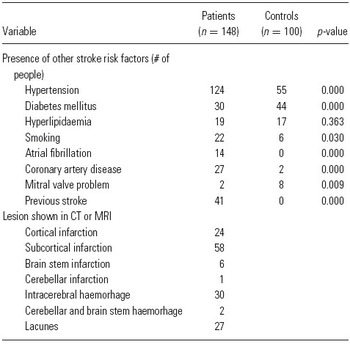
The criteria used for the diagnosis of stroke included clinical evidence of stroke and computed tomography (CT) of brain and/or cranial magnetic resonance imaging (MRI) evidence of cerebral infarction without demonstrable source of embolism. The patients were evaluated with cranial CT (n = 148) and MRI (n = 56) to define stroke and were grouped as ischaemic, haemorrhagic and lacunar infarctions (Table 1).
Descriptive characteristics and comparison of study groups

Risk factor records
The data were collected using face-to-face interview technique. Semi-structured questionnaires consisting of multiple questions related to age, gender and risk factors were completed. The participants responded to a preformed list of questions related to risk factors. The risk factor records were based on their self-report, clinical and laboratory analysis. Hypertension was considered to be present if, at the time of diagnosis, the subject had a systolic blood pressure greater than 160 mm Hg or a diastolic pressure greater than 95 mm Hg, if he or she have had a systolic blood pressure greater than 140 mm Hg or a diastolic pressure greater than 90 mm Hg during follow-up in clinics and if treatment for high blood pressure had been administered previously. Hypercholesterolaemia was considered present if subjects had serum total cholesterol greater than 200 mg/dl. Hyperglycaemia was considered present if subjects had a serum glucose level greater than 115 mg/dl or if treatment for diabetes had been previously implemented. A subject was accepted as a smoker if he or she reported smoking one package of cigarettes daily for 5 years. Modifiable risk factors were noted. Past histories related to cardiac disease and strokes were evaluated based on follow-up files, healthcare records and self-reports.
Statistical analysis
The prevalence of depression in stroke patients was evaluated and it was compared to the depression prevalence by using the same criteria in age and sex-matched healthy people in the same population living in Düzce. Intergroup differences and correlations were tested using frequency tests, Student's t-tests and correlation analysis. Data were expressed as mean ± SD. All analyses were made using the SPSS 10.0 version statistical software package and probability value of less than 0.05 was accepted as to be statistically significant.
Results
In our study population, the gender of patients (70 females, 78 males) and controls (54 females, 46 males) were similar in comparison. The mean age of patients (67.49 ± 11.41 years) and controls (64.76 ± 9.73 years) were similar too (p = 0.52). The descriptive characteristics, risk factors and diagnostic findings of study groups were revealed in Table 1.
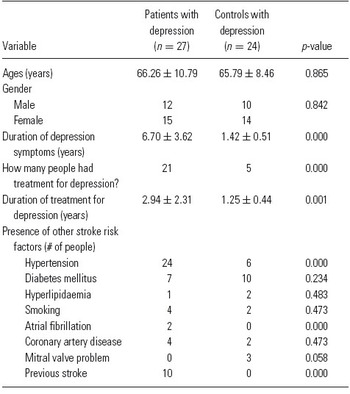
Depression was diagnosed in 27 patients and 24 controls (p = 0.37). When we evaluated only the patients and controls with depression, the duration of depression was longer in stroke patients in comparison to controls (p < 0.001). Nearly all controls talked about depression symptoms which continued less than 2 years (Table 2). In comparison, 89% of the patients delineated depression symptoms which continued more than 2 years. Twenty-one of 27 patients had treatment for depression while 5 of 24 controls had treatment (p < 0.001). Nine patients and seven controls were hospitalised in history (p > 0.05). In addition, the time duration of reported treatments was longer in the patients as seen in Table 2.
Comparison of study groups with depression

There was no correlation between the presence of depression and modifiable stroke risk factors (hypertension, diabetes, hyperlipidaemia, coronary artery disease, mitral valve prolapsus, smoking), age, gender and the lesions (seven cortical, eight subcortical, two lacunars and two brain stem ischaemic infarctions and eight haemorrhagic infarctions) in the patient group.
Discussion
Although significant psychological distress causing hypertension and reduced vascular function, autonomic nervous system dysfunction and increased platelet activity and aggregation are reported as predictors of fatal ischaemic stroke, whether an association exists between depressive symptoms and stroke remains uncertain (8,25–28). In this study, we tried to identify the clinical implications of an association between depression and stroke in older individuals. Findings from our case–control study suggest that depressive disorder is not associated with an elevated stroke risk, but that the risk of stroke should be considered in elderly people with long-term depression. Similar to our findings, some studies have concluded that depressive symptoms are not associated with an increased risk of stroke in general (Reference Colantonio, Kasi and Ostfeld25,Reference Wassertheil-Smoller, Applegate and Berge26) or with non-fatal ischaemic stroke or TIA (Reference May, McCarron and Stansfeld27). We also found that the presence of depression was independent of modifiable stroke risk factors and was not associated with age, gender and ischaemic lesions in the patient group. Twenty-four of 100 controls were reported as fulfilling the criteria of depression, which seems like a very high prevalence compared to a normal background population. But there are lots of studies conducted in neurology clinics or hospitals in which they reported high prevalence of depression (10–60%) related to chronic aspect of underlying disease or risk factors (Reference Wu, Zhang, Li, Zhu and Shen29–Reference Hamilton, Campos and Creed31). This was an important finding and supported the conclusion that depression was commonly seen in stroke. In our study group, this high prevalence may be related to hypertension or other risk factors which are chronic disorders and resulted in atherosclerosis like hypertension, diabetes or hyperlipidaemia, seen in control as shown in Table 1.
In contrast, Jonas and Mussolino (Reference Jonas and Mussolino4) reported a significant association between a high level of depressive symptoms and the incidence of subsequent stroke. Nilsson and Kessing (Reference Nilsson and Kessing32) reported that patients with depression severe enough to require hospitalisation were at increased risk for developing cerebrovascular disease. In this study, we asked the previous hospitalisations due to depression. There was not any statistical difference between the patients and controls with depression severe enough to be hospitalised in our study. Supporting these studies, Surtees et al. (Reference Surtees, Wainwright, Luben, Wareham, Bingham and Khaw33) reported that depression was associated with an 11% increase in the risk of stroke after adjusting for risk factors and socio-demographic variables (hazard ratio, 1.11; 95% confidence interval, 1.00–1.22). In our study, we did not measure levels of depression, but it was an important finding that the duration of depression differed and was higher in the patients in comparison. Our findings provide another additional evidence that there might be some pathogenic mechanisms explaining the association between depression and stroke (12–22).
Some studies have concluded that the risk of developing stroke/TIA increases in participants <65 years of age with symptoms of depression (Reference Gump, Matthews, Eberly and Chang7,Reference Colantonio, Kasi and Ostfeld25,Reference Wassertheil-Smoller, Applegate and Berge26). In contrast, when Jonas and Mussolino (Reference Jonas and Mussolino4) examined the risk of stroke in depressed individuals stratified by age (25–59 years and 60–74 years), a positive association was found in both age groups. Stroke risk was associated with high level of depression in both age groups (Reference Jonas and Mussolino4). All studies reported above supported that depression was an important risk factor for stroke in all age groups (4,7,25,26). Similarly, we found a high incidence of depression in older aged study population of us and age was not correlated with depression in our study.
The most important limitation of our study was a possible bias because of inclusion criteria based on history and records and the absence of follow-up. It is possible that we missed the data of patients with subclinical or minor depression. Another possible source of bias was a misclassification due to inaccurate diagnosis codes on medical records and health certificates. In addition, more patients had been treated for depression. Despite these limitations and confusions, our results provide additional evidence that there is no association between the presence of depression and stroke. However, a relationship between long-term depression and stroke indicates that effective treatment for depression may be important in the primary prevention of stroke. Because depressive symptoms are associated with a higher prevalence of other modifiable lifestyle risk factors, social support, psychological status, treatment modalities and medical follow-up, personal characteristics should be analysed more thoroughly in future studies on stroke.