Introduction
Neurocognitive impairment is an integral feature of schizophrenia, remaining stable across episodic and remissive periods (Saykin, Shtasel, Gur, & Kester, Reference Saykin, Shtasel, Gur and Kester1994). Neurocognitive deficits are also potentially important for understanding schizotypy, defined as the “latent personality organization that harbors the liability for schizophrenia” (Lenzenweger, Reference Lenzenweger2006; Meehl, Reference Meehl1962). Whereas a broad range of cognitive abilities are impaired in schizophrenia (Heinrichs & Zakzanis, Reference Heinrichs and Zakzanis1998), many studies suggest that individuals with schizotypy also exhibit impairment, albeit attenuated in severity, in specific areas such as working memory (Gooding, Kwapil, & Tallent, Reference Gooding, Kwapil and Tallent1999), delayed recall (Vollema & Postma, Reference Vollema and Postma2002), visual spatial (Lenzenweger & Gold, Reference Lenzenweger and Gold2000), attention (Gooding & Braun, Reference Gooding and Braun2004), and language (Poreh, Ross, & Whitman, Reference Poreh, Ross and Whitman1995). However, a handful of studies have not observed significant impairments between schizotypy and control groups (e.g., Cohen, Iglesias, & Minor, Reference Cohen, Iglesias and Minor2009). Gaining a clearer perspective on how neurocognitive abilities are affected across the spectrum holds important implications for schizophrenia, as they may reflect critical schizophrenic endophenotypes (Gur et al., Reference Gur, Nimgaonkar, Almasy, Calkins, Ragland, Pogue-Geile and Gur2007) and allow for detection of pre-morbid features of the illness.
Many schizotypy studies investigating neurocognition have used psychometric identification methods in college samples (Gooding & Braun, Reference Gooding and Braun2004). The use of college samples is conceptually advantageous because subjects are recruited around the peak age of schizophrenia onset (Chapman, Chapman, Kwapil, Eckblad, & Zinser, Reference Chapman, Chapman, Kwapil, Eckblad and Zinser1994) and can be tested without confounding factors, such as medication effects. Individuals recruited using psychometric-identification methods may be less symptomatic than individuals in the schizophrenia-spectrum identified using other methods (e.g., biological identification, ultra high risk interview) because they generally have sufficient social, cognitive, and financial resources to participate in higher education. Accordingly, examination of neurocognition in college samples provides a key test of whether neurocognitive impairment persists in even high-functioning populations on the schizophrenia spectrum. Our primary goal was to investigate the relationship between neurocognition and schizotypy in psychometrically identified college samples: we expected to find specific, but not global, neurocognitive deficits.
It is also important to consider whether neurocognitive deficits in schizotypy are associated with real world outcomes. In patients with schizophrenia, neurocognitive impairments are associated with lower quality of life (QOL; Chaplin et al., Reference Chaplin, Barley, Cooper, Kusel, McKendrick, Stephenson and Burns2006; Ritsner, Reference Ritsner2007), higher unemployment rates (Gold, Queern, Iannone, & Buchanan, Reference Gold, Queern, Iannone and Buchanan1999), poorer social skills, and less time spent in the community (Green, Reference Green1996). Patients with schizophrenia exhibiting neurocognitive impairments also represent increased costs to the public sector due to health and social care expenses (Patel et al., Reference Patel, Everitt, Knapp, Reeder, Grant, Ecker and Wykes2006). While a handful of studies demonstrate that functioning and quality of life are impaired in individuals with schizotypy (Cohen & Davis, Reference Cohen and Davis2009), few examine the relationship between neurocognition and functioning. One study has shown a significant relationship between neurocognitive problems and poor functioning in those with schizotypy (Aguirre, Sergi, & Levy, Reference Aguire, Sergi and Levy2008), especially in the social domain; however, others have failed to find a significant relationship between these variables (e.g., Cohen, Leung, Saperstein, & Blanchard, Reference Cohen, Leung, Saperstein and Blanchard2006; Dinn, Harris, Aycicegi, Greene, & Andover, Reference Dinn, Harris, Aycicegi, Greene and Andover2002). A secondary goal of this project was to assess whether neurocognitive impairments are related to real world outcomes in a schizotypy group.
The final purpose of this study was to compare subjective cognitive complaints between schizotypy and control groups, to determine the degree to which students at risk for schizophrenia report experiencing cognitive difficulties. Quality of life questionnaires evaluate functioning by quantifying the outcome of poor cognitive skills but do not directly measure subjects’ own assessment of their neurocognition. This key distinction may clarify the underlying relationship between cognitive deficits and daily functioning. Interestingly, two studies have reported that those with schizotypy self-report greater trouble with daily executive function than controls. However, in neither study did the schizotypy group differ from controls in objective measures of executive performance (Chan et al., Reference Chan, Yan, Qing, Wang, Wang, Ma and Yu2011; Laws, Patel, & Tyson, Reference Laws, Patel and Tyson2008). This suggests that subjective neurocognitive concerns are pronounced in schizotypy populations, and that these concerns are not commensurate with standard measures of neurocognitive functioning. This is an important finding to substantiate, as it may suggest that deficits in the college population are not meaningfully captured by standard neurocognitive instruments. It may also mean that the primary deficit is in the subjective domain—perhaps reflecting autobiographical beliefs or other “higher order” cognitive processes.
To address our goals, we conducted three studies to assess whether collegiate schizotypy and control groups show neurocognitive dysfunctions. In Study One, we measured neurocognition and quality of life in a sample of 167 psychometrically identified individuals with extreme levels of schizotypy (at the 95th percentile or above). An important feature of our sample is that it was heterogeneous with respect to schizotypal traits; including positive, negative, and disorganized traits. This improves upon many prior studies that use only one schizotypal trait dimension when examining schizotypy and neurocognitive functioning. The results from Study One were inconsistent with our predictions, so we conducted further follow-up studies. In Study Two, we expanded our tests to include executive functioning and subjective neurocognitive complaints. In Study Three, we conducted a meta-analysis of 33 studies investigating neurocognitive abilities in college students with psychometrically defined schizotypy.
Study One: Methods
Participant Selection
Participants for Studies One and Two were recruited from the undergraduate population at a university in the Southeastern Unites States. Students completed one of two measures of schizotypal traits online during separate data collection points (n = 1775 and 1507, respectively) for either course credit or a chance to win cash prizes. From these pools, we recruited individuals exhibiting elevated schizotypal traits on at least one of three subscales. Informed by (a) Meehl's (1962) theories of schizotypy, (b) taxometric studies suggesting a 10% population incidence of schizotypy (Lenzenweger & Korfine, Reference Lenzenweger and Korfine1992), (c) findings that over half of individuals in the top 10% of SPQ scorers met criteria for a schizophrenia-spectrum disorder (Raine, Reference Raine1991), and (d) evidence that the top 5% of schizotypy scorers were nearly eight times more likely to report a history of schizophrenia diagnosis and ten times more likely to report psychiatric hospitalization than controls at or below the mean (Cohen & Najolia, Reference Cohen and Najolia2011), we defined the schizotypy group by a percentile score at or above the 95th percentile using sex and ethnicity derived means from the larger database on positive, negative or disorganized scales. The use of a 95th versus 90th percentile reflects a conservative cutoff score, reflecting an attempt to reduce false positives, and has been used in our published research (e.g., Cohen & Hong, Reference Cohen and Hong2011). Control participants were recruited from a pool of individuals scoring below the 50th percentile on each of the three schizotypy subscales. The final sample consisted of 167 individuals with schizotypy and 57 control participants (for further recruitment details, see Minor & Cohen, Reference Minor and Cohen2010). Subjects were paid $30 for their participation. The Chapman Infrequency Scale (Chapman & Chapman, Reference Chapman and Chapman1983) was used to identify grossly inconsistent profiles (>3 items endorsed). Informed consent was obtained from each subject and research procedures were approved by the Institutional Review Board.
Measures
Schizotypal traits
Two versions of the Schizotypal Personality Questionnaire (SPQ; Raine, Reference Raine1991) were used to measure schizotypal traits. The SPQ (PsycINFO citations as of 8/15/2011 = 389) and SPQ-Brief (SPQ-B; Raine & Benishay, Reference Raine and Benishay1995) (PsycINFO citations as of 8/15/2011 = 90) reflect two of the most oft-used schizotypy questionnaires. The full SPQ (n = 1775) and SPQ-B (n = 1507) were used respectively for subjects during the first and second data collection points. The full SPQ consists of 74 items and has demonstrated high internal reliability, test–retest reliability, and convergent and discriminant validity. The SPQ is also significantly correlated (Wuthric & Bates, Reference Wuthrich and Bates2006) with the commonly used and longitudinally verified (Chapman et al., Reference Chapman, Chapman, Kwapil, Eckblad and Zinser1994) Chapman Scales: Perceptual Aberration (r = .70; Chapman, Chapman, & Raulin, Reference Chapman, Chapman and Raulin1978), Magical Ideation (r = .72; Eckblad & Chapman; Reference Eckblad and Chapman1983) and Social Anhedonia (r = .48; Eckblad, Chapman, Chapman, & Mishlove, Reference Eckblad, Chapman, Chapman and Mishlove1982). The SPQ-B consists of 22 items taken from the SPQ and has a commonly used three-factor solution (Cognitive-Perceptual, Interpersonal, and Disorganization). It has demonstrated adequate reliability and validity in several studies (e.g., Fonseca-Pedrero, Paíno-Piñeiro, Lemos-Giráldez, Villazón-García, & Muñiz, Reference Fonseca-Pedrero, Paíno-Piñeiro, Lemos-Giráldez, Villazón-García and Muñiz2009). To address concerns that the original dichotomous response format is insensitive to trait intensity (Peltier & Walsh, Reference Peltier and Walsh1990), we adopted a 5-point Likert type response scale used in recent SPQ research (Wuthric & Bates, Reference Wuthrich and Bates2005). Subjects’ response options ranged from “Strongly Disagree” to “Neutral” to “Strongly Agree.” The Likert scale version of the SPQ has shown high convergence and improved internal reliability (α = .95) compared to the forced-choice dichotomous response version (Wuthric & Bates, Reference Wuthrich and Bates2005). To address potential concerns that the SPQ and SPQ-BR tap different populations, we recomputed all group comparisons for each questionnaire separately. The results did not substantively change.
Neurocognitive functioning
Neurocognitive abilities were assessed using the Repeatable Battery for the Assessment of Neuropsychological Status (RBANS; Randolph, Reference Randolph1998), which consists of twelve subtests assessing five neurocognitive domains. The RBANS is appropriate for use in patients with schizophrenia-spectrum disorders, and has been cited by over 146 studies. Evidence suggests that the RBANS is sensitive to neurocognitive impairments commonly observed in schizophrenia (Gold et al., Reference Gold, Queern, Iannone and Buchanan1999) and has been previously used in studies of college schizotypy samples (Cohen et al., Reference Cohen, Iglesias and Minor2009). Although originally used to measure deficits in psychotic and elderly populations, the RBANS has since been used to detect more subtle differences in younger populations, showing sensitivity for high-functioning athletes: youth (Moser & Schatz, Reference Moser and Schatz2002) and college students (Killam, Cautin, & Cantucci, Reference Killam, Cautin and Santucci2005), as well as adolescents along the spectrum of schizophrenia disorders (Holzer et al., Reference Holzer, Chinet, Jaugey, Plancherel, Sophia, Halfon and Randolph2007). The RBANS is relatively efficient to administer, sensitive, reliable (α = 0.84), correlated with other neurocognitive batteries, such as the Wechsler Adult Intelligence Scale-III (r = .77; Wechsler, Reference Wechsler1997a) and Wechsler Memory Scale-III (r = .69; Wechsler, Reference Wechsler1997b), and is related to real world variables, such as employment status (Gold et al., Reference Gold, Queern, Iannone and Buchanan1999).
Functioning
Quality of life was assessed using a modified version of Lehman's Quality of Life Interview (QOL-I; Lehman, Reference Lehman1995). Quality of life was measured in 33 items across a range of seven objective (e.g., “How often do you talk to your family on the phone”) and subjective (e.g., “How do you feel about your family”) domains (home, daily activities, family, social, financial, health, and legal concerns). For data reduction purposes, the scales were summed to create total Objective and Subjective QOL-I scores (see Cohen & Davis, Reference Cohen and Davis2009 for psychometric support).
Proposed analyses
Analyses were conducted in three parts. First, we compared age, gender, and ethnicity between control and schizotypy groups to determine whether these variables should be controlled for in further analysis. Second, we used t tests to evaluate whether neurocognitive functioning and quality of life differed between control and schizotypy groups. It was our expectation that the schizotypy group would show significantly poorer functioning in each of the neurocognitive domains. Finally, we investigated whether Objective and Subjective QOL were related to neurocognitive performance using correlations. We hypothesized that QOL would be significantly correlated with each neurocognitive domain. All variables were relatively normally distributed. An alpha level of .05 was used for all analyses in this study.
Study One: Results
Demographic and Descriptive Factors
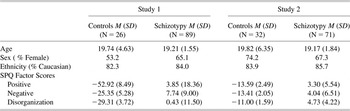
Demographic and descriptive variables are presented in Table 1. No significant differences in age, gender, or ethnicity were observed when the schizotypy and control groups were compared (p's > .10).
Demographic and descriptive characteristics for subjects in Study 1 and Study 2

Neurocognitive Performance and Quality of Life: Schizotypy Versus Control Groups
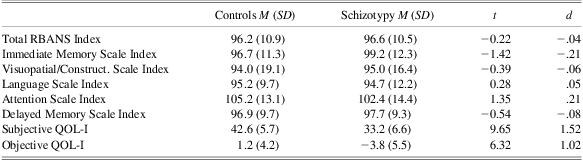
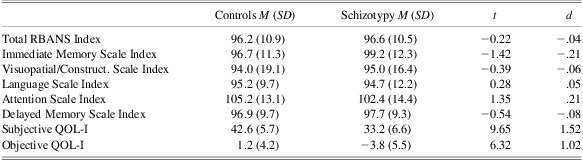
Table 2 contains the means and standard deviations for neurocognitive performance and QOL. Overall neurocognitive performance did not significantly differ between schizotypy and control groups. In contrast to our hypotheses, there were also no significant differences between groups in any of the five neurocognitive domains. The schizotypy group showed significantly lower scores as compared to controls for both subjective and objective quality of life.
Comparison between Schizotypy and control groups on RBANS and QOL-I scores
Neurocognition and QOL: Within Schizotypy
Subjective QOL was not significantly related to neurocognitive performance on any specific domain (p's > .10). As predicted, objective QOL was associated with better overall neurocognitive performance (r[166] = .16; p < .05). Performance in language domains was also related to higher Objective QOL ratings (r[166] = .17; p < .05); however, it should be noted that these correlations were in the small effect size range (Cohen, Reference Cohen1988). None of the other correlations for these analyses were statistically significant.
Study One: Discussion
Study one examined neurocognitive performance and quality of life in individuals with schizotypal traits. Contrary to our expectations, no significant differences were found between the schizotypy and control groups for neurocognitive variables. This was not a power issue, as there were no group differences in neurocognitive performance that rose to a medium level or better. In contrast, we did find, as supported by the literature (Cohen & Davis, Reference Cohen and Davis2009), that schizotypy was associated with a declination in both objective and subjective quality of life on the order of a large effect size. This suggests that individuals with schizotypy not only experienced subjective dissatisfaction with their general quality of life, but experienced objectively defined impoverishment in life quality as well (at least recorded via self-report). In terms of the relationship between neurocognition and quality of life, we found that global cognition and language performance were significantly correlated with objective functioning, suggesting that at least some facets of neurocognition are important for daily functioning. Generally, these correlations were not as robust as expected.
The general null findings of this study could be explained by the fact that there were few measures of working memory, which has been proposed as one of the key domains affected in individuals with schizotypy (Gooding et al., Reference Gooding, Kwapil and Tallent1999). A follow-up study was, therefore, conducted comparing working memory in psychometrically defined college students. It is also worth noting how dramatically quality of life was affected in the schizotypy population in comparison to how neurocognition was preserved. The measures of quality of life used in this study tap a broad range of domains, but generally do not assess cognitive complaints, so it was unclear the degree to which individuals with schizotypy report that their neurocognition abilities are impaired. This issue was also redressed in Study Two.
Study Two: Methods
Participant Selection
A separate data collection was conducted that was methodologically similar to that in Study One. In total, 1665 students completed the Schizotypal Personality Questionnaire – Brief Revised version (Cohen, Matthews, Najolia, & Brown, Reference Cohen, Matthews, Najolia and Brown2010). Of these, 47 individuals were recruited for the schizotypy group and 30 were recruited for the control group using the same procedures as in Study One. The Chapman Infrequency Scale (Chapman & Chapman, Reference Chapman and Chapman1983) was used to identify grossly inconsistent profiles (endorsing >3 items were excluded). Subjects were paid $30 for their participation in this study.
Measures
Schizotypal Traits
The SPQ-Brief Revised (SPQ-BR; Cohen et al., Reference Cohen, Matthews, Najolia and Brown2010) was used to measure schizotypal traits in this study. The SPQ-BR is an empirically based revision of the SPQ that features improved psychometric properties over the SPQ-B, such as greater internal consistency (α = .90), sensitivity, and convergent validity with relation to quality of life functioning. It is comprised of 32 items cohering into seven separate sub-ordinate subscales and three super-ordinate factors. As in Study One and in other recent research (Cohen et al., Reference Cohen, Matthews, Najolia and Brown2010), a Likert scale response format was used here (see Cohen et al., Reference Cohen, Matthews, Najolia and Brown2010; Wuthric & Bates, Reference Wuthrich and Bates2005 for reliability and validity support).
Working memory tests
We used five separate tests of working memory. These included measures of verbal working memory: the digit span forward, digit span backward, letter number, Continuous Performance Test – Individual Pairs; and of visual spatial working memory: spatial span (MATRICS, MCCB; Nuechterlein et al., Reference Nuechterlein, Green, Kern, Baade, Barch, Cohen and Marder2008; Kern et al., Reference Kern, Nuechterlein, Green, Baade, Fenton, Gold and Marder2008). Note that these tests were selected based on their importance in schizophrenia more generally, as evidence of their inclusion in the MATRICS battery.
Subjective cognitive complaints
Subjective cognitive complaints were measured using the Cognitive Difficulties Scale (McNair & Kahn, Reference McNair and Kahn1984). This measure includes 26 items assessing a broad range of subjective complaints regarding basic neurocognitive functions and their effects on daily functioning (e.g., “I forget appointments, dates, or meetings”, “I fail to recognize people I know”). A total score, reflecting increasing levels of cognitive complaints, was used in this study.
Proposed analyses
Analyses were conducted in three parts. First, we compared age, gender and ethnicity between control and schizotypy groups to determine whether these variables should be controlled for in further analyses. Second, t tests were conducted to compare raw scores of working memory performance between the schizotypy and control groups. We hypothesized that the schizotypy group would be significantly more impaired on each of these measures. Third, t tests were conducted to examine group differences in subjective neurocognitive complaints, with the expectation that the schizotypy versus control groups would show significantly more complaints. Finally, we examined the relationship between working memory ability and subjective cognitive complaints. Previous studies have shown a significant correlation between self-report of working memory deficits and objective working memory performance in schizophrenia samples (Garlinghouse, Roth, Isquith, Flashman, & Saykin, Reference Garlinghouse, Roth, Isquith, Flashman and Saykin2010), although this relationship does not appear to be preserved in schizotypy groups (Chan et al., Reference Chan, Yan, Qing, Wang, Wang, Ma and Yu2011; Laws et al., Reference Laws, Patel and Tyson2008). An alpha level of .05 was used for all analyses in this study.
Study Two: Results
Demographic and Descriptive Factors
Demographic and descriptive variables are presented in Table 1. No significant differences in age, gender, or ethnicity were observed when the schizotypy and control groups were compared (p's > .10).
Working Memory Performance: Schizotypy Versus Control
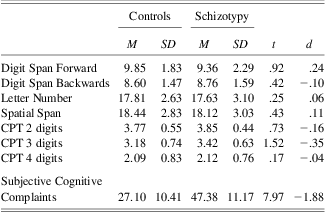
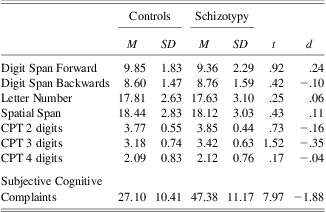
No significant differences were observed on working memory measures when the schizotypy and control groups were compared (see Table 3).
Working memory performance compared between the control and schizotypy groups
Subjective Cognitive Complaints: Schizotypy Versus Control
The schizotypy group reported significantly greater subjective cognitive complaints when compared to the control group (see Table 3).
Subjective and Objective Neurocognition Correlations
Subjective neurocognitive ability was found to be related to Digit Span Forward (r[45] = −.29; p < .05). No other significant correlations were observed for either group (p's > .10).
Study Two: Discussion
Study Two built on the findings of the first study by expanding the focus to working memory and subjective cognitive complaints. Although individuals with schizotypy were shown to have dramatically more subjective neurocognitive complaints than controls (on the order of nearly two standard deviations), no significant differences in working memory were observed. This is consistent with previous findings in the college population (Laws et al., Reference Laws, Patel and Tyson2008; Chan et al., Reference Chan, Yan, Qing, Wang, Wang, Ma and Yu2011). Collectively, these data suggest that college students with schizotypy do not show dysfunction in basic neurocognitive functions, in contrast to reports of demonstrative neurocognitive deficits (Poreh et al., Reference Poreh, Ross and Whitman1995). To investigate the state of the literature on neurocognition in college students with schizotypy, we next conducted a systematic and comprehensive meta-analysis of published studies on this topic.
Study Three: Methods
Search Strategy
To identify studies assessing neurocognitive performance in college schizotypy samples, we conducted a search in 2009 using PsycINFO, Psychology and Behavioral Sciences Collection databases (for a complete list of search terms used, see Appendix B). Our inclusion criteria consisted of: (1) studies with a psychometrically defined schizotypy group recruited from a college population; (2) the study had to contain means and standard deviations, correlations or other test statistics sufficient to compute effect sizes; (3) the study had to be published in a peer-reviewed journal; and (4) the study had to measure either global or specific neurocognitive domains using tests that are standardized or have documented psychometric support in a peer reviewed journal. This search was updated in 2012 to include recent studies. Including studies One and Two, 33 total studies were included in the meta-analysis (see Appendix A for a complete reference list).
Categorizing Psychometric Schizotypy Methods
Individuals with schizotypy included in this meta-analysis were defined by a variety of methods, such as standard deviation, median, or percentage of the sample, as well as by score on the psychometric test. There were also a variety of measures used: fourteen studies used the Chapman Scales: Perceptual Aberration Scale (Chapman et al., Reference Chapman, Chapman and Raulin1978), Revised Physical Anhedonia Scale (Chapman & Chapman, Reference Chapman and Chapman1978), Magical Ideation Scale (Eckblad & Chapman, 1983), Revised Social Anhedonia Scale (Eckblad et al., Reference Eckblad, Chapman, Chapman and Mishlove1982); seven studies used the SPQ (Raine, Reference Raine1991), six studies used the SPQ-B (Raine & Benishay, Reference Raine and Benishay1995), two studies used the Oxford-Liverpool Inventory of Feelings and Experiences (Mason, Claridge, & Jackson, Reference Mason, Claridge and Jackson1995), one study used the Cognitive Slippage Scale (Miers & Raulin, Reference Miers and Raulin1987), two studies used the Schizotypal Personality Scale (Claridge & Broks, Reference Claridge and Broks1984), and one study used the Minnesota Multiphasic Personality Inventory-168 (Hathaway & McKinley, Reference Hathaway and McKinley1983). Unfortunately, the variability in methods was sufficiently diverse as to render moderation analysis impractical.
Categorizing Neuropsychological Tests
Neuropsychological tests examining global or specific neurocognitive domains were examined. In total, we categorized tests into 10 different neurocognitive dimensions (global cognition, memory, fluency, processing speed, set shifting, visual spatial, language, attention, working memory, and reasoning). Tests were also categorized by whether they were timed versus untimed and overt visual spatial versus language, due to the previous schizotypy literature on reaction time (Lenzenweger, Reference Lenzenweger2001) and hemispheric asymmetry (Cohen et al., Reference Cohen, Iglesias and Minor2009). Categorizations were made using a team-consensus approach based on information obtained from test-manuals, from prior meta-analyses of this kind (Cohen et al., Reference Cohen, Saperstein, Gold, Kirkpatrick, Carpenter and Buchanan2007).
Meta-analytic Procedure
We used MetaWin statistical package to conduct our analyses (Rosenberg, Adams & Gurevitch, Reference Rosenberg, Adams and Gurevitch2000). Effect size values were independently computed for each neurocognitive domain for each study using the Hedges d statistic. If multiple measures for a single domain were reported from a single study, these effect sizes were averaged together. Cumulative effect sizes were computed using a procedure that statistically weighs individual effect sizes by their reciprocal variance scores. The rationale for this weighting procedure is that the closer a sample's effect size approximates that of the population, the smaller the variance of that effect size will be. Q statistics, based on χ 2 distributions, were also reported here. The Qtotal, a measure of the total heterogeneity of a sample, was used to determine whether the variability of individual effect size values within a group were greater than that predicted by sampling error. A significant Qtotal value suggests that there is significant heterogeneity in effect sizes within a group. All meta-analyses reported here used random effects models. The analyses were conducted in three steps. First, we computed aggregate effect sizes comparing schizotypy and control groups on neurocognitive tests. Second, we separated tests into categories (neurocognitive domain, timed vs. untimed, visual spatial vs. language) and computed effect sizes for both groups. Finally, we conducted moderation analyses. This involved comparing effect sizes in neurocognitive performance between studies defining schizotypy in terms of positive/cognitive-perceptual (K, number of studies = 20) and negative/interpersonal (K = 14) traits. Positive effect size values indicate that the schizotypy group performed better than the control group, whereas negative effect sizes reflect the opposite.
Study Three: Results
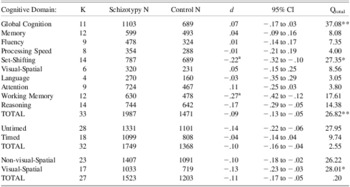
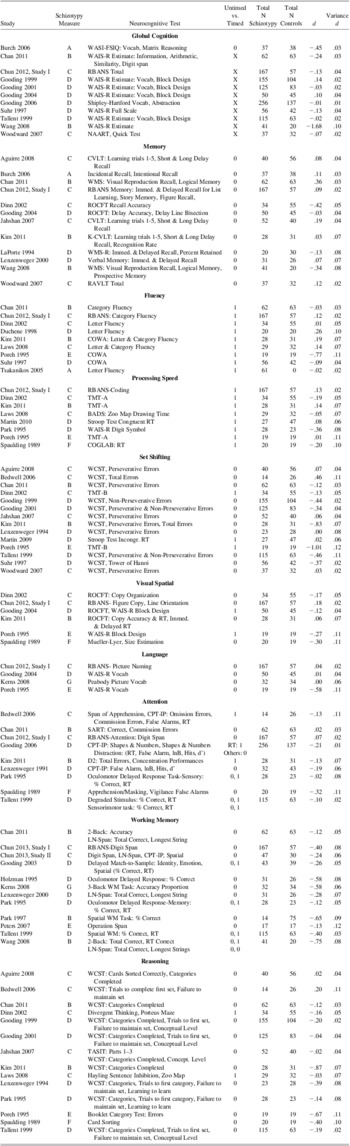
The findings for the meta-analysis investigating neurocognitive domains are summarized in Table 4. More detailed findings including individual studies and measures used can be found in Appendix C, as Table 5. No meaningful differences (defined as an effect size value <.20; Cohen, Reference Cohen1988) were found between the schizotypy and control groups on measures of global cognition, memory, fluency, processing speed, visual spatial, language, attention, and reasoning. Small effect sizes (d = 0.20–0.49; Cohen, Reference Cohen1988) were found for set shifting and working memory, suggesting that the schizotypy group performed more poorly than controls in these areas. The Q-total values were statistically significant for each of these domains. Negligible effect sizes were observed for timed versus untimed tests and language versus visual spatial abilities.
Meta-analysis of studies comparing college students with psychometrically-defined schizotypy to controls across various cognitive domains

K = Number of studies
a = d > 0.20
* = Qtotal p < .05
** = Qtotal p < .01
When the meta-analyses were recomputed for studies using positive and negative schizotypy scales, the results did not appreciably change. For both studies using positive and negative schizotypy scales, a small effect size deficit was observed in set-shifting and working memory abilities. Positive schizotypy was also associated with a small effect size level difference in processing speed (K = 3; d = −.24).
Study Three: Discussion
In Study Three, we evaluated the findings from published studies that compared neurocognitive functioning in schizotypy and control groups recruited from college populations. Although many studies have reported significant findings (e.g., Gooding et al., Reference Gooding, Kwapil and Tallent1999) we observed negligible effect sizes across most neurocognitive domains, independent of categorization. A total of 81% of studies examined showed only small or negligible findings. Small effect sizes were observed in two domains, with the schizotypy group performing more poorly for set shifting and working memory, which have both been shown as fundamental correlates of executive functioning (Miyake, Friedman, Emerson, Witzki, & Howerter, Reference Miyake, Friedman, Emerson, Witzki and Howerter2000). Potential working memory differences were found in contrast to the results from Study Two, which may have been underpowered due to small sample sizes. This discrepancy could also be due to different tasks used: we tested neither oculomotor delay response tasks nor delayed match-to-sample tasks, which were included in some studies in the meta-analysis. It is also important to note that we were unable to examine differences between schizotypy scales (e.g., SPQ vs. O-LIFE). It could be the case that neurocognition impairments manifest differently as a function of how schizotypy is defined. This reflects a limitation that can be addressed in future studies. Nonetheless, these results do not provide evidence that at-risk individuals from a high-functioning, university population exhibit global neurocognitive impairment. They also suggest that individuals from this population exhibit negligible deficits in most specific neurocognitive domains and, at best, modest executive functioning deficits.
General Discussion
The primary goal of this study was to assess whether neurocognitive impairment is present in individuals with psychometrically defined schizotypy recruited from college populations. Focusing on the college population is important in discerning core characteristics of schizophrenia-spectrum pathology from confounding post-psychotic factors. This examination reflects a key test of whether neurocognitive impairment remains stable even in high-functioning groups on the schizophrenia spectrum. There were three main findings from these sets of studies. First, individuals with psychometrically defined schizotypy showed marked concerns about their neurocognitive functioning, and, consistent with a prior report from our lab (Minor & Cohen, Reference Minor and Cohen2010), showed notable declines in both subjective and objective quality of life. In this regard, psychometrically defined schizotypy was by no means benign. Second, we did not observe any evidence of global or overt neurocognitive deficits. Individuals with schizotypy generally performed similar to controls. In the meta-analysis, schizotypy groups showed small reductions in executive functioning performance; however, as with previous studies (Chan et al., Reference Chan, Yan, Qing, Wang, Wang, Ma and Yu2011; Laws et al., Reference Laws, Patel and Tyson2008) performance was undemonstrative of their subjective complaints. Finally, neurocognitive functioning provided only small contributions to the variance in quality of life in individuals with schizotypy. Thus, in contrast to patients with schizophrenia, individual differences in neurocognitive dysfunctions did not greatly explain subjective functional deficits. This study provides evidence that college students with psychometrically defined schizotypy, as a group, do not show pronounced neurocognitive deficits, at least, as traditionally measured.
Working memory has been shown as a promising endophenotype in schizophrenia pathology for individuals with traceable genetic risk (Horan et al., Reference Horan, Braff, Nuechterlein, Sugar, Cadenhead, Calkins and Green2008). Our meta-analysis found working memory and set-shifting abilities to be disturbed, at a small effect size level, in psychometrically defined college schizotypes. It stands to reason that this may be a meaningful level of impairment for this high-functioning population; however, it is clear that the magnitude of impairment is not commensurate with subjective reports. It is worth noting that alternate recruitment methodologies not included in this meta-analysis, such as biological identification (Asarnow et al., Reference Asarnow, Nuechterlein, Asamen, Fogelson, Subotnik, Zaucha and Guthrie2002) and ultra high-risk interview (Trestman et al., Reference Trestman, Keefe, Mitropoulou, Harvey, DeVegvar, Lees-Roitman and Siever1995) consistently find significant neurocognitive impairment associated with these “at-risk” samples. Thus, it stands to reason that neurocognitive deficits do not manifest in all at-risk groups, such as high-functioning college students, but may be present in those high-risk individuals whose illness is most likely to worsen over time (i.e., ultra-high risk patients). Heterogeneity, with regards to schizotypy measures used and group definitions, could be considered a potential confound in this study. However, sensitivity analyses generally failed to support this notion, as there was little difference in magnitude of neurocognitive impairment between studies examining positive and negative schizotypy. Nonetheless, we did not directly compare these studies, so heterogeneity of schizotypy remains an important issue for future research.
A key finding regards the seemingly profound discrepancy in neurocognition between what individuals with schizotypy subjectively report and their actual abilities. Students at risk for schizophrenia showed a marked decline in QOL and increased cognitive complaints, yet these problems did not appear to be manifestations of classical neurocognitive deficits. In this regard, it seems relatively safe to conclude that college-based studies using clinical neuropsychological measures, at least as currently used, are not meaningfully tapping the “right stuff” (Green, Kern, Braff, & Mintz, Reference Green, Kern, Braff and Mintz2000). This observation has been made by others (e.g., Chang & Lenzenweger, Reference Chang and Lenzenweger2004; Chan et al., Reference Chan, Yan, Qing, Wang, Wang, Ma and Yu2011; Laws et al., Reference Laws, Patel and Tyson2008). Future research should focus on clarifying this striking disparity. One possibility is that individuals with schizotypy are impaired in some neurocognitive dimension not assessed using standard neurocognitive batteries. That is, memory and attention may largely be preserved, but other, as yet unidentified cognitive abilities are impaired. Some possible candidates that were not represented in our meta-analysis include abstraction, cognitive control and social cognition. Another possibility is that individuals with schizotypy show very specific, focal neurocognitive deficits that are masked by standard clinical instruments, which typically tap a broad range of neurocognitive, motivational and executive abilities. Perhaps the assessment of more specific cognitive abilities, using techniques from cognitive sciences, may yield more identifiable neurocognitive dysfunctions. Finally, it is possible that individuals likely to endorse items on the SPQ are also more likely to report personal problems on the QOL-I. This may reflect a response bias that could be avoided in future research by using more sensitive validity scales. It may also suggest that the deficit lies largely in the subjective domains, for example, reflecting biased autobiographical beliefs or meta-cognitive processes.
In contrast to what is seen in schizophrenia (Ritsner, Reference Ritsner2007) the contribution of neurocognitive functioning to global quality of life and functioning was relatively small. This suggests that the impoverishments in quality of life largely reflect the impact of other factors than basic neurocognitive abilities, at least, other than those assessed using standard clinical instruments. An important question becomes, what variables contribute to poor quality of life in the psychometrically defined schizotypy population? A recent study (Grant & Beck, Reference Grant and Beck2009) suggests an indirect relationship between neurocognitive deficits and impaired behavioral functioning in individuals with schizophrenia, proposing that defeatist beliefs embody the important, underlying link between the two; this connection may be similarly represented in non-psychotic, at risk individuals. Since those with schizotypy from the college population exhibit problems in daily functioning, without proportional neurocognitive deficits, dysfunctional attitudes appear a likely candidate for the diminution in quality of life. Moreover, poor emotional intelligence in schizotypy leads to problems in social and family functioning (Aguirre et al., Reference Aguirre, Sergi and Levy2008). Therefore, the subjective cognitive complaints and impoverished quality of life found in our study could be due to defeatist cognitive content or misguided personal and social beliefs.
In summary, the present findings support the notion that that psychometrically defined schizotypy is not benign, as even the college sample with schizotypy recruited in these studies exhibited notable declines in quality-of-life and increased concerns with their own neurocognitive abilities. In answer to the question, is the field measuring the right neurocognitive factors associated with psychometrically defined schizotypy in college samples, the response, based on the present findings of large abnormalities in subjective but not objective functioning, is a relatively clear “no”.
Acknowledgments
The authors acknowledge the efforts of Gina Najolia, Laura Brown, our undergraduate research assistants and our research subjects. The authors attest that they have no conflicts of interest. This work was supported by an internal Louisiana State University grant and a Louisiana Board of Regents grant to the senior author. The funding agency had no further role in study design; in the collection, analysis, and interpretation of data; in the writing of the report; and in the decision to submit the paper for publication.
Appendix A: Meta-analysis References Meta-analysis Studies
Meta-analysis Schizotypy Measures References
Appendix B: Meta-analysis Search Terms
Schizot* + cognit* + college/undergrad*/ student*
Anhedon* + cognit* + college/undergrad*/ student*
Chapman + cognit* + college/undergrad*/ student*
Magical Ideation + cognit* + college/undergrad*/ student*
Percept* Aberr* + cognit* + college/undergrad*/ student*
Psychosis-prone* + cognit* + college/undergrad*/ student*
Schizot* + memor* + college/undergrad*/ student*
Schizot* + executive* + college/undergrad*/ student*
Schizot* + languag* + college/undergrad*/ student*
Schizot* + verbal* + college/undergrad*/ student*
Schizot* + spatial* + college/undergrad*/ student*
Schizot* + attent* + college/undergrad*/ student*
Appendix C: Detailed Meta-Analysis Table
Mean Effect Sizes Computed for Schizotypy vs. Controls