Introduction
Due to increasing experience, endoscopic transoral laser microsurgery of early glottic cancer has become established as a safe and effective management option. Patients given impartial information about both radiotherapy (RT) and transoral laser microsurgery have been found to prefer laser treatment.Reference Bradley, Mackenzie, Wight, Pracy and Paleri1 There exists a perception that survival rates are the same for both RT and laser resection, but that voice outcomes are better with RT. However, a growing body of evidence suggests that transoral laser microsurgery has equally good voice outcomes.
In January 2002, the head and neck unit at the Queen Elizabeth II Health Sciences Centre, Halifax, Nova Scotia, Canada, began to offer transoral laser microsurgery to all patients with early stage glottic cancer. This study expands upon preliminary data previously published, to include a larger cohort of patients.
Methods
Between January 2002 and November 2007, our centre used transoral laser microsurgery to treat patients with a diagnosis of early stage (i.e. American Joint Committee on Cancer (AJCC) tumour (T) node (N) metastasis (M) stage T1 N0 M0 or T2 N0 M0), previously untreated, primary glottic cancer. All procedures were performed by a single surgeon (SMT) in the Division of Otolaryngology Head and Neck Surgery at the Queen Elizabeth II Health Sciences Centre. Prior to definitive surgery, all patients were discussed at regular Head and Neck Oncology Tumour Board multidisciplinary rounds.
In all cases, resection was performed using a Sharplan (Tel Aviv, Israel) CO2 laser with a power setting of 2–8 W, used in superpulse mode on a continuous setting with a variable spot size. The laser was coupled to an Acuspot micromanipulator (Sharplan). In small T1a cases, the tumour was resected en bloc whenever possible; however, it was frequently necessary to utilise a tumour-splitting approach and to resect the tumour piecemeal. All T2 tumours were resected using a tumour-splitting approach.
Patients were followed in the head and neck oncology clinic at the Queen Elizabeth II Health Sciences Centre, according to a surveillance protocol. Patients were seen approximately one month following surgery, and then three-monthly for the first year, four-monthly for the second year, six-monthly for the third to the fifth year, and yearly thereafter. For each patient, a minimum of five years' follow up was planned. Follow up involved clinical enquiry regarding speech, swallowing and respiratory morbidity, as well as clinical examination including neck palpation and flexible laryngoscopy.
All patients were asked to participate in voice studies, which were administered initially by a speech language pathologist and later by a nurse trained specifically to administer the tests. The schedule for voice testing was one test at the pre-operative consultation, one test three months post-operatively and one test 12 months post-operatively. All vocal data were collected prospectively submitted for publication, and have been reported elsewhere.
Collected data included patient demographics, surgical dates, and recorded progress and survival, as recorded in the clinical record. Data were entered into a database (Microsoft Access) and exported to a spreadsheet (Microsoft Excel) for analysis. Further statistical analysis was performed using the PASW 18 software program (SPSS Inc, Chicago, Illinois, USA).
Ethical considerations
The Research Ethics Board granted approval for the study of patient outcomes, prior to the creation of the patient data collection database. No additional patient visits or investigations were required to support this study.
Results
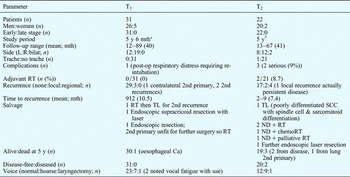
Within the study period, a total of 54 patients were treated with transoral laser microsurgery for early glottic cancer at our centre. One patient was lost to follow up as they emigrated in the first post-operative year; therefore, results for 53 patients are presented. Patients comprised 46 men and seven women, with a mean age of 66 years (range 30–84 years). Thirty-one patients were staged as T1 (27 T1a and five T1b) and 22 as T2. Table I describes patient demographics by tumour stage. The mean follow-up time was 40 months (range 12–88 months). Twenty tumours were located in the left vocal fold and 31 in the right vocal fold; two were bilateral (both were stage T2).
Results and demographics by tumour stage

*1 Jan '02 to 7 June '07; †1 Jan '03 to 13 Nov '07. T1 = tumour stage 1; T2 = tumour stage 2; y = years; mth = months; L = left; R = right; bilat = bilateral; trache = tracheostomy; post-op = post-operative; RT = radiotherapy; TL = total laryngectomy; SCC = squamous cell carcinoma; ND = neck dissection; Ca = cancer
Four patients suffered complications (7.5 per cent). One T1 patient developed post-operative respiratory distress requiring re-intubation, but was later successfully extubated the following day. One T2 patient suffered a significant, delayed (day 7) post-operative haemorrhage requiring emergency tracheostomy and admission to the intensive care unit, as part of a 27-day hospital stay (no other patient in the study group required a tracheostomy). One patient suffered post-operative surgical emphysema which resolved with conservative management. The final patient complication was a day 5 post-operative myocardial infarction requiring coronary artery bypass grafting.
All patients were able to tolerate a normal diet on the day following surgery, and none required a nasogastric tube.
At the time of writing (November 2009), follow-up data collection had identified four cases of second primaries and seven cases of recurrence.
There were two laryngeal second primaries in our cohort of patients. Both of these laryngeal second primaries occurred more than five years after the initial transoral laser microsurgery procedure. The other two cases of second primaries were of lung and oesophageal origin.
There were seven recurrences in our 53 study group patients. Two of these were T1 cases and the remaining five were T2 cases. Both the T1 cases recurred locally whereas only one of the T2 recurrences was local, the remaining four being regional.
At five years, the local control rate (without salvage) was 93.8 per cent and the disease-free survival rate (without salvage) was 87.6 per cent. The disease-free survival rate for T1 cases was 95.6 per cent, compared with 90.6 per cent for the T2 group.
The mean time to recurrence was 10 months (range two to 21 months). Of the T1 cases that recurred, one had a further endoscopic resection performed endoscopically (which on completion equated to supracricoid laryngectomy), followed by adjuvant RT; the other had RT but recurred again and went on to require total laryngectomy. The one case of T2 tumour with local recurrence was noted two months post-operatively; the surgical margins had been noted to be clear but the tumour was an aggressive subtype (a poorly differentiated squamous cell carcinoma with spindle cell and sarcomatoid differentiation). This patient went on to undergo total laryngectomy, offered after he failed RT administered as the primary salvage modality. The remaining T2 recurrences were all regional; all underwent neck dissection with adjuvant therapy (RT in two patients, chemoradiotherapy in one and palliative RT in one).
At last chart review (November 2009), four patients had died: two from their active disease (distant metastases), one from oesophageal cancer and one from a lung second primary.
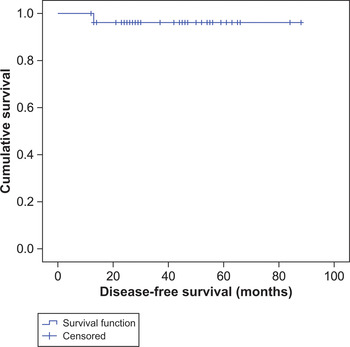
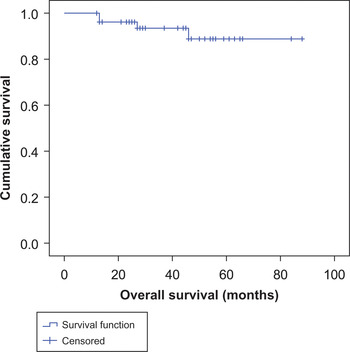
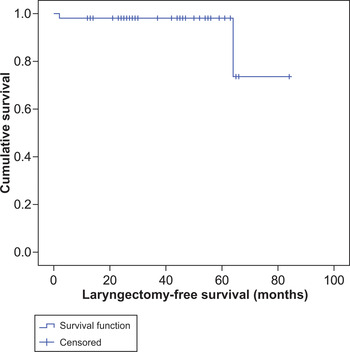
Kaplan–Meier survival analysis with censoring was performed for disease-free survival including salvage (Figure 1), giving a rate of 96.2 per cent at both 18 months and five years. The overall survival from all causes of death was 93.5 per cent at 18 months and 88.8 per cent at five years (Figure 2). Finally, the laryngectomy-free survival rate was 98.1 per cent at both 18 months and five years (Figure 3).
Disease-free survival, including salvage.

Overall survival from all causes of death.

Laryngectomy-free survival.

Discussion
Comparison with other studies
There is general agreement that the recommendations for treatment of early glottic cancer should follow a laryngeal-preserving strategy.Reference Pfister, Laurie, Weinstein, Mendenhall, Adelstein and Ang2 The three main treatments are transoral laser microsurgery, external beam RT and open partial surgery. A Cochrane review of the published data on the effectiveness of these three treatments was unable to definitively recommend any one of the three.Reference Dey, Arnold, Wight, Kelly and McKenzie3 Published local control rates at five years range from 78 to 94 per cent for T1 patientsReference Sjögren, Langeveld and Baatenburg de Jong4 and from 47 to 91 per cent for T2 patients,Reference McCoul and Har-El5, Reference Mendenhall, Werning, Hinerman, Amdur and Villaret6 with laryngeal preservation rates of 93–100 per cent for T1 patients and 76–93 per cent for T2 patients.Reference Mendenhall, Werning, Hinerman, Amdur and Villaret6 Our projected five-year survival rate is in keeping with the upper end of these results. It has recently been suggested that, for patients with T1a tumours, transoral laser microsurgery is superior to RT in terms of disease-free survival, length of time to recurrenceReference Thurnher, Erovic, Frommlet, Brannath, Ehrenberger and Jansen7 and laryngeal preservation rate.Reference Schrijvers, van Riel, Langendijk, Dikkers, Schuuring and van der Wal8 In our own centre, previously published results for RTReference Hafidh, Tibbo, Trites, Corsten, Hart and Nasser9 revealed a local control rate (before salvage) of 71 per cent for T1 cases and 63.3 per cent for T2 cases, which is much lower than our rate of 83.5 per cent for both stages combined.
Of the three main early glottic cancer treatments listed above, recent years have seen a decline in the use of open partial surgery,Reference Silver, Beitler, Shaha, Rinaldo and Ferlito10 possibly correlated with the expansion in availability of transoral laser microsurgery. Patients have also expressed a preference for transoral laser microsurgery over RT, due to the shorter duration of treatment. In our institution, all patients in this group are offered the choice of RT or transoral laser microsurgery; however, since 2002 no patient has opted for RT.Reference Taylor and Rigby11
A perception of better vocal outcomes has often been used to justify a preference for RT treatment. Assuming similar control rates, this would indeed be a discriminating factor. However, although evidence is sparse, a meta-analysis of published case series has suggested that there is no significant difference in vocal outcomes, comparing RT and transoral laser microsurgery for early glottic cancer; on the other hand, vocal outcomes following partial open surgery are worse.Reference Cohen, Garrett, Dupont, Ossoff and Courey12
• This retrospective study analysed 53 cases of early glottic laryngeal carcinoma (tumour stages 1 and 2) treated with transoral laser microsurgery
• At five years, disease-free survival (including salvage) was 96.2 per cent, overall survival (all causes) was 88.8 per cent and laryngectomy-free survival was 98.1 per cent
• Transoral laser microsurgery is a safe and effective initial treatment for early laryngeal cancer, with high disease-free survival and laryngeal preservation rates
Conclusion
This study provides further evidence that transoral laser microsurgery is a safe, effective option for the treatment of early glottic cancer. Treatment can be repeated if there is residual or recurrent disease, and the option for further, more radical surgery or RT is still available if needed for salvage. Furthermore, there is minimal morbidity and a high laryngeal preservation rate, and patients have demonstrated an overwhelming preference for this option over RT. Thus, transoral laser microsurgery will remain the treatment of choice for patients with early glottic cancer in our centre.