Methicillin-resistant Staphylococcus aureus (MRSA) is endemic in the US healthcare system and is one of the leading causes of healthcare-associated infections (HAIs).Reference Klein, Smith and Laxminarayan 1 In 2007, the Veterans Health Administration (VHA) implemented the MRSA bundle, which has been linked to a significant decrease in MRSA transmission and HAIs within VHA hospitals.Reference Jain, Kralovic and Evans 2 , Reference Evans, Kralovic and Simbartl 3 However, controversy continues regarding which aspect of the program played a role in the reduction of MRSA infections.Reference Gurieva, Bootsma and Bonten 4 Some evidence suggests that contaminated environmental surfaces play an important role in the transmission of HAIs.Reference Weber, Anderson and Rutala 5 The MRSA environmental contamination rates were assessed on 5 high-touch surfaces in hospital rooms that were designated as either contact or noncontact isolation rooms. Understanding the level of MRSA bioburden helps elucidate the transmission cycle of MRSA and increases our understanding of the role of the MRSA bundle in reducing environmental transmission.
METHODS
This study was conducted at a 120-bed acute care facility in the Central Texas Veterans Health Care System in Temple, Texas. A convenience sample of 100 hospital rooms was selected for this study. According to hospital protocol, any hospitalized patient who has or had MRSA colonization, infection at admission, or a history of either infection or colonization within 12 months is placed under contact isolation measures and transferred to an isolation room if needed (some of the noncontact isolation rooms share bathrooms). According to the institutional policy, each healthcare worker caring for any patient in contact isolation is required to perform hand hygiene and don gown and gloves before entering the room, then to perform hand hygiene and doff gown and gloves when exiting the room.
The infection control database was used to identify vacated contact and noncontact rooms that were occupied for at least 48 hours. Five high-touch surfaces (ie, call button, bedrail, tray table, bathroom handrail, and toilet seat) were sampled in each study room immediately after patient discharge but before manual disinfection was performed. The samples were collected using Rodac plates (Hardy Diagnostics, Santa Maria, CA), a chromogenic medium for the detection of MRSA from environmental surfaces. For flat surfaces (ie, call button, tray table, and toilet seat), the press plate method was utilized; for uneven surfaces (ie, bedrail and handrail), the roll plate method was used. The plates were incubated for 48±4 hours at 35±2°C, and MRSA colonies were then counted and recorded. These colonies were identified as MRSA according to standard microbiologic methods. The Wilcoxon rank-sum test was used to compare the MRSA bioburden (1) in contact vs noncontact rooms, (2) overall, and (3) for individual high-touch surfaces. Data were analyzed using SAS v9.3 (SAS Institute, Cary, NC) and a significance level of α=.05 was assumed throughout.
RESULTS
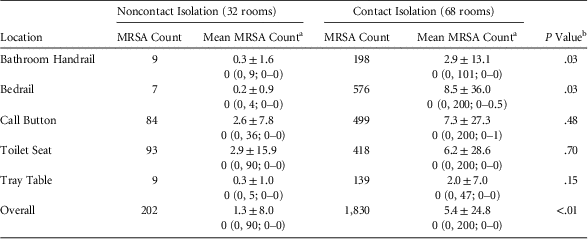
In total, 100 rooms were sampled; 32 were noncontact isolation rooms and 68 were contact isolation rooms. We identified a total of 202 MRSA colonies in noncontact isolation rooms and 1,830 in contact isolation rooms. In the noncontact isolation rooms, call buttons and toilet seats had the highest mean MRSA colony counts (mean±SD=2.6±7.8 for call buttons and 2.9±15.9 for toilet seats). A statistically significant overall difference in MRSA colony counts was observed between contact and noncontact rooms (P<.01), averaging 5.4 colonies for contact rooms and 1.3 colonies for noncontact rooms (Table 1). Examining bioburden by high-touch surface location, bathroom handrails and bedrails were the only locations with significantly different MRSA colony counts between contact isolation rooms and noncontact isolation rooms (P=.03 and .03, respectively).
MRSA Colony Counts from 5 High-Touch Surfaces in Noncontact Isolation and Contact Isolation Hospital Rooms (N=100)

Note. MRSA, methicillin-resistant Staphylococcus aureus.
a Values are presented as mean±SD (top values) and median (minimum, maximum; interquartile range) (bottom values).
b Wilcoxon rank-sum tests were used, assuming a significance level of α=.05.
DISCUSSION
Our results indicated the presence of environmental MRSA contamination in both contact and noncontact isolation hospital rooms, but the MRSA burden was significantly lower in noncontact isolation rooms. The bioburdens on toilet seats and call buttons were comparable in contact and noncontact isolation rooms. Possible reasons for MRSA in noncontact rooms include (1) residual contamination from prior occupants,Reference Jinadatha, Quezada, Huber, Williams, Zeber and Copeland 6 (2) intermittent colonizers or extra-nasal colonizers that were missed by nasal screening at admission,Reference McKinnell, Huang, Eells, Cui and Miller 7 and (3) staff members or visitors colonized or infected with MRSA who interacted with the patient environment.Reference Stiefel, Cadnum, Eckstein, Guerrero, Tima and Donskey 8
A higher MRSA burden in the contact isolation rooms was expected, but the fact that MRSA was detected in noncontact isolation rooms has potential implications for infection prevention. This finding highlights the importance of hand hygiene before and after every patient care interaction or contact with the patient environment.Reference Stiefel, Cadnum, Eckstein, Guerrero, Tima and Donskey 8 Additionally, this finding brings into question whether hospitals that employ enhanced disinfection techniques such as hydrogen peroxide vapor or mercury-based or pulsed-xenon–based ultraviolet devices should be using them in all rooms rather than exclusively in contact isolation rooms.Reference Jinadatha, Quezada, Huber, Williams, Zeber and Copeland 6 , Reference Otter, Yezli, Perl, Barbut and French 9
Our study has several limitations. It is a single-center VHA hospital experience, and the study findings may not be generalizable to other non-VHA facilities. The following variables were not assessed: length of stay; data regarding visitor movement and staff interaction; concurrent hand hygiene rates; shared bathroom data; and surface bioburden levels prior to occupation of the study room. The omission of these variables may have limited our conclusions. Additionally, in this study, we did not investigate the impact of the environmental contamination on transmission or HAIs, further limiting our conclusions regarding the impact of environmental burden in the study rooms.
In conclusion, our study identified the presence of MRSA isolates in hospital rooms of patients that were not previously identified as colonized or infected with this bacterium. The origins of these contaminates is unknown, but these results can shed some light on the transmission of healthcare-acquired MRSA infections and help us better determine interventions to prevent the spread of MRSA beyond contact isolation rooms.
ACKNOWLEDGMENTS
The authors would like to thank Timothy Erickson for manuscript editing, Kimberly Sikes for sample collection, Elicia Greene and the entire Infection Prevention and Control department, Allen Lassiter and the EMS team, along with nursing service for their help in coordinating study activities.
Financial support. This work was supported by a Merit Review grant from the Department of Veterans Affairs to JZ (grant no. IIR 12-347) and the study’s laboratory activity by a grant from Xenex Healthcare Services, LLC. Furthermore, this work was supported by the Central Texas Veterans Health Care System (Temple, Texas), with additional support from Baylor Scott & White Health (Temple, Texas) and the jointly sponsored Center for Applied Health Research (Temple, Texas).
Potential conflicts of interest. The authors declare that no competing interests exist.