INTRODUCTION
The prevalence of epilepsy in Saudi Arabia is estimated to be 6.54 per 1000 individuals (Al Rajeh et al., Reference Al-Ghatani, Obonsawin, Binshaig and Al-Moutaery2001). Although this is comparable to global rates (Brundtland, Reference Baxendale, van Paesschen, Thompson, Connelly, Duncan, Harkness and Shorvon2001; Haerer et al., Reference Gleissner, Helmstaedter and Elger1986), it may be an underestimate due, first, to the high prevalence of consanguinity in the country, producing more neurological conditions, including epilepsy (Abduljabbar et al., Reference Abduljabbar, Ogunniyi, Daif, Al-Tahan, Al-Bunyan and Al-Rajeh1998) and, second, the systemic underreporting of epilepsy among Saudi women (as Al Rajeh and his colleagues posited in their survey). Up to 40% of epilepsy is drug-resistant (Picot et al., Reference Piazzini, Canevini, Maggiori and Canger2008; Siegel, Reference Shebani, van de Vijver and Poortinga2004), and surgical treatment for epilepsy has established efficacy and is widely accepted (Kingwell, Reference Kilpatrick, Murrie, Cook, Andrewes, Desmond and Hopper2012; Krauss & Sperling, Reference Kneebone, Lee, Wade and Loring2011; Ontario Health Quality, Reference Nell2012; Spencer & Huh, Reference Soble, Eichstaedt, Waseem, Mattingly, Benbadis, Bozorg, Vale and Schoenberg2008). In Saudi Arabia, epilepsy surgery was initiated in 1998, making the kingdom one of the first countries in the Middle East to offer such a service (Khan & Alsemari, Reference Khalil2008). In particular, King Faisal Specialist Hospital and Research Centre (KFSHRC) has developed a comprehensive epilepsy program (CEP) that achieves surgical outcomes comparable to other such centers worldwide (Alsemari et al., Reference Al Salman2014). One goal of our program is the development of a state-of-the-science neuropsychological examination that also meets international standards.
The critical value of neuropsychological measures lies in assessing underlying pathology (lateralization and localization of seizure focus), guiding surgery based on the patient’s cognitive profile, monitoring effects of disease or treatment, predicting postsurgical outcomes, and tailoring rehabilitative plans (Jones-Gotman et al., Reference Ivnik, Sharbrough and Laws2010; Loring, Reference Lieblich and Kugelmass1997; Wilson et al., Reference Treyer, Buck and Schnider2015). There is general consensus that the simple translation of a neuropsychological test or test battery, developed in a certain country and culture, to another language and using it with patients from other countries or cultures is extremely problematic (International Test Commission, Reference Howell, Saling, Bradley and Berkovic2010; Manly & Echemendia, Reference Loring, Strauss, Hermann, Barr, Perrine, Trenerry, Chelune, Westerveld, Lee, Meador and Bowden2007; Nell, Reference Milner, Whitty and Zangwill2000; Puente, Reference Picot, Baldy-Moulinier, Daures, Dujols and Crespel1990). A recent review of neuropsychological studies conducted in Arab countries before 2016 (Fasfous et al., Reference Escandell and Ferraro2017) identified eight studies in the literature comparing neuropsychological function of Arab groups to Western or Israeli Jewish groups (Alansari & Baroun, Reference Alansari and Baroun2004; Josman et al., Reference Jones-Gotman, Smith, Risse, Westerveld, Swanson, Giovagnoli, Lee, Mader-Joaquim and Piazzini2006; Lieblich & Kugelmass, Reference Lencz, McCarthy, Bronen, Scott, Inserni, Sass, Novelly, Kim and Spencer1981; Parush et al., 2000; Shebani et al., Reference Schefft, Testa, Dulay, Privitera and Yeh2008; Sobeh & Spijkers, Reference Siegel2012, Reference Sobeh and Spijkers2013; Stanczak et al., Reference Spencer and Huh2001). All of the eight studies demonstrated clear test performance differences between Arabs and other ethnic groups, emphasizing the importance of adapting cognitive measures to the local culture, language, or educational experience.
From working as neuropsychologists at KFSHRC, Escandell (Reference Elbehairy2002) and Hassan (Reference Haerer, Anderson and Schoenberg2012) illustrated the necessity for developing a customized set of neuropsychological approaches that are both evidence-based and reflective of the Saudi social and cultural complexities. The aforementioned review by Fasfous et al. (Reference Escandell and Ferraro2017) revealed that only 45% of the tests used with Arab patients in neuropsychological publications underwent any type of adaptation, re-norming, or validation. Among the studies conducted in Saudi, only five neuropsychological measures underwent sufficient adaptation and validation based on the authors’ criteria: (1) Addenbrooke’s Cognitive Examination – Third Edition (Al Salman, Reference Al Rajeh, Awada, Bademosi and Ogunniyi2013), (2) semantic and (3) phonemic wordlist generation (Al-Ghatani et al., Reference Al-Ghatani, Obonsawin and Al-Moutaery2009; Al-Ghatani et al., Reference Al-Ghatani, Obonsawin and Al-Moutaery2011; Khalil, Reference Josman, Abdallah and Engel-Yeger2010), (4) Wechsler Memory Scale – Third Edition (Escandell, Reference Elbehairy2002; Hassan, Reference Haerer, Anderson and Schoenberg2012), and (5) Stroop Color Word Test (Al-Ghatani et al., Reference Al-Ghatani, Obonsawin and Al-Moutaery2010; Al-Ghatani et al., Reference Al-Ghatani, Obonsawin and Al-Moutaery2011). In addition, no Arabic language battery was developed specifically to examine neuropsychological function in epilepsy patients from Saudi or neighboring Arab countries.
As illustrated, a systematic review of the literature highlights the scarcity of properly standardized neuropsychological measures in Arabic, and the importance of linguistic and cultural adaptation to validate any newly developed test to be used in Arab populations. Based on the prevalence of epilepsy in Saudi Arabia, the advancement of epilepsy surgery in the country, and the vital role of neuropsychology in pre-surgical assessment, using culturally appropriate neuropsychological tests standardized for Arabic epilepsy surgical candidates is the appropriate and ethical practice with this population, necessitating the efforts of this study. Thus, we sought to adapt English-language tests to Arabic with the main purpose of serving Saudi epilepsy surgery candidates. We then examined its validity through (1) its ability to differentiate between neurologically and psychiatrically healthy adults and neurologic patients and (2) its ability to differentiate left and right temporal lobe epilepsy (TLE) focus for surgical candidates at KFSHRC.
METHOD
Participants
Patients with TLE
Fifty-six individuals referred to the CEP and epilepsy-monitoring unit (EMU) at KFSHRC and diagnosed with drug-resistant epilepsy were examined. Inclusion criteria were (1) the diagnosis of TLE resistant to drug treatment as determined by an epileptologist; (2) 15 years old or older; (3) valid results on standard surgical evaluation studies identifying either left or right temporal focus including (a) seizure semiology indicative of laterality as reported by an epileptologist, (b) inter-ictal electroencephalography (EEG) exam during EMU admissions or outpatient studies, (c) scalp or intracranial ictal EEG (iEEG) during EMU, (d) magnetic resonance imaging (MRI) (e), positron emission tomography (PET), and (f) postsurgical histopathological evidence of gliosis or sclerosis in the resected tissue. Those with no mesial temporal sclerosis (MTS) on MRI studies and those who met fewer than three criteria (a) to (c) and (e) were excluded. Non-MTS cases included those with MRI findings suggesting cortical dysplasia and neoplasm. Forty-two remained in the study after exclusion. According to these parameters, patients were classified into two groups: left TLE (n = 21) and right TLE (n = 21).
Healthy controls
For this small sample to lay the groundwork for large-scale normative data collection, we stratified by age (Saudi Central Department of Statistics and Information., Reference Saling2013) for ages 15 and above. Healthy control data were collected from six age groups and five educational levels based on percentage from the census. Stratification by gender was nearly equal for the two sexes, per the census. An attempt was also made to have a fair representation from different Saudi geographical areas (Western/Hijaz, Central/Najd, Eastern, Southern, and Northern), mainly based on parents’ region of origin if the participant was living in the central region. Medical histories were obtained on intake to determine healthy neurological and psychiatric (including substance use) status. Some participants were relatives of enrolled patients; some were employees of KFSHRC.
Measures
The battery developed for this study includes 15 tests, based largely on the neuropsychological battery utilized in the Division of Medical Psychology of the Johns Hopkins University School of Medicine. Tests in this battery were also chosen to align with the Epilepsy Common Data Elements (CDEs) tool of the U.S. National Institute of Neurological Disorders and Stroke (NINDS) (Loring et al., Reference Loring2011; www.commondataelements.ninds.nih.gov/Doc/EPI/F1140_Overview_of_Recommended_Neuropsychology_Instruments.docx). Eleven tests were translated to Arabic by the first author (postdoctoral fellow in neuropsychology and a native Arabic speaker, with English proficiency). Under the supervision of the last author, efforts were made to preserve item content or at least assess the same construct. Cultural modifications were made whenever necessary. Formal Arabic language (Fus’ha) was used where appropriate, but common Arabic expressions and colloquialisms were also used to facilitate comprehension by the average Saudi patient. The tests were back-translated to English by two bilingual, doctoral-level, health professionals, both of whom have limited familiarity with neuropsychological tests. The translated, adapted, and back-translated tests are (1) Wechsler Abbreviated Scale of Intelligence – Second Edition, (2) Jeddah Adaptation of the Boston Naming Test, (3) Bakker-Brandt Naming Test, (4) Token Test, (5) Baltimore Board, (6) Hopkins Verbal Learning Test – Revised (HVLT-R), (7) Brief Visuospatial Memory Test – Revised (BVMT-R), (8) Color Trails Test (CTT), (9) Edinburgh Handedness Inventory, (10) Grooved Pegboard Test (GPT), and (11) Quality of Life in Epilepsy Inventory (QOLIE-31). Four tests already available in Arabic were added to the battery: a Saudi modification of the Logical Memory subtest of the Wechsler Memory Scale – Third Edition (WMS-III; Escandell, Reference Elbehairy2002), Arabic letter and animal fluency (Khalil, Reference Josman, Abdallah and Engel-Yeger2010), Arabic modification of the Stroop Color-Word Test (Al-Ghatani et al., Reference Al-Ghatani, Obonsawin and Al-Moutaery2010), and Arabic Symptom Checklist-90 (SCL-90; Elbehairy, Reference Drewes, Sagberg, Jakola and Solheim2004). Original references, test description, and review of the adaptation process of each test appear in Supplementary Material Appendix A.
Procedure
On admission to the EMU of KFSHRC, patients received neuroimaging, video EEG monitoring, and other necessary investigative procedures. Demographic data (age, education, occupation, geographic origin, and handedness) and clinical data (age of seizure onset, family history of epilepsy, and frequency of seizures) were recorded. Those who met the study’s criteria from either the EMU or epilepsy outpatient clinics were identified by their epileptologists, and enrolled in the study after they gave informed consent. The test battery, which required approximately 4 hr (including breaks), was administered by an experienced psychometrist in a quiet, well-lit room. Similar procedure was conducted with the healthy group, and an attempt was made to match them on age and education with the patient group.
Nearly half of the patients received the original form of the WMS-III Logical Memory subtest (52%) and the other half received the new form (48%). The same was the case for healthy participants (original = 52%, new = 48%). For the two forms of the HVLT-R, 60% of patients were administered Form 1, and 40% Form 5. Exactly half of healthy controls received either form. Illiterate participants were read the SCL-90 and the QoLiE-31 instructions and items. Response sheets were de-identified and scored after the end of data collection. Authors carried out test scoring “blindingly.” Data from healthy control and patient participants were collected simultaneously, from late 2015 to middle 2017. This study was approved by KFSHRC’s institutional review board.
Analysis
Analysis of variance (ANOVA) was used to analyze differences in age and education between the three groups. Independent sample t-tests were used to compare seizure variables between R-TLE and L-TLE groups. Group differences in gender and handedness were tested with chi-squared tests for frequencies. Provided the normal, or close to normal distribution of data derived from most of our subtests, and that other tests of normality being frequently nonsignificant, parametric statistics were used to test for differences between the three groups on all measures, through multiple, one-way ANOVA procedures. QoLIE-31 differences between L-TLE and R-TLE groups were examined with independent sample t-tests. Post-hoc tests were used to follow up significant differences between the three groups (Games-Howell as equal variance was not assumed in several test indices). Pearson coefficient (r) was used to identify correlations between select continuous dependent variables (Hermann et al., Reference Hermann, Seidenberg, Haltiner and Wyler1995b) in the TLE groups. Independent sample t-tests were used to assess any differences between performances on the original and new forms of the WMS-III Logical Memory subscale, and Forms 1 and 5 of the HVLT-R. Missing data were excluded test-wise; there was no imputation.
RESULTS
“Missing Data Section removed and added under Tables 1 & and 2, and Demographics and Alternate form Reliability Titles were removed, and their content was combined and summarized.”
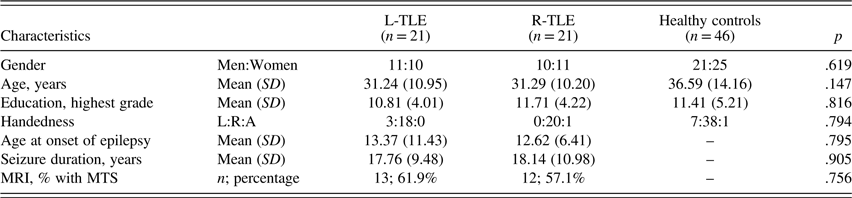
There were no significant differences among the three groups in age, education, gender distribution, or handedness. There was one illiterate participant in each of the epilepsy groups, and two in the healthy control group. Education level 9 years or less was 33.3% in the L-TLE group, 28.6% in the R-TLE group, and 39.1% in the healthy group. There were also no significant differences in seizure duration or age of onset between right and left TLE groups (Table 1). Pooled over the three groups, participants who received the alternate form of the Logical Memory scale scored similarly to those who received the original form. There were also no differences on the performance on all indices derived from the two forms of the HVLT-R. Alternate-form reliability for these two measures will be discussed elsewhere.
Demographic characteristics of the patient and healthy control groups

Note. Group differences in means were tested with ANOVA, and differences for frequencies were tested with chi-squared tests.
SD = standard deviation, TLE = temporal lobe epilepsy, L = left, R = right, A = ambidextrous, MTS = mesial temporal sclerosis, MRI = magnetic resonance imaging.
Group Differences on Neurocognitive Measures
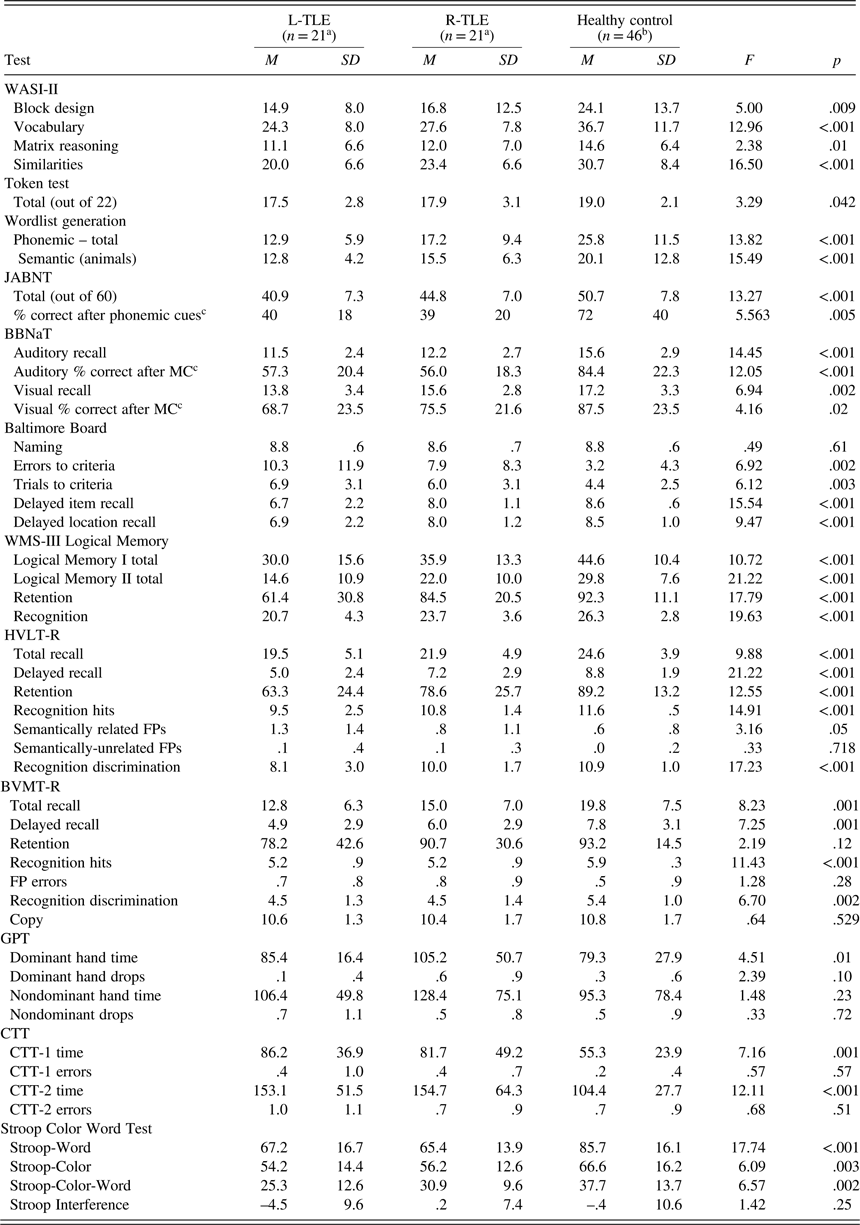
Scores on all the cognitive tests differed among control, L-TLE, and R-TLE groups (see Table 2), with few exceptions: Baltimore Board Naming, HVLT-R Semantically Unrelated-False Positive Errors, BVMT-R Retention, False-Positive Errors, and Copy, GPT non-dominant hand time and drops, GPT dominant hand drops, CTT errors, and Stroop Interference score.
Means and standard deviations and group differences between patient and healthy control groups on neurocognitive measures

L = left, R = right, TLE = temporal lobe epilepsy, M = Mean, F = Fisher’s ratio. WASI-II = Wechsler Abbreviated Scale of Intelligence – Second Edition, JABNT = Jeddah Adaptation of the Boston Naming Test, BBNaT = Bakker-Brandt Naming Test, MC = multiple-choice testing, WMSI-III = Wechsler Memory Scale – Third Edition, HVLT-R = Hopkins Verbal Learning Test – Revised, FP = false positives, BVMT-R = Brief Visuospatial Memory Test – Revised, GPT = Grooved Pegboard Test, CTT = Color Trails Test.
a Sample size is 21 except for BBNat, GPT nondominant, CTT, and Stroop Test (refer to Table C in Supplemental Material for exact ns). Reasons included time limitations, hemiparesis (GPT), difficulty passing the sample trials of either parts of the CTT, and a mixture of low literacy and difficulty understanding the Stroop-Color-Word trial.
b Sample size is 46 except for BBNat, GPT, CCT, and Stroop Test (refer to Table C in Supplemental Material for exact ns). Reasons were similar to the patient group, but largely stemming from low literacy.
c Those who had an errorless performance on the spontaneous naming part were not included in the count of percent correct responses after phonemic (on the JABNT) or multiple-choice testing (on the BBNatT).
Self-Report Measures
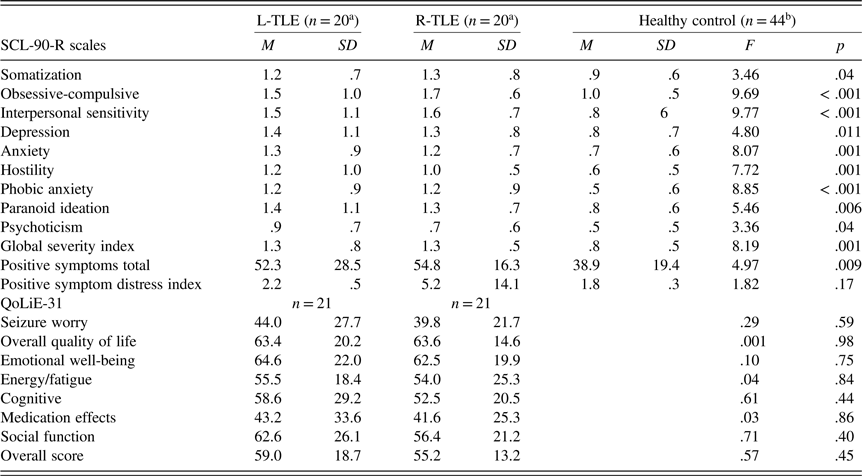
All SCL-90-R scales differed among control, L-TLE, and R-TLE groups (see Table 3), except the Positive Symptom Distress Index. Strongest significance was obtained on Interpersonal Sensitivity, Obsessive-compulsive, Phobic Anxiety, and Anxiety scales, respectively, in the direction which the epilepsy groups endorsed more symptoms than the healthy control group, reporting roughly similar to each other. When comparing the QoLiE-31 ratings of the L-TLE and R-TLE groups (Table 3), there was no significant difference on any of the scales.
Means, standard deviations, and group difference between the patient and healthy control groups on the SCL-90-R, and difference between the TLE groups on weighted scores of the QoLiE

SCL-90-R = symptoms checklist – revised, QoLiE-31 = quality of life in epilepsy – 31. M = Mean, SD = standard deviation, F = Fisher’s ratio.
a One participant was not administered the SCL-90-R due to apparent difficulty grasping item content.
b Two participants were not administered the SCL-90-R due to low literacy.
Post-hoc Analysis
One aim of this study was to examine whether performance on our newly developed battery was able to differentiate between the L-TLE and R-TLE groups. For this, Games-Howell post-hoc test was used. Individuals with L-TLE scored similarly to those with R-TLE on Block Design (p = .827), but significantly lower than healthy controls (p = .003). Patient groups did not differ on Vocabulary (p = .366) or Similarities (p = .222), but both were worse than controls on both tasks (p < .002). The L-TLE group scored lower than controls on the Token Test, approaching significance (p = .073), but not much lower than the R-TLE group (p = .898). Both scored significantly lower than controls on letter-based (p < .007) and category-based (L-TLE p < .001 and R-TLE p = .017) wordlist generation. JABNT scores for both L-TLE (p < .001) and R-TLE (p = .011) groups were significantly worse than healthy controls. The Jeddah Adaptation of the Boston Naming Test (JABNT) percent benefit after phonemic cues, as well as BBNat auditory recall, displayed the same pattern, both TLE groups being worse than controls (p < .008). The visual part of the BBNat differentiated between healthy and L-TLE (p = .004) groups, but not between healthy and R-TLE groups (p = .137). Baltimore Board Item Recall nearly differentiated TLE groups (p = .074), in which L-TLE scored lower. The L-TLE group scored lower than R-TLE on Logical Memory II (p = .07), and significantly lower on Recognition (p = .05), but Retention was more sensitive in differentiating the two (p = .019). It also strongly differentiated between L-TLE and healthy groups (p = .001), but not between controls and R-TLE patients (p = .249; see Figure 1a). The HVLT-R Delayed Recall and Recognition Discrimination strongly distinguished the two patient groups (L-TLE lower; p = .023, and .047, respectively). Total Recall and Retention did not, but those with L-TLE were much weaker compared to controls (p < 002; see Figure 1b). Both TLE groups were worse than controls on BVMT-R Total Learning and Delayed Recall (L-TLE: p < .003; R-TLE: p < .082), but similar to each other. On BVMT-R Discrimination, both groups scored worse than controls (L-TLE: p = .024; R-TLE: p = .023), but also similar to each other. Further, CTT-1 and CTT-2 did not distinguish the epilepsy groups, but both performed fairly worse than controls (L-TLE: p < .005; R-TLE: p < .07). Likewise, epilepsy groups scored similarly on all Stroop tasks, and both were lower than controls on Stroop Word (both < .002), Stroop Color (L-TLE: p = .01; R-TLE: p = .025), and Stroop Color-Word (L-TLE: p = .004; R-TLE: p = .094).
(a) WMS-III Logical Memory performance for healthy and left and right TLE groups. (b) HVLT-R performance for healthy and left and right TLE groups. Error bars represent standard errors.

Finally, there were no significant differences between the epilepsy groups on other cognitive tasks, or any of the scales comprising the SCL-90-R. However, people with R-TLE reported much more pathology than healthy controls on the Obsessive-Compulsive (p < 001), Interpersonal Sensitivity (p = .001), Anxiety (p = .006), Phobic Anxiety (p = .007), Hostility (p = .017), Paranoid Ideation (p = .031), and Depression (p = .048) scales, whereas differences of endorsements between L-TLE and healthy groups were of less significance (p = .121, .024, .021, .017, .024, .064, .078, respectively).
Correlations
For the sake of conciseness and ease of presentation, correlation between the neuropsychological measures and only four demographic and clinical variables are examined and discussed here, and for the TLE sample only. The selected demographic and disease variables are age at onset of seizures, seizure duration, age, and years of education (Baxendale et al., Reference Barr, Morrison, Zaroff and Devinsky1998; Hermann et al., Reference Hermann, Seidenberg, Haltiner and Wyler1995b; Strauss et al., Reference Strauss, Hunter and Wada1995). Supplemental Material Table A presents their correlation with neurocognitive measures, and Table B with self-report measures.
Additional Analysis
Given that many patients in our TLE sample exhibited MRI findings of MTS (n = 25), we examined the performance of our left MTS (n = 12), right MTS (n = 13), left non-MTS (n = 8), and right non-MTS (n = 9) groups. For this multiple ANOVAs were used, with Games–Howell post-hoc tests. Means, standard deviations, and F ratios are available in Tables E and F in the Supplemental Materials. Only post-hoc analyses of significant (or near-significant) differences on the main MTS analysis are reported here.
Patients with right non-MTS TLE scored significantly lower on Block Design than those with right MTS (p = .014) and those with left non-MTS TLE (p = .045). See Figure 2 in the Supplemental Material. Those with left MTS scored lower than those with right MTS on JABNT total correct (p = .061), approaching significance. The left non-MTS group benefitted from phonemic cues much more than did the left MTS group (p = .052). See Figure 3a. On Baltimore Board, the left-MTS group scored lower than the other three groups on Location Recall (left non-MTS, right MTS, and right non-MTS p = .035, .066, .076, respectively). A similar, but weaker, trend was noted on Item Recall; see Figure 3b in the Supplemental Material. On Logical Memory II, there was a clear trend for those with left MTS to score lower than those with right MTS (p = .059). The left MTS group retained fewer story details than the two right TLE groups (right MTS: p = .069, right non-MTS: p = .004) (see Figure 3c in the Supplemental Material). They also had significantly fewer “hits” on Recognition than the right MTS group (p = .039). Left MTS patients scored significantly lower than right MTS patients on HVLT-R Delayed Recall (p = .006). To a lesser extent, HVLT-R Retention and Recognition Discrimination indices significantly differentiated left from right MTS (p = .044 and p = .019, respectively). On BVMT-R Total Learning, the left MTS group scored significantly lower than the right MTS group (p = .032), and lower than the left non-MTS group (p = .039). The left non-MTS group achieved the highest BVMT-R Delayed Recall score, and the left MTS group achieved the lowest (p = .012). The difference between right and left MTS performance was significant, in which the right MTS group performed better (p = .024); see Figure 3d in the Supplemental Material. The right-non-MTS group scored significantly worse than the right MTS group on BVMT-R Copy (p = .033).
GPT dominant hand time completion differentiated between the left TLE groups; those with MTS were slower than those without (p = .029). Right MTS patients were the fastest to complete CTT-1, whereas their right-non-MTS counterparts were the slowest (p = .073). Self-report measures did not reveal significant differences across groups, although there was a trend for those with left-MTS to report more hostility (p = .073). After covarying for years of education, as the right-non MTS group was significantly less educated than the right MTS (p = .031), similar results were revealed on all measures apart from the finding concerning the CTT.
DISCUSSION
Measures developed and data derived from this study respond to the need of a large segment of Saudi Arabians suffering from epilepsy. Its validity is established through several of our findings, many widely consistent with expected “test behavior,” and the massive existing literature on the neuropsychology of epilepsy.
Similar to what is demonstrated in several seminal studies (Doss et al. Reference Brundtland2000; Hermann et al., Reference Helmstaedter, Grunwald, Lehnertz, Gleissner and Elger1995a,b), most intellectual measures used in the study yielded significant differences between patient and healthy groups, but not between left and right TLE groups. However, the Matrix Reasoning test did not differentiate control from patients, lending some support to a common notion: General cognitive abilities, as those assessed in Matrix Reasoning, tend to place closer to the average range in patients with TLE, with those with R-TLE showing less difference from healthy controls, and those with L-TLE demonstrating wider intellectual deficits (Ivnik et al., 1987; Lee, Reference Kuzniecky, Palmer, Hugg, Martin, Sawrie, Morawetz, Faught and Knowlton2010). Constructional praxis as assessed by Block Design was weak in those with right TLE but no MTS on MRI. This contrasts findings from Hermann, Seidenberg, Schoenfeld, and Davies (Reference Hermann, Seidenberg, Lee, Chan and Rutecki1997) and Gleissner et al. (Reference Fasfous, Al-Joudi, Puente and Perez-Garcia1998), in which both MTS groups were weaker than non-MTS groups. Possible explanations include participant selection, in which the right non-MTS group in this study has more extensive involvement of the right frontoparietal areas, and that MTS status may affect visuoconstructive function differently in this Arabian population.
The Token Test as expected (Hermann et al., Reference Hermann, Seidenberg, Lee, Chan and Rutecki1997; Strauss et al., Reference Stanczak, Stanczak and Awadalla1995) proved less valuable in differentiating left and right TLE with or without MTS. Our results are also consistent with a relatively recent meta-analysis (Metternich et al., Reference McConley, Martin, Palmer, Kuzniecky, Knowlton and Faught2014), in which healthy participants were significantly better in both phonemic and semantic wordlist generation than the two TLE groups, with no major differences between the latter groups, but a slight performance superiority in R-TLE. Similar to the original BNT, the JABNT performance was worse in left TLE (Howell et al., Reference Hermann, Seidenberg, Schoenfeld and Davies1994; Loring et al., Reference Loring, Lowenstein, Barbaro, Fureman, Odenkirchen, Jacobs, Austin, Dlugos, French, Gaillard, Hermann, Hesdorffer, Roper, Van Cott, Grinnon and Stout2008; Mayeux et al., Reference Martin, Hugg, Roth, Bilir, Gilliam, Faught and Kuzniecky1980), and differentiated left from right MTS groups (Alessio et al., Reference Alessio, Bonilha, Rorden, Kobayashi, Min, Damasceno and Cendes2006). Our finding and the literature suggest that MTS status plays a role in naming tasks, even in the ability to benefit from phonemic cues. In contrast, the visual confrontation part of the BBNaT was of less clinical utility in differentiating right and left MTS than the JABNT, possibly due to its less demanding nature compared to the BNT-like task (JABNT); this pattern is demonstrated and discussed in Schefft et al. (2003) and Loring et al. (Reference Loring, Lowenstein, Barbaro, Fureman, Odenkirchen, Jacobs, Austin, Dlugos, French, Gaillard, Hermann, Hesdorffer, Roper, Van Cott, Grinnon and Stout2008), when comparing the BNT and the simpler Visual Naming Test (VNT).
By far, the HVLT-R and the Logical Memory subscale of the WMS-III surpassed other measures in this study, providing most robust lateralizing value for this Saudi Arabian population. Although relatively few epilepsy studies have used the HVLT-R with TLE populations, it is expected that this memory task yields similar test performance to other commonly used wordlist tests, such as the Rey Auditory Verbal Learning Test and the California Verbal Learning Test, both of which have well-established sensitivity to L-TLE (Helmstaedter et al, Reference Hassan and Stevanovic1997; Hermann et al., Reference Hermann, Seidenberg, Haltiner and Wyler1995; Loring et al., Reference Loring, Lowenstein, Barbaro, Fureman, Odenkirchen, Jacobs, Austin, Dlugos, French, Gaillard, Hermann, Hesdorffer, Roper, Van Cott, Grinnon and Stout2008; Soble et al., Reference Sobeh and Spijkers2014). Our results also comport with cross-sectional and hippocampal correlational studies (Baxendale et al., Reference Barr, Morrison, Zaroff and Devinsky1998; Kilpatrick et al., Reference Khan, Alsemari, Engel and Pedley1995; Kuzniecky et al., Reference Krauss and Sperling2001; Lencz et al., Reference Lehrner, Kalchmayr, Serles, Olbrich, Pataraia, Aull, Bacher, Leutmezer, Groppel, Deecke and Baumgartner1992; Martin et al., Reference Manly and Echemendia1999) on how left MTS status affects delayed prose recall and percent story retention. Further, we demonstrated that story retention is specific to L-TLE, as it failed to distinguish R-TLE and healthy groups. Retention in both tasks had modest correlations with years of education, and none with age, further establishing their clinical utility with a wide range of ages (15–67), and patients with lower education.
Consistently, a substantial body of literature has challenged the popular material-specific model (Milner, Reference Metternich, Buschmann, Wagner, Schulze-Bonhage and Kriston1966) when it pertains to R-TLE, and the utility of commonly used visuospatial-figure-reproduction neuropsychological tasks, such as the Rey Complex Figure Test, Visual Reproduction subscale of the WMS, and BVMT-R (Kneebone et al., Reference Kingwell2007; Lee et al., Reference Lee2002; McConley et al., Reference Mayeux, Brandt, Rosen and Benson2008; Saling, Reference Rausch and Babb2009). Rausch and Babb (Reference Quiske, Helmstaedter, Lux and Elger1993) posited lack of correlation between right hippocampal neuron density and “nonverbal” memory tasks. This study with an Arab TLE population replicates these findings in the BVMT-R (Barr et al., Reference Andelman, Fried and Neufeld2004), with some of its indices rather indicating slight R-TLE superiority.
In this study, the fairly newly developed, relatively “culturally-free” memory test, the Baltimore Board, has demonstrated some clinical utility: Both Item and Location Recall were generally sensitive, in varying degrees, to L-TLE and left MTS among the rest of the groups. Further demonstrating the wide clinical utility of the Baltimore Board is its lack of correlation with age or level of education. With it, the Arabic neuropsychological test literature is provided with another asset in lateralization, in addition to wordlist and prose recall measures. As with visual memory measures discussed earlier, Location Recall did not manifest expected directionality based on the material-specific model (Abrahams et al., Reference Abrahams, Morris, Polkey, Jarosz, Cox, Graves and Pickering1999; Treyer et al., Reference Strauss, Sherman and Spreen2005), perhaps due to its ease of verbalization and relative simplicity in relation to location recall measures used in experimental designs.
Consistent with results of Hermann et al. (Reference Hermann, Seidenberg, Dow, Jones, Rutecki, Bhattacharya and Bell1991); Lehrner et al. (Reference Lee, Yip and Jones-Gotman1999); Piazzini et al. (Reference Parush, Sharoni, Hahn-Markowitz and Katz2001), there was no difference between right and left TLE in depression and anxiety ratings. Quiske et al. (Reference Puente, Goldstein and Hersen2000) found that emotional self-rating did relate to MTS status, but was independent of lateralization. In our study, Hostility ratings tended to be higher in left MTS, for which we found little literature, and is possibly specific to this TLE population. QoLiE did not reveal lateralizing differences, unlike results of Andelman et al. (Reference Alsemari, Al-Otaibi, Baz, Althubaiti, Aldhalaan, Macdonald, Abalkhail, Fiol, Alyamani, Chedrawi, Leblanc, Parrent, Maclean and Girvin2001). This is likely due to differences in demographic selection (education and gender distribution) and MTS samples included in the studies. Overall, research on relation of laterality to quality of life in TLE revealed lack of association (Drewes et al., Reference Doss, Chelune and Naugle2016).
The current study generally demonstrated expected relationships between test performance and demographic and epilepsy factors, further validating our newly developed protocol. In it, age of onset and seizure duration correlated with several measures (Hermann et al., Reference Hermann, Gold, Pusakulich, Wyler, Randolph, Rankin and Hoy2006; Strauss et al., Reference Stanczak, Stanczak and Awadalla1995). Vocabulary, GPT, and CTT-II correlated with age as expected. Years of education correlated with a number of tasks, most noteworthy, the Stroop test, JABNT, Logical Memory, and CTT, all documented in the neuropsychology literature (Strauss et al., Reference Strauss, Loring, Chelune, Hunter, Hermann, Perrine, Westerveld, Trenerry and Barr2006). We did not use a Saudi dialect, rather, formal and common colloquial Arabic, further facilitating new adapting efforts across Arab countries, as well as use in other Arab countries, or in large international metropolitan areas with Arabic-speaking populations.
The relation of performance to other disease factors such as type of seizures, history of status epilepticus, language dominance, and number of medications and doses was not investigated in this study. Further, this study is clearly limited by the number of participants enrolled in the MTS group. As such, only supportive conclusions can be made from this additional analysis. Although alternate-form reliability was demonstrated for Logical Memory and HVLT-R, the rest of the battery requires reliability investigations. Many studies investigating neuropsychological test performance have also assessed degree of mesial temporal sclerosis, which was not feasible at the time of planning this study. However, our findings can lay the groundwork for such analyses, given that a set of neuropsychological tests are now available for this population. It has also built the basis for a large normative data collection, and the possibility of use with other neurological populations.
ACKNOWLEDGMENTS
The authors thank Amal Abujaber, B.S., for her dedicated work in facilitating patient enrolment. This research received financial support from KFSHRC and the Saudi Arabian Cultural Mission.
SUPPLEMENTARY MATERIALS
To view supplementary material for this article, please visit https://doi.org/10.1017/S1355617719000432
CONFLICTS OF INTEREST
The authors have nothing to disclose.