Cream is a milk fluid product, rich in fat, which can be separated from milk by gravity or centrifugal force (Deosarkar et al., Reference Deosarkar, Khedkar, Kalayankar, Sarode, Caballero, Finglas and Toldrá2016; Hoffmann, Reference Hoffmann2011). In colloidal terms, it is defined as an emulsion containing fat globules dispersed in an aqueous solution (Walstra et al., Reference Walstra, Geurts, Walstra and Wouters2005).
Creams are classified by processing methods, e.g. pasteurized cream or ultra-high-temperature (UHT)-treated cream, and according to their fat content, ranging from 10 to 50% w/w fat (Codex, 2003; Deosarkar et al., Reference Deosarkar, Khedkar, Kalayankar, Sarode, Caballero, Finglas and Toldrá2016). Based on the fat standards, there is no international definition to describe cream varieties, so the nomenclature will vary according to the legislation of each country, such as double cream 48–55% (UK), heavy cream 36–45% (USA), whipping cream 30–40% (Germany), half cream 12–18% (UK), light cream 12–30% (France), and coffee cream 10–30% (Germany) (Hoffman, Reference Hoffmann, Roginski, Fox and Fuquay2002; Hoffmann and Buchheim, Reference Hoffmann, Buchheim, Fox and McSweeney2006; Hoffmann, Reference Hoffmann2011).
According to Mordor Intelligence's 2020 report, the sector of dairy cream is projected to grow 3.8% at a compound annual growth rate (CAGR) until the year 2026. In this report an increased demand for low-fat creams is highlighted due to health and wellness concerns (Mordor Intelligence, 2020). Lower fat intake is proposed as an effective way to reduce and prevent the risk of overweight and chronic diseases, eg obesity, heart disease, and diabetes (Mozaffarian, Reference Mozaffarian2016; Guan et al., Reference Guan, Liu, Wang, Huang, Luo and Li2021). However, it is a challenge to develop low-fat products that are desirable to consumers, since fat plays an important role in their physicochemical and sensory properties (Liu et al., Reference Liu, Xu and ShD2007). The fat content has a considerable impact on the physical and rheological properties of creams, for instance, viscosity tends to decrease at lower fat ratios, generating a more fluid product instead of a gel-like structure, and the velocity of creaming tends to increase, leading to a reduction in product shelf-life (McClements, Reference McClements2015).
Regarding the need to develop low-fat products, strategies in light cream processing that have been used to improve their physical properties include high-pressure homogenization and incorporating of hydrocolloids. The main reason to apply homogenization in dairy emulsions is to reach a more stable product. This process results in smaller fat globules and more uniform size distribution, and consequently the kinetic stability is improved (Walstra et al., Reference Walstra, Geurts, Walstra and Wouters2005). Homogenization occurs via passage of the cream at temperatures above 40°C and under high pressure, into a tiny orifice called a ‘homogenizing valve’ (Goff, Reference Goff and Kutz2019). The homogenization pressures generally used in dairy products ranges from 15 to 30 MPa (Wilbey, Reference Wilbey2016). An increase in homogenization pressure results in a more extensive reduction of the fat globule diameter, making dairy products more attractive in a sensorial sense and kinetically more stable (Donsì et al., Reference Donsì, Ferrari and Maresca2011). Homogenizers that operate at 100–300 MPa can reduce the milk fat globule size considerably more than traditional homogenizers (Hayes and Kelly, Reference Hayes and Kelly2003; Thiebaud et al., Reference Thiebaud, Dumay, Picart, Guiraud and Cheftel2003).
The use of hydrocolloids such as polysaccharides can also improve the stability, sensory and rheological properties of dairy products (Sahan et al., Reference Sahan, Yasar and Hayaloglu2008; Abaee et al., Reference Abaee, Mohammadian and Jafari2017; Yousefi and Jafari, Reference Yousefi and Jafari2019). Incorporation of hydrocolloids can increase the viscosity of systems, improving the kinetic stability of food products (McClements, Reference McClements2015). In addition, hydrocolloids may extend the shelf-life of dairy products, by a reduction in wheying-off, suspending dispersed particles or inhibiting the flocculation of protein micelles (Yousefi and Jafari, Reference Yousefi and Jafari2019). A large variety of hydrocolloids are used in dairy processing, acting as thickeners, fat replacers, stabilizers and gelling agents (Dickinson, Reference Dickinson2003; Ünal et al., Reference Ünal, Metin and Işıklı2003). Microcrystalline cellulose is a cellulose derivative used in the food industry due to its action in emulsion stabilization (Dickinson, Reference Dickinson2012; Winuprasith and Suphantharika, Reference Winuprasith and Suphantharika2015). Locust bean gum is a polysaccharide from the endosperm of the carob fruit seed, belonging to the galactomannan class (Barak and Mudgil, Reference Barak and Mudgil2014), capable of modifying the texture and rheology of food matrices (Hamdani and Wani, Reference Hamdani and Wani2017). Xanthan gum, an anionic heteropolysaccharide, originates from the bacterium Xanthomonas campestris (Palaniraj and Jayaraman, Reference Palaniraj and Jayaraman2011) and is able to produce a viscous and stable solution when dispersed in an aqueous medium, even at low concentrations (0.05−0.10%) (Garcia-Ochoa et al., Reference Garcia-Ochoa, Santos, Casas and Gómez2000; Niknezhad et al., Reference Niknezhad, Asadollahi, Zamani, Biria and Doostmohammadi2015).
Overall, there is a lack of studies that assess low-fat creams. To our knowledge, no researchers have investigated the associated effect of high-pressure homogenization and addition of hydrocolloids on the physical properties of UHT light cream. Thus, the present study tested the hypothesis that the use of high-pressure homogenization (80 MPa) and the addition of different hydrocolloids (microcrystalline cellulose, locust bean gum, and xanthan gum) may improve the physical stability and modulate rheological properties of UHT light cream.
Material and methods
Materials
Pasteurized whole milk with 3.0% (w/w) fat content and pasteurized cream with 35.0% (w/w) fat content were provided by Instituto de Laticínios Cândido Tostes (Juiz de Fora, Minas Gerais, Brazil). The hydrocolloids (microcrystalline cellulose, locust bean gum, and xanthan gum) and sodium citrate were supplied from Tate & Lyle Gemacom Tech (Juiz de Fora, Minas Gerais, Brazil).
Experimental design
The experimental design consisted of eight treatments with two replications: control treatment, ULC without hydrocolloid addition (CO), ULC supplemented with microcrystalline cellulose (MCC), ULC supplemented with locust bean gum (LBG), ULC supplemented with xanthan gum (XG), both at 20 and 80 MPa homogenization pressure. The samples were supplemented with 0.25% w/w of hydrocolloid and 0.10% w/w of sodium citrate, added to improve the stability of creams and to avoid the formation of protein precipitates during the UHT process. Hydrocolloids concentration level was based on the legally permitted concentration for UHT creams (FDA, 1977; BRASIL, 1996) and also by visual determinations, for instance, cream texture and phase separation, regarding each biopolymer requires a minimum concentration to develop its technological role (Saha and Bhattacharya, Reference Saha and Bhattacharya2010; Mudgil and Barak, Reference Mudgil and Barak2013)
UHT light cream production
Except for CO, the hydrocolloids were dispersed into the pasteurized whole milk and were thoroughly stirred for 20 min. To adjust the fat content of the cream samples to 15% (w/w), pasteurized whole milk (with or without hydrocolloids) and pasteurized cream were used, with 3.0% (w/w) and 35.0% (w/w) fat content, respectively. The cream samples were then homogenized (15 or 75 MPa pressure in the first stage and 5 MPa in the second stage) at 40°C, using a benchtop homogenizer (GEA Niro Soavi, NS2006H, UK), followed by UHT processing at 135°C for 4 s, in a pilot plant (MicroThermics UHT/HTST, USA) equipped with a packaging aseptic fume hood. Thus, each treatment was aseptically packed in sterilized glass jars and stored at a controlled temperature (25.0 ± 1.0°C), protected from light. The treatments were analyzed for stability and rheological characteristics after 40 d of production, and all analyses were conducted in duplicate for the two replications.
Stability analysis: ζ potential
The ζ potential of milk fat globules was estimated using Zetasizer Nano-ZS (Malvern Instruments, Worcestershire, UK). The samples were initially diluted with deionized water at a volume ratio of 1 : 1000. Then, diluted samples were placed in capillary cells and the instrumental analysis was conducted. During analysis, an electric field is applied by a pair of electrodes, to obtain the fat globule's electrophoretic mobility. The measurements were taken at 25.0 ± 1.0°C.
Emulsion stability
The emulsion stability percentage was determined by centrifugation. Approximately 10 ml of each sample was placed in graduated chromate cylindrical centrifuge tubes and centrifuged at 1030 × g for 15 min, at 25.0 ± 1.0°C. Then the emulsion stability (ES) was calculated by Eq. 1 (Huang et al., Reference Huang, Kakuda and Cui2001).
 $$ES( \% ) = \displaystyle{{RH} \over {IH}} \times \;100\;\% $$
In Eq. 1, ES (%) is the emulsion stability percentage, RH is the remaining emulsion height and IH is the initial emulsion height.
Rheological characterization
Rheological measurements were carried out using a rotational rheometer (DHR-1, TA Instruments, USA) with a parallel plate geometry (stainless steel, diameter = 25 mm; gap = 1 mm), at 25.0 ± 1.0°C. Using a spatula, a small amount of each treatment was carefully deposited in the rheometer plate, and the excessive sample amount was removed.
Flow behavior
Flow curves were determined by progressively varying the shear rate (γ ̇) from 0.05 to 200.0 s−1 (up-down-up curves; 300 s each curve), measuring the corresponding shear stresses (τ). The 3rd curves were evaluated by application of the Power Law Model (Eq. 2). The consistency index (κ) and the flow behavior index (n) were determined by application of the software SAS version 9.3 (Statistical Analysis 9.3, 2012, SAS Institute Inc.) using the equation:
 $${\rm \tau } = K\cdot \;( {\dot{{\rm \gamma }}} ) ^n$$
In Eq. 2, τ is the shear stress, γ ̇ is the shear rate, K is the consistency index (Pa⋅s) and n is the flow behavior index.
Dynamic Oscillatory Measurements
Viscoelastic properties were studied by oscillatory measurements. First, the linear viscoelastic range was determined in a strain sweep test (strain from 0.01 to 10.0%, at a constant frequency of 1.59 Hz). Then, a frequency sweep test was performed for frequencies (f) ranging from 1 to 10 Hz, at a fixed strain of 0.125%. Results were presented in terms of storage modulus (G′), lost modulus (G″) and tan (δ) as a function of the frequency.
Data analysis
Statistical tests were carried out at a 5% significance level by analysis of variance (ANOVA) using a completely randomized design (DIC) in a 4 × 2 factorial (hydrocolloid factor 4 levels, pressure factor 2 levels), with two replications, totaling 16 experimental units. These were compared via the Tukey test. Results were analyzed using the Speed Stat software (Carvalho et al., Reference Carvalho, Mendes, Mendes and Tavares2020).
Results and discussion
Stability
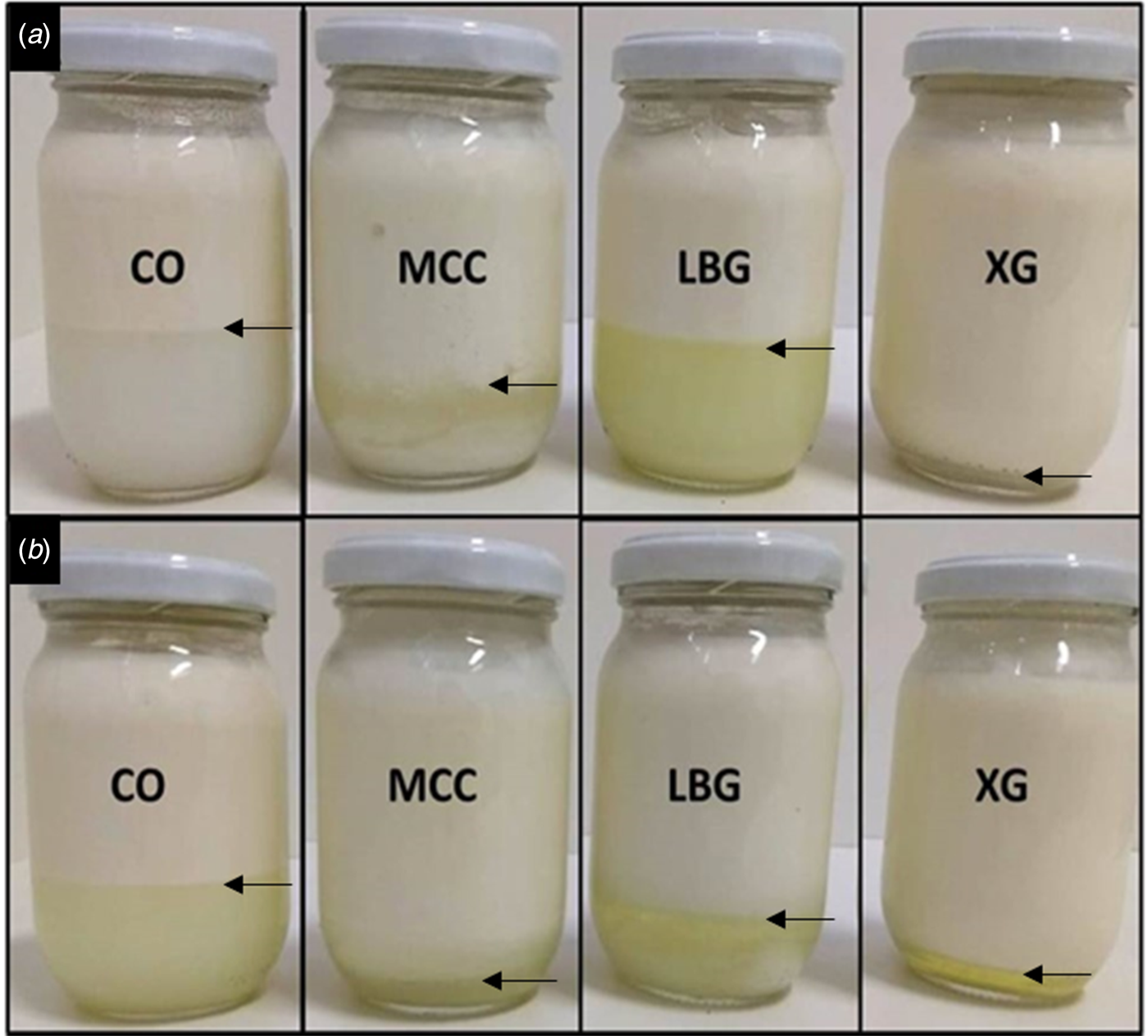
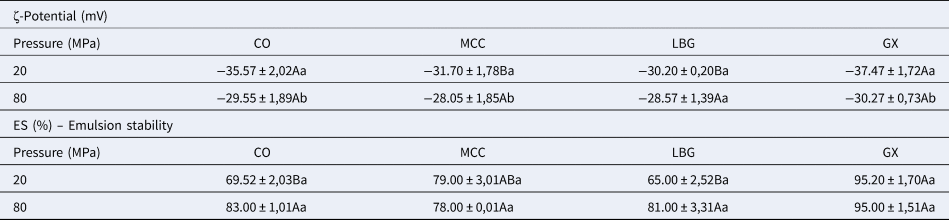
The ζ potential of fat globules and the emulsion stability percentage are shown in Table 1 and the stability of the samples is macroscopically represented in Figure 1.
Macroscopic observations of the samples after 40 d of production, a = 20 MPa, b = 80 MPa, arrows indicate phase separation.

Results of ζ-Potential and emulsion stability percentage (ES%)

Different capital letters in the same row and different lowercase letters in the same column represent significant differences by the Tukey test (P ≤ 0.05)
As shown in Table 1, all treatments presented negative ζ potential values, ranging from 28.05 to 37.47 mV. At 20 MPa, CO and GX presented the highest ζ potential values, showing significant differences from the other treatments. When applying high-pressure homogenization (80 MPa), except for LBG, there occurred a significant decrease in ζ potential for all ULC treatments. In that case, the ζ-potential decreased from 35.57 (CO 20 MPa) to 29.55mV (CO 80 MPa), 31.70 (MCC 20 MPa) to 28.05 mV (MCC 80 MPa) and 37.47(XG 20 MPa) to 30.27 mV (XG 80 MPa).
The ζ Potential is defined by the difference in electrical potential between the surface area of the colloidal particle and its liquid suspension (Cano-Sarmiento et al., Reference Cano-Sarmiento, Téllez-Medina, Viveros-Contreras, Cornejo-Mazón, Figueroa-Hernández, García-Armenta and Alamilla-Beltrán2018). The milk fat globules before homogenization typically show ζ potential values between −13 and −14 mV (Michalski et al., Reference Michalski, Michel, Sainmont and Briard2002), and after homogenization there is an increase in ζ potential caused by the adsorption of milk proteins, especially caseins on the surface of fat globules (Berton et al., Reference Berton, Rouvellac, Robert, Rousseau, Lopez and Crenon2012). Homogenization generates a high number of negative charges and increases the electrostatic forces on the membrane of fat globules, which together with other forces can prevent the occurrence of fat globule aggregation phenomena, such as coalescence and flocculation (Michalski and Januel, Reference Michalski and Januel2006). However, the amount of protein available to act as a surfactant might be limited (Rodarte et al., Reference Rodarte, Zamora, Trujillo and Juan2018). Applying a higher homogenization pressure provides the formation of smaller fat globules, and consequently a substantial increase in the interfacial area of the dispersed fat (Cano-Ruiz and Richter, Reference Cano-Ruiz and Richter1997; Biasutti et al., Reference Biasutti, Venir, Marchesini and Innocente2010). As a result, there is a larger interfacial area to be covered by the same amount of protein, and it is not possible to completely cover all the fat globule membranes (Zamora et al., Reference Zamora, Ferragut, Guamis and Trujillo2012). This fact can explain the significant ζ potential decrease for almost all creams homogenized at 80 MPa, as shown in Table 1.
Emulsion stability percentage values varied from 69.5% to 95.0%. Regarding the traditional pressure-homogenization (20 MPa), GX presented the highest ES (%), showing significant differences from CO and LBG, which presented the lowest ES (%) values. Although the high-pressure homogenization led to an increase in ES (%) for CO and LBG (Table 1), the increased homogenization pressure from 20 to 80 MPa had no significant influence on ES (%) for all ULC.
Emulsion stability is defined as the emulsion's ability to resist chemical or physical changes in its properties over time. Modifications in the spatial distribution or structural organization of the molecules may result in physical instability phenomena, such as creaming, flocculation, coalescence, partial coalescence, phase inversion and Ostwald ripening (McClements, 2005).
The highest emulsion stability percentage was observed for XG ranging from 95.0% to 95.2%, which was also more macroscopically stable (Fig. 1). Huck-Iriart et al. (Reference Huck-Iriart, Pizones Ruiz-Henestrosa, Candal and Herrera2012) found similar results in studies with oil emulsions supplemented with xanthan gum, showing high values of emulsion stability and viscosity. Xanthan gum generates high viscosities in food systems, even at low concentrations (Niknezhad et al., Reference Niknezhad, Asadollahi, Zamani, Biria and Doostmohammadi2015). A higher viscosity tends to retard the creaming process, where even when oil droplets were already aggregated, they could not move because of the high viscosity (Dickinson and Parkinson, Reference Dickinson and Parkinson2004). This is confirmed by Stokes' law, which describes a direct influence between viscosity and physical stability since an increase in viscosity causes a reduction in the phase separation speed. Therefore, this characteristic of xanthan gum may have contributed to the best results of ES (%) found in the XG samples.
 $$vs = \displaystyle{{d^2\cdot \Delta {\rm \rho }\cdot g} \over {18\cdot {\rm \mu }}}$$
Stoke's law: vs = phase separation velocity; d = particle diameter; Δρ = density difference among particle and continuous phase; g = acceleration of gravity and μ = viscosity.
Figure 1 showed that a macroscopical phase separation occurred in all creams, meaning a clear formation of fat aggregates at both homogenization pressures. Although HP generated a more extensive reduction in fat globule size than traditional homogenization, the lack of proteins to cover the new fat globules surface may promote the formation of fat aggregates (Huppertz et al., Reference Huppertz, Fox and Kelly2003; Zamora et al., Reference Zamora, Ferragut, Guamis and Trujillo2012; Rodarte et al., Reference Rodarte, Zamora, Trujillo and Juan2018). As a consequence, agglomerated fat globules have a larger diameter and can cream more rapidly (Wilbey, Reference Wilbey2016). Creaming is caused by differences in density between milk fat globules and the continuous phase. Due to their lower density, milk fat globules tend to rise to the surface which leads to a separation phase, creating a top cream layer and a clear phase at the sample bottom (Lieberman et al., Reference Lieberman, Rieger and Banker1989; Ma and Barbano, Reference Ma and Barbano2000).
The creams supplemented with hydrocolloids also presented creaming (Fig. 1). These results imply that the hydrocolloids used in this study have no association or demonstrated a weak interaction with casein micelles, leading to two distinct phases. The quality of protein−polysaccharide interactions is influenced by many factors, including pH, ionic strength of the solutions, molecular weight and concentration of polymers, and temperature (Protte et al., Reference Protte, Balinger, Weiss, Löffler and Nöbel2019). Regarding food emulsions, the thermodynamic incompatibility between proteins-polysaccharides will increase flocculation and creaming, as protein-coated droplets and polysaccharide molecules are driven into separate phases. This forms a dense cream layer plus an aqueous serum layer, which has important implications on the stability of the emulsion (Dickinson and Euston, Reference Dickinson and Euston1991; Ferragut and Chiralt, Reference Ferragut and Chiralt1996).
Rheological characterization and flow behavior
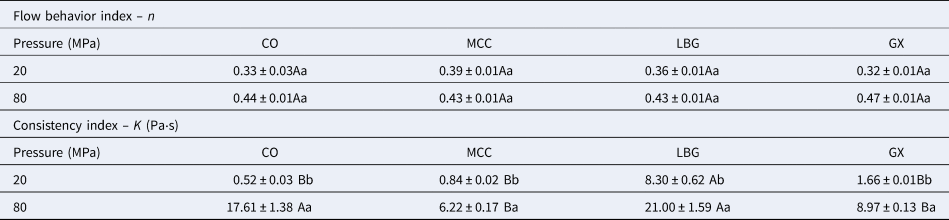
The flow behavior (n) and consistency index (K) were obtained by adjusting the data of the flow curves via the Power Law Model (Table 2). They presented high correlation coefficients (R 2) between 0.97 and 0.99.
Rheological parameters of UHT milk creams adjusted to the Power Law model (n = 2)

Different capital letters in the same row and different lowercase letters in the same column represent significant differences by the Tukey test (P ≤ 0.05)
The n values varied from 0.32 to 0.36 at 20 MPa and from 0.44 to 0.47 at 80 MPa homogenization pressure. Although the HP resulted in higher values of n (Table 2), according to the statistical test performed the comparison between hydrocolloid and homogenization pressure did not show significant differences among all samples. Therefore, the addition of hydrocolloids and the increase in homogenization pressure did not change the flow behavior of the creams, since all ULC were classified as pseudoplastic fluids (n < 1).
The results of the consistency index were significantly affected by the homogenization pressure (Table 2). Under HP, the K values increased significantly for all treatments, from 0.52 to 17.61 (CO), from 0.84 to 6.22 (MCC), from 8.30 to 21.0 (LBG) and from 1.66 to 8.97 (XG). Moreover, CO and LBG presented K values significantly higher than MCC and XG at 80 MPa.
Although no particle size measurement was taken, these results suggest that consistency was significantly influenced by the effect of high-pressure homogenization: the size reduction of fat globules, the adsorption of milk proteins on the surface of new fat globules, and the formation of protein and fat globules aggregates (Huppertz et al., Reference Huppertz, Fox and Kelly2003; Masson et al., Reference Masson, Rosenthal, Calado, Deliza and Tashima2011).
At the high homogenization pressure, the insufficient amount of milk proteins to cover the new surface of fat globules may lead to agglomeration phenomena of very small globules. This effect can favor bridge formation, contributing to the increase in K values (Hayes et al., Reference Hayes, Fox and Kelly2004). The simultaneous effect of UHT treatment and high homogenization pressure may also affect the nature of protein−protein interactions. Floury et al. (Reference Floury, Desrumaux and Lardières2000) suggested an unfolding or partial denaturation of globular proteins caused by high temperature plus high-pressure treatments. The denaturation of whey proteins can expose hidden hydrophobic sites, favoring their adsorption on fat globule membranes and/or protein−protein interactions (Biasutti et al., Reference Biasutti, Venir, Marchesini and Innocente2010). These mechanisms may explain the HP structuring effect on the creams.
At 20 MPa, LBG presented a K value significantly higher than the other ULC and stood out for reaching the highest consistency index of 21.0 at 80 MPa. Within the galactomannan class, locust bean gum has the lowest ratio of galactose in the mannose chain, which influences its water solubility and rheological characteristics (Barak and Mudgil, Reference Barak and Mudgil2014; Kontogiorgos, Reference Kontogiorgos2018). Thus, locust bean gum is able to modify rheological properties and increase the consistency index of a system (Lo et al., Reference Lo, Lee, Richter and Dill1996).
Viscoelastic properties
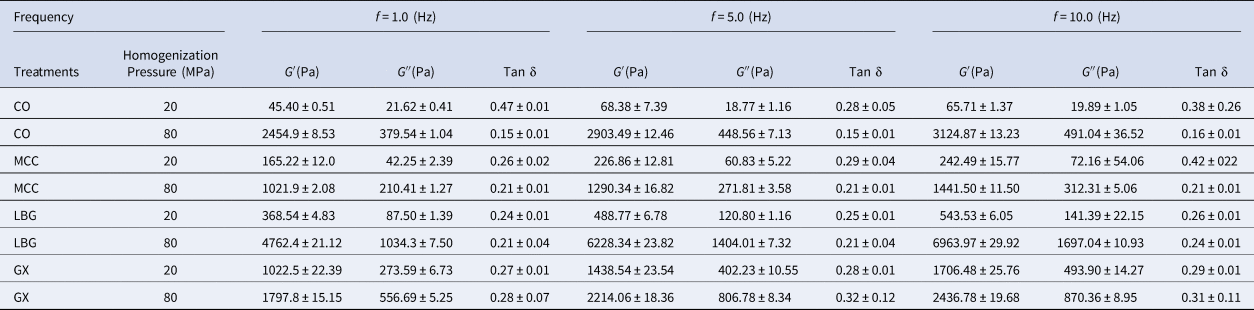
The viscoelasticity results are presented in Table 3, showing the parameters: G′ (storage modulus or elastic modulus), G″ (loss modulus or viscous modulus), and tan δ (loss tangent). G′ and G″ indicate the ability of the material to store and dissipate energy, respectively, while tan δ expresses the energy dissipated and stored during a deformation cycle (Dodero et al., Reference Dodero, Williams, Gagliard, Vicini, Alloisio and Castellano2019). The relationship between tan δ, G′ and G″ is given by equation 3:
 $${\rm{tan}}\;\delta {\rm{\ =\, }}{{{\rm{G^{\prime \prime}}} } \over {{\rm{G}}^\prime }}$$
Storage modulus (G′), loss modulus (G″) and loss tangent (tan δ) for the ULC at fixed frequency values (f)

In general, G′ was greater than G″ over the entire measured frequency (Table 3), which means that the elastic character was dominant compared to the viscous nature, indicating the formation of a gel network structure (Souza and Garcia-rojas, Reference Souza and Garcias-Rojas2017). Except for CO, at 20 MPa all moduli increased with frequency, suggesting a typical weak gel behavior (Ramírez-Santiago et al., Reference Ramírez-Santiago, Lobato-Calleros, Espinosa-Andrews and Vernon-Carter2012). Moreover, the loss tangent values for all samples were less than 1 (Table 3), confirming the predominance of the elastic behavior (Mounsey and O'Riordan, Reference Mounsey and O'Riordan2008; Rao, Reference Rao2014).
A remarkable increase in both G′ and G″ was observed when the samples were subjected to high-pressure homogenization (Table 3), as observed in the control treatment, where CO (G′): 65.71 Pa at 20 MPa, and 3124.87 Pa at 80 MPa, considering the same frequency (10 Hz). It seems that the HP favored the formation of a complex structure when compared to the traditional homogenization pressure (20 MPa), showing a pronounced elastic characteristic for samples subjected to the highest homogenization pressure. Martínez-Monteagudo et al. (Reference Martínez-Monteagudo, Kamat, Patel, Konuklar, Rangavajla and Balasubramaniam2017) reported a similar behavior in studies with dairy beverages, due to a remarkable increase in both moduli (G′ and G″), where G′ was always greater than G″ in the highest homogenization pressure treatment. The authors suggested that an increase in homogenization pressure contributes to the formation of macromolecular networks (Martínez-Monteagudo et al., Reference Martínez-Monteagudo, Kamat, Patel, Konuklar, Rangavajla and Balasubramaniam2017).
Structuring of a heterogeneous gel network at high homogenization pressure may occur between milk proteins, the smallest fat globules and other components present in the dairy matrix (Biasutti et al., Reference Biasutti, Venir, Marchesini and Innocente2010). At 80 MPa the milk fat globules were smaller, and the fat globules interface became larger, which increased the number of potential interactions (Coutouly et al., Reference Coutouly, Riaublanc, Axelos and Gaucher2013). The fat globules coated with milk proteins, mainly casein micelles, interact with the casein gel matrix and increase the rigidity of the milk gel (Heertje, Reference Heertje2014). This promotes interactions, forming bridges between the membranes of the fat globules and strengthening the gel network (Sanchez et al., Reference Sanchez, Beauregard, Bimbenet, Chassagne and Hardy1994). This effect of decreasing the particle size, together with the rise in interactions can increase the G′ (Saricaoglu, Reference Saricaoglu2019).
Additionally, the occurrence of aggregation phenomena may lead to the formation of particle networks that yield emulsions with gel-like characteristics (McClements, Reference McClements2005). The lack of milk proteins to act as a surfactant on fat globule membranes may promote flocculation and increase bridge formation (Darling, Reference Darling1982). Gelation can also be associated with another aggregation mechanism called ‘polymer bridging’ (Vincent, Reference Vincent1974), which occurs when the protein adsorbs onto more than one droplet, forming a particle−particle bridge (Darling, Reference Darling1982).
Furthermore, the synergic effect of UHT heat treatment and high-pressure homogenization may strengthen the gel and provide a tighter network structure. Roesch and Corredig (Reference Roesch and Corredig2003), in a study with soy protein emulsions, observed that the heat treatment resulted in emulsions with higher elastic moduli (G′) than those of unheated emulsions. The authors suggested that high-pressure homogenization may promote unfolding of the globular protein in addition to that caused by heat (Roesch and Corredig, Reference Roesch and Corredig2003). The degree of whey protein denaturation directly affects the rheological behavior of gels since these unfolded proteins can associate with casein, acting as binding material or interacting with other denatured whey proteins. These mechanisms can lead to an increase in the gel network rigidity, and consequently increase the G′ (Lucey et al., Reference Lucey, Teo, Munro and Singh1998; Serra et al., Reference Serra, Trujillo, Guamis and Ferragut2009)
Based on these considerations, this gel strengthening promoted by the HP effect may be correlated to the interactions between protein matrix and adsorbed proteins on the fat globule surface, the fat globules aggregation phenomena, such as partial coalescence or flocculation, and the cross-linking or bridging among denatured whey proteins and casein micelles.
For the treatments containing hydrocolloids, the network formed can also be correlated to protein−hydrocolloid interactions (Winuprasith and Suphantharika, Reference Winuprasith and Suphantharika2015), eg hydrophobic association, hydrogen bonding, and cation mediated cross-linking (Yousefi and Jafari, Reference Yousefi and Jafari2019).
In conclusion, these results suggest that HP has the potential to alter some rheological characteristics of UHT light cream, increasing its consistency and pronouncing the elastic behavior (G′ > G″). Thus, high-pressure homogenization at 80 MPa may be exploited to develop low-fat emulsions with modulated structures. Regarding the hydrocolloids used, locust bean gum stood out for favoring the consistency increase, while xanthan was able to maintain the stability of ULC, probably due to its ability to impart high viscosity.
Acknowledgments
The authors would thank the Brazilian research agencies: CAPES, CNPq, and FAPEMIG for their financial support; and LABEM–UFV for allowing the use of the rheometer.