Introduction
Arctic is a strategic Russian macroregion that occupies 35% of the area of the Russian Federation and contains recoverable total resources in the amount of 258 billion tons of standard fuel, which is 60% of all Russian hydrocarbon resources. In addition, about 90% of nickel and cobalt, 60% of copper, 96% of platinoids, 100% of barite and apatite concentrate are mined in the Arctic (Development Strategy of the Arctic Zone of the Russian Federation).
The Arctic zone of the Russian Federation includes nine constituent entities of the Russian Federation, four are included completely (Murmansk Oblast, Nenets Autonomous Okrug, Yamalo-Nenets Autonomous Okrug, Chukotka Autonomous Okrug) and five partially (Republic of Komi, Republic of Karelia, Republic of Sakha (Yakutia), Krasnoyarsk Territory, Arkhangelsk Region). The population of the Arctic Zone of the Russian Federation amounts to 2.6 million people living on the territory of 74 municipalities. Russian Arctic is the territory of traditional residence of the indigenous small-numbered peoples of the North (ISPN). According to the 2010 All-Russian Population Census the number of ISPN in the Arctic territories is amounting to 102000 people locating at the places of compact traditional residence within 41 Arctic municipalities. It should be noted that the places of compact residence of ISPN are mainly the permafrost zone, where natural resources of the Russian Arctic are located. The traditional types of economic activities of ISPN are reindeer farming, fishing, hunting, sea hunting and those are the basis for the preservation of the traditional way of life, culture and languages of the indigenous peoples.
The main information resource containing quantitative information about the indigenous peoples of the Arctic (national identity, number, places of compact residence) are the results of the 2010 All-Russian Population Census. In numerous federal forms of statistical observation, information about the indigenous peoples of the North is absent, since belonging to the peoples of the North is absent in official documents (birth certificate, passport, personal insurance policy number/SNILS, health insurance policy) and is determined by self-identification. This situation contradicts federal regulations governing social guarantees for ISPN in places of their traditional residence. To eliminate this contradiction, a statutory document was adopted in 2000 regulating the maintenance of the Register of Indigenous peoples of the North. Taking into account the enactment of this document stated as 2022–2025, quantitative indicators will appear in the forms of federal statistical observation, reflecting information on vocational education, employment, occupation, demographic indicators, etc. Until that time, polls will remain the main source of detailed quantitative data.
However, Fondahl, Filippova and Savvinova (Reference Fondahl, Filippova and Savvinova2020) note that the developed register is not perfect enough, the following nuances are highlighted –e.g. there are several places where representatives of indigenous peoples live and work, which are not included in the original list of “places of traditional residence”, approved by the Government of the Russian Federation in 2009. The experts also propose to expand the list of “traditional activities” to include auxiliary occupations in the field of health care and education, since 25% of the ISPN are employed in these sectors of the economy. Nowadays, only persons from the indigenous small-numbered peoples with a traditional lifestyle are included in the register. This means that native language teachers, children living in villages, retired elderly people and unemployed people will not be included in the register.
At the II Forum of the indigenous peoples of the North, Siberia and the Far East of the Russian Federation in Salekhard (April 2021) Timur Tsybikov, Head of the Department of State Policy in the field of interethnic relations of the Federal Agency for Ethnic Affairs of Russia, noted that about 2500 applications had already been submitted to the register, and more than half of these applications came from the Yamalo-Nenets Autonomous Okrug.
The development of the register of the indigenous peoples of the North is not the only novelty in the Russian Federation concerning the position of the indigenous small-numbered peoples in the Arctic. In 2021, the “Standard of Responsibility of Residents of the Arctic Zone of the Russian Federation in Relations with the Indigenous Minorities of the Russian Federation Residing and (or) Carrying Out Traditional Economic Activities in the Arctic Zone of the Russian Federation” came into force. According to the standard, the resident of the Arctic Zone of the Russian Federation is recommended to be guided by the principles of promoting the sustainable development of the indigenous small-numbered peoples of the Russian Federation, cooperation in improving the socio-economic situation in the territories where the indigenous small-numbered peoples live, and providing feedback on the activities of the Arctic zone resident. Currently, the Government of the Russian Federation obliges enterprises not only to make a profit, but also to treat the indigenous peoples living in the Arctic with care.
In addition, it is important to note that the State Duma is currently preparing a federal law on ethnological expertise. According to G.P. Ledkov, the chairman of Russian Association of Indigenous Peoples of the North, this law is very important, since it involves a preliminary study of possible changes in the habitat of the ISPN before starting the implementation of business projects in the territories of their residence.
Literature review
The Russian Arctic territories are characterised by the uneven development of urban and rural areas, sparsely populated areas, as well as geographical isolation of settlements. Due to specific spatial characteristics, Arctic regions of Russia undoubtedly determine the way of life of indigenous peoples (North and northerners, 2012; Radikov et al., Reference Radikov, Pitukhina, Tolstoguzov and Volokh2019).
The Arctic is traditionally interesting for scientists from the point of view of its development and, as a result, the focus of attention is often the transformation of the way of life of indigenous peoples (Stammler & Ivanova, Reference Stammler and Ivanova2020). Scientists have identified a number of factors that determine the well-being of indigenous peoples in the Arctic (Heleinak & Napper, Reference Heleinak, Napper, Koivurova, Broderstad, Cambou, Dorough and Stammler2021), self-determination and self-identification (Kuokkanen, Reference Kuokkanen2019), as well as stability (Langdon; Ravna et al.; Fondahl, Filippova, Savvinova & Shadrin, Reference Fondahl, Filippova, Savvinova, Shadrin, Koivurova, Broderstad, Cambou, Dorough and Stammler2021).
At the same time, indigenous peoples’ status in the Arctic labour market has been insufficiently studied. It is obvious that the stability of indigenous peoples in the labour market is determined by both socio-economic factors (Sokolva, Reference Sokolva2017) and some natural factors (Masloboev, Reference Masloboev, Borovichyov and Vronsky2020). It is noted that the indigenous peoples of the Russian Arctic are not beneficiaries of large industrial projects, which becomes one of the reasons for the continuing low standard of living of the indigenous peoples in the North of Russia (Alekseev & Alekseeva, Reference Alekseev and Alekseeva2014), while Canadian indigenous peoples often successfully participate in large economic projects of their corporations receiving both economic benefits and recognition (The Inuvik – Tuktoyaktuk Highway) (Schweizer & Povoroznyuk, Reference Schweitzer and Povoroznyuk2019).
A separate part of research papers is devoted to the problems of indigenous peoples in the education system (Alekseev & Alekseeva, Reference Alekseev and Alekseeva2014). It should not be forgotten that indigenous peoples, as a rule, have a developed spirit of collectivism – they live and work collectively, like one big family. On the contrary, modern education at universities is based on principles of pronounced individualism due to the credit and point-rating system of grading; on the student’s independent development and implementation of their educational path. A student from a rural area, finding himself for a long period of time outside the family and being close to people with alien, in his opinion, cultural and moral values, becomes disoriented, loses the value of university education for him/herself (Bakhtina & Gubarev, Reference Bakhtina, Gubarev and Yakunina2014; Alekseev & Alekseeva, Reference Alekseev and Alekseeva2014; Dranaeva, Reference Dranaeva2012; Solovyova, Reference Solovyova2013).
Ivanova and Stammler analyse e.g. the models of political leadership of persons from among the indigenous small-numbered peoples in the Republic of Sakha (Yakutia). Urban students emphasised the importance of the personal qualities of a good political leader, while rural Indigenous youth found professional qualities important. They found that the preferred political leader for students studying in the regional capital fits the leadership type of “leader-servant”, whereas the rural young people prioritised what is called a “leader-fireman”.
Professor G. Duhaime, a Canadian scientist from the University of Laval, in his works emphasises the global importance of Arctic resources, while also showing the disparities and conflict that resource exploitation can mean for indigenous communities. Thus, he introduces social indicators that measure both the behaviour and perceptions of Inuit living in the Canadian Arctic with respect to the social, cultural and economic conditions of Arctic communities (Duhaime et al., Reference Duhaime, Searles, Usher, Myers and Frechette2004).
Based on the studies carried out in relation to indigenous peoples, it can be concluded that new challenges to economic area (development of information technologies, activities of corporations, development of the Russian Arctic) form a new agenda. This gives rise to the development of a wide range of promising research on issues: indigenous peoples and globalisation (Koivurova, Reference Koivurova2010; Sukneva, Reference Sukneva2017), indigenous peoples and interaction with industrial companies (North and northerners, 2012) and indigenous peoples and preservation of their cultural heritage.
There are no publications devoted to the analysis of the professional preferences of ISPN, comparison of their position in the Arctic labour market in relation to the other population, and the study of the choice of educational paths of ISPN is not enough presented in both Russian and international scientific periodicals. This article is devoted to filling in these gaps.
Materials and methods
When analysing the professional activity of ISPN, the main issues are the form of participation in labour activity (work for hire or self-employment), professional qualification level, availability of vocational education or another way of obtaining hard skills.
To carry out this analysis, all types of economic activities were divided into two spheres – the sphere of the real economy (or production sphere) and the social sphere. The first area includes such economic activities as agriculture, forestry, fishing and fish farming, mining and processing industries, construction, energy, etc. The social sphere includes – education, health care, social work, physical education and sports, culture, art, etc.
At the same time, in the production sphere, while maintaining the lifestyle of the indigenous peoples, traditional types of economic activities and occupations that correspond to them (hunter, reindeer farming, chum-keeper) prevail, and in the social sphere, it is the same occupations as among the local population (teacher, paramedic) that prevail in places of compact residence of ISPN.
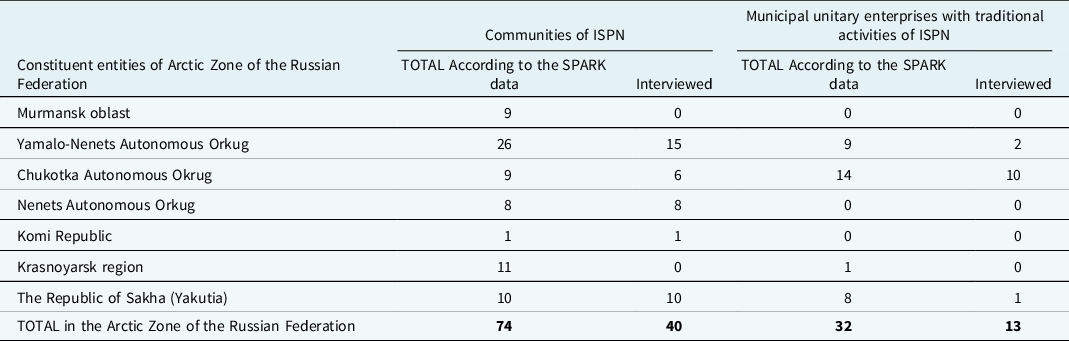
The main forms of economic activity in the places of compact residence of the ISPN are the communities of ISPN and municipal unitary enterprises (MUEs). According to the database of the information resource SPARK-Interfax, of all indigenous communities in Russia, 74 are registered as businesses or legal entities. Additionally, 32 MUEs have that status (Russian companies, 2021).
The survey among the communities and MUEs was carried out within the framework of a federal project devoted to the development of forecast indicators for the recruitment needs of the economy of the Arctic territories of the Russian Federation for the period up to 2035. The questionnaire for employers contained questions about the type of economic activity of the organisation, territorial location, number and professional qualifications of employees and new occupations. To unify the answers, the all-Russian classifiers of types of economic activity OKVED2 (Russian Industry Classification System) and occupations of Russian National Classification of Occupations of Employees, Positions of Civil Servants and Wage Category were used. In total, 963 employers, including 352 enterprises/organisations in the real sector of the economy and 611 in the social sphere, took part in the survey of enterprises/organisations conducting economic activities in municipalities – places of traditional residence of ISPN.
In the course of this survey, completed questionnaires were received from 40 out of 74 communities of indigenous small-numbered peoples (540 workers), and from 13 out of 32 MUEs (1754 workers) created in places of compact residence of ISPN to support the traditional activities of indigenous peoples.
It should be noted that these two categories of surveyed enterprises/organisations in places of compact residence of ISPN give different profiles on the occupations of workers: a survey of all economic organisations gives the occupational structure of employment of the entire population, and a survey of communities and MUEs – gives the occupational structure of employment of ISPN.
In more detail, in the context of the Arctic territories, the results of the survey of the communities of ISPN and MUEs are presented in Table 1.
Amount of the communities of ISPN and the municipal unitary enterprises of the Arctic Zone of the Russian Federation, participated in survey.

Interviewing ISPN communities caused the greatest difficulty, since they are characterised by high dispersal, migration mobility and often lack of access to the Internet. The most numerous communities of indigenous small-numbered peoples conduct economic activities in the Chukotka Autonomous Okrug and the Nenets Autonomous Okrug. The rest of the communities are small, with up to 20 workers. From the data presented in Table 1, it follows that in the Murmansk region and in the Arctic territories of the Krasnoyarsk Territory, it was not possible to interview the economic entities of ISPN.
The survey of social organisations made it possible to form a list of occupations of those who works in the social sphere, which is the same both for all residents in places of compact residence of ISPN and for the representatives of ISPN themselves.
When developing indicators of recruitment needs in the production and social spheres for ISPN in the medium term, a macroeconomic methodology of annual additional recruitment needs was used (Gurtov & Pitukhin, Reference Gurtov and Pitukhin2020).
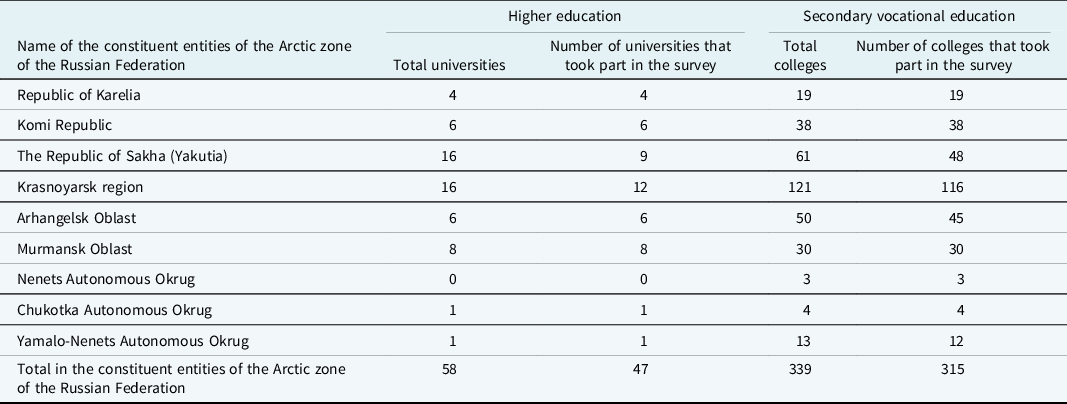
To analyse the preferences of young people of ISPN of the Arctic territories when choosing an educational specialty at a university or college, a survey of educational organisations of the constituent entities of the Arctic Zone of the Russian Federation was conducted. The questionnaire asked about the number of indigenous small-numbered peoples from places of compact residence in the Arctic Zone of the Russian Federation who entered the first year of study in the field of training/specialty in 2019. Forty-seven universities (including branches) and 315 colleges/technical schools conducting educational activities in the constituent entities of the Arctic zone of the Russian Federation took part in the survey.
According to the data in Table 2, 91% of universities and colleges, conducting educational activities in the constituent entities of the Arctic zone of the Russian Federation, took part in the survey. 100% participation in the survey was noted in the Republics of Karelia, Komi, Murmansk Oblast and Chukotka Autonomous Okrug.
Distribution of universities and colleges that took part in the survey of educational organisations of the constituent entities of the Arctic zone of the Russian Federation

According to the results of the survey, information was obtained on the number of applicants from among the ISPN who entered the first year: in higher education programmes – 33 people, in the programmes of mid-level specialists – 514 people and in the programmes of skilled workers and employees – 266 people. The distribution of freshmen out of ISPN by educational specialties will be discussed below.
Main part
ISPN occupations in industrial and social sectors
The sample from the database of employers’ surveys by occupations of communities and MUEs reflects the basic occupations, common among the traditional types of activities of ISPN and contains 164 occupations.
The list of occupations in the Russian National Classification of Occupations of Employees is very detailed and contains more than 8000 positions. To facilitate the analysis, these 164 occupations according to the occupations of Russian National Classification of Occupations of Employees were grouped according to the criterion “related occupation”. So, e.g. the occupation “Zootechnician” includes such four related occupations from the classifier as “223377 Zootechnician”, “223409 Zootechnician of a department (complex, agricultural plot, farm)”, “207505 Chief zootechnician” and “223411 Zootechnician on pedigree business ”. A similar grouping was carried out for the occupations “Engineer”, “Operator”, “Accountant”, “Chief”, “Worker”, etc.
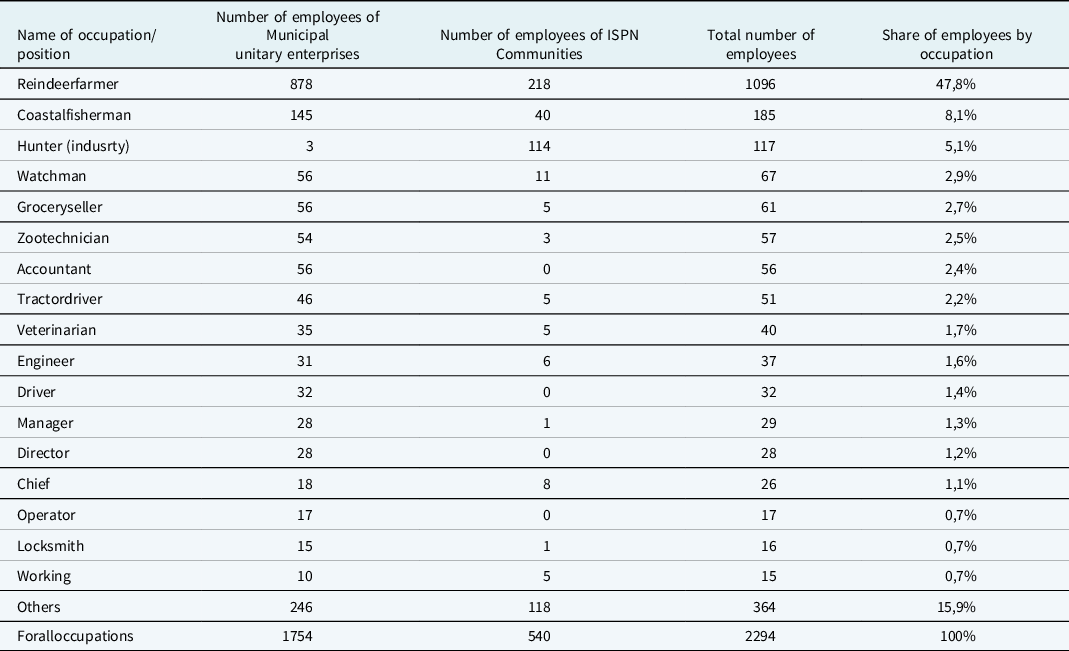
Table 3 provides a list of 20 basic occupations with an indication of the number of employees, which is fundamental to the traditional activities of the industrial sector of ISPN.
The average annual number of workers in basic occupations in the communities of ISPN and the municipal unitary enterprises located in places of compact residence of ISPN in the Arctic

As expected, the list of the most widespread occupations for the ISPN is headed by a reindeer farmer, a coastal fisherman and a hunter. At the same time, the list of widespread occupations includes such occupations as accountant, tractor driver and operator.
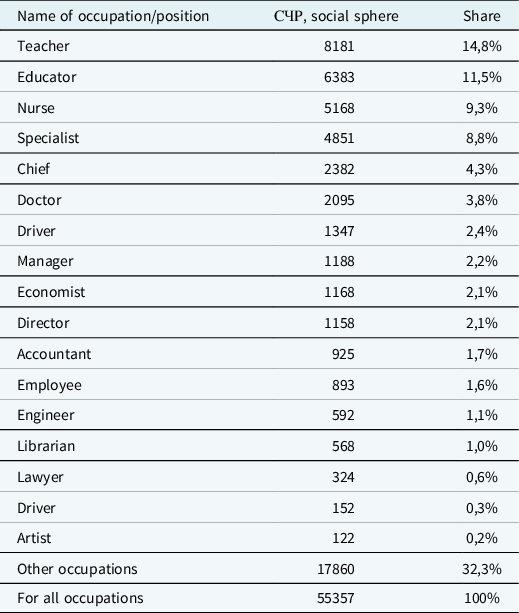
The sample by the occupation of employees of organisations in places of compact residence of ISPN related to the social sphere contained 940 unique occupations. Based on the grouping of related occupations, a list of TOP-20 most demanded complex occupations of the workers of social sphere has been formed.
The list of widespread occupations/positions in the social sphere is headed by a teacher, educator and nurse. A significant number of occupations/positions in the social sphere are related to management and include the positions of chief, director and manager (Table 4).
Average annual number of employees in social organisations located in places of compact residence of ISPN in the Arctic

Both lists of occupations (ISPN and MUEs; social organisations) contain usual widespread occupations such as driver, accountant and worker.
In the future, the structure of social sphere employees among ISPN will be considered the same as the structure of employees of the entire population in the places of compact residence of ISPN.
Forecast assessment of the recruitment needs of the economy of the Arctic territories for workers among ISPN
To assess the projected recruiting needs of the economy from among ISPN, it is necessary to assess the number of ISPN employed in the economy. Since there are no such data in statistics, an indirect method is used to generate them. Thus, out of the total population of 2.62 million of Arctic territories of the constituent entities of the Arctic zone of the Russian Federation, the number of people employed in the economy, taking into account persons working on a rotational basis, is 1.42 million people. The number of shift workers is 0.27 million people. Consequently, the number of employed in the economy from the local population is 1.15 million people or 43% of the total population.
Using the same ratio for persons from among ISPN, we find that of the total population of ISPN in the Arctic territories of the constituent entities of the Arctic zone of the Russian Federation (102000), the number of employed from among ISPN is 43000.
The rate of natural age retirement of those employed in the economy of the Arctic territories is on average 0.035. Taking into account this value, the annual additional need of the economy for personnel from among ISPN for the reproduction of the labour force is 15000 people. Since in the retrospective period, the number of ISPN has not changed significantly, this integral indicator will be valid until 2025.
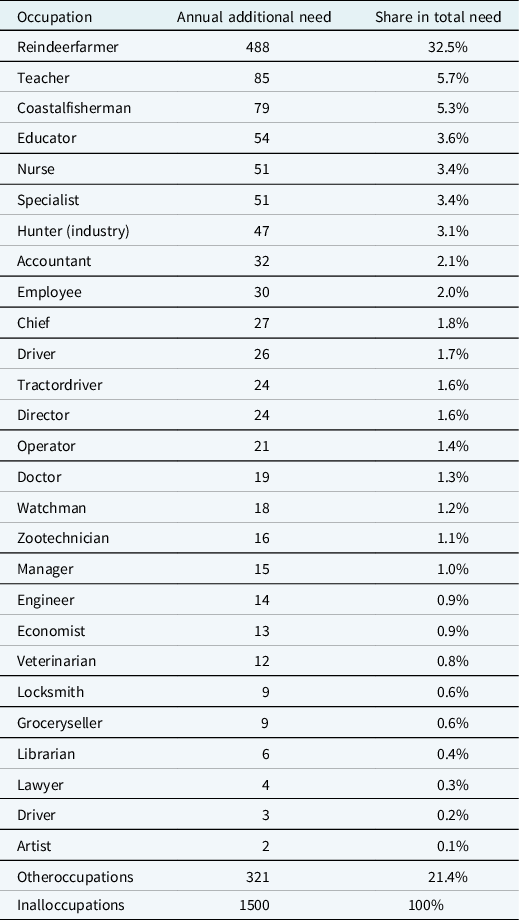
Taking into account the fact that 32% of workers are employed in the organisations of the social sector of the Arctic, the distribution of the annual additional needs staffing needs of the Arctic economy for ISPN is presented in the proportions: 500 workers by occupation in the social sector and 1000 workers by occupation in the real sector of the economy in relation to the traditional types of activities of ISPN. The list of occupations for ISPN in the real and social sectors of the economy was given in Section 4.1. In these lists, 32% of occupations in the social sector and 16% of occupations in the real sector of the economy were classified as “other”. Taking this into account, 321 workers out of 1500 required annually from ISPN are included in the list with the occupations “other” annual additional needs, the remaining 1179 workers of the indigenous peoples are divided into 27 occupations of widespread and popular occupations. Estimated projections for these 27 occupations are shown in Table 5.
Forecast indicators of the annual additional needs of the economy for persons among ISPN for 2021.

Attention is drawn to the fact that the list of the most widespread occupations for the personnel reproduction of workers from among ISPN in the places of their compact residence in the Arctic territories includes the following expected occupations: reindeer farmer, teacher, coastal fisherman, educator, nurse, specialist and hunter.
This list correlates with suggestions introduced by scientists G. Fondal, V. Filippova and A. Savvinova – it is extremely important to include to the Federal Register of ISPN not only persons engaged in traditional activities, but also those employed in occupations in the field of health care and education (Fondahl et al., Reference Fondahl, Filippova and Savvinova2020).
Training of persons among ISPN in educational institutions of the constituent entities of the Arctic zone of the Russian Federation
Based on the analysis of questionnaires of educational organisations operating in the constituent entities of the Arctic zone of the Russian Federation, a list of areas of training/specialties and enlarged groups of specialties was formed, to which in 2019 people ISPN were enrolled for the first-year course from places of compact residence in the Arctic territories.
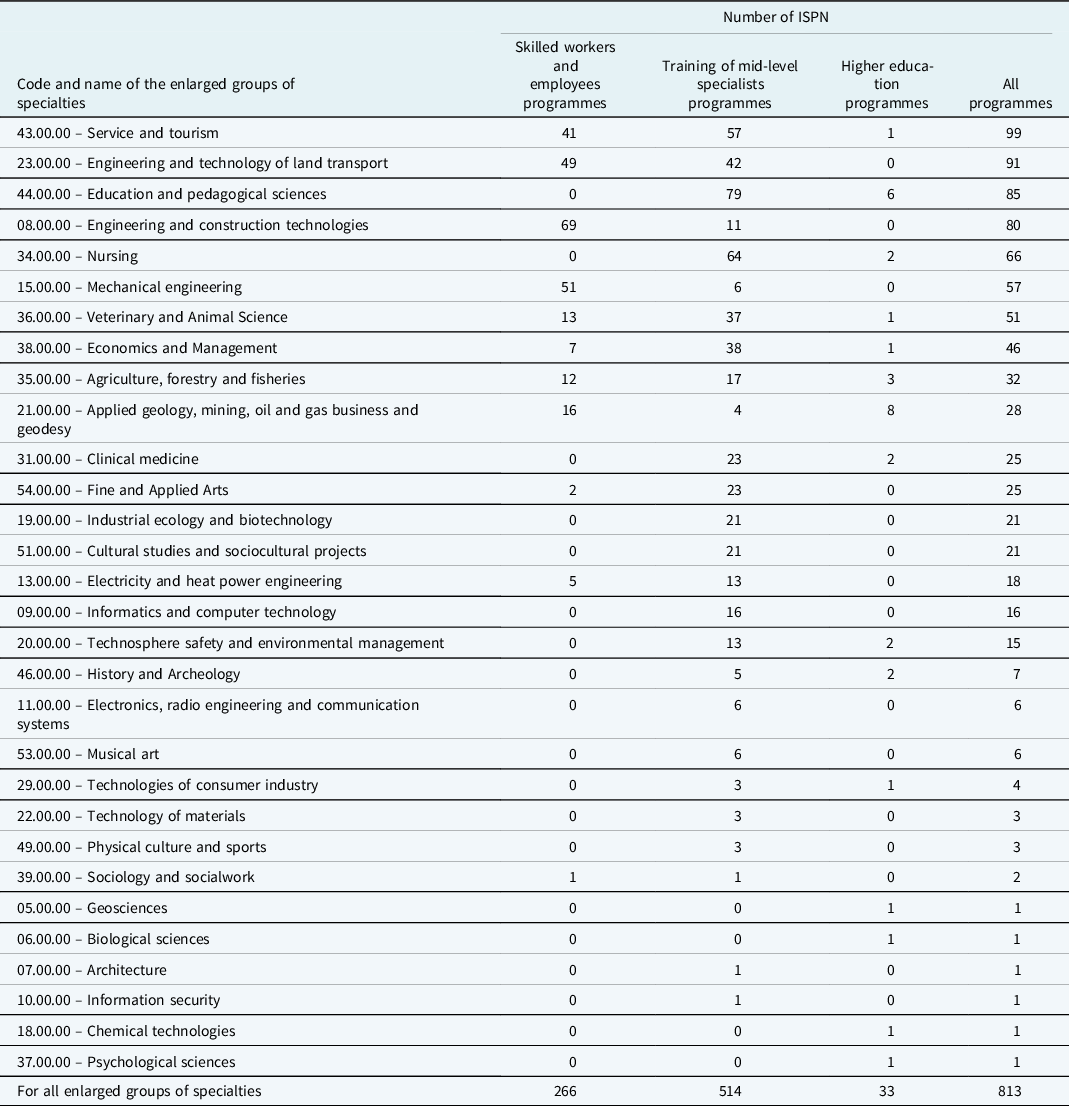
According to a survey of universities and colleges of the constituent entities of the Arctic zone of the Russian Federation, it was clear that 813 applicants from ISPN were enrolled in the first year, including 33 people in universities and 780 in colleges or technical schools. The most demanded by ISPN for admission to the first year were the areas of training of mid-level specialists (MLS) – 63% of the total number of those enrolled in the first year at all levels of education; and training of skilled workers and employees (SWE) – 33%. Higher education was chosen by only 4% of applicants from among ISPN.
Table 5 presents detailed indicators for the enlarged groups of specialties selected by applicants from among ISPN for vocational education.
The demanded enlarged groups of specialties for ISPN include: 43.00.00 – Service and tourism, 23.00.00 – Engineering and technology of ground transport, 44.00.00 – Education and pedagogical sciences, 08.00.00 – Engineering and construction technology, 34.00.00 – Nursing. Within the framework of the above-mentioned enlarged groups of specialties, the following areas of training/specialties were the most popular: 34.02.01 – Nursing, 15.01.05 – Welder, 23.02.03 – Maintenance and repair of motor vehicles, 44.02.01 – Preschool education, 43.02.15 – Cook and confectionery, 36.02.01 – Veterinary medicine, 43.01.02 – Hairdresser, 38.02.01 – Economics and accounting (by industry), 43.01.09 – Cook, pastry chef and 44.02.02 – Teaching in primary school.
Let us consider in more detail to what extent the training of young people from among ISPN in the educational institutions of the constituent entities of the Arctic zone of the Russian Federation in the professional context corresponds to the indicators of the projected recruitment needs of the economy of the Arctic territories from among the persons of ISPN.
Comparison of the data in Tables 5 and 6 shows that for a number of occupations that are traditional for the economic activities of ISPN, there are structural inconsistencies associated with insufficient volumes of professional training of representatives of ISPN. First of all, this is typical for occupations that require higher education, such as a doctor, teacher and engineer. In occupations requiring secondary specialised education, such as a reindeer farmer, a coastal fisherman and a hunter (industry), there is also a lack of professional training. For these occupations, there are specialised programmes for the training of skilled workers, which allow them to get a vocational education and be a qualified specialist in the field of traditional economic activities of ISPN. Nevertheless, representatives of ISPN do not choose these specialties for vocational education: only five representatives of ISPN were enrolled in training in 2019 at 35.01.21 – a reindeer herder-machine operator, with the need for reindeer farmers from among ISPN of 488 people. Probably, young people acquire the necessary competencies in this occupation through the transfer of life experience from “fathers to children” in practical everyday life.
The number of ISPN from places of compact residence in the Arctic zone of the Russian Federation enrolled in 2019 in the first year of colleges/technical schools/universities located on the territory of the constituent entities of the Arctic zone of the Russian Federation

Conclusion
Research results made it possible to draw the following conclusions:
-
1) The surveys of 40 communities of indigenous small-numbered peoples and 13 MUEs showed that indigenous peoples are still inclined to choose their traditional areas of professional activity in the Arctic labour market (hunting, reindeer farming and sea hunting), which contributes to the preservation of the traditional way of life of indigenous peoples in the Arctic, despite the high rates of economic modernisation of the Russian Arctic.
-
2) A quantitative forecast assessment of the annual additional staffing needs of the economy of the Arctic territories for workers from among the ISPN was formed in the amount of 15000 people (500 workers in occupations in the social sector and 1000 workers in occupations in the real sector of the economy in relation to the traditional types of activities of the indigenous peoples) ensuring reproduction of the labour force of ISPN in the professional and qualification context.
-
3) A survey of 47 universities (including branches) and 315 colleges/technical schools in the Russian Arctic showed that the number of first-year students from ISPN who entered the first year of higher education programmes (33 people) is small compared to the number of people who entered the first year of programmes of secondary vocational education (780 people). Therefore, it is important to improve the policy of attracting and retaining students from among the representatives of indigenous peoples in universities, which, in turn, depends on the effectiveness of partnerships between universities, regional authorities and public organisations.
Acknowledgement
The study was supported by a grant from the Russian Science Foundation, project No. 21-18-00500 “Institutional engineering of monocities in the Arctic zone – modernisation and sustainable development”.
Conflict of interest
None.