INTRODUCTION
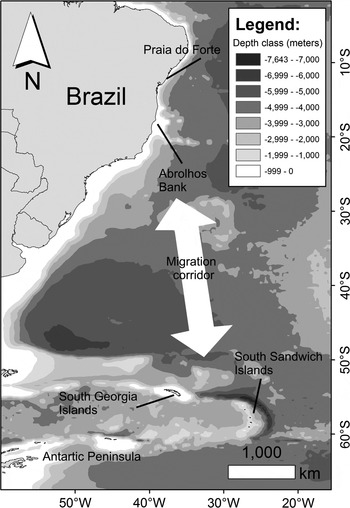
In the southern hemisphere, the International Whaling Commission names as ‘Breeding Stock A' the humpback whale population which migrates annually to the east coast of South America (IWC, 1998, 2005) (Figure 1); having the Abrolhos Bank as its main area of concentration (Siciliano, Reference Siciliano1997; Martins et al., Reference Martins, Morete, Engel, Freitas, Secchi and Kinas2001; Andriolo et al., 2006). The migratory route of this particular stock was investigated through different techniques that indicated the Sandwich Islands and South Georgia Islands along with adjoining areas as its feeding ground (Stevick et al., Reference Stevick, Godoy, McOsker, Engel and Allen2006; Zerbini et al., Reference Zerbini, Andriolo, Heide-Jorgensen, Pizzorno, Maia, VanBlaricom, DeMaster, Simões-Lopes, Moreira and Bethlem2006; Engel & Martin, Reference Engel and Martin2009). Aerial surveys showed that the distribution of humpback whales in the waters of the Brazilian coast range from Rio de Janeiro up to Rio Grande do Norte (24°–5°S) (Andriolo et al., Reference Andriolo, Kinas, Engel and Martins2006b; Wedekin et al., Reference Wedekin, Engel, Azevedo, Kinas, Andriolo, Luna, Ilha and Simões-Lopes2009). Abundance estimations were conducted along the distribution area and resulted in 6404 humpback whales (coefficient of variation (CV) = 0.11) in 2005 and 7920 humpback whales (CV = 28.3) in 2008 (Wedekin et al., Reference Wedekin, Engel, Azevedo, Kinas, Andriolo, Luna, Ilha and Simões-Lopes2009; Andriolo et al., Reference Andriolo, Kinas, Engel, Martins and Rufino2010) with a growth rate of 7.4% per annum (Ward et al., Reference Ward, Zerbini, Kinas, Engel and Andriolo2006).
Map showing the Breeding Stock A and its migratory route.

Since 1988, the humpback whale population has been monitored in the Abrolhos Bank area through research cruises during the reproductive season from July to November (e.g. Engel, Reference Engel1996; Martins et al., Reference Martins, Morete, Engel, Freitas, Secchi and Kinas2001; Freitas et al., Reference Freitas, Kinas, Martins and Engel2004; Wedekin et al., Reference Wedekin, Neves, Marcondes, Baracho, Rossi-Santos, Engel and Simões-Lopes2010). From 2000 until the present, studies that were conducted off the northern coast of Bahia show the humpback whales found in this area are similar in group composition and social structures to those found in other reproductive areas (Rossi-Santos et al., Reference Rossi-Santos, Neto, Baracho, Cipolotti, Marcovaldi and Engel2008). The data also show a gradual increase in the encounter rate off the northern coast of Bahia which suggests that the humpback whales are reoccupying this former breeding ground, possibly as a result of the population growth due to the end of commercial whaling (Rossi-Santos et al., Reference Rossi-Santos, Neto, Baracho, Cipolotti, Marcovaldi and Engel2008).
Humpback whales show site fidelity to their breeding and feeding grounds in different parts of the world (e.g. Clapham et al., Reference Clapham, Baraff, Carlson, Christian, Matilla, Mayo, Murphy and Pittman1993; Matilla et al., Reference Matilla, Clapham, Vásquez and Bowman1994; Wedekin et al., Reference Wedekin, Neves, Marcondes, Baracho, Rossi-Santos, Engel and Simões-Lopes2010); however, different studies indicate that the whales are more ‘loyal’ to feeding grounds than breeding grounds (e.g. Clapham et al., Reference Clapham, Baraff, Carlson, Christian, Matilla, Mayo, Murphy and Pittman1993; Calambokidis et al., Reference Calambokidis, Steiger, Straley, Herman, Cerchio, Salden, Urbán, Jacobsen, von Zeigesar, Balcomb, Gabriele, Dahlheim, Uchida, Ellis, Miyamura, Ladrón de Guevara, Yamaguchi, Sato, Mizroch, Schlender, Rasmussen and Barlow2001; Acevedo et al., Reference Acevedo, Aguayo-Lobo and Pastene2006).
The difference regarding site fidelity patterns may reflect differences in the size of the population analysed (Calambokidis et al., Reference Calambokidis, Steiger, Straley, Herman, Cerchio, Salden, Urbán, Jacobsen, von Zeigesar, Balcomb, Gabriele, Dahlheim, Uchida, Ellis, Miyamura, Ladrón de Guevara, Yamaguchi, Sato, Mizroch, Schlender, Rasmussen and Barlow2001). The residence times reflect the minimum time that the individual remains in a certain area and may indicate habitat preferences for each social class (Craig & Herman, Reference Craig and Herman2000).
These differences can also be explained by the migration of individuals to other breeding grounds each year (Salden et al., Reference Salden, Herman, Yamaguchi and Sato1999; Garrigue et al., Reference Garrigue, Forestell, Greaves, Gill, Naessig, Patenaude and Baker2000, Reference Garrigue, Aguayo, Amante-Helweg, Baker, Caballero, Clapham, Constantine, Denkinger, Donoghue, Flórez-González, Greaves, Hauser, Olavarria, Pairoa, Peckham and Poole2002), differences in the sampling efforts and behavioural aspects of the humpback whales in the breeding ground (Wedekin et al., Reference Wedekin, Neves, Marcondes, Baracho, Rossi-Santos, Engel and Simões-Lopes2010). Also, some authors suggest that a fraction of the population, possibly females, remain in the feeding ground all year long, diminishing the possibility of resight at each season (Brown et al., Reference Brown, Corkeron, Hale, Schultz and Bryden1995; Craig & Herman, Reference Craig and Herman1997).
Gender differences in the site fidelity and migration patterns can be the result of distinct factors acting differently in males and females (Craig & Herman, Reference Craig and Herman1997). The migration between the breeding and feeding grounds is not only spatially but also temporally great (Stone et al., Reference Stone, Flórez-González and Katona1990; Gabriele et al., Reference Gabriele, Straley, Herman and Coleman1996; Rasmussen et al., Reference Rasmussen, Palacios, Calambokids, Saborío, Dalla Rosa, Secchi, Steiger, Allen and Stone2007). Despite the evidence that humpback whales might eat opportunistically during the migration (Stockin & Burgess, Reference Stockin and Burgess2005; Danilewicz et al., 2009), the apparent lack of feeding at the breeding grounds suggests a considerable demand for energy, particularly for pregnant or nursing females (Chittleborough, Reference Chittleborough1965; Lockyer, Reference Lockyer1981). According to Dawbin (1996), a sexually mature female passes through a reproductive cycle that includes pregnancy, nursing and resting; each of these activities taking approximately one year. Males, on the other hand, lack a resting phase as they seem to be able to mate in every season (Symons et al., Reference Symons, Weston and Weston1958). These factors can be responsible for behavioural differences between males and females, resulting in a greater number of males in the breeding grounds (Brown et al., Reference Brown, Corkeron, Hale, Schultz and Bryden1995) and a greater site fidelity rate when compared to the females.
The main objective of this study was, therefore, to verify the existence of site fidelity and measure residence times of the humpback whales on the coast of Bahia. Previous studies suggest that the area is being recolonized (Rossi-Santos et al., Reference Rossi-Santos, Neto, Baracho, Cipolotti, Marcovaldi and Engel2008; Andriolo et al., Reference Andriolo, Kinas, Engel, Martins and Rufino2010) and it has been systematically monitored from 2000 to 2009. In addition to assessing the site fidelity and residence times, another objective was to identify whether there was a difference between males and females regarding site fidelity off the north-east coast of Bahia and the eastern coast of Brazil, including the Abrolhos Bank, which is the most important reproductive area of the southern Atlantic.
MATERIALS AND METHODS
Study area
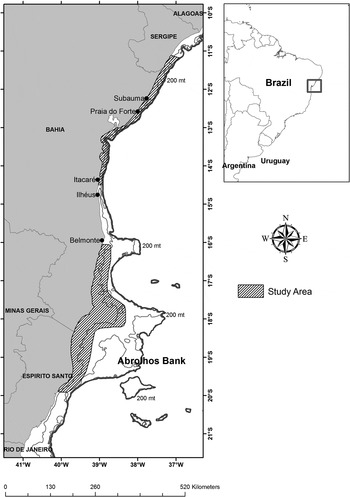
The study area located along the Brazilian eastern coastal waters is represented by the coast of Bahia and the Abrolhos Bank. The definition used in the present study as the ‘northern coast of Bahia' (NCB) was arbitrarily made based on operational matters and sampling efforts, and includes the area in between the city of Itacaré (14°16′S 38°59′W) and Subaúma, municipality of Entre Rios (12°0.1′S 37°33′W)—a coastline that is nearly 300 km long. From 2007 until 2009, research cruises were conducted up to the northern coast of Sergipe State (11°16′S 37°10′W), which increased the sampled area to 400 km of coast (Figure 2). The main feature of the NCB is a narrow continental shelf, with a width of approximately 15 km. The depth along the continental shelf, in the sampled areas ranges, from 20–70 m deep (DHN, 1995). The Abrolhos Bank (16°40′–19°30′S 37°25′–35°45′W) is an extension of the continental shelf and its width reaches up to 220 m.
Study area during the humpback whales' reproductive season on the northern coast of Bahia and the Abrolhos Bank.

Efforts and field procedures
In order to study the site fidelity and residence times on the northern coast of Bahia, daily cruises were conducted on 15–20 m long schooners equipped with 250 hp engines, during the humpback whales' reproductive season (July–October). All the cruises were carried out when the weather and sea conditions were favourable (Beaufort scale below 5). The mean duration of the cruises was 9 hours. Although most cruises left from Praia do Forte (12°35′S 37°59′W), efforts were made to guarantee that both northern and southern areas were covered during all the seasons. Therefore, 4–5 days expeditions were carried out twice each season, from 2005 to 2009, with a three-month interval between consecutive expeditions. The main objective of such expeditions was to increase the sampling area located between 11° and 14°S. Cruises were carried out daily, going north and south on alternative days, guaranteeing that the areas were covered homogeneously. From 2001 until 2009 data were also collected aboard whale-watching vessels. The whale-watching trips were carried out mainly in the Praia do Forte and Itacaré regions, for approximately 5 hours per day. These cruises rendered a total of 821 days of sampling or 3784 sampling hours (Table 1).
Sampling efforts in days and hours during the research and whale watching cruises between 2000 and 2009 off the northern coast of Bahia, Brazil.

Humpback whales can be individually photo-identified by their unique patterns of pigmentation on the ventral portion of the fluke in combination with the shape of its edge (Katona & Whitehead, Reference Katona and Whitehead1981). During the cruises conducted from 2000 until 2004, individual whales were identified from photographs taken with analogue cameras: Nikon N90 with 300 mm lenses. From 2004 until 2009, the photographs were taken using digital cameras (models Nikon D40, D70, D80 and D200) and lenses ranging from 80 mm up to 400 mm. For the present study, only the pictures of good quality, sharp focus and taken from a 90° angle were used, assuring that the shape and pigmentation variances could be perfectly seen. The newly identified individuals were classified according to the proportion of black and white of the ventral part of the fluke, ranging from total white (known as Pattern 1) to total black (Pattern 5) (Rosenbaum et al., Reference Rosenbaum, Clapham, Allen, Nicole-Jenner, Jenner, Florez-González, Urban, Ladrón, Mori, Yamaguchi and Baker1995). Two researchers compared each new photograph with all of the previous pictures belonging to the same pattern category, to classify images down to an individual level and to determine whether the image was a resighting of a previously identified whale, or not.
The analysis of the pictures allowed the estimation of occupational rates and site fidelity, following the procedures and definitions used in Clapham et al. (Reference Clapham, Baraff, Carlson, Christian, Matilla, Mayo, Murphy and Pittman1993) and Mattila et al. (1994). According to these authors, occupation or residence times are defined by the number of days between the first and last sighting of a photo-identified whale during a season. Site fidelity was estimated based on the numbers of whales resighted within a season divided by the number of whales photo-identified in the same season. In order to analyse differences in site fidelity among males and females, data collected in the Abrolhos Bank region since 1989 were also used. It should be noted that, as shown in Figure 2, the Abrolhos Bank region and the northern coast of Bahia are separated by 175 km and were sampled independently.
To identify the sex of each whale DNA analysis is useful (Palsboll et al., Reference Palsboll, Vader, Bakke and El-Gewely1992; Cypriano-Souza, Reference Cypriano-Souza2008). Another way of identifying the sex was through the identification of the social position of a whale in a group. An adult seen constantly in the company of a calf was considered to be its mother, therefore a female. An adult playing the role of an escort, in the company of a female and calf, was considered to be a male (e.g. Glockner-Ferrari & Ferrari, Reference Glockner-Ferrari and Ferrari1985; Clapham et al., Reference Clapham, Palsboll, Mattila and Vasquez1992; Craig & Herman, Reference Craig and Herman1997).
The Mann–Whitney U-test was used to compare the resight rate for males and females along the years while the Chi-squared (χ 2) test was used to compare the resighting rates for each year along consecutive years and the proportion of individuals that were sighted only once.
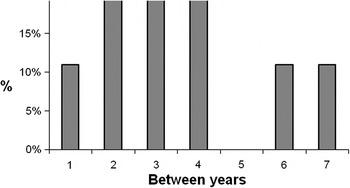
Number of years between resights at the northern coast of Bahia, Brazil, between 2000 and 2009.

RESULTS
Site fidelity and residence times
A total of 841 whales were identified between 2000 and 2009, 635 of them during research cruises and 206 during whale-watching trips. The vast majority of the individuals (96%; N = 809) were seen only once, with only 32 individuals (4%) being resighted. Among these resights, 72% (N = 23) of them were resighted within a year. The number of resightings in the same year varied from 1 in the years of 2001 and 2004 up to 6 in 2003, while in the years of 2007 and 2009 no whale was resighted (Table 2). The occupation rate varied from 1 to 21 days (mean = 5.3; SD = 5.4; N = 23).
Identified and resighted whales during the same season and between seasons on the northern coast of Bahia, Brazil, between 2000 and 20009.

Only 1% (N = 9) of all individuals were resighted between years (Table 2). The resights occurred with gap periods varying from 1 to 7 years, with intervals of 2, 3 or 4 years being more common (Figure 2). All of the 9 individuals reported in more than one season were only resighted once.
Gender differences regarding site fidelity
By crossing gender information with the photo-identification catalogue a total of 207 individual whales were identified, the majority (119 individuals) being male. The average number of years in which males and females were resighted was similar (Mann–Whitney U-test, H = 1, 69; df = 1; P = 0,193; P > 0.05). Most individuals were seen only during one year, males (N = 85, 71%) and females (N = 70, 58, 8%). The proportion of males and females within the same year was also similar (χ 2 = 1, 76; df = 1; P > 0.05; Table 3).
Resights of males and females identified on the eastern Brazilian coast between 1989 and 2009.

Among the 34 males sighted in more than one year, 15 of them (44%) were resighted in consecutive years. Among the females, 18 were sighted in more than one year and 11 of them (61%) in consecutive years. The difference between genders in this case was not considered to be statistically significant (χ 2 = 0.41; df = 1; P > 0.05).
DISCUSSION
Site fidelity and residence times
The northern coast of Bahia was considered to have low site fidelity and occupancy rates. The average occupancy rate (5.5 days) and the greatest number of days in between two resights were smaller than that observed in other breeding grounds. Wedekin et al. (Reference Wedekin, Neves, Marcondes, Baracho, Rossi-Santos, Engel and Simões-Lopes2010) studied the same population in the Abrolhos Bank and found an occupancy rate of 15 days with a maximum of 71 days between resights. Higher rates were also observed for the population studied in the Caminguin Islands, in The Philippines (Acebes et al., Reference Acebes, Darling and Yamaguchi2007); for the one in Machalilla National Park, Equador (Scheidat et al., Reference Scheidat, Castro, Denkinger, González and Adelung2000); Silver Bank, Caribbean (Matilla et al., Reference Matilla, Clapham, Katona and Stone1989); and Hawaii (Craig & Herman, Reference Craig and Herman1997).
The results reported in this study suggest regional differences in the occupancy rates within the same humpback whale population in two different locations of their breeding ground off the Brazilian coast. Differences were also found in previous studies carried out in other populations. Capela & Flores (Reference Capela and Flores1993) found a high occupancy rate (mean = 17 days) for the Gorgona Island, Colombia. Scheidet et al. (2000) reported that only 10% of the whales that were resighted in Ecuadorian coastal waters remained in the sampled area for longer than two weeks. The coasts of Colombia and Ecuador are considered to be reproductive areas for the same humpback whale population that breeds off the western coast of South America. For the humpback whales that reproduce in the Caribbean Sea, Matilla et al. (Reference Matilla, Clapham, Vásquez and Bowman1994) found a lower occupancy rate for Samana Bay, the Dominican Republic, than the ones documented for other areas in the same region (e.g. Silver Bank), possibly because Samana Bay represents a ‘passing-by' area between two important breeding locations (the nearby Silver and Navidad Banks). Therefore, differences among occupancy rates for the same population in different locations may reflect the way in which whales explore each region. In addition, the differences could also be a result of the whales' social organization in each location. Félix & Haase (Reference Félix and Haase2001) suggest that the greater occupancy rates in the Gorgona Island, Colombia can be explained by the high concentration of females and calves (50%) that in this particular area remain closer to the coast, while in Ecuador this social group represented only 10% of all the records, thus reflecting smaller occupancy rates. Félix & Haase (Reference Félix and Haase2001) suggest that the concentration of females and calves closer to the coast may facilitate the resight of those groups which have a lower mobility. Differences among the social organization of the humpback whale population at the Abrolhos Bank and NCB were documented in previous studies. Rossi-Santos et al. (Reference Rossi-Santos, Neto, Baracho, Cipolotti, Marcovaldi and Engel2008) found that at the northern coast of Bahia females and calves represented only 17% of the social groups documented, while in the Abrolhos Bank, females and calves represented 50% of the social groups recorded (Martins et al., Reference Martins, Morete, Engel, Freitas, Secchi and Kinas2001; Morete et al., Reference Morete, Pace III, Martins, Freitas and Engel2003). Since females and calves have a preference for shallow, coastal waters (Herman et al., Reference Herman, Forestell and Antinoja1980; Smultea, Reference Smultea1994; Ersts & Rosenbaum, Reference Ersts and Rosenbaum2003), it is expected that the social organization may influence the occupancy rates recorded. The majority of the cruises on the NCB were carried out in shallow waters, inside the limits of the continental shelf. Indeed, in the present study, one of the individuals resighted was a female with its calf and the female's occupancy rate was 11 days, a number greater than the average rate found for the area.
Differences in the occupancy rate reported among two different breeding locations in Hawaii (Maui and Big Island) suggest that Maui would be more of a ‘passing-by' area (Craig & Herman, Reference Craig and Herman2000). Besides that, the differences among those areas can also be the result of different regional densities (Craig & Herman, Reference Craig and Herman2000). On the Brazilian coast, the humpback whales' distribution is heterogeneous and approximately 80% of the population is concentrated in the Abrolhos Bank, while the other 20% is distributed along the north-eastern coast, including NCB (Andriolo et al., Reference Andriolo, Kinas, Engel and Martins2006b). Thus, different densities on the Brazilian coast may have influence on the different occupancy rates documented in this study.
Similar to the Maui region in Hawaii, the NCB could also represent a ‘passing-by' area. It is well-known that humpback whales inhabit the shallow waters of tropical regions, usually on the continental shelf (Clapham & Mead, Reference Clapham and Mead1999). Since the continental shelf in the studied area is one of the narrowest shelves along the Brazilian coast (Ekau & Knoppers, Reference Ekau and Knoppers1999), the whales could be moving in a latitudinal direction, towards non-sampled areas, diminishing the chances of resights. Individuals moving in the same season between the Abrolhos Bank, NCB, and the coast of Paraíba (located about 600 km north from the study area) are examples of how fluid those movements can be (Wekedin et al., 2010).
When compared to other breeding grounds, the site fidelity found for the study area was low, with a small number of whales observed in the same area for over a year. A greater site fidelity was found for the Abrolhos Bank, considered to be the most important breeding ground located in all the south-western Atlantic (Martins et al., Reference Martins, Morete, Engel, Freitas, Secchi and Kinas2001; Andriolo et al., Reference Andriolo, Martins, Engel, Pizzorno, Más-Rosa, Freitas, Morete and Kinas2006a) with intervals between resights greater than 10 years, reaching up to 16 years (Wedekin et al., Reference Wedekin, Neves, Marcondes, Baracho, Rossi-Santos, Engel and Simões-Lopes2010).
In this study, even though the number of resights within the seasons was smaller than the numbers documented for other reproductive areas, a maximum interval of 7 years between resightings was documented, suggesting some level of site fidelity in the sampled area. On the western Australian coast an occupancy rate of 9 years was registered with a discovery-tag, used during the whaling periods (Chittleborough, Reference Chittleborough1965).
For the Abrolhos Bank, it has been suggested that elements such as sampling effort, behavioural features and the population growth, may interfere in the probability of resighting (Wedekin et al., Reference Wedekin, Neves, Marcondes, Baracho, Rossi-Santos, Engel and Simões-Lopes2010). The same elements can also interfere in the number of resightings on the NCB, since the same reproductive population inhabits this area. According to Craig & Herman (Reference Craig and Herman1997), low site fidelity rates in reproductive areas can be related to the exchange of individuals in breeding grounds through the years or the fact that some individuals may not migrate during certain seasons. Meanwhile, the distribution of individuals along the breeding ground may also interfere in the number of resightings. Humpback whales are extremely transient and can move about 42 km per day in their breeding area (Zerbini et al., Reference Zerbini, Andriolo, Heide-Jorgensen, Pizzorno, Maia, VanBlaricom, DeMaster, Simões-Lopes, Moreira and Bethlem2006). Also, Wedekin et al. (Reference Wedekin, Neves, Marcondes, Baracho, Rossi-Santos, Engel and Simões-Lopes2010) noticed that the humpback whales off the Brazilian coast can move up to 600 km within the breeding season. According to Baker & Herman (Reference Baker and Herman1981) humpback whales make use of a wide area in the breeding ground. Thus, the low site fidelity showed for the NCB could be a result of the combination between ecological aspects and sampling efforts. The sampled area was, during the first years, 300 km wide, but it was enlarged to 400 km in 2007. However, low levels of photo-identification effort were made in the northern portion of the sampled area. In 2004, an expedition was carried out in the waters off the Rio Grande do Norte State (5°48′S 35°0.5′W). Rio Grande do Norte is 750 km away from the study area but in 2004 the research team documented one resighting of an individual that has been photo-identified both in the NCB and the Abrolhos Bank (Wedekin et al., Reference Wedekin, Neves, Marcondes, Baracho, Rossi-Santos, Engel and Simões-Lopes2010). These data suggest that the area located in the north of NCB might be part of the same breeding ground, which would be greater than the one frequently sampled.
Zerbini et al. (Reference Zerbini, Andriolo, Rocha, Simões-Lopes, Siciliano, Pizzorno, Waite, DeMaster and VanBlaricom2004) estimated that the humpback whale population that reproduces on the north-western coast of Brazil (5°–12°S) had 628 individuals (CV = 0.31) in the years 1999 and 2000. Aerial surveys carried out along the entire Brazilian coast resulted in 6404 individuals (CV = 0.11) in 2005 and 7920 individuals (CV = 28.3) in 2008 (Wedekin et al., Reference Wedekin, Engel, Azevedo, Kinas, Andriolo, Luna, Ilha and Simões-Lopes2009; Andriolo et al., Reference Andriolo, Kinas, Engel, Martins and Rufino2010). Andriolo et al. (Reference Andriolo, Kinas, Engel, Martins and Rufino2010) argue that the breeding ground off the Brazilian coast stretches from Rio Grande do Norte State to Rio de Janeiro State (5°–24°S). Moreover, Wedekin et al. (Reference Wedekin, Engel, Azevedo, Kinas, Andriolo, Luna, Ilha and Simões-Lopes2009) indicate that the densities of whales found on the coast of the States of Alagoas and Sergipe (north of the NCB) found in 2008 were also greater than those found in 2005. These studies support the idea that the humpback whales are reoccupying former breeding grounds along the north-eastern coast of Brazil.
In a comparison between the photo-identification catalogues from the NCB and Abrolhos Bank, only a small number of resightings were found (N = 17), suggesting that the individuals that have been photo-identified show a certain level of site fidelity to specific regions on the Brazilian coast (Wedekin et al., Reference Wedekin, Neves, Marcondes, Baracho, Rossi-Santos, Engel and Simões-Lopes2010). On the other hand, the low site fidelity rates for the NCB suggest that the individuals that have been photo-identified in the study area might go to non-sampled areas. Since the site fidelity rate also reflects the population size (Calambokidis et al., Reference Calambokidis, Steiger, Straley, Herman, Cerchio, Salden, Urbán, Jacobsen, von Zeigesar, Balcomb, Gabriele, Dahlheim, Uchida, Ellis, Miyamura, Ladrón de Guevara, Yamaguchi, Sato, Mizroch, Schlender, Rasmussen and Barlow2001) and the photo-identification catalogue from the NCB has 841 humpback whales, it is reasonable to assume that this would be the minimum number of individuals that comes to this region. We emphasize the necessity of amplifying sampling effort in order to estimate the real size of the humpback whale population off the north-eastern Brazilian coast.
The low occupancy rates and site fidelity suggest a brief stay in the study area and a possible movement of the whales in a larger area; which supports a need to carry out monitoring activities in other areas along the north-eastern coast of Brazil.
Humpback whales, like the other species that belong to the order Cetacea, are protected in Brazilian waters since 1987. However, humpback whales inhabit areas where anthropogenic activities such as fishing, oil exploration and boating also occur, and may have impacts upon this species (Wedekin et al., Reference Wedekin, Neves, Marcondes, Baracho, Rossi-Santos, Engel and Simões-Lopes2010).
Whale-watching activity has shown continuous growth off the cost of Bahia (Cipolotti et al., Reference Cipolotti, Morete, Basto, Engel and Marcovaldi2005). According to Wedekin et al. (Reference Wedekin, Neves, Marcondes, Baracho, Rossi-Santos, Engel and Simões-Lopes2010) the movement of individuals and the low site fidelity rates might minimize the local impacts of the whale-watching activities that are concentrated in certain regions. On the other hand, it may increase the probability of the humpback whales' interaction with other anthropogenic activities along the breeding ground.
Gender differences regarding site fidelity
The site fidelity rates of humpback whales using the Brazilian coast as a breeding ground are similar between males and females. The similarities between the genders include not only the average number of resightings each year, but also the number of resightings within consecutive years and the proportion of sightings each year.
It is interesting to note that unlike what was observed in this particular study, different situations were found in other breeding grounds. In the Hawaiian breeding ground behavioural differences between genders were found. In that specific region, males showed greater site fidelity in both, the number of resightings each year and the resightings within consecutive years (Craig & Herman, Reference Craig and Herman1997). This latter study also suggests that these data might be directly related to the sex-ratio, as previous studies showed that the males are in greater number than the females off the Hawaiian coast. Indeed, other studies suggest that not all the individuals, particularly females, necessarily migrate to the breeding ground. Brown et al. (Reference Brown, Corkeron, Hale, Schultz and Bryden1995) found a sex-ratio of 2.4:1 among humpback whales migrating along the eastern Australian coast. Off the Brazilian coast the sex-ratio is 1.2:1, similar to the expected rate of 1:1. The difference between the rate found and expected is not statistically significant (Cypriano-Souza, Reference Cypriano-Souza2008). Therefore, the sex-ratio documented by Cypriano-Souza (Reference Cypriano-Souza2008) supports the site fidelity similarity between genders that was documented in this study.
Site fidelity differences between genders could be the result of distinct behavioural strategies between males and females. Craig & Herman (Reference Craig and Herman1997) emphasize that the main reasons for the differences in the migration patterns of different genders are the energetic costs of migration and costs of reproduction as well as the maximization of reproductive success. Balaenopterid whales can use up to 25% of their annual energy consumption during migration (Lockyer, Reference Lockyer1981). The costs of reproduction, in the different reproductive phases, are even greater; considered to be 25%–35% higher than the energetic costs of growth and metabolism. The costs of lactation are considered to be 15 times greater than the costs of pregnancy itself (Lockyer, 1978 cited in Lockyer, Reference Lockyer1981). Therefore, it is expected that different behavioural strategies with respect to the migration of males and females result in site fidelity differences in their breeding ground. Off the Brazilian coast males and females showed similarities in site fidelity. One possible explanation is that the males can migrate to different breeding grounds in different seasons. The movement of individuals to different breeding grounds has been documented (e.g. Darling & Cerchio, Reference Darling and Cerchio1993; Garrigue et al., Reference Garrigue, Aguayo, Amante-Helweg, Baker, Caballero, Clapham, Constantine, Denkinger, Donoghue, Flórez-González, Greaves, Hauser, Olavarria, Pairoa, Peckham and Poole2002; Constantine et al., 2007) and on many occasions those ‘wandering’ individuals were considered to be males (e.g. Salden et al., Reference Salden, Herman, Yamaguchi and Sato1999). This errant behaviour was first documented by Darling & McSweeney (Reference Darling and McSweeney1985). They documented the same individuals in different breeding grounds in distinct years and on many occasions could also assert that they were males. Palumbi & Baker (Reference Palumbi and Baker1994) affirmed that the increasing mixture of nuclear alleles (that differ from mitochondrial alleles which are known to be maternally transferred), between the humpback whale populations that migrate to the Hawaiian and Californian coasts, suggest that males' movements between different breeding grounds are greater than those of the females. The occurrence of males in different breeding grounds might work as a mechanism able to increase genetic variability of the reproductive populations (Salden et al., Reference Salden, Herman, Yamaguchi and Sato1999), frequently separated by enormous distances.
Similarities between the songs performed by the males belonging to different populations also indicate the exchange of individuals between breeding grounds (Payne & Guinee, Reference Payne, Guinee and Payne1983; Cerchio et al., Reference Cerchio, Jacobsen and Norris2001). Similarities were also found between the songs performed by the population that breeds on the Brazilian coast and the population that breeds on the Gabon coast, suggesting some level of interaction between the individuals (Darling & Souza-Lima, Reference Darling and Souza-Lima2005). Thus, the absence of some females that might remain in the feeding ground and the absence of certain males that might migrate to a different breeding ground may result in the equilibrium of the sex-ratio, also resulting in equal site fidelity rates shown by both genders for the Brazilian coast.
A comparison between catalogues from both areas (Brazilian coast and Gabon coast) did not reveal any resightings (Pacheco de Godoy et al., Reference Pacheco de Godoy, Collins, Ersts, Engel and Rosenbaum2004), however it is important to increase the efforts comparing the Brazilian catalogue with the catalogues from other regions on the western coast of Africa, since the Gabon coast represents only a small region of that breeding ground.
Recently an individual identified at the Abrolhos Bank was resighted, two years later, on the coast of Madagascar. This represents a longitudinal and inter-oceanic migration of at least 9800 km between breeding grounds (Neves, personal communication). This record suggests that the migration between distant breeding grounds may be more common than has been previously documented.
ACKNOWLEDGEMENTS
This paper is part of the first author's Master's degree thesis in ecology and biomonitoring at the Universidade Federal da Bahia, Brazil. We are most grateful to the entire Humpback Whale Institute team, especially to Roberta Lana Reis and Márcia Engel for their administrative support. We thank the photographer and cinematographer Enrico Marcovaldi for his help with collecting scientific data. We thank Guilherme Mauruto for his help with the maps and Luciana Leite for her help with the English version of this paper and comments. We are immensely grateful to PETROBRAS for the financial support and Fundação Garcia D'Ávila and Fundação AVINA for their additional support.