We investigate two questions central to understanding electoral politics. One asks, why do people vote? As many rational choice critics argue, a vote really only matters if it is decisive, breaking a tie between candidates.Footnote 1 For a non-trivially sized electorate, the odds of being the tie-breaking voter are near zero. With the voter having almost no chance of altering the electoral outcome, the cost of voting, even though small, is still likely to exceed its expected value. A second question focuses on voters, asking what determines how they choose between candidates. Debate in this arena revolves around three bases for choosing for whom to vote: (1) to fulfil some psychological or other source of affinity that leads people to identify with one or another political party across elections;Footnote 2 (2) to support parties and candidates whose policies the voter favours;Footnote 3 or (3) to gain personal patronage rewards or local benefits in the form of pork in exchange for voter support.Footnote 4 We offer a game theoretic solution to these puzzles.
The article proceeds as follows. In the next section we review critical features of the literature on voting, tying it to the literature on patronage and pork-barrel politics. Then we introduce our basic model. The model distinguishes between two ways that a voter can be pivotal: (1) in the sense of tipping the outcome of the election one way or the other; and (2) in the sense of providing sufficient electoral support to the winning candidate or party that the voter's group – a discernible voter bloc such as a ward or precinct – gets ‘pork’ or patronage benefits that it otherwise would not have got.Footnote 5 Having examined these concepts of pivotalness, we first derive symmetric voting equilibria. In these equilibria, voters can rationally support parties even when the policies of those parties harm their welfare. Further in these equilibria voters also want to turnout. We then discuss asymmetric voting equilibria in which each voter group supports the parties at a different rate. We show that asymmetric voting equilibria can produce different turnout rates across the different groups. Furthermore, the motivation to support one party rather than another can differ substantially between groups such that one group might vote primarily based on policy differences between the parties, while the vote choice in another might be primarily motivated by pork and patronage. This variation in the motivation for voting is endogenous.
The model's principal conceptual innovation is to introduce the idea of contingent prize allocation rules. Rather than assume parties compete solely in terms of public policy or by buying individual votes through patronage, parties are modelled as offering rewards to the most supportive group or groups. By making the allocation of these prizes contingent on group-level support, a party incentivizes groups to co-ordinate on supporting it. A contingent prize allocation rule converts voting into a competition to show the greatest loyalty to the party expected to win election. Furthermore, precisely because this contingent prize mechanism works by creating intergroup competition to express the greatest loyalty, it does not suffer from credibility concerns that often arise in studies of patronage. We show that if parties use a contingent prize allocation rule then there will be larger prizes and fewer public goods than would occur if parties directly buy individual votes.Footnote 6 This discussion provides an explanation for some patronage-based democratic systems, like Tanzania or India, that emulate the corruption and inefficiency conditions of more autocratic regimes. Although all the voters might recognize that they would be better off under a reformist party's rule, established patronage parties persist because each of the voters wants the reformist party elected but with someone else's vote. We conclude by discussing the implications of our model and offering policy advice for eliminating political patronage.
Literature Review
Although it is agreed that voters are unlikely to be pivotal in shaping who wins the election, much of the literature assumes that voters have a dominant incentive to vote as if their vote matters. A number of scholars focus on group rationality and the incentives to follow leaders and argue that this increases voting.Footnote 7 Feddersen and Sandroni argue that the desire to vote ethically increases turnout.Footnote 8 Huckfeldt and Sprague find that socialization is an important component of how people vote.Footnote 9 Others examine the time consistency of voting in shaping future party platforms.Footnote 10 They point to the signalling quality votes have. Meirowitz and Schotts demonstrate that the signalling interest of voters dominates what we refer to as outcome pivotalness.Footnote 11
Our focus on a contingent prize allocation rule creates an incentive, as we will see, to vote even when the voter has little chance of altering the electoral outcome. Others have also examined targeted rewards in electoral contests, but their interest is not in explaining voting per se.Footnote 12 While agreeing that each voter has a neglible probability of being pivotal in the election as a whole, Schwartz notes that such a voter might well be pivotal in determining whether her precinct, or other sub-district jurisdiction, supports a particular candidate. If candidates reward supportive precincts, then although the individual voter might be insignificant in the election as a whole, still her support might strongly influence the allocation of benefits in a smaller, local jurisdiction such as an individual precinct. Indeed, he suggests that voters, tempted by the chance to gain pork or patronage benefits, might even vote for a party they do not favour if it is expected to win the election anyway. Schwartz shows that his decision theoretic assessment is more consistent with the evidence for voter turnout than are alternative accounts of the rationality of voting.Footnote 13
Schwartz's critical insight was to expand the debate about the rationality of voting to include what we refer to as prize pivotalness rather than just outcome pivotalness. Our analysis expands on Schwartz's and other arguments about targeted rewards, by emphasizing the contingent nature of party rewards to discernible voter groups. By encapsulating voting in a game theoretic setting, with group level benefits that are contingent on the level of localized support, we are able to deduce broad political principles. For instance, the game demonstrates that parties/candidates are better off using a localized contingent prize allocation rule (as explained in the next section) over a reformist political agenda; that diminished public goods provision results from patronage and pork-barrel voting; that (rational) equilibrium voting strategies include choosing to vote on the basis of party identification or other forms of straight party-line voting, voting on the basis of strong policy preferences, voting to gain patronage and pork, voting in response to different mixes of these voter incentives, or not voting at all. The strategic setting explains variation in turnout, polarization of political parties and voters, and provides implications about term limits, gerrymandering and many other features of electoral politics.
Patronage – the granting of favours and rewards by politicians in exchange for electoral support – is generally viewed within the literature as being bad for economic performance and democracy.Footnote 14 While Lizzeri and Persico demonstrate that targeted rewards are inefficient, Magaloni shows empirically that patronage and pork enable incumbent parties to win elections even when they are less popular than the opposition.Footnote 15 The empirical record supports the conclusion that targeted rewards retard public goods provision and growth.Footnote 16
Patronage is an effective way to garner political support when voting is not anonymous. The Australian ballot, an official ballot produced by the state rather than provided by parties, has made it harder for parties to verify voter choice.Footnote 17 Despite these changes, parties have found ingenious ways to undermine anonymity. For instance, voting machines in New Jersey in the 1890s made different noises depending upon how votes were cast. Chandra documents how parties in India discern voter choice by frequently emptying the ballot box to provide an ongoing count of the votes.Footnote 18
Despite these tricks, the secret ballot has greatly reduced the ability of parties to monitor individual votes.Footnote 19 Yet, patronage parties persist. They have, of course, adapted to the impediments secret ballots put in their way. Pork barrel politics, which we refer to throughout as a special form of patronage, focuses benefits on a discernible set of voters, such as those in a ward or precinct, rather than on individual voters.
Time consistency and credible commitment are crucial features of patronage.Footnote 20 Parties offer rewards in exchange for votes. Individuals promise to vote for a party in exchange for material benefits. Once elected, the party no longer wants to hand over rewards, and once rewarded the voters can renege on their promise. The anonymous ballot makes the credibility problem even harder to resolve because the party cannot verify whether the voter held up her or his end of the deal. Norms and reciprocity have been proffered to solve the credibility dilemma but some issues remain unresolved.Footnote 21 Even discounting the credibility issue, direct exchanges between a party and individuals cannot fully account for widespread popular support because the patronage-oriented party in standard accounts does not give bribes to everyone, and in many cases the value of the bribes is very low. Stokes illustrates the problem by citing the example of the Argentinian party worker given ten tiny bags of food with which to buy the forty voters in her neighbourhood.Footnote 22 Furthermore, there is evidence that those who receive rewards are no more likely to support the party than those who do not.Footnote 23 The contingent prize allocation explanation we offer resolves these difficulties. It does so by relying on the use of carefully targeted pork rather than individual patronage.
In our account, pork is targeted based on a contingent prize allocation rule: benefits (individual and collective; that is, patronage and pork) go to the discernible electoral groups, such as precincts, that give the winning party the greatest support rather than only to individual voters or to the winning candidate's entire constituency.Footnote 24 The group-prize mechanism requires that groups be identifiable; that the level of electoral support from each group is observable; and that parties can offer rewards that selectively benefit particular groups. Electoral precincts are one example of groups that fulfil these criteria. Votes are counted at the precinct level and parties can allocate projects to one geographical precinct over another. However, the theory is equally applicable to any other societal groupings that satisfy these criteria, whether these groups are based on linguistic, religious, ethnic or economic divisions. That is, the theory is about bloc identification and rewards. Electoral precincts are simply an easy-to-observe vehicle for allocating patronage prizes. Here we emphasize the development of the theory. Although the model fits several well-established empirical regularities and also suggests new, testable hypotheses, we do not investigate these here. In later work we hope to address many of these empirical implications.
A Model of Contingent Prizes and Pivotal Voting
The model assumes three groups or voting blocs which, for convenience, can be thought of as electoral precincts. We identify the three groups as G 1, G 2 and G 3. We assume two political parties, A and B. The parties can observe the vote totals from each group, but they cannot observe individual votes. If party A allocates political rewards (prizes) on the basis of the number of votes each group produces, then voters can be pivotal in two senses. First, voters might be pivotal in the traditional sense of determining which party wins – outcome pivot. This should be thought of as the pivotality of central concern in the rational voting literature. Second, voters can be pivotal in deciding which group (or voting unit) provides the party with the most support, and hence receives the prize – prize pivot. As we shall see, prize pivot dominates outcome pivot in voter choices over parties. Within the three group case we show that with a contingent prize allocation rule in place, even when there is a hegemonic party supported by all voters, so that each voter has zero influence over the electoral outcome (that is, voters are not outcome pivotal), the voter's incentive to vote for the hegemonic party is equal to one third of the value of the prize. As we will see, this incentive is driven by the voter's influence over the allocation of the prize: that is, the voter's prize pivot.
There are n (odd) voters in each of the groups. To win the election, party A needs to win a majority of the votes, that is at least (3n + 1)/2 votes. All votes count equally but votes are reported by group. Parties cannot observe how individuals vote; however, they observe electoral results by group or precinct. Parties A and B induce patronage support by promising to reward the precinct that gives it the most support; that is, by promising a prize contingent on electoral support. Later we explain why this promise is credible.
Voters care about two things when choosing whom to support: policy and prizes. Let α be the common voter assessment of the policy-based value of party A relative to party B. In addition to the common benefit, each voter, i, receives εi benefits if party A is elected. Voters know their own evaluation of party A, but they do not know the values held by other voters. We assume that each voter's evaluation of party A is independent, with an expected value of zero. In particular, we assume that Pr(εi < x) = F(x), with associated density f(x), which has full support on the real line and is symmetric about zero. The symmetry assumption simplifies mathematical expressions. The examples utilize the logistical distribution: F(x) = e −x/(1 + e −x).
In addition to policy benefits from the competing parties, voters care about what the parties will give to them or their group. Patronage parties offer political rewards which we refer to as prizes: parties A and B hand out prizes worth ΘA and ΘB depending upon which party wins. These prizes could take many forms. This could be local goods or services, commonly referred to as pork, or it could be individual private rewards, such as standard patronage quid-pro-quo deals randomly allocated to members of the group. A party can only allocate a prize if it wins the election.
Patronage parties offer jobs and superior services to supporters. They might choose to locate a new school, road or health clinic where it preferentially benefits one group more than another. For convenience, we shall think of the prize as a local public good for the precinct that receives it.Footnote 25 If, for instance, party A wins the election and gives the prize to group G 1, then all members of G 1 receive value ΘA and the members of the other groups get nothing (even if they also voted, albeit less strongly, in favour of party A). For the time being we assume the size of the prize is fixed and examine the consequences of how it is allocated. Later, we examine the trade-off between the provision of public goods, g, and prizes, Θ.
Our primary goal is to understand how a contingent prize allocation rule shapes vote choice within and across groups. We characterize Nash equilibria, where a voting strategy is defined as follows: if voter m's evaluation of party A is εm, then m's strategy is to vote for party A with probability σm (εm). Given such a strategy, the probability that voter m supports party A is  .
Outcome Pivot, Prize Pivot
Because parties do not see individual votes, they cannot allocate prizes based upon individual votes. However, they can compare the level of support across different groups (e.g., voter blocs, precincts) and reward the group that produces the most votes by allocating the prize to it. This creates competition to be the most supportive group. While an individual's influence over which party wins an election is small, the voter can remain highly pivotal in the allocation of the prize if a party uses a contingent prize allocation rule.
Unfortunately, due to their opaque nature, it is often difficult to discern the internal workings of patronage parties.Footnote 26 Still, sometimes we are able to observe party rules that are structured to reward supportive groups in much the manner assumed here. For example, Gosnell describes how in Chicago the size of each ward's Democratic vote directly translated into its influence on various Democratic committees.Footnote 27 If, for instance, one ward produced twice as many Democratic votes as another, then its ward leader would have twice the votes within the internal deliberations of the Democratic party and, therefore, a much greater opportunity to send rewards back to his ward. Such a system institutionalizes the mapping between electoral support and the allocation of rewards.
Similar biases exist at the national level in the United States. For instance, the rules of the Democratic party's national convention reward the states that provided the highest level of support to the Democrats in previous elections. In particular, each state's share of the 3,000 democratic delegates is calculated by the following allocation formula:

where A = Allocation Factor, SDV = State Democratic Vote, SEV = State Electoral Vote, and TDV = Total Democratic Vote.Footnote 28 The Republican party uses a more complicated system which allocates delegates on the basis of Republican support in previous state and federal elections.Footnote 29 In both cases, parties use a contingent rule to assign the prize – in this case, influence over picking presidential candidates.
Parties can also allocate punishments according to electoral support. Singapore's Lee Kuan Yew was notorious for punishing electoral districts by removing public housing benefits if the district did not overwhelmingly support him.Footnote 30 In Zimbabwe, Robert Mugagbe has gone even further. He bulldozed houses and markets in those areas which supported opposition candidates.Footnote 31 Parties allocate sticks and carrots based upon electoral support. The primary objective of this article is to examine the consequences of contingent prize allocation rules on voting behaviour.
We examine the following simple winner-takes-all contingent prize allocation rule in which the victorious party gives the prize to the group that provided the greatest level of support. If party A's vote totals from groups G 1, G 2 and G 3 are i, j and k, respectively, then the probability that party A allocates the prize to G 1 is QA (i, j, k), where

As the examples above illustrate, there are many allocation rules that are contingent upon electoral support. Here, we analyse the single simple rule in which the victorious party gives a prize to the group that gives it the most support. Elsewhere, we compare the properties of different contingent prize allocation rules, in a manner similar to the tournaments literature, which examines how different compensation and promotion policies elicit different effort levels.Footnote 32
The key to contingent prize allocation rules is, as noted earlier, that voters can be outcome pivotal and they can be prize pivotal. We now formally develop the concepts of outcome pivot and prize pivot, restricting our attention to equilibria that are symmetric within group in the sense that all members of a group adopt the same strategy.
Voters from groups G 1, G 2 and G 3 support party A with probabilities pi, pj and pk. Let WA represent the probability that party A will win the election if voter m from G 1 votes for A. Similarly, let WB represent the chance A wins if m votes for B. For presentational convenience, throughout we show these calculations from the perspective of a representative voter m from group G 1.
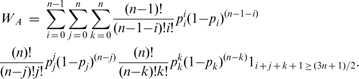
This equation deserves some explanation. The expression is a summation over all the possible vote combinations in the three groups. The term
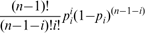
is the probability that i of the n−1 other voters in G 1 vote for party A given that each voter in G 1 individually votes for A with probability pi. This formula is taken directly from the binomial theorem. There are analogous expressions for the number of votes for A in groups G 2 and G 3. The function 1i +j +k + 1≥(3n + 1)/2 is an indicator function that takes value 1 when A wins the election, that is when i + j + k + 1 is at least (3n + 1)/2 votes for party A. This indicator function takes the value zero when B gets more votes than A. Hence, WA is the probability that party A wins if voter m supports it. As n increases calculating these probabilities becomes time consuming. Myerson's approach of treating the number of voters as a random Poisson-distributed variable offers the potential means to generate simple approximations of these probabilities.Footnote 33
If m votes for party B then A receives one fewer vote than in the above case. Therefore, party A's probability of winning the election, WB, is
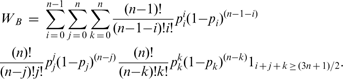
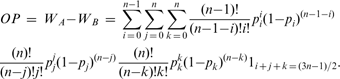
We define outcome pivotalness, OP, as the difference between WA and WB. OP represents the traditional concept of pivotalness and is the probability that m's vote changes the electoral outcome.
In addition to determining the electoral winner, a voter's decision can also alter how the winning party distributes the prize. Under the simple contingent prize allocation rule, Q(i, j, k), voter m's group wins the prize if it offers A the greatest level of electoral support. Given the probabilities with which other voters support A, we can calculate the likelihood of m's group winning the prize if m votes for A and if m votes for B. We define APrizeA as the probability that voter m's group (G 1) receives the prize from party A if m votes for party A:
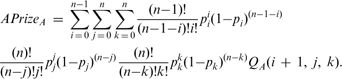
Alternatively, if m votes for B, then the chance that m's group receives the prize from A is APrizeB.
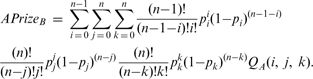
The probability of receiving the prize from A is monotonic in m's vote choice, APrizeA ≥ APrizeB, because QA (i + 1, j, k) ≥ QA (i, j, k). We define prize pivotalness, PPA, as the difference between APrizeA and APrizeB. It reflects how m's vote choice affects the likelihood of m's group receiving the prize from A.

There are analogous expressions for B's prize allocation: BPrizeA, BPrizeB and PPB.
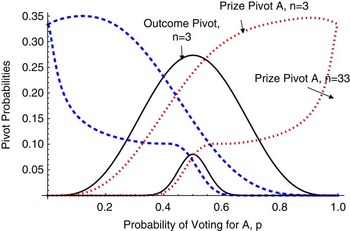
Figure 1 examines the symmetric case where all voters are equally likely to support party A (p = pi = pj = pk). The figure plots outcome pivot OP and prize pivots (PPA and PPB) as a function of p – the individual likelihood of voting for party A – and the number of voters. The solid lines represent outcome pivot OP. The dotted and dashed lines represent prize pivot for A and B, respectively: PPA and PPB. Figure 1 displays pivot probabilities when the number of voters per precinct is 3 (upper lines) or 33 (lower lines). The horizontal axis plots p, the probability with which voters support party A.
Outcome pivots and prize pivots for n = 3 and n = 33

Outcome pivot, OP, drops off very quickly as n increases (the lower solid line shows change in OP as a function of p when n is 33; the upper solid line shows the relationship between OP and p when n is 3 per precinct), particularly when p is not close to ½. Likewise, prize pivot, PPA, declines as the size of the electorate grows (again lower lines compared to upper lines). However, provided that p > 1/2 (that is, voters are more likely to vote for A than not), the impact of a voter's decision on the allocation of the prize remains substantially greater than 10 per cent even when the electorate increases to ninety-nine voters (that is, thirty-three per precinct with three precincts). As the number of voters grows, prize pivot probabilities decline but they do not converge to zero rapidly. For instance, using simulation we examined the prize pivot for the symmetric case in an electorate of 59,049 voters (310). Provided p, the probability that voters support A, is above ½, the prize pivot is at least 0.4 per cent. Furthermore, independent of the number of voters, as the individual probability of voting for party A approaches 1, then prize pivot converges to a third (as p→1, PPA→1/3). Hence, while the probability of being outcome pivotal becomes vanishingly small as the electorate becomes large, this diminution of pivotalness is much slower in terms of the allocation of the prize.
Voting Decisions
Our analyses characterize Nash equilibria in the voting game. Given the probability with which each of the other 3n−1 voters vote for A, we examine the vote choice of representative voter m from group G 1. If m votes for party A, then her expected payoff is:

Alternatively, if m votes for B, her expected payoff is:

Voter m supports A when Um (VoteA)−Um (VoteB) ≥ 0. If OP < 0 then Um (VoteA)−Um (VoteB) is strictly increasing in εm. In this case voter m's best response is fully characterized by a threshold  , where
 is the value of εm for which the value of voting for A equals the value of voting for B.

Since εm has full support, if OP > 0 there always exists  that satisfies Equation 4. If εm >
 then σm (εm) = 1; otherwise σm (εm) = 0. We refer to such a strategy as a threshold strategy. If m uses a threshold strategy then the probability that she votes for A is pm = Pr(εm >
 ) = 1−F(
 ) = F(−
 ).
Threshold strategies are not the only plausible voting strategies. Voters might always vote for one party independent of their evaluation of the other parties. This might be true, for instance, because of a strong psychological identification with one party over the other.Footnote 34 We define ZA as the set of voters who always vote for A (independent of their evaluation of A): ZA = {m∈G 1∪G 2∪G 3 such that σm (εm) = 1 for all εm}. We let ZA 1 represent the set of voters from group G 1 who always vote for A: ZA 1 = ZA∩G 1. Similarly, ZB = {m∈G 1∪G 2∪G 3 such that σm (εm) = 0 for all εm} is the set of voters who vote for B independent of their evaluation of party A. Let ZR be the set of voters who randomize for whom they vote in some way: ZR = {(G 1∪G 2∪G 3)\(ZA∪ZB)}. Note that any voter using a threshold strategy is part of ZR. However, this is not the only kind of randomization. For instance, a voter might flip a coin to decide who to support. Let the notation |ZA| indicate the number of voters who play the pure strategy of always voting for A.
In the following series of propositions, we characterize the properties of Nash equilibria in the voting game. The proofs of the propositions are in an appendix.
PROPOSITION 1: Unless either |ZA| > (3n + 1)/2 or |ZB| > (3n + 1)/2, all voters use threshold voting strategies.
Proposition 1 tells us that if party A is guaranteed to win by at least two votes then there are equilibrium strategies that might include voter m always voting for one party independent of her evaluation of the parties. All voters voting for party A is an interesting example of such an equilibrium, which we explore in detail later. However, if party A is not guaranteed a margin of victory of at least two votes, then in equilibrium all voters must be using threshold voting strategies. Voters using such strategies vote for A when their evaluation of party A, ε, is above a threshold level. It is important to note that while voters use these thresholds, they do not necessarily reflect their sincere evaluations of party A. That is, in general  ≠ −α.
Voters can only adopt pure voting strategies, that is support one of the parties whatever their evaluation of party A, if the outcome of the election is a forgone conclusion. The next proposition explores conditions under which members of different groups can support a party that is bound to lose the election. We examine possible equilibrium voting strategies within the groups under this contingency.
PROPOSITION 2: If |ZA|−|ZB| > |ZR| + 1 (i.e. party A is guaranteed to win the election), then in equilibrium voter m in group G 1 only always votes for B (m∈ZB) if either |ZA 1| + |ZR 1| + 1 < max{|ZA 2|, |ZA 3|} (in which case AprizeA = AprizeB = 0) or |ZA 1| > max{|ZA 2| + |ZR 2|, |ZA 3| + |ZR 3|} (in which case AprizeA = AprizeB = 1).
Proposition 2 tells us that a voter could only always support the losing party if her group had no chance of winning the prize from the winning party or if her group was certain to win the prize even without her support. The intuition can be seen by considering some simple examples with three voters in each of three groups with all voters using deterministic strategies. Let (3,3,3) indicate that each group produced 3 votes for A. This is an equilibrium: since APrizeA = 1/3 and AprizeB = 0, all voters strictly want to support A. Party A is certain of winning and each group has a one third chance of receiving the prize. If a voter switches her vote, the electoral outcome does not change – A still wins – but her group no longer has any chance of getting the prize. In this case, no one supports the losing party because doing so reduces their group's chance of getting the prize.
The voting distributions (1,3,3) and (0,3,3) are equilibria in which members of group G 1 support the losing party. Each of these voters can support B as part of an equilibrium because switching their vote would not alter the distribution of the contingent prize. However, the vote distribution (2,3,3) cannot be an equilibrium. The voter supporting B in group G 1 can give her group a one third chance of obtaining the prize if she switches to voting for party A.
Fully Symmetric Equilibria
First we characterize equilibria in which all voters adopt the same voting strategy: σi (ε) = σj (ε) for all i, j. Then we examine asymmetric equilibria in which voting strategies are symmetric within groups but asymmetric across groups.
Always support Party A
There always exists a pure strategy equilibrium in which all voters choose A (or all choose B). As we have seen, the unanimous choice of one party ensures that each group has a 1/3 chance of receiving the prize. Should any voter support B, then her group has no chance of receiving the prize. While no voter is outcome pivotal, they are all pivotal with respect to the prize from party A and so they all strictly want to support party A.
Interior solutions
There are also equilibria with interior solutions characterized by the threshold  . Specifically,

This is a fixed point. Given the threshold  the probability that each voter supports A is:

Given these vote choices by the other voters, voter m strictly supports party A if εm >  , strictly prefers B if εm <
 and so, voting according to the threshold voting rule is a best response.
PROPOSITION 3: There always exist two types of fully symmetric equilibrium in the voting game: everyone supports A equilibrium and there are interior threshold equilibria.
Asymmetric Interior Equilibria
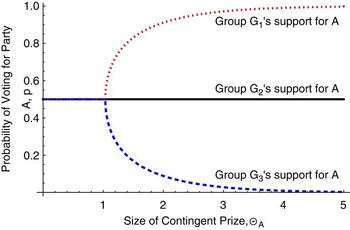
We now characterize equilibria in which members of a group use the same voting strategy but these strategies differ across groups. Figure 2 illustrates an equilibrium where each group differs in its likelihood of supporting party A. The figure plots the probability with which each group supports party A (p 1, p 2 and p 3) against the size of the prize offered by the parties (ΘA = ΘB = Θ) for α = 0 and n = 3. When the prize is small, all groups are equally likely to vote for party A. Once the prize is worth a little more than 1, competition to receive the prize allows the groups to polarize. Members of group G 1 disproportionately support party A, group G 3 disproportionately supports party B, while the voters in group 2 generally decide the election since they are equally likely to vote for either party. Of course, the assignment of group G 1 as the supporter of A is arbitrary and shuffling the labels does not change the incentives. Indeed, this is what makes the endogenous polarization such an interesting phenomenon. Initially, group G 1 need have no innate attachment to party A; however, once group G 1 is perceived to generally support party A, all its members have an incentive to fulfil this expectation to advantage the group in its quest for the prize. Polarization is self-enforcing.
Asymmetric equilibria and prize size

In the equilibrium shown in Figure 2, the members of groups G 1 and G 3 seek the prizes offered by parties. Since these groups disproportionately support one party, its members know that should that party win they are highly likely to get the prize allocated by that party. Consider the incentives of a voter in group G 1 as the size of the prize becomes large such that p 1 is close to 1 and p 3 is close to zero. If party A wins then it is highly likely that the prize goes to G 1. Indeed, the only likely eventuality in which G 1 does not get the prize from a victorious party A is when all the voters in G 2 support A. This occurs with probability (p 2)3 = 1/8. In this case, group G 2 get the prize half the time. A member of group G 1 might prefer party B on the basis of policy (i.e. εm < 0) and, should this voter support party B, she greatly enhances the chance that party B wins. However, by switching she greatly reduces the chance that her group obtains the prize. Indeed, party A is only likely to win if all the voters in group G 1 support it, in which case A is likely to give the prize to group G 1. In the numeric example, by supporting party A, a member of group G 1 gets a payoff of about (α + ε)/2 + ΘA 7/16 (with α = 0 in this example). If she switches to support B then her payoff is approximately (α + ε)/8. Unless their evaluation of party A, ε, is less than approximately −7ΘA/6, group G 1 members support A. Parallel logic explains why G 3 members support party B. Thus, the voting model suggests the opportunity for there to be within-group strong party support based on expectations about contingent benefit allocations, even if some group members do not actually like the policies of the party for which they vote.
Next, consider the incentives for members of group G 2. These voters support party A and B based upon their policy evaluation of the party (ε) and therefore, in expectation, they are equally likely to vote for either party. Consider the incentives of m, a member of this group. This voter has a significant pivotal influence in altering who wins the election. Indeed, she is outcome pivotal about half the time (when the other members of her group each vote for a different party). This provides m with considerable incentive to vote for her preferred party, particularly when the magnitude of ε is large. However, m is also interested in capturing the prize. If she knew that both of the other members of her group had voted for A then she could get about a 50 per cent chance of the prize for her group by also voting for A. Particularly when the prize is large, m would have considerable interest in voting against her policy interests to get the prize. However, since the members of G 2 generally split their support, it is equally likely that the other members of her group have co-ordinated on supporting B, in which case she would want to support B also. Since the prize-chasing incentives cancel each other out, m votes on the basis of policy. Since members of group G 2 are unlikely to co-ordinate all their support on a single party, they are unlikely to be awarded the prize. Therefore, their vote choices are predominantly motivated by policy concerns or psychological party affinities. For this reason, if the model is extended to allow for abstentions, then it is policy-driven members of group G 2 who abstain when they are relatively indifferent between the parties’ policies. In contrast, members of groups G 1 and G 3 not only want to pay the cost of voting, they often vote against their policy interests. There are other asymmetric equilibria.
Co-ordination Within Groups and Polarization Across Groups
Before proceeding to the implications of the model, it is useful to delve into the incentives for group members to co-ordinate. Consider a representative voter m from group G 1. Suppose this voter believes that each member of G 2 will vote for party A with probability p 2, and G 3 members support A with probability p 3. Further, suppose m believes that the other voters in her group will vote for party A with probability p 1. Substituting these values into the expressions for WA, WB, APrizeA etc. enables us to find type,  , of voter m who is indifferent between supporting A and B:

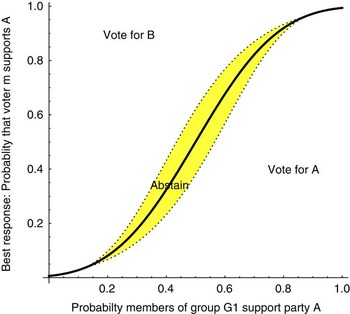
Figure 3 plots the probability with which voter m supports party A given her belief about voting behavior, p 1, p 2 and p 3, in the groups. Figure 3 is constructed assuming p 2 = 0.8, p 3 = 0.2, α = 0 and n = 3. The horizontal axis plots the probability with which the other members of group G 1 support party A (p 1). The vertical axis shows the probability with which m supports party A given her beliefs: that is to say, the black line shows  as a function of p 1.
Within group incentives to co-ordinate votes

The figure provides a partial equilibrium analysis in the sense that, given expectations about p 2 and p 3, equilibrium voting behaviour within group G 1 is characterized by the points at which  , the solid black line, cuts the 45° line. In particular, given p 2 and p 3, members of group G 1 are playing best responses if they each vote for A with probability 0.99; if they each vote for A with probability 0.01; or if they each vote for party A 50 per cent of the time.
Although Figure 3 is a specific example, it illustrates many general themes. Group members endogenously co-ordinate their voting. If the other members of the group are likely to support A, then voter m is incentivized to vote for A. Once group G 1 is identified with party A, each of the members of G 1 individually wants to reinforce these expectations and support A. Contingent prize allocation rules encourage this endogenous polarization, which effectively converts group G 1 from n separate voters making, separate voting decisions to a bloc of votes. Yet, there is no coercion. Each individual in the group wants to co-ordinate with the bloc voting decision.
The size of the contingent prize shapes the degree of endogenous polarization. When prizes are small then the incentive of the group to co-ordinate is relatively low. The curve in Figure 3 ( ), although always increasing, is relatively flat around its extremes. As the size of the prize grows then the incentives to co-ordinate increase, the function
 becomes much steeper in the middle, and the group forms a more cohesive voting bloc. Eventually, as the size of the prize continues to increase, the curve
 resembles a step function. The presence of contingent prizes encourages the formation of voting blocs, and the greater the size of the prizes the tighter these voting blocs are likely to be.
Contingent prize allocation rules provide an alternative explanation to the socialization phenomenon observed by Huckfeldt and Sprague according to which neighbours tend to vote the same way.Footnote 35 There is socialization in the sense that voters learn the voting proclivities of their neighbours, but the response to this information is a rational co-ordination of voting rather than an adoption of the neighbours’ values. One potential means to distinguish between these competing ideas is to examine the voting behaviour as people move in and out of the group (or electoral precinct). Migration offers one useful example. People who move into a neighbourhood just prior to an election probably do not have time to become socialized to their neighbours’ values, but perhaps they have time to learn how their new neighbours are likely to vote. For instance, a neighbourhood of posters for a particular candidate allows the new immigrant to quickly assess the neighbourhood's affiliation even if she does not have time to be socialized to the values that might underlie such support. The political socialization and the rational response to co-ordinate differ in the time scale they take to act. Redistricting offers another potential opportunity to study the model's vote co-ordination argument.
Turnout
As we noted at the outset, a major critique of the rational voting literature has been to question why people vote given that the individual voter's chance of influencing the electoral outcome is vanishingly small as the size of the electorate grows. The contingent prize model offers an explanation as to why voters turn out even when their vote is unlikely to alter who wins. What is more, it identifies which groups of voters are most likely to vote. The shaded area in Figure 3 assesses the probability that a voter will abstain when voting is costly.
Thus far, we have treated voting as costless and assumed full turnout. However, suppose voting is costly. In the case shown in Figure 3, the cost of voting is c = 0.4. Generalizing from the model and assuming any ties are split by a coin flip, we can calculate m's payoff from supporting A or B using the formulae derived above minus the cost of voting. We can also derive the expected payoff from abstaining. The height of the shaded area in Figure 3 indicates the probability with which m abstains. Obviously, as the cost of voting (c) increases, m is more likely to abstain. More interestingly, the analysis shows that m is more likely to abstain when her group is indecisive with respect to which party it supports. When most members of group G 1 will vote for party A (the right hand side of Figure 3), m strongly supports A and is unlikely to abstain. However, when group G 1's support for A is more variable (in the middle of Figure 3), voter m has less incentive to turnout, as evidenced by the greater height of the shaded area in Figure 3 when p is around 0.5. When group G 1 is not strongly affiliated with one party, this group has a relatively low chance of winning the prize, so its members make their electoral choice based on their evaluation of the party. When m is relatively indifferent between the two parties in terms of policy evaluation (α + εm ≈ 0), m has little incentive to pay the cost of voting unless the election is likely to be close.
The extent to which pivotalness affects turnout depends upon group membership. Turnout is high in groups that strongly identify with one party. Further turnout in such groups is relatively insensitive to the closeness of the race since members of such groups are motivated by the competition for prizes. Party machines, such as New York's Tammany Hall, generated high turnout from their core constituencies even in relatively uncontested elections.Footnote 36 Tammany voters in core democratic neighborhoods voted even though they were confident about the outcome of the election: they wanted to win prizes (pork) from their party. In contrast, in groups that are not strongly affiliated with a particular party, turnout is likely to be lower and more dependent upon the closeness of the race. Voters in such groups have little prospect of capturing the prize and so vote only to influence the electoral outcome. Consequently, they are more likely to turn out when the election is expected to be close.Footnote 37 The empirical literature shows turnout is higher in close elections. The model suggests that the elasticity between turnout and closeness is greater in competitive precincts than in precincts that predominantly support one party.
Incumbency and Policy Choice
Contingent prize allocation rules allow hegemonic parties to remain dominant even when they are widely recognized as offering inferior benefits relative to other parties. Magaloni, for example, documents the persistence of the dominant PRI party in Mexico after it had been thoroughly discredited.Footnote 38 The model provides an explanation for such persistence. It also explains the policy choices of different parties.
If a hegemonic party relies predominantly on contingently allocated prizes, then it incentivizes voters to support it. As shown above, everyone voting for a single party is in equilibrium. It is also a very robust outcome. While no one is pivotal in terms of altering the electoral outcome, everyone is pivotal in terms of the prize allocation. This equilibrium persists even when everyone recognizes that they would be better off under an alternative government. Suppose that for all voters α + εi + ΘA < 0, such that even under the best case scenario every voter prefers party B to party A. It is still the case that A can win. A contingent prize allocation rule makes it hard for reformers to win, even if every voter recognizes that the reformer has the best policies and will produce the most benefits. The reformer's electoral problem is that, while every voter might want the reformer to win, each voter wants the reformer to win with someone else's votes.
Consider for a moment the Pakistani election of 1997 in which Imran Khan, one of Pakistan's most successful and distinguished all-round cricketers, launched the Pakistan Tehreek-e-Insaf (PTI) party against the entrenched patronage parties, Pakistan People's Party (PPP) and Pakistan Muslim League (PML-N). Khan, who had huge popularity and name recognition derived from his career as Pakistan's cricket captain, ran his party on the platform of cleaning up corruption. Although he admitted he had little political experience, he also said, ‘but then neither have I any experience in loot and plunder’.Footnote 39 Despite the recognition of the need for reform, Khan was the only member of his party to win a seat. The PML-N party won the election by a landslide and engaged in corruption until being deposed by a military coup in October 1999.
Contingent prize allocation rules offer an explanation as to why the voters turned their backs on a reformist party in favour of continued corruption and patronage. Suppose for a moment we assume that Khan could and would have implemented reformist policies. Under this assumption PTI would have been better than the mainstream alternatives, PPP and PML-N, for the vast majority of Pakistanis. Yet, Khan's problem was that even if all the voters want him in office, they want him elected on other people's votes. Since the PTI ran on a platform of honest public goods provision, the benefits accrued to people whether they voted for it or not. This is not the case with a patronage or pork-oriented party. Unless the voters were certain the PML-N would lose and hence could not reward their most supportive groups, voters want to vote for the PML-N to enhance their prospects of receiving the prizes that it offered. Reformist parties have real problems challenging entrenched patronage parties. Everyone might want them to succeed but everyone also wants someone else to vote the reformist into power.
The model not only explains why Imran Khan's reformist party was unsuccessful, it also explains why Khan pursued a reformist agenda while the incumbents persist in their policies of handing out prizes. Suppose party A contemplates increasing the benefits it offers. It might, for instance, improve the quality of its public goods provision or reduce taxes. Such policy shifts improve welfare for all citizens and so can be operationalized as an increase in α. Alternatively, A might off a non-contingent prize, θ, if it is elected. Finally party A might increase the size of the prize it offers; that is, increase ΘA. By comparing the voters’ incentives to vote for A rather than B we can calculate the marginal value of each of these policy changes. Modifying Equation 4 to incorporate θ, voter m supports A rather than B if

The marginal returns to increased public goods and increased non-contingent prizes are 1. In contrast, the marginal return to an increase in the size of the contingent prize is

That is, the marginal return to increased contingent prizes is the ratio of the prize pivotalness to outcome pivotalness. As can be seen in Figure 1, when p is low and voters are unlikely to support party A, this ratio is relatively low. In contrast as p increases, the ratio becomes very large. A party's electoral prospects determine which policies are most likely to garner it electoral support.
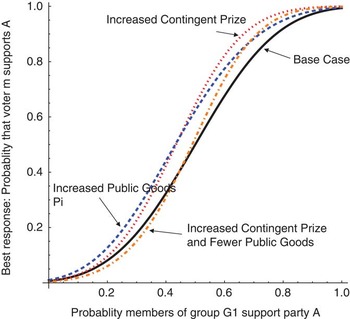
Established incumbent parties promote contingent prizes at the expense of increased public goods. In contrast, non-incumbent parties are reformist and promote public goods. Figure 4 revises Figure 3. The solid black line is identical to the line in Figure 3 and shows  , the probability that voter m from group G 1 supports party A, as a function of how the other members of her group are likely to vote (p 1). The dotted line recalculates m's vote choice if party A increases the size of its contingent prize reward, ΘA, by one unit. The dashed line shows the effects of increasing α or θ by one unit; that is, such a shift might reflect an improvement in public goods provision. Both these policy improvements increase the desirability of party A; both lines are shifted up relative to the black line. However, the change in vote probability for party A from these policy changes depends upon the level of party affiliation by the group. When group G 1 is likely to vote for party A (right-hand side of Figure 4), then increasing the size of the prize improves A's electoral chances more than an increase in public goods. The reverse is true when group G 1 is unlikely to support party A (low p 1, left-hand side of Figure 4).
Policy choice and electoral support

The dot-dash line in Figure 4 considers the trade-off between prizes and public goods. It shows that the likelihood that voter m supports party A changes as A increases its contingent prize ΘA but at the expense of decreasing public goods (α). When group G 1 is likely to support party A, such a shift enhances A's electoral prospects. Yet, when A is unlikely to garner the support of group G 1, such a shift away from public goods towards more prizes diminishes A's vote share in group G 1. New political parties focus on the provision of public goods while incumbent parties promote prizes at the expense of public goods provisions. In the light of these predictions, it is small wonder that the Tammany leader George Washington Plunkitt ran around New York offering clothing, comfort and shelter to fire victims in strongly Democratic neighbourhoods rather than implementing the building and fire code standards that would prevent fires in the first place.Footnote 40
Credibility and Contingent Prizes
Before concluding, we contrast the contingent prize set-up with traditional patronage arguments. In standard patronage arguments, party or machine candidates offer individual voters rewards in exchange for their vote. Such a mechanism is plagued with credibility problems.Footnote 41 If the reward is paid out in anticipation of the vote, the party or candidate cannot be confident that the voter will actually vote the agreed way. If the vote is confidential, the party or candidate cannot know whether the voter-beneficiary lived up to his or her part of the bargain. If the personal benefit is promised for delivery after the election, then the voter cannot be confident that the candidate or party, once elected, will pay out the benefits rather than pocketing them. So, neither the voter nor the candidate or party can credibly commit to the patronge-for-votes deal.
The patronage mechanism is further complicated because parties do not hand out enough patronage to reward all their supporters. Evidence from Argentina suggests that the contingent prize account is more compelling than the traditional quid pro quo explanation. Brusco, Nazareno and Stokes examined whether people who received gifts from a party feel compelled to vote for it.Footnote 42 They found that few respondents to their survey felt such an obligation. Consistent with these results, Guterbock found that in Chicago those who received party service were no more likely to vote Democratic.Footnote 43
Scholars have considered a variety of solutions to the issue of credibility in direct exchange models of patronage. For instance, Robinson and Verdier propose an economic explanation.Footnote 44 They assume parties are better able to extract rents from some groups compared to others, which de facto ties the fates of particular workers to particular parties. Other approaches look at reputation. For instance, drawing on the literature on co-operation in the repeated prisoner's dilemma setting, Stokes invokes a trigger punishment system to explain why parties deliver rewards and voters support them.Footnote 45 If a party fails to deliver rewards, then voters do not support it in the future, and if voters take bribes but fail to support the party, then they never receive bribes in the future. This punishment mechanism requires the party to know how individuals vote, which could explain why patronage works best in tight-knit communities.
The contingent prize argument does not suffer from these credibility issues. The mechanism does not rely on the credibility of the individual voter's commitment nor on the party's ability to monitor the individual voters. Voters support the party, not in response to past gifts, but in the hope of winning the prize for their group in the form of pork; that is, local public goods. Only a few voters or blocs need to receive rewards in order to stimulate competition for the scarce prizes in the future. The only significant credibility issue here is whether parties can commit to allocate prizes after they are elected. This is readily resolved by an argument that relies on verifiable, discernible vote-shares by precinct/group. Provided that the party cares about its electoral future it hands out prizes.
Although the contingent prize allocation mechanism resolves the credibility issues associated with patronage parties, it relies on voters identifying with groups. However, as voters become more socially and physically mobile, group identification erodes and the focus on prizes becomes less salient. For instance, in developed democracies many voters live in one district, work in another and undertake leisure in others. This makes it hard for parties to reward voters for their support through group rewards. Mobility erodes patronage networks.Footnote 46
There is considerable disagreement in the patronage and voting literatures as to whether parties reward core supporters or swing voters.Footnote 47 When viewed from the contingent prize allocation perspective these differences do not seem so irreconcilable. Our model considered a single electoral district with multiple precincts. Suppose we extend the model such that a party needs to carry two of three electoral districts to win and each district is composed of three precincts. If these districts differ in marginality then we conjecture that the party's best strategy is to offer a large prize for the most supportive precinct in the marginal district. Such a strategy maximizes the party's chance of securing the support of voters in the marginal district that is key for victory. When related back to the debate about core supports versus swing voters, the party is doing both. It gives the largest prize to the swing district, but within that district it rewards those who support it.
Conclusion
A contingent prize allocation rule explains how parties can incentivize voters to support them by offering to reward those groups that provide the greatest level of political support. Given such an incentive scheme, the voters support the party, not because they like its policies, but because they want to win the prize for their group. Voters can be pivotal in two senses. They can determine the outcome of the election – outcome pivotal – and they can alter the distribution of political rewards – prize pivotal. In large electorates, each voter's influence on the outcome of the election is miniscule. But not so with regard to the allocation of the prize. Given that the prize incentive dominates the incentive to influence which party wins, voters will sometimes even vote for parties whose policies harm their welfare. Furthermore, the desire to win the prize motivates people to vote even though who will win the election is a forgone conclusion.
The contingent prize scheme works when parties observe the electoral support of groups and target rewards to those groups that are most supportive. We have focused on geographical precincts because this is a common way in which voters are partitioned into groups. Yet, in the theory there is nothing special about this partition. All that really matters is that parties observe votes by groups and can target rewards to those groups. The system fails if the technology of policy provision makes it difficult to target rewards to groups. The increasing complexity and scale of public policy projects has led to increasing professionalization and the requirement of talented and trained civil servants rather than just party loyalists. These technological changes can constrain the ability of parties to target rewards to certain groups, although pork-barrel legislation is a means for elected officials to circumvent the old patronage system through appointment to jobs. That is, the prevalence and nature of patronage changes as the types of goods and services that government provides changes.
Chandra, Hale and Levitsky all report that parties use the counting of votes at the subdistrict level to measure electoral support.Footnote 48 This is one way parties use to get partially around the secret ballot. In the context of geographical grouping, parties can be better incentivized to produce public goods rather than pork, if votes are pooled and counted at the district level and not the precinct level. If the ballot boxes from all the precincts are taken to a central district level office and votes from all the precincts are counted together, then the contingent prize allocation rule cannot be used. This suggests both an experiment to test the arguments made here and a public policy fix (albeit one that may contradict both the interests of politicians and of some voters). If the votes were pooled at a larger district in some randomly chosen cities or provinces in a patronage prone nation, then we should expect differences in the policies and politics between areas where votes are pooled compared to those counted at the local level.