1. Introduction
One of the strongest instances of institutional change since the late 1980s has been the increase in central-bank independence (CBI) in many countries (Arnone et al., Reference Arnone, Laurens, Segalotto and Sommer2009; Crowe and Meade, Reference Crowe and Meade2007; Cukierman, Reference Cukierman2008). The underlying motivation of the reforms leading up to this greater independence is a belief that they contribute to lower inflation rates by limiting the discretionary power of politicians, who have an incentive to use monetary policy for electoral gain (Kydland and Prescott, Reference Kydland and Prescott1977; Rogoff, Reference Rogoff1985). There are, indeed, indications that CBI has been successful in this regard (Acemoglu et al., Reference Acemoglu, Johnson, Querubín and Robinson2008; Brumm, Reference Brumm2006; Klomp and de Haan, Reference Klomp and de Haan2010). However, the year of implementation of these reforms differs between countries. What explains such differences in timing? Knowing the answer to this question is important, since it helps clarify the factors that facilitate or stall important economic reforms.
Therefore, we analyze potential determinants as to how long it takes for CBI reforms to come about. We include political and economic factors – but also cultural variables, with special attention being paid to social trust, measured as the share of a population that thinks that people in general can be trusted. An increasing number of studies find that cultural factors, not least social trust, help explain economic, political and social outcomes (Alesina and Giuliano, Reference Alesina and Giuliano2013; Algan and Cahuc, Reference Algan, Cahuc, Aghion and Durlauf2013).
In particular, we present reasons for expecting an inverse u-shape relationship between social trust and the time it takes for CBI reform to be undertaken. The idea is that low trust entails a strong need for reform, which will induce policymakers to try to undertake it more swiftly, while high trust entails a strong ability to undertake reform, which will facilitate for policymakers to agree upon it and push it through. These two factors explain why low and high trust can be expected to be associated with relatively quick policy reform. At intermediate trust levels, however, there is neither need nor ability strong enough to speed up the reform process, making it slower.
Our empirical analysis supports such a pattern for our full sample as well as for democracies and autocracies separately. Interestingly, for democracies, the inverse u-shape is skewed such that it is almost linear. This suggests that the predominant relationship is one of higher social trust being associated with faster CBI reform in this subsample. In addition, we find that some factors, in addition to trust, tend to speed up reforms: inflation, democracy, change to democracy, membership in the European System of Central Banks (ESCB), number of CBI reforms in countries with which there is economic cooperation, uncertainty avoidance and masculinity. Some other variables, on the contrary, seem to prolong the time to reform: unemployment and International Monetary Fund (IMF) credits.
To our knowledge, this is the first study to look at cultural, political and economic factors as potential explanations of how fast economic reforms are implemented. Alesina et al. (Reference Alesina, Ardagna and Trebbi2006) include economic and political variables but not cultural ones; they find that reforms are more rapidly adopted after crises, when new governments take office and when strong presidents or clear legislative majorities are present. Otherwise, previous studies do not primarily look at the speed of reforms but at factors that might affect reforms coming about or the scope of reforms. For example, Heinemann and Tanz (Reference Heinemann and Tanz2008) study how social trust relates to market-oriented institutional reforms, and they find evidence that it promotes such reforms in three areas: government size, the legal system and the regulation of private companies and the labor market. Pitlik and Wirth (Reference Pitlik and Wirth2003) report that inflation and growth crises, as well as democracy and a divided system of government, are positively related to liberalization. Similarly, Pitlik (Reference Pitlik2008) shows that a bad growth performance is conducive to liberalizing reforms in democracies but not in autocracies; and Giuliano et al. (Reference Giuliano, Mishra and Spilimbergo2013) find a positive effect of democracy on the adoption of economic reforms. Daunfeldt et al. (Reference Daunfeldt, Hellström and Landström2013) found that CBI reform was more probable in non-OECD countries if there had been high and variable inflation in the past, and if the politicians faced a high probability of being replaced.
With this as the background, we first outline our theoretical idea of the relationship between social trust and reform speed; we then present our data and empirical methodology; after which the results and our interpretation are introduced.
2. Social trust and central-bank independence reform
The basic starting point is a situation with ‘too high’ inflation, as perceived by central political decision-makers. They then ponder how to reduce it, and if they (or their advisors) have read their Kydland and Prescott (Reference Kydland and Prescott1977) and Rogoff (Reference Rogoff1985), they realize that the situation is the result of the institutional setting within which monetary policy has been conducted and the incentives this setting has entailed. The question is, how a change in this setting that results in lower inflation can be achieved, and when a solution (CBI reform) has been identified, how can it be brought about in a quick manner. It is here that social trust becomes important for explaining the speed with which CBI reform comes about. In essence, the question is as to what extent a cultural variable has bearing on the nature of institutional change.
Two relevant factors: need and ability
We propose, primarily inspired by Heinemann and Tanz (Reference Heinemann and Tanz2008) and Berggren et al. (Reference Berggren, Daunfeldt and Hellström2014), that two factors are relevant: the need and the ability to undertake reform. The main difference between this study and these two is that the former looks at the general relationship between social trust and reforms, while we look at CBI reforms with their special characteristics, and that the latter looks at the relationship between social trust and a de jure index of CBI, while we look at the time it takes for CBI reform to come about.
The lower the level of social trust, the greater the need for CBI reform. The reason is that with little trust, the underlying problem of the situation, identified by the literature on time inconsistency in monetary policy as a credibility or lack-of-trust problem, is worse.Footnote 1 Plausibly then, inflation is also higher. A low-inflation monetary policy is not credible if people and financial actors do not trust the politicians to adhere to stated goals of keeping inflation low, and the well-known result with high inflation ensues. This makes it more important to change the institutional setting for monetary policy such that a decision-making instance that will not face incentives to raise inflation gets more power. This implies a more independent central bank (in line with Rogoff, Reference Rogoff1985). However, if people trust others, including policymakers, plausibly because of displayed trustworthiness, the lack-of-trust problem is smaller and inflation arguably lower (albeit still possibly perceived to be too high). In that case, the need for CBI is smaller. If the need for reform is perceived to be high, then actors will also make stronger efforts to make it come about, and the more probable it is that it indeed also comes about fast.Footnote 2 To this one can add the idea of Funke (Reference Funke1993), that if reform policies are not perceived as credible, then one needs to implement them quickly, to both overcome resistance and allow them to yield beneficial outcomes reasonably soon.
The higher the level of social trust, the greater the ability to undertake CBI reform. This is because trust helps to remove obstacles to reforms coming about, among other things in the following ways. First, trust makes it easier to dissemble expert information about the long-term benefits of reforms: people will be more willing to accept such information, from policymakers and the media, if the senders are perceived to be trustworthy (Boix and Posner, Reference Boix and Posner1998). In the context of CBI, this will enable those who plan to make the central bank more independent to explain more effectively the logic of the time-inconsistency problem and how a politically governed monetary authority tends to generate higher inflation. Second, interest groups can block reform if they think that they can gain by opposing it, but high trust reduces suspicion and enhances cooperation among groups, making the blocking of reforms less probable.Footnote 3 One can, for example, imagine that groups who benefit from high inflation, such homeowners with big loans, will try to stop reforms that reduce inflation – and especially if trust is low. Low trust will, for instance, tend to create an expectation that reformers are not acting with each group's or even overall social benefits in mind. Third, compensation schemes are more credible in a setting with high trust, which makes it easier for those in society who think they will lose out on reforms to accept them, given compensation promises. If those who gain from inflation feel convinced that the reformers will compensate them in other ways over time, their resistance might be given up. Trust is also related to pro-social preferences (Fehr, Reference Fehr2009), and therefore even people who think they will lose from reforms can be expected to be more willing to accept them even without compensation schemes if they believe that the reforms will result in good social consequences. This can make politicians in high-trust contexts bold in proposing reforms, as they consider the risk of electoral punishment relatively small. Fourth, initiators of CBI reforms in a country with high trust will not expect their political opponents to exploit a reform process for short-term gain to any great extent; and they will also expect bureaucrats, not least in the central bank, to behave well and follow their intentions with the reform once it is in place.Footnote 4 All these factors indicate that trust increases the ability to undertake CBI reform, and the higher the ability to undertake such a reform, the sooner it comes about, all else being equal.
When putting these two factors, need and ability, together, we get a relationship between social trust and the time it takes for a CBI reform to come about in the form of an inverse u-shape. At low levels of social trust, the need for reform is urgent, and as decision-makers therefore work hard to bring about reform, the time it takes is relatively short. At high levels of social trust, the ability for reform is high, and therefore the time for reform to become about is relatively short. At intermediate levels of social trust, neither need nor ability is very high, which implies a longer time before reform happens.
The way in which social trust matters
We see low or high social trust as helping but not solely causing CBI reform to come about. If low or high social trust was sufficient, it could not be easily explained as why countries with similar trust levels have had similar CBI reforms at different points in time. Rather, according to our understanding, social trust affects some but not all necessary (and jointly sufficient) factors required for CBI reform to occur. This means that low or high social trust (compared with intermediate levels) makes it more likely that all necessary conditions are met, and that reform comes about, earlier rather than later, but it alone does not suffice.
Following Berggren et al. (Reference Berggren, Daunfeldt and Hellström2014), we suggest these necessary conditions for reform implementation: that certain ideas have emerged and have been accepted (the identification of the time inconsistency problem by academic economists), that there is a perception of a problem that needs to be solved (high inflation rates, the political dependence of central banks) and that some individuals are willing to lead the initiation of a reform process. Social trust arguably affects the latter two of these conditions (by affecting the perceived need for and the ability to undertake reform), but it does not solely cause these necessary conditions to be met and it does not affect the first necessary condition. The time it takes for CBI reform to appear can therefore vary between countries, even though trust levels are quite stable over time, and even though they are sometimes similar between countries.
3. Data
Based on the data in Daunfeldt et al. (Reference Daunfeldt, Hellström and Landström2013), collected through a questionnaire to central banks worldwide, we know when CBI reforms occurred. The questionnaire asked both whether some institutional change had taken place that granted the central bank more independence from elected policymakers (in which case we say that a reform occurred), and if so, then when did it take place. Note that the measure does not take into consideration how much CBI had increased (and that only increases in CBI were recorded). Our dependent variable is the number of years from 1980 until CBI reform, defined in the way just described, took place (2005 at the latest). This variable thus takes a low (high) value for countries implementing CBI reforms relatively early (late). The starting year, 1980, was chosen since the first CBI reform was recorded then in our dataset, and it occurred in the United Arab Emirates (but as reported below, we also check whether our results are robust to starting in 1985). The next two (New Zealand and Chile) took place in 1989. Figure 1 shows the number of CBI reforms in the world over time.
The number of central-bank independence reforms per year (one observation refers to one country). Source: Daunfeldt et al. (Reference Daunfeldt, Hellström and Landström2013).

Our explanatory variable of main interest is social trust, the share of the population that answers ‘yes’ to the first part of the question: ‘In general, do you think most people can be trusted or can't you be too careful?’ Similar to Bjørnskov (Reference Bjørnskov2007), we use the average of all available observations in the World Values Survey, LatinoBarómetro, the AfroBarometer, the Asian and East Asia Barometers, and the Danish Social Capital Project; the idea is that averages reduce the risk of letting atypical data of individual years matter.
We also use a set of economic and political control variables, based on previous studies: inflation (IMF, 2011); unemployment (ILO, 2011); GDP per capita and the use of credits from the IMF (World Bank, 2011); political fragmentation in parliamentFootnote 5 and whether the country is a federation or not (Lundell and Karvonen, Reference Lundell and Karvonen2003); the number of coups (Marshall and Marshall, Reference Marshall and Marshall2010); the quality of government (ICRG, 2008); a democracy dummy (Cheibub et al., Reference Cheibub, Gandhi and Vreeland2010); change to democracy (in the preceding decade) (Cheibub et al., Reference Cheibub, Gandhi and Vreeland2010); CBI reforms in economic cooperation (to capture peer effects), i.e. the number of countries with preceding CBI reforms in the organization of which the country is a member (of the European Union, the African Economic Community, the Asia-Pacific Economic Cooperation or the Latin American Free Trade Association) prior to reform in the own country (Daunfeldt et al., Reference Daunfeldt, Hellström and Landström2013); pre-reform CBI (Cukierman et al., Reference Cukierman, Webb and Neyapti1992); dummy for members of the ESCB; and three cultural variables: power distance (the extent to which inhabitants in a country accept that power is distributed unequally within a society), uncertainty avoidance (tolerance of uncertainty) and masculinity (the extent to which individuals in a country tend to endorse goals usually more popular among men) (De Jong, Reference De Jong2002).Footnote 6 These explanatory variables are measured as the average of the values of the 10-year period preceding CBI reforms (different periods in different countries) to reduce the risk of reverse causality and for having atypical values from some particular year that influence the results. As for reverse causality, we think the risk is small in any case due to the nature of social trust: It is a deep-rooted cultural variable that is surprisingly stable over time (Bjørnskov and Tinggard Svendsen, Reference Bjørnskov and Tinggaard Svendsen2013; Uslaner, Reference Uslaner2008), and it is highly unlikely that it would be affected by a reform in the area of monetary policy. On the other hand, if we had studied more specific trust measures, such as trust in the central bank or trust in government, the speed of reform could have influenced trust.
Several of these variables have missing values, and since there is a great risk that this introduces bias and affects the representativeness of the sample (from list-wise deletion of cases with missing observations), we created a larger sample through multiple imputation (Graham et al., Reference Graham, Cumsille, Elek-Fisk, Schinka and Velicer2003).Footnote 7 The multiple imputation approach produces unbiased parameter estimates that reflect the uncertainty associated with missing observations and is robust to violations of assumptions in the underlying imputation model. We use five imputed datasets. The empirical analysis is performed on each of these datasets, and the estimation results for each are later combined (Rubin, Reference Rubin1987).
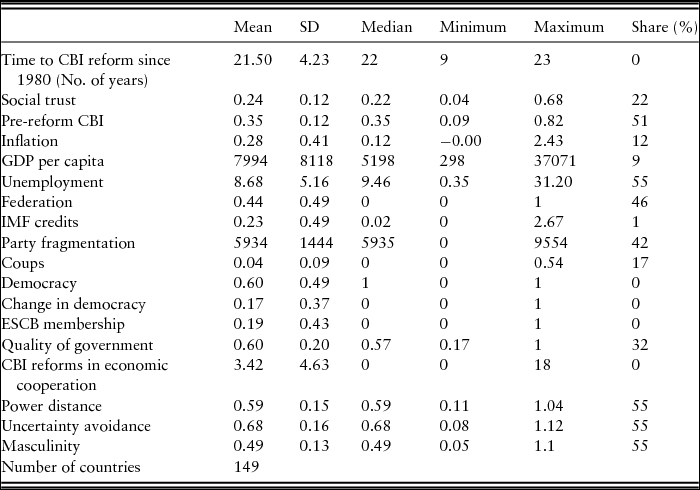
The sample includes 149 countries observed annually over the period of 1980 to 2005. Descriptive statistics are given in Table 1.
Descriptive statistics
Notes: The values for the explanatory variables correspond to the average value over 10 years preceding the implementation of major CBI reforms in each country.
‘Share’ refers to the proportion of observations, in relation to the total, that are missing and have been replaced with multiple imputation.
4. Empirical analysis
To analyze the time it takes for CBI reforms to be implemented, with particular focus on social trust, we perform a duration analysis (see, for instance, Cameron and Trivedi, Reference Cameron and Trivedi2005). As mentioned, our dependent variable is the number of years it takes from 1980 for CBI to be implemented. All countries enter the sample in 1980, the mean time until CBI reform is 21.5 years (median 23 years), and the number of countries implementing CBI reforms is 90. The data are right-censored at 26 years (for the 59 countries without a CBI reform).
In Figure 2, we display the unconditional Kaplan–Meier survivor (left) and the smoothed hazard functions (right).Footnote 8 The survival function indicates that implementation of CBI reforms began after 10 years (the sample starts in 1980), and that the probability of observing no CBI reforms in the population declined each following year, with the largest drop after 19 years, indicating that CBI reforms were becoming more likely to occur. The probability that an average country implements a CBI reform at t (given no previous implementation), increased until 2002 (22 years from 1980) and then declined, as indicated by the hazard function.
The Kaplan–Meier survivor (left), and smoothed hazard function (right).
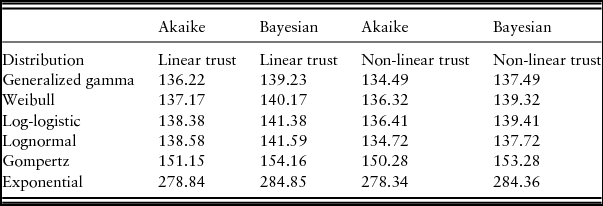
To model the time it takes until a CBI reform is undertaken, we utilize a parametric approach, since it produces more efficient estimates conditional on a correct distributional assumption.Footnote 9 In Table 2, we report the estimated Akaike and Bayesian information criteria for models based on the generalized gamma, Weibull, log-logistic, log-normal, gompertz and the exponential distributions, for both linear and non-linear specifications of our trust variable (including all other control variables in all specifications).
Akaike and Bayesian information criteria for different model and distributional specifications
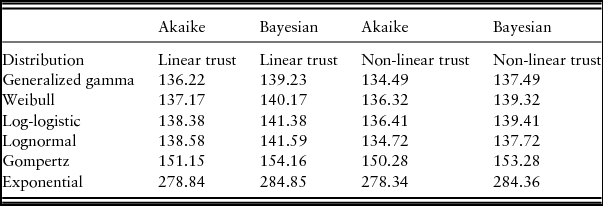
As can be seen, based upon both information criteria, the generalized gamma distribution is preferable for all models (closely followed by the log-normal for the non-linear specification). The generalized gamma model has a density given by
 \begin{equation}
f(t) = \frac{{\lambda p(\lambda t)^{p\kappa - 1} e^{ - (\lambda t)^p } }}{{\Gamma (\kappa )}},\end{equation}
where λ = exp (Xβ) and (p, κ) are two shape parameters allowing for a flexible hazard rate.Footnote 10
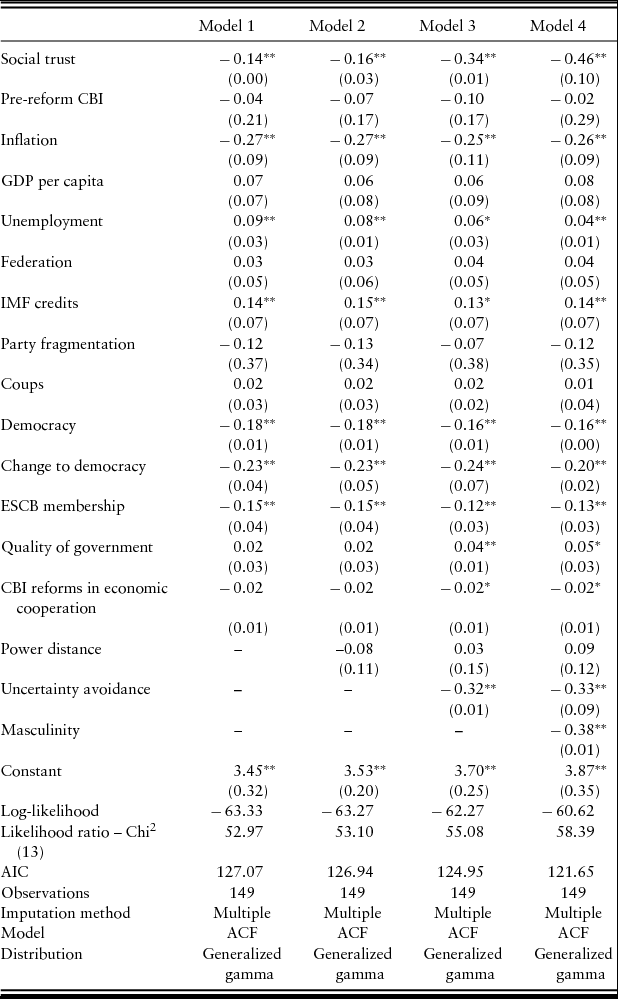
In Table 3, estimation results for a number of gamma distributed models are displayed with trust entering in a linear fashion.
Duration analysis of determinants of time until implementation of CBI reform–linear trust
Notes: The table report results for regression models with the number of years from 1980 until CBI reform as the dependent variable.
The explanatory variables are the average of the values for the 10-year period preceding CBI reforms (different time periods in different countries).
*significant at the 10% level, **significant at the 5% level.
All models imply a negative significant effect, at the 5% level, from trust on duration until reform, i.e. a higher trust level shortens the time until a CBI reform is implemented.Footnote 11 To get a feeling for the magnitude of the estimates, we calculate marginal effects in the following way:
 \begin{eqnarray}
&&{\rm Percentage\,change\,in\,the\,time\,it\,takes\,for\,CBI\,reform\,to\,come\,about} \nonumber\\
&&\quad=100\times [e^{\beta _{\kappa ^\delta } } - 1],\end{eqnarray}
where δ is the change in the covariate Xk. The estimate for the trust variable indicates that an increase of 20 percentage points in trust (e.g. from the level of France, 0.22, to that of the United States, 0.42), all else equal, would decrease the time until reform by 8.8%. That is, if France had had the trust level of the United States, all else being equal, the CBI reform would have been implemented about one year earlier.
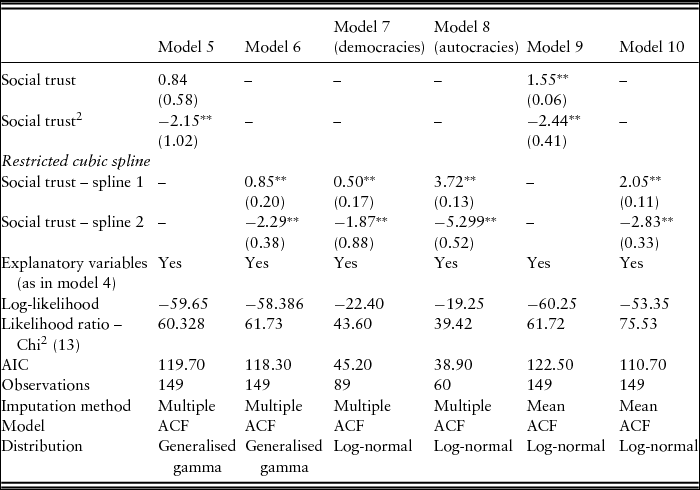
So far, we have modeled trust in a linear fashion, but as proposed in Section 2, trust may stand in a non-linear relation to the time until reform. To investigate possible non-linear effects, we first consider adding a quadratic trust term.Footnote 12 In Table 4, model 5, the results imply an inverse u-shape, but the positive-sloping segment is insignificant.Footnote 13
Duration analysis of determinants of time until implementation of CBI reform – non-linear trust
Notes: The table report results for regression models with the number of years from 1980 until CBI reform as the dependent variable.
The explanatory variables are the average of the values for the 10-year period preceding CBI reforms (different periods in different countries).
**Significant at the 5% level.
The models based on the generalized gamma distribution did not converge when separating between democracies and autocracies due to the smaller samples sizes. The results for these sub-samples are therefore based on models using the log-normal distribution. Results for other explanatory variables are similar to those previously reported for models with linear trust specifications.
However, we prefer another way of considering non-linearity: using a restricted cubic spline.Footnote 14 With a restricted cubic spline, a continuous smooth function for trust is obtained: linear before the first knot, piecewise cubic polynomial between adjacent knots and linear again after the last knot. Modeling the non-linear effect of trust with a restricted cubic spline with three knots at the 10, 50 and 90 percentiles of the trust variable confirm the inverse u-shape as well as its statistical significance – see model 6 in Table 4.Footnote 15
In Figure 3, the predicted time until reform (based on model 6, with trust modeled as a restricted cubic spline) is displayed, varying over the social trust variable, with a 95% confidence interval indicated by the shaded area and with other explanatory variables at their mean. As can be seen, the time until reform varies from about 22 years at an intermediate trust level to a little more than 16 years at the highest trust level.
Predicted time until reform (in years) depending on social trust (model 6, Table 4).
In Figure 4, the corresponding marginal effects varying with social trust are displayed, for an increase in trust of 10 percentage points, all else is equal. Thus, it shows the marginal effect, i.e. the predicted change in time until reform of such a change in trust for different values of trust. The 95% confidence levels are indicated by the shaded area. For example, the figure implies that if Switzerland (with a trust level of 0.44) experienced an increase of trust with 10 percentage points, it would implement a CBI reform about 1.5 years earlier; and that if Poland (with a trust level of 0.21) experienced the same change in trust, it would implement a CBI reform about one year later.
Marginal effects (in years) for different levels of social trust (model 6, Table 4).
In Table 4, we also run separate models for democracies and non-democracies (models 7 and 8). We make this division as the political decision-making process, arguably differs between the two country groups, which might affect the way in which trust affects the speed of reform. For example, we would expect the ability part of our theory to play a more important role in democracies, since collective decision-making involves more groups of actors and is more fractionalized (cf. Boix and Posner, Reference Boix and Posner1998). We would also expect the need part of our theory to matter more in autocracies, since trust is lower in such countries, which implies that formal reforms are more important to achieve a certain goal. Since the sample sizes are reduced by making this division, models based on the relatively complex generalized gamma distribution turn out not to converge. However, results from models based on the log-normal distribution (second best for non-linear specifications, according to Table 2) confirm the inverse u-shape for both democracies and non-democracies.
In Figure 5, the predicted time until reform (in years) for the separate samples of democracies (left) and non-democracies (right) (based on models 8 and 9 in Table 4, modeling trust as a restricted cubic spline) are displayed over the social trust variable, with the 95% confidence indicated by the shaded area and with other explanatory variables at their mean.
Predicted time until reform (in years) for democracies (left) and non-democracies (right) based on models 7 and 8, Table 4.
While the inverse u-shape is obtained for both samples, the negative slope dominates for the sample of democracies (for those with a trust level a bit above 0.20), implying that here higher trust implies faster CBI reform. Reform comes about quickly in these countries because of a strong ability to agree on the implementation of reform, an ability that increases in trust. For autocracies, with generally low trust levels, the need for reform is what drives the results.
In Figure 6, the corresponding marginal effects (in years) for democracies (left) and non-democracies (right) for an increase in trust of 10 percentage points are displayed, all else being equal.
Marginal effects (in years) for democracies (left) and non-democracies (right) based on models 7 and 8, Table 4.
To exemplify, for the sample of democracies these results imply that if the Netherlands (with a trust value of 0.55) increased its trust by 10 percentage points, it would, all else being equal, be likely to implement a CBI reform about 1.5 years earlier. For non-democracies, the results imply that Morocco (with a trust level of 0.18) would be likely to implement a CBI reform almost three years later if its trust level increased by 10 percentage points. Notable, marginal effects are significantly different from zero for social trust levels above about 0.24 for democracies and for trust levels below about 0.26 for non-democracies.
As for other explanatory variables, it turns out that several are related to the speed of reform. The results for our main model (model 6 in Table 4, unreported here, but available upon request) are similar to those reported for model 4 in Table 3, and indicate that a relatively higher inflation, being or becoming a democracy in the previous 10-year period, being an ESCB member, having a larger number of CBI reforms in countries with which there is economic cooperation, being characterized by uncertainty avoidance (the tolerance of uncertainty found in people) and masculinity (the extent to which individuals in a country tend to endorse goals usually more popular among men), all shorten the duration to CBI reform for an average country. In contrast, a relatively higher unemployment rate and IMF credits increase the duration.Footnote 16
To comment on a few of these, a 10 percentage point higher past inflation rate shortens the duration to reform by about seven months. High historical inflation, thus, seems to create stronger preferences for implementing reforms in order to achieve credibility for a low inflation goal, supporting Hayo's (Reference Hayo1998) claim that CBI is related to an historical feedback process. Democracies on average implement CBI reforms 3.6 years earlier than non-democracies, and countries that changed their ruling system to a democracy in the previous 10-year period implemented CBI-reforms about four years earlier (compared with both other democracies and non-democracies). Countries that are members of the ESCB are on average 4.3 years faster with their CBI reforms than non-membership countries. These latter results clearly illustrate that the institutional framework matters for the speed of reform. As for unemployment, a higher past rate of 10 percentage points relates to a delay by 1.5 months. We suggest that this follows from politicians believing that CBI reforms will entail lower inflation and from expectation, due to simple Phillips curve considerations, that this will worsen the unemployment problem (and their ability to combat it in the future).
In contrast to these results, more IMF credits appear to increase the time it takes for a CBI reform to come about, which is somewhat unexpected. Maxfield (Reference Maxfield1997) suggests that CBI reforms are more likely to be implemented in high debt developed countries, since they want to signal creditworthiness to foreign investors and IMF to get more funds. This would imply earlier reforms in high debt countries. This theory is thus not supported by our results.
To test the sensitivity of our results toward using multiple imputation to replace missing observations, we also present results, in models 9 and 10 in Table 4, for the two different non-linear trust specifications (quadratic trust and restricted cubic splines), where traditional mean imputation was used instead. Reassuringly, the results confirm the previously found inverse u-shape for social trust.
Given that ESCB membership required monetary stability, one may view the ESCB membership variable as potentially endogenous. To test whether our results are affected by the inclusion of this variable, we have both re-run our regressions excluding the ESCB membership variable and excluding the countries that were ESCB members. In both cases, the results indicate that relationship between trust and our dependent variable still holds.
We have also used 1985 as the starting point for our dependent variable rather than 1980, as a sensitivity check, and the empirical findings are virtually unchanged.
Finally, we have also tested as to what extent our results are affected by extreme observations by re-estimating models on a sample excluding the top and bottom 5 percentiles of the social trust distribution. The results remain unchanged.Footnote 17
5. Concluding remarks
It comes with the job for politicians to present reform proposals in order to better achieve desired outcomes. However, it is one thing to want a reform, another to see it become reality. While some reforms are implemented quickly, others take a long time and may never see the light of day. In this paper, we try to explain the speed of reforms. What factors may shed light on how fast reform comes about? We look at economic and political factors but especially highlight a cultural variable, i.e. social trust, as an explanatory factor. Do reforms – fruitfully viewed as instances of institutional change – come about faster depending on whether trust is high, low or intermediate?
We try to answer this question by looking at a particular kind of reform, to increase CBI in order to increase the chances for credible low-inflation policies. We argue, on theoretical grounds, that social trust should matter for bringing about CBI, by affecting both ability and perceived need to undertake reforms. This implies an inverse u-shape relationship such that both low and high trust levels are associated with earlier reforms. In the former case, the need for reform is sufficiently high to bring about political action and quick reform; in the latter case, the ability to undertake reform, by mitigation of various obstacles, is sufficiently high to bring about fast reform. In the intermediate case, neither need nor ability is strong enough for trust to speed up reform, and the time it takes is consequently longer.
Our empirical investigation, comprising a sample of 149 countries, indicates that the inverse u-shape is indeed obtained. CBI reform comes about more quickly in countries with low and high trust, but it takes longer time in the countries in-between. In countries where about 25% think that others can be trusted (the intermediate case), it took about 22 years from 1980 for CBI reform to come about. The corresponding figure for countries with really low trust was around 19 years, and for countries with really high trust it was about 17 years – in the latter case, a five-year difference.
The inverse u-shape is found for both democracies and autocracies when studying them separately. However, the shape of the curve for democracies is heavily skewed to the right, implying primarily that high trust speeds up reforms in such countries. Presumably, this is because the political process comes to agreement much faster in the presence of central actors trusting each other. For the autocracies, the effect of trust is such that low levels are related to faster reform, arguably because in such low trust settings, the need for reform is especially great for a goal of credible low inflation to be obtained.
What we find particularly interesting is that in addition to ‘traditional’ explanatory factors, e.g. previous experiences with inflation, the unemployment rate, membership in the ESCB and in organizations within which other countries had undertaken reforms before, a cultural factor is at least as central, and often more important (quantitatively), for explaining the time it takes until institutional change comes about. This points at the importance of incorporating social trust and other cultural factors in future studies on reforms of institutions of various kinds.
Acknowledgements
The authors wish to thank Christian Bjørnskov and Frank Streif for very helpful advice, and participants in the Australasian Public Choice Society Conference in Singapore, 2013, the WINIR conference in London, 2014, the WWW for Europe Conference at Mendel University in Brno, 2014, and the European Public Choice Society Conference in Groningen, 2015 for good comments, and in Berggren's case, Johan and Jakob Söderbergs Stiftelse, Torsten Söderbergs Stiftelse and the Swedish Research Council for financial support.