The Antarctic Treaty was adopted by twelve nations in Washington, DC on 1 December 1959 with the interests of science and the progress of all mankind. Seven of these nations asserted territorial claims, including the overlapping claims of Argentina, Chile and the United Kingdom in the Antarctic Peninsula. The five other nations were non-claimants, including the United States and Soviet Union (now Russian Federation), which reserved rights to press claims in the future.
What compelled these nations to adopt the Antarctic Treaty and to establish the first institution to manage an international space beyond national jurisdictions? Why has the Antarctic Treaty succeeded in managing nearly ten percent of the Earth, for peaceful purposes only, continuously over the past half century? What are the ‘common interests’ of nations in the Antarctic?
Consider the situation in the 1950’s. Antarctica could easily have become a region for testing or storing weapons, including nuclear weapons that existed in the United States, Soviet Union and United Kingdom. There were no native human inhabitants to object and Antarctica itself was a frozen desert, isolated at the southern end of the Earth surrounded by a vast ocean. Yet, Antarctica became the first nuclear-free zone on Earth where all activities of a military nature have been prohibited, except the use of military personnel or equipment for scientific research or for any other peaceful purpose.
The Antarctic Treaty is elegant in its simplicity; only requiring fourteen articles for its firm foundation to manage the region south of 60°S in the interests of all mankind ‘for ever.’ This agreement established a bridge of cooperation between the two superpowers and 10 other states on the basis of science, as kindled by the International Geophysical Year (IGY).
Established territorial adversaries such as Argentina, Chile and the United Kingdom agreed in Article IV of the Antarctic Treaty that no acts or activities shall constitute a basis for asserting, supporting or denying a claim while the Antarctic Treaty is in force. Open and unfettered inspection was enabled by Article VII in all areas of Antarctica, including all stations, installations, and equipment. Bolstered by the freedom of scientific investigation and international cooperation through science, as provided in Arcticles II and III, the Antarctic Treaty created a framework for stewardship of an entire continent and its surrounding ocean in the interests of all mankind.
There was no ‘magic bullet’ in the Antarctic Treaty that at once solved problems for ever. Rather, the unique step that mankind made with the Antarctic Treaty was the establishment of an evolving process of consultation for nations continuously to adjust their solutions in relation to ever changing circumstances. As Article IX.1of the Treaty noted:
Representatives of the Contracting Parties named in the preamble to the present Treaty shall meet at the City of Canberra within two months after date of entry into force of the Treaty, and thereafter at suitable intervals and places, for the purpose of exchanging information, consulting together on matters of common interest pertaining to Antarctica, and formulating and considering, and recommending to their Governments, measures in furtherance of the principles and objectives of the Treaty including measures regarding:
A use of Antarctica for peaceful purposes only;
B facilitation of scientific research in Antarctica;
C facilitation of international scientific cooperation in Antarctica;
D facilitation of the exercise of the rights of inspection provided for in Article VII of the Treaty;
E questions relating to the exercise of jurisdiction in Antarctica;
F preservation and conservation of living resources in Antarctica.
This consultative process was set in motion by President D. Eisenhower on 3 May 1958, when he invited all nations engaged in scientific activities in Antarctica during IGY to develop an administrative arrangement dedicated to the principle that the vast uninhabited wastes of Antarctica shall be used only for peaceful purposes. Over the next eighteen months, sixty secret meetings were held in the United States. Inclusion of the Soviet Union in these secret meetings is noteworthy, particularly because Eisenhower had to prevail over objections from his joint chiefs of staff. Without the Soviet Union, however, it is extremely unlikely that the Antarctic Treaty would have secured the kind of legitimacy and robustness that we have witnessed over the past half century.
Finally, on 15 October 1959, the conference on Antarctica was formally initiated in Washington, DC among the twelve Antarctic IGY nations. The Antarctic Treaty was finalised over the next six weeks, culminating with its adoption at 1776 Pennsylvania Avenue in an annex of the United States Department of State on 1 December.
At the heart of the Antarctic Treaty are the six matters of common interest pertaining to Antarctica that were established by the 12 IGY nations in the interest of all mankind. These common interests, which were negotiated over months of diplomatic exchanges, offer lessons about the ingredients of global stewardship and the governance of international spaces beyond national jurisdictions.
A common interest in all international spaces is peaceful uses. Peace is the epitome of international cooperation and a guiding light to prevent international discord. As demonstrated in Antarctica, even military personnel and equipment can only be used for peaceful purposes such as search and rescue and the support of science. The challenge and foresight required with international spaces is to establish such peaceful uses before national interests are defended. In Antarctica, the 1959 Treaty intervened to promote peace with its complex interplay of national interests and scientific-based internationalism.
Science, as Eisenhower recognised throughout his administration, was applied as a tool of diplomacy in developing the Antarctic Treaty. The process of designing, planning and implementing the IGY was a clear and compelling source of international cooperation. As with the governance of other international spaces, science has a dual role: to interpret the dynamics of the Earth system (for example phenomena of stratospheric ozone depletion, geophysics, and climate change) and to carry out the monitoring, reporting, and verification needed to maintain trust in international cooperation.
Rights of inspection originated with the ‘open skies for peace’ proposal that was introduced by Eisenhower at the Geneva summit on 21 July 1955 regarding aerial surveillance of nuclear weapons facilities in the United States and Soviet Union. While these directed negotiations about the open use of space were untenable at the time, the IGY and international science offered an alternative diplomatic path. The following week, on 29 July 1955, the White House publicly disclosed its first space policy and its intention to create a scientific satellite programme as part of the IGY under the principle of ‘Freedom of Space’.
With the IGY connection, Antarctica eventually emerged as the first international space with its inspection provisions and nuclear strategies, which were most relevant to the United States and Soviet Union in the late 1950’s.
Another common interest in Antarctica relates to the question about the exercise. However, addressing this question does not presume to be in favour of any particular exercise of national jurisdiction as reflected by the Antarctic Treaty concept that claims cannot be asserted, supported, or denied while this international space exists. Article IV enabled balance between claimants, non-claimants and subsequent third parties.
Among the matters of common interest is the preservation and conservation of living resources, which provide a continuing justification for scientific presence. Preservation and conservation of living resources also have become the pillar for strategic approaches that are are seen in contemporary terms of ecosystem based management, sustainable development and environmental security. Article IX, as noted above, anticipated the need for further regime development.
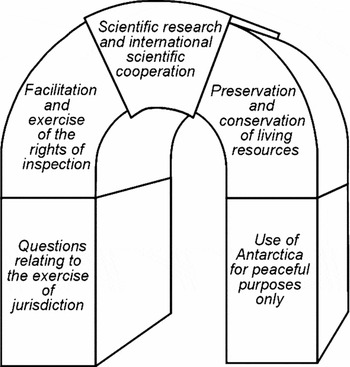
Peace, inspection, jurisdictions and conservation all are matters of common interest that underlie the stewardship of international spaces in the interests of all mankind. However, as a type of universal language that promotes objectivity and cooperation, science can be viewed as the keystone common interest that enables all other common interests to mature (Fig. 1). It also helped unquestionably that science and scientists were held in high public regard in the western and Soviet societies in the 1950s.
‘Matters of common interest pertaining to Antarctica’ (from Article IX of the Antarctic Treaty) with science as the ‘keystone common interest’ that underlies the policies that have enabled the Antarctic Treaty system continuously to promote cooperative stewardship of this international space since 1959. Adapted from Berkman, P.A. 2002. Science into policy: global lessons from Antarctica. London: Academic Press.

While the Antarctic Treaty itself offers a combination of policies for the unique region south of 60°S, the process of conceiving and implementing common interests is relevant to other international spaces. Notably, the Antarctic Treaty inspired the 1967 Treaty on the Principles Governing the Activities of States in the Exploration and Use of Outer Space, including the Moon and other Celestial Bodies. Under the 1982 United Nations Convention on the Law of the Sea (UNCLOS) the high seas and deep sea are the other international spaces. All of these regimes include the concept of ‘common’ interests for the benefit of all.
Today, among the highly charged challenges we face as a civilisation is stewardship of the Arctic. In the central Arctic Ocean the high seas exists under UNCLOS and customary international law as an undisputed intenational space. Moreover, the high seas is legally separated from the continental shelf and the sovereign jurisdictions that are increasingly asserted by the surrounding Arctic coastal states. Building on the lessons from Antarctica with optimism and hope, establishment of common interests in the high seas of the central Arctic Ocean will promote peace and cooperation in this other international space for the lasting benefit of all humanity.