


On 13 September 2022, French President Emmanuel Macron announced the formation of a national Citizens’ Assembly tasked with deliberating on assisted dying and aiding in the reform of the French euthanasia laws, a highly sensitive and controversial issue (Jérôme Reference Jérôme2022). Following the assembly’s decision to permit active assisted dying and assisted suicide, the French government presented a draft bill on 10 April 2024 to legalize the assembly’s decision, in this way empowering a demographically representative body of citizens. Using such democratic innovations to address real or perceived democratic deficits in representative democracies is increasingly common. Although there has been no authoritative census, tens of thousands of new and potentially democratic ways of engaging the people have been organized over the last few decades (Talmadge Reference Talmadge2023).Footnote 1 It is likely that most such events are not initiated by elected political elites, but rather by administrators seeking better governance, or by civil society groups seeking to organize inclusive forms of advocacy. But many democratic innovations have been introduced by elected political elites, sometimes for strategic reasons, such as solving complex and risky issues with uncertain political payoffs such as euthanasia, or sometimes for normative reasons, such as fostering more inclusion of underrepresented people in decision making. Yet elites are elected to make these very decisions on behalf of the constituents. By delegating some of these decisions back to the people or asking for input, they assume a high risk of uncertainty, including the risk of empowering alternatives to their own authority and influence. What, then, is in it for elected representatives? Can democratic innovations help advance democracy while also serving the interests of democratically elected elites? To date there has not been much theoretical analysis or empirical research that maps the interests of elected elites onto democratic deficits.
What we do know is that electoral democracies are facing significant democratic deficits. Citizens’ feelings of being excluded from political and economic decisions are creating openings for populist candidates claiming to represent the people against elites. Changes in mass communication and digital technologies have dramatically expanded possibilities for misinformation and communication enclaves, threatening the epistemic quality of public opinion (Anderson Reference Anderson, Edenberg and Hannon2021). Politicians often find themselves unable to govern in the face of mobilized civil society opposition, political gridlock, and elected colleagues who pander to constituents committed to conspiracy theories (Rosenblum and Muirhead Reference Rosenblum and Muirhead2019). Although they remain central to democracy, elections and conventional relations of representation between elected politicians and citizens do not seem to be providing the legitimacy necessary for democratic governance.
Scholarship on democratic innovations suggests that initiatives such as deliberative minipublics or participatory budgeting could, in principle, supplement the legacy institutions of electoral democracy so that they function more democratically (Aragonès and Sánchez-Pagés Reference Aragonès and Sánchez-Pagés2009; Bächtiger et al. Reference Bächtiger, Dryzek, Mansbridge and Warren2018; Elstub and Escobar Reference Elstub and Escobar2019; Smith Reference Smith2009). They can include citizensFootnote 2 in policy making (Fung and Wright Reference Fung and Wright2003), represent those who often lack voice, increase public knowledge of issues, and – in deepening democratic legitimacy – underwrite decision makers’ capacity to act on behalf of constituents (Newton and Geissel Reference Newton and Geissel2011). But we have not systemically theorized when, where, and why political elites, particularly elected ones, might adopt democratic innovations.Footnote 3 Those studying the emergence of democratic innovations have tended to see these processes from the side of citizens. But what would incentivize elected officials to turn to democratic innovations to supplement the authority and legitimacy they have earned through elections? We need to ask this question if we are to understand how democratic innovations might strengthen existing democratic institutions in the face of their current challenges, while deepening the democratic project.
In this paper, we develop some middle-level democratic theory that maps democratic deficits onto elite incentives. Our theoretical assumption is that democratic deficits generate challenges for elected representatives, which might in turn produce incentives to democratically innovate. While our analysis is primarily theoretical (and should be understood as a contribution to democratic theory), we aim at theory that is empirically attentive and politically relevant. We illustrate the theory with examples of democratic innovations, taken primarily from the Participedia.net database and checked against other sources.Footnote 4 Theorizing the incentives of their most powerful stakeholders in democratic political systems to adopt democratic innovations is part of the broader question of how democratic innovations might supplement and integrate into electoral democracies (Landemore Reference Landemore2022; Pin Reference Pin2022; Warren Reference Warren, Landwehr, Saalfeld and Schäfer2022).
We begin by explaining what we mean by ‘democratic innovations’ and why elected politicians are often skeptical of them. We then speculate about normative and strategic reasons that elected politicians favor democratic innovations, before looking at ways politicians may seek to co-opt democratic innovations toward non-democratic ends. Next, We theorize democratic deficits and the problems they generate for elected officials. Finally, we consider the strategic incentives that follow from these problems and provide examples of democratic innovations that address them. We conclude that strategies that seek to deepen democracy by supplementing representative democracy with democratic innovations will be most successful if they are matched to the incentive structures of electoral democracy.
What Are ‘Democratic Innovations’?
The term democratic innovations is a relatively recent term, introduced into the language of democratic theory and practice around two decades ago (Elstub and Escobar Reference Elstub and Escobar2019; Saward Reference Saward2003; Smith Reference Smith2009), despite the fact that many of the practices we now count as democratic innovations are decades older. By democratic innovations, we mean practices and institutions that promise to deepen or widen democracy in one or more of its dimensions. By ‘democracy’ we will simply mean ‘rule of the people’. At a high level of abstraction, political systems function democratically when their institutions and practices (a) empower inclusions in decision making of those potentially affected; (b) form individual preferences into collective agendas; and (c) generate collective decision capacities, such that a people can provide for itself (Warren Reference Warren2017). While electoral institutions are central to achieving these effects through voting, campaigns, and representative decision-making bodies, the term democratic innovations tends to be used for institutions and practices that are, or would be, relatively new to a context, and fall outside of the older, legacy institutions of representative democracy. Thus, reforms to existing institutions such as electoral systems (for example ranked choice voting, independent electoral boundary commissions, and voting access reforms) may be enormously important for deepening democracy, but they generally fall outside of current usage of the term ‘democratic innovation’. Democratic innovations usually involve one or more of the following features: (a) the participation of ordinary citizens; (b) provide new forms of representation; (c) involve learning and deliberation by citizens and public officials alike; (d) usually play an advisory (rather than direct decision-making) role within the broader ecology of institutions and practices that comprise democratic political systems; and (e) differ between the electoral and governance parts of political systems.
A. Participation of ordinary citizens: Democratic innovations often involve ordinary people or their advocates in ways that are more intensive than the act of voting for a representative or ballot measure. Ordinary people can bring new perspectives and knowledge into political processes. They are better connected to the problems they experience directly than their elected representatives, although they may not have knowledge of broader policy, political, structural, and legal contexts. Importantly, they are often better placed to gain the trust of their fellow citizens, as they are less likely to have conflicts of interest and are less likely to think, speak, and act strategically, as they need not seek election, seek funding, or knit together coalitions that involve conflicting interests or values (Warren and Gastil Reference Warren and Gastil2015).
B. Representation: Democratic innovations often involve non-electoral forms of representation, particularly those that involve some ordinary citizens representing other ordinary citizens (Warren Reference Warren, Nagel and Smith2013). Deliberative minipublics, for example, use near or stratified random selection to populate bodies. Owing to this selection process, they may represent a relevant public, population, or constituency better than bodies comprised through competitive elections (Abizadeh Reference Abizadeh2021). Near or stratified random selection can prevent highly mobilized partisans or special interest groups from hijacking processes, as often happens with public hearings. Stratified random sampling – random sampling that guarantees the representation of certain group members – promotes equity, a dimension of equality attentive to social inequalities (Beauvais Reference Beauvais, Bächtiger, Dryzek and Warren2018a). Open processes within which anyone can participate, such as participatory budgeting, are justified by the relative ease with which people who are most interested or most affected by an issue can represent themselves, or delegate representation to other ordinary citizens (Ryan Reference Ryan2021).
C. Learning and deliberation: Many democratic innovations aim to improve learning and deliberation among ordinary citizens, particularly in contrast to the often low quality of broader public sphere deliberation, and within social media epistemic bubbles. Learning and deliberation can be designed into processes through a variety of different techniques, including providing participants with relevant information about different sides of different policy options, hearing from advocates and members of affected communities, and providing access to experts, technocrats, and politicians so they can hear what informed elites have to say. Democratic innovations typically create space for deliberation – reciprocal reason-giving – among participants, so they can share perspectives and opinions, learn from one another, and influence others through persuasion. Some kinds of processes use techniques to improve listening, such as asking participants to repeat another’s argument before offering their own. Some democratic innovations also aim to feed higher quality learning and deliberation back into the public sphere, such as by holding public roundtables where participants can meet with members of the public to explain what they have learned to the broader public. However, strategies for effective connections between these new processes and broader publics are still in their infancy.
D. Advisory (rather than empowered) decision making: There are important arguments within democratic theory for empowered bodies populated through sortition, much like Athenian juries (Guerrero Reference Guerrero2014; Landemore Reference Landemore2022). To date, however, only a very small number of democratic innovations, such as participatory budgeting, are empowered to make decisions. Most actually existing democratic innovations function as advisory supplements to established institutions and are not empowered to make binding decisions, which would often require difficult constitutional changes. Civil servants in a municipal planning department, for example, might convene a citizens’ jury or other democratic innovation to gain feedback on local planning decisions. Some democratic innovations function as advisory supplements to broader publics – for example, prior to voting on a ballot measure, as with the Oregon Citizens’ Initiative Review (Gastil and Knobloch Reference Gastil and Knobloch2020).
E. Electoral democracy versus governance: Finally, to date most democratic innovations in Organisation for Economic Co-operation and Development (OECD) democracies occur within the ‘governance’ parts of political systems in ministries and agencies, focused on policy areas such as education, healthcare, and infrastructure development, and convened by administrators, often with pressure from democracy advocates, social movements, or non-governmental organizations (NGOs). Most cases of democratic innovations have focused on specific kinds of policy problems that fall within the remit of policy-defined agencies, possibly because ‘street-level bureaucrats’ are both close to their policy constituencies and subject to pressure from issue-based organizations. We think the problem of incentives for policy administrators to adopt democratic innovations are easier to conceive than those of elected officials. Democratic innovations often fit within legislated requirements to consult with stakeholders, communities, and others that comprise policy-determined constituencies in policy development processes, and they are less likely to involve conflicts with administrators’ authority. As important as these developments are, here we are focused on the potentially more contentious relationships between elected officials – the most powerful stakeholders in democratic systems – and democratic innovations.
Why Elected Officials Might Avoid Democratic Innovations
Why might elected officials avoid democratic innovations? While research is scant (cf. Saintraint and Suiter Reference Saintraint, Suiter and Gherghina2024), there might be four general possibilities: lack of knowledge, low expected political returns from these kinds of public input and engagement, perceived challenges to democratic legitimacy gained through election, and concerns about weakened or fragmented sites of power and authority.
First, because most elected officials make their careers within electoral systems, we suspect that many are unlikely to know about democratic innovations beyond the well-known devices of town halls and referendums. To our knowledge, this question has not been researched. It is possible that more knowledge about democratic innovations would lead to greater support, as suggested by the Irish Constitutional Convention (Participedia case 5316) that mixed elected politicians with ordinary citizens, leading politicians to support further citizens’ assemblies, including on abortion and marriage equality (Farrell et al. Reference Farrell, Suiter, Harris and Cunningham2021; Saintraint and Suiter Reference Saintraint, Suiter and Gherghina2024). There is also some evidence that members of the US Congress introduced to ‘deliberative town halls’ are also favorable to this democratic innovation (Neblo et al. Reference Neblo, Esterling and Lazer2018). To date, however, few democratic innovations have been constructed with educating elected politicians as a goal.
Secondly, elected politicians may be skeptical that democratic innovations are fruitful tools for garnering public input. One of the few studies of this question suggests that when politicians describe ideal processes, they list attributes associated with well-designed democratic innovations. Ideally, processes should promote thoughtful deliberation among diverse groups of participants who are open-minded and willing to both speak and listen. However, most politicians also say that it is not participatory processes, but rather informal, one-on-one conversations with constituents, that tend to be the most useful for public input, including responding to letters, emails, petitions, or activities on social media (Hendriks and Lees-Marshment Reference Hendriks and Lees-Marshment2019; Thompson Reference Thompson, Elstub and Escobar2019; cf. Saintraint and Suiter Reference Saintraint, Suiter and Gherghina2024). This contradiction may be because most elected politicians are likely only to know about long-standing democratic supplements: town halls and referendums. Town halls can self-select for angry constituents, posing risks of public embarrassment, or simply new opportunities for ‘interest groups rather than the broader public’ to exert political influence (Hendriks and Lees-Marshment Reference Hendriks and Lees-Marshment2019, 20). And referendums can go spectacularly wrong. Brexit, which was intended to be a tactic to resolve internal dissention within the Conservative Party, has turned into perhaps the largest self-inflicted wound in modern UK history. This kind of case likely provides elected politicians with evidence that ordinary citizens lack the expertise to advise or make policy.
Thirdly, it is also likely that, by running successful electoral campaigns, elected politicians tend to view themselves as having gained all the democratic legitimacy they need to govern. Elected governments typically claim democratic mandates, and then often turn their gaze inward, to the business of managing political relations within or among those parties included in government, while strategically managing communications with constituents, advocates, and broader publics. They are likely to view democratic innovations as challenges to the legitimacy and decision-making authority they believe they have already earned through election, and, indeed, will often view any process that involves unelected citizens as ‘undemocratic’ (Garry et al. Reference Garry, Pow, Coakley, Farrell, O’Leary and Tilley2022; Saintraint and Suiter Reference Saintraint, Suiter and Gherghina2024, 8–9).
Finally, and perhaps most significantly, elected officials may see democratic innovations as setting up competing sites of power and democratic legitimacy. In Australia, for example, the state government in Victoria proposed a reform that involved legislation for mandatory deliberative engagement; elected politicians were strongly opposed and rejected the measure. A key reason was that they were not willing to share power with a body of citizens (Savini and Grant Reference Savini and Grant2020), although the final Victoria Local Government Act mandated ‘deliberative engagement’ of citizens by the city council for broad planning processes. These fears sometimes may be warranted. In a study of community-based organizations (CBOs, Participedia case BOs) in Boston, Levine (Reference Levine2016) found that the authority of elected officials eroded as CBOs came to be viewed as the legitimate representatives of neighborhoods, a development he termed ‘the privatization of political representation’. Ballot initiatives – a key way for citizens to directly make policy – can result in divided authority and poor governance, as with the cascading financial crises introduced by California’s infamous Proposition 13, which limited the state’s ability to raise funds through property taxes (Citrin Reference Citrin2009). Examples such as these suggest that we should pay close attention to the ways democratic innovations interact with the institutions of electoral democracy.
Elected Officials’ Motivations for Democratic Innovations: Normative Incentives
Assuming that elected officials have knowledge of democratic innovations, there are two broad categories of motivations they might have to favor them, which we will call normative and strategic. Normative motivations do not present difficult theoretical problems, although there remain important empirical questions as to their kinds and prevalence (Saintraint and Suiter Reference Saintraint, Suiter and Gherghina2024, 8–10). We mention them first, and then move on to strategic motivations, the main focus of this paper.
First, elected officials may have strong convictions about hearing from, and representing, all of their constituents (Fenno Reference Fenno1977, Reference Fenno1998). Democratic innovations that seek to represent an affected public, such as deliberative minipublics that use some form of stratified random sampling to populate a body, are more likely to provide voice (through representation) for constituents who are less organized, less educated, or less well-resourced than citizens who are likely to show up at public hearings or to write, lobby, or pressure officials. This possibility may have been in play with a citizens’ assembly convened to develop a long-term neighborhood plan in Vancouver, Canada (Participedia case 4228). In this case, the city council approved and supported a planning department proposal for a citizens’ assembly, in part because they believed that, through their normal processes of public input, they were hearing almost entirely from homeowners, who comprised about 30 per cent of this neighborhood of 30,000, in contrast to the 70 per cent of renters (Beauvais and Warren Reference Beauvais and Warren2019). Similarly, elected representatives may look for democratic innovations because they are frustrated with status quo politics that push them to respond primarily to the loudest and most well-resourced constituents. Probably for principled reasons, thirteen sitting members of the US Congress participated in experiments in what they called ‘deliberative town halls’, in which they combined an online town hall format with a stratified sample of constituents (Minozzi et al. Reference Minozzi, Neblo, Esterling and Lazer2015; Neblo et al. Reference Neblo, Esterling and Lazer2018).
A second possibility is that elected officials are worried about the democratic legitimacy of the political system (Saintraint and Suiter Reference Saintraint, Suiter and Gherghina2024). In Germany, elected elites became alarmed by declining voter turnout – particularly among lower-income and lower-education groups – and by declining levels of support for democracy in general. As part of a coalition agreement, the Christian Democratic Union, the Christian Social Union, and the Social Democratic Party convened an expert commission on democracy, which was followed by a Citizens’ Assembly on Democracy (Bürgerrat Demokratie) to counteract this pattern and to remobilize constituents. Following agenda-setting by regional forums, 160 randomly selected participants heard from experts and stakeholders and discussed strategies to improve parliamentary democracy (Participedia case 5806).
A third possibility, suggested by Saintraint and Suiter (Reference Saintraint, Suiter and Gherghina2024) in their study of Irish politicians’ views of the Irish citizens’ assemblies, is that politicians appreciate the roles that citizens’ assemblies can play in clarifying public agendas and stimulating a higher quality of public discourse, either directly or by serving as trusted information proxies. Deliberative democratic innovations, many Irish politicians believed, made it easier for them to craft good public policies in response to their constituents’ considered opinions and preferences, supporting their roles as democratic representatives and political leaders.
Elected Officials’ Strategic Incentives and Democratic Outcomes
In discussing normative motivations, we use the modal verb forms ‘may’ and ‘might’ because actual incentives are difficult to know, and may overlap with strategic incentives. In the next four sections – the heart of this article – we are interested in the kinds of strategic incentives that elected officials may have to adopt or support democratic innovations. Elected officials may do well by doing good, such that strategic motivations support normative goals – indeed, this is basic to good institutional design. This idea, of course, has been at the heart of democratic theories of institutional design at least since Madison et al. (Reference Madison, Hamilton and Jay1787) justified the draft US constitution in The Federalist (see also Mill Reference Mill1859 Ch.III, and Mill Reference Mill1861 Ch.V). For purposes of institutional design, we should not assume that those who run for office are democratically principled or even publicly minded, although certainly many are. But whether or not they are democratically principled, elected politicians all have strategic interests in their careers – winning office and advancing their careers in political parties and within elected bodies. In those democratic theories that incorporate the Madisonian approach to institutional design, an electoral democracy works by distributing bits of power – the vote – to all those who have citizenship status within a jurisdiction. When combined with competitive elections, voting should incentivize elected officials to attend to their constituents – initially through campaigns and election, and then through re-election. At least some bodies constituted by elections, like the US Senate, should be insulated from the strategic interests of electioneering to enable deliberation on matters of common concern. And powers should be sufficiently concentrated in an executive that governments can make and execute decisions, closing the circle between inclusion, deliberation, and providing public policies that speak to common concerns. This is, of course, an idealized sketch of how electoral democracy should work – Madisonian in origin, but incorporated into most normative theories of electoral democracy.
Of course, this idealized theory is ideal, and has been consistently criticized as either too ideal, or as glossing over intrinsic failures (see, for example, Achen and Bartels Reference Achen and Bartels2016; Bagg Reference Bagg2024; Dahl Reference Dahl2003; Schattschneider Reference Schattschneider1960). We will not repeat or discuss these criticisms, but simply note that electoral democracy does not, and probably cannot, accomplish all of the work of democracy, and now likely requires democratic supplements. We are interested here in theorizing overlaps between strategic incentives of elected officials – incentives structured by electoral authorization and accountability – and democratic innovations.
Elected Officials’ Strategic Incentives that Co-Opt Democratic Innovations
We also note that ‘democracy’ in the term democracy innovations is normative and aspirational. Just because something is called ‘democratic’ does not necessarily make it so. While our theory is cautiously optimistic about the possibilities, there can be no theoretical guarantees that democratic innovations will serve democracy. On the one hand, given the state of current research, it is often hard to know whether a specific democratic innovation that prima facie appears to be democratic will have democratic consequences within the broader political system, although there are now a few large-n studies that seek to identify the consequences of democratic innovations for policy (Arnold et al. Reference Arnold, Bächtiger and Warren2024; Font et al. Reference Font, Smith, Galais and Alarcon2018; Jacquet et al. Reference Jacquet, Ryan and Van Der Does2023; OECD 2020; Pogrebinschi Reference Pogrebinschi2023).
On the other hand, we know that democratic innovations can be, and often are, co-opted by political elites, including elected officials. Indeed, to the extent that elected officials have strategic interests in democratic innovations, we might also expect them to have interests in controlling these processes in ways that undermine their democratic consequences. Two such strategies have been documented in the literature: democracy washing and cherry picking. Democracy washing (by analogy to green washing) occurs when a process appears to be democratic, but is merely performative, intended to provide legitimacy for decisions have already been made, made elsewhere, or would have been made in the same way without the process. Examples are most common in authoritarian regimes that seek to mobilize popular participation to demonstrate regime support. In Venezuela, Hugo Chavez organized ‘communal councils’ in 2006 both to mobilize support and to do a ‘democratic’ end run around the legislature and judiciary. In 2010 in Hungary, after Fidesz-MPP (a right-wing authoritarian party) won the parliamentary elections, a ‘National Consultation’ became a communication tool of the Prime Minister. The consultation was comprised of a letter from the Prime Minister that included some carefully crafted questions, followed by consultations, each on a specific topic (Oross and Tap Reference Oross and Tap2021). In China, local deliberative processes were widely organized under the Hu Jintao regime, probably to channel political demand, undermine ‘peasant actions’, and provide information necessary for governance without democratization (He and Warren Reference He and Warren2011). But democracy washing occurs within democratic systems too. Although about Canadian policy processes rather than elected officials, Fuji- Johnson (Reference Fuji-Johnson2011) concludes that democratic innovations involving deliberative processes only succeed where aligned with the economic and strategic interests of the organization. Neblo et al. (Reference Neblo, Esterling and Lazer2018) note that when members of Congress hold town halls, they use them ‘primarily to rally their strongest supporters and to deflect the attacks of their most vocal opponents’.
Another documented strategy is cherry picking: elites organize advisory democratic innovations, but then pick those recommendations they wish to adopt, while ignoring or tabling the remainders. Font et al. (Reference Font, Smith, Galais and Alarcon2018, 631) looked at 571 policy proposals from participatory processes in Spain and found that policy proposals are most likely to be adopted where they aligned with the preferences of the governments in power; they concluded that ‘the dynamics of cherry-picking proposals are clear’ (see also Smith Reference Smith2009, 93; Suteu and Tierney Reference Suteu and Tierney2018, 282; Sintomer et al. Reference Sintomer, Herzberg and Röcke2008; Saintraint and Suiter Reference Saintraint, Suiter and Gherghina2024, 9). Similarly, in a survey of national-level deliberative minipublics in several European countries, Arnold et al. (Reference Arnold, Bächtiger and Warren2024) found that processes that are elite-organized are significantly more likely to be consequential for policy than those emerging from non-elite organizers. Strategies of elite co-optation of democratic innovations appear common enough that we need to ask, and to research, the conditions under which democratic innovations actually contribute to deepening or defending democracy.
Democratic Deficits
Granting these important caveats, however, here we are interested in theorizing the possibilities that democratic deficits can generate strategic interests for elected officials to hand over powers of advice, or sometimes decision, to innovative democratic processes, thus (functionally) deepening democracy. In this section, we offer an account of kinds of democratic deficits that may translate into incentives for elected officials to supplement electoral democracy with democratic innovations.
Democratic deficits are gaps between democratic ideals and political system performance. At a system level, we can specify democratic deficits more closely by using a problem-based approach to democratic theory (Warren Reference Warren2017), although other approaches could be used to very much the same ends. To count as ‘democratic’, political systems should solve three kinds of problems: they should empower inclusion, organize collective agendas, and enable collective decision making. While there are many ways and places within political systems that can support these functions, we limit our analysis here to electoral systems and elected bodies, as our purpose is to theorize the relationship between these functions and incentives of elected political elites.Footnote 5 While these three functions can be framed and justified normatively (as the ‘deficits’ language suggests), here we use this approach to theorize the ways in which citizens’ expectations might translate into strategic problems for elected officials.
First, to count as ‘democratic’, a political system must include those people entitled to voice and impact through distributed empowerments. With respect to electoral systems and elected bodies, the key means of empowered inclusion are elections that authorize and hold to account representatives of constituents through voting, organizing, communicating, and resisting (Yashar et al. Reference Yashar, Kapiszewski and Levitsky2021). Democratic deficits here appear as weak or corrupted principal-agent relationships, inequitable access to political officials, and the underrepresentation of less educated, less wealthy, and/or minority citizens and denizens. Democratic deficits can also appear as global issues – migration, climate change, security, and economic interdependencies – that generate problems for citizens that do not map onto, or cross, organized jurisdictions. These democratic deficits will appear in ongoing inequitable representation with respect to the problems citizens face. Deficits related to failures of inclusion can manifest in organized opposition, protests, and pressure directed at elected political elites (Krastev Reference Krastev2014).
The second function political systems must serve to count as democratic is collective agenda-setting and will formation. Once inclusions are achieved – that is, once those who should have power and voice are represented at the table – democracies need to form this input into collective agendas and wills, through deliberation, negotiation, and bargaining. Collective agenda-setting and will formation occurs within electoral systems through party platforms as well as the multiple kinds of deliberation, negotiations, and bargaining that occur within elected governments, and between branches and levels of government. Democratic deficits here often appear as issues that parties, legislative bodies, and governments fail to prioritize, deliberate, and formulate into agendas that reflect the interests and values of constituents. Deficits are particularly common when international pressures require quick decision making and the co-ordination of a large number of global elite actors, such as migration and refugee issues, climate change, or global pandemics (Goldstone and Diamond Reference Goldstone and Diamond2020). Democratic deficits here appear in the form of epistemic bubbles, angry or alienated voters who punish elected representatives for deliberating, negotiating, or compromising, and perspectives and opinions that fail to be represented at all in elite discourses.
To count as democratic, political systems must also have the capacity to make decisions through which ‘the people’ are formed into collective agents capable of doing collective things for themselves, usually issue-by-issue. Deficits here usually appear as legislative incapacities to decide and govern. They may appear as uncertainty within legislatures of public support for decisions, or legislative gridlock, either owing to factions within a governing party or coalition, or, in separated power systems, conflicts between branches of government, including between upper and lower houses in legislatures. Elite disengagement increases the risk of legislative gridlock, as do issues where interest groups are sufficiently well-resourced to veto decision making. When deficits of inclusion and collective will formation undermine the democratic legitimacy of elected decision makers, they may increasingly feel the need to reach for extra-legislative devices such as ballot measures. Deficits of legitimate governing capacity undermine democracy just as surely as deficits of empowered inclusion and collective agenda and will formation.
To be sure, democratic deficits differ among kinds of electoral systems as well as the social and political ecologies within which they operate (Norris and Inglehart Reference Norris and Inglehart2019; Norris Reference Norris2011). This said, in today’s increasingly interconnected world, consolidated electoral democracies face similar structural pressures – increasing political demands and constraints on capacities to meet these demands – that are eroding the legitimacy of representative democracies. We see the evidence in flatlining trust in government and high levels of citizen disaffection; in policies that are viewed as illegitimate, often by majorities of citizens, even when enacted by elected governments; and in the decline of mainline brokerage parties in most electoral democracies.
Mapping Democratic Deficits onto Electoral Incentives
When we ask why elected politicians might be strategically incentivized to adopt democratic innovations, we can formulate the question in this way: What do democratic deficits look like from the standpoint of elected officials who are, among other things, seeking to win election or re-election? That is, we need to specify democratic deficits in the form they take as problems for politicians motivated by electoral success. Theoretically, elected politicians should respond to democratic deficits if they appear as problems with mobilizing or maintaining their electoral constituencies, and problems of managing relationships that bear on electoral success within a party, between parties, or within elected governments. Following our approach above, we order these as problems of empowered inclusion, collective agenda and will formation, and collective decision making – that is, the problems a political system must solve to count as ‘democratic’, and which, unsolved, are likely to produce parallel kinds of democratic deficits.
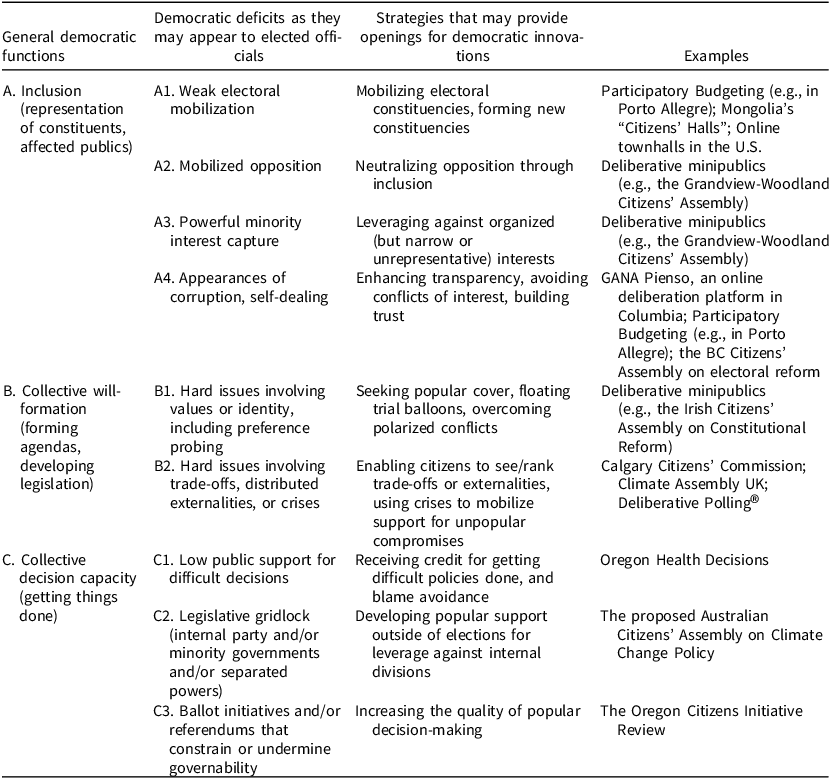
The examples we offer illustrate the theory and its potential empirical relevance. For the most part, we used the Participedia.net database as our source of examples, each marked by their Participedia ID number. The examples should perform the ‘clarifying, didactic, persuasive, and universalizing’ functions for political theory that Dryzek (Reference Dryzek2025) very nicely discusses. The cases are indicative rather than exhaustive, and many cross-cut the categories we are using to elaborate the potentials of democratic innovations with electoral democracy. Our general strategy for structuring our problem is sketched in Table 1.
Mapping Democratic Functions onto Electoral Incentives for Democratic Innovations (DIs)

Table 1: Long description
A table with three columns and multiple rows. The columns are labeled ‘General democratic functions’, ‘Democratic deficits as they may appear to elected officials’, ‘Strategies that may provide openings for democratic innovations’, and ‘Examples’. The table is divided into three main sections: A. Inclusion, B. Collective will-formation, and C. Collective decision capacity. Each section contains specific deficits, strategies, and examples. For instance, under A. Inclusion, deficits include weak electoral mobilization and powerful minority interest capture, strategies include mobilizing electoral constituencies and leveraging against organized interests, and examples include Participatory Budgeting and Deliberative minipublics.
Openings for Democratic Innovations within Inclusion Deficits
A. Mobilization and constituency formation: The central vectors for empowered inclusions within electoral democracy are mobilizations of constituents’ voting powers. Politicians need to continually mobilize their electoral constituencies, and will often test whether there are latent (unorganized) constituencies or voters on the margins that can expand their base (Saintraint and Suiter Reference Saintraint, Suiter and Gherghina2024; Strøm Reference Strøm1990). Elected politicians usually rely on political parties for mobilization, and upon social movements that are incorporated into parties, such as the union movement for labor parties, or religious congregations for conservative parties. They will continue to do so. However, with brokerage parties in decline (and, in some places, collapse), there are opportunities for new ways of mobilizing existing constituencies, while expanding mobilization for constituencies that have tended to be excluded. Some kinds of democratic innovations – for example participatory budgeting, where citizens decide directly on the uses of some portion of a municipal budget – were clearly motivated by these incentives. Originating in part as a mobilizing tactic by the Labor Party in Brazil (Hagelskamp et al. Reference Hagelskamp, Schleifer, Rinehart and Silliman2016; Ryan Reference Ryan2021; Wampler Reference Wampler2010), participatory budgeting was originally developed in Porto Allegre, Brazil, by the Workers’ Party (Partido dos Trabalhadores). Elected representatives from the Workers’ Party used participatory budgeting to empower citizens to control some portion of public budgets (Participedia case 5524, de Sousa Santos Reference de Sousa Santos1998; Ganuza and Baiocchi Reference Ganuza, Baiocchi, Elstub and Escobar2019; Wampler and Avritzer Reference Wampler and Avritzer2004). Participatory budgeting functions to educate citizens by empowering them – in Brazil, often within the least advantaged favelas – while increasing transparency and reducing corruption (Ryan Reference Ryan2021, 92–3). Participatory budgeting in Brazil also had the effect of mobilizing voter support for the Workers’ Party in Brazil (de Sousa Santos Reference de Sousa Santos1998).
Budgeting is only one area where public involvement may be spurred by the elected officials. Participatory processes may be also used to mobilize otherwise disaffected or passive publics. For instance, in 2009, the then newly elected Mongolian president Elbegdorj Tsakhia established ‘Citizens’ Halls’ to mobilize citizens whose habits of disengagement were left over from a long-lasting autocratic regime (Participedia case 1150, Undarya Reference Undarya2013). This initiative was designed to include citizens in the legislation drafting process and was funded directly by the state. The Citizens’ Halls are open to participation by any citizens, and citizens can voice their opinions via a letter, a fax, or an email to the Citizens’ Hall website. Even though citizens cannot make proposals for new legislation, they can provide input into the proposals put forward by the government. The topics that were presented to the Citizens’ Hall have ranged from a legislation on press freedom to financing higher education and scholarships.
Elected officials can also use deliberative town halls or similar democratic innovations to change the attitudes and behaviors of their individual constituents. Specifically, elected officials can use democratic innovations to persuade constituents to adopt their policy preferences, to encourage the voters to trust them, and ultimately to vote for them. Minozzi et al. (Reference Minozzi, Neblo, Esterling and Lazer2015) use randomized controlled field experiments to show that when elected officials (members of US Congress and a US Senator) met with constituents in online town halls, the elected officials were able to persuade constituents on policy issues and garnered significantly more support among those constituents with whom they met.
Finally, democratic innovations might help elected officials develop positive reputations within the party and also for the constituents. Especially for career politicians in state legislatures, a desire to move higher up the political ladder may motivate them to be more in tune with citizens’ interests (Weber Reference Weber1999). Cherie Maestas (Reference Maestas2003, 440) studied eight state legislatures and observed that ‘political ambitions combined with the resources offered by professional legislatures can enhance the prospects for representation of citizen interests’. The reason for this is that legislators with ambitions for higher office cannot neglect their constituents’ interests even when they feel secure in their current office.
B. Neutralizing opposition: Elected politicians can use democratic innovations to neutralize citizens organized in opposition. Whether or not demobilization advances or undermines democracy will depend upon effects on empowered inclusions. Elected politicians often face organized opposition from social movements and advocacy groups. While opposition groups often seek to remove a representative or elected government in the next election, they may also simply be seeking to have their agendas represented and included. Opposition, particularly when it is visible and media savvy, can often damage electoral success. Politicians do not wish to be seen caving to opposition, which their base may view as weakness or lack of principles. To save face, they may instead opt for processes that include a broader range of affected citizens, and enable deliberative give and take, which, if successful, can neutralize purely oppositional politics. Neutralization, when it occurs through empowered inclusion, can result in more democracy. An example was the Grandview-Woodland Citizens’ Assembly, commissioned by the City of Vancouver (Canada) City Council, aimed at neutralizing homeowners angry with a proposed thirty-year plan for a neighborhood of 30,000 seeking residential densification, by including the unorganized renters who comprised about 70 per cent of residents (Participedia case 4228, Beauvais and Warren Reference Beauvais and Warren2019; Beauvais Reference Beauvais, Bächtiger, Dryzek and Warren2018a).
C. Avoiding special interest capture: Elected politicians often seek to represent broad constituencies, but find that they are heavily lobbied by well-organized but unrepresentative interests – so much so that responding to the broad but less organized part of their constituencies can pose electoral threats. Indeed, in the United States, members of Congress commonly complain that even if they seek to more broadly represent their constituents, the well-organized interests are those that pose electoral dangers, especially in primaries, should the representative stray. Politicians who seek to more directly represent their constituents will often rely on techniques like town hall meetings. These can exacerbate inequalities, as they self-select for people who have organizational advantages by virtue of education, wealth, occupation, ethnicity and race, language, or gender. There are, however, techniques that politicians can use to develop other sources of legitimacy that push back against organized interest capture. Deliberative minipublics – which involve randomly selecting participants from a broader population – can enable politicians to hear from, and even deliberate with, those unorganized constituents from whom they are unlikely to hear (Neblo et al. Reference Neblo, Esterling, Kennedy, Lazer and Sokhey2010). In a case mentioned above, the City of Vancouver convened the Grandview-Woodland Citizens’ Assembly partly to prevent highly mobilized homeowners, representing about 30 per cent of the neighborhood of 30,000, from capturing a neighborhood planning process to the exclusion of the other 70 per cent of renters (Beauvais and Warren Reference Beauvais and Warren2019; Beauvais Reference Beauvais2018b).
D. Avoiding the appearance of corruption or self-dealing: Democratic innovations can increase transparency and reduce appearances of self-dealing or corruption, improving an elected government’s reputation and thus electoral chances. For instance, in contexts with high levels of corruption, democratic innovations can improve a government’s reputation, which may have been part of the motivation for an e-participation initiative in Nariño, Colombia. The department of Nariño in Colombia was hard hit by the conflict between the Revolutionary Armed Forces of Colombia (FARC) and the government. In 2016, the government of Nariño, led by Governor Camilo Romero, started ‘GANA Pienso’, an online deliberation platform under the rubric of Open Government Initiative to improve communication between the government and the constituents, enhance transparency, and reduce corruption. Beyond learning about the inner workings of the government and voicing concerns, the online platform also enabled users to propose a topic and deliberate about it, or simply state whether they are in favor of a general topic (Participedia case 5654, Gobernación de Nariño Reference de Nariño2016). Some participatory and deliberative processes seemed to be motivated by local officials hoping to avoid accusations of corruption. For instance, when Brazilian municipal decision makers adopted participatory budgeting, evidence suggests that corruption declined, probably owing to the increased budget transparency that came with transferring budget control to citizens (Wampler Reference Wampler2010).
There are also issues in which politicians are conflicted, particularly those involving political process reforms. Electoral system reforms and drawing district maps are examples. In such cases, politicians can risk reputational costs if they advance self-serving changes. For example, Gordon Campbell, British Columbia’s (BC’s) premier, tasked a 2004 citizens’ assembly, the BC Citizens’ Assembly (BCCA), to craft a proposal for electoral system reform, which would then be decided by voters in a referendum (Participedia case 1, Fournier et al. Reference Fournier, van der Kolk, Carty, Blais and Rose2011; Warren and Pearse Reference Warren and Pearse2008). There is strong evidence that the BCCA acted as a trusted information proxy: knowledge of the BCCA’s recommendation increased support for the proposed change, even among low-information voters (Climate Assembly UK Reference Climate Assembly2020; Cutler et al., Reference Cutler, Johnston, Carty, Blais, Fournier, Warren and Pearse2008).
Openings for Democratic Innovations within Collective Agenda Formation Deficits
A. Hard issues involving values or identity; preference probing: Issues involving values and identity, particularly those that cut across electoral coalitions, will often be avoided by elected politicians and bodies, even if there is popular pressure to act. Under these circumstances, elected politicians may have incentives to hand decisions over to the people. Democratic innovations, particularly those that seek to achieve both good representation and deliberation, can provide popular cover for hard choices, provide alternatives to normal legislative processes, float trial balloons, or overcome polarizing conflicts.
Sometimes handing off decisions to the people can help elected politicians avoid hard choices, while revealing what the people want. A well-designed process, such as the standing Irish Citizens’ Assembly (Participedia 5316, see also Participedia case 850 Suiter et al. Reference Suiter, Farrell and O’Malley2016; Farrell et al. Reference Farrell, Suiter and Harris2019; O’Malley et al. Reference O’Malley, Farrell and Suiter2020), can help politicians take credit for addressing an issue, while also avoiding taking a decision. The standing citizens’ assembly was founded by the Irish parliament, and paved the way for subsequent citizens’ assemblies that produced referendums on same-sex marriage and abortion. In their interviews with Irish politicians, Saintraint and Suiter (Reference Saintraint, Suiter and Gherghina2024, 6) note that the politicians they interviewed came to see citizens’ assemblies as a way of bridging both interparty divides in the governing coalition and intraparty divides: some ‘participants described CAs [citizens’ assemblies] as useful in deflecting discontent about policies that might not resonate well with loyal voters but which are deemed necessary, as evident in urban–rural intra-party divides’ (also see Farrell et al. Reference Farrell, Suiter, Harris and Cunningham2021). Saintraint and Suiter (Reference Saintraint, Suiter and Gherghina2024, 6) also found evidence that many Irish politicians came to view citizens’ assemblies ‘as a credible way of figuring out what public wants, as members of CAs mostly do not have entrenched ideological positions, nor are they motivated by electoral gains’.
B. Hard issues involving trade-offs or distributed externalities; preference probing: Citizens often punish elected politicians for making trade-offs, such as between high taxes and good services. In 2015, Mayor Naheed Nenshi of Calgary, Canada, partnered with the Chamber of Commerce and other business associations to convene a citizens’ commission to propose recommendations regarding necessary infrastructure and to identify sources of funding (Participedia case 4606).Footnote 6 The key problem was to find alternatives to infrastructure funding through commercial or residential property taxes, often seen as hurting businesses. Not unlike a citizens’ jury or citizens’ assembly, the citizens’ commission was comprised of thirty-six randomly selected participants who heard from a range of experts (such as academics and engineers), stakeholders, and the wider public. In the end, the citizens’ commission identified a range of revenue-generating recommendations for a sustainable infrastructure system.
With complex issues involving trade-offs and externalities, a well-designed process can help politicians figure out what their constituents would prefer, if citizens knew what a compromise would entail, who would pay, and who would benefit. Issues such as climate change mitigation and adaptation involve short-term, focused costs with long-term generalized benefits – problems that have a classic free-ridership structure. This kind of problem is especially acute for politicians, who can be blamed for more expensive fuel, higher taxes, and public works with uncertain and/or long-term benefits (unlike, say, highway projects or public schools). It is not until long after the next election cycle that benefits visible to the public are likely to accrue. The likely result is that politicians have strong incentives to underinvest in (for example) climate change mitigation (Bonfiglioli and Gancia Reference Bonfiglioli and Gancia2013). Democratic innovations can help solve such dilemmas for elected representatives. For instance, the Climate Assembly UK (Reference Climate Assembly2020) was commissioned by parliamentary select committees from the UK House of Commons – a set of cross-party Members of Parliament (MPs) – to promote public deliberative dialogue on reducing greenhouse gas emissions (Participedia case 5710, Elstub et al. Reference Elstub, Carrick, Andrews and Ivings2025; Lorenzoni et al. Reference Lorenzoni, Jordan, Sullivan-Thomsett and Geese2025).
More generally, Deliberative Polling® – short deliberative processes involving samples of 400 or more randomly selected citizens – is designed to determine what publics would think if they have information about an issue and have taken time for consideration (Fishkin Reference Fishkin2018). Deliberative Polls have been conducted over 150 times across fifty countries (Deliberative Democracy Lab n.d.). Many are commissioned by elected officials seeking guidance on how to lead on difficult issues in ways that publics are likely to find acceptable. For example, the Parliament of Mongolia commissioned its first national Deliberative Poll in 2017 to gain informed public opinion on proposed constitutional changes (Fishkin and Siu Reference Fishkin and Siu2021; Fishkin and Zandanshatar Reference Fishkin and Zandanshatar2017). The Mongolian Parliament has since passed legislation requiring Deliberative Polling prior to considering constitutional amendments that affect the roles of parliament, the presidency, and the prime minister. Like with avoiding appearances of corruption or self-dealing, elected officials who are navigating hard issues or trade-offs may also benefit from publicly visible processes because they create an opportunity to deflect blame, should decisions go sideways.
Openings for Democratic Innovations within Collective Decision Deficits
A. Public support for hard decisions: Following from above, when democratic innovations take on and help to resolve hard issues, the decision capacities of elected bodies can be increased. The ‘Oregon Health Decisions’ case offers a clear example of a legislature turning to democratic innovation when it was unable to make difficult decisions about cuts to Medicaid spending. In the mid-1980s, the Oregon legislature was unable to cover Medicaid demands with available funds, and was simultaneously unwilling to increase the taxes that would be necessary to meet the shortfall (Participedia case 5298, Sipes-Metzler Reference Sipes-Metzler1994). Faced with this funding shortfall, the state sought to rank disease coverage by cost and effectiveness, hoping to use (say) the money saved from one dialysis patient close to death to fund the nutrition and health of hundreds of expectant mothers. Unwilling to make decisions that were, in effect, about who lives and who dies, the state funded a non-profit to engage in extensive deliberations with the public. A key result was increased public willingness to pay for increased Medicaid support, which gave the legislature decision options that avoided dire trade-offs (Sipes-Metzler Reference Sipes-Metzler1994).
B. Legislative gridlock: Many electoral and constitutional systems are prone to gridlock, particularly those that involve separated powers (the United States and most Latin American countries) and/or single member plurality electoral systems that require coalition-building within parties on pain of failing to generate electoral pluralities (for example the United States, the United Kingdom, and Canada). As part of strategic maneuvering, politicians may seek support to boost their position within a party, to bolster popular support for a minority government, or seek popular advantage with a separated power system. We do not have good examples that constructively address this kind of problem, but we can point to a number of cases where elites reach for participatory processes after failing in a referendum. For instance, the Australian Citizens’ Assembly on Climate Change Policy was proposed after the Australian Labour government was unable to move forward on climate change policy due to the Liberal–National coalition’s opposition to their proposed Emissions Trading Scheme (ETS) to cap carbon emissions (Participedia case 5106). However, the proposal for a citizens’ assembly received intense backlash from opposition politicians, who effectively managed to frame the proposed assembly as a ‘cop-out’. The Labour leader subsequently lost her majority, and the proposal was ultimately abandoned. Although a failed case, it does show that strategic maneuvering in legislatures can sometimes involve new ways of involving the public, but without (say) populist strategies to undermine institutions.
C. Ballot initiatives and referendums that constrain governability: Systems with regular ballot initiatives or sporadic referendums can generate ungovernable situations for legislatures and governments. California’s Proposition 13 was an example of the former, Brexit the latter. For these kinds of contexts, legislatures have motivations to upgrade these institutions with democratic innovations. The Oregon Citizens’ Initiative Review (CIR) is one such case: in 2008, the state legislature authorized a process that attached a citizens’ jury to two of the most consequential ballot initiatives, beginning with the 2010 general election (Participedia case 597, Gastil and Knobloch Reference Gastil and Knobloch2020; Gastil et al. Reference Gastil, Richards and Knobloch2014). The members were instructed to learn, deliberate, and provide advice to Oregon voters through the Voters’ Pamphlet. Research showed that, in fact, Oregon voters were induced by the CIR to learn more about the issues, and many used the process as a trusted information proxy (Warren and Gastil Reference Warren and Gastil2015).
Conclusion
Although essential for the democratic project, free, fair, and competitive elections are not generating the legitimacy sufficient for democratic governance. Flatlining political trust, policies that are often viewed as illegitimate even when enacted by elected governments, and the decline of mainline brokerage parties are creating openings for populist politicians who promise to directly embody ‘the will of the people’. In principle, democratic innovations can be used to supplement electoral systems so that they function more democratically, which helps restore trust and enhances the legitimacy of the elected officials.
While elected politicians sometimes reach for democratic innovations, most remain skeptical (often in marked contrast to those in ministries and agencies, who we do not discuss here). They tend to view the elections that bring them to power as providing democratic legitimacy, and their experiences with non-electoral engagement with ‘the people’ tend to underwrite a widely shared cynicism about people’s capacities to co-govern. Those who see promise in democratic innovations to enhance the democratic functions of electoral democracy will need to understand where they fit with electoral incentive structures. By delineating the space of overlap between democratic innovations and incentives, this paper begins to theorize the possibilities for sustainable democratic innovations by relating their potentials to the long-standing institutional design proposition that democratic systems work when they harness the strategic interests of public officials for the public good. Our theoretical analysis starts to identify alignments between democratic deficits and electoral incentives into which democratic innovations might fit. We suggest that genuine democratic advances are possible even when elites are acting with purely strategic motivations, and that normative and strategic interests can, under some conditions, overlap and reinforce one another. What we offer here is some middle-level democratic theory, illustrated with brief examples, that should help to identify the places and conditions under which this reinforcement might occur. In doing so, we add some definition to the emerging field of democratic innovations, focus new research, and increase the chances that the field will play its part in defending and deepening the democratic project.
Acknowledgments
We would like to thank André Bächtiger, Stephanie Burkhalter, Dimitri Courant, Kevin Elliott, Alice El-Wakil, Michael Morrell, Azucena Moran, Michael Neblo, Janosh Pfeffer, Paolo Spada, Graham Smith, Nivek Thompson, and the three anonymous reviewers for their valuable input into various drafts of the paper.
Authors’ contributions
The authors contributed equally to this paper and are listed in reverse-alphabetical order.
Financial support
This research received no specific grant from any funding agency, commercial, or not-for-profit sectors.
Competing interests
None.

 Open access

