

Historically, the success or ‘health’ of an organisation was determined by its profit margins — a healthy profit was an indication of a healthy organisation. While financial viability continues to be an important measure, an organisation driven solely by budgets overlooks the importance of the human aspect of an organisation that sustains it in the long term. In consequence, the measure of a healthy organisation that is emerging since the 1990s expands beyond financial success to encompass the concept of a healthy workplace that not only protects employees from physical injury but protects psychological wellbeing within the workplace as well, while concomitantly pursuing organisational goals (Cooper & Cartwright, Reference Cooper and Cartwright1994; Jaffe, Reference Jaffe, Sauter and Murphy1995). This concept is receiving increased global attention from organisations in the wake of a mounting body of evidence empirically supporting a link between occupational environment, worker health, and productivity (World Health Organization [WHO], 2006, 2010).
Nevertheless, exploring health in the workplace is not novel, in that earlier research honed its focus to identify characteristics of jobs that affected wellbeing, attitudes, and job performance. The approach of Argyris (Reference Argyris1957), for example, was to explore the psychological wellbeing and success of the individual to adapt to the organisational structure and control systems in the workplace while motivation-hygiene theories framed by Herzberg (Reference Herzberg1987) looked at the factors of job satisfaction. Additionally, Levi (Reference Levi1990) considered the structures and processes of the working environment that he believed had a direct causal relationship on the prevalence and incidence of injury and illness in the workplace while Siegrist's (Reference Siegrist1996) effort–reward imbalance model concentrated on work situations characterised by a combination of high effort expended for low reward — be that in terms of salary, job satisfaction, recognition, or career opportunities. Furthermore, Karasek (Reference Karasek1979; Karasek & Theorell, Reference Karasek and Theorell1990) linked the affect between job characteristics and job performance through the demand-control model — a link well established since the Trist and Bamford (Reference Trist and Bamforth1951) studies of job de-skilling and rates of depression. However, the novelty of the current contemporary concept of a healthy workplace is its holistic approach to prevention, protection, and promotion of both physical and psychological health of the worker in the workplace.
Notwithstanding the research generated, our increased knowledge of the job characteristics that impact health, and our understanding of the beneficial impact of a holistic approach to workplace issues, the robust chronicle of literature suggests a healthy workplace is elusive to define and thereby daunting to apply. Jaffe (Reference Jaffe, Sauter and Murphy1995), for example, defined a healthy workplace in terms of the physical, social, and psychological working environment within which the employee is provided with safe working conditions, is treated with respect, and is allowed personal growth, participation, and involvement in the design and implementation of jobs that collectively achieve mutual organisational and individual goals. The depth of this definition is further supported through the WHO defining a healthy workplace as one in which ‘workers and managers collaborate to use a continual improvement process to protect and promote the health, safety and wellbeing of all workers and the sustainability of the workplace’ (WHO, 2010, p. 11).
However, the weakness of such a broad definition is that it may lend itself to superficial change strategies such as introducing a fitness program reflecting an individual orientation to health (Kelloway & Day, Reference Kelloway and Day2005a, Reference Kelloway and Day2005b) without prioritising the concept as a core strategy (i.e., aligning strategies, practices and policies such as a disability management program) to reflect an organisational orientation to health. An organisational orientation is one that provides a working environment to support, protect and promote the physical and psychological health and wellbeing of employees as the organisation pursues its business goals (Lowe, Reference Lowe2004). Meaningful change towards a healthy workplace presupposes a synergy within and among all levels of an organisation (Zohar & Luria, Reference Zohar and Luria2005). As described by the Health and Safety Authority (HSA; 2008) in Ireland a healthy workplace is achieved through a combination of policies, programs, procedures and practices, in conjunction with a demonstration of leadership and commitment (HSA, 2008). These definitions illustrate the complexity of the construct in that the attainment of a healthy workplace requires the examination and improvement of the internal environment of the organisation — inclusive of a person's perception of its culture, climate, and leadership, as well as the formal and informal implementation of its practices, policies and procedures. In consequence there is no prescribed strategy that culminates, if ever, in a healthy workplace — the implementation is as variable as workplaces and the process is a flux without definitive end (Grawitch, Gottschalk, & Munz, Reference Grawitch, Gottschalk and Munz2006). Regardless of the complexity of these definitions, what can be taken away from the literature is that a pertinent definitional characteristic of a healthy workplace involves active management commitment to protect and maintain the health of the workforce.
Within this context of a healthy workplace is a related approach that aims to mitigate medical conditions and injuries as they occur. Aimed at the individual level and similarly requiring active management commitment, Shrey (Reference Shrey1996) described the practices and policies pertinent to a disability management program as a proactive, employer-based prevention and remediation strategy — indeed, a paradigm shift in rehabilitation, in that it brought the rehabilitation of ill or injured workers into the workplace. Concomitant with the concept of a healthy workplace, a disability management program aims to (a) prevent the occurrence of accidents and disability, (b) mitigate the effects through early intervention and return-to-work options when disability does occur, (c) decrease lost time by maintaining a continued occupational bond and availing of optimum timing for return to work, and (d) provide an individualised, participative process that facilitates restoration and accommodation to support the continued relationship between the worker and the employer (Shrey, Reference Shrey and King1998).
Therefore, regardless whether the focus is an organisational level development towards a healthy workplace or an individualised level return-to-work plan, the literature supports the premise that understanding the context of the workplace and the factors that contribute or impede progress is essential (Amick et al., Reference Amick, Habeck, Hunt, Fossel, Chapin, Keller and Katz2000). Undoubtedly what the concept and definition of a healthy workplace infers is that any improvement process should begin with an assessment to explore the nature and context of the workplace. For Schneider (Reference Schneider and Schneider1990, Reference Schneider, Ashkanasy, Wilderon and Peterson2000) the nature and context of workplaces refers to multiple climates or behavioural patterns that emerge from employees’ perceptions of the organisations practices, policies and procedures. Indeed, the focus of Zohar's span of work (Zohar, Reference Zohar1980, Reference Zohar, Quick and Tetrick2003, Reference Zohar2010) supports the multiplicity and specificity of climates and the representation of climate as the shared knowledge of and consistent behaviour towards a core strategic target — for example, shared perceptions and consistent performance of safety behaviours as a result of a specific strategic focus on safety defines the safety climate. Therefore, what the literature suggests is that the nature and context of the workplace consists of multiple climates that represent shared knowledge and consistent behaviours towards a specific target, such as a climate for safety, customer service, creativity, or even health. Although there are competing models to measuring climate such as the global approach proposed by Patterson et al. (Reference Patterson, West, Shackleton, Dawson, Lawthom, Maitlis and Wallace2005), the priority for this research was to discern a specific climate that represents a health orientation within an organisation; that is, a climate for health that focuses on the organisation's practices, policies and procedures in order to support, protect and maintain the health of employees.
The approach taken in this research is consistent therefore, with the climate model espoused by Zohar (Reference Zohar2010) — a model that proposes and supports the multiplicity and specificity of climates in a workplace. The rationale for this approach is based on the theoretical implication that is supported by the extant body of literature that suggests that strategies designed to improve the workplace will be more effective when they are prioritised and consistently carried out within the context of a positive organisational climate (Carr, Schmidt, Ford, & DeShon, Reference Carr, Schmidt, Ford and DeShon2003; HSA, 2008; Neal & Griffin, Reference Neal and Griffin2006; Neal, Griffin & Hart, Reference Neal, Griffin and Hart2000; Zohar, Reference Zohar1980).
The first phase of this study, therefore, was to devise a user friendly, facet-specific tool to assess employees’ perceptions of the organisation's policies, practices and working environment pertaining to the support and protection of employees. This assessment tool — The Workplace Scale (WPS) — is linked to relevant structural characteristics of a healthy workplace (i.e., an organisation's policies, practices and procedures), and covers a wide range of characteristics incorporated from research on healthy workplaces. Thereafter the wider objective of the larger study was to examine employees’ perceptions of their working environment in terms of the culture, leadership and workplace climate to measure how well the concept of a healthy workplace was embedded in the workplace. The purpose was to develop an assessment tool that would (a) have sound psychometric properties, (b) assess important dimensions of a healthy workplace (c) be an upward communication mechanism for employees, and (d) be a user-friendly assessment tool to enable management to baseline and monitor progress towards building a healthy workplace.
The Workplace Scale
The WPS concentrates on employees’ shared knowledge of policies, practices and processes of the workplace that support, protect and promote the health, safety and wellbeing of all workers (WHO, 2010). The rationale for concentrating on shared knowledge is based in the work of Neal et al. (Reference Neal, Griffin and Hart2000). While looking specifically at safety in the workplace, Neal et al. (Reference Neal, Griffin and Hart2000) maintained that the building of a climate within a workplace begins with shared knowledge and investigated the mechanisms by which workplace climate affects safety behaviour. In particular, Neal et al. (Reference Neal, Griffin and Hart2000) proposed that knowledge, skill, and motivation are important determinants of performance and that the relationship between workplace climate and performance is mediated through these determinants. The logic of their hypotheses was that an individual must understand (knowledge) how to perform work safely and have the resource to be able to do it (skill) in order to comply (motivation) with safety procedures. Extending this logic, Fitz-enz (Reference Fitz-enz2000) suggests communication plays a significant role in effectiveness of organisational initiatives. Consequently, the purpose of the WPS was to evaluate employees’ knowledge of and attitudes towards the policies, procedures and practices supporting health, wellness, and safety at work, based on the premise that if employees are to value or develop a healthy workplace they must have shared knowledge of the pertinent policies, procedures and practices in order to do so.
Method
Procedures
Pre-study Procedures
Construct explication and scale development of the WPS was a detailed iterative process, pilot-tested in different locations over four phases of data collection that spanned 48 months prior to the main study. Item generation for the scale and the testing of its psychometric adequacy mirrored the typical development phases for survey research methods, for example, defining key concepts, question construction and refining through the iterative process of pilot testing, and testing the psychometric properties of the scales as described by Lavrakas (Reference Lavrakas2008). Thus, for example, this initial development of the WPS was completed in collaboration with a Health Authority in British Columbia at a time when the organisation was reviewing the direction of their workplace health, safety and disability management programs. Focus meetings were held with key personnel to review the questionnaire and ensure the items generated were based on pertinent issues relevant to the continuous improvement of existing programs and that the issues were consistent with the theoretical literature on healthy workplaces. A large pool of items (99) constituted the initial questionnaire to ensure adequate coverage of the constructs being explored. Each pilot administration was analysed separately and adhered to the procedure suggested by Field (Reference Field2004) — in that, unsatisfactory items that did not discriminate adequately among the constructs (i.e., the range of points on the scale were not used or an over response on one point skewed the scale) were reworded for clarity and retested. Finally, redundant items were eliminated using the statistical procedures of item reliability analysis and principal component analysis on each of the constructs. Thus, the questionnaire was reduced to 31 items measured on a 5-point Likert type scale and consistently yielded 5 components during this iterative process of pilot testing. Throughout these four phases of data collection only full responses were analysed. Rather than risk a distortion of the data all questionnaires with any missing data were removed from the analysis. Some 23 questionnaires were eliminated during the pilot-test phases and a total of 213 responses were included in the analyses.
Main Study Procedures
Following this preliminary work, data from a fresh sample were collected to test the structure of the final version of the WPS using factor analysis. Distribution was initiated in a health sciences organisation in Ontario by networking with professional contacts. Thereafter the questionnaire was cascaded electronically from one contact via another. Upon receipt of each new response an acknowledgement email was generated to the sender along with a covering letter providing details of the study and requesting further distribution among colleagues. Over a period of six weeks 108 surveys were returned electronically.
Participants
This method of cascading the questionnaire among professional colleagues yielded 108 responses — 38 from Ontario, 15 from British Columbia, 30 from England, 17 from Ireland, 4 from Michigan and 4 from New Zealand. Females made up 69% of the sample; 54% of respondents indicated they were within the age ranges of 36 to 45 and 46 to 55 years, 19% were above age 55 years, and 27% below age 36. The majority of respondents (32%) had between 3 to 5 years service and 27% reported over 20 years service with their employer. Half of the respondents indicated they had supervisory positions. The majority came from health sciences and education backgrounds.
Measure the Workplace Scales
The belief guiding the development of the scale was that the building of a specific climate begins with shared knowledge. Consequently, the measure developed is (a) a pragmatic, functional scale linked to characteristics relevant to a healthy workplace from a structural perspective of health (i.e., organisation's policies, practices and procedures), and (b) covers a wide-range of work–support–wellness constructs incorporated from research on healthy workplaces. Each statement was self-scored on a 5-point Likert-type scale ranging from 1 (disagree) to 5 (agree). The constructs and sample items of the final version of the scale are described as follows.
Support (8 Items)
This construct focuses on employees’ perceptions of the level of support for individuals with functional limitations returning to the workplace with questions such as ‘I believe my workplace would be supportive of employees on early return-to-work programs after their medical leave’. Shoemaker, Robin, and Robin (Reference Shoemaker, Robin and Robin1992) found that the level of acceptance from employees to such interventions could act as either a driving force in accepting the intervention or a restraining force in rejecting the intervention. Indeed it is empirically supported that successful implementation of intervention programs is jeopardised without a receptive environment (Amick, et al., Reference Amick, Habeck, Hunt, Fossel, Chapin, Keller and Katz2000; Harder, McHugh, Wagner, & Harder, Reference Harder, McHugh, Wagner and Harder2006). Accordingly, it is necessary to develop an infrastructure, such as policies and procedures, but it is also necessary to understand the perceptions and attitudes of employees’ towards the intervention (Brouwer, Amick, Lee, Franche, & Hogg-Johnson, Reference Brouwer, Amick, Lee, Franche and Hogg-Johnson2015).
Process (3 Items)
This construct continues the focus on the knowledge aspect of a supportive work climate. There is much research to support the therapeutic value of work in the recovery process. For example, there is ample research supporting the benefits of early return-to-work plans, in that return-to-work plans allow for physical and psychological reconditioning to the job, re-education on safe work practices and progressive upgrading of work activities and stamina (e.g., Durand & Loisel, Reference Durand and Loisel2001; McDowell & Fossey, Reference McDowell and Fossey2015; Shrey, Reference Shrey1996, Reference Shrey and King1998).
Knowledge (3 Items)
However, it is also consistently demonstrated that policies and procedures are not broadly communicated to employees (Akabas & Gates, Reference Akabas and Gates1990; Friesen, Yassi, & Cooper, Reference Friesen, Yassi and Cooper2001). For example, Krause, Dasinger, and Neuhauser (Reference Krause, Dasinger and Neuhauser1998) found only 20% of the disability claimants sampled had knowledge of return-to-work programs. It was also found that for those individuals who had knowledge of the programs a return to work was twice as likely compared to individuals who had no knowledge of the programs. Grawitch et al., (Reference Grawitch, Gottschalk and Munz2006) similarly suggest employees are more likely to engage with programs when they are aware of them. Indeed, Friesen et al. (Reference Friesen, Yassi and Cooper2001) has described workers’ lack of knowledge as a barrier to the effective implementation of such interventions while McDowell and Fossey (Reference McDowell and Fossey2015) found employers themselves may be reluctant to provide accommodations in some instances even though Secker and colleagues (Secker &, Membrey, Reference Secker and Membrey2003; Secker, Membrey, Grove, & Seebohn, Reference Secker, Membrey, Grove and Seebohm2003) found ample evidence for employees wish to engage in work interventions. Therefore, this construct taps into the extent of employees’ knowledge of the organisation's programs and procedures through statements such as ‘In the event I am absent from the workplace for a period of time on medical leave I know the return-to-work options available to me for non-occupational related absences (e.g. sickness)’. Both the Process and Knowledge constructs deal with medical leave in the workplace but make the distinction between the process of medical leave and knowledge of resources related to medical leave.
Protection (8 Items)
A safe work environment and safe work behaviours are important contributors to the overall health and wellness of employees. Therefore, it is important that the scale measures the indicators that have been identified through the literature as reliable predictors of safety-related outcomes. These indicators include management values (e.g. management concern for employee wellbeing), management and organisational practices (e.g. provision of safety equipment), communication, and employee involvement in workplace health and safety (Christian, Bradley, Wallace, & Burke, Reference Christian, Bradley, Wallace and Burke2009; Zohar, Reference Zohar2002; Zohar, Reference Zohar, Quick and Tetrick2003; Zohar & Luria, Reference Zohar and Luria2004). These aspects of workplace health are measured through a range of questions scored on a 5-point Likert type scale such as: ‘I believe the organisation makes worker safety a high priority’; ‘the organisation provides me with the small things that can improve my safety’; ‘the organisation accepts suggestions on how to improve safety practices’.
Promotion (9 items)
Work-health can be enhanced or hindered depending upon the level of workplace engagement demonstrated by the employer and reciprocated by the employee. Employer commitment to and engagement in providing and promoting a positive psychosocial environment is cited as a cornerstone of healthy workplaces (Cooper & Cartwright, Reference Cooper and Cartwright1994; Goetzel & Ozminkowski, Reference Goetzel and Ozminkowski2008)). The scale focused on employees’ perceived benefit of engaging in wellness programs with such statement as ‘I believe participating in workshops or sessions would be good by improving how I feel about myself’.
Analyses
Various methods of analyses were used as the honing and development of the scale progressed. Initially the range and skewness of item responses were viewed such that items showing a limited range of response options or items that were highly negatively or positively skewed were reworded and re-administered. Items were also assessed using item reliability analysis to assess the internal consistency of the constructs (Gliem & Gliem, Reference Gliem and Gliem2003). Items not consistent within the constructs (i.e., coefficients < .4) and not correlating well with the other items in the construct were removed to improve the internal consistency of the constructs. Still in the theory testing stage of survey development principal component analysis (PCA) was initially used as a data reduction method (Field, Reference Field2004). The benefit of PCA in theory building is that the total variance is considered in the solution allowing for a less stringent analysis than factor analysis that partitions the variance (shared, unique and error variance) and only considers the shared variance in the solution (Tabachnick & Fiddell, Reference Tabachnick and Fidell2001). Although PCA is described as a large sample procedure, Costello and Osborne (Reference Costello and Osborne2005) found that current practice used subject-to-variable ratios of less than 5 in 40.5% of cases. Furthermore, MacCallum, Widaman, Zhang, and Hong (Reference MacCallum, Widaman, Zhang and Hong1999) demonstrated that high loading, simple structure and high communalities permit the use of PCA with samples less than 100. Costello and Osborne similarly support that stronger data can use smaller samples. The strategy adopted of testing, evaluating, honing items and retesting the items in early data collection was undertaken to strengthen the items as sample size was consistently small and the initial item pool was larger than the number of respondents. The less stringent approach of PCA was appropriate to the early stage of development (Field, Reference Field2004) while the more stringent approach of factor analysis was employed on the final iteration of data collected from an international sample to test the interpretability and dimensionality of the scale.
Ethics Approval
Ethics approval for all phases of this study was granted by the University of Northern British Columbia, Canada.
Results
Primary Analyses
What is reported here is the primary analysis conducted with the fresh data set (N = 108) to test whether the final 31 items maintained an interpretable structure. An SPSS factor analysis procedure using maximum likelihood extraction and varimax rotation was conducted. Maximum likelihood extraction partitions the variance so only shared variance is in the solution and varimax rotation assumes the factors are orthogonal (i.e., independent of one another) and together this procedure produces a cleaner, more interpretable solution than using PCA alone (Costello & Osborne. Reference Costello and Osborne2005).
The Kaiser-Meyer-Olkin test of sampling adequacy was .83, which indicated a high proportion of variance in the variables was attributable to the underlying factors. Bartlett's test of sphericity was also significant indicating the data was suitable for conducting a factor analysis. The chi square was significant; however, the critical N should be ≥ 200 when an assessment of goodness-of-fit is being carried out, particularly when a non significant chi square is used to indicate a good fit. Given the known sensitivity of this statistic to sample size and given the sample size is below the critical N, the chi square/degrees of freedom ratio was used to determine adequate fit between the data and the theory (Byrne, Reference Byrne2010; Kenny & McCoach, Reference Kenny and McCoach2003). A heuristic given for a reasonably good fit is 2 or below. In this instance it was 2 (χ2 = 598.03/df = 294).
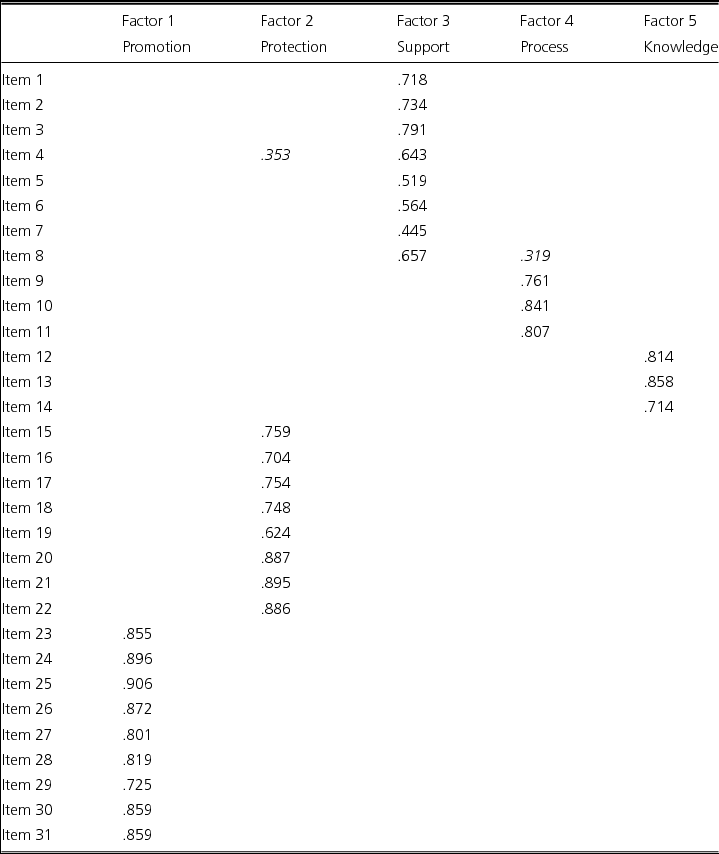
The criteria used to determine the number of factors to rotate was the scree test and the interpretability of the factor solution. Six factors were rotated using a varimax rotation procedure. Using a cut-point load rating of 0.3 (Tabachnick & Fidell, Reference Tabachnick and Fidell2001) the rotated solution, as shown in Table 1, yielded five interpretable factors consistent with the constructs previously examined using PCA and accounted for 67% of the variance.
Workplace Scale: Rotated Factor Matrix (N = 108)

Note: Extraction method: Maximum likelihood. Rotation method: Varimax with Kaiser normalisation. Loadings below the .3 cut-off are not listed in the table as rotation converged in six iterations.
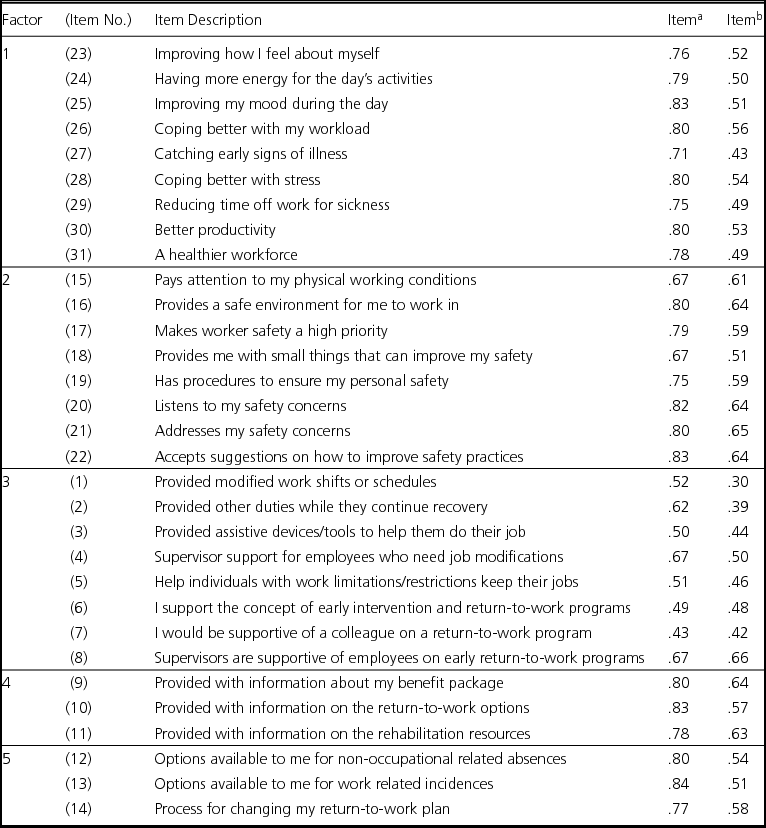
Item-total correlations are presented in Table 2. The table presents the item-total in columns 3 and 4. Column 3 of the table represents the corrected item-total correlation for the items in the factor (i.e., the correlation of the designated item with the summated score of the remaining items in that factor) and demonstrates that the multiple items designed to measure the construct do intercorrelate with one another. Column 4 represents corrected item-total correlation for the designated item with the summated score of the remaining items in the scale and shows internal consistency with all items. The heuristic for this value is .4 (Gliem & Gliem, Reference Gliem and Gliem2003). Cronbach's reliability alpha for the scale was .92.
Item-Total Correlation for the 31 Items Retained (Cronbach's alpha = 92)

Note: a = corrected item-total correlation by factor; b = corrected item-total correlation by scale.
Discussion
The purpose of this study was to devise an assessment tool that would (a) have sound psychometric properties, (b) assess important dimensions of a healthy workplace (c) be an upward communication mechanism for employees and (d) be a user-friendly assessment tool to enable management to either (1) baseline and monitor at an organisational level progress towards building a healthy workplace, or (2) target an assessment at a specific program, such as a disability management program to baseline and monitor progress. Indeed, the tangible product of the study is a user-friendly tool to baseline the development of a healthy, sustainable workplace, while providing employees with an efficient upward communication mechanism to enable management to monitor progress of same. The five dimensions measured within the scale displayed acceptable levels of reliability and were factorially distinct
The process to establish sound psychometric properties for the WPS is described in terms of classical test theory (i.e., a measure is composed of a true score and error score), the reliability indices reported for the WPS indicates the measure has excellent reliability and that it is performing well. The reliability pertains to the consistency of and stability of the measurement across different measurement conditions (Poortinga, Reference Poortinga1989). For the WPS the different measurement conditions involved four pre-study rounds of data collection with different samples that demonstrated consistent performance of the items across contexts specifically relating to item reliability and principal component analysis. This stability continued to be reflected in the reliability and factor analysis reported here. The use of an international sample of individuals from different organisations demonstrated the stability of the measure in that the data collected yielded a Cronbach's alpha of .92 for the scale and an identical dimension structure when using PCA on a Canadian sample and a stronger structure when using factor analysis on the international sample. The factor analysis revealed an interpretable five factor solution, each factor representing a relevant aspect of the literature on healthy workplaces — Support, Process, Knowledge, Protection, and Promotion. More specifically the results in Table 1 and Table 2 demonstrate the internal consistency of the measure and thus support the continuing use of the WPS into the larger planned study, which examines the internal context of workplaces from industrial settings in terms of culture, climate and leadership. Notwithstanding the robust performance reported here, the scale will also benefit from repeat administration on larger and more representative samples as we progress into the next phase of this larger study.
The process described also ensures the WPS assesses important dimensions of a healthy workplace. The process of item generation was guided by a review of the scientific literature related to healthy workplaces and guided by the focus groups to ensure practical relevancy and content. Thus far the development of the WPS has adhered to the major steps outlined by Spector (Reference Spector1992) for scale development (i.e., construct definition, scale design, pilot testing, administration and item analysis). This development is also consistent with Spector's four prerequisite characteristics for a summated rating scale, which are (1) multiple items in each dimension, (2) each item is a statement that is rated by respondents, (3) there is no right or wrong answer to the statements, and (4) the use of a quantitative scale. The WPS meets these characteristics and is grounded in the relevant literature on healthy workplaces. A higher score indicates a more positive perception of each dimension. Indeed, the five-facet measure revealed through factor analysis and developed in Canada is homologous to the categories in the strategy proposed by the HSA of Ireland to achieve workplace health. The WPS assesses promotion, protection, support and knowledge of policies and resources for medical leave. The strategy focuses on prevention, promotion, and rehabilitation, which overlap the dimensions of the WPS and supports a cross-cultural application. However, the next phase of this study will also be important to the continued development of the WPS as we investigate correlations between this scale and similar scales to establish construct validity.
The third objective was to develop a tool that could act as an upward communication mechanism for employees. Tourish and Hargie (Reference Tourish and Hargie2004) stress the importance of employee voice and the mutual benefits from upward communication in the decision making process. The movement towards a healthy workplace advocates for a participative approach to the organisation of work rather than viewing employees simply as instrumental for fulfilling organisational goals (Detert & Burris, Reference Detert and Burris2007). Open and clear communication is the cornerstone to effective management (Bennis, Reference Bennis1989) and the building blocks of trust (Thomas, Zolin, & Hartman (Reference Thomas, Zolin and Hartman2009). While typically communication comes from a top-down direction, in genuinely supportive environments the perceptions of employees can be used as an upward communication mechanism to shape change (Tourish & Hargie, Reference Tourish and Hargie2004). The WPS provides employees the opportunity of providing feedback that can facilitate positive change in the policies, practices and procedures of the workplace.
The final objective was to devise a user-friendly, facet-specific scale that is easy to complete. The scale has a total of 31 items under five headings that takes at most 15 minutes to complete. It can be easily administered electronically through email or survey monkey or as a paper and pencil questionnaire. Indeed, the result is a pragmatic benchmarking instrument that evaluates shared, concrete knowledge of policies, practices and procedures relating to health, supportiveness and safety at work. The importance of shared knowledge is relevant to the development of norms that implicitly govern attitudes, beliefs and expectancies regarding work-related behaviours, interpersonal relations and the nature of organisational support (Hammer, Saksvik, Nytrø, Torvatn, & Bayazit, Reference Hammer, Saksvik, Nytrø, Torvatn and Bayazit2004). Moreover, knowledge of the organisational practices, policies and procedures develops the behavioural norms and expectancies within which a participative and collaborative process operates (Cooper, Reference Cooper1998; Kelloway & Barling, Reference Kelloway and Barling2010) — particularly under the remit of a disability management program. It is well understood that policies have both a formal statement and an informal style by which they are implemented or interpreted. It is only by fostering awareness among all employees of acceptable behavioural norms and expectancies that a healthy workplace can develop. Communication channels need to be sufficiently broad enough to reach all employees (Frese & Keith, Reference Frese and Keith2015). Open and broad communication is cited in the literature as a key element of successful implementation of initiatives (e.g., see Westmorland & Williams, Reference Westmorland and Williams2002; WHO 2010). Without strong communication the framework of a healthy working environment may be difficult to foster (Daft, Reference Daft2015). The utility of the WPS is in that important first step of benchmarking before implementing such workplace health initiatives and thereafter, monitoring progress with the implementation of the initiative. The WPS is a bottom-up communication to management from which continuous improvement strategies can be tailored to address concerns from employees.
Finally, it must also be considered that workplace health is a molar latent construct without precise definition in the literature. The dimensions selected here operationalise the concept of workplace health and reflect pertinent aspects of workplace health identified though the literature. Although the dimensions are not singularly sufficient for, nor an exhaustive composition of workplace health, they do reflect policies, practices and strategies that support, promote and protect the health of the worker. Constructing a picture of workplace factors to facilitate the promotion, protection or support of the workforce allows the full potential of health initiatives to be achieved — particularly in relation to a disability management program that is long associated with improved outcomes for ill and injured workers (Amick et al., Reference Amick, Habeck, Hunt, Fossel, Chapin, Keller and Katz2000).
Limitations and Future Direction
A limitation that should be mentioned is in relation to the samples drawn for the multi-phased development process. In the preliminary pilot-testing phases the samples were drawn exclusively from one health care provider using different geographic sites. Each administration demonstrated an adequate performance of the WPS and was consistent in yielding five factors. For this phase of the study we used a nonprobability sampling technique to test the statistical properties of the questionnaire and cascaded the WPS electronically. Notwithstanding that the 108 respondents came from different organisations in different countries, they were predominantly from health care or educational backgrounds that would limit the generalisability of the WPS outside a health care setting. Nevertheless, this does not detract from the robust performance of the WPS yielding five factorially distinct dimensions to date. Indeed, the robustness of the scale enabled us to confidently bring it forward for further testing in industrial settings. In the subsequent phase of this study the performance of the WPS was tested against measures of culture, climate and leadership to explore how robust the performance continued to be when compared to the other measures. This work is reported under separate cover.
Conclusion
Although the concept of a healthy workplace is elusive to define and presents challenges in workplace application, what was achieved in this phase of the study is a tangible product that evaluates employees’ perceptions and knowledge of the practices and procedures in the workplace that prioritise the development of a healthy, supportive workplace. Embedded within this context of a healthy workplace is a concomitant approach — disability management — which aims to mitigate medical conditions and injuries as they occur. Each factor identified by the WPS — Support, Process, Knowledge, Protection, and Promotion — represents relevant aspects of the literature at (a) the organisational level for developing a healthy workplace, and (b) the individual level for developing a disability management program. The utility of the WPS will be to baseline and monitor the development of and progress towards a healthy, supportive workplace and will be of value to organisations seeking to improve their workplaces. Notwithstanding these benefits, it is essential that future phases of this study investigate correlations between the WPS and similar more established scales to ensure construct validity.