Implications
Pre-weaning mortality rates in farm animals are high and variable between farms: 10% to 25% in lambs, 7% to 50% in kids, 0% to 50% in calves, 0% to 35% in foals, 5% to 35% in pigs (Mellor and Stafford, Reference Mellor and Stafford2004), and important efforts are carried out by farmers to reduce these economically and ethically questionable losses. Concurrently, gestating females are often exposed to stressors or poor housing conditions that also question modern industrial farming acceptability. The present review shows that stress of pregnant females may impair neonatal health and survival in pigs and ruminants through its impact on maternal behavior as well as on passive, innate and acquired immunity of the offspring.
Introduction
Research has clarified much about the causes of neonatal mortality in farm animals and has provided practical means for decreasing it. The major mortality and health problems are due to hypothermia, hypoxia or starvation. Maternal undernutrition, mismothering, injury and infection represent a significant part of morbidity and mortality after the perinatal phase (Mellor and Stafford, Reference Mellor and Stafford2004; Baxter et al., Reference Baxter, Jarvis, Palarea-Albaladejo and Edwards2012; Walker et al., Reference Walker, Epperson, Wittum, Lord, Rajala-Schultz and Lakritz2012). Management practices dedicated to improve neonatal survival and health are mainly focusing on the young animal itself, on its direct environment, or on the maternal qualities of the lactating mother. Less investment is devoted to the prenatal environment of the young, particularly the general health and welfare status of the pregnant mothers.
Besides genetic factors, environmental events acting prenatally on the developing fetus are important determinants for disorders later in life (Barker et al., Reference Barker, Godfrey, Gluckman, Harding, Owens and Robinson1993; Fowden et al., Reference Fowden, Giussani and Forhead2006). The concept that poor maternal nutrition during pregnancy can have long-term consequences on health and well-being of the offspring is broadly accepted (Reynolds and Caton, Reference Reynolds and Caton2012). For example, gestating cattle submitted to drought give birth to calves with severe health and growth abnormalities (White et al., Reference White, Ward, Toribio and Windsor2010), and nutritional strategies for pregnant females have been developed to favor fetal growth and neonatal survival (Le Floc'h et al., Reference Le Floc'h, Gondret, Matte and Quesnel2012; Reynolds and Caton, Reference Reynolds and Caton2012). In this review, major physiological stressors such as malnutrition or materno-fetal infections will not be considered because they have obvious effects for the offspring that have been described elsewhere, and efforts are made in modern farm systems to suppress these two sources of problems. In this review, the term ‘stressor’ refers to less marked, non-nutritional and non-pathogenic environmental challenges that nevertheless impair maternal welfare and can induce a physiological stress response. These stressors are often related to housing or management practices. The effects of such stressors, occurring during gestation, on pre-weaning mortality and morbidity and the possible physiological mechanisms will be presented.
Maternal stress during gestation and prenatal stress in the offspring: relevance in farm animal species
Sources of maternal stress
Reproductive females in modern husbandry are often exposed to stressors during gestation. For example, in intensive pig husbandry, pregnant females have to face transportation and moving to a new environment, hunger because of food limitation, leg disorders, fear from human or social stress because of grouping with unfamiliar conspecifics and competition for the access to feed (Hemsworth, Reference Hemsworth2003; D'Eath et al., Reference D'Eath, Tolkamp, Kyriazakis and Lawrence2009; Spoolder et al., Reference Spoolder, Geudeke, Van der Peet-Schwering and Soede2009). In cattle, climatic stress, handling, transportation, fear from humans and social stress are also common stressors (Hemsworth, Reference Hemsworth2003; Arnott et al., Reference Arnott, Roberts, Rooke, Turner, Lawrence and Rutherford2012). Maternal stressors induce a stress response, raising maternal endogenous levels of cortisol and catecholamines (De Leeuw and Ekkel, Reference De Leeuw and Ekkel2004; Roussel et al., Reference Roussel, Hemsworth, Leruste, White, Duvaux-Ponter, Nowak and Boissy2006; Couret et al., Reference Couret, Otten, Puppe, Prunier and Merlot2009b), which are assumed to be the main mediators of prenatal stress (see below). Microbial challenges, even when they do not lead to in utero transmission of any pathogen (poor hygiene conditions, mastitis, feet and leg diseases, etc.), deteriorate maternal health and cause metabolic and immune changes that cumulate with the neuroendocrine stress response and could influence fetal or neonatal development (Dauby et al., Reference Dauby, Goetghebuer, Kollmann, Levy and Marchant2012).
Extrapolation of data from basic research
Exposure to severe stress during pregnancy influences the developing fetus, affecting its birth weight and physiology, including immune system maturation after birth (Merlot et al., Reference Merlot, Couret and Otten2008). In rodents, these effects are partly mediated by the fetal exposure to high concentrations of glucocorticoids from maternal origin (Barbazanges et al., Reference Barbazanges, Piazza, Le Moal and Maccari1996). Indeed, the access of glucocorticoids to the fetal compartment is regulated by the placental enzyme 11β-hydroxysteroid dehydrogenase type 2 (11β-HSD2). Although a proportion of the cortisol produced by the mother during the stress response is inactivated by this enzyme, cortisol levels are still elevated in the fetus. In farm animals, this has been demonstrated in pig (Klemcke et al., Reference Klemcke, McGuire and Christenson1995) and sheep (Hennessy et al., Reference Hennessy, Coghlan, Hardy, Scoggins and Wintour1982). Trophic factors modulating placental physiology might also be involved. For example, stress stimulates adrenaline release and, high physiological levels of adrenaline reduce uterine artery blood flow in sheep, altering materno-fetal glucose exchanges (Jones and Gu, Reference Jones and Gu1986).
Rodent data on prenatal stress cannot be simply transposed to farm animals because of major species differences. Species that give birth to non-precocious offspring (rats, rabbits and mice) have a large proportion of immune development during late gestation and the postnatal period (Holladay and Smialowicz, Reference Holladay and Smialowicz2000; Holsapple et al., Reference Holsapple, West and Landreth2003). By contrast, animals that give birth to precocious offspring (sheep, pig, cattle and primates) display development of the immune system predominantly in utero (Trebichavský et al., Reference Trebichavský, Tlaskalová, Cukrowska, Splíchal, Sinkora, Øeháková, Sinkora, Pospísil, Kováøù, Charley, Binns and White1996; Sinkora et al., Reference Sinkora, Butler, Holtmeier and Sinkorova2005). Furthermore, primates and rodents have a hemomonochorial and hemotrichorial placentation, whereas pigs, sheep and goats have an epitheliochorial placentation, which affects the route of acquisition of maternal immunity. Passive immunity is obtained through the placenta in rodents and primates, and via colostrum in ungulates. Thus, specific studies are needed to investigate whether prenatal stress can influence neonatal survival and the immune function in ungulate offspring.
Models of prenatal stress in farm animal species
Most of the studies investigating the influence of prenatal stress on factors influencing neonatal survival and immunity in farm animals focused on pigs, using behavioral stressors such as nose sling restraint that involves pain (Tuchscherer et al., Reference Tuchscherer, Kanitz, Otten and Tuchscherer2002), rough treatment (Lay et al., Reference Lay, Kattesh, Cunnick, Daniels, Kranendonk, McMunn, Toscano and Roberts2011) or social stress (Jarvis et al., Reference Jarvis, Moinard, Robson, Baxter, Ormandy, Douglas, Seckl, Russell and Lawrence2006; Couret et al., Reference Couret, Otten, Puppe, Prunier and Merlot2009b). Experiments were also conducted using artificial activation of the maternal corticotrope axis with adrenocorticotropic hormone (ACTH) injections (Haussmann et al., Reference Haussmann, Carroll, Weesner, Daniels, Matteri and Lay2000; Otten et al., Reference Otten, Kanitz, Tuchscherer, Puppe and Nurnberg2007) or mimicking corticotrope axis activation by providing pregnant sows with oral cortisol (Kranendonk et al., Reference Kranendonk, Hopster, van Eerdenburg, Van Reenen, Fillerup, de Groot, Korte and Taverne2005). However, studies using synthetic glucocorticoids must be considered cautiously because these exogenous glucocorticoids are metabolized by the placenta less efficiently, and thus have more severe consequences on fetal development than natural glucocorticoids (Singh et al., Reference Singh, Cuffe and Moritz2012). In ruminants, studies using stressors such as transport also provide data concerning mortality, or birth weight of the offspring (Lay et al., Reference Lay, Randel, Friend, Jenkins, Neuendorff, Bushong, Lanier and Bjorge1997a; Roussel et al., Reference Roussel, Boissy, Montigny, Hemsworth and Duvaux-Ponter2005; Cooke et al., Reference Cooke, Bohnert, Cappellozza, Mueller and DelCurto2012).
Heat and cold stress are not behavioral stressors. However, because they both activate the corticotrope axis (Messias de Braganca et al., Reference Messias de Braganca, Mounier and Prunier1998; Webster et al., Reference Webster, Stewart, Rogers and Verkerk2008) and are relevant challenges for animals kept outdoors as well as indoors, the consequences of maternal thermal stress during gestation will be also considered in this review. Studies on pigs also compared the consequences for the offspring of contrasted housing conditions of sows during their pregnancy, most often comparing individual stalls and collective pens of variable size. The welfare benefit of group housing is still in debate. Compared with individual stalls, group housing increases circadian cortisol secretion (Melchior et al., Reference Melchior, Zanella, Lovatto, Lehnen, Lanferdini and Andretta2012), but not in response to an ACTH challenge (Broom et al., Reference Broom, Mendl and Zanella1995; Boyle et al., Reference Boyle, Leonard, Lynch and Brophy2002). Group housing decreases oral stereotypes and aggression (Broom et al., Reference Broom, Mendl and Zanella1995); however, the impact on body lesions is uncertain and probably strongly depends on the interaction with the presence of foraging material and the housing design (Boyle et al., Reference Boyle, Leonard, Lynch and Brophy2002; Harris et al., Reference Harris, Pajor, Sorrells, Eicher, Richert and Marchant-Forde2006; Hulbert and McGlone, Reference Hulbert and McGlone2006). Although these studies do not provide contrasted groups in terms of maternal stress, they are included in the review because of their practical relevance for pig husbandry.
Effect of maternal stress during gestation on morbidity and mortality of the offspring
Pre-weaning mortality
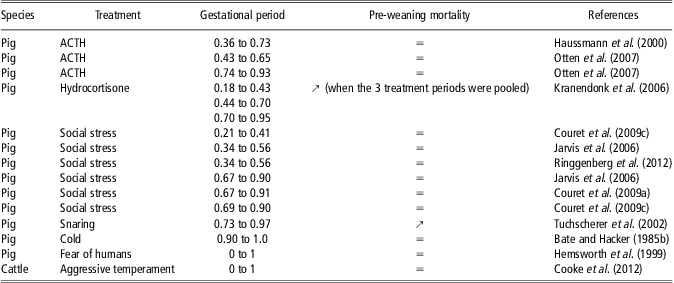
Maternal stress has a negative impact on reproductive performances in rodents, such as a reduced litter size (Götz et al., Reference Götz, Wolf and Stefanski2008) or an increased mortality of neonates (Pollard, Reference Pollard1984; Lordi et al., Reference Lordi, Patin, Protais, Mellier and Caston2000), but this effect was not consistently reported (Llorente et al., Reference Llorente, Brito, Machado and González2002; Kapoor and Matthews, Reference Kapoor and Matthews2005; Götz et al., Reference Götz, Wolf and Stefanski2008). In farm animals, stressors occurring during early gestation might lead to abortions or, in polytocous species such as the pig, to partial fetal losses without abortion (Von Borell et al., Reference Von Borell, Dobson and Prunier2007). However, most of the time, the development of the fetuses continues until term (Von Borell et al., Reference Von Borell, Dobson and Prunier2007). A majority of studies, mainly in porcine species, failed to show any link between prenatal stress and mortality during the neonatal period (Table 1). Only one study demonstrated a clear effect of prenatal stress on mortality. In this study, repeated nose sling restraint during the last third of gestation more than doubled the mortality of the piglets during the suckling period (Tuchscherer et al., Reference Tuchscherer, Kanitz, Otten and Tuchscherer2002).
Impact on neonatal survival of maternal stressors or pharmacological activation of maternal corticotrope axis in farm animals

The gestational period when the treatment was applied is expressed in percentage of the total gestation length (e.g. 0 to 0.5 means ‘from conception to mid-gestation’).
Studies comparing different housing systems during the gestation of sows are not included in the table because they did not provide contrasted groups in terms of maternal stress.
Most of the time individual penning of sows led to a pre-weaning mortality similar to group housing (Broom et al., Reference Broom, Mendl and Zanella1995; Bates et al., Reference Bates, Edwards and Korthals2003; Harris et al., Reference Harris, Pajor, Sorrells, Eicher, Richert and Marchant-Forde2006; Hulbert and McGlone, Reference Hulbert and McGlone2006), except for some studies where a lower (Cronin et al., Reference Cronin, Simpson and Hemsworth1996) or a higher (Karlen et al., Reference Karlen, Hemsworth, Gonyou, Fabrega, Strom and Smits2007) mortality were found in litters from individually housed sows. Providing straw bedding to group-housed sows (Von Borell et al., Reference Von Borell, Morris, Hurnik, Mallard and Buhr1992; Spoolder et al., Reference Spoolder, Burbidge, Edwards, Simmins and Lawrence1996) or combining group penning with provision of foraging materials (wood shavings) during pregnancy (Von Borell et al., Reference Von Borell, Morris, Hurnik, Mallard and Buhr1992; Spoolder et al., Reference Spoolder, Burbidge, Edwards, Simmins and Lawrence1996) did not influence pre-weaning mortality.
Pre-weaning morbidity and markers of inflammation
Human epidemiological data show that maternal stress during pregnancy may be a risk factor for congenital malformations, and respiratory, digestive, skin and genito-urinary diseases (Tegethoff et al., Reference Tegethoff, Greene, Olsen, Schaffner and Meinlschmidt2011). Few data are available on farm mammals. In pigs, treatment of the mother with ACTH during the last third of gestation did not affect the frequency of diseased piglets during the lactation period (Otten et al., Reference Otten, Kanitz, Tuchscherer, Puppe and Nurnberg2007). However, a strong behavioral stressor involving pain applied at the same gestational period increased the number of diseased piglets per litter until weaning (Tuchscherer et al., Reference Tuchscherer, Kanitz, Otten and Tuchscherer2002). Studies that did not measure the occurrence of disease events directly but assessed blood levels of health markers, such as acute phase proteins and inflammatory cytokines, failed to find a clear effect of prenatal stress. Indeed, repeated social disturbance of the mothers during late gestation did not affect the levels of haptoglobin in piglets around weaning (Couret et al., Reference Couret, Jamin, Kuntz-Simon, Prunier and Merlot2009a). Nose sling restraint stress during late gestation decreased blood levels of tumor necrosis factor-α (TNF-α) and interleukin-6 (IL-6), but not of C-reactive protein, serum amyloid A (SAA) and haptoglobin in 2-month-old pigs (Collier et al., Reference Collier, Williams, Carroll, Welsh and Laurenz2011). When comparing the piglets born from gilts housed in stalls or in groups, Sorrells et al. (Reference Sorrells, Eicher, Scott, Harris, Pajor, Lay and Richert2006) did not find significant differences in TNF-α, haptoglobin and alpha-1-acid glycoprotein levels during the 1st month of life.
To conclude, data showing an effect of prenatal stress on mortality and morbidity are scarce. Furthermore, the conclusions of most of them are based on small numbers of experimental animals that did not allow an accurate evaluation of morbidity and mortality rates. Epidemiological data are lacking. Nevertheless, data from the literature suggest that prenatal stress might have an impact on important factors involved in the preservation of neonatal health. These factors can be either related to maternal biology or to true prenatal stress effects, that is, long-term alterations in fetal ontogeny (Figure 1). These two aspects are described below.
Maternal and offspring characteristics determining neonatal health and that might be affected by a maternal stress occurring during gestation.
Effect of maternal stress during gestation on maternal qualities
Colostrum production
Consumption of colostrum provides energy for thermoregulation and passive immunity. Insufficient colostrum intake is one of the major causes of mortality until weaning in farm mammals (Tyler et al., Reference Tyler, Hancock, Wiksie, Holler, Gay and Gay1998; Devillers et al., Reference Devillers, Le Dividich and Prunier2011). To the best of our knowledge, the impact of psychological stress on colostrum yield and gross composition has not been investigated. In pigs, psychological stress during the last third of pregnancy had no effect on IgG contents in colostrum (Tuchscherer et al., Reference Tuchscherer, Kanitz, Otten and Tuchscherer2002; Couret et al., Reference Couret, Jamin, Kuntz-Simon, Prunier and Merlot2009a).
In pigs, heat stress during the last week of pregnancy decreased (Machado-Neto et al., Reference Machado-Neto, Graves and Curtis1987), whereas cold stress during the last 2 days increased (Bate and Hacker, Reference Bate and Hacker1985b) the circulating IgG levels in neonates. The possible causes for these variations are either an impaired ability of the neonate to suckle colostrum and absorb IgG (see below), or a decrease in the quantity and quality of the colostrum produced by the mother. Colostrum quality might be affected as heat stress tended to decrease colostrum IgG (Machado-Neto et al., Reference Machado-Neto, Graves and Curtis1987). The physiological mechanisms responsible for this alteration have not been investigated.
In cattle, heifers born from cows exposed to natural summer heat stress during the last 45 days of pregnancy had lower serum concentrations of IgG after colostrum consumption than heifers born from mothers that received a cooling treatment (Tao et al., Reference Tao, Monteiro, Thompson, Hayen and Dahl2012). Several studies investigated whether alteration in the transfer of maternal immunity from heat-stressed cows was related to a deterioration of the composition and/or the quantity of colostrum produced by the mothers. Nardone et al. (Reference Nardone, Lacetera, Bernabucci and Ronchi1997) found that heat stress during the last 3 weeks of gestation was associated with decreased energy and protein content in colostrum, including a reduction of colostral IgG and IgA. Adin et al. (Reference Adin, Gelman, Solomon, Flamenbaum, Nikbachat, Yosef, Zenou, Shamay, Feuermann, Mabjeesh and Miron2009) found that exposure to heat stress during the dry period reduced both the quantity of first colostrum and its IgG content. However, cows exposed to natural summer heat in Florida had higher colostral IgG concentrations than cows sampled during other months of the year (Shearer et al., Reference Shearer, Mohammed, Brenneman and Tran1992). Furthermore, cows exposed to a moderate heat stress owing to the hot Mediterranean summer had similar colostrum IgG concentrations as those delivering during spring (Lacetera et al., Reference Lacetera, Bernabucci, Ronchi, Scalia and Nardone2002). In these last two studies, the effect of heat was confounded with a more general seasonal effect.
In pigs and cattle, colostrum yield and composition are under hormonal control, with prolactin and steroids (progesterone, estradiol and glucocorticoids) playing a key role (Barrington et al., Reference Barrington, McFadden, Huyler and Besser2001; Farmer and Quesnel, Reference Farmer and Quesnel2009). Alterations in prolactin and progesterone concentrations during the prepartum period were associated with a decreased production of colostrum by primiparous sows (Foisnet et al., Reference Foisnet, Farmer, David and Quesnel2010). Moreover, prolactin was demonstrated to induce the cessation of IgG transfer into colostrum in cows, and glucocorticoids are also likely to be involved (Barrington et al., Reference Barrington, McFadden, Huyler and Besser2001). As heat stress increases prolactin levels during the last few weeks of gestation of cows (do Amaral et al., Reference do Amaral, Connor, Tao, Hayen, Bubolz and Dahl2011), prolactin has been proposed as a candidate for the decreased colostrogenesis in heat-stressed cows (Tao et al., Reference Tao, Monteiro, Thompson, Hayen and Dahl2012). By contrast, in sows, repeated injections of ACTH during the third trimester of gestation had minor influence on maternal progesterone levels (Brüssow et al., Reference Brüssow, Schneider, Kanitz, Otten and Tuchscherer2005), and heat stress starting at 84 days of gestation did not affect maternal prolactin levels around parturition (Messias de Braganca et al., Reference Messias de Braganca, Mounier and Prunier1998). These observations fit with the negligible effect of maternal stress on colostrum production in sows. Further studies are required to determine whether increased cortisol in stressed females played a role in terminating IgG transfer into colostrum.
Gut flora of the neonate
Maternal stress during late pregnancy can also alter the establishment of the newborn's commensal intestinal flora. In Rhesus monkeys, maternal stress reduced the numbers of lactobacilli and bifidobacteria in the gut during the first 24 weeks of life of the offspring (Bailey et al., Reference Bailey, Lubach and Coe2004). In rats, maternal cortisone injection reduced the concentrations of total and gram-negative bacteria in pups (Schiffrin et al., Reference Schiffrin, Carter, Walker, Fieberg, Bejamin and Isael1993). These alterations in the flora of the offspring are suspected to result from stress-induced changes in maternal gut flora or milk. Comparable studies in farm animals are lacking. Such changes could be particularly important because these commensal bacteria are involved in protection against diarrheal illness in piglets and calves (Abe et al., Reference Abe, Ishibashi and Shimamura1995).
Maternal care
Maternal care is a major element for perinatal survival in mammals. In pigs, two social reorganizations during mid or late pregnancy did not alter maternal behavior around parturition and until 6 h post parturition (Jarvis et al., Reference Jarvis, Moinard, Robson, Baxter, Ormandy, Douglas, Seckl, Russell and Lawrence2006). However, more frequent social perturbations during mid-gestation increased the time lying ventrally in early lactation, thus restricting access to the udder and indicating a lower motivation of sows to nurse (Ringgenberg et al., Reference Ringgenberg, Bergeron, Meunier-Salaün and Devillers2012). In sheep, repeated transport associated with isolation stress during the last third of pregnancy reduced the dam's motivation to stay in contact with her lamb when a human being was approaching (Roussel et al., Reference Roussel, Hemsworth, Leruste, White, Duvaux-Ponter, Nowak and Boissy2006). The authors hypothesized that this might not result from a weaker mother–young bond but from increased fear of human, because of the aversive treatments that ewes experienced in the contact of humans during pregnancy. Accordingly, in another study, ewes subjected to daily aversive handling during the last 5 weeks of gestation displayed increased grooming of their lamb during the first 24 hours after parturition, but fear of humans disrupted their ability to follow their lambs closely when carried away by a human (Hild et al., Reference Hild, Coulon, Schroeer, Andersen and Zanella2011).
Prenatal stress might even influence maternal behavior of female offspring. Indeed, group-housed sows socially stressed during mid or late pregnancy gave birth to female offspring that were more responsive to newborn piglets that approached their head and tended to bite them more than control females (Jarvis et al., Reference Jarvis, Moinard, Robson, Baxter, Ormandy, Douglas, Seckl, Russell and Lawrence2006).
Effect of maternal stress on subclinical maternal health deterioration and consequences on maternal qualities
Immune status of the mothers and transmission of pathogens
If stress during gestation weakens maternal immunity and worsens maternal health status, it might also affect the immune and microbial inheritance that the mother transmits to its progeny. In humans, maternal stress during gestation was associated with increased markers of inflammation in maternal plasma and increased responsiveness of maternal immune cells to inflammatory stimulation in vitro, supporting the view that prenatal stress alters maternal immune function (Coussons-Read et al., Reference Coussons-Read, Okun and Nettles2007). In gestating sows, repeated social stress increased salivary cortisol but did not alter either blood cell counts and lymphocyte proliferation, or the antibody response to an immunization (Couret et al., Reference Couret, Otten, Puppe, Prunier and Merlot2009b).
Regarding housing environment, most of the studies comparing individual stall v. group housing combined or not with provision of foraging materials failed to detect any impairment in the maternal immune markers investigated (Von Borell et al., Reference Von Borell, Morris, Hurnik, Mallard and Buhr1992; Hulbert and McGlone, Reference Hulbert and McGlone2006; Sorrells et al., Reference Sorrells, Eicher, Harris, Pajor and Richert2007). The lack of difference might be owing to the fact that the space allocated per animal in the small groups was not much bigger than in individual stalls (not more than 2.3 m2 per sow). In opposite, sows housed in large groups on deep litter or with a lot of space per animal (9 m2) displayed improved lymphocyte counts during lactation (Broom et al., Reference Broom, Mendl and Zanella1995) or neutrophil/lymphocyte ratio at the end of gestation (Karlen et al., Reference Karlen, Hemsworth, Gonyou, Fabrega, Strom and Smits2007) than sows housed in individual stalls.
Individual housing is expected to limit the spread of pathogens that disseminate via direct contacts between animals or via the feces. Contrarily, epidemiological data suggest that individual housing during pregnancy may increase the transmission of pathogens from the mother to the fetus or neonate. Indeed, compared with group-housed sows, animals housed in individual pens during pregnancy were found to be more at risk for post-weaning multisystemic wasting syndrome development in their offspring (Rose et al., Reference Rose, Larour, Le Diguerher, Eveno, Jolly, Blanchard, Oger, Le Dimna, Jestin and Madec2003) and shedding of Campylobacter coli in their feces during lactation (Denis et al., Reference Denis, Henrique, Chidaine, Tircot, Bougeard and Fravalo2011). However, in these studies, the reason for the difference between stall and group housing in pathogen transmission is not known, and investigation is needed to determine whether maternal stress is involved.
Colostrum production
The impact of subclinical maternal problems during gestation on colostrum production and quality has been poorly explored. In cows, pre-partum mastitis reduced the volume of colostrum and the total amount of IgG exported into colostrum, along with total protein and fat contents (Maunsell et al., Reference Maunsell, Morin, Constable, Hurley, McCoy, Kakoma and Isaacson1998). In an artificial model of mild chronic inflammation, cows were treated orally with interferon-alpha (IFN-α) during the last 2 weeks of pregnancy (Trevisi et al., Reference Trevisi, Amadori, Bakudila and Bertoni2009). At the first milk sampling, 3 days postpartum, the IFN-α group showed less protein and fat contents in milk than did the control group, which suggests that the immunoglobulin protein fraction might have been also decreased during the first 3 days.
Effect of maternal stress during gestation on the biology of the offspring
Birth weight
Birth weight is a critical factor for neonatal survival and disease incidence in farm species (Tuchscherer et al., Reference Tuchscherer, Puppe, Tuchscherer and Tiemann2000; Bleul, Reference Bleul2011). Although human studies show that maternal stress exposure during mid-pregnancy is a risk factor for preterm birth and small for gestational age children (Class et al., Reference Class, Lichtenstein, Langstrom and D'Onofrio2011), results from studies in farm animals are less clear.
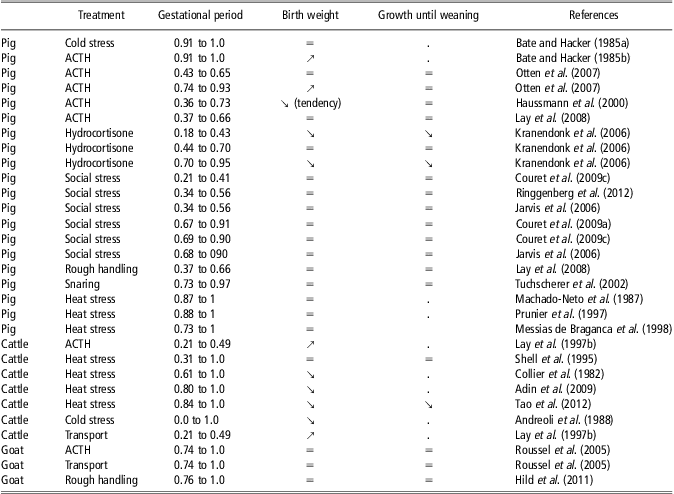
In pigs, maternal treatment with ACTH or glucocorticoid reduced (Haussmann et al., Reference Haussmann, Carroll, Weesner, Daniels, Matteri and Lay2000; Kranendonk et al., Reference Kranendonk, Hopster, Fillerup, Ekkel, Mulder, Wiegant and Taverne2006), or increased the birth weight of the piglets (Otten et al., Reference Otten, Kanitz, Tuchscherer, Puppe and Nurnberg2007). A variety of maternal psychological stressors have been studied (Table 2). None of them affected piglet birth weight except in one study where individual housing during gestation decreased litter weight (Bates et al., Reference Bates, Edwards and Korthals2003). Heat stress during the last 10 or 30 days of pregnancy had no impact on individual and litter birth weight (Machado-Neto et al., Reference Machado-Neto, Graves and Curtis1987; Prunier et al., Reference Prunier, de Braganca and Le Dividich1997; Messias de Braganca et al., Reference Messias de Braganca, Mounier and Prunier1998).
Impact on birth weight of maternal stressors or pharmacological activation of maternal corticotrope axis in farm animals
The gestational period when the treatment was applied is expressed in percentage of the total gestation length (e.g. 0 to 0.5 means ‘from conception to mid-gestation’).
In ruminants, maternal ACTH treatment increased birth weight of calves (Lay et al., Reference Lay, Randel, Friend, Jenkins, Neuendorff, Bushong, Lanier and Bjorge1997a) but not of goat kids (Roussel et al., Reference Roussel, Boissy, Montigny, Hemsworth and Duvaux-Ponter2005). Behavioral stressors were mainly reported to have no impact or to increase birth weight (Table 2). Heat stress during the last third of pregnancy had no impact (Shell et al., Reference Shell, Early, Carpenter and Buckley1995) or decreased birth weight in calves, lambs and goat kids (Collier et al., Reference Collier, Doelger, Head, Thatcher and Wilcox1982; McCrabb et al., Reference McCrabb, McDonald and Hennoste1993; Mellado et al., Reference Mellado, Vera, Meza-Herrera and Ruiz2000; Tao et al., Reference Tao, Monteiro, Thompson, Hayen and Dahl2012). Moreover, it has been shown in ewes that heat stress during mid-pregnancy had a delayed effect on fetal growth later during pregnancy, probably because of a long-lasting negative effect on placental growth (McCrabb et al., Reference McCrabb, McDonald and Hennoste1993). Exposure of dams to winter weather during the last third of gestation decreased the birth weight of calves relatively to those of dams housed at thermoneutrality (Andreoli et al., Reference Andreoli, Minton, Spire and Schalles1988).
Passive immunity
Impairment of the transfer of maternal immunity to the neonate has been described above. Besides effects on colostrum composition and quantity, late gestational stress can also decrease the ability of the offspring to acquire maternal immunity from colostrum. For example, decreased blood IgG contents were observed in piglets whose mothers were exposed to stress during late pregnancy, whereas IgG levels in the colostrum were not altered (Tuchscherer et al., Reference Tuchscherer, Kanitz, Otten and Tuchscherer2002). There are no data investigating whether prenatal stress affects the amount of colostrum that neonates ingest, but indirect measurements suggest that this is unlikely the case. In pigs, treatment of the mother with ACTH during gestation did not affect neonatal vitality and latency of the first colostrum intake (Otten et al., Reference Otten, Kanitz, Tuchscherer, Puppe and Nurnberg2007). Furthermore, the postnatal growth does not seem to be significantly deteriorated, which suggests that prenatally stressed neonates have at least normal milk consumption (Table 2).
Prenatal stress might affect the absorption of colostral IgG through the gut. Indeed, calves born from heat-stressed cows presented lower plasma IgG levels than control calves after ingestion of colostrum from their respective dams, despite the fact that calves were fed with similar amounts of colostrum, and that similar IgG levels were found in the colostrum of their mothers (Tao et al., Reference Tao, Monteiro, Thompson, Hayen and Dahl2012). The ability of neonatal gut to take up and transfer intact proteins from the epithelium into the circulation is a very time-specific process that develops close to term, and the signals inducing gut closure probably vary among species (Sangild, Reference Sangild2003). In pigs, glucocorticoids might be involved in that phenomenon (Bate and Hacker, Reference Bate and Hacker1985a and Reference Bate and Hacker1985b; Machado-Neto et al., Reference Machado-Neto, Graves and Curtis1987; Bate et al., Reference Bate, Ireland, Connell and Grimmelt1991). Fetal glucocorticoid levels increase during the last few days before parturition and then decrease continuously after birth until reaching levels comparable to adult levels. The prenatal increase in cortisol has been proposed to be the signal for enhanced gut permeability for IgG, whereas the decrease after birth would favor gut maturation and closure (Bate et al., Reference Bate, Ireland, Connell and Grimmelt1991). Therefore, a transient increase in maternal glucocorticoids because of maternal stress in late gestation may accelerate gut maturation, leading to impaired immunoglobulin acquisition after birth.
Innate immune function of the offspring
The inflammatory response has been investigated in pigs using in vivo lipopolysaccharide (LPS) challenges, but the results are contradictory. The fever response to LPS was increased in female pigs born from sows treated with glucocorticoids during pregnancy (de Groot et al., Reference de Groot, Kranendonk, Fillerup, Hopster, Boersma, Hodgson, Van Reenen and Taverne2007). Collier et al. (Reference Collier, Williams, Carroll, Welsh and Laurenz2011) found that restraint stress during the last quarter of gestation altered pro-inflammatory cytokine and stress hormone response of 1-month-old piglets to an LPS injection, and that these changes were influenced by gender. Plasma IL-6 and SAA increased more in prenatally stressed offspring of both genders, but TNF-α and cortisol responses were decreased in prenatally stressed male offspring only (Collier et al., Reference Collier, Williams, Carroll, Welsh and Laurenz2011). Conversely, regardless of the time of application (mid or late gestation), repeated maternal social stress did not affect cortisol and IL-6 plasma responses to an LPS challenge of male piglets (Couret et al., Reference Couret, Prunier, Mounier, Thomas, Oswald and Merlot2009c). However, when explored in vitro, immune cell responsiveness to LPS was decreased by late prenatal stress in both genders. Blood cell cultures stimulated with LPS tended to release less IL-6 in 2-month-old prenatally stressed piglets but not in younger ones (Couret et al., Reference Couret, Jamin, Kuntz-Simon, Prunier and Merlot2009a), and to proliferate less at 1 and 35 days of age (Tuchscherer et al., Reference Tuchscherer, Kanitz, Otten and Tuchscherer2002). However, the ability of blood monocytic cells from growing pigs to produce nitric oxide in response to LPS was not altered by rough handling or ACTH treatment occurring during mid-gestation (Lay et al., Reference Lay, Kattesh, Cunnick, Daniels, Kranendonk, McMunn, Toscano and Roberts2011).
Skin wound healing is closely related to inflammatory processes. It has been found accelerated in piglets born from ACTH-treated mothers (Haussmann et al., Reference Haussmann, Carroll, Weesner, Daniels, Matteri and Lay2000; Lay et al., Reference Lay, Kattesh, Cunnick, Daniels, Kranendonk, McMunn, Toscano and Roberts2011). Apart from the inflammatory response, the non-specific immune response was nearly not explored in prenatally stressed farm animals. Only one study investigated natural killer cell cytotoxic responses in piglets and found that prenatal stress had no impact (Tuchscherer et al., Reference Tuchscherer, Kanitz, Otten and Tuchscherer2002).
Acquired immune function of the offspring
Piglets stressed during late pregnancy were reported to decrease the thymus size at birth (Tuchscherer et al., Reference Tuchscherer, Kanitz, Otten and Tuchscherer2002), blood lymphocyte and granulocyte numbers (Couret et al., Reference Couret, Jamin, Kuntz-Simon, Prunier and Merlot2009a), and blood CD4/CD8 ratio (Couret et al., Reference Couret, Jamin, Kuntz-Simon, Prunier and Merlot2009a) in the neonatal period relatively to unstressed counterparts. The functional impact of prenatal stress on immune function was investigated by in vivo challenges, which did not reveal any effect of prenatal stress. For example, antigen-specific responses of piglets to an immunization against ovalbumin during the lactation period were tested by measuring the blood anti-ovalbumin IgG levels and the ovalbumin-stimulated proliferative response of lymphocytes (Couret et al., Reference Couret, Prunier, Mounier, Thomas, Oswald and Merlot2009c). Results revealed no significant effect of prenatal stress. Similarly, the antibody production in response to immunization against sheep red blood cells was not altered in piglets born from sows that were ACTH-treated or roughly handled during mid-gestation (Lay et al., Reference Lay, Kattesh, Cunnick, Daniels, Kranendonk, McMunn, Toscano and Roberts2011).
In vitro investigations revealed that prenatal stress in pigs could either increase (Couret et al., Reference Couret, Otten, Puppe, Prunier and Merlot2009b; Couret et al., Reference Couret, Prunier, Mounier, Thomas, Oswald and Merlot2009c) or decrease (Tuchscherer et al., Reference Tuchscherer, Kanitz, Otten and Tuchscherer2002) blood lymphocyte proliferation after in vitro mitogen stimulation. These alterations were observable until 35 days (Tuchscherer et al., Reference Tuchscherer, Kanitz, Otten and Tuchscherer2002) or even 2 months of age (Couret et al., Reference Couret, Jamin, Kuntz-Simon, Prunier and Merlot2009a). Heat stress during late gestation in cows also reduced blood lymphocyte proliferation until 56 days of age in their female offspring (Tao et al., Reference Tao, Monteiro, Thompson, Hayen and Dahl2012). This effect might be specific to the blood because the lymphocyte proliferation was not affected in other compartments such as the spleen or thymus (Couret et al., Reference Couret, Prunier, Mounier, Thomas, Oswald and Merlot2009c). Prenatal stress may also increase the sensitivity of lymphocytes to the inhibitory effect of glucocorticoids. Indeed, in vivo ACTH treatment induced more severe inhibition of blood lymphocyte proliferation in prenatally stressed piglets (Tuchscherer et al., Reference Tuchscherer, Kanitz, Otten and Tuchscherer2002). However, this hypothesis was partly confirmed when exposing thymocytes of prenatally or control piglets to physiological doses of cortisol in vitro: spontaneous proliferation of thymocytes was more inhibited by cortisol in prenatally stressed piglets than in controls, but this difference disappeared when thymocytes were stimulated with a mitogen in the presence of cortisol (Couret et al., Reference Couret, Prunier, Mounier, Thomas, Oswald and Merlot2009c).
Regarding the possible existence of windows of vulnerability to prenatal stress, late maternal stress seems to have a more pronounced disrupting influence than early prenatal stress on the immune system of pigs. Indeed, application of prenatal stress (Couret et al., Reference Couret, Prunier, Mounier, Thomas, Oswald and Merlot2009c) or pharmacological activation of the corticotrope axis during the first third of gestation (Otten et al., Reference Otten, Kanitz, Tuchscherer, Puppe and Nurnberg2007) had no impact, whereas the same treatments applied during late pregnancy did have an impact.
Sex-specific effects of prenatal stress
Interestingly, the effects of prenatal stress differ among male and female offspring. Sex-specific effects of prenatal stress were reported in pigs concerning the lymphocyte proliferative response, which was more affected in females (Couret et al., Reference Couret, Prunier, Mounier, Thomas, Oswald and Merlot2009c) and the inflammatory response to LPS, which was more altered in males (Collier et al., Reference Collier, Williams, Carroll, Welsh and Laurenz2011). In sheep, sex-specific effects of prenatal stress were reported on the emotional reactivity of goat kids (Roussel et al., Reference Roussel, Boissy, Montigny, Hemsworth and Duvaux-Ponter2005). In primates and rodents, sex-specific effects were also reported on behavior and neuroendocrine function (Weinstock, Reference Weinstock2007) as well as on immune function, which seemed to be more consistently affected in male offspring (Klein and Rager, Reference Klein and Rager1995; Coe et al., Reference Coe, Lubach, karaszewski and Ershler1996). These differences might be due to a higher placental transfer of maternal glucocorticoids in males, as observed in rodents (Montano et al., Reference Montano, Wang, Even and Vomsaal1991). In pigs (Klemcke and Christenson, Reference Klemcke and Christenson1996), sheep (Braun et al., Reference Braun, Li, Sloboda, Li, Audette, Moss, Matthews, Polglase, Nitsos, Newnham and Challis2009) and humans (Stark et al., Reference Stark, Wright and Clifton2009), female placentae seem to have a greater ability to increase their 11β-HSD2 activity or expression in response to physiological stressors than male placentae.
Conclusion
The data from the present review show that, in pigs and ruminants, maternal stress alters important parameters related to neonatal survival such as transfer of passive immunity from the mother to the newborn and immune defences of the neonate. Impaired maternal care could also be involved. However, no effects on neonatal health, growth and survival could be consistently demonstrated. Field data from epidemiological studies are needed. Even if the effects of maternal stress during gestation on neonatal survival are weak, stress of pregnant females in modern husbandry remains an ethical question because of the deteriorated welfare in the mothers, and altered emotional and stress reactivity in the offspring (Braastad, Reference Braastad1998).