Introduction
Highly functioning Emergency Medical Service (EMS) agencies are characterized by clinical sophistication, response time reliability, and economic efficiency.Reference Cortez, Panchal, Davis and Keseg 1 One of the most important determinants of the EMS system performance is the scope of practice of the prehospital providers. The decision to deliver Basic Life Support (BLS) or Advanced Life Support (ALS) services requires deliberate evaluation while considering whether the response is tiered or uniform, or which providers will perform patient transportation.Reference Cortez, Panchal, Davis and Keseg 1
When compared, optimally-utilized, all-ALS systems appear to provide faster response times, are more operationally efficient, have simpler dispatch functions, and are fiscally advantageous.Reference Overton and Gunderson 2 The prominent drawback of all-ALS systems is the dilution of provider skills and experience.Reference Overton and Gunderson 2 Though the advantages of ALS systems appear numerous, recent evidence has demonstrated that BLS providers (emergency medical technicians [EMTs]; providers capable of delivering life-supporting measures that are non-invasive)Reference Cortez, Panchal, Davis and Keseg 1 can safely respond alone to low-risk calls,Reference Stout, Pepe and Mosesso 3 and mixed crews (BLS and ALS providers) have shorter on-scene times than all-ALS crews.Reference Key, Pepe, Persse and Calderon 4 In cases of urban trauma, cardiac arrest, myocardial infarction, and altered mental status, ALS care demonstrated no significant benefit over BLS staffing models.Reference Kelly and Currell 5 Further examination of this issue demonstrated variable performance of ALS and BLS crews depended on the mechanism of injury and presenting complaint with ALS care improving survival in non-traumatic cardiac arrests but having no impact on survival in trauma patients.Reference Kelly and Currell 5 - Reference Ryynanen, Iirola, Reitala, Palve and Malmivaara 7 Recently, in an observational study comparing ALS and BLS care, ALS care was associated with higher mortality than BLS care in patients with various time-critical diagnoses.Reference Bakalos, Mamali and Kamninos 8 This controversy suggests that the decision to use an ALS versus BLS staffing model may be more complicated than simply patient presentation and available treatment options by the prehospital team. The exact determining factor for choosing between these staffing models is unclear, but each may serve a role for different EMS agencies.
Given the uncertain efficacy of alternative staffing models for EMS systems, this study in a large, metropolitan, fire-based EMS system was conducted to compare the use of a paramedic-basic (PB) staffing model (one paramedic teamed with one EMT) with the traditional paramedic-paramedic (PP) staffing model. This evaluation was done in the setting of a well-developed EMS system that has utilized an all-ALS response (PP staffing model) for the previous 18 years.
Methods
Study Setting
This evaluation was a retrospective review comparing the performance of two ambulance staffing models in the City of Columbus, Division of Fire (CFD; Columbus, Ohio USA) from September 17, 2013 through December 31, 2013. This study was part of a quality improvement project, which was approved by The Ohio State University Institutional Review Board (Columbus, Ohio USA).
The CFD is the primary EMS provider for the metropolitan area of Columbus, serving over 822,000 constituents covering 217 square miles. There are approximately 130,000 calls requesting EMS services per year. The system includes 32 ALS ambulances (PP) and 32 ALS engine trucks (one paramedic with EMTs) that are managed by seven EMS supervisors handling EMS operations in their respective battalions.
The ambulance staffing model used in the City of Columbus is two paramedics per each ALS ambulance. Every patient encounter in the service area is attended to by an ALS ambulance.
Study Design and Population
The purpose of this pilot study was to compare the performance of standard ALS-staffed ambulances (the PP ambulances) with ambulances staffed with a paramedic and an EMT (the PB ambulances). The EMTs were experienced clinical providers that volunteered overtime hours to staff the PB ambulances. As part of the study design, each PB ambulance was compared to a PP ambulance at the same station controlling for service area and call volume.
During the study period, the PB ambulances were in service between 11:00 am to 11:00 pm, Tuesday through Saturday, and served as additional ALS ambulances and attended to patient encounters independently. One PB ambulance was positioned at Station A and one PB ambulance was positioned at Station B. As above, each PB ambulance was compared to the corresponding PP ambulance at the respective station. Station A and Station B were located in geographically distinct regions of the city to ensure no crossover between ambulances and no sharing of patients.
The study population included all patients requesting prehospital services. Patient encounters not attended to by the study ambulances were excluded.
Primary Outcomes
The overall goal of this study was to evaluate the performance of PB ambulances versus the standard of PP ambulances across the full spectrum of patient encounters. The primary outcome measure was the total on-scene time for the ambulance units. Other secondary outcomes evaluated include time-to-electrocardiogram (EKG), time-to-intravenous (IV) line insertion, IV-line success rate, and percentage of patient encounters with protocol violations. Time intervals were measured utilizing a computer-aided dispatch system synchronized with a standard time reference. Primary and secondary outcome measures were calculated based on automatically recorded time intervals.
Protocol violations were defined as failure to follow the applicable standard operating procedures, as determined by study authors (EC and DPK) or EMS supervisor. Examples of protocol violations included not administering aspirin to patients with chest pain, not measuring a blood glucose level in patients with seizures, and not documenting a pulse oximetry reading in patients with respiratory complaints.
Rather than exclusively focusing on cardiac arrest, penetrating trauma, respiratory failure, and other high-acuity conditions, the full spectrum of patient encounters was studied for two reasons. First, the study’s EMS system utilizes an all-ALS response. In high-acuity encounters, additional ALS vehicles are on-scene with PB ambulances. Second, additional paramedics on engine vehicles and EMS supervisor vehicles also are dispatched on higher acuity patient encounters, but not on lower acuity encounters. Therefore, hypothesis testing was not limited to higher acuity patient encounters.
Data Analysis
Prehospital data were extracted from the electronic patient care report (Safety PAD, OPEN, Inc.; Minneapolis, Minnesota USA). A data sheet was created for study variables. Chart reviews were performed by one of the authors (EC). All extracted variables were present as discrete data points in the medical records and did not require interpretation by the abstractor. Therefore, inter-rater reliability was not performed. Analysis was performed using Microsoft Excel (Microsoft Corporation; Redmond, Washington USA) and STATA v.12 (STATACorp; College Station, Texas USA). Data were reported as proportions with 95% confidence intervals (CI) and medians with interquartile ranges (IQR). Significance was evaluated utilizing the Mann-Whitley U Test.
Results
During the study period, the ambulances at Station A were involved in a total of 1,639 encounters while ambulances at Station B were involved in a total of 1,576 encounters. At Station A, the PP ambulance accounted for 1,229 (75%) of the patient encounters while the PB ambulance accounted for 410 (25%) of the patient encounters. At Station B, the PP ambulance accounted for 1,150 (73%) of the patient encounters while the PB ambulance accounted for 426 (27%) of the encounters.
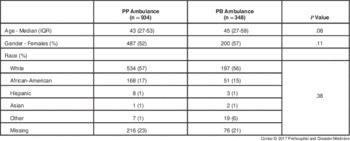
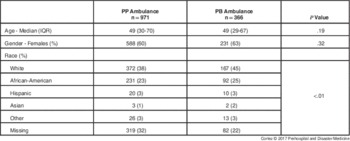
Patient demographic information was compared at each station between the PP ambulance and the PB ambulance. At Station A, there was no difference between patient age, gender, and race (Table 1). There was no difference in chief complaints of the encounters between groups (P=.21). At Station B, there was no difference between patient age, gender, and race (Table 2). There also was no difference in chief complaints of the encounters between groups (P=.85).
Station A Demographic Information

Abbreviations: PB, paramedic-emergency medical technician; PP, paramedic-paramedic.
Station B Demographic Information

Abbreviations: PB, paramedic-emergency medical technician; PP, paramedic-paramedic.
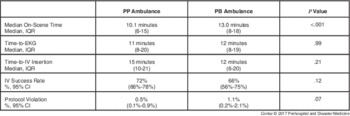
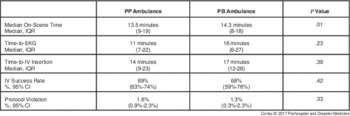
Primary outcomes and secondary outcomes for Station A and Station B are noted in Tables 3 and 4, respectively. Median on-scene time at Station A was shorter for the PP ambulances than the PB ambulances (PP: 10.1 minutes, IQR 6.0-15; PB: 13.0, IQR 8.1-18; P<.001). This also was true for Station B with median on-scene times of 13.5 minutes for PP ambulances (IQR 8.5-19) versus 14.3 minutes for the PB ambulances (IQR 9.9-20; P=.01). There were no differences in any secondary outcome measures between PP and PB ambulances at Station A (Table 3) or Station B (Table 4). Protocol violations were noted with chest pain (no EKG performed, no aspirin administered, or no supplemental oxygen administered), respiratory distress (no pulse oximetry measurement or no albuterol therapy), trauma (no cervical collar applied or transport to a non-trauma center), seizures (no blood glucose level documented), and alcohol intoxication (non-transport).
Station A Secondary Outcome Measures

Note: Total number of EKG’s performed (PP ambulance=89; PB ambulance=41). Total number of IV lines performed (PP ambulance=207; PB ambulance=97).
Abbreviations: EKG, electrocardiogram; IV, intravenous line; PB, paramedic-emergency medical technician; PP, paramedic-paramedic.
Station B Secondary Outcome Measures

Note: Total number of EKG’s performed (PP ambulance=95; PB ambulance=59). Total number of IV lines performed (PP ambulance=260; PB ambulance=111).
Abbreviations: EKG, electrocardiogram; IV, intravenous line; PB, paramedic-emergency medical technician; PP, paramedic-paramedic.
Discussion
In this comparison of traditionally staffed PP ambulances with alternatively staffed PB ambulances, the on-scene time was found to be longer for the PB ambulances. The differences in on-scene times were statistically significant at both Station A and Station B. However, the clinical significance of these differences is questionable.
Several different factors may have attributed to longer on-scene times for the PB ambulances. First, the personnel staffing the PB ambulances varied throughout the study. Several different paramedics and EMTs rotated on the PB ambulances. This may have led to unfamiliarity among crewmembers. Second, only the paramedics on the PB ambulances were permitted to complete patient care reports. Therefore, the paramedics were tasked with assessing the patient, delivering ALS-level interventions, and documenting in the patient care report. In the PP ambulances, many of these responsibilities are shared between the two paramedics. Third, the personnel on the PB ambulances were aware that the study personnel reviewed every patient encounter. Therefore, on-scene times may have been increased secondary to a Hawthorne effect.
It is difficult to determine whether the longer on-scene times for the PB ambulances were clinically significant. Clinical significance is based on several different factors, including the type of diagnosis, the number of ALS interventions required to stabilize the patient, and general scene dynamics. For example, longer on-scene times for out-of-hospital cardiac arrest may be justified; however, on-scene delays for penetrating trauma may be detrimental.
However, the results of the secondary analysis suggest that the clinical significance of the increased on-scene times for the PB ambulances is low. The ALS interventions included in the secondary analysis were chosen because they were the most common interventions performed by CFD across the full spectrum of patient encounters in this all-ALS system. Additionally, these ALS interventions are time-sensitive procedures most often completed in critically ill patients. Other ALS interventions, such as defibrillation and endotracheal intubation, were not included because the incidence of these procedures is exceedingly rare, and additional paramedics assist the PB ambulances when patients are in cardiopulmonary arrest.
The protocol violation rate also was similar between PB ambulances and PP ambulances. Since patient outcome information was not evaluated in this pilot study, the protocol violation rate served as a quality measure for the PB ambulances. This finding is reassuring but additional quality concerns not detected by the protocol violation are possible.
Several studies have evaluated different response models on out-of-hospital cardiac arrest parameters. Eschmann and colleagues determined whether the number of ALS personnel on scene of an out-of-hospital cardiac arrest was associated with return of spontaneous circulation or survival to hospital discharge.Reference Sanghavi, Jena, Newhouse and Zalslavsky 9 The authors concluded that more than two paramedics on-scene was not predictive of improved outcomes.Reference Sanghavi, Jena, Newhouse and Zalslavsky 9 Persse and colleagues compared cardiac arrest outcomes between tiered-response and uniformed-response models and reported better outcomes for patients treated with tiered-response.Reference Eschmann, Pirrallo, Aufderheide and Lerner 10 Additional studies have found that BLS providers can safely respond alone to low-risk calls,Reference Stout, Pepe and Mosesso 3 and mixed crews (BLS and ALS providers) have shorter on-scene times than all-ALS crews.Reference Key, Pepe, Persse and Calderon 4
Isenberg and Bissell provided a summary of crew configuration differences in a 2005 literature review. The authors report no benefits of ALS care compared to BLS care for urban trauma, cardiac arrest, myocardial infarction, and altered mental status.Reference Kelly and Currell 5 Further, most of the studies suggested an increased mortality rate for trauma patients managed by ALS providers.Reference Kelly and Currell 5 Ryynanen and colleagues suggested in a 2010 systemic review that ALS care might benefit patients suffering myocardial infarctions, blunt head injuries, multi-trauma, seizures, and respiratory distress whereas BLS care was better suited for penetrating injuries.Reference Isenberg and Bissell 6 Bakalos and colleagues performed a meta-analysis in 2011 and concluded that ALS care can increase survival in non-traumatic cardiac arrests, but ALS is not associated with increased survival in trauma patients.Reference Ryynanen, Iirola, Reitala, Palve and Malmivaara 7
This study illustrates several key operational principles related to EMS. The PP ambulances at each station included in this study have traditionally demonstrated high run volumes in recent years. The additional resources created by the PB ambulances decreased the workload of the PP ambulances. Such dissipation of call volumes experienced by busy ambulances may have positive effects on employee morale, patient satisfaction, and patient safety.
Further, additional ambulances in busy urban areas during peak-demand hours may improve important operational parameters such as fractile response times, time-to-EKG for acute myocardial infarctions, and time-to-defibrillation for out-of-hospital cardiac arrests.
Limitations
The study was limited in several ways. First, this was a retrospective chart review that served as a pilot program for changes to ambulance staffing. Second, the data extractor was not blinded to the results of the study and no inter-rater reliability was calculated. Third, the study was developed collaboratively between all stakeholders, including EMTs, paramedics, administration personnel, and legal counsel. Therefore, the EMS personnel participating in the study were not blinded, which may have created a possible Hawthorne effect. Fourth, the study did not account for the influence of additional paramedics on engine and EMS supervisor vehicles during higher acuity patient encounters. Secondary to pre-existing system operations, such influences could not be addressed in the study design. However, this also was one of the strengths of the study because it represented the typical prehospital patient encounter. Fifth, the EMTs on the PB ambulances were highly motivated volunteers, and may not have been representative of the typical EMT in the system. Therefore, selection bias may have been present.
Conclusion
In the setting of a well-developed EMS system utilizing an all-ALS response, this study suggests that PB ambulance teams may function well when compared to PP ambulances. Though longer scene times were observed, differences in time to ALS interventions (EKG, IV insertion, and IV success rate) and protocol violation rates were not different. Hybrid ambulance teams may be an effective staffing alternative, but decisions to use this model must address operation, economic, and community concerns.