In the early months of 1980, shortly after my arrival in the Sultanate of Oman, I was offered an opportunity to join a small convoy of vehicles crossing the desert. The trip was to take a week and would start in Salalah, the capital of Dhofar, the southern region of Oman, and end in Muscat. The route did not quite retrace the steps of the English explorers Bertram Thomas in the 1930s and Wilfred Thesiger in the 1940s, but it felt like it. We traveled in four-wheel-drive vehicles instead of on camel, as Thomas and Thesiger had done, and we had access to some graded roads as well as the recently opened 1,000-kilometer tarmac highway connecting Muscat with Salalah. But the landscape was the same, vast tracts of seemingly untouched open scrub, gravel, rock, and sand. The purpose of the journey was largely to permit a medical team to trace several lapsed tuberculosis patients from tribes in the interior and to provide immunizations to the children of these communities.
Several days into our journey and halfway across our proposed itinerary, we came upon a small group of nomadic pastoral Harasiis tribe families preparing to attend a wedding. We stopped and asked their permission to begin vaccinating their children. We were asked why we wanted to do this.
We said, “The Sultan of Oman wishes to see all Omanis immunized against these diseases.”
“Why would he want to do this for us?” they persisted.
We were initially at a loss for an answer. We had assumed that the sense of belonging to one nation and of the obligations of leadership had reached this part of the country. It had not.Footnote 1
Ceremony and elaborate protocols are commonly associated with kingship, authority, and power. The pageantry associated with the British monarchy in its public ceremonials, for example, is imbued with a sense of an ancient past. Yet, these traditions are recent inventions derived from the late Victorian period.Footnote 2 Traditions, particularly Western practices, are often made up, choreographed, and then formally instituted in a matter of a few years, rapidly gaining a sense of permanence.Footnote 3 Sometimes entirely new symbols and devices are invented to confirm gravitas and substance and to serve as rallying points for the new entity (e.g., Marianne, John Bull, or Uncle Sam).
Invented traditions set up, support, and maintain kingship, oligarchy, and other institutions. Once established, these ceremonial rituals tend to take on a life of their own, sometimes thriving in an inverse relationship to the actual realities of power and authority. Created or invented rituals and traditions serve several purposes: they may establish or symbolize legitimate relations of authority or particular institutions, and they also may be used to inculcate a set of beliefs or conventions of behavior.Footnote 4 Although the first purpose was commonly used in British and French colonial contexts in AfricaFootnote 5 and South Asia,Footnote 6 the second generally characterized the invented rituals in the Middle East and North Africa. In this region, the general socialization of highly fragmented societies and cultures was enhanced by the marking out of rituals, ceremonies, and new traditions. The creation of such practices—which included processions, bands, regalia, and anniversaries—worked to give the state and its often oligarchic leadership greater legitimacy while at the same time creating a sense of commonality among the country's diverse peoples.
In the Middle East, few studies exist that examine the rituals of royalty—invented and derived. Morocco has been the focus of a number of studies examining the longevity of Moroccan kingship.Footnote 7 For centuries, Moroccan monarchs have conducted royal progressions (harkas) with elaborate entourages throughout the country, embodying in their person and their companions royal authority and power.Footnote 8 In Jordan, a few studies have emerged considering aspects of ceremonial, monarchy, and national identity.Footnote 9 In the Gulf states, the relationship of the rulers to local merchants and the later effort to create a “national identity” have also been explored.Footnote 10 In the case of Oman, however, no studies at present consider the relationship between ceremony in the consolidation of power and authority and the perception of that state's nationals.Footnote 11
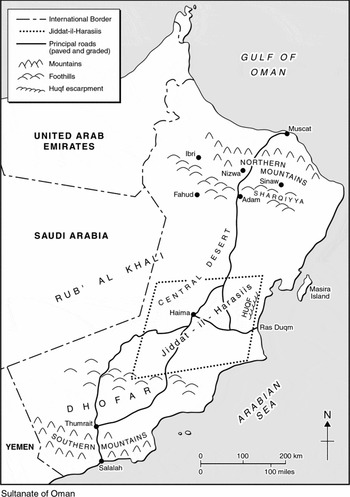
This article explores the creation and elaboration of certain ceremonials and court rituals in the Sultanate of Oman after the accession of Sultan Qaboos in 1970. It investigates the relationship between the development of these ceremonial and ritual events and the perception of leadership and authority in the person of the sultan, as well as the development of a sentiment of common nationality. Its ethnographic underpinning is the most remote and marginal of Oman's people, the nomadic pastoral Harasiis tribe of the central desert of Oman (Figure 1).Footnote 12 Although the creation of rituals of royalty was important for building a sense of national belonging among this most cut off and distant of communities, these same ceremonies and created traditions developed lives of their own. Over time these rituals ossified sultanic courtly behavior, contributing little to the organic sense of Omani citizenship and eventually disillusioning some marginal groups.
Map of Oman by Jane Jackson based on author's sketch.

BACKGROUND ABOUT THE DEARTH OF CEREMONY IN RECENT AL BU SAIDI COURTS
The Al Bu Said dynasty came to power in 1744.Footnote 13 Over the centuries this dynasty underwent swings in authority and power.Footnote 14 The mid-19th century saw a rapid decline in Al Bu Said fortunes, and British interests in Oman came to be directed and managed from Delhi rather than from Whitehall. For the whole of the 20th century and into the 21st, Oman has had only four rulers: Faysal (1888–1913), Taymur (1913–32), Said (1932–70), and Qaboos (1970–present). All four rulers owed their position to British support in one way or another.
The indigenous population of the country was relatively large and markedly heterogeneous. In the north it included a small, elite urban merchant class with strong cultural ties and trade links with India and the coast of East Africa. Along the coast, subsistence fishing settlements were common, and in the mountains and intervening valleys, terraced farming communities maintained ancient systems of water collection and distribution.Footnote 15 The few towns in the interior were centers of regional trade as well as of religious learning. The population of the south of the country, in Dhofar, was of South Arabian or Himyaritic descent, sharing a distinct culture, history, and language base. In the middle of the country's central desert, hundreds of kilometers from agrarian and urban settlements, were a number of nomadic pastoral tribes, some with cultural and social links derived from central Arabia and others from Himyaritic Yemen. This thinly populated desert region played a marginal role in Omani dynastic history. Until recently these pastoral tribes of the interior of Oman had little knowledge of the secular government of the sultan on the coast; some were only slightly more physically connected with the Ibadi imam in Oman's Jebel Akhdar.
By the 1920s, the Omani coastal strip under the sultan's control was increasingly in debt to the Indian merchants of Muscat. Loans were secured from the British government to free the sultan from dependence on these Indian merchants. However, these loans carried with them a growing dependence on Great Britain and its political and civil service. In 1925, for example, Bertram Thomas was seconded to Oman as the British financial adviser for Muscat. In fact, he assumed the position of prime minister and virtually ran the government during Sultan Taymur's frequent absences abroad.
By the time Said was formally recognized as the ruler of Oman in 1932, the twenty-one-year-old had inherited a country riddled with financial difficulty. Only through frugal, nearly parsimonious, budgeting over the next thirty-eight years was the sultan able to repay the British loans and thus wrestle some control of the state back into his own hands. Eradicating the sultanate's long-term public debt through unenviable economizing was to set a pattern for economic management. In the late 1930s and 1940s, Sultan Said was able to implement a modest modernization program. He cooperated completely with the British during World War II.
Oil exploration commenced in Oman during the 1930s. In the central desert of Oman, both the Harasiis and the Jeneba nomadic pastoral tribes were affected by these activities. Interviews with these tribesmen indicated that these incursions into their traditional territory were the first encounters many had had with Europeans. The Jeneba tribe living between the Indian Ocean and the edge of the Jiddat al-Harasiis closely watched the oil-exploration activities and then formally laid claim to the Jidda (jidda means flat, arid/semi-arid land), maintaining that it was their land, which they merely permitted the Harasiis to occupy. Sultan Said and his adviser, Bertram Thomas, decided that occupancy was the determining factor in land-right issues, however, and dismissed the Jeneba claim. Wilkinson, moreover, suggests that the sultan's true motive in coming down on the side of the Harasiis was his confidence that the Harasiis were potentially stronger allies in his claim to future oil rights in the central desert interior.Footnote 16 Pastoral tribes in the north of the country, such as the Duru, bordering on areas under the control of the Ibadi imam were increasingly being drawn into the political and armed conflict between the sultan on the coast and the Ibadi imam in the interior.
In 1955, an exploratory search party landed at Duqm on Oman's eastern coast and made its way across the Jiddat al-Harasiis to arrive at Fahud in Duru tribal territory. Sultan Said, determined to consolidate his areas of interest and sovereignty over this region, contended in his negotiations with the oil concerns that the Harasiis tribe in the interior and the Jeneba tribe along the coast near Duqm had no relationship with the Ibadi imam in the north and were, by default, part of his domain. For the Jeneba, this was a problematic assertion because their leader maintained a residence in an area within the Ibadi imamate.Footnote 17 For the Harasiis, however, there was no strong link either to the imam or to the sultan; neither had a representative or local governor (wālī) in the Harasiis tribal territory. The Harasiis were, at that time, on the margins, almost beyond the government's administrative reach.
During this period, Sultan Said's relationship with Great Britain was cemented by two nearly simultaneous crises. In 1952, Saudi Arabia attempted to occupy part of Oman in the al-Buraymi Oasis.Footnote 18 In the same year, the imam (who allied himself with Saudi Arabia) launched his rebellion, which spilled over into a contestation over ownership of any oil finds by oil-company exploration teams. In 1959, a combined assault by the sultan's forces and the British on Jebel Akhdar ended with the defeat and retreat of the Ibadi imam and his rebels. The success of the 1959 campaign heralded a period of uncontested and genuinely close cooperation between the sultan and British authorities.
This period also saw Sultan Said search for ways to develop the country without “modernizing” it. He prohibited the general importation of cars. He banned sunglasses and flashlights and insisted that the gates of the capital of Muscat be closed at sunset. He permitted only three schools to operate in the entire country; they admitted 100 boys a year, whom he personally chose. For most of the 1960s, Said withdrew to his palace complex in Salalah, the capital of Dhofar. The Harasiis and Jeneba leaders, as well as other prominent tribal members from the interior deserts, made annual trips to Salalah to receive monetary gifts from the sultan in recognition of their political importance to him. However, his increasingly petty and eccentric behavior and occasionally outlandish rules for his subjects resulted in growing discontent and sporadic outbreaks of violence against him and his rule.Footnote 19
Yet Sultan Said was a cultured and cosmopolitan man. Throughout the 1950s and 1960s he made annual trips to the United Kingdom, generally in the summer.Footnote 20 He was a keen music lover and enjoyed opera. Often he passed his summer sojourns in London, where he frequently met British politicians and Foreign Office officials and negotiated expenditure for military hardware and troops. During this time, British concerns over the sultan's isolation in his palace in Salalah culminated in the secretary of state for foreign affairs, Selwyn Lloyd, pointedly informing him that the queen did not spend all her time in Balmoral Castle.Footnote 21
In 1964, oil was discovered in the central desert of Oman, and by 1967 export had begun. Projected revenues jumped dramatically, but even then Said remained cautious about spending money he did not yet have. Although he commissioned plans for a new port at Muscat and a hospital in Ibri, among other projects, he took his time giving the go-ahead to implement these works. Until his overthrow by his son, Qaboos, Said continued to act and behave with the shrewdness and calculation of someone always on the edge of financial ruin. His household and his retainers were kept under very tight fiscal control; no excess or flourish in décor or entertainment was tolerated. His hold over authority and power revolved around his relations with his armed forces and his British political agents and not upon any pomp or ceremony to celebrate or consolidate his reign or to impress his fellow Omanis.
The unrest and growing unpopularity of the sultan was compounded by a rebellion in the mountains above Salalah supported by the neighbouring People's Democratic Republic of Yemen. By the summer of 1970, fearful that the Marxist–Leninist rebellion might succeed, British forces quietly instigated and supported a coup d'etat led by Said's son, Qaboos.
Unlike his father and grandfather before him, Qaboos was not educated in India or Baghdad. The only son of a Qara, a Dhofari tribeswoman, he had remained in Salalah until the age of sixteen, never once having visited the north of the country. At this point in Qaboos's life, his father agreed to dispatch him to the United Kingdom to complete his education. He was sent first to the home of Philip Romans in Bury St. Edmunds, East Anglia. Romans, the retired headmaster of Baroda College of the University of Bombay, had established a school for students from the Arabian Gulf called Feltsham House. Upon leaving Feltsham House, Qaboos was enrolled in the Royal Military Academy Sandhurst. He graduated in 1962 and became an officer of the British Army's Scottish Rifles (the Cameronians), serving in Germany for one year. The next year, the Foreign Office secured for him several months at the Bury St. Edmunds council to observe public administration and accounting. During this intense residency in the United Kingdom, Qaboos, not surprisingly, began a lifelong love affair with military pageantry.
The years in England and, in particular, in the British military deeply affected the young man. In 1964, after a world tour chaperoned by the retired British general F. C. L. Chauncy and his wife, Qaboos returned to Dhofar, and his father placed him under a virtual “house arrest” in the royal palace of Salalah. There Qaboos was instructed to study Islamic law but denied any opportunity to take an active administrative role in the government. Some scholars believe that as the rebellion in Dhofar grew in intensity, the British began to work surreptitiously toward a quiet palace coup. Others saw that Qaboos, chafing under his house arrest, began to make cautious inquiries through carefully screened personal visitors as to whether the British would support the overthrow of his father.Footnote 22
On the night of 23 July 1970, Qaboos launched a nearly bloodless palace coup: a small group of supporters stormed through the palace doors and up into Said's apartments. There they were met by a fusillade fired by Said and his personal slaves. The sultan was wounded in the foot. Peterson maintains that this injury occurred when Said cocked one of the two pistols he used to defend himself.Footnote 23 Said was flown out of Salalah by the British Royal Air Force to Bahrain, where his wound was dressed, and then taken to the United Kingdom, where he lived out the last years of his life in a suite at the Dorchester Hotel on London's Park Lane.
After the 1970 palace coup, Sultan Qaboos encouraged all Omanis living abroad to return to the country to help build a government infrastructure nearly from scratch.Footnote 24 The advisers to the new sultan set about distancing the royal son from his father by overstating, exaggerating, and occasionally distorting known facts about Said's “miserliness” and eccentricities.Footnote 25 In the early years of Qaboos's reign, this information was used to distinguish the old order of Said from the “New Dawn” of Qaboos. For many years, it remained generally understood that the father's eccentricities had been damaging to the Oman people and thus justified the palace coup that brought the modern, British-educated son to power.
In a very short period of time, the armed forces, the police force, the internal security service, the civil service, and government ministries of health, education, social affairs and labor, agriculture and fisheries, water and electricity, communications, and roads, among others, were set up. The trappings of a modern state were put into place almost overnight. Thousands of miles of roads were blacktopped, and Muscat was connected for the first time by a modern road network to Salalah. The social and economic transformations of the coastal areas and the mountains behind in both the north (Oman) and the south (Dhofar) of the country, funded mainly by petroleum wealth, were enormous. The same was not true of the interior desert areas of the country. They remained isolated from the rapid political, social, and economic transformation taking place along the coastal region of Oman and Dhofar.
RECOGNIZING THE NEED TO CREATE TRADITIONS
When Sultan Qaboos came to power in 1970, there was a decided lack of public ceremony or palace ritual associated with the monarchy. This fact was played up and used to lay the groundwork for the elaboration of new rituals and traditions associated with Qaboos's court, as well as the development of a cult of personality far removed from the established eccentricities of his father. There was only one residence in Muscat for the sultan (which had lain unoccupied for the previous twelve years) and another compound in Salalah. Simple rituals of hospitality reflected general Omani culture. Protocol for the occasional state visitor to Muscat remained peculiarly lacking in substance and luster in contrast to states in other parts of the world that increasingly sported a competitive inventiveness to ceremony in order to enhance the position of the head of state.
Until the late 1960s, most state visitors to Oman arrived by boat and were greeted on shore by a small representation of family members and others from Muscat's small merchant elite appointed by the sultan for the occasion. An internal British government memorandum from then British consul general Phillips in Muscat, dated 17 August 1960, revealed British- government concern about a questionable “national salute” or anthem. The letter contends that the national salute was written by “the bandmaster of a cruiser in about 1932” and that the only band in Oman that might have been able to play it was “disbanded in or around 1937 (Muscat Infantry Band).” There were no occasions, according to Phillips, at which the salute was officially played.
Even after the palace purse was no longer so meager,Footnote 26 Sultan Said was loathe to develop too much elaboration around court ceremonials or state arrivals and departures. He did, however, purchase a twelve-man whaler for use in Muscat harbor to meet and greet important guests. Working with the offices of Charles Kendall and Partners in London, he commissioned a new conveyance for ceremonial occasions, which conceptually had significance not unlike a new state carriage for the British monarch.Footnote 27
As the order neared completion, Said was asked by John Kendall—the son of the founder of the firm—what kind of dress/uniform he wished for his oarsmen in Muscat. None, the sultan replied, just the white long dress (dishdasha) commonly worn by all men in Oman. John Kendall, taking on much the same role as Reginald Brett, the éminence grise in British governing circles at the beginning of the 20th century, pushed for some greater identifying marker for these men to show that they belonged to the royal palace.Footnote 28 Kendall suggested a ceremonial uniform of white dishdasha but with straightforward waistcoats and braid. Still the sultan declined to order any special dress for these oarsmen, explaining that such elaboration would be pompous and not suitable for his court.Footnote 29
Qaboos came to the throne with vastly different experiences and perspectives. Unlike his Anglo-Indian-educated father and grandfather, he had no experience of the world outside of Dhofar until he was sent to the United Kingdom, where he developed a love of many things Western and particularly British: classical music, military pageantry, horsemanship, and bagpipes. After the coup that brought him to power, Sultan Qaboos had to set about uniting the disparate elements of his country—the interior with the coast and the north with the south. This unity, which he recognized would center upon the person of the sultan, needed new traditions to support it.
Qaboos was befriended by the Shah of Iran and King Hussein of Jordan—both of whom sent significant troop numbers to Dhofar to help the sultan put down the rebellion in the mountains by the mid-1970s. King Hussein, also a Sandhurst graduate, developed a particularly close relationship with Qaboos, about six years his junior. The king frequently visited the sultan, and many close to the royal court said that he also tutored the sultan in monarchic protocol. In one story that circulated for years, King Hussein advised the young sultan that it was befitting his status to keep his guests and petitioners waiting; the only exception to this rule was never to be late for the British monarch, Queen Elizabeth II.
SETTING UP THE STRUCTURES TO ELABORATE CEREMONY AND RITUAL
Within a month of the coup d'etat, Sultan Qaboos appointed his uncle prime minister and set about creating the core structures of a “modern” state. All British-government employees—with the exception of those in the Department of Defense—were replaced; Omanis were appointed as the new ministers and other high-level government post holders.Footnote 30 The sultan embarked on a program designed to reinforce and celebrate his reign. The old Bayt al-ʿAlam Palace in Muscat was demolished and replaced by the new and spectacular Qasr al-ʿAlam. Used for ceremonial occasions and state visits rather than as a regular residence, it was a symbol of the privileged “renaissance” of the Al Said dynasty. In addition, a building program of palaces and royal guesthouses commenced so that by the early 1980s the sultan had at least three residences both in the north and the south of the country befitting his role as political leader of the nation. By the beginning of the 21st century, Qaboos had at least seven royal residences in the north and three in the south, as well as residences and estates in the United Kingdom and in Germany.Footnote 31
By naming roads, ports, schools, hospitals, mosques, sports stadiums, and residential areas after him, Qaboos was inscribing his presence upon the national geography.Footnote 32 His concern for “his people” was affirmed by the constant repetition of his name on radio and television and by the hanging on walls of offices, businesses, and private homes of photographic portraits in which he wore national dress or military uniform—each in a similar pose, with hands crossed across his lap. The written press and television coverage of all the sultan's meetings, his comings and goings, and his telegrams of greetings and congratulations from other heads of state was a daily diet consumed by all Omanis.
The linking of his name with all that was new, modern, and progressive was in many ways like the official discourses found in support of state leaders in other countries in the region. In Syria, for example, the state has long been linked with the person of the ruler. The regular depiction of Hafiz al-Asad in the decades before his death in 2000 as the omnipresent and omniscient leader was an attempt to control the symbolic world of Syrian society. Official rhetoric and images operated as a form of power helping to enforce and sustain al-Asad's reign.Footnote 33 In Oman as well, symbols, rhetoric, pageantry, and ceremony worked not only to represent the person of the sultan but also to produce and consolidate his political power.
CREATING THE GLUE THAT BINDS
Sometimes symbols, created traditions, and pageantry have been used to create a separation between one ruler and the state or to break totally from the government of the past as, for example, in Iran and in the former Soviet Union. In Oman, however, the continuity of the ruling dynasty was unquestioned even if the personality and approach to rule was regarded as diametrically opposed. Sultan Said was replaced by his son, Qaboos. There was no immediate break with the past or profound change of direction that the elaboration of new ceremonials, traditions, and pageantry confirmed. Rather it was the recognition that the parsimonious qualities of the previous leadership had resulted in an almost total lack of state ceremony that needed to be corrected and elaborated in the effort to unite a country that had seen two serious insurrections in the previous two decades. The country of Muscat and OmanFootnote 34 needed to be glued together, and this required the entry of the new sultan and his iconography into the religion-infused mountains of the north as well as the secessionist-leaning south.
The consolidation of Qaboos's secular leadership with the spiritual or religious aspects of the society was problematic because the decades-old division between the sultan and the Ibadi imam in the interior had created a disjuncture in the way in which most Omanis regarded the religious and the political.Footnote 35 Through a concerted program of building mosques—many named after him—and establishing his presence in these places of worship each Friday, Qaboos gradually made his leadership felt. The splendid main mosque in Ruwi and the mosque of Nizwa were the first two mosques the sultan built.Footnote 36 This program of building religious establishments continued throughout the following decades and culminated in the inauguration of the Sultan Qaboos Grand Mosque in Bausher on 4 May 2001. This immense structure covers an area of 416,000 square meters. With its minarets and domes, it echoes the heights of the Ottoman Empire. Its five minarets—each representing one of the pillars of Islam—surpass the three of the Grand Umayyad mosque of Damascus.
CREATING CEREMONIALS AND ELABORATING STATE OCCASIONS
In 1971, the year following Qaboos's accession, a new celebration—perhaps inspired by British royal birthday tradition—became an important symbol of national unity. The sultan's birthday took on significance beyond the personal, becoming a marker for national celebration. The actual date of the coup that brought him to power was 23 July.Footnote 37 This unfortunately fell during one of the hottest months of the year. Sultan Qaboos decided instead to celebrate this important marker of his power in November, a relatively cooler month that coincided with his birthday. From 1971 on, Qaboos's birthday, 18 November, became known as “National Day” (al-īd al-waṭanī). (Queen Elizabeth II's birthday also formally moved from 21 April to June in the United Kingdom to accommodate the possibility of better weather.) National Day was marked by a formal tea party in the gardens of the sultan's residence for senior Omani dignitaries and military personnel, the diplomatic corps, foreign professionals, advisers, and consultants as well as senior palace staff.
For most Omanis, however, the tea party was of little significance. Relatively few were invited in any one year. For the masses—even from the remote interior—what mattered were the ceremonial military parades held in newly constructed stadiums, the precision military drill teams, and the show of fighting strength of the new military units (air force, army, and navy) under the command of Qaboos. These spectacles and the invitations to attend them were eagerly anticipated each year. In the first decade of his reign, the public responded to these events with fascination and astonishment.
By the early 1980s, however, Omani nationals began to expect greater showmanship and extravagance, particularly at the national days marking five-year intervals. The celebrations for the fifth, tenth, and fifteenth were each outdone by the next. Oman reached the apex at the twentieth celebration in 1990, with a spectacular laser-light show over the town of Muscat. Five years later, many expressed disappointment with a twenty-fifth anniversary celebration that failed to surpass its predecessors.Footnote 38
Interwoven in the fabric of these newly created National Day celebrations were the incorporation and “modernization” of the interior's traditional camel races. They had long been popular as a local and seasonal tribal activity. With the introduction of vehicles and the increasing obsolescence of beasts of burden,Footnote 39 however, camels at the racetrack took on a new cultural significance as symbols of revival.Footnote 40 Regional races determined which camels should be brought to the capital area to compete in the annual races sponsored by the sultan. For the first fifteen years of Qaboos's reign, these races were held on a simple open gravel plain near Seeb Palace. In 1991 this track was converted into a formal racecourse specially designed to hold camels within its boundary. The race had become part of the established tradition marking Omani unity and nationhood. Its formal audience was the dignitaries and guests of the sultan marking each annual National Day. However, it was the months-long buildup of qualifying regional trials that both united and captured the attention of the camel-owning population of the country—mainly the nomadic and recently settled pastoral communities of Oman.
CREATING MILITARY PAGEANTRY, EMBLEMS, DECORATIONS, AND MEDALS
Over this first decade of Qaboos's reign, an elaborate structure of ceremonial units gradually emerged. In 1970, the Dhofar Force, a private army acting as the ruler's personal bodyguards in Dhofar, was incorporated into the Sultan's Armed Forces (SAF). Shortly thereafter, the Royal Guard RegimentFootnote 41 was formed, taking on protection as well as ceremonial duties. It covered investitures and state dinners, as well as guards of honor for visiting dignitariesFootnote 42 both in the north and the south of the country and traveled abroad with the sultan. This necessitated the creation of all the trappings that underpinned such ceremonial occasions: royal bands, mounted bands, custom uniforms, regimental colors, badges, emblems, flags, and medals. By 1975, with the assistance of a succession of British advisers, regimental colors, uniform facings, berets, and other requirements of ceremony had been determined. In rapid succession, the Royal Guard Regiment formed the Royal Band South and the Royal Band North and later the Royal Mounted Band. In 1978, a full mounted band performed at a National Day event.Footnote 43
Along with the creation of special military units with ceremonial functions came the requirement to create a national emblem that set Sultan Qaboos's reign apart from previous Al Said rulers. The Al Said dynasty's emblem, later called the national emblem or royal arms of Oman, is a device consisting of crossed Omani swords with a superimposed khanjar, a local Arab curved dagger that is worn on a waist belt and placed centrally in front of the body.Footnote 44 This national emblem formed the cap badge of the entire SAF until 1977, when different unit and service badges were introduced, designed, or at the very least approved by the sultan.Footnote 45 These national emblems continued to feature in all armed forces cap badges and were used in many other badges. The national emblem of crossed khanjars was later surmounted by a crown and used for directly “royal” entities, such as on the cap or rank badges of all the sultan's uniformed forces, including the Royal Guard of Oman, Royal Yacht Squadron, Royal Army of Oman, Royal Air Force of Oman, Royal Navy of Oman, the Sultan's Special Forces, Royal Oman Police, and the Royal Flight. This national emblem and the various service cap badges and medals were familiar to most Omanis, including those in the interior of the country, where serving soldiers and policemen were often recruited.
The evolution of medals in Oman mirrored the diversification in the armed forces. The first medal emerged as a result of the Jebel Akhdar campaign in 1958/59. It was directly modelled on the British style of campaign medals.Footnote 46 In 1960 a gallantry medal was inaugurated, and in 1965 a general service medal was instituted. However, it was not until after the accession of Qaboos that this tradition of creating ceremonial awards was given real expression. Immediately after assuming power, Qaboos commissioned the Accession Medal and Order of Oman. These were followed by the Order of RenaissanceFootnote 47 or Unity Medal, the Endurance Medal commemorating the end of the Dhofar War, and a series of anniversary and National Day medals to commemorate the 1980 anniversary of the sultan's accession on 23 July 1970 and later the National Days at five-year intervals. In 1976 the sultan approved an overall “order of wear” encompassing the orders and medals for the armed forces. This list spanned five different categories. The more recent order of precedence (1995) produced by the palace office encompasses twenty-six different categories.Footnote 48
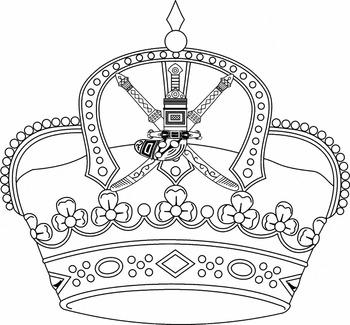
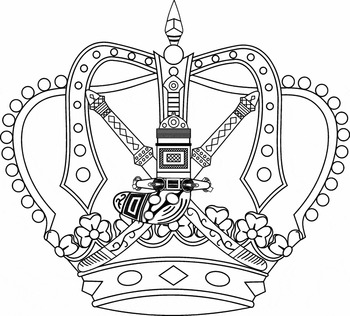
As the offices of government became established and the National Day celebrations came to be expected and regarded as “traditional,” Qaboos searched for a more ceremonial and monarchic emblem to symbolically draw the Al Said dynasty closer to the modern state of Oman. In 1977 Qaboos requested from John Kendall some drawings or sketches for a royal or sultanic crown from which he might select a standard pattern for all future requirements.Footnote 49 Kendall commissioned J. R. Gaunt and Sons in Birmingham to carry out this request, and in August 1977 two sketches based on the St. Edward's Crown by one of the company's commercial illustrators were sent to Muscat for the sultan to review (Figures 2 and 3).Footnote 50 The one the sultan selected (Figure 2) was then integrated into the emblems and decorations of all his uniformed units, armed forces, and special-service units. This newly adopted crown, symbolizing the power of the national sovereign, enveloped and surrounded the earlier imagery of the young ruling monarch.
One of two provisional designs for the royal emblem presented to Sultan Qaboos. This was the one chosen.

One of two provisional designs for the royal emblem presented to Sultan Qaboos.

MEETING AND UNITING THE OMANI PEOPLE
For Sultan Qaboos, the north of the country was new territory, and its people were unfamiliar to him. From the earliest days of his rule, he made regular efforts to meet with people in Muscat and elsewhere. It was not unusual to find him inspecting, without warning, a ministry office building early in the day to see which employees were on time and busy and reprimanding those caught doing nothing or reading the newspapers. He also took to viewing new development projects at night when no one was around.Footnote 51 In these early years, Qaboos frequently made short trips into the interior of the country to visit schools and government offices and to meet with the people.
In 1977, accompanied by units of the Royal Guard and the Royal Flight, he made his first full crossing of the country from Salalah to Muscat on a tour of several weeks. He camped out in the desert and at each site received foreign and national guests as well as local petitioners in an elaborate circular tent. At first these annual trips had an open and spontaneous quality to them. Unlike the rulers of other Gulf states, Sultan Qaboos did not have a tradition of a weekly majlis (an open forum) where men came forward with their requests, complaints, and petitions. These convoys through the country became instruments for keeping in touch with local people and for measuring the public mood and sentiment. Tribal leaders and commoners, old and young, could and did approach the sultan to air their grievances, present requests, or give their felicitations.
Throughout the 1970s and 1980s these annual trips, sometimes as long as six weeks, became important rituals marking the transformation of the young monarch into the mature sovereign.Footnote 52 Although the actual camp residence of the sultan on these tours was kept simple, the accompanying security and service provisions gradually became more elaborate. When the camps were some distance from the capital, visiting dignitaries were transported to the sultan's camp by Royal Flight helicopters. The sultan took as many ministers with him as possible. Others the sultan summoned after hearing local complaints or in order to put them into the line of fire when a particular disgruntlement was highlighted.
Nearly each of these annual convoys camped for a week or more on the edge of the rose-colored sand dunes of the Empty Quarter in the Haylet il-Harashif of the Jiddat al-Harasiis. This remote campsite 500 kilometers from Muscat and Salalah put the sultan in the middle of tribal homelands and gave these communities special access to the court. Instead of sending leaders on an annual trip to Salalah to receive gifts for their allegiance, the tribes were “hosting” the sultan. It is ironic that unlike the tribally based Gulf states, where the royal courts had become urban and fixed, the sultan's royal court was developing a mobile dimension. Under the reign of Qaboos, the leader of the nation came to the interior and camped in tribes' midst, demonstrating his accessibility while cementing their sense of loyalty and nurturing their allegiance.
For the Harasiis tribe and other marginal and remote communities in the interior, these annual tours and weeklong National Day celebrations established and consolidated the sense of obligation and the duties of the tribal community to the sovereign. Their emerging sense of “Omaniness” was built upon, and enhanced by, these invented and ceremonial acts, which took on the appearance of long-held traditions.
By the mid-1980s and onward, Harasiis speech was peppered by references to the sultan and the debt owed to him by the people of Oman—including the tribes of the interior. All discussion of programs, services, and anticipated development was prefaced with the expression “thanks to His Majesty the sultan.” Although an element of this speech was due to the formality of the language, the sentiment, in large measure, was sincere. The “why does the Sultan want to do this?” of a decade earlier had been replaced by the acceptance and recognition of their place in the order of things in Oman. These communities knew they had access to their sultan. He regularly visited and camped out among them. Their interests were addressed on these occasions and many problems actually solved. This contact between subject and ruler, coupled with the elaboration and invention of ceremonies and rituals of monarchy developed over the previous two decades, contributed significantly to the consolidation of the perception by the various tribal peoples in the interior of the country of the sultan as ruler of Muscat and Oman, the sovereign of a state that encompassed Dhofar as well as the north of the country.
Only in the last decade has tradition and ceremony started to become overgrown, intricate, and incapable of flexibility. The renaissance has moved into a baroque stage that by its formality and tortured protocol is gradually cutting people off from real access to the ruler and placing him on a pedestal of power and authority. From an assured recognition of the whereabouts of the sultan between two palaces in the north and the south of the country or else on convoy to meet the people has developed a complex pattern of movement among numerous palaces and frequent road convoys and “desert encampments.” In recent years the sultan has taken to moving on convoy and camping in the interior of the country for at least four months of the year; the rest of the time is spent in one of his dozen or more residences spread around the country.Footnote 53
Even his palace compound in Muscat—once a discrete part of a traditional Muslim town—has sprawled over the entire city, obliterating much of the old town, including the traditional suq and many of the former homes of British political advisers, the British and American embassies, as well as homes once belonging to his uncles, nieces, and nephews. This baroque growth, the creation of vast open spaces for royal displays, National Day events, and armed forces ceremonial activities (parades, tattoos, and celebrations with fireworks exploding from ramparts), has transformed a place once of much charm into a set location for the execution of the sultan's newly created royal traditions. These public spaces, then, have become fields of performance, appearances, images, and displays reproducing the power relations and authority of the sultan.Footnote 54
The association of ceremony with actual authority and power is becoming less certain, and the cult of the person of the sultan is increasingly supporting the further elaboration of rituals. The “meet the people” convoys now number more than 500 vehicles and when camped resemble massive trailer parks. Of greater significance, it is no longer possible for ordinary Omanis, including the once privileged tribesmen of the interior desert, to gain direct access to the sultan. They must make a written request of the wālī, or local governor. If it is approved, the petitioner is then permitted entry to a “large majlis tent” where a Ministry of Interior representative holds audience.
The ideal of accessibility by a ruling monarch who moves around the country to meet his people has been undermined by the sheer numbers of people who now follow the convoys in an effort to talk to the sultan. Today the police barricades are too deep and the numbers desiring a hearing too great to be accommodated. The eagerly anticipated annual convoy of the early decades supported by nearly continuous live media coverage has now become a set of carefully planned and choreographed road trips with hundreds of vehicles. Contemporary media coverage makes much use of archival footage of earlier trips.
Ever more frequently the sultan sends his ministers to hear his people's grievances and to take up the topics the community wishes to discuss. More often than not, these grievances are filtered, and little of the substance of these urgent matters or complaints reaches the sultan's ears. Protocol and ritual elaborated and choreographed for one end, the socialization or inculcation of a value system and perceptions revolving around the notion of a single and coherent state or Sultanate of Oman, seem to have become means unto themselves—the maintenance and continuity of the offices of the royal court. As Geertz has suggested, such ceremonials and spectacles are not merely representations of state power but become instances of that power.Footnote 55
As the new traditions and ceremonials elaborated around the rule of Sultan Qaboos take on more formality and are increasingly rigidly interpreted by the supporting court bureaucracy, the very measures set up to unite the population and give legitimacy to a young, “untested” monarch are beginning to alienate the least connected elements of the population.Footnote 56 The same Harasiis people who so enthusiastically welcomed the sultan as their ruler in the 1980s and 1990s and adopted clear expressions and behaviors of national identity are now being driven away by both the barriers to access and the decreasing cultural resonance of the more recent ceremonials and displays surrounding the Omani royal court. The seeming disappearance of the sultan behind police barricades and the mile-long convoys—coupled with fanciful architecture, elaborate flyovers, landscaping, and other trappings related to the modern Omani state—has meant that for some, especially the marginal tribal nationals discussed previously, the patriarchal father figure has become too remote and culturally distant.Footnote 57
Among the Harasiis tribe this has meant that other traditions, more in keeping with their own customs, are resurfacing and gaining prominence. The demand for respect for their mobility, for their land use and water rights, and for equality among men are being expressed outright. This has driven some families to move their primary households across the Omani border into the United Arab Emirates (UAE), often leaving satellite camps of camel and goat herds behind in the care of hired Baluchi and Indian herders. The UAE rulers have built several new “towns” to house these and other nomadic tribesmen emigrating from Saudi Arabia, Qatar, and other points north.
Housed in free, well-planned, and widely spaced low-lying bungalows that suit their lifestyles, these mobile pastoral peoples receive subsidies for their livestock, and their access to local health and education services is not marked by discriminatory or patronizing practices. One recent Harasiis arrival told me, “Here no one treats you like dirt. You are respected and your requests for assistance are not regarded as begging. But still the Jidda is better, because without all our people together, our children will soon lose their Harsuusi language.”Footnote 58 Whereas once these Harasiis families did not know why the sultan of Oman would want to immunize their children, they are now acutely aware that they have been prevented from approaching him with petitions or grievances. It is as though the sultan—in the distances that have been created by the elaboration of rituals—can no longer be their tribal paterfamilias. These observations derive not from ignorance of their surroundings, as may have been the case in the recent past, but from sophisticated observation of contemporary conditions.Footnote 59 Their temporary or permanent migration to these new “towns” has also been noted by the Omani royal court.Footnote 60
CONCLUSION
Traditions and ceremonies have always been invented, elaborated, and refined to meet the needs of those in power, to support perceptions of social cohesion and group membership, and to legitimize particular relations of authority. The invented ceremonies and traditions of the British monarchy are particularly exemplary of this process in their growing splendor, popularity, and public appeal. Although originally elaborated to mark the power of the sovereign, particularly in Victorian India, these ceremonials eventually took on a life of their own. The awarding of medals and ceremonials and the creation of grand traditions and other ritual aggrandizements came to be possible only because of growing royal weakness. In Great Britain, it can be argued that enhanced ceremonials were made possible as the power of the monarchy was exchanged for the popularity of the reigning sovereign. The less power retained in the hands of the monarch, the more the rituals and ceremonials around the royal household took on a life of their own, defining and unifying a perception of national identity. This is true, too, in Oman. The traditions are multiplying and growing, becoming more elaborate and fanciful year after year as they incorporate celebratory military parades, decorations and tattoos, national orchestral pieces, camel races, and laser-light shows.
The sultan remains the national figure of unity, elaborated out of the wealth of invented ceremonials and created traditions. The cult of personality around the person of the sultan remains a popular one, but the supporting rituals are ossifying and losing the element of purpose in underpinning a sense of social cohesion in Oman. As the sultan has consolidated his hold on Oman, the ceremonials and rituals that he created have lost the sense of being accompaniments of his power. Instead, the sultan is becoming distant and inviolate; the overelaborated trappings of power no longer serve to unite but instead set him apart from his people. The increasing remoteness of the sultan and his “disappearance” behind the walls of his many palaces are a reminder, a flashback to the days of his father's reign. For many Omanis, this is an awkward link with the past. For the increasingly marginalized nomads, this loss of contact is acutely felt. A few have voted with their feet and moved out of his orbit of influence.
For all the new ceremonies and traditions, military pomp, and ingenious media presentation of the sultan's meetings with his people, the general withdrawal of the person of the ruler from the public is generally recognized and regretted. Perhaps still holding some remnant of gratitude for the rapid social and economic improvements in their lives, most—but not all—the people of Oman recognize their “Omaniness” and passively accept the barriers to contact that these rituals and ceremonies now create.