INTRODUCTION
The emergence of leading Chinese multinational enterprises (MNEs) such as Huawei, Lenovo, and Haier has stimulated academic research on the internationalization of Chinese MNEs. These include research on the driving forces of Chinese outward foreign direct investment (OFDI) (Buckley, Clegg, Cross, Liu, Voss, & Zheng, Reference Buckley, Clegg, Cross, Liu, Voss and Zheng2007; Erdener & Shapiro, Reference Erdener and Shapiro2005; Liu, Buck, & Shu, Reference Liu, Buck and Shu2005; Luo & Wang, Reference Luo and Wang2012); entry mode strategy (Cui & Jiang, Reference Cui and Jiang2010, Reference Cui and Jiang2012; Meyer, Ding, Li, & Zhang, Reference Meyer, Ding, Li and Zhang2014); cross-border mergers and acquisitions (M&As) (Deng, Reference Deng2009; Sun, Peng, Ren, & Yan, Reference Sun, Peng, Ren and Yan2012); and China's home country institutions (Luo, Xue, & Han, Reference Luo, Xue and Han2010; Lu, Liu, Wright, & Filatotchev, Reference Lu, Liu, Wright and Filatotchev2014; Wang, Hong, Kafouros, & Wright, Reference Wang, Hong, Kafouros and Wright2012).
A number of scholars argue that emerging economy MNEs (EMNEs) in general and Chinese MNEs in particular are major players challenging MNEs from advanced economies (Luo & Tung, Reference Luo and Tung2007; Rui & Yip, Reference Rui and Yip2008; Zeng & Williamson, Reference Zeng and Williamson2007). Others argue that this claim is exaggerated and based on biased selective anecdotal evidence (Collinson & Rugman, Reference Collinson and Rugman2007; Jormanainen & Koveshnikov, Reference Jormanainen and Koveshnikov2012). Jormanainen and Koveshnikov (Reference Jormanainen and Koveshnikov2012) suggest that scholars need to be cautious when generalizing from these specific cases because these firms are so rare, and their behaviours and experiences may not be representative for the entire population of EMNEs. In fact, these firms are ‘outliers’ (Collinson & Rugman, Reference Collinson and Rugman2007; Narula, Reference Narula2006). In a related manner, Peng, Sun, and Blevins (Reference Peng, Sun and Blevins2011) call for the social responsibility of international business (IB) scholars to rectify the exaggeration of Chinese OFDI portrayed by Western media.
Due to unique characteristics of Chinese MNEs and their internationalization patterns, a number of scholars argue that allegedly the traditional IB theories are not sufficient to explain the internationalization of Chinese MNEs (Child & Rodrigues, Reference Child and Rodrigues2005; Filatotchev, Strange, Piesse, & Lien, Reference Filatotchev, Strange, Piesse and Lien2007). New theories have been developed using a few case studies and anecdotal evidence (Luo & Tung, Reference Luo and Tung2007; Mathews, Reference Mathews2006). Others argue that Chinese MNEs do not need firm-specific advantages (FSAs), i.e., proprietary internal strengths of MNEs relative to rivals, to embark on internationalization (Hashai & Buckley, Reference Hashai and Buckley2014; Hong, Wang, & Kafouros, Reference Hong, Wang and Kafouros2015). On the other hand, Narula (Reference Narula2012) argues that the current theories are sufficient, in which EMNEs behave similarly to MNEs based in developed countries, only that they have different sets of country-specific and firm-specific assets. Thus, the current literature lacks common theoretical grounds and convincing empirical evidence (Jormanainen & Koveshnikov, Reference Jormanainen and Koveshnikov2012).
Despite the large volume of literature on Chinese OFDI, little is known about the financial performance of Chinese MNEs in international markets. Some studies examine sales growth and internationalization process through M&As as evidence of success stories of Chinese MNEs’ globalization (Liu, Reference Liu2007; Matthews, Reference Mathews2006). These examples include Lenovo (Liu, Reference Liu2007; Liu & Buck, Reference Liu and Buck2009; Quelch & Knoop, Reference Quelch and Knoop2006); Huawei (Hong & Sun, Reference Hong and Sun2006; Luo, Cacchione, Junkunc, & Lu, Reference Luo, Cacchione, Junkunc and Lu2011); Haier (Bonaglia, Goldstein, & Mathews, Reference Bonaglia, Goldstein and Mathews2007; Du, Reference Du2003; Duysters, Jacob, Lemmerns, & Yu, Reference Duysters, Jacob, Lemmerns and Yu2009; Palepu, Khanna, & Vargas, Reference Palepu, Khanna and Vargas2005; Liu & Li, Reference Liu and Li2002), and the Wanxiang Group (Warner, Hong, & Xu, Reference Warner, Hong and Xu2004).
Given that the literature on Chinese MNEs is based on a few case studies and anecdotal evidence, it will be interesting to find out the number of Chinese manufacturing firms to be true MNEs. An MNE is defined as a firm with at least 10 percent of annual sales in foreign markets and three foreign subsidiaries (Rugman, Reference Rugman1981). Furthermore, there is scarce evidence on the financial performance of Chinese MNEs, particularly the performance of their overseas operations. Against this background, Rugman & Nguyen (Reference Rugman, Nguyen, Cuervo-Cazurra and Ramamurti2014) suggest that the financial performance of Chinese MNEs should be benchmarked relative to global peers rather left in the limbo of the literature of EMNEs. In this study, we aim to address two research questions:
-
1. To what extent are the largest 500 Chinese manufacturing firms to be true MNEs by definition?
-
2. How is the financial performance of Chinese manufacturing MNEs relative to their global peers?
To explain the performance of Chinese MNEs, we develop our theoretical perspectives from the insights of new internalization theory, which is an extension of internalization theory. The MNE expands internationally by establishing a network of foreign subsidiaries rather than by exporting or licensing (Buckley & Casson, Reference Buckley and Casson1976; Hennart, Reference Hennart1982; Rugman, Reference Rugman1981). According to Rugman and Verbeke (Reference Rugman and Verbeke1992), some forms of FSAs are location-bound. We argue that many large Chinese firms’ FSAs are bound to home country-specific advantages (home CSAs) (Rugman & Nguyen, Reference Rugman, Nguyen, Cuervo-Cazurra and Ramamurti2014; Rugman, Nguyen, & Wei, Reference Rugman, Nguyen and Wei2014; Verbeke, Reference Verbeke2013; Voss, Buckley, & Ross, Reference Voss, Buckley, Cross, Alon, Chang, Fetscherin, Lattemann and McIntyre2009). For this reason, they have difficulty in transferring their FSAs across borders due to their home location-specific characteristics. They have not yet developed new advanced management capabilities through recombination with host CSAs. Thus, they fail to achieve superior financial performance in their overseas operations relative to global peers. We examine this idea using a new original dataset of the largest 500 Chinese manufacturing firms, and the industry financial data from ONESOURCE Global Business Browse by Thomson Reuters.
We have made several important contributions to the literature. First, we find that among the largest 500 Chinese manufacturing firms, there are only 49 Chinese firms to be true MNEs. The rest are purely domestic firms. After more than one decade of ‘going global’, most of the largest Chinese manufacturing firms remain oriented to large domestic markets. Peng et al. (Reference Peng, Sun and Blevins2011) use macro-level data and find a relatively small amount of Chinese OFDI. We analyze firm-level data and we find that there are relatively few Chinese firms to be true MNEs.
Second, we use the financial benchmarking, which is a well-established method in management accounting and financial management to compare the performance of large manufacturing Chinese MNEs relative to global peers using the industry financial data for the period between 2008 and 2012. These include five-year sales growth, five-year net profit margin, return on asset (ROA), total-debt-to-equity, current ratio, and quick ratio. The financial benchmarking is explained in the methodology section. We find that large manufacturing Chinese MNEs have significantly poor financial performance relative to global peers. We confirm this finding by analyzing the most frequently studied Chinese MNEs in the existing literature. Overall, we find that the literature exaggerates the internationalization and foreign success of Chinese MNEs. Furthermore, our work using the financial benchmarking method is a timely response to the call by finance scholars to integrate contemporary finance into IB research (Agmon, Reference Agmon2006; Bowe, Filatotchev, & Marshall, Reference Bowe, Filatotchev and Marshall2010; Oxelheim, Randoy, & Stonehill, Reference Oxelheim, Randoy and Stonehill2001, Reference Oxelheim, Randoy, Stonehill, Verbeke and Merchant2012).
Third, we contribute to the current debate in the literature (Cuervo-Cazurra, Reference Cuervo-Cazurra2012): to what extent does the traditional IB theory explain the internationalization and performance of Chinese MNEs? Our theoretical development from new internalization theory (Rugman & Verbeke, Reference Rugman and Verbeke1992, Reference Rugman and Verbeke2001; Verbeke, Reference Verbeke2013) is consistent with home country institution view and home country-bounded nature of Chinese MNEs’ FSAs (Luo et al., Reference Luo, Xue and Han2010; Rugman, Reference Rugman, Ramamurti and Singh2009). We show that new internalization theory has robust explanatory power to address this research phenomenon.
The remainder of the paper is organized as follows: the second section reviews the extant literature. The third section presents new internalization theory, which is the theoretical foundation of our study. The fourth section presents empirical work, in which we describe the source of data and the research methodology. Then, we show our findings. The fifth section discusses and interprets the findings, and presents the conclusions and implications.
LITERATURE REVIEW ON CHINESE MNEs
The Literature is Based on as Few as a Dozen Case Studies
We have carefully examined the literature on Chinese MNEs in the international management and international business journals, edited volumes, and books published between 2000 and 2014, since China initiated its ‘go global’ policy, which promotes overseas investment in 2000. We focus on papers presenting either conceptual models or case studies that have been published in leading journals according to the Association of Business Schools’ (ABS) Academic Journal Guide. These include the Journal of International Business Studies; Journal of World Business; International Business Review; Management International Review; Academy of Management Journal; Management and Organization Review; Journal of International Management; Global Strategy Journal; Asia Pacific Journal of Management.
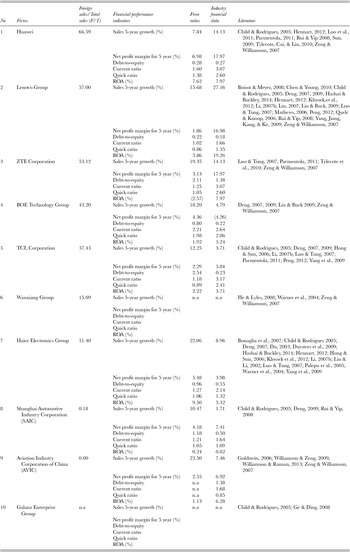
Paradoxically, the literature has focused only on a small number of high profile Chinese firms. Thus, it provides us little insight into the international activities of the majority of Chinese firms. Table 1 reports 10 Chinese firms that are the most frequently studied in the extant literature, arranged by their foreign (F) to total (T) sales (F/T) ratio for 2012 (column 2), and its related key financial ratios relative to the industry financial data (columns 5 and 6).
List of the 10 most frequently studied Chinese firms

Notes: Data is from OneSource Database (by Thomson Reuters, Reuters Research Inc., published by Avention Inc., 2013, data as of March 31, 2013). Sales five-year growth, and net profit margin for 5 year (%) are derived from the five-year period of 2008–2012; other company ratios are calculated from the 2012 data, with corresponding industry ratios reflecting ratios for 2012; data on F/T is from 2012 annual reports of the companies.
Home Country Institution and Chinese OFDI
The home country institution perspective, which is an extension of the institution-based view, has been widely applied to examine Chinese OFDI (Deng, Reference Deng2009; Luo et al., Reference Luo, Xue and Han2010; Voss et al., Reference Voss, Buckley, Cross, Alon, Chang, Fetscherin, Lattemann and McIntyre2009). From a macro-economic perspective, the surge of Chinese OFDI has been attributed to public policies and support by Chinese government in encouraging domestic firms to go abroad (Buckley et al., Reference Buckley, Clegg, Cross, Liu, Voss and Zheng2007; Cross et al., Reference Cross, Buckley, Clegg, Voss, Rhodes, Zheng, Liu, Dunning and Lin2007). From a micro-economic level, Chinese MNEs’ internationalization strategy, such as resource-driven M&As, location choices, and the ownership structure of foreign subsidiaries are mingled with various home country institutional incentives (Cui & Jiang Reference Cui and Jiang2012; Rui & Yip Reference Rui and Yip2008; Wang et al., Reference Wang, Hong, Kafouros and Wright2012; Zhang, Zhou, & Ebbers, Reference Zhang, Zhou and Ebbers2011).
Chinese government's support and the role of state ownership, which is a type of Chinese CSAs, confer Chinese firms resource advantages in their OFDI, thus compensate for their lack of intangible knowledge-based FSAs. It is argued that the internationalization may enhance Chinese firms’ capabilities to take risks abroad (Buckley et al., Reference Buckley, Clegg, Cross, Liu, Voss and Zheng2007; Luo et al., Reference Luo, Xue and Han2010). Government support and artificially cheap credit have greatly increased Chinese firms’ purchasing power in international M&As (Child & Rodrigues, Reference Child and Rodrigues2005; Gammeltoft, Barnard, & Madhok, Reference Gammeltoft, Barnard and Madhok2010; Luo et al., Reference Luo, Xue and Han2010). Luo and Tung (Reference Luo and Tung2007) develop the springboard view, which argues that Chinese firms use OFDI, especially through M&As of Western MNEs, as a springboard to seek access to sophisticated resources to compensate for their latecomer disadvantages, to mitigate domestic institutional disadvantages, and to secure preferential treatment from home governments.
The common assumption in the current literature is that strategic-asset-seeking FDI, which aim to acquire technology capabilities, global brand, distribution networks, and management expertise is a dominant motive for Chinese M&As. The literature focuses mainly on the benefits that Chinese firms gain from such investments (e.g., Klossek, Linke, & Nippa, Reference Klossek, Linke and Nippa2012; Wang & Boateng, Reference Wang and Boateng2007). However, there are relatively few studies examining the costs of such a strategy. Peng (Reference Peng2012) casts doubt on Chinese firms’ overseas acquisitions in their pre-acquisition and post-acquisition phases as they lack experience and fail to undertake due diligence. Rugman et al. (Reference Rugman, Nguyen and Wei2014) find that less than half of the announced foreign acquisitions of Chinese firms have been successfully completed.
Chinese MNEs’ Performance is a Mystery
The financial performance of Chinese MNEs has been under-researched in the extant literature. This is probably due to the fact that Chinese OFDI is a relatively new phenomenon, and its long-term performance is not understood (Peng, Reference Peng2012). Previous studies find that post-acquisition integration challenges constrain the success of most cross-border M&As (Shimizu, Hitt, Vaidyanath, & Pisano, Reference Shimizu, Hitt, Vaidyanath and Pisano2004). Chinese firms could be more vulnerable due to their lack of FSAs, especially the absence of systems integration and internal managerial coordination (Peng, Reference Peng2012; Rugman, Reference Rugman, Ramamurti and Singh2009).
The dominant view is that the acquired foreign assets enable Chinese firms to access foreign markets and compete with other MNEs (Liu, Reference Liu2007; Luo & Tung, Reference Luo and Tung2007; Rui & Yip, Reference Rui and Yip2008). However, there is little evidence to support this claim. A number of studies examine the internationalization process and sales patterns of Chinese firms, which are viewed as evidence of their globalization and international success (Liu, Reference Liu2007; Matthews, Reference Mathews2006). We show subsequently that sales are not necessarily an indicator of financial stability and sustainability.
THEORETICAL DEVELOPMENT
New Internalization Theory
Internalization theory explains the existence of the MNE when it achieves multinationality through the creation of internal markets to replace missing external intermediate markets. The MNE is particularly good at overcoming the public good externality of knowledge by substituting its internal market, and using substitutions to transfer tacit knowledge across national borders. The MNE needs to possess FSAs relative to local firms, which should outweigh the costs and risks of doing business abroad due to the liabilities of foreignness (Hymer, Reference Hymer1960; Zaheer, Reference Zaheer1995). The MNE establishes property rights over its FSAs so that they would not be dissipated to other firms (Rugman, Reference Rugman1981). In other words, the MNE transfers, deploys, exploits, and protects its FSAs through the use of foreign subsidiaries, which monitor, meter, and regulate the use of FSAs abroad (Rugman, Reference Rugman1981; Rugman, Verbeke, & Nguyen, Reference Rugman, Verbeke and Nguyen2011). Overall, internalization theory focuses on the efficiency aspects of the MNE (Buckley & Casson, Reference Buckley and Casson1976; Hennart, Reference Hennart1982; Rugman, Reference Rugman1981).
Rugman and Verbeke (Reference Rugman and Verbeke1992) develop the concepts of non-location bound and location-bound FSAs (NLB and LB FSAs). The former can be internationally transferred with low costs and little adaptation, and can be deployed and exploited in both home and host countries, and brings the benefits of economy of scale, scope and integration. The latter is bound to a particular location, a country, or set of countries, or a region and brings the benefits of national responsiveness. Rugman and Verbeke (Reference Rugman and Verbeke2001) demonstrate that FSAs can be developed not only by parent firms in the home country (parent-firm FSAs) but also by foreign subsidiaries in host countries (subsidiary-specific advantages SSAs). Previous literature documents that subsidiaries have created new capabilities and competencies in recombination with host CSAs (Andersson, Forsgren, & Holm, Reference Andersson, Forsgren and Holm2002; Birkinshaw, Reference Birkinshaw2000; Cantwell & Mudambi, Reference Cantwell and Mudambi2005). Rugman and Verbeke (Reference Rugman and Verbeke1992, Reference Rugman and Verbeke2001) refer to this contribution as new internalization theory.
Verbeke (Reference Verbeke2013) advances three types of FSAs. These are stand-alone FSAs through recombination with home CSAs; routines and codification; and recombination capability leading to tacit knowledge, which is the highest-order FSA. The recombination capability requires the firm not only to transfer abroad its existing set of FSAs developed by parent firms, but also to create new knowledge-based FSAs through the recombination with host CSAs. Such recombination of tacit knowledge requires that MNE managers meld home and host CSAs with FSAs held by geographically dispersed MNE units, and develop novel recombinations (Rugman, et al., Reference Rugman, Verbeke and Nguyen2011; Verbeke, Reference Verbeke2013). Hennart (Reference Hennart2009, Reference Hennart2012) states that such recombinations of FSAs and host CSAs is very difficult to achieve, since local (host country) resources are monopolized by local firms and are not freely accessible. This constrains and inhibits market entry and expansion of EMNEs (Hennart, Reference Hennart2009).
New Internalization Theory and Chinese OFDI
We argue that the types of FSAs which Chinese firms may possess are built upon home CSAs and deeply embedded in Chinese institutional environments (Rugman et al., Reference Rugman, Nguyen and Wei2014; Wei, Reference Wei2010). These include low-cost labour; large home market size; artificially cheap and implicitly subsidized debt capital; national innovation systems; privileged access to government relationships and networks; state ownership and national champion identities; dominant control and access to local input resources in domestic networks and output markets in China (Buckley, Reference Buckley2014; Luo & Wang, Reference Luo and Wang2012; Rui & Yip, Reference Rui and Yip2008; Rugman & Nguyen, Reference Rugman, Nguyen, Cuervo-Cazurra and Ramamurti2014; Rugman et al., Reference Rugman, Nguyen and Wei2014). In other words, Chinese firms have developed home country-bound FSAs, which is a type of stand-alone FSAs by Verbeke (Reference Verbeke2013)’s definition. For this reason, it is very difficult for Chinese firms to transfer their FSAs across borders due to home country-specific characteristics (Rugman et al., Reference Rugman, Nguyen and Wei2014).
Yet, reliance on home country CSAs might slow down or even impede Chinese firms to invest and to develop knowledge-based intangible types of FSAs. Managers interpret home country CSAs and past experience in local markets as a rationale for the existing success formulae. However, this success may restrain organizational learning when Chinese firms venture internationally. They may become less open to learning from new experiences, and less prepared for adaptations to new demands, and new requirements in international business environments outside China. They may become less motivated to adapt their organizational routines, business systems, and practices to accommodate host country conditions. They may become less ready to innovate and thereby develop knowledge-based FSAs. Consequently, they find it difficult to turn opportunities in international markets into superior financial performance results for overseas operations.
This phenomenon is akin to what March (Reference March1991) calls a ‘success trap’, defined as the focus on the exploitation of (historically successful) current business activities and as such neglect the need of exploration of new opportunities and enhancement of long-term viability. This has also been known as the ‘competency trap’ (Levinthal & March, Reference Levinthal and March1993). The competency trap implies that learning from experiences favors exploitation behavior, in which business practices become focused on well-known alternatives, underestimating the potential benefits of the unknown (March, Reference March1991). Firms come to over-rely on past experiences and do not adjust for new challenges, which are self-destructive behaviours.
In a related manner, Hennart (Reference Hennart2012) argues that EMNEs in general derive significant gains from the monopoly of home CSAs. They use this monopoly power to finance intangible-seeking investments in developed countries to obtain FSAs they lack, and hence, compete with FSA-rich MNEs in domestic and international markets (Hennart, Reference Hennart2012). Our theoretical perspectives are also in line with home country institution based views (Buckley et al., Reference Buckley, Clegg, Cross, Liu, Voss and Zheng2007; Buckley, Clegg, Cross, Voss, Rhodes, & Zheng, Reference Buckley, Clegg, Cross, Voss, Rhodes, Zheng and Sauvant2008).
Chinese MNEs have developed mainly home country-bound FSAs, so then how do they integrate acquired strategic assets in foreign markets and turn them into sustainable FSAs? Due to a short period of internationalization, Chinese MNEs still lack integration capabilities and savvy managerial talents, which give us little confidence that they are capable of integrating foreign acquisitions to develop anything resembling tacit knowledge recombination capabilities in host economies (Fan, Nyland, & Zhu, Reference Fan, Nyland and Zhu2008; Peng, Reference Peng2012; Rugman, Reference Rugman2007). Furthermore, the inefficient and centralized governance structure associated with state ownership (Chen & Young, Reference Chen and Young2010; Globerman & Shapiro, Reference Globerman and Shapiro2009) may reduce the willingness of Chinese parent firms to give autonomy to foreign subsidiaries to develop FSAs in host countries. In other words, Chinese MNEs have not developed recombination capabilities, which are the highest-order FSAs. Consequently, they find it very challenging to achieve superior financial performance in their overseas operations, because FSAs are key determinants of performance, not multinationality per se (Morck & Yeung, Reference Morck and Yeung1991; Nguyen, Reference Nguyen2011; Rugman, Reference Rugman1981; Rugman & Verbeke, Reference Rugman, Verbeke and Boddewyn2008; Verbeke & Brugman, Reference Verbeke and Brugman2009).
METHODOLOGY
Data Sources and Sample
Our new original dataset of the largest 500 Chinese manufacturing firms comes from China Enterprise Confederation and China Enterprise Directors Association. We examine these firms’ annual reports together with other stock market documents (e.g., prospectuses and various announcements) to obtain their financial data (sales, geographic segments, and number of foreign subsidiaries). We exclude 136 Chinese manufacturing firms from the dataset due to the unavailability of annual reports. We have a remaining 364 Chinese firms.
Our financial benchmarking of Chinese manufacturing MNEs’ performance relative to the industry financial data (peer group analysis) comes from ONESOURCE Global Business Browser. It is one of the leading financial intelligence commercial databases provided by Thomson Reuters, Reuters Research Inc., and published by Avention Inc.
Financial Benchmarking
Financial benchmarking is defined as the establishment by collection of data of comparators, which allow relative levels of performance to be identified (Drury, Reference Drury2009; Seal, Garrison, & Norren, Reference Sea, Garrison and Norren2011). Financial benchmarking is a well-established method in the fields of management accounting and financial management, and it has been widely adopted by MNEs in business reality. Financial benchmarking uses financial information most often in the form of ratios and metrics to perform these comparisons (Drury, Reference Drury2009; Seal et al., Reference Sea, Garrison and Norren2011). When benchmarks are used, the main question is: what is the average level of performance for a given ratio and metric in a specific industry?
One method of benchmarking is peer group analysis. For example, the North American Industry Classification System (NAICS), which is a product of the US Office of Management and Budget, serves as a method of identifying potential peers in the same industry for comparison. Firms with the same NAICS codes are identified. The financial ratios and metrics from a group of peers in the same industry are generated, which are known as industry financial data benchmarks. Once the benchmark is established, we can compare financial ratios of a particular company relative to the industry financial data or two firms operating in the same industry (Drury, Reference Drury2009; Seal et al., Reference Sea, Garrison and Norren2011).
Industry Financial Data
We use ONESOURCE database to collect financial data of Chinese manufacturing firms identified as true MNEs, and the industry financial data. We contact the Support Centre of ONESOURCE (operated by Avention, Inc.) to obtain a document called ‘Risk Management Association (RMA) Industry Norms Data Dictionary’. According to ONESOURCE, the industry financial data are provided by the RMA, which is the most respected source of objective and unbiased information on issues of importance to credit risk professionals. RMA has generated the RMA Annual Statement Studies, which have been the industry standard for comparison of financial data for over 85 years. Today, the RMA features data for over 740 industries (ONESOURCE, 2013).
The RMA has used more than 269,000 financial statements to produce the composite financial data. The financial data come directly from RMA member institutions and represent the financials from their commercial customers and prospects (ONESOURCE, 2013). In order to ensure confidentiality, company names are removed before the data is delivered to RMA. The raw data making up each composite is not available to any third party (ONESOURCE, 2013).
The RMA's Annual Statement Studies generate Financial Ratio Benchmarks. RMA shows balance sheet and income statement information in a common size format, with each item a percentage of total assets and sales. RMA computes common size statements for each individual statement in an industry group, and then aggregates and averages all the figures. A minus sign beside the value indicates credits and losses (ONESOURCE, 2013).
Data is organized by industry in accordance with the NAICS. A NAICS code may correspond to more than one Standard Industrial Classification (SIC), so there may be several SICs listed. If a NAICS code maps to more than three SIC codes, only the first three SICs will be listed at the top of the page, with all corresponding SIC codes found in the NAICS description index (ONESOURCE, 2013). When there are fewer than 10 financial statements in a particular asset or sales size category, the composite data is not displayed because a sample this small is not considered representative and could be misleading.
Measurements
Degree of internationalization
An MNE is defined as a firm, which is headquartered in one country but having operations in other countries (Rugman, Reference Rugman1981). An MNE must have a ratio of foreign sales over total sales (F/T) at 10 percent and three foreign subsidiaries (Rugman, Reference Rugman1981). The threshold of 10 percent F/T comes from international accounting standards, such as IFRS8-Operating Segments (for firms’ reporting in compliance with IFRS), and SFAS No. 131, FASB-Disclosures about Segments of an Enterprise and Related Information (for firms’ reporting in compliance with US GAAP).
Foreign sales ratio is measured by foreign sales over total sales (F/T), which has been widely used to measure the degree of internationalization (Hennart, Reference Hennart2011; Li, Reference Li2007a; Ruigrok, Amann, & Wagner, Reference Ruigrok, Amann and Wagner2007). The F/T data, which we use in our study, is determined by the way Chinese firms report in their annual reports. When we analyze F/T ratio of Chinese firms, we carefully consult their accounting policies and disclosure notes. We find that Chinese firms define foreign sales as sales outside Mainland China and they report sales in Hong Kong and Macau as foreign sales. Foreign sales include both export sales by parent firms from China and sales generated by their foreign subsidiaries through FDI in host countries. We used F/T data in 2012 for the largest 500 Chinese manufacturers, with the only exception of Suntech. Suntech went bankrupt in 2011, and its annual report became unavailable after that time. So, we had to use its data of the year 2011.
Financial performance
We use multi-dimensional performance indicators, which measure growth, profitability, financial stability, and management effectiveness of Chinese MNEs (Rugman & Colinson, Reference Rugman and Collinson2012). ONESOURCE provides financial performance data of average five-year sales growth, five-year net profit margin, total debt-to-equity ratio, current ratio, quick ratio, and return on asset (ROA) of Chinese firms relative to the industry financial data. The average of five-year data neutralizes variance over time (ONESOURCE, 2013).
RESULTS
The Majority of the Largest 500 Chinese Manufacturing Firms are Not MNEs
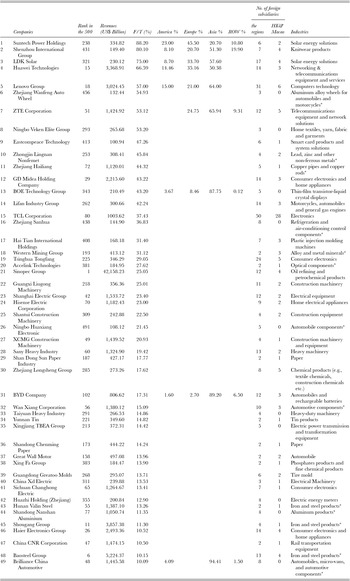
We find that among the largest 500 Chinese manufacturing firms, there are only 49 manufacturing firms to be ‘true MNEs’ by a basic definition. Table 2 reports these 49 MNEs, which are ranked by their F/T ratio. The average F/T ratio of Chinese MNEs is approximately 29 percent (including sales in Hong Kong and Macau). Many subsidiaries of these Chinese manufacturers (27 percent of total subsidiaries) are located in Hong Kong and Macau or both, and therefore are not really indicators of FDI. In addition, if Hong Kong and Macau sales were excluded, the F/T ratio of Chinese manufacturing firms would be lower and it is likely that there would be even fewer Chinese manufacturing MNEs. Furthermore, China, as one of the largest exporters in the world, has its domestic firms achieving foreign sales through exporting, as exports are part of ‘foreign sales’, leaving little for sales generated by foreign subsidiaries through FDI activities. In short, the majority of the largest Chinese manufacturing firms are purely domestic firms, not MNEs.
The 49 Chinese manufacturing MNEs by F/T for 2012

Source: Authors’ calculation. Note: (*) indicates material and component manufacturers, whereas the rest are final product manufacturers.
We examine these firms’ operations. Specifically, we identify firms operating in material and component manufacturing and those making final products (Table 2, last column). We find that out of the largest 49 Chinese manufacturing MNEs, the majority of them are final product manufacturers, accounting for 71 percent. Based on their F/T data, we find that the average F/T for final product manufacturers is 31 percent, while the average F/T for material and component manufacturers is 26 percent.
We examine these firms’ sales by geographic segments (Table 2). Suntech is the only ‘global’ company with more than 20 percent of its sales in all three regions of the broad triad of North America, Europe and Asia Pacific (Rugman & Verbeke, Reference Rugman and Verbeke2004). Ironically, this Chinese ‘global’ firm underscores the point we make subsequently on the implications of poor financial performance of Chinese firms in their internationalization. In March 2013, Suntech was the first company from Mainland China to default on its US bonds payment of US$541 million (Morales & Martin, Reference Morales and Martin2013). Subsequently, Suntech's main unit, Wuxi Suntech Power Holdings Co., Ltd. was placed into insolvency as Chinese banks filed bankruptcy against Suntech (Goossens & Doom, Reference Goossens and Doom2013; Sui-Lee, Reference Sui-Lee2013). The company's American Depository Receipts were delisted from the New York Stock Exchange and placed on the over the counter exchange.
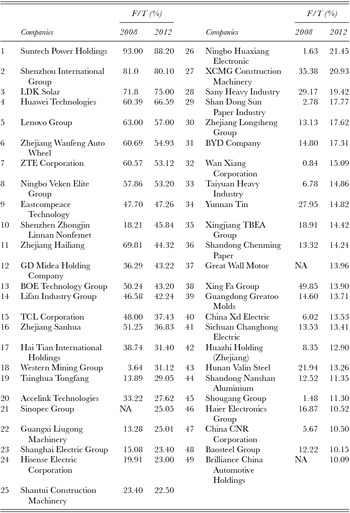
We compare F/T data of these Chinese manufacturing MNEs in 2008 and in 2012 (Table 3). We find that there are no significant changes. Among 49 Chinese MNEs, there are 26 firms that have witnessed a decrease in foreign sales ratio in 2012 compared to 2008. Overall, Chinese firms focus predominantly on their large Mainland China domestic market, and their foreign sales though FDI are very limited. One plausible explanation is that Chinese firms are unable to achieve foreign sales due to the nature of their home country-bound FSAs and the over-reliance on the domestic market.
49 Chinese manufacturing MNEs by F/T for 2008 and 2012

Source: Authors’ calculation.
Our new finding here using a new dataset of large manufacturing firms is fully consistent with Rugman and Nguyen (Reference Rugman, Nguyen, Cuervo-Cazurra and Ramamurti2014), who find that there are only five MNEs out of the largest 73 Chinese firms in the Fortune Global 500 in 2012. The rest are domestic firms. In addition, we find that the current literature suffers from a basic error. When a firm from an emerging country, especially from China, enters into the Fortune Global 500, it is automatically referred to as an MNE (Guillen & Garcia-Canal, Reference Gullien and Garcia-Canal2010: 10). This is not correct.
We revisit Table 1 (column 2): out of the 10 most frequently studied Chinese firms in the extant literature, there are two firms, which are not MNEs, namely, Shanghai Automotive (SAIC) and Aviation Industry Corporation of China (AVIC). The F/T ratio of SAIC is only 0.18 percent, and AVIC has no foreign sales. Indeed, there are only seven firms that have been correctly identified as Chinese MNEs in the extant literature. They are Huawei, Lenovo, ZTE, BOE, TCL, Wanxiang, and Haier. Overall, we find relatively few Chinese manufacturing firms to be MNEs.
The literature on Chinese MNEs also uses other anecdotal evidence, such as Weiqiao Textile, Pearl River Piano, Ping An, Industrial and Commercial Bank of China (ICBC), Bank of China, and Agriculture Bank of China (Hennart, Reference Hennart2012; Zeng & Williamson, Reference Zeng and Williamson2007). However, a basic analysis of financial data from these firms’ annual reports shows that they are not MNEs by a basic definition. In other words, successful Chinese domestic firms (Williamson & Zeng, Reference Williamson, Zeng, Ramamurti and Singh2009; Williamson & Rama, Reference Williamson, Raman, Williamson, Ramamurti, Fleury and Fleury2013; Zeng & Williamson, Reference Zeng and Williamson2007) have been chronically misinterpreted as Chinese MNEs.
Financial Benchmarking of Large Chinese Manufacturing MNEs Relative to Industry Financial Data
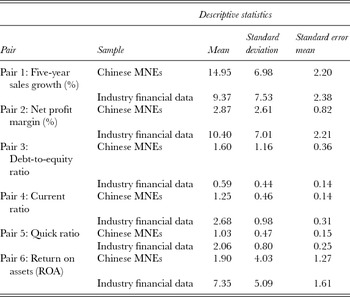
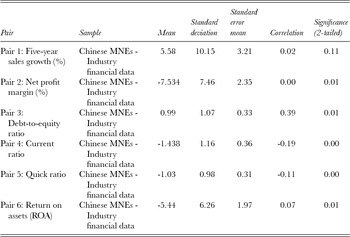
We use data from ONESOURCE to compare the financial performance of large Chinese manufacturing MNEs with the average industry financial data for the five-year period 2008–2012 (Table 4). As such, the industry and time effects are controlled. We report the significant level by using paired samples two-tailed t-test (Table 5). We find that compared to the industry financial data, the financial performance of Chinese manufacturing MNEs is significantly lower across key financial performance metrics (average five-year net profit margin, return on asset ROA), and they have higher risk profiles in terms of financial stability (total debt-to-equity ratio, current ratio, and quick ratio). Once the basic key performance indicators are applied across Chinese manufacturing MNEs, it is highly unlikely that the case examples in the existing literature can be shown to have successful strategies and sustainable performance.
Financial benchmarking on the performance of Chinese manufacturing MNEs relative to the industry financial data

Note: Data is from OneSource Database (by Thomson Reuters, Reuters Research Inc., published by Avention Inc., 2013, data as of March 31, 2013).
Paired samples t-test

Note: Data is from OneSource Database (by Thomson Reuters, Reuters Research Inc., published by Avention Inc., 2013, data as of March 31, 2013).
We revisit Table 1 (columns 4 and 5), in which Huawei, Lenovo, ZTE, TCL are often cited in the literature as evidence of Chinese MNEs’ successful internationalization. However, we find that the financial performance (profit and ROA) of these particular MNEs is lower relative to the industry financial data. For example, Huawei's net profit margin for the five-year period is 6.98 percent compared to the industry financial data of 17.97 percent. Lenovo's net profit margin is very thin at 1.86 percent, while the ratio for the industry financial data is nine times higher at 16.98 percent. Similarly, ZTE has been operating at a loss with a negative net profit margin (3.13 percent) compared to the industry of 17.97 percent. The net profit margin for TCL is 2.29 percent compared to the industry of 3.84 percent. The only Chinese manufacturing MNE with a solid financial performance is Haier, because Haier focuses on the Chinese domestic market where it has generated 90 percent of its total sales (Table 1).
Some of the frequently studied Chinese firms (SAIC, ZTE, and TCL) rely heavily on debt financing as reflected in their total-debt-to-equity ratio. This is probably due to their access to easy, artificially cheap, and subsidized debt capital from state-owned banks with mandates to support national champion firms. The financing of large Chinese firms in general has been in the hands of sovereign wealth funds, which are state-owned investment funds (Bremmer, Reference Bremmer2009).
Our finding on the high level of debt in the capital structure of Chinese manufacturing MNEs relative to the industry financial data (Table 4) is fully consistent with theoretical arguments by Buckley (Reference Buckley2014). He provides a comprehensive discussion on cheap credit (a type of Chinese CSAs). The access to low-cost credit might enable Chinese firms to internationalize by buying out Western firms in cross-border M&As. However, managing these financial resources effectively and efficiently to deliver superior performance results in overseas operations is another matter. This requires advanced international financial management skills, which Chinese firms need more time to develop. In short, Chinese firms have built their FSAs based upon home CSAs, but they have not yet developed advanced management skills in combination with host CSAs. The findings support our theoretical development in the earlier section.
The International Strategy of Chinese Firms and its Impact on Performance
The literature has emphasized the global nature of Chinese giants, such as Lenovo, Huawei and ZTE. We find that Chinese manufacturing MNEs, which report their geographic segment sales, are actually home region oriented, with more than 50 percent of sales in their home region of the triad (Rugman & Verbeke, Reference Rugman and Verbeke2004). To be more precise, the majority of Chinese manufacturing MNEs are oriented to large home country domestic markets in China. By focusing on the internationalization activities of the 10 most notable Chinese firms, and mainly their acquisitions of Western firms, the existing literature shows an inherent bias in exaggerating Chinese firms’ international success.
It is argued that MNEs from emerging markets have strong absorption capacity, which allows them to recognize, to access, to develop new knowledge, and to combine these resources with cost innovation capabilities developed at home (Deng, Reference Deng2007; Williamson & Zeng, Reference Williamson, Zeng, Ramamurti and Singh2009; Zeng & Williamson Reference Zeng and Williamson2007). We show that the acquired strategic assets potentially enable Chinese firms to enhance their competitive position in China, but cannot sustain their success in overseas markets. We find that sales growth of Chinese manufacturing MNEs is mainly attributed to sales growth in the domestic market, not in international markets. This is due to our careful analysis of Chinese firms’ sales by geographic segments and market share data by re-examination of the frequently-studied firms, and thus we can offer new insights.
Re-examination of Frequently-studied Chinese Firms
Lenovo
Lenovo has been used as an example of a promising Chinese MNE, with particular emphasis on its acquisition of IBM's personal computer division. There is consensus in the literature that the acquisition has enabled Lenovo to build a global brand, and to reach global customers by using IBM's brand, production lines, and management expertise, worldwide distribution and sales networks (Child & Rodrigues, Reference Child and Rodrigues2005; Liu, Reference Liu2007; Luo & Tung, Reference Luo and Tung2007; Mathews, Reference Mathews2006; Rui & Yip, Reference Rui and Yip2008; Zeng & Williamson, Reference Zeng and Williamson2007). By taking IBM's worldwide PC market share, Lenovo became the third largest PC manufacturer in the world in 2005. According to Gartner, Inc., Lenovo has been among the top five global companies in terms of worldwide PC vendor market share from 2005 to 2012.
We find that Lenovo's global market share is largely attributable to its leading position in China rather than in international markets. Lenovo's foreign sales in Asia Pacific, Europe, and the Americas, compared to its total sales, have been shrinking since 2005 (Lenovo annual reports, various years). After the acquisition, Lenovo experienced difficulty in maintaining IBM's PC market share in the United States. Based on Gartner data, Lenovo is among the top five PC manufacturers in the US market in 2005 (the year Lenovo completed the purchase of IBM's PC business). Since then Lenovo has dropped out of the top five in the US. It was not until 2012 that Lenovo reached the fifth place in the US market share.
In contrast, Lenovo has increased significantly its domestic market share and its domestic sales ratio in China after the acquisition (Lenovo annual reports, various years). Our empirical findings show that the acquisition of IBM's PC division has not enabled Lenovo to succeed beyond its core home market. In the same vein, the five-year sales growth of Lenovo is only 15.58 percent whereas the industry growth rate is 27.16 percent (Table 1).
TCL
TCL acquired Schneider Electronics in 2002. TCL acquired French Thomson's global colour TV business (branded RCA) and become the world's largest TV producer. TCL acquired Alcatel's global mobile phone business in 2004. TCL sells mainly the Thomson and Schneider brand in the European market and RCA brand TVs in North America (TCL, 2002, 2004). However, due to financial difficulties of European operations, TCL Thomson Electronic (TTE) Europe has been downsized, and it was returned to Thomson in 2006 (TCL, 2006). At the same time, on going poor performance instigated the voluntary wind-up of Schneider Electronics in 2011 (TCL, 2011). Although RCA has nine percent of the market share in the US market, it is perceived as old-fashioned and used mainly by elderly Americans (Bell, Reference Bell2008).
These acquisitions have not paved the way for TCL's future international expansion. Its foreign sales in the North American and European markets decreased from 48 percent to 23 percent of total sales between 2005 and 2008, while its domestic sales increased from 37 percent to 69 percent between 2005 and 2011 (TCL Annual report, various years). In other words, while TCL's five-year sales growth of 12.25 percent is higher than the industry financial data of 3.71 percent, it is attributable mainly to strong sales growth in Mainland China market, not in international markets (Table 1).
Shanghai Automotive (SAIC)
The acquisitions of MG Rover (UK) and SsangYong Motor (South Korea), which have been discussed intensively in the literature, have failed to make SAIC to be a true MNE. Only 0.18 percent of its total sales have been generated from foreign sales (Table 1). Furthermore, due to deterioration, South Korean SsangYong Motor went bankrupt and filed to restart operations in 2009 with Seoul Central District Court (SAIC, 2009).
BOE
The literature highlights the acquisition by BOE Technology. For example, BOE acquires Korean firm HYDIS's TFT-LCD production line, which has been cited to improve BOE's technology and strengthen its global sales network and service system (Deng, Reference Deng2007, Reference Deng2009; Zeng & Williamson, Reference Zeng and Williamson2007). However, due to operating difficulties, BOE HYDIS has applied for the Legal Reorganization Procedure to Central District Court in 2006, and has lost control (BOE, 2007). BOE generates much of its sales in Asian countries.
Haier
Haier is another well-known example of Chinese firm's internationalization with primary focus in the United States. Haier established facilities in an industrial park in South Carolina, a marketing venture in New York, and an R&D/design centre in Los Angeles, which aim to improve brand reputation, draw on local expertise in design and technology, and target local customers (Child & Rodrigues, Reference Child and Rodrigues2005; Duysters et al., Reference Duysters, Jacob, Lemmerns and Yu2009). It has been argued that Haier's presence in the United States not only yields local market share, but also supports its investments in other countries (Deng, Reference Deng2004, Reference Deng2007). However, Haier's foreign sales account for only 11.40 percent of its total sales in 2012 (Table 1). If sales in Hong Kong and Macau were excluded from the calculation of foreign sales, Haier would be a home country-based firm, which generates the vast majority of its sales from the domestic market in Mainland China (Table 1).
Wanxiang Group
Wanxiang Group's interest in the US market is evident by its acquisitions of several American companies, including Zeller Corporation, LT Company, UAI Company, GBC Company, PS Corporation, AI Company, and ACH. In 2013, Wanxiang obtained the US government's approval to buy the bankrupt electric-car battery maker, A123 Systems, in order to enhance the technology that A123 has developed. With internationalization and strategic-asset acquisition, Wanxiang has expanded its foreign markets. However, its focus remains on China, as foreign sales account for only 15 percent of total sales in 2012 (Table 1). In short, our analysis of the most popular case studies of Chinese MNEs’ internationalization success stories in the extant literature provides new interesting insights. We find that Chinese MNEs have achieved growth mainly in home country market, not in international markets.
DISCUSSION
Implications for Theoretical and Empirical Literature
Our study reveals superficial thinking in much of the extant literature on Chinese MNEs’ internationalization and performance. We emphasize that the theory on the strategy of Chinese MNEs needs to be empirically validated in the performance of the firms (Rugman & Nguyen, Reference Rugman, Nguyen, Cuervo-Cazurra and Ramamurti2014). Furthermore, the literature based on 10 case studies and anecdotal evidence of Chinese firms has led to the misinterpretation of theories and misplaced calls for new theories. We show that new internalization theory (Rugman & Verbeke, Reference Rugman and Verbeke1992, Reference Rugman and Verbeke2001; Verbeke, Reference Verbeke2013) has fully robust explanatory power. Chinese MNEs have home country-bound FSAs, which are deeply embedded in home CSAs (Rugman & Li, Reference Rugman and Li2007; Rugman et al., Reference Rugman, Nguyen and Wei2014; Rugman & Nguyen, Reference Rugman, Nguyen, Cuervo-Cazurra and Ramamurti2014). They have difficulty in transferring these FSAs across borders. In addition, they have not yet developed advanced management capabilities in recombination with host CSAs. Thus, they fail to achieve superior financial performance in overseas operations.
Interestingly, we find that among the largest 500 Chinese manufacturing firms, there are only 49 to be true MNEs, whereas the rest are purely domestic firms. The financial performance of Chinese manufacturing MNEs is poor relative to global peers using the financial benchmarking method with the industry financial data (peer group analysis). Because of the home country-bound nature of FSAs, such as government support and the lack of recombination capabilities with host CSAs, Chinese MNEs are unable to explore and secure foreign markets by deploying and exploiting the newly acquired strategic assets. Their sales growth has been mainly attributed to the success in domestic markets. Large Chinese manufacturing MNEs with OFDI activities, such as Lenovo, Huawei, and Haier might aim to increase their sales in international markets to gain global competitive positions. But, at least until now, they are only capable of growing by recombining their FSAs (including the foreign acquired assets) with China's home CSAs, but not with host CSAs. Chinese MNEs’ FSAs built upon Chinese CSAs may give them the opportunity to develop new FSAs based on their foreign activities. Unfortunately, we still find little evidence that this has occurred. We suggest that going forward, the literature on Chinese MNEs needs to better align theory with empirical evidence.
Implications for Practice
Our findings provide important strategic implications for Chinese managers and public policy makers. Managerial effectiveness cannot tolerate a lack of focus on financial performance, which is critically important for firms’ survival in the short term and in the long term. Policy makers are recommended to implement effective controlling and monitoring mechanisms to prevent potential abuses of government resources, especially credit financing, which may lead to wasteful investments and corruption. Chinese government is recommended to encourage firms to develop internationally transferrable FSAs, such as technology, global brands, and managerial capabilities, because they ensure the sustainability of firms’ internationalization and performance.
Limitations and Future Research Implications
Our study has several limitations, which might open a new direction for future research. To address our research questions, we focus on the largest 500 Chinese manufacturing firms, because of the important role of manufacturing in China. We use the financial benchmarking method to examine the performance of Chinese manufacturing MNEs relative to global peers. However, we cannot test hypotheses using regression techniques. This is because we find that there are only 49 firms out of the largest 500 Chinese manufacturers to be true MNEs. With such a small sample size of 49 manufacturing MNEs, the results from a multiple regression undermine the reliability, and the resulting estimates of error are potentially unreliable and may under or overestimate the true error (Hair et al., Reference Hair, Black, Babin and Anderson2010). We recommend that future research examine large Chinese service firms or a combination of service and manufacturing firms, identify the number of firms to be true MNEs, and compare and contrast the results with our findings. If the sample size of Chinese firms to be true MNEs is sufficiently large, it will be interesting to extend our study by using multivariate data analysis.
Future research needs to be more cautious in interpreting domestic Chinese firms as MNEs. We find that the majority of the largest Chinese manufacturing firms are home country based as they rely heavily on domestic market for their sales activities. Although Chinese OFDI has attracted significant attention in academic literature, there is still inadequate research on financial performance of international operations of Chinese firms. First, we demonstrate that performance is not driven by multinationality, so it is incorrect to interpret Chinese firms as successful MNEs based on their foreign activities such as M&As.
Second, we show that FSAs are key determinants of performance. On the one hand, Chinese firms are still lacking traditional Western types of FSAs (Hennart, Reference Hennart2012; Wei, Reference Wei2010). One the other hand, Chinese firms fail to demonstrate a successful performance in international markets due to their lack of the recombination capabilities with host CSAs. The relationship between Chinese firms’ FSAs and their performance makes a great contribution to both IB theory and the literature on EMNEs. Future empirical analysis with firm-level data on FSAs and performance is needed in order to shed new light on this important phenomenon.
Third, we show that over-reliance on home country CSAs (e.g. large domestic market for sales, low-cost credit financing, and low-cost labour for manufacturing, etc.) as a source of advantages might eventually become a source of risks for Chinese firms. They might be less prepared to innovate and develop FSAs, which are based on knowledge, information, and intellectual properties (e.g. advanced technology, global brands, and international managerial skills). The paradox is that they might be constrained in home country institutional deficiencies, which they seek to escape through internationalization in the first place (Witt & Lewin, Reference Witt and Lewin2007). Further research on the impact of home country CSAs on foreign performance of Chinese firms is needed.
CONCLUSION
New internalization theory with two dimensions of firm-specific advantages (FSAs) and home and host country-specific advantages (CSAs) are particularly valuable in explaining the internationalization and performance of Chinese MNEs. We find that there are relatively few Chinese manufacturing firms to be true MNEs by a basic definition (only 49 MNEs out of the largest 500 Chinese manufacturing firms). They rely on home country CSAs and government support rather than internationally transferrable FSAs to embark on internationalization. The cross-border expansion through acquisitions tends to yield non-sustainable FSAs. They have not yet developed new FSAs in combination with host CSAs. Consequently, their financial performance is poor relative to global peers using the industry financial data benchmarking method.