Implications
Although the inclusion in the finishing diet of entire bulls of either whole linseed or conjugated linoleic acid (CLA) increase the content of CLA in the muscle, whole linseed in the concentrate can be considered as a cheaper alternative to improve the fatty acid profile of beef. Besides, linseed improves some organoleptic properties such as beef flavour, although it may also increase the perception of rancid notes throughout ageing. Nevertheless, short ageing times (7 days) can be enough for optimal tenderness of Longissimus muscle while reducing the impact of off-flavours.
Introduction
Beef fat is a significant source of saturated fatty acids in the human diet because red meat has a relatively high ratio of saturated to unsaturated fatty acids. This undesirable fatty acid ratio is a risk factor for the development of vascular and coronary diseases (Barton et al., Reference Barton, Marounek, Kudrna, Bures and Zahradkova2007). There has been an increased interest in recent years for manipulating the fatty acid composition of meat (Wood et al., Reference Wood, Richardson, Nute, Fisher, Campo, Kasapidou, Sheard and Enser2003; Scollan et al., Reference Scollan, Dannenberger, Nuernberg, Richardson, MacKintosh, Hocquette and Moloney2014) with modifications of livestock diets being one of the most important strategies. Human nutritionists are recommending lower fat intakes along with greater intakes of polyunsaturated fatty acids (PUFA), especially of n-3 fatty acids (Voedingsaanbevelingen voor België, 2000). It is well known that the low PUFA/SFA and high n-6/n-3 ratios of some foods contribute to the imbalance in the fatty acid intakes of today’s consumers (Wood et al., Reference Wood, Enser, Fisher, Nute, Richardson and Sheard1999; WHO, 2003). Besides beneficial effects of PUFA for human health, the CLA isomers, in particular c9t11CLA and t10c12CLA, have received much attention for their health implications due to anticarcinogenic, antidiabetic and immune modulating effects and the potential for reduction in body fat mass (Pariza, 2004). CLA is a group of naturally occurring fatty acid isomers found in some foods such as beef and other ruminant products (Ritzenthaler et al., Reference Ritzenthaler, McGuire, Falen, Schultz, Dasgupta and McGuire2001). During ruminal biohydrogenation of dietary unsaturated lipids, unique fatty acid intermediates including CLA and trans-vaccenic acid, are produced in addition to saturated end products (Scollan et al., Reference Scollan, Choi, Kurt, Fisher, Enser and Wood2001). However, the CLA content of beef may also be increased by feeding rumen protected CLA supplements, making CLA available for absorption in the intestine and deposition in tissues (Poulson et al., Reference Poulson, Dhiman, Ure, Cornforth and Olson2004).
The fatty acid composition of the intramuscular fat in beef affects not only the nutritional value but also the sensory properties (Wood et al., Reference Wood, Enser, Fisher, Nute, Richardson and Sheard1999) including odour (Campo et al., Reference Campo, Nute, Wood, Elmore, Mottram and Enser2003), firmness, colour (lipid and pigment oxidation), flavour (Elmore et al., Reference Elmore, Mottram, Enser and Wood1999), juiciness, aroma and tenderness (Thompson, Reference Thompson2004). In addition to the relationship between fatty acid composition and sensory properties, the variation in the absolute concentrations and relative proportions of different fatty acids can affect the composition of meat and many of its physical and chemical features (Thompson, Reference Thompson2004). Some studies have evaluated the effect of the inclusion of linseed and rumen protected CLA on growth performance, carcass quality and fatty acid profile of meat (Schiavon et al., Reference Schiavon, De Marchi, Tagliapietra, Bailoni, Cecchinato and Bittante2011). However, there is limited information available on the instrumental and sensory quality of beef from cattle fed whole linseed (rich in n-3 fatty acids) and rumen protected products whose polyunsaturated fatty acids suffer less biohydrogenation in the rumen. The aim of this work was to study the instrumental and sensory qualities of meat from young Friesian bulls fed with high-concentrate diets enriched with polyunsaturated fatty acids due to the addition of linseed and coated-CLA.
Material and methods
Animals and treatments
A total of 48 Friesian entire males (initial live weight=239.8±0.7 kg and 198.7±4.1 days old) were randomly assigned to one of four dietary treatments. All the diets contained the same feed ingredients and supplementation with vitamin E (110 mg/kg concentrate). The four diets differed in their amount of whole linseed (rich in n-3 polyunsaturated fatty acids) and CLA provided in the diet: Control (L0 C0): 0% whole linseed and 0% of CLA, linseed (L10 C0): 10% whole linseed and 0% of CLA; CLA (L0 C2): 0% whole linseed and 2% protected CLA, and linseed+CLA (L10 C2): 10% whole linseed and 2% protected CLA. All the concentrates were isoenergetic and isonitrogenous and were offered along with water and cereal straw ad libitum. After a finishing period of 123±11.1 days, the bulls (mean live weight 458.4±16.6 kg) were slaughtered using standard procedures in an EU-licensed abattoir. Carcasses were chilled at 4±2°C for 24 h under commercial conditions. At 24 h postmortem, the Longissimus muscles including the Longissimus thoracis (LT) and Longissimus lumborum (LL) were removed from both sides of the carcass. Subcutaneous fat and connective tissue were trimmed from the muscles before meat quality evaluations. Dietary treatment effects on growth performance and carcass data are presented elsewhere by Albertí et al. (Reference Albertí, Gómez, Mendizabal, Ripoll, Barahona, Sarriés, Isausti, Beriain, Purroy and Realini2013).
The CLA supplement (Lutrell® pure, BASF, Germany) consisted of methyl esters of CLA bound to a silica matrix which are coated with fatty acids (in triglyceride form) containing hydrogenated soybean oil. The lipid-coated CLA contained 800 g/kg of lipid, 178 g/kg of ash, and 22 g/kg of moisture. The lipid portion contained 456 g/kg of palmitic and stearic acids, 79.2 and 76.8 g/kg of cis-9, trans-11 CLA and trans-10, cis-12 CLA isomers, respectively, and 91 g/kg of other fatty acids.
Instrumental analysis
The pH was measured (pH meter Crison 507) at 24 h postmortem in the LT at the 10th rib on the left side of the carcass; 2 cm-thick steaks were removed from the LT (between T8 and T10) to determine drip loss on raw meat according to Honikel (Reference Honikel1998). Steaks were immediately weighed and placed in a plastic net and then suspended in a jar, ensuring that the samples did not make contact with the container. The samples were suspended at 4°C and re-weighed after 24 h suspension. Drip loss was calculated by differences in weights between initial and final weight and expressed as a percentage. LT samples were removed between T6 and T7 on the right side of the carcass and kept frozen under vacuum conditions (−18°C). The samples were then analysed for moisture, ash, lipid and protein composition, according to official methods (AOAC, 1990).
At 24 h after slaughter, steaks (100 g) were cut at the 6th rib level from the left half-carcass, vacuum packaged, frozen and kept at −20°C. These samples were used for determination of fatty acid profile in a GC Agilent 7890 (Gomez et al., Reference Gomez, Mendizabal, Sarries, Insausti, Alberti, Realini, Perez-Juan, Oliver, Purroy and Beriain2014).
Vitamin E was determined in 1-cm thick samples from the LT (between T7 and T8) by liquid extraction in duplicate as described by Lyan et al. (Reference Lyan, Azais-Braesco, Cardinault, Tyssandier, Borel, Alexandre-Gouabau and Grolier2001) with the following modifications: 0.1 g freeze-dried meat was deproteinized with ethyl alcohol and vortexed; lipophilic components were then extracted with hexane. After the hexane phase was collected and evaporated with a vacuum centrifuge, the dry residue was dissolved in acetonitrile–methanol–dichloromethane and transferred into a 2 ml glass screw-top vial for automatic sampling using 40 μl for HPLC (HPLC 1100; Agilent, Karlsruhe, Germany]. HPLC separation used a 100×4.6 mm, RP C18, 2.6 μm Kinetex column and Krudkatcher ultra HPLC in-line filter (0.5 μm depth filter×0.004 in id). The isocratic mobile phase was a mixture of acetonitrile–methanol–dichloromethane–ammonium acetate 0.05 M in water 75–10–10–5. The analysis was performed at a flow rate of 1.5 ml/min with the column oven temperature maintained at 35°C. The run time was 8 min.
A 3-cm thick steak from the LT of the right side was cut at 24 h postmortem and placed in a polystyrene tray, covered with plastic film permeable to oxygen and stored at 4°C in darkness. Colour measurements were assessed at 15 min and 1, 2, 5, 7, 9, 12 and 14 days after cutting using a Minolta 4600d Spectrophotometer in the CIELAB space (Lightness, L*, redness, a*, yellowness, b*) (CIE, 1976). Hue (Hº=arctan (b*/a*)] and chroma (C*=(a*2+b*2)1/2)] were calculated.
The LT (between T7 and T10) was sliced into three 3.5-cm thick steaks for Warner-Bratzler shear force evaluation for tenderness. The steaks were vacuum packaged at 4°C, aged for 1, 7 and 21 days, and then kept frozen at −18°C. Before the analysis, steaks were thawed for 24 h at 4°C, and cooked into a water bath until reaching an internal temperature of 70°C, which was monitored with an internal thermocouple probe (JENWAY, 2000). Cooking losses were assessed as the percentage of weight losses after cooking. Each steak was then cut in small samples with the muscle fibres parallel to the longitudinal axis, getting a minimum of eight samples of 1 cm2 (square cross-section) per animal and postmortem ageing time. Shear force (kg) was assessed using an INSTRON 4301 with a Warner-Bratzler (WB) device.
Trained taste panel
The LL was sliced into 2-cm thick steaks for sensory analysis by a trained panel. Steaks were vacuum packaged and kept at 4°C for 7 and 21 days, then frozen and stored at −18°C until further analysis.
For the sensory analysis protocol, the steaks were thawed for 24 h in a refrigerator at 4°C (same procedure followed for instrumental texture analysis) before each session. After removing the vacuum packaging, individual steaks were wrapped in aluminium foil and cooked at 200°C in a double plate grill (SAMMIC P8D2) until the internal temperature reached 70°C, which was monitored using an internal thermocouple (JENWAY, 2000).
Each cooked steak was trimmed of fat and any external connective tissues, cut into ~2×2×2 cm samples, wrapped in coded aluminium foil and stored at 55°C in a warm cabinet until tasting. To evaluate the effect of the four diets and the two ageing times (7 and 21 days), sensory tests were performed during 10 sessions in a sensory evaluation laboratory equipped with individual booths and under red lighting, to mask any differences in meat colour. In comparative multi-sample test using a balanced incomplete block design, the samples were served randomly to an eight-member trained sensory panel. To avoid the possible effects of the order of presentation, and first-order and carry-over effects, the samples were presented to panellists in different orders. During one training session, the panellists agreed upon a set of sensory descriptors. Panellists used a 10-cm unstructured line scale (0=very low; 10=very high) to quantify odour intensities (beef, rancid, fat), tenderness, juiciness, fibrousness, flavour intensities (beef, acid, fat, liver, metallic, rancid) and overall liking.
Statistical analysis
pH, drip loss, chemical profile and vitamin E were analysed by the GLM procedure of SPSS (19.0) in a 2×2 design considering addition of linseed (rich in n-3 fatty acids) and addition of CLA (rich in CLA isomers) as main effects. Colour, cooking losses and instrumental texture data were analysed with a MIXED model of SAS (8.3), including display or ageing time in the model as fixed effects, as well as addition of linseed and CLA effects, and their interactions, and animal as random effect. Data from the sensory panel were analysed also with a MIXED model, considering linseed, CLA, ageing time (7 and 21 days), session and panellist as fixed effects, and animal as random effect.
The mean and standard error of the mean (SEM) were calculated for each variable. When the interaction between effects was significant (P⩽0.05), means were separated using the Duncan’s multiple range tests with a significance of P⩽0.05. To describe the relationships between meat sensory quality traits, a Principal Component Analysis, which makes possible to identify the most important directions of variability in a multivariate data matrix and to present the results in a graphical plot (Destefanis et al., Reference Destefanis, Barge, Brugiapaliaga and Tassone2000), was performed using SAS (8.3).
Results and discussion
Diet effect on beef quality
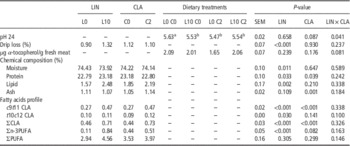
The interaction between linseed and CLA was significant (P=0.041), showing higher pH of the meat without either linseed or CLA additions in the diet (Table 1). In any case, pH values from all treatments were below 5.80 indicating that pH was not limiting for meat quality (Warren et al., Reference Warren, Scollan, Nute, Hughes, Wood and Richardson2008).
Effect of linseed (LIN) and conjugated linoleic acid (CLA) in the diet on meat quality, chemical composition of Longissimus thoracis and the fatty acid profile (g/100 g total fatty acids) of intramuscular fat (adapted from Gomez et al., Reference Gomez, Mendizabal, Sarries, Insausti, Alberti, Realini, Perez-Juan, Oliver, Purroy and Beriain2014) in Friesian young bulls

L0 C0=No linseed-No CLA; L10 C0=Linseed-No CLA; L0 C2=No linseed-CLA; L10 C2=Linseed-CLA; ΣCLA=total conjugated linoleic acid isomers; PUFA=polyunsaturated fatty acids.
Different letters in the same row indicate significant differences at P⩽0.05. pH 24: pH measured in L. thoracis at the at 10th rib in the left half carcass at 24 h postmortem.
The inclusion of linseed significantly increased drip loss (P⩽0.001), but there was no influence of CLA enrichment (Table 1). Water holding capacity is a factor that also relates to the juiciness of meat (Lawrie and Ledward, Reference Lawrie and Ledward2006). For that reason high drip losses are negative from the meat quality perspective. Other authors have found decreasing drip loss with the inclusion of flaxseed (Juárez et al., Reference Juárez, Dugan, Aldai, Basarab, Baron, McAllister and Aalhus2012) but with higher values (~4%) than ours after 4 days of storage at 2°C, instead of the 24 h of our study, which would increase the water losses.
The chemical composition of the LT (moisture, proteins, lipids and ashes) was especially affected by the inclusion of linseed (Table 1). Moisture content was lower (P⩽0.05) in meat from animals fed linseed enriched diets (73.9% v. 74.4%), but the inclusion of CLA did not influence this value. The inclusion of whole linseed and CLA fatty acids influenced the protein content (P⩽0.05) of LT muscle. Meat from linseed enriched diets showed greater protein percentage than meat from not linseed-enriched diets, whereas animals fed with CLA had lower protein percentage in the muscle than animals fed without CLA. The amount of intramuscular fat increased (P⩽0.01) with the inclusion of linseed in the diet; animals fed linseed showed 2.48% of intramuscular fat v. 1.57% in animals fed without linseed. However, there were no significant differences in meat enriched with or without CLA (2.19% and 1.86%, respectively). Administration of CLA mixtures has been found to strongly reduce body fatness in growing animals (Pariza, Reference Pariza2004). Such reduction, mainly due to the biological action of the t10c12-CLA isomer, appears to be caused mostly by a reduction in body fat accretion and not to a mobilization of body fat that had already accumulated before the experiments (Pariza, Reference Pariza2004). Little research is available about the effects of feeding protected CLA on carcass composition in growing cattle, but considering the results obtained with other species (Barnes et al., Reference Barnes, Winslow, Shelton, Hlusko and Azain2012), it could be expected that administration of coated-CLA could cause a reduction in body fatness. In the current work, intramuscular fat content (P=0.21) in CLA fed animals was not different from that of animals fed without CLA, probably due to the slaughter age of the young bulls, not old enough to show these differences. The results for ash content (P⩽0.01) also showed significant differences, with the CLA dietary treatment leading to the greatest percentage. But, the inclusion of linseed did not affect the amount of ashes in the meat.
Gomez et al. (2014) analyzed the intramuscular fat in the same animals as the current study (Table 1). The inclusion of linseed in the diet increased the amount of n-3 PUFA in the intramuscular fat by 3.7 fold (P⩽0.001), greater than the two-fold increase when linseed was added at 5% in the diet (Albertí et al., Reference Albertí, Beriain, Ripoll, Sarriés, Panea, Mendizabal, Purroy, Olleta and Sañudo2014). Some authors have reported that CLA supplementation in pig diets reduces backfat and increases marbling (Barnes et al., Reference Barnes, Winslow, Shelton, Hlusko and Azain2012). However, in cattle the effect of the trans-10, cis-12 isomer on the amount of fat deposited in the various depots remains unclear (Schiavon et al., Reference Schiavon, De Marchi, Tagliapietra, Bailoni, Cecchinato and Bittante2011). In the present study, the amount of total CLA in the intramuscular fat increased with the inclusion of coated-CLA in the diet (0.51% v. 0.35%), as well as when animals were fed whole linseed (0.51% v. 0.35%). The amount of the cis-9, trans-11 CLA isomer was also significantly higher (P⩽0.001) in the intramuscular fat of animals fed with linseed or CLA.
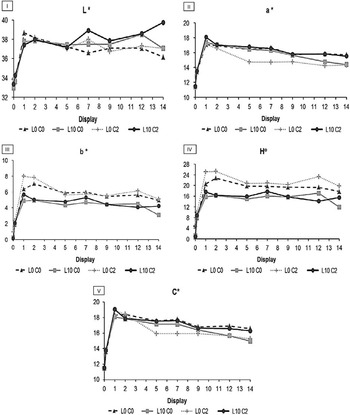
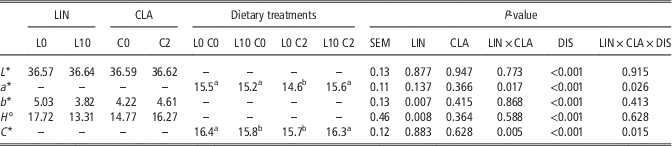
The inclusion of linseed affected yellowness (b*) and hue (Hº) (P<0.01), but the inclusion of CLA did not affect any of the colour parameters (P>0.1). There were significant interactions between inclusion of linseed and CLA in redness (a*) (P<0.05) and Chroma (C*) (P<0.01) (Table 2). However, display strongly affected all colour parameters (P<0.001) (Figure 1). The addition of CLA in the diet significantly increased hue, whereas the inclusion of linseed decreased hue values and yellowness. Beef colour is dependent on myoglobin content and oxidation state of the pigment, and both are affected by diet (Priolo et al., Reference Priolo, Micol and Agabriel2001). Some authors argued that differences in lightness could be partially explained by differences in the intramuscular fat content (Coulon and Priolo, Reference Coulon and Priolo2002). While consumers would find meat visually acceptable when Chroma values are 18 (McDougall, Reference McDougall1982), this threshold value was based on meat from grass-fed animals, and animals older than yearlings used in the present study. In these young animals, some authors have reported acceptable Chroma values <18 (Ripoll et al., Reference Ripoll, Casasús, Albertí and Blanco2011). According to that, meat from all treatment groups would be well accepted by consumers, even after 14 days of storage. When animals are fed with a similar basal diet, but fatty acid composition is altered by the addition of different fats to the diet, lipid and colour stability can be expected to be more related to the fatty acid composition than to the antioxidant concentration (Scollan et al., Reference Scollan, Choi, Kurt, Fisher, Enser and Wood2001). From the initial exposure to oxygen, all the measurements increased until day 1, but thereafter lightness remained stable, while redness, yellowness, hue and Chroma gradually decreased, especially after 5 days of storage. Dietary vitamin E supplementation (all-rac-tocopheryl acetate) is perhaps the best known method for improving meat quality by reducing lipid and myoglobin oxidation in fresh meat and meat products (Dunshea et al., Reference Dunshea, D’Souza, Pethick, Harper and Warner2005). In the current study, the amount of vitamin E added to the diet was similar for all the treatments; therefore it seems that the incorporation of linseed to the diet might have modified the fatty acid composition largely enough to affect colour.
Effect of display (days) on colour measurements L* (I), a* (II), b* (III), Hº (IV) and C* (V) in meat from Friesian young bulls. L0 C0: No linseed-No CLA; L10 C0: Linseed-No CLA, L0 C2: No linseed-CLA; L10 C2: Linseed-CLA. Effect of display (DIS) was significant in all colour parameters (P<0.001). Interactions DIS×LIN and DIS×CLA was not significant. Interaction DIS×LIN×CLA was significant for L* and a*.

Effect of linseed (LIN) and conjugated linoleic acid (CLA) in the diet and display (DIS) on colour measurements L*, a*, b*, Hº and C* in Friesian young bulls

L0 C0=No linseed-No CLA; L10 C0=Linseed-No CLA; L0 C2=No linseed-CLA; L10 C2=Linseed-CLA.
a,b,c,d,eValues with different letters in the same row within dietary treatments or display duration statistically different at P⩽0.05.
LIN, CLA, DIS and their interactions have been included in the ANOVA model. DIS is shown in Figure 1.
Diet and ageing effects on texture
Cooking losses and instrumental texture evaluation of Longissimus muscle were not affected by the inclusion of linseed (P>0.1) or CLA (P>0.1). However, postmortem ageing had a significant effect on all texture measurements (Table 3). Beef cooking losses were greater at 1 day of ageing compared with 7 and 21 days, which did not differ amongst treatments. Shear force was greater (P=0.081) in animals fed without any addition of linseed or CLA in comparison with animals fed only whole linseed. However, based on these measurements, there was no difference in tenderness between those treatments with CLA (L0 C2 and L10 C2) and L0 C0 or L10 C0 treatments. Some authors have proposed that dietary fatty acids influence tenderness and juiciness, since fat tissue hardness is affected by the melting point of fatty acids (Wood et al., Reference Wood, Richardson, Nute, Fisher, Campo, Kasapidou, Sheard and Enser2003), although texture is more likely to be affected by the total amount of fatty acids rather than individual ones (Wood et al., Reference Wood, Richardson, Nute, Fisher, Campo, Kasapidou, Sheard and Enser2003). Meat texture changes with ageing, especially tenderness. Some reports have indicated that tenderness is slightly positively related to intramuscular fat content (Chriki et al., Reference Chriki, Renand, Picard, Micol, Journaux and Hocquette2013). However, in agreement with others authors (Campo et al., Reference Campo, Sañudo, Panea, Albertí and Santolaria1999), the influence of intramuscular fat content would be less important for texture characteristics than ageing.
Effect of linseed (LIN) and conjugated linoleic acid (CLA) in the diet and ageing on cooking loss (%), shear force (kg) and toughness (kg/cm2) in Friesian young bulls

L0 C0=No linseed-No CLA; L10 C0=Linseed-No CLA; L0 C2=No linseed-CLA; L10 C2=Linseed-CLA.
Different letters in the same row within dietary treatments indicate significant differences at P⩽0.05.
Interactions with ageing=P⩾0.5.
The shear force decreased (P⩽0.001) as ageing time increased (Table 3). Ageing can be used to decrease shear force values during postmortem storage (Sañudo et al., Reference Sañudo, Macie, Olleta, Villarroel, Panea and Albertí2004) as a result of the increased myofibrillar fragmentation, which is mediated greatly by calpains (Koohmaraie, Reference Koohmaraie1996). In the present work, WB shear force values in the LT muscle (P⩽0.001) was significantly different according to ageing time and clearly decreased up to 7 days of ageing, in agreement with Sañudo et al. (Reference Sañudo, Macie, Olleta, Villarroel, Panea and Albertí2004). However, there were no differences from 7 days onwards. Postmortem ageing for six days has been observed to reduce shear force values (Aalhus, Reference Aalhus1992) although other reports have extended this period up to 14 days (Miller et al., Reference Miller, Kerth, Wise, Landsell, Stowell and Ramsey1997).
Diet and ageing effects on sensory quality
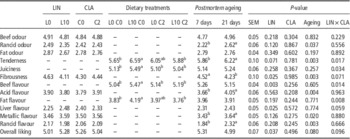
The significance of the inclusion of whole linseed and/or CLA addition, postmortem ageing time and their interactions on sensory attributes is shown in Table 4.
Effect of linseed (LIN) and conjugated linoleic acid (CLA) in the diet and ageing on meat sensory quality by a trained panel in Friesian young bulls

L0 C0=No linseed-No CLA; L10 C0=Linseed-No CLA; L0 C2=No linseed-CLA; L10 C2=Linseed-CLA.
Mean scores rated from 0=very low to 10=very high. Different letters in the same row within dietary treatments indicate significant differences at P⩽0.05. LIN×Ageing was significant for rancid flavour (P=0.016), CLA×Ageing was significant for beef flavour (P=0.037) and LIN×CLA×Ageing was not significant.
Tenderness is one of the predominant criteria for assessing the quality of beef. Some authors reported the positive relationship between tenderness and intramuscular fat content (Chriki et al., Reference Chriki, Renand, Picard, Micol, Journaux and Hocquette2013). The effect of fatty acids on tenderness may be related to the different melting points of the fatty acids. Thus, when the unsaturation is high, the melting point decreases, and this fact may increase tenderness (Partida et al., Reference Partida, Olleta, Sañudo, Albertí and Campo2007). Although the scores for this attribute were over half of the scale in all treatments, tenderness was the greatest in meat from linseed fed animals (6.59), although the addition of CLA together with linseed decreased this perception (5.88) (Table 4). Also Maddock et al. (Reference Maddock, Bauer, Koch, Anderson, Maddock, Barceló Coblijn, Murphy and Lardy2006) found that meat from flaxseed fed animals was more tender than meat from steers finished on a corn-based diet without flaxseed. Since fibrousness is negatively related to tenderness (Campo et al., Reference Campo, Sañudo, Panea, Albertí and Santolaria1999), meat from animals fed linseed was less fibrous (P=0.025) than meat from animals without linseed in the diet. In addition to that, there was an interaction between the inclusion of linseed and CLA on juiciness (P=0.034), showing that meat enriched only with whole linseed was juicier than meat from other treatment groups.
The linseed enriched diet produced meat that had a greater intensity of beef flavour. Other studies have shown that the content of n-3 PUFA in the meat increases sensory attributes such as ‘grassy’, ‘greasy’ and ‘fishy’ and the development of off-flavours are perceived stronger (LaBrune et al., Reference LaBrune, Reinhardt, Dikeman and Drouillard2008). That could also explain why liver flavour was higher in meat from linseed-fed animals (P=0.025), although in contrast with LaBrune et al. (Reference LaBrune, Reinhardt, Dikeman and Drouillard2008) findings, no significant differences were found in other flavours such as metallic, acid or rancid due to diet.
The effect of ageing time was significant on rancid odour (P⩽0.01), tenderness and fibrousness (P<0.01), acid (P⩽0.01), metallic (P<0.05) and rancid (P⩽0.01) flavours, and only had a tendency on overall liking (P=0.080). Rancid odour was rated higher at 21 days of ageing than at 7 days. Rancidity arises from oxidation, an exponential process that increases with time, but vacuum packaging of fresh meat protected the meat from oxygen and light providing sufficient shelf life (Lee and Yoon, Reference Lee and Yoon2001). Thus, the fact that these steaks were stored intact and under vacuum conditions has slowed down the process so that the maximum value for rancid flavour at 21 days was only 2.32 on a 10-points scale.
Ageing time is one of the most influential factors affecting sensory perception of tenderness. Some authors have observed that as postmortem ageing time increased, tenderness improved (Jeremiah and Gibson, Reference Jeremiah and Gibson2003). Results from the current study showed a tenderness improvement in the LL muscle between 7 and 21 days of postmortem ageing time, with meat aged for 21 days scored less fibrous than meat aged for 7 days. The postmortem ageing time is an important factor for the development of flavour precursors. Ageing (7 and 21 days) improves the flavour, reaching an optimum and then, at longer ageing times (21 and 35 days) off-flavours develop (Monsón et al., Reference Monsón, Sañudo and Sierra2005). The panellists found differences in some negative flavours with increased acid flavour (P⩽0.05), metallic (P<0.05) and rancid flavour (P⩽0.01) in meat aged for 21 days, although the scores remained low in the rating scale.
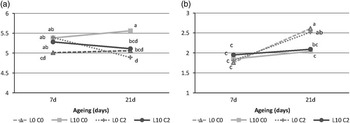
The linseed and CLA addition by postmortem ageing interactions for rancid and beef flavours are illustrated in Figure 2. The meat from animals fed the diet enriched with linseed showed similar evolution in rancid flavour throughout the ageing time, with no strong increase from 7 to 21 days. However, meat from animals fed without linseed showed higher scores for rancid flavour as postmortem ageing increased. Since linseed was incorporated in the feed as whole linseed, some of the antioxidants in the seed might have been incorporated into the meat thus increasing the stability through ageing under vacuum conditions. Beef flavour decreased with the ageing of meat from CLA fed animals, especially from those without linseed in the diet, showing the lowest score at 21 days of ageing.
Diet by postmortem ageing interaction on beef flavour (a) and rancid flavour (b). Different letters within dietary treatments indicate statistically different at P⩽0.05. L0 C0: No linseed-No CLA; L10 C0: Linseed-No CLA, L0 C2: No linseed-CLA; L10 C2: Linseed-CLA

Principal components analysis
Data from the panel test (Figure 3) were plotted with the first two principal components (PC) explaining 76.2% of the overall variation, dietary treatment being explained mainly by the first component (44%) and ageing mainly by the second one (32.2%). The results indicate the negative correlation between overall liking and several attributes such as fibrousness, fat odour, rancid flavour, acid flavour or metallic flavour. Tenderness was positively related with juiciness, beef flavour and overall liking and placed on the positive side of the axis, coincidentally with other findings (Destefanis et al., Reference Destefanis, Barge, Brugiapaliaga and Tassone2000) where the eating quality characteristics are positively correlated among them and placed on the positive side of the plot. The samples from animals that were fed with linseed were placed on the positive side of the axis and the rest of the treatments were on the negative side of the axis. The short ageing time (7 days) was clearly separated from long ageing time (21 days). The inclusion of linseed was correlated with positive attributes, such as beef flavour or tenderness. Meat from animals fed linseed aged for 21 days was related to tenderness, juiciness and liver flavour, and meat from linseed aged at shorter times was related to fat flavour, beef flavour and overall liking. The L0 C0, L0 C2 and L10 C2 treatments aged for 21 days were characterized by rancid odour, beef odour, rancid flavour, acid flavour and metallic flavour. There was a strong (and expected) negative correlation between tenderness and fibrousness, while tenderness was related with linseed aged for 21 days, the fibrousness was associated with the rest of the treatments at 7 days of ageing.
Principal components analysis of sensory quality of meat from Friesian bulls fed with whole linseed and protected CLA enriched diets. L0 C0: No linseed-No CLA; L10 C0: Linseed-No CLA, L0 C2: No linseed-CLA; L10 C2: Linseed-CLA. 7d: 7 days of ageing; 21d: 21 days of ageing.

Conclusions
The incorporation of CLA in the Longissimus muscle by the addition of coated-CLA in the animal feeding did not improve its tenderness or juiciness, whereas increasing the n-3 polyunsaturated fatty acids composition by adding whole linseed in the diet of Friesian young bulls improved marbling. The inclusion of linseed or CLA in the concentrate had a stronger influence than ageing time on the organoleptic properties of beef. However, the instrumental beef quality was more affected by ageing time.
In addition, greater rankings for specific sensory quality parameters were found for meat from animals fed the linseed enriched diet when compared with meat from CLA-fed animals. Although meat from linseed-fed animals may have a perceived liver flavour, other sensory quality characteristics, such as tenderness and beef flavour had greater rankings. Ageing for 21 days increased the meat rancid notes suggesting that shorter ageing times (7 days) could be recommended for the consumption of Longissimus muscle from enriched meat with linseed and protected CLA.
Acknowledgements
The authors would like to thank the INIA for funding the project RTA 2009-00004, Gobierno de Aragón/European Social Fund, and the Centre of Research and Agro-alimentary Technology of the Aragón Government for helping with the animal fattening. They also thank the Animal Production personnel of the Faculty of Veterinary and the trained test panel for their technical assistance.