Implications
Being born nearly agammaglobulinemic, calves strictly depend on immunoglobulin (Ig) absorption from colostrum to acquire immune protection. Inadequate colostrum administration leads to failed transfer of passive immunity (FTPI), which has significant negative effects on calf health and survival. The FTPI remains a widespread problem in dairy farming. This study investigated the management factors associated with FTPI in calves, particularly focusing on the combined effect of delivery time, amount and quality of the first colostrum meal. The results will be useful to develop farm-specific programs aimed at improving the newborn calf management practices.
Introduction
Despite their great impact on animal welfare and farm profits, farmers often underestimate morbidity and mortality rates of dairy calves (Vasseur et al., Reference Vasseur, Pellerin, de Passillé, Winckler, Lensink, Knierim and Rushen2012; Mee, Reference Mee2013). Furthermore, mean calf mortality values hide the right skewed distribution of mortality data, which show a very wide inter-farm variability ranging from minimal losses to a calf mortality over 20.0% (Mee, Reference Mee2013; Uetake, Reference Uetake2013). Among other several factors possibly linked to calf diseases and mortality occurrence, a proper colostrum provision is the first step in calf loss prevention. As calves are born almost agammaglobulinemic, they depend on colostrum ingestion for acquiring maternal immune protection against infectious diseases (Weaver et al., Reference Weaver, Tyler, VanMetre, Hostetler and Barrington2000; Lorenz et al., Reference Lorenz, Fagan and More2011). The intestinal absorption of intact Ig from colostrum is greatest within 6 h from birth (‘open gut’), but decreases steadily since the 6th to the 12th hour of life and basically ends within 24 h (‘closure’) (Godden, Reference Godden2008; Lorenz et al., Reference Lorenz, Fagan and More2011). Therefore, an adequate transfer of passive immunity to newborn calves is ensured by feeding colostrum within 6 h of birth, in adequate amount (i.e. 10.0% to 12.0% of calf BW, corresponding to about 3.0 or 4.0 l of colostrum for a Holstein calf) and of good quality (i.e. with Ig concentration ⩾50.0 g/l and bacterial count <100 000 CFU/ml) (Weaver et al., Reference Weaver, Tyler, VanMetre, Hostetler and Barrington2000; McGuirk and Collins, Reference McGuirk and Collins2004; Godden, Reference Godden2008). Inadequate colostrum provision leads to FTPI, a condition which is defined as calf serum Ig concentration lower than 10.0 g/l at 24 to 48 h of life (Jaster, Reference Jaster2005; Godden, Reference Godden2008; Furman-Fratczak et al., Reference Furman-Fratczak, Rzasa and Stefaniak2011). However, a serum Ig concentration of at least 16.0 g/l seems to be required for good immune protection (Waldner and Rosengren, Reference Waldner and Rosengren2009; Furman-Fratczak et al., Reference Furman-Fratczak, Rzasa and Stefaniak2011). Many studies indicated FTPI as a major risk factor in the incidence and severity of both enteric and respiratory calf diseases (Donovan et al., Reference Donovan, Dohoo, Montgomery and Bennett1998; Maunsell and Donovan, Reference Maunsell and Donovan2008; Furman-Fratczak et al., Reference Furman-Fratczak, Rzasa and Stefaniak2011), and it has been reported that 31.0% to 39.0% of calf mortality could be due to FTPI (Wells et al., Reference Wells, Dargatz and Ott1996; Tyler et al., Reference Tyler, Hancock, Thorne, Gay and Gay1999; Godden, Reference Godden2008). Long-term consequences of FTPI, such as negative effects on age at first calving and performances in the first lactation of heifers, have also been reported (Heinrichs and Heinrichs, Reference Heinrichs and Heinrichs2011). Potential negative effects on health and performances of male calves conveying to veal or beef industries should also be considered. Studies carried out on dairy calves in different countries reported a prevalence of FTPI ranging from 35.0% to 40.0% (Weaver et al., Reference Weaver, Tyler, VanMetre, Hostetler and Barrington2000; Trotz-Williams et al., Reference Trotz-Williams, Leslie and Peregrine2008; Vogels et al., Reference Vogels, Chuck and Morton2013), indicating that FTPI is still a current problem in dairy farming and that continuous research is needed to assess the trend of FTPI prevalence over time. Moreover, although several studies in literature have focused on evaluating single management factors responsible for FTPI in calves (particularly delivery time, amount and quality of the first colostrum meal), they have never considered the combined effect of such factors, which is instead of crucial importance in dairy practice, being chiefly responsible for calf passive immunity levels. This study first investigated the correlation of FTPI with several farm-level management practices and then suggested an innovative approach for evaluating the combined effect of delivery time, amount and quality of the first colostrum meal on the transfer of passive immunity in newborn calves.
Material and methods
The study was conducted from March to August 2014 on a convenience sample of 21 dairy farms located in northeastern Italy (Veneto Region). Farms were selected according to herd size (50 to 150 cows), breed reared (Italian Holstein Friesian), housing system (loose), adoption of a voluntary plan for the control of bovine viral diarrhea (BVD) and farmer’s willingness to be part of the study. As calf serum Ig concentration was assessed on the blood samples collected for the routine BVD virus testing, no additional calf manipulations were needed for the study.
Data collection and sampling
As first step, farmers were interviewed by means of a questionnaire regarding the newborn calf management practices. Each farm was then visited twice weekly by the person in charge of conducting the study (data collection and sample delivery to the laboratory) along with the farm veterinarian responsible for the BVD control plan. The blood samplings were performed by the veterinarian on calves between 1 and 5 days of age. Blood was withdrawn from the jugular vein using 10 ml Vacutainer® tubes without anticoagulant (Becton Dickinson, Franklin Lakes, NJ, USA) and samples were stored at 4°C until delivery to the laboratory within 2 h of collection. Considering an expected FTPI prevalence of 35% (Cavirani et al., Reference Cavirani, Taddei, Cabassi, Donofrio, Toni, Ghidini, Piancastelli, Schiano and Flammini2005), together with a 10% relative precision and a confidence level set at 95%, a sample of 87 calves would be enough to conduct a cross-sectional study as this survey is (Daniel, Reference Daniel1999). However, according to the availability of the blood samples carried out for the BVD control plan, the sample size was enlarged to reach the 10% of the expected calving per year within each farm in order to estimate also the within-farm prevalence of FTPI and to enhance the strength of the data set. The calves included in the study were all born from Holstein cows and were both males and females, Holstein purebreds and Holstein-beef crossbreds. When the farm was visited, data were recorded for each calf regarding sex and breed, parity of the nursing cow (i.e. cow whose colostrum was provided to the calf), whether the calving was assisted by the farmer (e.g. for fetal macrosomia or malposition), and management of colostrum (delivery time since birth and amount of the first colostrum meal). Moreover, farmers were asked to collect a sample of the first colostrum meal provided to each calf included in the study in a 100 ml tube and to store it at –20°C. Colostrum samples were gathered at every visit to each farm and maintained at –20°C during transportation to the laboratory.
Laboratory analysis
Blood samples were centrifuged at 3076×g for 10 min at 20°C. The serum aliquot for Ig assessment was transferred into 2 ml tubes and stored at –20°C until the day of the analysis. To perform the analysis, blood serum and colostrum samples were thawed in a water-bath at 20°C and 37°C, respectively. Colostrum samples were then processed according to the procedure reported by Ceniti et al. (Reference Ceniti, Trimboli, Massimini, Morittu, Gigliotti, Cicino and Britti2016): in order to separate albumin and globulin fractions from the casein fraction, 40.0 μl of a commercial rennet solution (Naturen; CHR Hansen, Hoersholm, Denmark) were added to 4.5 ml of each colostrum sample and incubated at 37°C for 5 min. Thereafter, the clot was disaggregated with a plastic stick and each sample was centrifuged at 3076×g for 15 min at 15°C. The supernatant (colostrum whey) was collected and distilled water was added to restore the initial volume of extraction (4.5 ml). Total protein concentration (g/l) of both blood serum and colostrum whey samples was first assessed by biuret method using an automatic analyzer (Cobas C501; Roche Diagnostics, Mannheim, Germany). The protein fractions (%) of the same samples were then analyzed by a semi-automated agarose gel system (Hydrasys LC Sebia, Bagno a Ripoli, FI, Italy) associated with Phoresis software, as described in Tóthová et al. (Reference Tóthová, Nagy, Seidel and Kováč2013). One pool of serum and one of colostrum samples (n=10) were created and aliquoted for intra- and inter-assay precision test. The intra- and inter-assay coefficients of variation were, respectively, 3.4% and 5.9% for serum, and 1.0% and 1.6% for colostrum. Finally, for each serum and colostrum whey sample, the percentage of the Ig fraction determined by electrophoretic analysis was converted into the absolute concentration (g/l) based on the total protein concentration (g/l) obtained by biuret method.
Data and statistical analysis
Data description
Of the overall 247 calves sampled, three calves of different farms were excluded from the study (one due to congenital intestinal atresia and two because of blood sample hemolysis). Therefore, the final data set consisted of 244 calves (mean±SD: 12±3 calves sampled per farm). Throughout the study, 223 colostrum samples were collected (mean±SD: 11±2 colostrum samples per farm) but because 15 calves were fed colostrum from another cow included in the study, analyses of the first colostrum meal were available for 238 calves. Even if three farmers declared to make routinely use of commercial colostrum supplements or replacers, none of the calves considered in the study received them. Data on time and amount of the first colostrum meal were lacking for two calves born during the night.
For descriptive statistics, three levels of calf serum Ig concentrations were defined based on literature (Godden, Reference Godden2008; Furman-Fratczak et al., Reference Furman-Fratczak, Rzasa and Stefaniak2011): <10.0 g/l (FTPI), from 10.0 to 15.9 g/l (adequate transfer of passive immunity) and ⩾16.0 g/l (optimal transfer of passive immunity (OTPI)). Similarly, colostrum samples were divided into two main classes according to Ig concentration: <50.0 g/l (poor-quality colostrum), and ⩾50.0 g/l (good-quality colostrum) (Godden, Reference Godden2008).
Statistical analysis
As parity is one of the main factors that may affect colostrum quality, χ 2 test was used to preliminarily investigate differences between primiparous and multiparous cows in the percentage of poor-quality colostrum samples. The association of the single variables, obtained from both the management questionnaire and the individual calf data, with FTPI (calf serum Ig <10.0 g/l) was then screened by univariable analysis (PROC GLIMMIX; SAS Institute Inc., Cary, NC, USA), including farm as random effect and considering calf as statistical unit. Only some variables coming from the individual calf data were significant (P<0.05) at the univariable analysis, and therefore only those variables were subsequently included in the mixed effects multivariable logistic regression model, with farm as random effect (PROC GLIMMIX). Odds ratios for FTPI occurrence and 95% confidence intervals were calculated for the binary variables that entered the multivariable model, whereas regression coefficients and standard errors were calculated for the continuous ones. The model validity was evaluated considering the ratio between χ 2 and its degrees of freedom, which should be equal to 1, as values larger than 1 indicate overdispersion (SAS Institute Inc., 2009). The level of significance was set at 0.05 for all the statistical analyses performed in this study.
Cumulative colostrum management score
A cumulative colostrum management score (CMS) was developed to test the combined effect of delivery time, amount and quality of the first colostrum meal on calf serum Ig concentration, where higher values of CMS corresponded to an overall better management of colostrum. The CMS was generated for 236 calves according to the following three-step procedure. Step (1): in order to make the variables comparable, specific scores from ‘0’ to ‘3’ were assigned to the delivery time, amount and quality of the first colostrum meal of each calf. The limits of the specific scores were built based on the quartiles distribution of each variable (Table 1). Step (2): a Regression Tree Analysis (RTA) (DellTM StatisticaTM, Version 13© Dell Inc.) was used to verify whether the three variables considered in Step (1) had the same importance in influencing calf serum Ig concentration, and to obtain a weighted coefficient for each of them. The RTA was performed considering calf serum Ig concentration as the outcome variable and delivery time, amount and quality of the first colostrum meal as the predictors. All the variables included in the RTA were continuous. Step (3): the CMS was calculated for each calf as the sum of the three specific scores assigned in Step (1), each weighted by the respective coefficient obtained from the RTA in Step (2). The effect of CMS on calf serum Ig concentration was finally evaluated by a multilevel linear regression model (PROC MIXED; SAS Institute Inc.) that included also the effects of calf sex and breed, and considered farm as random effect. The CMS was then validated by applying it to a new data set of 72 calves (both males and females, Holstein purebreds and Holstein-beef crossbreds; Lora et al., unpublished data) sampled using the same protocol adopted in this study, and comparing the regression coefficients obtained from the two data sets by a Student’s t test (further details are available in Supplementary Material S1).
Limits of the specific scores that were assigned to delivery time, amount and quality (immunoglobulin concentration) of calves’ first colostrum meal for the calculation of the cumulative colostrum management score

Results
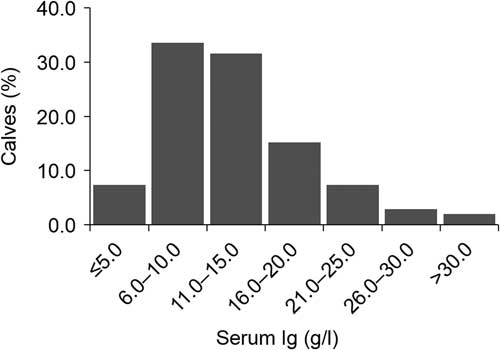
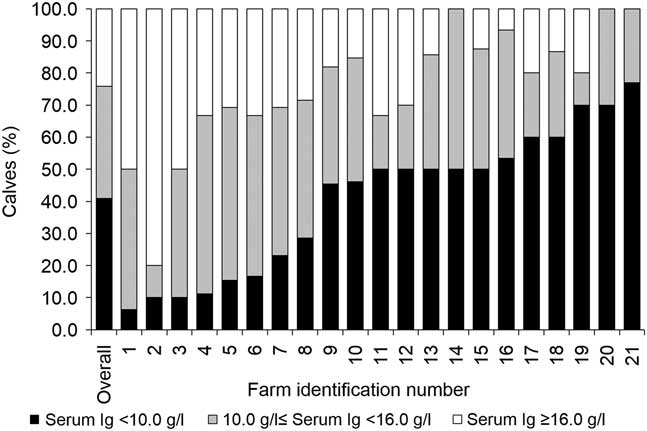
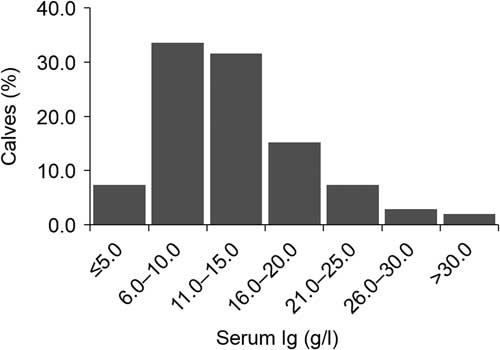
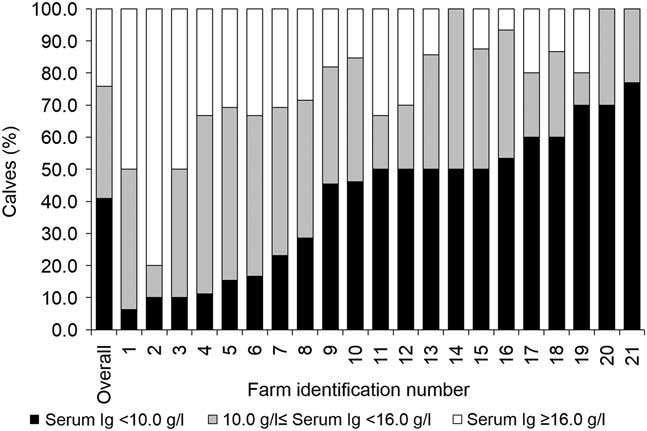
The overall calf serum Ig concentration ranged from 1.4 to 38.5 g/l, with a mean value of 12.4 g/l (Figure 1). In total, 41% of calves had FTPI, 34.8% had adequate transfer of passive immunity, and 24.2% had OTPI (Figure 2). Distribution of calves among farms according to the three levels of serum Ig concentration showed a wide variability (Figure 2), with only six farms having less than 20.0% of calves with FTPI, and two farms having no calves reaching OTPI.
Distribution of serum immunoglobulin (Ig) concentration of 244 calves (1 to 5 days of age) of 21 Italian dairy farms.
Overall and within-farm distribution of calves (n=244) with failed transfer of passive immunity (serum immunoglobulin (Ig) concentration <10.0 g/l), adequate transfer of passive immunity (serum Ig concentration from 10.0 to 15.9 g/l) and optimal transfer of passive immunity (serum Ig concentration⩾16.0 g/l) on 21 Italian dairy farms.
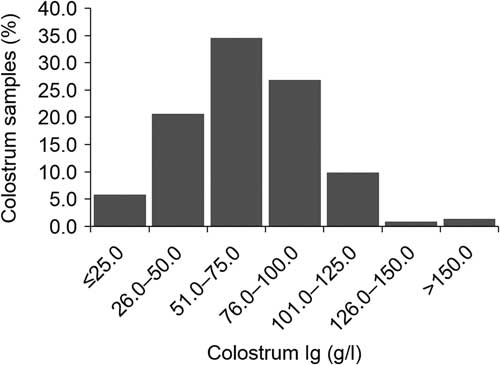
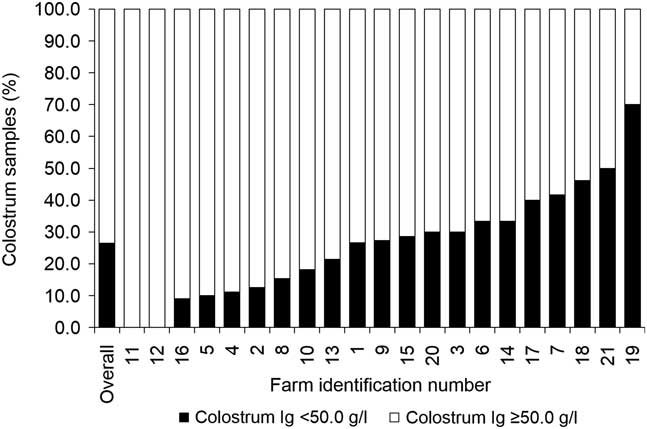
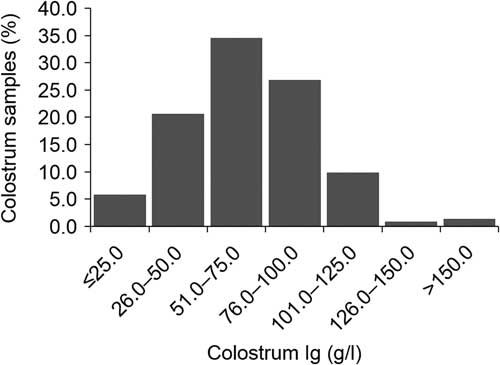
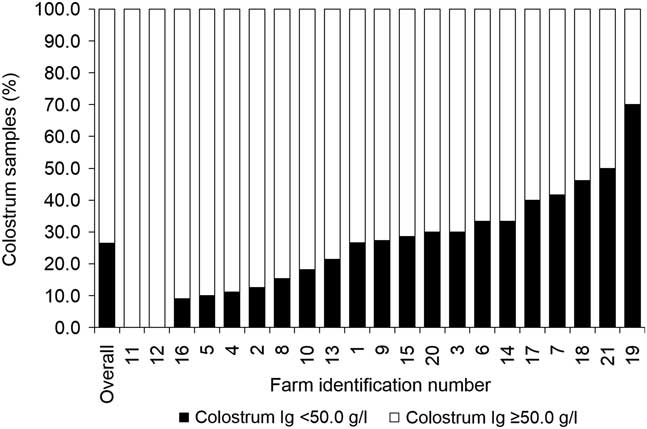
Out of the 223 colostrum samples collected, 78 (35.0%) came from primiparous and 145 (65.0%) came from multiparous cows. Colostrum Ig concentrations ranged from 10.9 to 169.7 g/l, with a mean value of 68.1 g/l (Figure 3). The overall percentage of poor-quality colostrum samples was 26.5%. No difference in the percentages of poor-quality colostrum samples was detected between primiparous (34.6%) and multiparous (22.1%) cows (χ 2=3.48; P=0.062). The distribution of colostrum samples according to their quality varied considerably among farms (Figure 4): only two farms had all colostrum samples of good quality, whereas in nine farms over 30.0% of colostrum samples were of poor quality.
Distribution of colostrum immunoglobulin (Ig) concentration of 223 Holstein cows belonging to 21 Italian dairy farms.
Overall and within-farm distribution of poor-quality (immunoglobulin (Ig) concentration <50.0 g/l) and good-quality (Ig concentration ⩾50.0 g/l) colostrum samples (n=223) collected from Holstein cows at 21 Italian dairy farms.
Calf management practices and association with failed transfer of passive immunity
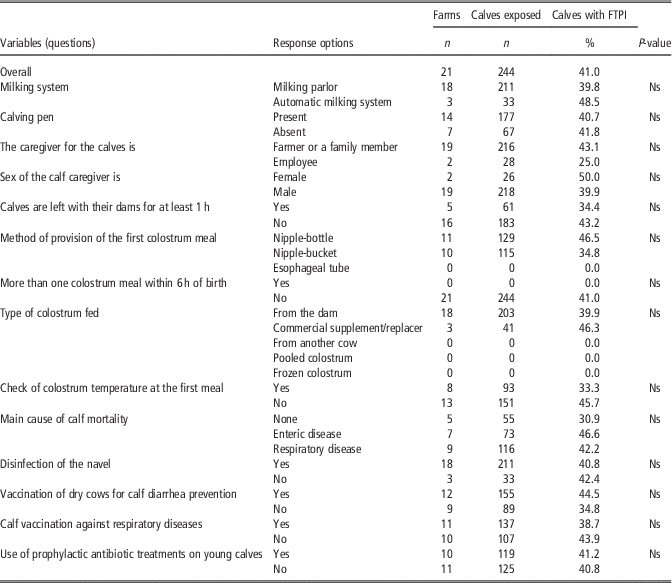
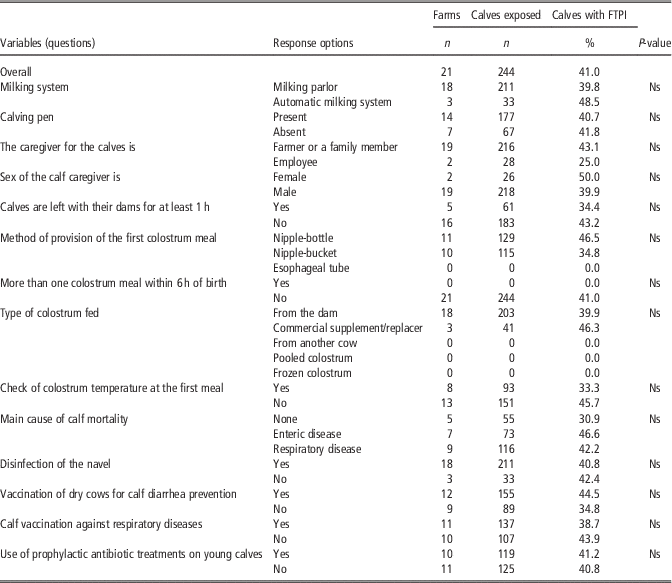
Results from the univariable analysis showed that none of the management practices considered at farm-level was associated with FTPI occurrence in calves (Table 2).
Descriptive statistics of the responses to the questionnaire on calf management practices at farm level administered to 21 Italian dairy farmers. Percentage of calves with failed transfer of passive immunity (FTPI - serum immunoglobulin concentration <10.0 g/l) by response options, and effects of the variables on FTPI occurrence are also reported
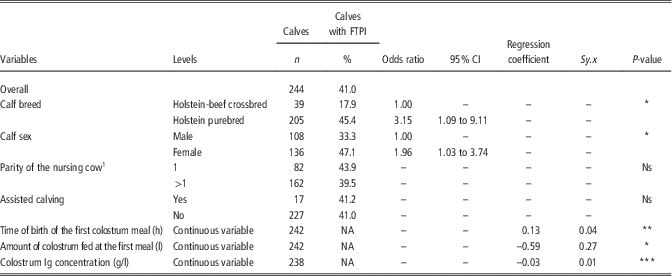
Regarding individual calf data, the final data set (n=244) consisted of 136 female and 108 male calves, 205 Holstein purebreds and 39 Holstein crossbreds (Table 3). In total, 7% of them were born with assisted calving. On the whole, nearly one-third (33.6%) of the calves were fed colostrum from primiparous cows. Most of the calves (80.2%) were fed the first colostrum meal within 6 h from birth (overall mean±SD: 4.0±4.1 h), but 65.3% consumed 2.0 l of colostrum or less at the first meal (overall mean±SD: 2.1±0.7 l). However, calves were provided good-quality colostrum in 74.4% of the cases.
Descriptive statistics of individual data on calves at 21 Italian dairy farms. Odds ratios and 95% confidence intervals (CI) or regression coefficients and Sy.x, are reported for the variables associated with failed transfer of passive immunity (FTPI - serum immunoglobulin concentration <10.0 g/l)

NA=not applicable; Ig=immunoglobulin.
*P<0.05; **P<0.01; ***P<0.001.
1 Nursing cow was intended as the cow whose colostrum was provided to the calf, which could have been either its own dam or another cow.
Parity of the nursing cow and assisted calving were not associated with FTPI at the univariable analysis, whereas calf breed and sex, time after birth, amount and quality of the first colostrum meal affected FTPI occurrence at both the univariable and the multivariable analyses (Table 3). Particularly, Holstein purebred calves were 3.2 times more likely to have FTPI than Holstein crossbreds (P=0.034), and female calves had 1.96 times higher odds of FTPI than males (P=0.041). Moreover, the risk of having FTPI increased by 13% (P=0.002) with every hour of delay of the first colostrum meal provision since birth, whereas it decreased by 59% with every additional liter of colostrum given to the calves (P=0.028) and by 3% with every additional gram per liter of Ig contained in the colostrum fed (P<0.001) (Table 3).
In regards to model validity, the ratio between χ 2 and its degrees of freedom was 0.99, thus demonstrating a relevant model fit (SAS Institute Inc., 2009).
Cumulative colostrum management score
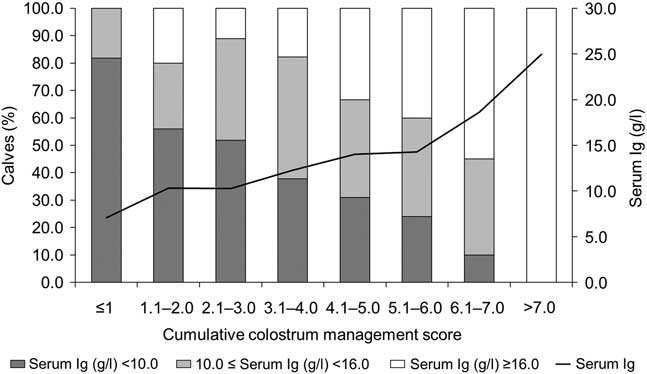
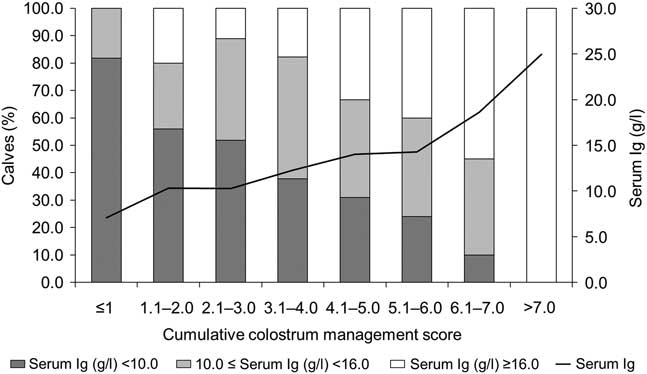
As resulted from the RTA, the three main factors considered for the CMS construction had different importance in influencing calf serum Ig concentration: the quality of colostrum provided at the first meal was the most important one (weighted coefficient=1.00), followed by the time after birth of the first colostrum meal (weighted coefficient=0.79) and the amount of colostrum fed at the first meal (weighted coefficient=0.71). Therefore, the final formula used to calculate the CMS for each calf was: [(score of time after birth of the first colostrum meal)×0.79]+[(score of amount of colostrum fed)×0.71]+[(score of quality of colostrum fed)×1.00]. A clear relationship was found between CMS and calf serum Ig concentration, with a regression coefficient of 1.53 (Sy.x=0.22; P<0.001), and no differences were found in the comparison with the regression coefficient obtained from the validation data set (P>0.05; Supplementary Material S1). Considering the lowest CMS values (⩽1.0), 82.4% of the calves had FTPI and none of them reached OTPI (Figure 5). As CMS improved, the percentage of calves with FTPI decreased substantially, whereas the fraction of calves with OTPI increased. Considering the highest CMS values (>7.0), none of the calves had FTPI and all of them reached OTPI (Figure 5).
Distribution of calves (n=236) with failed transfer of passive immunity (serum immunoglobulin (Ig) concentration <10.0 g/l), adequate transfer of passive immunity (serum Ig concentration from 10.0 to 15.9 g/l) and optimal transfer of passive immunity (serum Ig concentration ⩾16.0 g/l) according to the cumulative colostrum management score (CMS) calculated for each based on delivery time, amount and Ig concentration of their first colostrum meal. Distribution of calf serum Ig concentration according to CMS is also reported (regression coefficient=1.53; P<0.001).
Discussion
The overall percentage of calves with FTPI found in this study was higher than that previously reported by Cavirani et al. (Reference Cavirani, Taddei, Cabassi, Donofrio, Toni, Ghidini, Piancastelli, Schiano and Flammini2005) for Italian dairy calves (35.0%). Slightly lower percentages of calves with FTPI had been reported also by Vogels et al. (Reference Vogels, Chuck and Morton2013) for Australian calves (38.0%) and by Trotz-Williams et al. (Reference Trotz-Williams, Leslie and Peregrine2008) for Canadian calves (37.1%) and a value of 19.2% was reported by Beam et al. (Reference Beam, Lombard, Kopral, Garber, Winter, Hicks and Schlater2009) for US heifer calves. Moreover, the low fraction of calves with OTPI found in this study (Figures 1 and 2) clearly indicated generalized deficiencies in colostrum management for Italian dairy calves. The problem was even more evident when considering the within-farm percentage of calves with FTPI, being over the 20.0% threshold of acceptability recommended by McGuirk and Collins (Reference McGuirk and Collins2004) in more than two-thirds of the farms (Figure 2). Such a result was in line with findings by Cavirani et al. (Reference Cavirani, Taddei, Cabassi, Donofrio, Toni, Ghidini, Piancastelli, Schiano and Flammini2005), who reported a within-farm prevalence of FTPI higher than 30.0% in 70.6% of the surveyed Italian dairy farms (n=85). It appears therefore that Italian farmers did not make any progress about colostrum management for newborn calves over the last 10 years.
The mean colostrum Ig concentration found in this study was in line with data reported by Swan et al. (Reference Swan, Godden, Bey, Wells, Fetrow and Chester-Jones2007) on colostrum quality of US Holstein cows (Ig concentration of 76.7±30.0 g/l, mean ± SD); however, the overall percentage of poor-quality colostrum samples was higher than that previously reported by Cavirani et al. (Reference Cavirani, Taddei, Cabassi, Donofrio, Toni, Ghidini, Piancastelli, Schiano and Flammini2005) for Italian Holstein cows (17.1%). Although the investigation on factors that influence colostrum Ig concentration was not an aim of this study, the possibility that younger cows produced lower-quality colostrum than older ones was considered, being parity a major factor responsible for colostrum quality (Godden, Reference Godden2008). However, no effect of the parity (primiparous v. multiparous) on the percentages of poor-quality colostrum samples was detected in this study.
Considering the distributions among farms of calves by levels of serum Ig concentration (Figure 2) and of colostrum samples by their quality (Figure 4), it should be noticed that several farms with high percentages of poor-quality colostrum samples had low percentages of calves with FTPI, and vice versa (i.e. farms number 3, 6, 11 and 12; Figures 2 and 4), suggesting that other factors could be responsible for FTPI occurrence in calves beyond colostrum quality.
Calf management practices and association with failed transfer of passive immunity
Even if none of the calf management practices considered in the farm questionnaire were associated with FTPI occurrence in calves (Table 2), some observations should be made. First, despite the fact that three farmers declared the routine use of commercial colostrum supplements or replacers and the others stated to always provide calves with the own dams’ colostrum, none of the calves received colostrum supplements or replacers in this study, whereas 15 were fed colostrum from another cow. This demonstrated the existence of a discrepancy between the routine practices declared by the farmers and the actual individual calf management. Such a discrepancy, which represents a practical limit of the routine management questionnaires, might distort results of the statistical analysis, thereby making crucial to this study the collection of additional individual calf data. However, it was interesting to observe that none of the farmers used esophageal tube feeders for routine colostrum administration nor offered their calves more than one colostrum meal within the first 6 h of life. Particularly, many farmers stated that they intentionally fed calves a scarce amount of colostrum and did not offer them more than one colostrum meal within 6 h of life assuming that an amount of colostrum higher than 2.0 l was unsuitable to be eaten by newborn calves soon after birth. However, in a study by Vasseur et al. (Reference Vasseur, Rushen and de Passillé2009), 42.0% of the calves (n=36) spontaneously consumed more than 4.0 l of colostrum at the first feeding and 25.0% of them consumed 3.0 to 4.0 l. Even if no statistical associations were found, being FTPI a major predisposing factor for calf diseases and mortality (Maunsell and Donovan, Reference Maunsell and Donovan2008; Furman-Fratczak et al., Reference Furman-Fratczak, Rzasa and Stefaniak2011), it was somehow expected that most of the farmers had problems of calf mortality due to enteric or respiratory diseases (Table 2) considering the high overall percentage of FTPI found in this study. For the same reason, it was expected that in many farms calves were vaccinated against respiratory diseases and fed milk added with antibiotics to prevent neonatal diarrhea (Table 2). In this regard, Berge et al. (Reference Berge, Lindeque, Moore and Sischo2005) pointed out that prophylactic antibiotic treatments in dairy calves could be minimized or even avoided if there were an adequate transfer of passive immunity. Vaccination of dry cows for calf neonatal diarrhea prevention was also widely adopted by the farmers (Table 2), but it should be emphasized that the benefits of such practice for calf health (Kohara et al., Reference Kohara, Hirai, Mori, Ishizaki and Tsunemitsu1997; Jayappa et al., Reference Jayappa, Davis, Dierks, Sweeney and Wasmoen2008) may not be effective without proper colostrum administration.
As regards individual calf data (Table 3), the lack of association between dam parity and FTPI was not surprising because the parity of the cow did not affect colostrum quality in the current study. Not even assisted calving affected FTPI occurrence, even if lower levels of passive immunity can be observed in calves born with difficulty because of their poor vitality and the postnatal acidosis that frequently occurs in such cases (Godden, Reference Godden2008; Murray and Leslie, Reference Murray and Leslie2013). Among those factors that were associated with FTPI (Table 3), the effects of calf breed and sex were unclear. According to Quigley and Drewry (Reference Quigley and Drewry1998) and Vogels et al. (Reference Vogels, Chuck and Morton2013), male and crossbred calves should have been more at risk of having FTPI than female and Holstein purebred ones, due to their larger size that leads to higher Ig requirement, but results of this study showed an opposite situation that was difficult to explain. It could be hypothesized that other factors, probably linked to particular farmers’ habits and other aspects of farm management, were responsible for this result. On the other hand, it was expected that a delay of the first colostrum meal since birth had negative effects on transfer of passive immunity in calves (Table 3), because of the progressive closure of the intestinal guts and the consequent reduction in intestinal Ig absorption (Weaver et al., Reference Weaver, Tyler, VanMetre, Hostetler and Barrington2000; Godden, Reference Godden2008). Moreover, the lower was the amount of colostrum fed at the first meal, the higher was the risk of FTPI occurrence (Table 3). As farmers usually do not measure colostrum Ig concentration, a scarce amount of colostrum might not have a sufficient quality to provide the minimum Ig mass required for a successful transfer of passive immunity to calves. For example, Quigley and Drewry (Reference Quigley and Drewry1998) and Chigerwe et al. (Reference Chigerwe, Tyler, Summers, Middleton, Schultz and Nagy2009) suggested that at least 3.0 l of colostrum should be provided at the first meal to minimize the percentage of calves suffering from FTPI. At lower amounts, adequate colostrum Ig concentration assumes fundamental importance in the successful transfer of passive immunity in calves (Stott and Fellah, Reference Stott and Fellah1983; McGuirk and Collins, Reference McGuirk and Collins2004). Hence, it was not surprising that in this study the risk of FTPI was reduced when higher-quality colostrum was provided to the calves (Table 3).
Cumulative colostrum management score
This study revealed that the quality of colostrum fed at the first meal was the most important factor affecting calf serum Ig concentration, beyond time after birth and amount of the first colostrum meal. Nevertheless, good colostrum quality alone did not appear to be sufficient to ensure low percentages of calves with FTPI at farm level (e.g. farm numbers 11, 12 and 16; Figures 2 and 4), indicating that the other factors (delivery time and amount of the first colostrum meal) were still relevant for the successful transfer of passive immunity in calves. Therefore, delivery time, amount and quality of the first colostrum meal should be considered in combination and not as single factors, having a synergic action (Quigley and Drewry, Reference Quigley and Drewry1998; Weaver et al., Reference Weaver, Tyler, VanMetre, Hostetler and Barrington2000; Godden, Reference Godden2008). The CMS proposed in this study was an expression of such a combination and showed a wide range of values, each representing a different solution of colostrum provision (Figure 5). The relationship between CMS and calf serum Ig concentration clearly demonstrated the importance of the synergic action of the three main factors (delivery time, amount and quality of the first colostrum meal) on transfer of passive immunity in calves. Particularly, the maximum and the minimum CMS values emphasized that FTPI was completely avoided and most of the calves reached OTPI when high-quality colostrum administration was combined with the best delivery practices, whereas the opposite happened when bad delivery practices were associated with poor-quality colostrum provision (Figure 5). Moreover, the highest CMS value suggested that passive immunity transfer in calves is maximized when at least 2.5 l of high-quality colostrum (Ig concentration >87.6 g/l) are provided within 1.0 h from birth. Such indications are in line with those reported by Morin et al. (Reference Morin, McCoy and Hurley1997) and by Jaster (Reference Jaster2005) in two studies addressed to evaluate, under experimental conditions, the effects of quality, quantity and timing of colostrum feeding on Holstein and on Jersey calves, respectively. However, even the intermediate CMS values were of practical interest, because as colostrum management improved, with different combinations of delivery time, amount and quality of the first colostrum meal, the fraction of calves with FTPI decreased, whereas the percentage of calves that reached OTPI increased. Moreover, considering that the same CMS value could result from the sum of different single scores assigned to the three main factors, CMS values that approach the highest one represented different solutions of colostrum provision in which high calf serum Ig concentrations were obtained. The latter observation was the scientific demonstration that a deficiency in one of the three main factors (delivery time, amount or quality of the first colostrum meal) in the dairy practice could be compensated by adjusting the other two. In this perspective, CMS could be further developed for practical applications that produce farm-specific recommendations for reducing FTPI prevalence in calves.
Conclusions
Despite widespread awareness of the importance of a successful transfer of passive immunity in calves, this study underlined farmers’ scarce level of expertise in effectively managing colostrum provision to newborn calves. Much effort is still required to increase dairy farmers’ consciousness about FTPI prevention through proper colostrum management practices in order to improve the health of both female and male calves and possibly reduce antimicrobial use in young stock rearing. The CMS proposed in this study could be further developed as a tool for achieving such goals, in this way contributing to the generation of farm-specific indications for FTPI prevention.
Acknowledgments
This study was supported by the grants obtained from the Italian Ministry of Health for the research project (RC IZSVE 10/2011). The authors want to thank the ‘Associazione Veneta Allevatori – AVA’ and the ‘Associazione Veterinari Buiatri ORUS’ for their support to data and samples collection.
Supplementary material
To view supplementary material for this article, please visit https://doi.org/10.1017/S1751731117002579