Introduction
Like other filarial species, Dirofilaria immitis, the causative agent of canine and feline cardiopulmonary dirofilariosis and human pulmonary dirofilariosis, harbours intracellular symbiotic bacterium of the genus Wolbachia (Sironi et al., Reference Sironi, Bandi, Sacchi, Di Sacco, Damiani and Genchi1995) that play a key role in the moulting and embryogenesis of filariae (Taylor et al., Reference Taylor, Cross, Ford, Makunde, Prasad and Bilo2001). Wolbachia is released into the bloodstream when D. immitis dies, either naturally or as a consequence of a filaricidal treatment. This fact decisively contributes to the development of the inflammatory and obstructive pathology of heartworm disease (Kramer et al., Reference Kramer, Simón, Tamarozzi, Genchi and Bazzocchi2005; Morchón et al., Reference Morchón, Bazzocchi, López-Belmonte, Martín-Pacho, Kramer, Grandi and Simón2007).
This pathology leads to the appearance of blood vessel obstructions, infarction, blood flow decrease and hypoxia, as well as renal damage caused by microfilariae (Hormaeche et al., Reference Hormaeche, Carretón, González-Miguel, Gussoni, Montoya-Alonso, Simón and Morchón2014). Inflammation, hypoxia and tissue injury provide the required conditions to produce angiogenesis – the process to create new vessels from the pre-existing vasculature (Dennis et al., Reference Dennis, Schubert and Bauer2011; Núñez-Gómez et al., Reference Núñez-Gómez, Pericacho, Ollauri-Ibanez, Bernabeu and Lopez-Novoa2017). The regulation of this process requires an accurate balance, which includes the stimulation of pro-angiogenic factors such as Vascular Endothelial Growth Factor-A (VEGF-A) or membrane Endoglin (mEndoglin), among others, as well as the inhibition of anti-angiogenic factors such as sFlt-1 or soluble Endoglin (sEndoglin) (Alitalo & Carmeliet, Reference Alitalo and Carmeliet2002). Angiogenesis, or the modification of the expression of angiogenic factors, has previously been related to various pathological conditions associated with infectious agents such as bacteria or viruses (Urbanowicz et al., Reference Urbanowicz, Kutzner, Riveiro-Falkenbach and Rodriguez-Peralto2016; Narimatsu et al., Reference Narimatsu, Hattori and Koike2019).
Numerous species of tissue and blood helminths are potentially capable of inducing angiogenesis (Dennis et al., Reference Dennis, Schubert and Bauer2011). Lymphatic filariae produce remodelling of the lymphatic vessels, a fact that has been related to the pathogenesis caused by these parasites (Bennuru & Nutman, Reference Bennuru and Nutman2009) and the angiogenic activity of an Onchocerca volvulus antigen has been proved (Tawe et al., Reference Tawe, Pearlman, Unnasch and Lustigman2000). Moreover, in a previous work, we have shown that complex antigenic extracts derived from D. immitis adult worms with different concentrations of Wolbachia show different capacities to modify the expression of pro- and anti-angiogenic factors, as well as the induction of pseudocapillary formation in vitro (Zueva et al., Reference Zueva, Morchón, Carretón, Montoya-Alonso, Santana, Bargues, Mas-Coma, Rodríguez-Barbero and Simón2019). In this current study, using canine microvascular endothelial cell cultures, we analyse the influence of recombinant Wolbachia surface protein (rWSP) on angiogenic factors expression and its ability to stimulate the formation of pseudocapillaries.
Material and methods
Cell culture and stimulation of endothelial cells
Canine primary lung microvascular endothelial cells (CPLMEC) from Cell Biologics (Chicago, IL, USA) were grown in Endothelial Cell Medium (Cell Biologics, Chicago, IL, USA) supplemented with the Endothelial Cell Medium Supplement Kit (0.5 ml of VEGF, 0.5 ml of EGF, 5.0 ml of L-glutamine), 2% fetal bovine serum (FBS; Cell Biologics), 50 U/ml penicillin and 50 μg/ml streptomycin, as previously described by Zueva et al. (Reference Zueva, Morchón, Carretón, Montoya-Alonso, Santana, Bargues, Mas-Coma, Rodríguez-Barbero and Simón2019). Plates were pre-coated with 0.1% pig gelatine (Sigma Chemical Co., San Luis, MO, USA). Cells were cultured at 37°C in a humidified atmosphere in the presence of 5% carbon dioxide/95% air. Medium was changed every three days. Passaging was performed with the ratio of 1:3. Cell counts were performed using a Countess® Automated Cell Counter (Invitrogen, Carlsbad, CA, USA) following the manufacturer's instructions.
Reagents and stimulation of human endothelial cells
rWSP was prepared and purified to avoid lipopolysaccharide contamination as previously indicated (Brattig et al., Reference Brattig, Bazzocchi and Kirsching2004) and, finally, was stored at −80°C.
CPLMEC were treated as previously described by Zueva et al. (Reference Zueva, Morchón, Carretón, Montoya-Alonso, Santana, Bargues, Mas-Coma, Rodríguez-Barbero and Simón2019). In brief, endothelial cells (106 cells/plate) were plated on 60 mm culture plates and were grown for four days to obtain confluent cultures and treated with 1 μg/ml of rWSP for 24 h. Non-stimulated cells were used as controls in the same conditions. Subsequently, hypoxia was induced for 24 h, replacing oxygen in the air with an inert gas in a hypoxia chamber. Finally, the supernatant of the cell cultures was collected and CPLMEC were lysed in an ice-cold lysis buffer (20 mm Tris hydrochloride (pH 7.5); 140 mm sodium chloride; 10 mm ethylenediaminetetraacetic acid; 10% glycerol; 1% Igepal CA-630; aprotinin, pepstatin and leupeptin at 1 μg/ml each; 1 mm phenylmethylsulfonyl fluoride and 1 mm sodium orthovanadate).
Angiogenic factors assays
VEGF-A, sFlt, mEndoglin and sEndoglin concentrations in the endothelial cell culture medium were measured by enzyme-linked immunosorbent assay (ELISA) using a Canine VEGF Quantikine ELISA kit (R&D Systems, Minneapolis, MN, USA), Dog CD105 ELISA kit (LSBio, Seattle, WA, USA), Canine Soluble Fms-Like Tyrosine Kinase Receptor 1 ELISA kit (MyBioSource, San Diego, CA, USA) and Dog CD105 ELISA kit (LSBio), respectively, following the manufacturers’ instructions. The results are presented as the mean ± standard error of the mean (SEM) of three experiments performed in duplicates.
Endothelial cell tube formation assay
Endothelial cell tube formation was assessed as previously described by Jerckic et al. (Reference Jerckic, Rivas-Elena and Santibáñez2006). In brief, a total of 8000 CPLMEC per well were plated on Matrigel® precoated plates (BD Biosciences, San José, CA, USA) and cultured in Endothelial Cell Medium supplement. Half an hour later, rWSP was added in the wells (1:10 dilution). After seeding on Matrigel®, cells spread and aligned with each other to develop hollow, tube-like structures. The cells and intercellular junctions were observed each hour for 7 h of incubation and the morphological changes were photographed at 3 h using a phase contrast inverted Zeiss Microscope (Carl-Zeiss, Jena, Germany). Subsequently, the intercellular junctions were divided between the cell bodies to calculate the relationship between them (endothelial cell tube formation = cellular connections/cellular bodies). Non-stimulated cells were used as controls in the same conditions. Each experiment was performed in triplicate.
Cellular viability
CPLMEC (5 × 10⁵ cells/plate) were plated on 35 mm culture plates and were grown for four days to obtain confluent cultures and treated with 1 μg/ml of rWSP for 24 h. Subsequently, hypoxia was induced for 48 h. Non-stimulated cells were used as control systems in the same conditions. Cell counts were performed using the equipment Countess® Automated Cell Counter (Invitrogen) following the manufacturer's instructions.
Statistical analysis
GraphPad Prism version 7 (San Diego, California) was used for all data analyses. Analyses were performed by analysis of variance (ANOVA) and revised for repeated measurements when appropriate. If ANOVA revealed overall significant differences, individual means were assessed post hoc using Tukey's test. All the results were expressed as the mean ± SEM. In all the experiments, a significant difference was defined as a P-value of <0.01 for a confidence level of 99%.
Results and discussion
Firstly, we proved that the cell viability of cultures stimulated with rWSP was not affected compared to those non-stimulated cell cultures. This fact rules out the possibility that the effects shown are due to some form of rWSP toxicity on vascular endothelial cells.
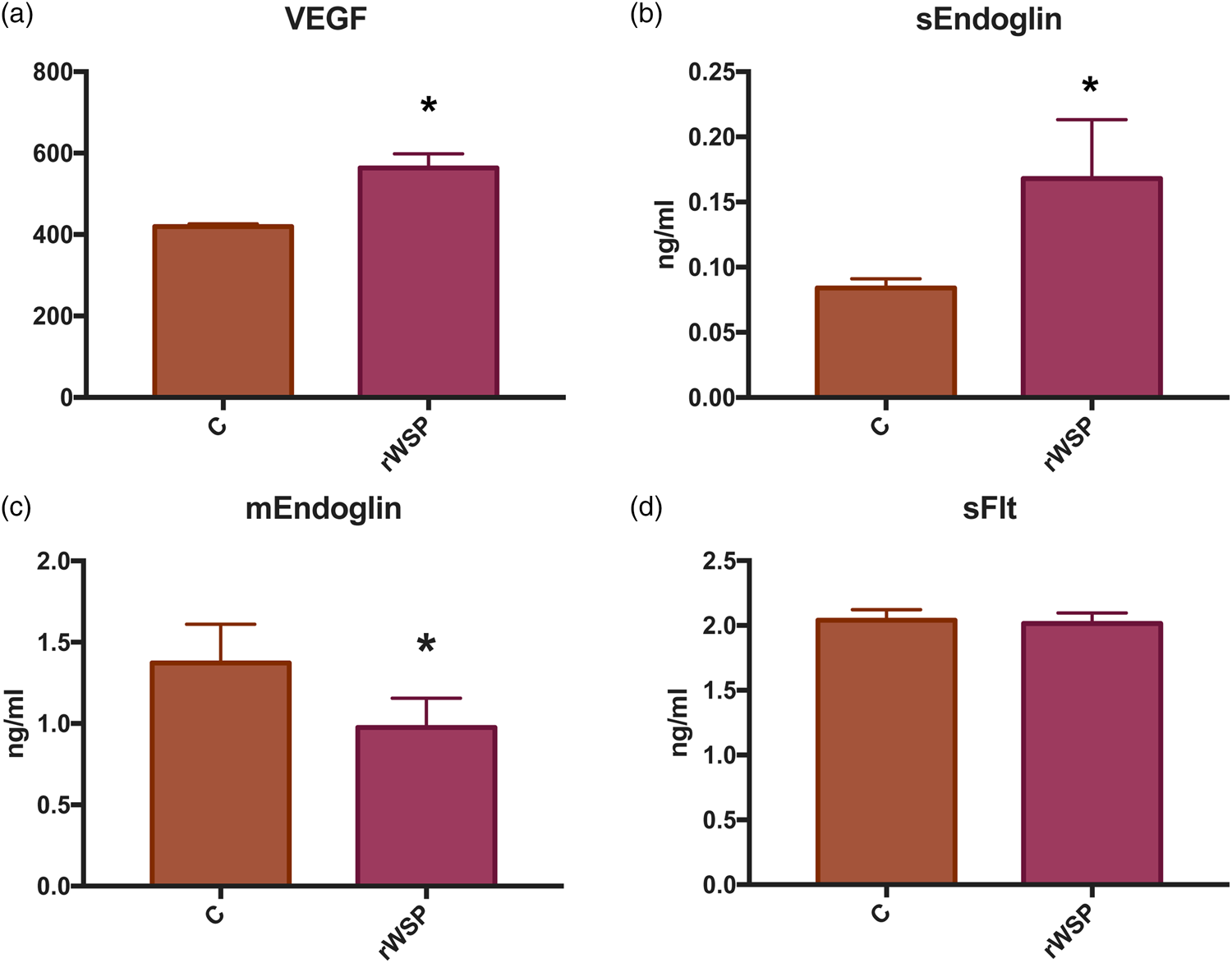
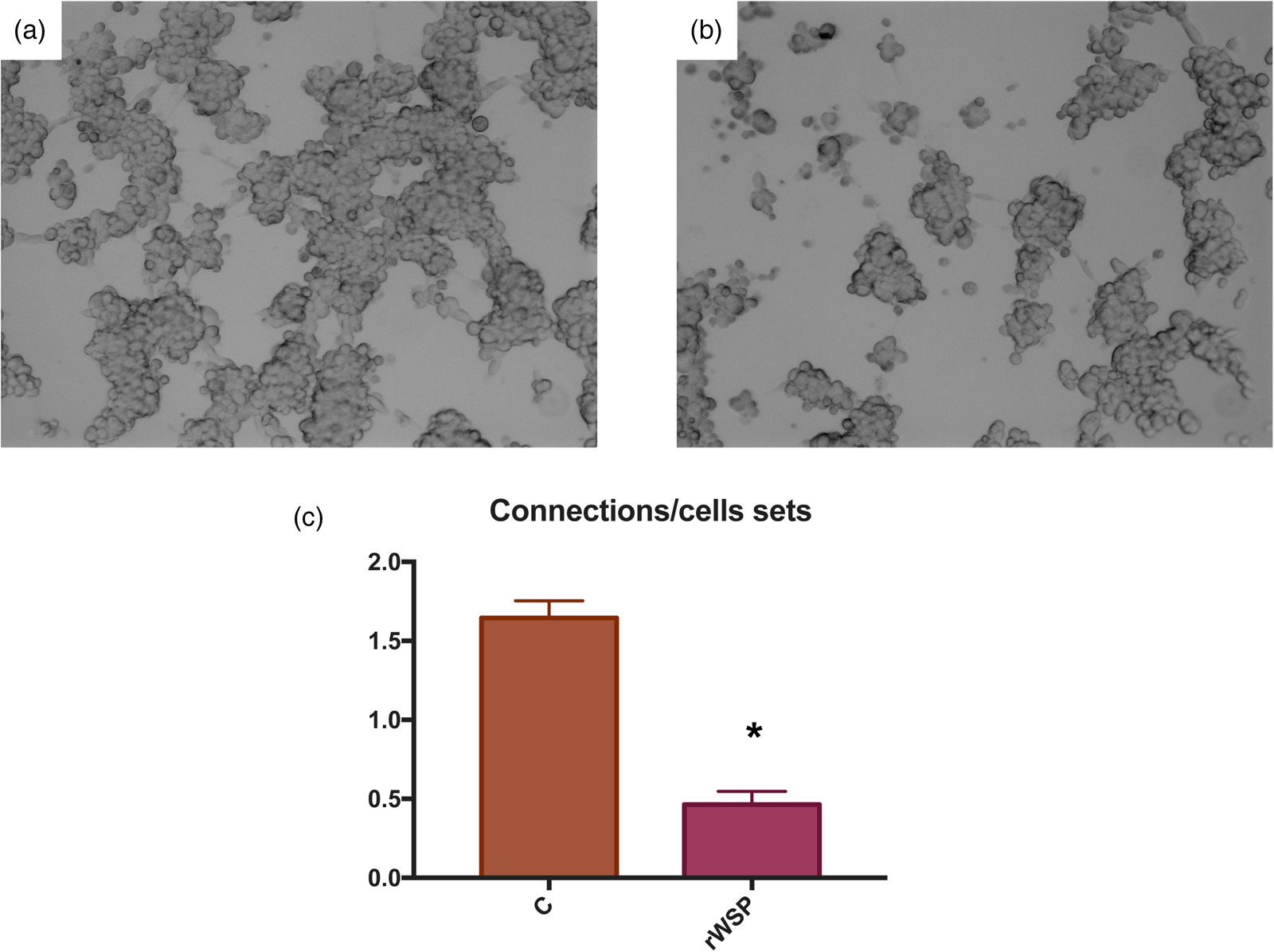
The stimulation of CPLMEC with rWSP significantly increased the expression of VEGF-A and sEndoglin when compared to non-stimulated cultures (P < 0.01in both cases) (fig. 1a, b). However, CPLMEC stimulated with rWSP showed a significant decrease in the expression of mEndoglin when compared to the non-stimulated cultures (P < 0.01) (fig. 1c). In addition, rWSP did not modify the expression of sFlt in CPLMEC compared to non-treated controls (fig. 1d). The capacity for pseudocapillary formation was assessed by analysing the cell junctions (connections) and the cell groups that emerged in stimulated and non-stimulated cultures, as previously described by Zueva et al. (Reference Zueva, Morchón, Carretón, Montoya-Alonso, Santana, Bargues, Mas-Coma, Rodríguez-Barbero and Simón2019) (fig. 2). The formation of pseudocapillaries and the connections/joint relationship in cultures stimulated with rWSP were less organized, and a significant and severe decrease in the formation of pseudocapillaries and cell junctions compared to non-stimulated cultures was observed (P < 0.01).
Expression of angiogenic factors VEGF-A (a), sFlt (b), mEndoglin (c) and sEndoglin (d), measured in supernatants of non-stimulated cultures (C), cultures stimulated with rWSP. Results are expressed as the mean ± standard deviation of three independent experiments. Significant differences in comparisons with the other groups are indicated by an asterisk (*).

Endothelial cell tube formation assay on Matrigel plates. Representative images from non-stimulated cultures (a) and cultures stimulated with rWSP (b). Graphic representation of the cell connections/cell sets relationship in non-stimulated cultures (C), cultures stimulated with rWSP. Results are expressed as the mean ± standard deviation of three independent experiments. Significant differences in comparisons with the other groups were indicated by an asterisk (*).

It is thought that each helminth species is potentially angiogenic. Regarding round worms, it is still unclear whether the angiogenic factors of the host and/or those from the nematodes are responsible, alone, for neovascularization during helminth infections (Dennis et al., Reference Dennis, Schubert and Bauer2011). Dirofilaria immitis, lymphatic filariae and O. volvulus are able to cause angiogenesis/lymphangiogenesis and/or modifying the expression of angiogenic factors (Tawe et al., Reference Tawe, Pearlman, Unnasch and Lustigman2000; Bennuru & Nutman, Reference Bennuru and Nutman2009; Zueva et al., Reference Zueva, Morchón, Carretón, Montoya-Alonso, Santana, Bargues, Mas-Coma, Rodríguez-Barbero and Simón2019). All of them harbour intracellular symbiotic Wolbachia bacterium, which make it more difficult to analyse the angiogenic mechanisms and to determine the responsibility of the parasite and Wolbachia molecules in the process. Using an in vitro model, we have verified some of the effects caused by the rWSP on the expression of factors related to angiogenesis in vascular endothelial cells. The results obtained suggest that this molecule has eminently anti-angiogenic effects, reducing the expression of mEndoglin (pro-angiogenic), increasing that of sEndoglin (anti-angiogenic) and decreasing the trend to the formation of pseudocapillaries. However, rWSP also causes a significant increase in VEGF-A expression. VEGF-A not only participates in angiogenesis, of which it is a key pro-angiogenic factor (Adams & Alitalo, Reference Adams and Alitalo2007), but also stimulates endothelial permeability and inflammation (Figueroa et al., Reference Figueroa, Subramanian, Cury, Truong, Gardecki, Tearney, Hoffmann, Brady and Tawakol2012), which may contribute to the appearance of blood vessel obstruction and its sequelae, which can subsequently contribute to activating angiogenesis. There are numerous factors involved in angiogenesis, of which only a few are addressed in this paper. In addition, the complexity of the relationships established between D. immitis (and Wolbachia) and its hosts and the possible interrelations between mechanisms must be taken into account. Previously, we have shown that both D. immitis molecules and rWSP are able to turn on the fibrinolytic system, binding plasminogen and generating plasmin (González-Miguel et al., Reference González-Miguel, Morchón, Mellado, Carretón, Montoya-Alonso and Simón2012, Reference González-Miguel, Morchón, Carretón, Montoya-Alonso and Simón2013; Diosdado et al., Reference Diosdado, Gómez, Morchón, Simón and González-Miguel2017). This mechanism helps vascular cell remodelling (Dennis et al., Reference Dennis, Schubert and Bauer2011) and thrombus suppression, a priori boosting the survival of the parasite. However, it can lead to a pathogenic mechanism that damages the endothelium when maintained for long periods of time (González-Miguel et al., Reference González-Miguel, Morchón, Siles-Lucas and Simón2015, Reference González-Miguel, Siles-Lucas, Kartashev, Morchón and Simón2016). The tissue plasminogen activator, a key element to the fibrinolytic process, which is activated by both parasite antigens and by WSP (González-Miguel et al., Reference González-Miguel, Morchón, Mellado, Carretón, Montoya-Alonso and Simón2012, Reference González-Miguel, Morchón, Carretón, Montoya-Alonso and Simón2013; Diosdado et al., Reference Diosdado, Gómez, Morchón, Simón and González-Miguel2017), is able to release VEGF reservoirs, so that, hypothetically, its stimulation could contribute to angiogenesis. In a previous study, we have observed that different amounts of Wolbachia in D. immitis antigenic extracts used to stimulate vascular endothelial cell cultures produce different effects on some pro- and anti-angiogenic factors and on the capacity of pseudocapillary formation (Zueva et al., Reference Zueva, Morchón, Carretón, Montoya-Alonso, Santana, Bargues, Mas-Coma, Rodríguez-Barbero and Simón2019). However, it seems risky to try to compare the effects of a single molecule with those obtained with complex antigenic extracts, because these include other Wolbachia molecules that can have different activities in isolation or even used together, as we have already shown when analysing the ability of WSP and heat-shock protein (GroEl) of Wolbachia in the stimulation of inducible nitric oxide synthase (iNOS) expression (Morchón et al., Reference Morchón, Bazzocchi, López-Belmonte, Martín-Pacho, Kramer, Grandi and Simón2007).
To sum up, it is demonstrated that rWSP modifies the expression of some angiogenic factors and the capacity of the formation of pseudocapillaries in vitro, with an apparently anti-angiogenic result. The fact that rWSP also takes part in the activation of other related physiological processes, such as inflammation and fibrinolysis, makes it very difficult to confer a unique role to a molecule as versatile as VEGF-A in relation to the angiogenic process. More studies are needed for a correct understanding of the responsibility of rWSP and other Wolbachia and D. immitis molecules in the physiological modifications leading to neovascularization.
Financial support
This work was supported by Agencia de Desarrollo Económico de Castilla y León, Spain (co-financed with FEDER funds) and Gobierno de Canarias, Spain (ProID2017010111).
Conflicts of interest
The authors declare that they have no competing interests..