In democratic countries, society constitutes a key element of the political system. It appoints some of the political elite to positions of power every few years through an electoral process. Hence, rival politicians in democratic systems attempt to sway the electorate while simultaneously having to deal with the contrary opinions that divide their fellow citizens. The next election is always hanging over their heads like the sword of Damocles. It can either reaffirm their mandate or sweep them from power. These democratic ground rules hold true for the European Union (EU). In recent years, voters in EU countries have frequently dispensed with tradition and broken out of their well-worn ruts, much to the dismay of those in power and their opposite numbers in other EU countries. This was certainly the case in the UK during the 2016 Brexit referendum and the early general election of 2017, and in Poland during the simultaneous presidential and parliamentary elections of 2015. These and other verdicts handed down by the voters in EU countries have created a political situation that will remain in force until the next elections and which will affect relationships both within and without the Union.
Every year, Gallup Inc. surveys the societal relationships that EU countries have with the USA, Germany, Russia and the PRC as well as the EU itself. The respondents state whether they accept or reject their policies. The survey results therefore additionally indicate the feelings they arouse in the surveyed countries. From an international relations standpoint, they also furnish information on Europeans’ views regarding designated international political entities as international community leaders, and consequently, their preferred constitutional framework for the international community.
The Gallup polls for 2014–2016 are analysed here. The year 2014 was selected as the starting point by virtue of three crises whose combined effect has been to bring about a significant re-evaluation of the relationships between European countries and the EU and between the EU and the rest of the world in the years since. These crises are: the Eurozone crisis (since 2009); the Ukrainian crisis associated with the Euromaidan revolution, Russia’s annexation of Crimea and its support for separatists in the eastern regions of the country (since 2013); and the migrant crisis (especially since 2015). The year 2016 was selected as the endpoint, as this was the most recent year for which data were available at the time of the study. The responses of the supporters and opponents of the surveyed entities have been averaged out over the period 2014–2016 in order to eliminate any randomness that might have occurred in any single year. The percentage point (pp) differences between the supporters and opponents were then calculated, analysed and plotted on a map. Finally, the Pearson correlation coefficients (PCCs) were calculated. These revealed the interdependencies between the supporters and opponents of leadership being exercised by particular geopolitical entities.
Most EU member states viewed US policies positively in 2014–2016. The most enthusiastic attitudes towards US policies were evinced by the Portuguese, followed closely by the Romanians, and then the Hungarians, Belgians, Dutch, Irish and British. Supporters of US policies exceeded critics by more than 30 pp in all these countries, and by more than 40 pp in Portugal and Romania. At the opposite end of the spectrum were Slovenia, Austria and Greece, where the preponderance of US critics was greatest, at over 20 pp in each country. The majority of appraisals of US policies were likewise negative in Bulgaria, Estonia, Latvia, Cyprus, Slovakia and Germany. Generally, however, positive appraisals of US policies prevailed in the EU (Figure 1).
Balance of approval and disapproval of the United States as a world leader. (To view this figure in colour please see the online version of this journal.)

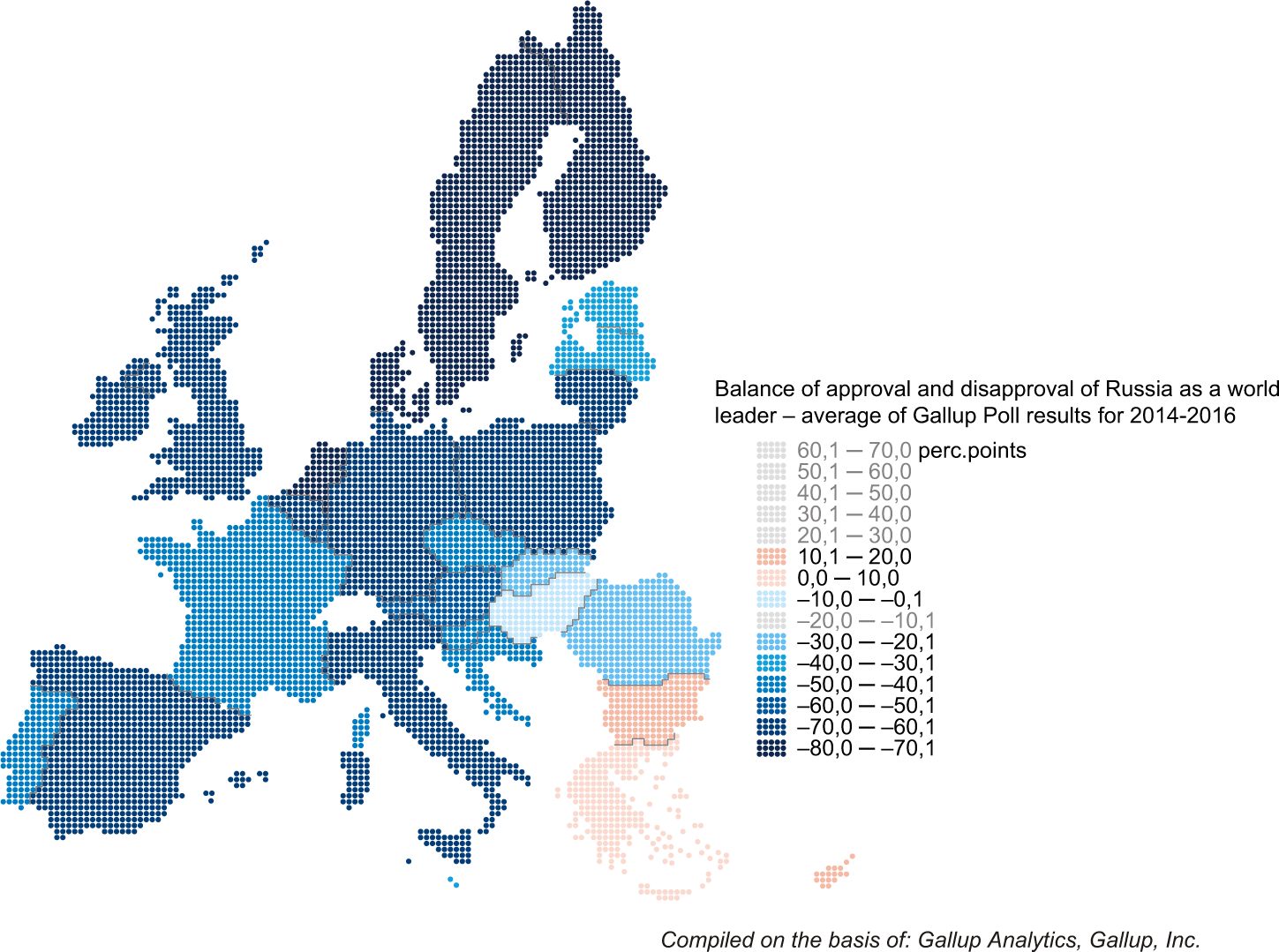
The relationship that EU countries had with Russia was a completely different story. Only Orthodox Bulgaria, Greece and Cyprus appraised Russia’s actions positively. Support for Russian policies was most marked in Cyprus, where supporters outnumbered opponents by almost 20 pp. The figures for Bulgaria and Greece were 16 pp and 9 pp respectively. The remaining EU countries were unenthusiastic or even downright hostile. Of the larger EU countries, France was conspicuous in expressing relatively mild disapproval of Russian policies. Here, opponents of Moscow ‘barely’ exceeded supporters by just under 50 pp. Critics dominated by between 60 pp (Spain) and 69 pp (Germany) in the other large EU countries, namely Spain, Germany, Poland, the UK and Italy. Sweden, the Netherlands, Finland and Denmark were especially uncompromising towards Russia. Critics exceeded supporters by more than 70 pp in these countries, with Sweden exhibiting the greatest difference (more than 77 pp). Curiously, post-communist Eastern Europe was less antipathetic towards Russia than Western Europe. Only Poland and Lithuania manifested the high levels of disapproval of Russian policies (with critics dominating by 66 pp and 61 pp respectively) that typified the ‘old’ European countries, whereas critics only dominated by between 10 pp (Hungary) and 41 pp (the Czech Republic) in the remaining post-socialist and post-Soviet countries. Bulgaria, which had an overall positive appraisal of Russia, was an exception (Figure 2).
Balance of approval and disapproval of Russia as a world leader. (To view this figure in colour please see the online version of this journal.)

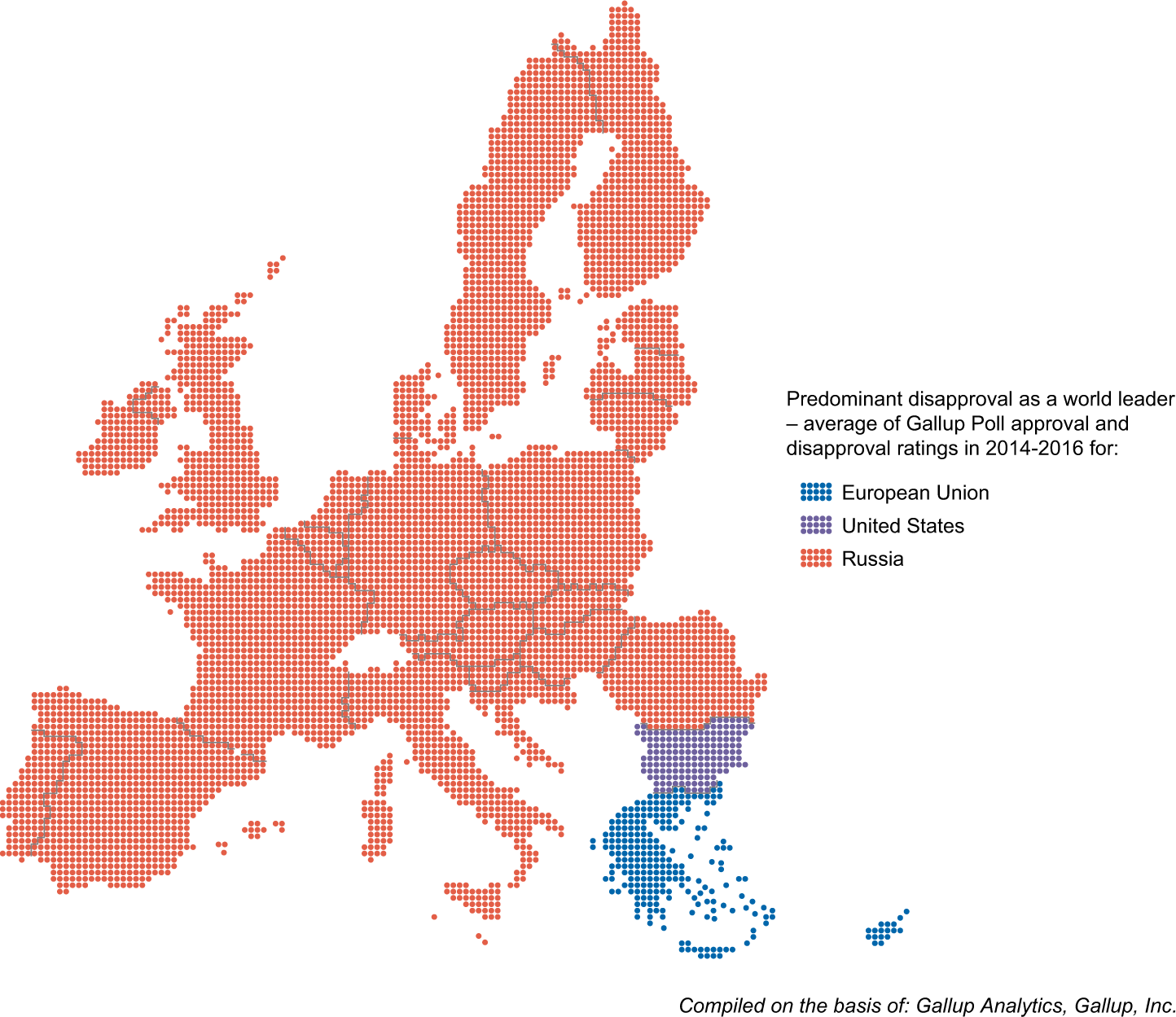
Be that as it may, critics of Russia outnumber those who view the USA, Germany, the PRC and the EU negatively in almost every EU country, the exceptions being Bulgaria (where US critics dominate) and Greece and Cyprus (EU critics) (Figure 3).
Predominant disapproval as a world leader. (To view this figure in colour please see the online version of this journal.)

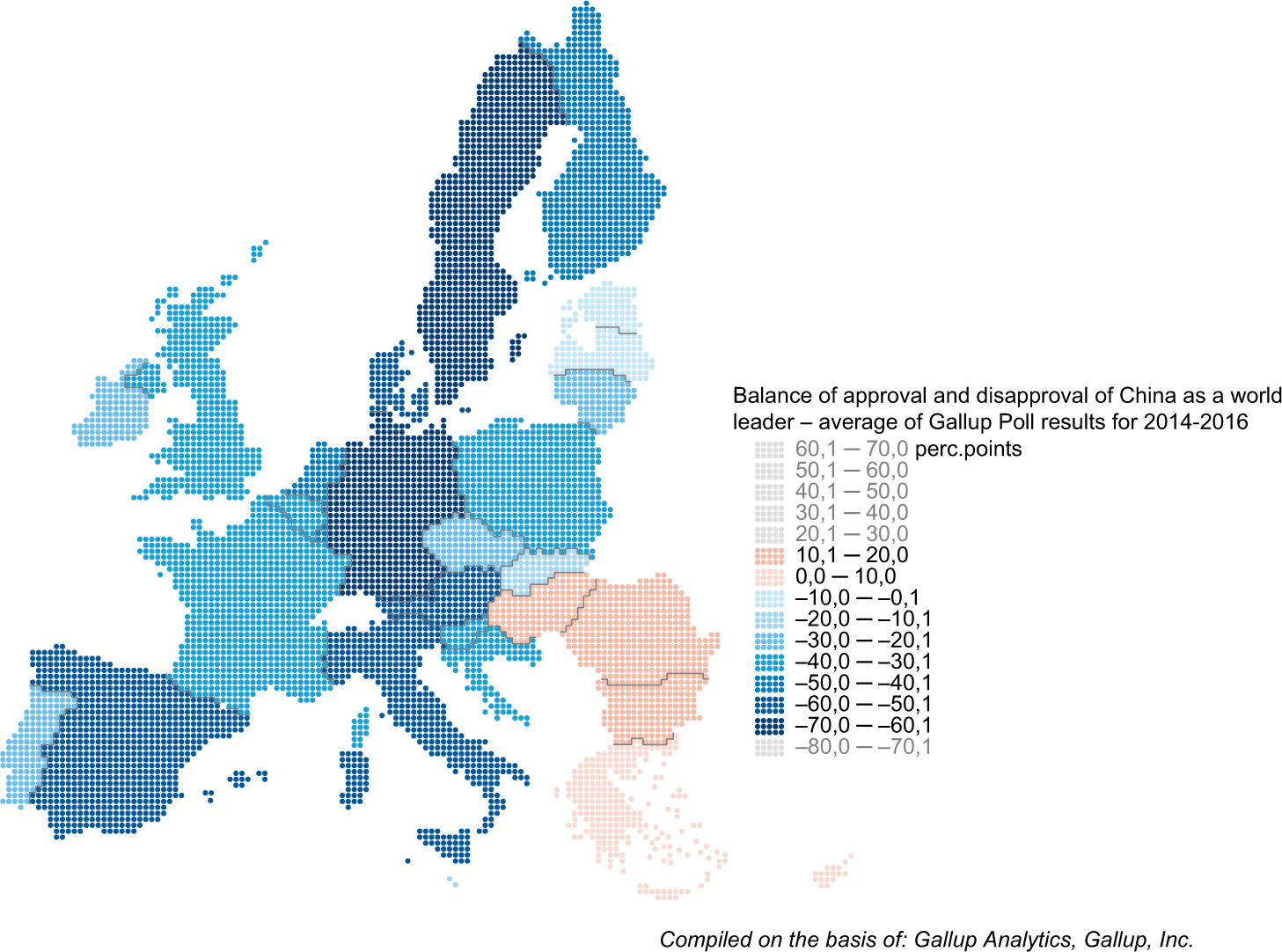
EU countries appraised PRC aspirations analogously. Only Hungary, Romania, Bulgaria, Greece and Cyprus had an overall positive view of PRC policies (positive appraisals exceeded negative ones by no more than 17 pp, with Bulgaria showing the strongest support). The rest of the EU was either hostile or very hostile to the prospect of PRC global leadership.
Germany and Sweden were most negative about PRC aspirations, with critics dominating by more than 62 pp in both countries. Post-communist EU countries generally viewed PRC policies more favourably than did those in Western Europe (Figure 4).
Balance of approval and disapproval of China as a world leader. (To view this figure in colour please see the online version of this journal.)

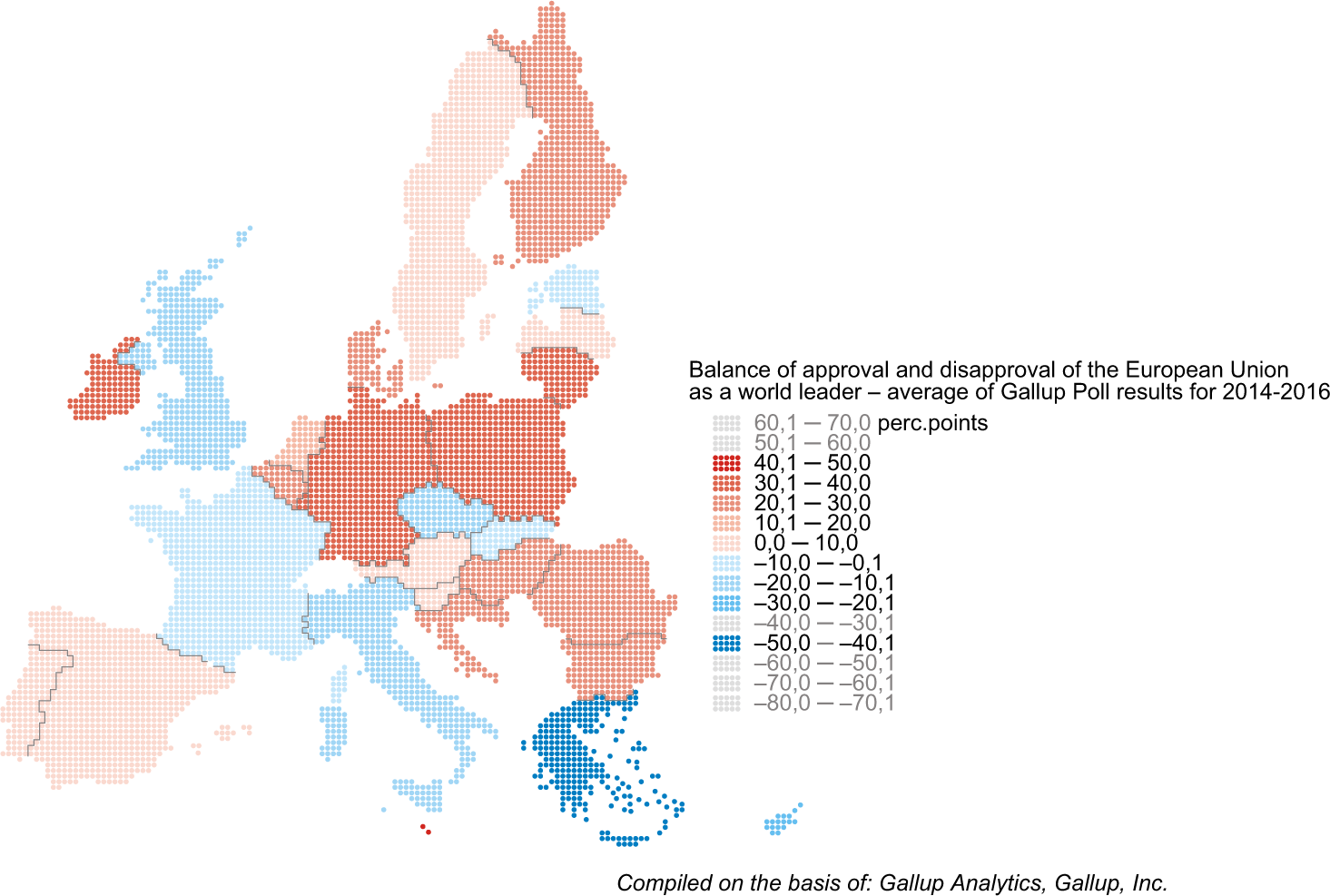
Majorities in no fewer than eight EU countries opposed the EU taking a leadership role in the present-day world (Figure 5). This was certainly the case in the UK (19 pp), as the ‘Brexit’ referendum made abundantly clear, but not only there. If the EU wishes to hold on to its remaining 27 countries, it had better hope that the Czech (11 pp more against the EU), Italian (18 pp), Cypriot (22 pp), and especially Greek (44 pp), governments do not hold similar referenda in the near future. In France (4 pp more against), Estonia (almost 3 pp) and Slovakia (2 pp), the outcome of any vote to leave the EU would most likely not be decided until the last minute. By contrast, the most enthusiastically pro-European countries in the EU were Ireland (almost 36 pp more for), Lithuania (almost 32 pp), Luxembourg (almost 35 pp), Malta (48 pp), Germany (31 pp), and Poland (31 pp). Except for Germany and Poland, this group consists of small countries. So, the only countries in the E6 group, which comprises the six largest and most powerful EU countries (France, Germany, Italy, Poland, Spain, and the UK), that are enthusiastically pro-European, i.e. where support for the EU leadership clearly outweighs opposition to it, are Germany and Poland (with France, Italy, and the UK overall critical, and Spain supportive, but with a majority of less than 8 pp). The hypothesis can therefore be put forward that Germany and Poland, instead of building tension in their mutual relations (e.g. around migration, energy, and internal affairs policies), as is currently the case, should act in concert to regulate European integration, as the governments of both countries have strong societal mandates authorizing them to act on behalf of the EU. This is all the more so given that Germany’s attitude to US leadership is decidedly closer to Poland’s than it is to that of the remaining E6 countries, with the exception of Spain. Moreover, not only are the attitudes of Poles and Germans towards Russian leadership very similar, they are the most negative in the E6 and among the most negative in the EU. The difference between the Polish and German perception of the PRC (critical majorities of 39 pp and 63 pp, respectively) is one of the greatest in the E6, with only the French and the British being less sceptical than the Poles. This may be because Beijing seems to be perceived as a counterbalance to Russia in the countries east of Germany. Generally, however, the PRC is a fairly abstract international relations challenge for Europeans. This further confirms the correlation coefficients calculated here. So far as the PRC is concerned, most of these have no statistical significance. However, the vehement political disputes between Poland and EU institutions at present may alter the extent of Poland’s support for the concept of Europe.
Balance of approval and disapproval of the European Union as a world leader. (To view this figure in colour please see the online version of this journal.)

There is a strongly pro-German majority (Figure 6) in the EU, but three groups of countries stand out by dint of having a smaller majority in support of German policies. The first group comprises southern countries affected by the global financial crisis and forced by Germany to implement reforms (Cyprus, Greece, Spain, Portugal and Italy). Only the first two, of all the countries in the EU, categorically rejected German leadership, with critics in the ascendant by 8 pp and almost 37 pp respectively. The second group consists of the two Baltic countries Latvia and Estonia, both of which have large Russian minorities. Finally, the third group is made up of Poland, the Czech Republic, Slovakia, and Slovenia. These four ‘Slavic’ countries have historically had to resist German expansion. This has at various times been cultural, colonizing, or military in nature. Poland, the Czech Republic, and Slovenia are on the edge of the ‘Germanic world’ and have clashed head-on with the Drang nach Osten since the Middle Ages. As for Poland, the Czech Republic and Slovakia (the latter two comprising Czechoslovakia in 1918–1939 and 1945–1993), the period 1938–1945 appears to have cast a long shadow over Polish–German and Czech–Slovak–German relations. It would therefore seem that these three countries are still alienated from Germany by a distinct mistrust borne of their experiences in the not-so-distant past.
Balance of approval and disapproval of Germany as a world leader. (To view this figure in colour please see the online version of this journal.)

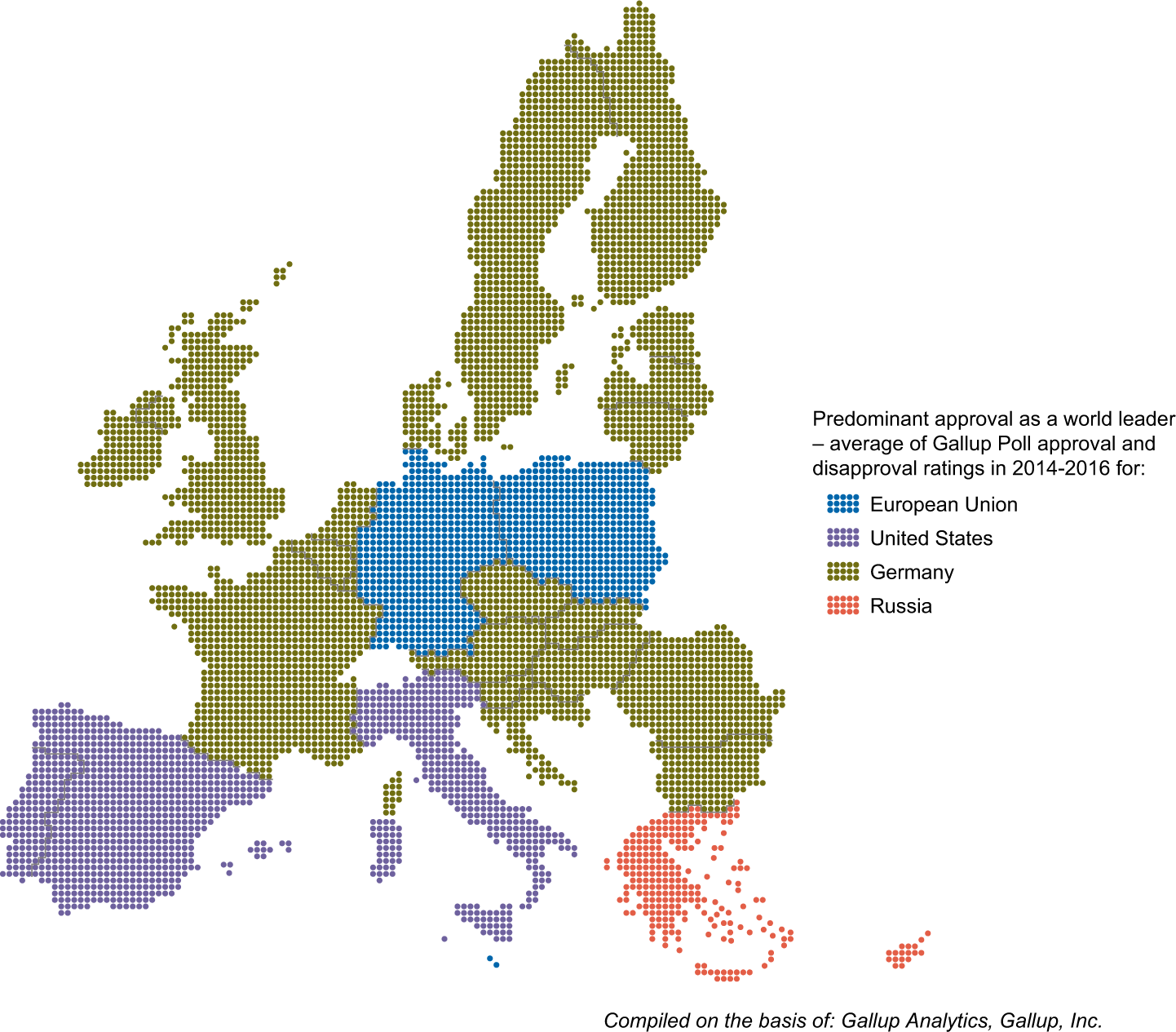
If majority support in particular EU countries is the only consideration, then approval for German leadership was given priority in Western Europe, Scandinavia, the Baltic countries, the former Austro-Hungarian empire (the extent of which is clearly marked on the map), and Romania and Bulgaria (note: a member of the Hohenzollern-Sigmaringen dynasty reigned in Romania until 1947 and a member of the Saxe-Coburg-Gotha dynasty in Bulgaria until 1946; both were of German origin) (Figure 7). The European option only prevailed in Poland and Germany. However, considering that the Germans were not asked for their opinions on their country’s policies, and, if they had been, the German option would have prevailed there, Poland would appear to be the only EU country in which most people support EU leadership in international relations. Majority support for the USA was marked in the south and south-west fringes of the EU (Portugal, Spain and Italy) and the Russian option in the Orthodox south-east of the EU (Greece and Cyprus).
Predominant approval as a world leader. (To view this figure in colour please see the online version of this journal.)

Aggregating particular endorsement and disapproval options into the general ones describing the political choices of EU countries delivered even more interesting results (Figure 8). The countries that have more supporters than opponents of the policies of the EU, the USA and Germany, and more opponents than supporters of Russia and the PRC, can be considered the heart of the West. This group comprises the Scandinavian and Benelux countries, Poland, Lithuania, Croatia, Ireland, Portugal and Spain. At the other end of the spectrum are Greece and Cyprus, where there are more supporters than opponents of Russia and the PRC, and more opponents than supporters of the EU, the USA, and Germany. This places them in the non-Western camp. There are more supporters than opponents of the EU and Germany in Germany, Austria, Slovenia and Latvia. These countries also have more opponents than supporters of the great powers. Slovakia and Estonia are staunchly pro-German. The UK, France and Italy, as well as the Czech Republic in Central Europe, typically have more supporters than opponents of the USA and Germany and reject EU, Russian and PRC leadership. These countries, then, have a Western profile, but they also have clear reservations about European integration. According to Gallup Inc., Bulgaria is the only EU country that rejects only the USA as the leader of the international community, while only Hungary and Romania reject only Russia.
Types of approval of the European Union, United States, Germany, Russia and China as world leaders. (To view this figure in colour please see the online version of this journal.)

The PCC analysis was conducted in two stages. First, the interdependencies between EU countries’ positive and negative appraisals of leadership being exercised by the examined geopolitical entities were investigated. Member states were treated as equivalent entities. Second, as the populations of EU countries vary considerably, PCCs were weighted with the population of each country (population data from World Population Prospects 2015, www.un.org). Only statistically significant results were considered in either phase (standard two-tailed t-tests with 5% statistical significance thresholds were calculated for both phases). Most likely, only the second PCCs, weighted by population, show the associations in the EU that are actually significant.
Twenty-two (out of 45) of the interdependencies established by the unweighted PCCs are statistically significant. Five of them establish obvious dependency, i.e. there are very strong negative correlations between the positive and negative appraisals of leadership being exercised by the analysed entities (e.g. the positive appraisal of US leadership has a very strong negative correlation with the negative appraisal of US leadership). Nine of the next 17 dependencies describe the relationships between the EU, the USA and Germany, i.e. within the borders of the West. All convergent (both positive and negative) appraisals of EU, US and German leadership are favourably correlated. On the other hand, opposing appraisals are negatively correlated: a positive appraisal of the EU with a negative appraisal of Germany and vice versa; and a positive appraisal of the USA with a negative appraisal of Germany. It is noticeable that in the case of the USA and Germany, an increase in acceptance or disapproval of Washington goes hand in hand with a corresponding acceptance or disapproval of Germany as leader. The PCCs also show that approval for the USA as leader implies a fall in disapproval for an analogous role for Germany. Both countries, then, are perceived in EU countries as being leaders jointly working together. A similar dependency, based on the calculated dependencies links the USA with the EU. This demonstrates the importance of transatlantic ties to Europeans. The relationship between Germany and the EU is similarly being moulded. Here, it also shows what Europeans think about leadership in the Union itself. The PCC shows that acceptance or disapproval of the EU taking a leadership role accordingly implies acceptance or disapproval of Germany as leader. At the same time, an increase in support for EU leadership is associated with a decrease in opposition to Germany, and, conversely, an increase in disapproval of EU leadership in international politics is associated with a decrease in acceptance of Germany in that role. This means that Germany is a natural leader in the eyes of EU citizens.
Strong associations are likewise apparent between the appraisal of Russian leadership and the leadership of the other four entities (these are described by the remaining eight significant statistical dependencies that resulted from using unweighted PCCs). The PCC for Russo-American relations points to a strong dependency between an increase in approval for US leadership and a decline in acceptance and an increase in opposition for potential leadership activities on the part of Russia. An identical dependency is apparent in the EU–Russia relationship. There is a similar dependency in the Russo–German relationship in that approval of Russian leadership occurs simultaneously with a decrease in support for Germany and an increase in disapproval of Berlin. By contrast, as the number of opponents of Russia increases, so does consent for Germany to assume a leadership role. The foregoing correlations imply that in the EU we are dealing with a divergent appraisal of the potential aspirations of the West and Russia. Europeans do not see Russia and the West as always being mutually complementary, but as distinct international relations alternatives in the political sense. Additionally, in the first series of correlations, the only statistically significant result for the appraisal of the PRC is a negative correlation between a positive appraisal of Russia and a negative appraisal of the PRC. This means that support in the EU for these two undemocratic countries as leaders of the international community is interlinked insofar as acceptance of Russia as leader diminishes opposition to similar aspirations on the part of Beijing.
Only seven of the interdependencies revealed by the weighted PCC are statistically significant, five of which once more constitute the previously mentioned obvious interdependencies. Additionally, a positive appraisal of EU leadership is favourably correlated with a positive appraisal of PRC leadership. This is a strong relationship, but it is only statistically significant when the correlation is weighted. It is therefore difficult to gauge the extent to which the residents of EU countries really positively appraise EU world leadership and likewise positively appraise PRC leadership. However, the strongest dependency, which appears in both the weighted and unweighted PCC, is the favourable link between a positive appraisal of US world leadership and a positive appraisal of Germany as global leader. As the weighted PCC enables the voice of every resident of every country in the EU, and not just the countries in their entirety, to be considered, this interdependence would seem to be most relevant at the EU level. Given Germany’s dominant role within the EU and the general acceptance thereof in Europe, this association can be thought of as reflecting Europeans’ strong conviction of the value of transatlantic bonds and the need to maintain them.
Acknowledgements
The maps accompanying the article were made as part of a project ‘Atlas of Political Geography Centre, Poland. Poland in the Contemporary World’ financed by the National Science Centre. Grant No. 2014/15/B/HS5/00729. The atlas was published in Polish and English in 2018.
The survey results from the Gallup Inc. come from the library of Ohio State University, Columbus, OH, USA.
About the Authors
Marcin Wojciech Solarz is Professor of Political Geography in the Political & Historical Geography Research Group, Faculty of Geography and Regional Studies, University of Warsaw, Poland. He is the author of, amongst other works, ‘The birth and development of the language of global development in light of trends in global population, international politics, economics and globalisation’, Third World Quarterly, 38(8) (2017); The Language of Global Development: A Misleading Geography (Abingdon and New York: Routledge, 2014, 2016); ‘The rise, fall and rebirth of Polish political geography’, Geopolitics, 19(3) (2014); ‘“Third world”. The 60th anniversary of a concept that changed history’, Third World Quarterly, 33(9) (2012). He is the editor of, amongst other things, New Geographies of the Globalized World (Abingdon and New York: Routledge, 2018).
Małgorzata Wojtaszczyk is a Junior Lecturer in the Political & Historical Geography Research Group, Faculty of Geography and Regional Studies, University of Warsaw, Poland.
Maciej Zych works in Statistics Poland.
Anna M. Solarz is a Junior Lecturer in the Chair of Regional and Global Studies, Faculty of Political Science and International Studies, University of Warsaw, Poland.