Introduction
The works of Luigi (Alvise) Cornaro (Trattato della Vita Sobria, 1558, first translated into English as A Treatise of Temperance and Sobrietie) and Gabriele Zerbi (Gerontocomia, 1489, translated as On the Care of the Aged) have been considered by several historians of ageing as precursors of modern gerontology and geriatrics (Freeman Reference Freeman1979: 32; Joutsivuo Reference Joutsivuo and Lagerlund2007: 172; Lind Reference Lind1988: 3). Others have suggested they represent precursors of ‘anti-ageing’ medicine (Trüeb Reference Trüeb2006: 66–7). Despite such plaudits, little attention has been paid to the texts themselves let alone to the social and intellectual context in which they were written. Neither were historical ‘one offs’, for as Minois has pointed out, an ‘unprecedented’ number of treatises were written about later life during the Renaissance (1989: 270). Few attempts have been made to explain why this should have been so. The aim of this paper is to offer some explanation for the emergence at this time of all these various treatises on ageing.
In order to do so, I shall first outline the principal treatises on ageing that were published during the Renaissance, discuss their main themes and explore their links both to the civic humanism of the time and to the influence of the Galenic tradition and its role in promoting public health and personal wellbeing. Much of the material in these treatises relates to the Galenic notion of the six ‘non-naturals’. Galen (CE 129–197) used this term to describe elements external to the body, not forming part of life itself, but which are necessary for health and wellbeing (Garcia-Ballester Reference Garcia-Ballester, Kollesch and Nickel1993; Niebyl Reference Niebyl1971). Set against this intellectual context, I then consider the distinct demographics of central and northern Italy that made ageing such a concern to the elites of the time and why the status of old age was such an important personal and political issue for them. In the final section of the paper, I consider the status of these Renaissance manuals as pre-modern precursors of gerontology. In making comparisons between the past and the present, I focus upon the commonality that exists between Renaissance ideas of ‘virtù’ and living a ‘good old age’ and contemporary literature on the virtues of ‘successful’ ageing. At the same time I argue that the ‘scholastic’ element underlying Renaissance writing on ageing and its medieval heritage contrasts markedly with the empirical orientation of contemporary gerontology whose scientific traditions derive more from the later ‘scientific’ revolution of the mid-17th century. Nevertheless, in their non-pathologising of old age and their exhortation to live long and live well, morally and materially, they presage much of the ethos of contemporary writings on ‘successful’ ageing. It is in this, more restricted sense, that these manuals can be viewed as precursors of successful ageing, their authors advocate avant le lettre for a ‘third age’, fired by the same sense of contradiction between the potential achievements of age and the vulnerability of those achievements.
Handbooks for a good age
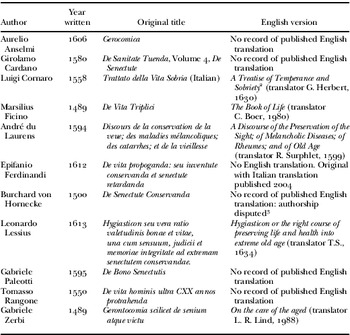
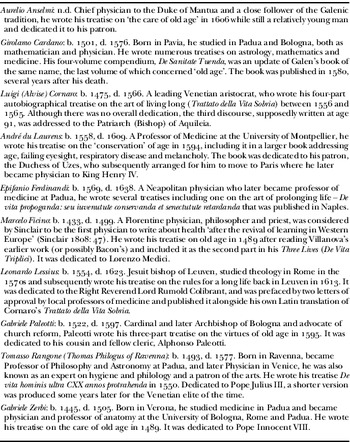
Who were Cornaro and Zerbi and what did they write about age and ageing in their manuals? To properly contextualise the content of these two books and their authors it is necessary to recognise that they are not ‘one offs’. Between the late 15th and early 17th centuries (1485–1610) a number of books and essays were published on how to live a long life and how to live well into old age. Some of the principal works of the period and brief biographies of the authors are outlined in Tables 1 and 2.
Major Renaissance treatises concerning the care, cause and cure of old age1

Notes: 1. Various other treatises on health and well-being not specifically addressing later life were published during the fifteenth and sixteenth centuries (see Sinclair's 1808 translation of Halle's eighteenth century “Review of the history of ‘Hygiene’” or McKenzie's review (1780) of “The art of preserving health” for details of other related fifteenth and sixteenth century works). Likewise recommendations about how older people should behave were starting to appear in sections of sixteenth century treatises on art, courtly behaviour, and dietetics (see Campbell, 1998, for examples in relation to the art of painting and the parallels with the art of the ageing courtier.
2. Sometime before he completed the Hygiasticon, in 1613, Leonardo Lessius had translated ‘Ludovich’ Carnaro's De Vita Sobra into Latin ‘to make it common to all men’ (Lessius, 1634: 10). He appended it as an annex in his own work. In the English translation of Hygiasticon, completed by a writer who seems to have left behind only his initials (TS, possibly Thomas Smith) published in 1634, an earlier English translation of Carnaro's De Vita Sobra completed by George Herbert was published. It seems that this was the first English version of De Vita Sobra. A ‘new and improved’ English translation was published in 1903 by William F. Butler. It is from this latter translation that all subsequent citations are made.
3. According to Goldschmidt (1938) “nothing about the good Dr Burchard von Horneck seems to be very reliable … so I am afraid one distinctive epithet we might give to Burchard von Horneck is that he was a liar” (Goldschmidt, 1938: 506). I have been unable to trace this work and given his record of scratching out authors' names and replacing them with his own, it seems doubtful whether this treatise can be attributed to him or indeed whether it is an original work.
Brief biographies of Renaissance authors mentioned in the text

These books were written mostly by physicians. Zerbi was a traditional ‘scholastic doctor’ immersed in the Galenic tradition, as were Anselmi, Cardano, du Laurens, Ferdinandi and Rangone. Only Ficino was not a proper ‘Galenist’. Two were clerics (Lessius and Paleotti) while Cornaro was a gentleman scholar and patrician. Writing and getting one's work known and published was a matter of concern to an increasing number of scholars. With the advent of printing and as books reached a wider and more literate audience than ever before, writing offered a means of gaining and exercising influence more effectively than by simple word of mouth or personal contacts. Although the printing press was established first in Germany in the late 1440s, it soon spread to Rome (1467) and on to Venice (1469) and within a decade, it had been established in all the major cities of Italy (Pettegree Reference Pettegree2010: 49). The benefits of good reviews were not so much their impact on sales as the prestige and status they conferred on the author. A year after the publication of Gerontocomia, Pope Innocent VIII (to whom it was dedicated) increased Zerbi's salary from 150 to 250 florins (Lind Reference Lind1988: 14). Cornaro, who came from a well-established, if slightly down-at-heel Venetian family which traced its patrician heritage to ancient Rome, basked in his status as a man of much publicised and slightly exaggerated ‘self-made’ longevity. Sales of his Trattato della Vita Sobria were such that, according to his compatriot, Girolamo Cardano, it was ‘in everybody's hands’ (Siraisi Reference Siraisi1997: 79).
Most of these books were written in Italy by Italians. The exceptions are du Laurens and Lessius, and the latter had studied in Italy. The city states of Northern Italy formed an intellectual nexus linked to other centres of learning across Europe. The authors moved easily from one city state to another and most held a variety of positions in different centres and cities during their adult lives (see Table 2 for brief biographies). Ficino, a physician and philosopher who published his De Vita Triplici at the same time as Zerbi's Gerontocomia, first studied philosophy in Florence before moving to the University of Bologna to study medicine. Later he returned to Florence, became a tutor to the Medici family and began formal religious studies leading to his being ordained a Dominican priest in 1473. Zerbi spent time in Bologna, Florence, Padua, Rome and Venice while Cornaro who grew up in Venice spent considerable time in Padua, Rome and Verona. These works formed part of the corpus of ‘European’ Renaissance culture. Several were translated into other vernacular European languages. Seven English translations of Cornaro's work were published during the 17th and 18th centuries (Axon Reference Axon1901) as well as numerous French, German and Dutch versions (Gruman Reference Gruman2003: 122). Ficino's De Vita Triplici was translated into French, German and Italian in the course of the 16th century while the original underwent some 30 editions (Allen Reference Allen1990). Lessius' work Hygiasticon was re-published several times and translated into Italian, French and English in the same century in which it was written.
Given the novelty of the intellectual networks of the Renaissance and the place these authors occupied within them, how distinctive an intellectual contribution did their books make? Their content possesses many common features, typically combining general lifestyle advice with more detailed instructions on the types or amounts of food and drink that should be taken as well as particular regimes to combat or defer the visible signs of ageing. They draw upon earlier ‘regimens’ of health, including those that specifically addressed old age. Ficino seems to have had the works of either Arnold de Villanova (De conservanda juventute et retardanda senectute) or Roger Bacon (De retardandis senectutis accidentibus et de sensibus conservandis) at his side while he was writing his book (Clark Reference Clark1986). They also relied heavily upon the ‘classical’ tradition of Galenic and Hippocratic writing and what none offered to do – even Rangone who saw human life as capable of being lived and lived well ‘beyond 120 years’ – was to violate Galen's understanding of ageing and promise eternal youth. They were what Gruman has termed ‘hygienists’ (Gruman Reference Gruman2003) concerned primarily to offer advice on how to achieve a longer and healthier later life. A good old age was deemed an eminently achievable goal and most had little time for ‘alchemie’. None treated old age as inherently pathological and it would not be until the scientific revolution of the later 17th century that old age was discussed as a form of pathology (Schäfer Reference Schäfer2002: 532).
What is noteworthy is their common employment of references from the secular writings of classical Greek and Latin authors such as Aristotle, Cicero, Galen, Plato, Pliny and Plutarch rather than from the Bible or the doctrines of the medieval church. This became less true over time. Zerbi's book, for example, cites Galen more than 100 times and Avicenna over 70 times but makes no reference to any scriptural writing. Ficino likewise sticks to the classics. Cornaro, though himself not a physician and less keen to present himself as the ‘learned doctor’, still manages to cite both Galen and Hippocrates but offers no specific biblical references. Even the cleric Paleotti makes more references to Cicero, Pliny and Seneca than to such Church writers as St Anthony and St Augustine. Lessius, the other clerical writer of this genre, follows Cornaro in making most reference to the writings of Aristotle, Galen and Hippocrates (whom he believed, along with others such as Ficino and Ferdinandi, to have lived ‘to 105 yeares’; Lessius 1613/1634: 129) but he makes several references to the scriptures, not infrequently citing biblical or theological writings. As the vigour of the Renaissance faded and the Church's use of press censorship grew, these treatises (Ferdinandi and Lessius, especially) seem to have chosen to make more explicit reference to the scriptures as sources of authority, in a way rarely seen in the earlier treatises written by Cornaro, Ficino and Zerbi.
More generally these authors shared the goal of advising, enabling and expounding on an engaged lifestyle to realise an enjoyable and worthwhile old age and, thereby, to procure an easeful death. Such regimens were typically directed at educated and well-connected men of mature years. ‘I write … for men who are prudent and temperate, for men of intelligence who are useful either privately or publicly’ (Ficino 1489/1994: 39). Some claimed to make their books ‘suitable not just for philosophers and doctors but for everyone’ (Anselmi 1606, cited by Bergdolt Reference Bergdolt and Dewhurst2008: 199 – for a similar sentiment, see also Lessius 1613/1634: A1, line 49). Cornaro wished to extend his prescription for a long and healthy old age to rich and poor alike. Thus, he wrote, even if ‘old persons on account of poverty cannot afford to indulge in all’ his recommended foods (which included ‘veal, kid, and mutton, … fowls of all kinds as well as partridges and birds like the thrush’), nevertheless they can still ‘maintain their lives with bread, bread soup and eggs – foods that certainly cannot be wanting even to a poor man’ (Cornaro 1558/Reference Cornaro and Butler1903: 87–8). Nevertheless the presumed readership was that of educated, literate men and none make any reference to women's ageing.
The tone of their writing also differed from earlier ‘pro-longevity’ tracts, such as those of Bacon, Arnold de Villanova, Bernard de Gordonio and Guido da Vigevano. First, they address an unspecified (though clearly a male elite) readership unlike these earlier tracts which were written as if they addressed a particular patron or would-be patron. Secondly, they focus more upon the self-management of ageing than the medicinal treatment of aged patients (contrast this with Bacon who suggests direct recourse to occult/secret medicines). Thirdly, they lay more emphasis upon the personal and social rather than the spiritual benefits of old age.Footnote 1 Fourthly, their advice is mostly pragmatic and practical and contains little that might be considered overtly magical. This is especially the case in those works written after the 15th century (Anselmi, Cardano, Cornaro, du Laurens, Ferdinandi, Lessius, Paleotti and Rangone) while those written during the 15th century (Zerbi and Ficino) still echo elements of the earlier more esoteric writings of Bacon, de Gordonio and de Villanova.Footnote 2 Finally, they draw heavily and usually explicitly upon the use of the six Galenic ‘non-naturals’ as the principal source for wellbeing in ways that these earlier writers did not.
The humanist tradition
One reason the Renaissance treatises moved beyond the literature of the Middle Ages was because they were all to varying degrees imbued with the spirit of humanism. Although subject to a variety of interpretations, humanism generally describes a renewed interest in the nature of ‘man’,Footnote 3 his understanding of himself and his relationship with others, drawing upon classical Greek and Latin traditions more than the traditions of the early Christian church (Brotton Reference Brotton2006; Hale Reference Hale1993). The issues, themes and approaches encompassed by humanism emerged in the work of 14th-century Italian writers such as Petrarch (1304–1374) and Boccacio (1313–1375) but were more fully elaborated by writers such as Leon Battista Alberti (1404–1472), Leonardo Bruni (1369–1444), Baldassare Castiglione (1478–1529) and Niccolo Machiavelli (1469–1527). An important theme in most humanist writing is the emphasis upon virtue and wellbeing and more broadly, upon appropriate civic and personal conduct. These themes were expressed in a number of ‘lifestyle’ manuals published during this period, covering topics as diverse as the education of children, models of family life, regimens of diet, health and guidance on virtuous lifestyles (Bell Reference Bell1999; Kallendorf Reference Kallendorf2008). It was a tradition that influenced most of those who wrote their treatises promoting healthy ageing, prolonging active life and seeking relief from the ‘ills’ of old age.
Humanist literature was concerned with the lifestyle of the upper echelons of society. Even if it initially displayed a preference for the contemplative life over that of commerce and politics, there was ‘an appreciation of wealth as the foundation of civic action and even as a condition for the exercise of certain kinds of virtue’ (Seigel Reference Seigel1966: 5). The shift in emphasis from the ‘rareness’ and ‘divinity’ of the contemplative life espoused by earlier Renaissance writers like Petrarch to the ‘more excellent’ usefulness of the active life espoused by Alberti, Bruni, Castiglione and Machiavelli, helped in ‘re-basing’ lifestyles from the sacred and scholarly toward the profane and practical. As Nauert has suggested, humanism became part of the shared culture of the elite classes of Renaissance Italy because it ‘depended ultimately on the conclusion by hard headed businessmen, oligarchs and princes that humanistic studies were useful to those who ruled’ (2006: 34).
Humanist ‘how to’ literature covered a wide range of topics from running a family (Alberti's Della Famiglia, 1443), dress and comportment (Giovanni della Casa's Il Galate, 1558), education (Matteo Vegio's De Liberorum Educatione, 1460), exercise (Giralamo Mercuriale's De Arte Gymnastica, 1569), the etiquette, style and conversation of a courtier (Castiglione's Il Cortegiano, 1528) and perhaps most notorious of all, the appropriate way to govern outlined in Machiavelli's treatise Il Principe, 1516). Firmly within this tradition was Marsilio Ficino's De Vita Triplici (1489) with its three mini-manuals on how men of letters should look after their health, how they should align their life with the heavens and, of particular significance for this paper, how they can prolong their life. Ficino's book was dedicated to Lorenzo Medici and was published in Florence at the same time as fellow physician Gabriele Zerbi's Gerontocomia first appeared in Rome, which in his case, was dedicated to Pope Innocent VIII.
Popes, princes and local oligarchs were powerful figures, concerned with their physical, moral and economic status, and Ficino and Zerbi no doubt made their dedications with the intention of furthering their own fortunes. But in addition to advancing their own personal interests with the rhetoric of ‘civic humanism’ is the frequent reference they pay to the canon of ‘scholastic’ medicine. Zerbi, one of the most traditional Galenic physicians and an ‘academic aggregator’ (French Reference French, Wear, French and Lonie1985: 72) refers to Galen over 100 times in his book, Avicenna over 70 and Aristotle over 30 times. Ficino, the most radically minded of these writers, makes fewer references to any authorities, perhaps because he rushed this part of the book, and already had as a template before him, Arnold de Villanova's earlier treatise on retarding old ageFootnote 4 (Boer in Ficino 1489/1994: xix). Nevertheless, he refers ten times to Avicenna, eight times to Galen and three times to Aristotle in a work only 42 pages long. Leaving to one side the differences between these two works, what is significant is that both demonstrate a broad allegiance to a medical canon that had been consolidated during the early Renaissance by improved access to Galen's original Greek and Latin works and by the expanding academic clinician tradition built up within the Italian medical schools. It is to this medical canon that I now turn.
Galen's legacy
Prior to the 14th century, there were only three university-based medical schools in Europe, Bologna, Montpellier and Paris. Bologna, ‘the mother of Italian studia in medicine’ (French Reference French2003: 94) had taken the lead in formalising the teaching of medicine, blending the logic of Aristotle with the medical canon of Galen and Hippocrates to create a curriculum designed to produce ‘rational and learned doctors’ (French Reference French2003: 111). Galen (with his Arabic commentators and interpreters Averroes, Avicenna and Rhazes) provided the core of medical teaching and his writings continued to exercise a central influence on medical theory and practice throughout the Renaissance (Jacquart Reference Jacquart and Grmek1998). The Galenic tradition stressed the dual role of medicine in both the preservation of health and the treatment of illness (Gil Sotres Reference Gil Sotres and Grmek1998). It was a distinction made in Galen's text Hygieina (translated into Latin in the 13th century) and repeated even more forcefully in Avicenna's Canon of Medicine (translated into Latin in the late 12th century). This canon represented the chief authority for most subsequent writing and teaching on the practice of hygiene (Gil Sotres Reference Gil Sotres and Grmek1988: 302).
Known as the regimen sanitatis or ‘rules for health’, the Galenic tradition conceived of the promotion of health through the alteration and modification of the six ‘non-naturals’. This forms a central theme in Zerbi's Gerontocomia and is present (although not always in systematic form) in most of the other Renaissance treatises on ageing well. Supplementing these ‘external’ influences on ageing were the ‘endogenous’ processes of ageing associated with the humours. Humoural theory was employed by these authors as a generalised template for ‘intrinsic’ ageing, regarded as a ‘natural’ if not necessarily inevitable process. Thus Ficino explains ageing as the weakening and extinguishing of natural heat arising from a deficiency, putrefaction or excess of the fatty humour that nourishes it, while Zerbi suggests that old age comes from ‘the decay of the natural humidity caused by the innate heat … like the flame of the lamp which is extinguished because it consumes the material which feeds the flame’ (Zerbi 1489/1988: 35–6). This viewpoint is reiterated by du Laurens, when he writes of ‘our natural heat … consuming of his radical moisture doth little by little fall a drying and cooling’ (du Laurens 1594/1599: 172). Cornaro, insofar as he offers any theoretical explanation of ageing, treats it similarly as a ‘decrease of natural heat’ (Cornaro 1558/Reference Cornaro and Butler1903: 83).
Humoural theory was based upon and itself validated the naturalness of ageing. It was the given against which the hygienists fashioned their advice. Despite such a given, however, Galen considered it possible not ‘to prevent aging but … to slow the process down’ (Theoharides, Reference Theoharides1971: 380). His followers did not treat his scepticism as a reason to believe that nothing could be done to improve health in later life or extend the length of life itself. But in contrast to Bacon's quick route through potions and substances found only in the ends of the earth, it was through the appropriate use of the six ‘non-naturals’ that these hygienists claimed one could preserve or prolong life.
Res non naturales
Unlike the natural processes exemplified by the four humours, the non-naturals (res non naturales) operated outside the body and accounted for the extrinsic non-pathological causes of ageing. Ageing was modifiable through their appropriate use (or accelerated through their misuse). This Galenic viewpoint was shared by all the Renaissance writers on ageing, from Anselmi to Zerbi. It is particularly explicit in Zerbi's Gerontocomia where he devotes a whole chapter to the ‘justified use of the six non-naturals’ in the care of old age (Zerbi 1489/Reference Zerbi and Lind1988: 81). From this framework, the rest of his book makes various recommendations regarding the appropriate quality of the air, the balance between rest and exercise, suitable food and drink, the regulation of sleep and wakefulness, regular regimes of elimination and excretion, and the promotion of emotional wellbeing.
While none of the other writers were quite so exhaustive as Zerbi, most organised their material through the lens of the six ‘non-naturals’. Ferdinandi in his short treatise followed traditional Galenic lines, with the last six of his eight chapters devoted to each of the six non-naturals. Anselmi likewise used this theme to organise his treatise as, in a more roundabout way, did Cardano, in the last volume of his De Sanitate Tuenda (1580). In this volume, concerned with preserving health in old age, Cardano argues for a distinction to be made between a long life and a robust or good life. Eating heartily and regular exercise may indeed constitute a good life, but those who pursue such a good life are in practice prone to excess and hence rarely live long. In contrast, he suggests, those who eat and exercise little followed the better recipe for longevity, as demonstrated by the abstemious lives of monks and nuns (the only positive mention of women in any of these books). du Laurens, under the general heading of diet, also outlines the role of the six non-naturals of air, meat and drink, sleep and waking, labour and rest, emptiness and fullness, and the ‘passions of the minde’ in promoting a healthful old age (du Laurens 1594/Reference du Laurens and Surphlet1599: 178). The least systematic use of Galen's six non-naturals is evident amongst the non-physicians, Cornaro, Lessius and Paleotti.
Cornaro, for example, emphasised only one of the six non-naturals, food and drink. The simplicity of his regime – he recommends eating four little meals a day, instead of the two meals a day of youth (Cornaro 1558/Reference Cornaro and Butler1903: 86–7)– may have helped account for its popularity. Unlike the physicians, he does not go into detail of the kinds of foods to be eaten although at one point he does outline his own regime: ‘bread; then bread soup or light broth with an egg or some other nice little dish of this kind; of meats I eat veal, kid and mutton; I eat fowls of all kinds as well as partridges and birds like the thrush. I also partake of such salt water fish as the goldney and the lie and among the various freshwater kinds, the pike and others’ (Cornaro 1558/Reference Cornaro and Butler1903: 87) along with ‘such wines as agreed with my stomach’ (Cornaro 1558/Reference Cornaro and Butler1903: 47).
Firming up this general precept of dietary restraint, the cleric, Lessius, proposes a more general framework for corporeal continence to assure a just, sober and long life. His fourth rule, for example, proposes that for those ‘steeped in years’, ‘twelve, thirteen or fourteen ounces of food a day should be enough; accounting into this proportion bread, flesh, eggs and all other kind of victuals; and as many or but a few more ounces of drink would suffice’ (Lessius 1613/Reference Lessius and Ferrer1634: 45), while in his seventh rule he suggests that men abstain from looking at delicacies or otherwise reconstruct them in their imagination not ‘as outwardly they appear, good, pleasant, savoury, relishing and bringing delight to the palate; but filthy, sordid, evil flavoured and detestable’ (Lessius 1613/1634: 72–3). The turn toward dietary restraint evident in Cornaro and other later writers has been seen as a general feature of writings on health from the mid sixteenth century onwards (Garcia-Ballester Reference Garcia-Ballester, Bynum and Nutton1991: 27).
In contrast, the 15th and early 16th-century manuals were concerned primarily with what to eat and drink. Zerbi (1489/Reference Zerbi and Lind1988) devotes more than 20 of the 50-odd chapters in his book to the appropriate kind of food and drink that should be taken to live well into old age, ranging from the testicles of small birds, to bread soaked in diluted wine, to sublimated human blood and soluble gold. Ficino's recommendations are equally exotic, recommending soluble gold and human blood – as well as human breast milk – to be drunk with the moon rising, to be followed by a little powder of sweet fennel (Ficino 1489/Reference Ficino and Boer1994: 56). He also recommends such accessible culinary treats for old age as honey, fresh cheese, figs and ‘above all pistachios’ (Ficino 1489/Reference Ficino and Boer1994: 59) along with meats ‘thoroughly cooked’ and ‘especially wines’ (Ficino 1489/Reference Ficino and Boer1994: 51).
Although sleep and wakefulness have been considered to play an important part in the Renaissance literature on the preservation of health (Dannenfeldt Reference Dannenfeldt1986), this particular non-natural played a limited part in advice books on ‘healthy ageing’. Zerbi recommends ‘a sleep rather longer and more complete but not too long, without too great a lingering in bed’ as ‘quite helpful for the restoration of [old people's] humidity’ (Zerbi 1489/Reference Zerbi and Lind1988: 243). Daytime sleep is to be avoided but if it does happen, should be undertaken sleeping on an elevated pillow with the legs bent up. Following Zerbi, du Laurens advises alternating the position during sleep, sleeping first on the right side (‘for feare the liver should fall upon the stomach and oppress it’) then on the left side (‘so that the vapours retained by lying on the right side may breathe out’) before finally going back to the right side, with the limbs ‘somewhat drawn up’ (du Laurens 1594/Reference du Laurens and Surphlet1599: 190). In contrast to sleep, almost all these writers paid attention to the regulation of mood, the sixth and last of the Galenic non-naturals. Although they more or less ignore any prophylactic measures to sustain memory and mental fitness, they show a consistent concern for sustaining the spirits and maintaining ‘mental balance’ in old age. Ficino proposed maintaining emotional calm by avoiding coitus and prolonged thought while Zerbi recommends conversation, music and looking ‘frequently at visible objects of great beauty’ (1489/1988: 270). Cornaro supports pleasant conversation and enjoying the company of ‘men distinguished for their intellect’ (1558/1903: 68–9) while Lessius insists that the root to emotional tranquillity lies in a sober diet which ‘especially if there be adjoined some little help by means of purging medicines’ will cause all evil humours to be ‘by littler and little abated’ (Lessius 1613/Reference Lessius and Ferrer1634: 160).
Stressed more by earlier medieval writers such as Bacon and de Villanova, regimes for elimination and repletion are mentioned only by Anselmi, Ferdinandi, Lessius, Rangone and Zerbi. Their advice includes regular blood-letting, vomiting and the proper evacuation of the bladder and bowels. du Laurens omits any discussion of what he called ‘emptiness and fulness’ and the process of elimination is touched upon neither by Cornaro, Ficino, nor Paleotti. Anselmi considered that the regular evacuation of the bowels contributed to health in old age, while Zerbi recommended figs, prunes and raisins as laxatives and ‘softening suppositories’ (Zerbi 1489/Reference Zerbi and Lind1988: 254). Lessius considered a twice-yearly purging of the body – through a cycle of enemas, emetics and bloodletting – necessary for ‘church men, lawyers, scholars and the like’ who took little exercise and are less than careful in their diet (Lessius 1613/Reference Lessius and Ferrer1634: 93–4). Sexual behaviour which came under the same heading was only ever lightly touched upon, particularly by the more religiously inclined writers such as Ferdinandi, Lessius and Paleotti. Sex was generally considered life shortening, and most of these manuals recommend severely limiting sexual activity or better still sexual continence at least in the warmer months (Cardano Reference Cardano1580: 303; Ferdinandi 1612/Reference Ferdinandi, Portulano-Scoditti and Distante2004: 50; Zerbi 1489/Reference Zerbi and Lind1988: 273–4).
Three centuries earlier Roger Bacon had considered it unlikely that anyone could follow the strict regimes that were based upon the ‘non naturals’: ‘For who can avoid the Air infected with putrid Vapours carried about with the force of the Winds? Who will measure out Meat and Drink? Who can weigh in a sure Scale or Degree Sleep and Watching, Motion and Rest, and things that vanish in a moment, and the Accidents of the Mind, so that they shall neither exceed nor fall short?’ (Bacon 1240?/1638: II, 13–14). By the late 15th century, however, the Italian city authorities had at least begun to address the former, improving sewage and drainage systems and leading Alberti to proclaim that many villas in and around Florence experienced ‘crystal clear air’ with ‘little fog, no deleterious wind and … pure healthy water’ (Alberti, cited in Bergdolt Reference Bergdolt and Dewhurst2008: 162). The importance of good clean air – the first non-natural – for older people was stressed by most of these Renaissance authors including du Laurens, Ferdinandi, Ficino, Rangone and Zerbi, and more indirectly, by Cornaro too. Ferdinandi recommended living by the sea, ‘maris regio facet ad longam vitam…’ (1612/2004: 27) in a fragrant place, neither humid nor full of odours, while Rangone attributed the declining longevity of Venetian senators both to their over indulgence and the foul airs arising from burial grounds in the city (Sinclair Reference Sinclair1808: 116).
Public health in the Renaissance
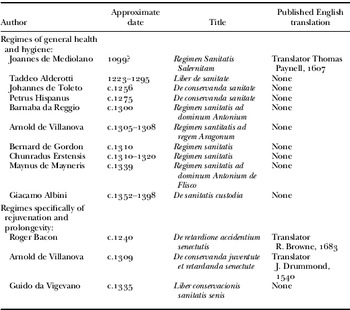
Fresh air and the control of sewage were key issues for the public health systems of the Renaissance (Cipolla Reference Cipolla1992: 10). For much of the Middle Ages, health and wellbeing had lain largely in the hands of the church and the monastic hospitals where care for the poor, sick and homeless was provided. The purpose of such institutions was less to heal than to offer support, prayer and welfare to alleviate helplessness, impoverishment and infirmity of every sort (Seidler Reference Seidler, Kawakita, Sakei and Otsuka1989: 13). In the 13th century medicine and medical care began to develop within a new academic framework of ‘scholastic medicine’ that was less dominated by the church. At the medical school in Salerno, the school and its teachers – the so-called masters of Salerno – had created the idea of a ‘canon’ of medicine, drawing heavily upon the writings of Galen which had been ‘recovered’ in western Europe during the 12th and 13th centuries, translated from the Arabic into Latin (Jacquart Reference Jacquart and Grmek1998). From the new institutions of medical learning, various regimens of health care emerged, outlining how people could avoid illness and live a healthy life (Bergdolt Reference Bergdolt and Dewhurst2008: 127). These regimens of health proliferated during the 14th century and although many were still written for a particular member of the ecclesiastical or secular elite, by the later 14th century they had begun to find a new market amongst the urban bourgeoisie (Garcia-Ballester Reference Garcia-Ballester, Bynum and Nutton1991: 24). Table 3 outlines the principal regimens written and preserved dating from the 12th to the 14th centuries.
Late medieval regimens of health, hygiene and prolongevity

As these treatises began to circulate outside the schools, they stimulated a broader interest in health and hygiene. During the Renaissance, Italian hospitals were renowned for their architectural splendour, the cleanliness of their environment and the quality of medical care offered to their sick. The Santa Maria Nuova in Florence, first built in 1288, was ‘arguably the first Western European hospital in the modern sense of the word … dedicated exclusively to the care of the sick … and directed by lay members of the medical profession’ (Park and Henderson Reference Park and Henderson1991: 169). In the wake of the plagues affecting Italy in the 14th century, the Italian city states experimented with different models of public health care – from the salaried doctors of Venice to the large specialised hospitals for the sick poor in Florence and Milan. City councils developed plans to improve public health and personal hygiene through the establishment of Public Health Boards (Cipolla Reference Cipolla1976) as a new belief emerged that society should be capable of organising itself and its members in such a way that could prevent disease, promote health and prolong life for the benefit of all.
This switch from regimens of health dedicated to and written for individual rulers to regimens of health directed at the public was accompanied by a similar turn toward ‘democratising’ medical care. Physicians who had customarily offered individual care only to the households of the elite now competed with priests in providing care within publicly funded hospitals. The Italian Renaissance hospital represented a major step away from the medieval idea of ‘hospitality’ toward the present-day idea of a hospital as a site of treatment. It was staffed by doctors, who were often also professors of surgery and medicine in the local university and nurses instead of members of the clergy and their lay assistants. As medicine was replacing the influence of the clergy in the hospitals, the health boards who controlled the doctors were themselves staffed by non-medical lay members drawn from the urban nobility, maintaining the secular control of public health (Cipolla Reference Cipolla1976: 14). Their duties extended from recording deaths and the causes of deaths to control over the hospitals, regulation of the professional activities of physicians, surgeons and apothecaries, and the control of sewage, food standards and the disposal of domestic waste and the quarantining of the sick (Cipolla Reference Cipolla1976: 34–5).
City states funded students to attend medical schools, paid eminent doctors to serve as community physicians and employed specialists on fixed-term contracts to treat the sick poor – and to bring along their students to help with visits to the poor. Although such practices were not unknown outside Italy, the employment of learned doctors in the service of public health was remarkable in its extensiveness and the deployment of learned academic physicians to serve the poor whilst teaching at the local medical school. In Pisa, for example, the university offered chairs to those it employed (Cipolla Reference Cipolla1976: 94). This combination of medical school training, followed by salaried practice as either a community physician or consulting physician to a hospital or other institution (with the possibility of an academic position) provided a prototype for modern hospital and community services. It also did much to embed health-care practices within a civic, secular fabric, a process which continued to evolve over the subsequent centuries.
Age and the sociodemography of Renaissance Italy
The wealth that was available to build magnificent hospitals, endow chairs in medicine and employ significant numbers of physicians and health officers has been seen as indicative of the flourishing economies of the city states of Northern Italy in the early Renaissance. The impact this mercantile wealth had in fostering the re-awakened interest in classical style, thought and culture that constitutes the Italian Renaissance has been exhaustively documented in Jacob Burkhardt's classic work for this period (Burkhardt Reference Burkhardt1990). Rather less emphasised, at least until recently, has been the economy of the later Renaissance when most of these treatises on ageing were written. The economic dynamism of earlier times had begun to fail. The successful city states of the late medieval period were ceasing to thrive in the early modern world of commerce and manufacturing of the seventeenth century (Brown Reference Brown1989). In the minds of some historians, the reason for this lies in the growing hold that an urban patrician class had on society and their preference for a more indulgent, consumer-focused lifestyle over the energetic mercantilism that earlier had brought wealth to the city states. Having achieved their success, the new elites were content to withdraw into their palaces, leaving no access for succeeding generations to join them. From such a perspective, the Renaissance was ‘nothing more … than a grandiose operation in which a prodigious quantity of effort, intellect and sensibility was used to defend – behind a stupendous facade – an edifice corrupted by time’ (Romano 1974, cited in Brown Reference Brown1989: 774).
Even if one were to accept that economic decline had set in by the late Renaissance, the city elites of Northern Italy continued to flourish (Poos Reference Poos1989: 799). Despite wars, famine and plague, longevity was not uncommon. Within the elites of the city states, men typically reached later life while still retaining considerable political and economic power. Survival into adulthood meant at least an even chance of living to age 60 or more (McManus Reference McManus1975). For women and for the labouring classes such longevity, though not exceptional, was nevertheless less common. Higher mortality rates among women during childbirth was a major influence on women's longevity, whilst amongst the poor, inadequate diets, bad housing, lack of effective sanitation and frequent exposure to disease contributed to a shorter life. The well-to-do merchant, Gregorio Dati, married four times and had some 28 children from his wives, each of whom was progressively younger than himself. Three of his wives died in or shortly after childbirth and only eight of his children seem to have survived beyond the age of five (Dati 1430/Reference Dati, Martines and Bruckner1991).
The relative size and wealth of the older (male) population tended to restrict the opportunities for young men to acquire positions of authority and ownership (Ellis Reference Ellis2009: 99; Poos Reference Poos1989: 807–8). Such barriers seem to have been particularly strong in Venice where the state had long operated a kind of ‘gerontocratic’ caste system which ensured that only the over-fifties could ever occupy the principal positions of power. These ‘senior senators’ were in turn presided over by the most senior of seniors, the Doge or principal magistrate, chosen from amongst their ranks and, like the Pope, appointed for life (Finlay Reference Finlay1978; Lewin Reference Lewin, Peterson and Bornstein2008). At the same time an atmosphere of political uncertainty was evident in many Italian city states, as the older urban elites found themselves challenged by a new generation keen to establish more ‘modern’ regimes reflecting the new humanist ‘culture’ (Ellis Reference Ellis2009). In the wake of the shifting solidarities of age, gender and class, generational conflicts arose over methods of governance, styles of art and architecture, the teaching and practice of medicine and, more generally, the ways of conducting one's life. Many older citizens decried the ‘consumerism’ of the times and the lack of restraint on the part of the youth. Such criticisms were exemplified in comments made by two Venetian writers on old age, Cornaro and Rangone. Rangone claimed that the lack of nonagenarian senators in 16th-century Venice was a direct consequence of conspicuous consumerism and the growth of luxury amongst the elite families which stood in marked contrast to the temperate habits of previous, longer-lived generations (Rangone, cited in Sinclair Reference Sinclair1808: 116), while Cornaro was an open advocate for senior citizens whose abstemious ways would enable them long to serve the state with discretion and virtue.
Drawing upon tax returns or contasta for the cities of Florence, Pisa, Pistoia and their surrounding countryside, Herlihy and Klapisch-Zuber (Reference Herlihy and Klapisch-Zuber1988) constructed demographic tables outlining the size and wealth of households according to the age of the head of household. The over-sixties represented over 10 per cent of the Tuscan population and households headed by people aged over 60 were just as likely to be ‘wealthy’ as households containing no-one of that age (Gilleard Reference Gilleard2002: table 1). Estimates of average age at death, for those reaching adulthood, suggest that amongst the ‘better off’ in Renaissance Italy, median life expectancy was over 60 (Greenspan, Heinz and Hargrove Reference Greenspan, Heinz and Hargrove2008; Lewin Reference Lewin, Peterson and Bornstein2008; McManus Reference McManus1975). Such longevity was not typical for Europe as a whole; for those who reached the age of 25, amongst the elite in 15th- and 16th-century Belgian, Dutch, English and French society, there was only an even chance of living beyond 50 years of age (Hatcher Reference Hatcher1986; Vandenbroucke Reference Vandenbroucke1985).
Equally distinct were the age differences at marriage. There was an average age difference at marriage of some 12 years, with women in urban centres being teenagers when they married while men were typically at or, in the case of Florence, over the age of 30 (Herlihy and Klapisch-Zuber 1984: table 7.1: 210). In the 16th century, figures from Germany indicate an average four-year gap, with brides and grooms both marrying in their early twenties; in Geneva there was an average gap of six years, with men tending to be in their mid- to late twenties while women were in their early twenties, while in England and Holland, the modal age of bridegrooms was between 20 and 24 (Hajnal Reference Hajnal, Glass and Eversley1965). In short, this ‘Renaissance’ pattern of late age marriage for men and early age for women was especially marked amongst the Italian elites but was not replicated across the rest of Europe. Potential conflicts between age, power and sexuality arising from such marriage patterns provided another more personal arena in which age (or rather male seniority) was a distinctly contestable source of privilege.
Still, age and seniority, though often attacked, retained considerable power as social mobility declined and the great patriarchal family clans continued to dominate the political and cultural landscape of late Renaissance Italy (Blanshei Reference Blanshei1979; Romano Reference Romano and Milner2005). Old men made up a cohort of ‘sovereigns, ministers, warriors, diplomats, merchants, [and] churchmen’ performing most of the key roles in the various spheres of public life (Minois Reference Minois1989: 288). More than before, significant numbers of the elite achieved and held on to old age and were materially rewarded for doing so. Young men were less able to leave the paternal home and set up independent households (as was the case, for example, in England and Holland) leading to multigenerational households (amongst the elite) where three or more generations were not uncommonly represented within the same household (Blanshei Reference Blanshei1979: 605; Herlihy Reference Herlihy1972: 10).
The late age at marriage and the continuing dependency of adult men still controlled by their father created numerous occasions for the privately conducted ‘generational’ conflicts that were illustrated over and again in Italian comedies of the time (Ellis Reference Ellis2009). These issues were amplified by the public jousting for political power in cities such as Florence where the battle between the old order and the new led to accusations by the young of self-serving cowardice by the old. Writing of the defeat of the last republic in Florence (1527–1530), Trexler cites one Jacopo Nardi who claimed that, faced with attack from the Medici's soldiers, while ‘the vecchi rushed home to lock up their shops; the giovani stood and fought the tyrants’ mercenaries' (Trexler Reference Trexler1980: 523). Such public and private intergenerational conflicts were re-enacted in poetry (Marx 1986), prose, as well as the theatre (Taunton Reference Taunton2007), particularly in late 16th-century Italian comedies (Ellis Reference Ellis2009). The stock characters of the Italian commedia dell'arte, the ‘lean and slippered’ miserly Pantalone, had become regular figures of fun, but such humour seems to have remained within limits, never seriously undermining the actual legitimacy and authority of the senior citizens of Italian society (Ellis Reference Ellis2009: 100). As Romano notes, while the majority of older people in the Italian city states were classed as the ‘old, poor and impotent’, the elite commanded a very different view of older men as wise rulers, thus justifying their ‘disproportionate’ share of power as the city states solidified into the protected elites of foreign powers (Romano Reference Romano and Milner2005: 264).
Within this landscape of an increasingly crystallised urban elite where older men exercised their senior power as paterfamilias at home, and as councillors and senators in the city, where inter- and intra-generational social mobility was steadily decreasing, challenges to the power of the vecchi were frequent, but rarely effective. In Northern and Central Italy, age stood for stability, success and patronage, symbolised by its ‘grey beards and broad shoulders’ (Lewin Reference Lewin, Peterson and Bornstein2008: 316). Nevertheless, in a society that was increasingly standing still and whose economy was gradually losing its pre-eminence to the emerging states to the north, Germany and the Netherlands, particularly (Hale Reference Hale1971: 138), such seniority was associated with not a little anxiety, and an implicit fear over the loss of power – whether sexual, financial or political. If, as Romano suggests, ‘the elite and non-elite elderly occupied a position between centrality and marginality’ (Romano Reference Romano and Milner2005: 251), it was important for those occupying the more central positions to present a positive picture of ‘successful ageing’. Arguably these treatises on ‘ageing well’ provided its patrician readers with a kind of comforting image for those uncertain times of fading glory.
Modern-day contrasts
How closely can the Renaissance manuals on successful ageing be compared with the gerontological literature of the late 20th century? While the Hippocratic and Galenic explanation of ageing as the cooling and drying of bodily humours is no longer seen as offering a plausible account of ageing, and there is a much more extensive understanding of the diseases associated with later life, these books do bear comparison with much recent literature on successful ageing (Rowe and Kahn 1998). Some of the closest links arise from the pursuit of Galen's six non-naturals, with their emphasis upon general precepts for living a healthy life at every age. Dietary restriction, careful choice of food and drink, fresh air and exercise, a good night's sleep and appropriate emotional self-management constitute maxims that have support from public health and epidemiology as well as ‘Galenic’ authority. At the same time, the classical idea of deferring or diminishing ageing by preventing as much as possible the cooling and drying of the humours evident in much of the Renaissance literature has its parallel in the 20th-century idea of eradicating or mopping up as much as possible those ‘free radicals’ which are considered the main source of the metabolic errors preceding contemporary ‘senescence’.
Secondly, the Renaissance was a time when there were certainly ‘two nations in retirement’, a prosperous and privileged later life for the few and a marginal and impoverished old age for the many (Romano Reference Romano and Milner2005). The links between socio-economic status and the value ascribed to later life are as evident today as then; the difference lies in the locus of such distinctions. The consumers of modern-day manuals for successful ageing form a much larger segment of the population in Western society than was the case in the Renaissance, just as the conspicuous consumption of the time pre-occupied a much smaller number of men and women than it does now (Welch Reference Welch2005). What is perhaps of continuing relevance is that in past and present-day manuals alike, there is a clear statement that, given the appropriate cultural and material resources, later life can be a very successful period in life. That that success is tinged on all sides by anxieties can lead some writers to claim the ‘goods’ of old age with a rather too nervous insistence. This is a feature not just of writers such as Carnaro, Lessius and Paleotti, but of many present-day authors too.
What of the differences? Certainly attitudes toward sex in later life are very different now. Not only did these treatises almost universally exclude any consideration of women ‘ageing well’ but most ignored or minimised the importance of sexuality itself. The contemporary virtue of a sexually active lifespan seems to represent the reverse of the Renaissance idea that sex should be avoided or if practised, done so rarely and quickly and never on a full stomach. Likewise the current mantra of eating several portions of fruit and vegetables each day contrasts with the general advice to shun fruit and most vegetables that was given in some of the later Renaissance manuals. Advice on preserving ‘brain power’ that can be found in many contemporary ‘successful ageing’ manuals (e.g. McKhann and Albert Reference McKhann and Albert2002) is notable by its absence from their Renaissance counterparts.
Psychological aspects of self-management were not ignored, but their focus was upon managing one's emotions and avoiding emotional upset rather than maintaining mental prowess. Lessius, for example, considered dieting as a means of ‘mitigating the passions and affections, especially those of anger and melancholie’ (1616/1634: 151), while Zerbi recommends stimulating agreeable sensations to promote a sense of joy, hope and love to ‘wipe away the troubles of old age’ (1489/1988: 265). Ficino recommends nourishing the spirit through pleasant odours, listening to warm and lively songs, and exposing oneself to ‘greenery’ (1489/1994: 62). None of these writers make any recommendations about mental exercises or methods of promoting or retaining one's memory. There are several possible explanations for this. First is the tendency in Galen's medical writings to place mental exercises such as reading, writing and performing calculations under the general rubric of diet or way of life, distinct from mental activities designed to ‘steady the soul’ (Garcia-Ballester Reference Garcia-Ballester, Kollesch and Nickel1993: 109). Second, the relative absence of concern over preventing cognitive decline might be that the intended readership were those still actively involved in ‘intellectual labour’ such as clerics, doctors, lawyers, merchants, politicians and scholars. Thirdly, since old age in the Renaissance was located at any time after 40 and even advanced old age was located around the age of 60 or 70 (Gilbert Reference Gilbert1967; Romano Reference Romano and Milner2005), these are ages when dementia is a still infrequent cause of debility (Fratiglioni et al. Reference Fratiglioni, Launer, Andersen, Breteler, Copeland, Dartigues, Lobo, Martinez-Lage, Soininen and Hofman2000: figure 2).
Finally, as noted earlier, the basic timetable for ageing has changed dramatically. No longer is ageing seen as beginning in one's forties – as Zerbi, Ficino, Ferdinandi and Anselmi all claimed – nor is it seen as the product of a progressive loss of heat and moisture. Current models of senescence are based upon cellular biology and the distinction between ‘mortal’ somatic cells and ‘immortal’ germ cells. The former are considered subject to the accumulation of stochastic errors that the cells lose the capacity to repair, while the latter are designed to be virtually immune to such errors. For somatic cells, to quote Empson, ‘it is the waste that remains that kills’, whether that waste derives from free radical formation, the accumulation of lipofuscin or cross-linked proteins (Hayflick Reference Hayflick1996: 241–57). Interventions to prolong life and retard senescence rely, notionally at least, on developing ways of preventing or reducing this potentially lethal waste – by ingesting anti-oxidants, taking drugs to reduce lipofuscin or neutralising the chemicals responsible for cross-linking. But even if the modern ‘theoretical framework’ is quite different from the Galenic model, the focus of self-help manuals remains upon diet, drugs and lifestyle – variants in many ways of the good old six non-naturals.
Conclusions
The Renaissance has been credited with giving birth to individualism and the reflexive cultivation of the self (Elias Reference Elias1982). The focus upon the individual and the cultivation of personal ‘virtue’ is reflected in much of the Renaissance ‘lifestyle’ literature, which offers advice on everything from bringing up children to city planning. Earlier regimens of health, mostly provided as the personal recommendations to princes, were developed as manuals for a growing literate urban class. They ceased to be written prescriptions directed at a particular ruler or prince, and became instead printed self-help books dedicated to some potential patron as a means of claiming status, but intended to offer advice to a wider literate population, typified by Ficino's treatise directed at maintaining ‘the good health of those who work in letters’ in his De Vita Triplici (Ficino 1489/1994: 3).
The cultivation of personal virtue flourished within the broader culture of civic humanism, which included a concern not only for the right way to live, but more generally for the preservation and development of the health and wellbeing of the population, the civitas of the Italian city states. The rediscovery and circulation of classical texts and the significance attributed to them (particularly the civic virtues of the Greek city states and the Roman republic) fostered a self-conscious rhetoric of citizenship and the ideal of a well-managed life. If, in second modernity, we reflexively view our own identities through the historical prism of modernity, so arguably the playwrights and philosophers, doctors and divines of the Renaissance viewed their own times in the light of the achievements and limitations of the classical period.
Agedness was no longer uncommon. The experience, subjective and objective, of ageing engaged and preoccupied people not just at the end of their lives but equally if not more often in what we might now call their middle ages but which they deemed as signifying ‘old age’ (Gilbert Reference Gilbert1967; Romano Reference Romano and Milner2005). Minois (Reference Minois1989) gives numerous examples of middle-aged Renaissance men's anxieties over ageing, as does Gilbert (Reference Gilbert1967). In such circumstances ‘ravaged by the plague and now teeming with rich old men, Italy gave birth to some of the most important texts of this genre … (i.e. wellness guides for seniors)’ (Adamson Reference Adamson2007: 8). What might be considered middle-aged angst about ageing expressed by artists and writers such as Aretino, Erasmus and Michelangelo resonates today with the idea of a mid-life crisis and its intimations of mortality first articulated by Elliot Jaques in the 1960s (Jaques Reference Jaques1965).
The consciousness of the politically important, yet vulnerable position of the aged as well as the not uncommon and frequently commented upon experience of personal ageing and the new ‘burning anxiety for life’ of the times (Homet Reference Homet1997, cited in Classen Reference Classen and Classen2007: 6) no doubt contributed to the development and popularity of these ‘wellness guides for seniors’ and their rational and restrained promises of a ‘good’, ‘long’ or ‘healthy’ old age. This much resonates with the contemporary scene and the promise of a temperate yet worthy and worthwhile old age bears much resemblance to Peter Laslett's call for a responsible and virtuous third age, free from the signs of ‘indolence’ (1989: 196–203).
Whilst many more such parallels can be drawn (the rise of banking and the decline of manufacture and trade, the emphasis upon and critiques of an increasingly consumerist culture, issues of intergenerational conflict, etc.), there are obvious differences too. The relative ‘prematurity’ by which old age was reckoned is an important consideration in determining what was and what was not included in these treatises. Moreover, even if the age range was looser and wider, the penetration of these treatises was limited by the relatively small numbers of the elite who might read or write about ageing. The pervasiveness, through all these Renaissance texts, of the humoural model of old age outlined by a physician who had died nearly 2,000 years ago is remarkable; none showed any interest in challenging, exploring or significantly modifying this fundamental premise. These treatises were framed in an academic tradition pre-dating the ‘scientific revolution’ of the mid-17th century. The persistence of symbolic or magical ideas concerning rejuvenation evident in the earlier texts such as those of Ficino or Zerbi reveals their medieval roots. Granted these caveats, it is perhaps not unreasonable to see this genre of Renaissance writing as a prototype of contemporary discourses on successful ageing and these Renaissance writers as early advocates for a ‘third age’, though not quite the precursors of a modern ‘scientific’ gerontology.
Acknowledgements
Thanks to Kay Higgs for her help with the Italian translation of Ferdinandi's De vita propoganda and to Peter Singer for his help with Galen and the six non-naturals.